Do it yourself drain field: what's legal, what works, and what to skip
By the SepticMind Editorial Team
TL;DR
- You can do some drain field work yourself, but in most U.S.
- states a licensed contractor must pull the permit and sign off on the install.
- DIY is realistic for minor repairs like cleaning a distribution box or fixing surface drainage.
- A full new leach field costs $3,000 to $15,000 installed.
- Doing the earthwork yourself saves $1,500 to $4,000 where codes allow.
What is a drain field and how does it actually work?
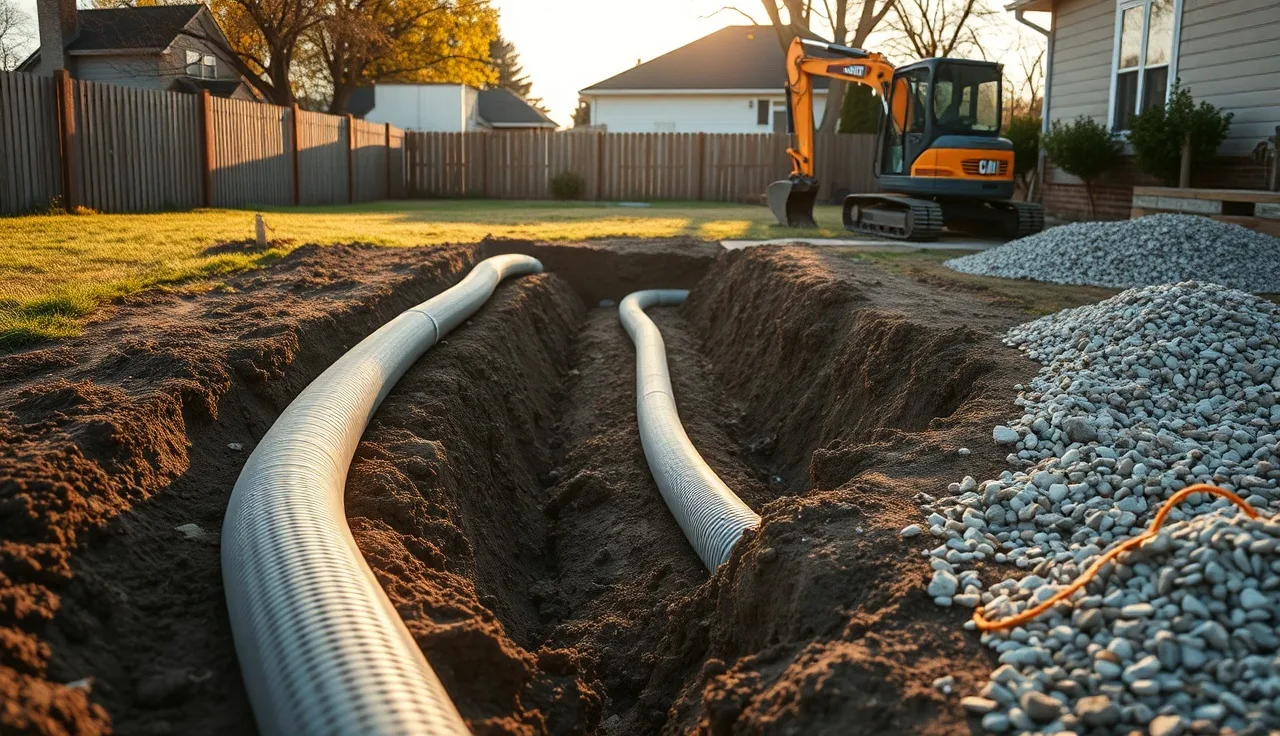
A drain field (also called a leach field or absorption field) is the last treatment stage of a conventional septic system. Effluent leaves the tank, flows into a distribution box, then spreads through perforated pipes laid in gravel-filled trenches. The soil under those trenches does the real work. Bacteria and physical filtration strip pathogens and nutrients before the water reaches groundwater. [1]
The trenches are usually 1 to 3 feet wide, 2 to 5 feet deep, and 50 to 100 feet long, but your required dimensions depend entirely on soil type and household flow rate. [2] Gravel surrounds the perforated pipe, and a layer of geotextile fabric sits on top of the gravel to stop soil from migrating down and clogging the void space.
The biomat is the thin biological layer that forms where the gravel meets the soil. A healthy biomat improves treatment. A thick, compacted biomat from an overloaded system is what kills a drain field.
That distinction drives your DIY decisions. Many "failed" drain fields haven't structurally collapsed. They're just biomat-clogged, and they may respond to rest or bacterial treatment instead of a full replacement.
If you want the whole system mapped out before you pick up a shovel, the leach field overview walks through every component.
Can you legally install a drain field yourself?
It depends on your state and county, and you need to look it up before you buy a single length of pipe. Most states require a licensed installer or onsite wastewater professional to pull the permit and certify the work. A few rural counties barely enforce anything, but "nobody's checking" is not the same as legal, and it won't save you at closing.
Texas allows a licensed homeowner-installer for owner-occupied single-family homes under specific conditions. [3] California takes the opposite line and requires a licensed C-42 Sanitation System contractor for subsurface septic work. [9]
The EPA's SepticSmart guidance tells homeowners to check with the local health department or regulatory agency before doing any work on a septic system. [1] That's not boilerplate. Permit violations can bring fines, forced removal of unpermitted work at your expense, and title problems when you sell.
Here's the typical regulatory chain:
- The state environmental or health agency sets the baseline code (the onsite wastewater rules).
- The county or local health department administers permits under that code.
- Counties can be stricter than the state baseline. None can be more lenient.
What you can almost always do without a contractor license:
- Pump your own tank in many states (a licensed pumper is required in others).
- Inspect and clean a distribution box.
- Replace the lid on a tank or distribution box.
- Apply EPA-registered septic additives.
- Divert surface water away from the field.
What almost always needs a licensed pro:
- Any new trench excavation for a drain field install.
- Perc test interpretation and system sizing.
- Connecting new pipe to the existing system.
The septic system repair guide covers the licensed-versus-DIY line for repairs beyond the field itself.
What permits and soil tests do you need before any work starts?
Permits come first, not last. Skipping this step is the most expensive mistake DIYers make on drain field projects. A standard new-system or replacement permit application asks for a site plan, soil test results, a design, and proof you meet setback rules.
The full list usually looks like this:
- A site plan showing the house, well (if any), property lines, and proposed field location.
- Soil evaluation results, usually a percolation (perc) test or a soil morphology evaluation by a licensed soil scientist.
- A system design prepared or reviewed by a licensed designer in most states.
- Setback documentation. The EPA recommends at least 50 feet from private wells and 10 feet from property lines, but state minimums vary. [1]
You can sometimes run the perc test yourself under supervision, but most states require a licensed health official or soil evaluator on site to certify the results. [8] The test measures how fast water drains through your soil in a standardized hole. Soil that percs too fast (under 1 minute per inch) may let poorly treated effluent reach groundwater. Soil that percs too slowly (over 60 minutes per inch in many codes) forces an alternative system like a mound or drip field. [8]
Permit fees typically run $150 to $500 for a residential replacement system. [4] That is not where you save money. Fight the urge to skip it.
A septic tank inspection is often folded into the same permit process, so book it early.
What does a DIY drain field actually cost versus hiring a contractor?
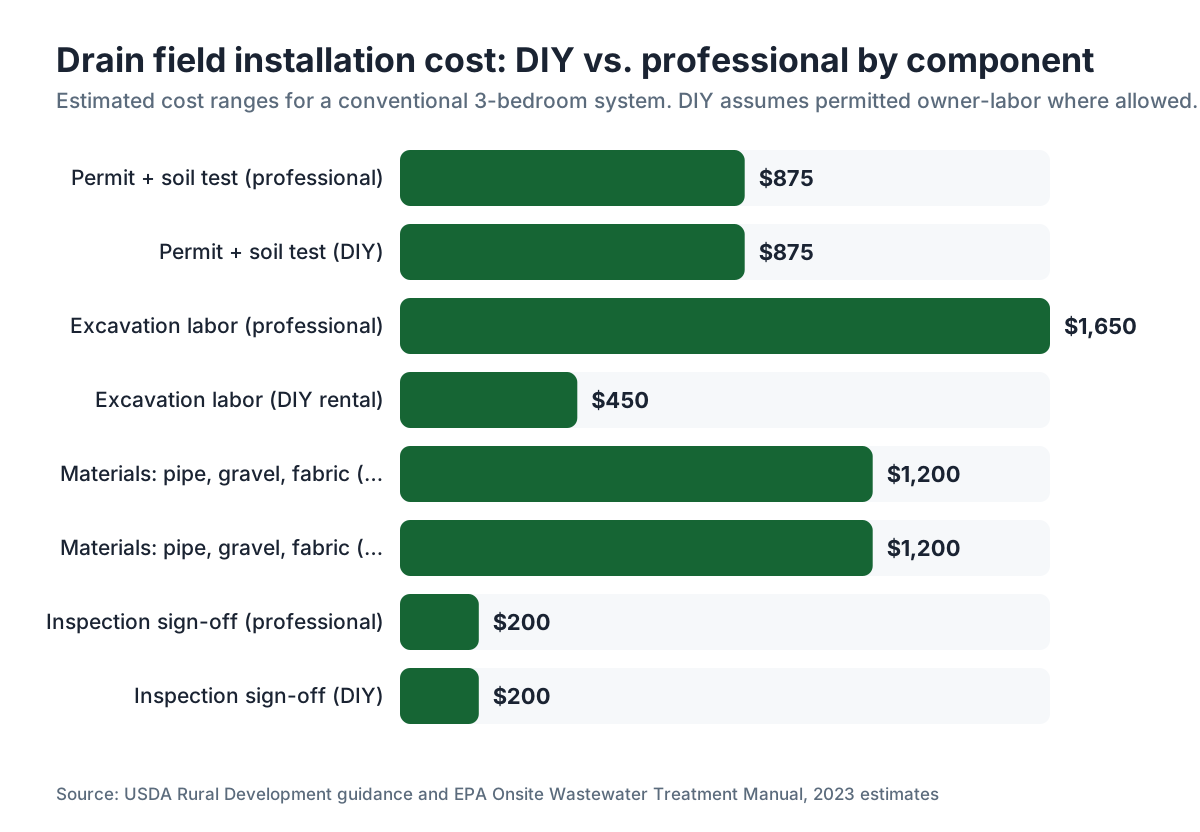
Cost is why most people ask about DIY, so let's be blunt about the numbers. A professionally installed conventional drain field for a 3-bedroom home runs $3,000 to $15,000 depending on soil, trench length, local labor, and whether the distribution box needs replacing. [4] Complex systems (mound, drip, aerobic) run $10,000 to $20,000 and up.
Do your own labor where it's allowed and you save on excavation and pipe-laying, which is roughly 40 to 60% of the total on a conventional system. That's $1,500 to $4,000 on a mid-range job. Equipment rental (a mini-excavator runs $300 to $500 a day) and materials (perforated pipe, gravel, geotextile fabric) still cost real money.
What you cannot DIY your way out of:
- Permit fees.
- Soil evaluation, usually $300 to $800.
- Final inspection by the health department.
- The learning curve on the excavator. Trench cave-ins are a real hazard.
For full system cost context, the cost to install septic system article has regional breakdowns.
| Cost component | Professional | DIY where allowed | Notes |
|---|---|---|---|
| Permit + soil test | $450, $1,300 | Same | Cannot skip |
| Excavation labor | $800, $2,500 | $300, $600 (rental) | Requires skill |
| Pipe + gravel + fabric | $600, $1,800 | $600, $1,800 | Same materials |
| Distribution box | $150, $400 | $150, $400 | Same materials |
| Licensed inspector sign-off | $100, $300 | $100, $300 | Required in most states |
| Total estimate | $3,000, $8,000 | $1,500, $4,500 | Conventional system only |
How do you size a replacement drain field?
Sizing a drain field starts with two numbers: daily wastewater flow and your soil's absorption rate. Get either one wrong and the field fails, sometimes within a few years.
The standard daily flow estimate is 100 to 150 gallons per bedroom per day. [2] A 3-bedroom home is designed for 300 to 450 gallons a day. High-water-use fixtures or extra occupants push that baseline up.
Your soil's absorption rate comes from the perc test. State codes turn the perc rate into a required square footage of trench bottom per gallon per day. Here's a common example: soil that percs at 30 minutes per inch might carry an application rate of 0.6 gallons per square foot per day, so a 400 GPD system needs about 667 square feet of trench bottom. [2]
Trench width is usually 12 to 36 inches. Divide required square footage by trench width to get total linear feet. Then add 50 to 100% for a reserve area (required in most states) that stays untouched until the primary field needs replacing.
The math is simple. The inputs have to be exact. That's why state codes make a licensed designer run the calculations even when a homeowner does the digging. A field undersized by 20% fails two or three times faster than one sized right.
If your old field failed and you don't know why, get it evaluated before you size a replacement. Building a new field over an unsolved problem (say, a tank that's been passing solids downstream) is how people spend the money twice. Regular septic tank pumping prevents a huge share of premature field failures.
What are the step-by-step stages of a drain field installation?
This is the process for a conventional gravity-fed trench system. Alternative systems (mound, drip, chamber) follow different steps.
Step 1: Site prep and layout
Mark trench locations with stakes and string. Keep equipment off the reserve area. Don't work wet soil. Compacting saturated soil destroys the absorption capacity you're paying for. [2]
Step 2: Excavation
Dig trenches to the permitted depth, usually 18 to 36 inches to the bottom of the gravel bed. Keep the trench bottom level (use a laser level or a 4-foot level every few feet). Keep sidewalls as vertical as you can. Scarify the trench walls and bottom with a fork or pick if the machine glazed the soil.
Step 3: Gravel bed
Add 6 to 12 inches of clean washed gravel (3/4 inch to 1.5 inch stone, no fines) to the trench bottom. Level it carefully.
Step 4: Pipe placement
Lay perforated pipe with the holes facing down. Slope it at least 1/8 inch per foot (some codes allow level pipe in chamber systems). Connect to the distribution box at the head of the system.
Step 5: Cover gravel and fabric
Add 2 inches of gravel above the pipe crown. Lay geotextile filter fabric over the gravel to keep soil out. The fabric is not optional. Skip it and you shorten the field's life.
Step 6: Backfill
Backfill with native soil, mounding slightly for settling. Don't compact with heavy equipment. Don't pave over the field.
Step 7: Inspection
Call for the permit inspection before backfilling if your jurisdiction wants an open-trench look. Many do. Backfill before the inspector signs off and you may be digging it all back up.
Step 8: Restoration and marking
Seed with grass. Mark access points. Add the location to your property's septic record.
Once the field is running, track your septic tank pump out schedule. Pump the tank within the first year to confirm solids levels are normal.
Can you repair a failing drain field yourself without replacing it?
Yes, sometimes. This is where homeowner DIY makes the most sense, because minor repairs don't always need permits or licensed contractors.
The most common fixable problems:
Clogged distribution box. The D-box splits flow from the tank into each trench. It collects sediment and can shift out of level, flooding one trench while others stay dry. You can dig it up, clean it, re-level it, and replace the lid yourself. Cost: a few hours and $50 to $150 in parts. This works when uneven distribution is the actual cause.
Surface saturation from runoff. If roof runoff, driveway drainage, or a high lawn grade sends surface water over the field, regrading and adding French drains around the perimeter can restore function. No permit needed in most jurisdictions for surface grading.
Biomat clogging. Resting the field (alternating between two fields if you have them, or routing to a portable holding tank for a while) lets the biomat oxidize and thin out. Some people use hydrogen peroxide injection or bacterial inoculants. The EPA notes these products have limited documented effectiveness [1], but resting the field on its own has shown benefit in extension research. [5]
Broken pipe in the trench. If you can find the broken section (usually a wet spot, or a camera inspection tells you), you can excavate that stretch and splice in new pipe. Whether you need a permit depends on the jurisdiction. Call first.
What you generally cannot fix without replacement:
- Soil that's permanently saturated (high water table, dense clay, or soil that absorbed grease).
- Fields genuinely undersized for the household's flow.
- Fields where the tank has been sending solids for years and the gravel is fully plugged.
For the bigger picture of what's fixable, the septic tank repair guide covers tank-side issues that often get misdiagnosed as field failures.
What are the biggest DIY mistakes that cause drain field failures?
Contractors who handle field replacements see the same mistakes over and over. Almost all of them are preventable.
Driving or parking over the field. One pass with a loaded pickup can permanently cut absorption capacity. Even foot traffic on wet soil compacts the top 6 inches, where most treatment happens. [2]
Planting trees near the field. Roots hunt moisture and they will find your perforated pipes. Keep trees at least 30 feet away. Willows and other water-seekers need 50 feet or more. [10]
Running a garbage disposal hard. Disposals raise solids loading to the tank by roughly 50%, according to University of Minnesota Extension. [5] More solids means more carryover to the field and faster biomat buildup.
Flushing non-biodegradables. Wipes (even the "flushable" ones), medications, grease, and household chemicals disrupt the bacteria that treat your wastewater. The field depends on a healthy microbial community in both the tank and the soil. [1]
Skipping tank pumping. This is the top cause of premature field failure. When the tank fills with solids, those solids carry over into the trenches and permanently plug the gravel. The EPA recommends pumping every 3 to 5 years for a typical household, though the real interval depends on household size and tank volume. [1] See how often to pump septic tank for the data behind those numbers.
Ignoring wet spots or slow drains. Catch it early and it's a cheap repair. A field caught at the biomat-clogging stage is a repair job. That same field left another two years is a replacement job.
Septic operators who juggle multiple residential accounts often use software like SepticMind to track pumping cycles and flag overdue inspections before small problems turn into field replacements.
Are there alternative drain field systems a homeowner can build more easily?
Some alternative systems are genuinely more DIY-friendly than a conventional trench field. Others are a lot harder.
Chamber systems. Instead of gravel, plastic arch chambers (Infiltrator is the common brand) create the void space for effluent. They're lighter, easier to handle without heavy equipment, and cut the volume of excavation. They're permitted in most states, and some installers report faster installs. The trench geometry and sizing rules stay the same. You're just swapping gravel for chambers. [6]
Raised mound systems. If your soil has a high water table or poor percolation, a mound raises the absorption area above grade using fill sand. These need more design precision, more materials, and pressure-dosing pumps. They're hard to DIY right and have more parts to fail. I'd hire a pro for a mound unless you have real construction experience.
Aerobic treatment units (ATUs). ATUs use aeration to produce highly treated effluent, which allows a smaller field. They need electric power, ongoing maintenance contracts in most states, and specialized knowledge to service. Not a good DIY candidate.
Drip irrigation systems. Pressure-dosed drip emitters buried shallow across a large area. High engineering complexity, requires filtration, and the emitters clog without proper maintenance. Hire a professional.
For most homeowners doing a DIY replacement on a failed conventional field, a chamber system on the same footprint is the most practical upgrade. Same permitting, easier install, and Infiltrator's installation guides are genuinely useful. [6]
For what a full new system costs with these alternatives factored in, the cost to put in a septic tank article breaks it down by system type.
How do you maintain a DIY-installed drain field to make it last?
A properly installed drain field should last 20 to 30 years with the right care. Plenty fail in under 10 from neglect. The maintenance is genuinely simple.
Pump the tank on schedule. For a 1,000-gallon tank serving a family of four, every 3 to 5 years is right. A household of two can stretch to 7 or 8 years. A household of six should pump closer to every 2 years. [1] The septic tank cleaning article walks through what a proper pump-out covers.
Inspect the distribution box once a year. No professional needed. Lift the lid, check that the outlet ports are clear and water levels look normal. A D-box that's sitting lopsided is an easy fix before it becomes a flooded trench.
Protect the surface. Mow the grass over the field (it's good for the soil). Don't plant anything with deep roots. Don't build over it. Don't let vehicles on it.
Manage household water use. High-efficiency toilets and washers cut hydraulic loading on the field. Spread laundry over several days instead of eight loads on Saturday, and you avoid the peak flow surges that push solids into the field.
Watch for warning signs. Slow house drains, gurgling toilets, wet or smelly spots over the field, and oddly lush green grass over the trenches all mean trouble early. Catch them and the fix is almost always cheaper.
Managing a rental or multiple units on septic makes all of this tedious to track by hand. Platforms like SepticMind are built for operators to manage maintenance schedules and inspection records across many properties, so nothing slips.
For the septic tank emptying process and what a service visit involves, that guide has the detail you need before calling a pumper.
When should you stop trying DIY and call a professional?
I'm generally pro-DIY here for small repairs. But some situations clearly call for a pro. Call one when the stakes are high, the diagnosis is uncertain, or the law simply won't let you sign off on your own work.
Call a professional when:
- Your perc results are borderline, or you're near wetlands, a well, or a steep slope. Getting sizing wrong near sensitive areas has both environmental and legal consequences.
- The original field failed within 10 years of installation. That usually means the system was wrong for your soil to begin with, so you need a redesign more than a replacement.
- You see sewage surfacing in the yard or backing up into the house. That's a public health issue. Many states treat sewage surfacing as an emergency requiring licensed remediation. [3]
- You're within 200 feet of surface water (or your state's equivalent buffer), where setback rules are tighter and inspection scrutiny is higher. [7]
- The project needs any electrical work (pump panels, ATU controls).
- You're in a jurisdiction with no homeowner-installer permit, and the inspector won't sign off on unlicensed work.
The honest math: DIY labor savings on a $5,000 job might be $1,500 to $2,000. Make a sizing error, fail an inspection, or watch the field fail again in three years, and you've lost all of it plus more. Get at least two professional quotes before you commit to DIY. Most homeowners find the gap is smaller than they expected once equipment rental is in the picture.
For the case where the whole system needs replacing, more than the field, the septic tank installation guide covers when the tank itself has to go too.
Frequently asked questions
Is it legal to install your own drain field?
In some states, yes, with a homeowner-installer permit for owner-occupied single-family homes. In most states, a licensed contractor must pull the permit and certify the work even if you do the labor. Texas has a homeowner-installer pathway. California requires a licensed C-42 contractor. Always check with your county health department before starting any work.
How deep do drain field trenches need to be?
Typical trench depth is 18 to 48 inches from grade to the trench bottom, though your state code and soil evaluation set the actual required depth. The gravel bed at the bottom is usually 6 to 12 inches deep, with the perforated pipe sitting on top of it. Shallower installs work in areas with good aerobic soil. Deeper ones suit some soil types.
What kind of gravel do you use in a drain field?
Clean washed crushed stone, 3/4 inch to 1.5 inch diameter, with no fines or clay content. Fines migrate to the soil interface and speed up clogging. Most state codes specify washed stone, and some allow alternatives like tire-chip aggregate or proprietary chamber systems. Don't use pea gravel or river rock. They compact too easily.
How long does a DIY drain field last?
A properly installed and maintained drain field, DIY or professional, should last 20 to 30 years. Fields that fail early almost always have one of three causes: undersizing, irregular tank pumping that lets solids carry over, or soil compaction from traffic. Correct installation plus a pumping schedule every 3 to 5 years are the two biggest factors in how long it lasts.
Can I use chambers instead of gravel to make installation easier?
Yes. Plastic arch chamber systems like Infiltrator are approved in most states and are much easier to handle without heavy equipment. They cut out gravel hauling, reduce excavation volume, and many contractors prefer them for that reason. The permitting process and sizing calculations match a conventional gravel trench system. The manufacturer installation guides are detailed and accurate.
Do I need a perc test to replace an existing drain field?
Usually yes, especially if the system is moving or getting resized. Some counties waive the perc test for a same-footprint replacement if the original test records are on file. Don't assume the waiver applies to you. Confirm with the permit office. A soil evaluation costs $300 to $800, far cheaper than installing a field in soil that won't pass.
What setback distances are required for a drain field?
The EPA recommends at least 50 feet from private wells and 10 feet from property lines, but state and local codes vary a lot. Many states require 100 feet from wells, 25 feet from surface water, and set distances from foundations and easements. Some add buffers near wetlands or steep slopes. Check your state's onsite wastewater rules and your county's local amendments before siting a field.
Can a failed drain field be restored without full replacement?
Sometimes. If the failure is biomat clogging from poor tank maintenance, resting the field can help. Cleaning and re-leveling the distribution box fixes many cases of uneven loading. Surface water intrusion responds to regrading. Fields that failed from soil saturation, years of unpumped solids, or original undersizing usually need replacement, not restoration.
How many linear feet of trench does a 3-bedroom house need?
It depends on soil perc rate, but a rough estimate for average soil (30-minute perc) is 200 to 400 linear feet of trench at 18 to 24 inches wide. State formulas differ. Some use trench-bottom square footage, others use linear feet at a standard width. Your licensed designer or health department runs the actual calculation from your perc test results.
What happens if you build a drain field without a permit?
Consequences vary by jurisdiction but can include fines, a stop-work order, forced removal of the unpermitted work at your expense, and a lien or disclosure requirement when you sell. Title companies and buyers' inspectors often catch unpermitted septic work. In some states, unpermitted systems count as public health violations with escalating daily fines.
How soon after installation can you use a new drain field?
Most jurisdictions require a final inspection and permit sign-off before the system goes into service. Once approved, a conventional gravity system can be used right away. There's no cure time for gravel systems the way there is for concrete. The field develops its biomat layer over the first few months of use, which is normal.
What tools and equipment do you need to install a drain field?
For a conventional trench system: a mini-excavator or backhoe (rent for $300 to $500 a day), a laser level or standard 4-foot level, a plate compactor for backfill (never on the gravel area), hand tools for spreading gravel and placing pipe, and a utility locator service to mark buried lines before you dig. You'll also need a truck or delivery for gravel, pipe, and fabric.
Does a DIY drain field affect your homeowner's insurance or property value?
A properly permitted and inspected DIY field carries no insurance or value penalty. An unpermitted install is a different story. Insurance policies typically exclude damage from unpermitted construction, and real estate disclosures require reporting known permit violations. Home inspectors flag septic systems specifically, and FHA or VA lenders require septic inspections as a condition of financing.
How do you know if your drain field is actually failing versus just stressed?
Failure signs: sewage surfacing over the field, backup into the house, persistent soggy ground over the trenches, and strong sewage odors outdoors. Stress signs that may be reversible: slightly slow drains, very green grass over the field, and a lopsided distribution box. A camera inspection of the pipes plus a tank pump-out and inspection are the right first diagnostic steps before assuming replacement.
Sources
- U.S. EPA, SepticSmart homeowner guidance: EPA recommends 50-foot setback from private wells, advises checking local health department before any septic work, recommends pumping every 3-5 years, and notes limited documented effectiveness of septic additives
- U.S. EPA, Onsite Wastewater Treatment Systems Manual (EPA/625/R-00/008): Trench dimensions, soil loading rates, perc test procedures, daily flow estimates of 100-150 gallons per bedroom, and soil compaction warnings
- Texas Commission on Environmental Quality, On-Site Sewage Facilities rules (30 TAC Chapter 285): Texas homeowner-installer permit pathway and sewage surfacing as an emergency requiring licensed remediation
- USDA Rural Development, Water and Environmental Programs: Conventional drain field installation cost range $3,000, $15,000; permit fees typically $150, $500 for residential replacement
- University of Minnesota Extension, Septic System Owner's Guide: Garbage disposals increase solids loading by approximately 50%; field resting has shown benefit for biomat-clogged systems
- Infiltrator Water Technologies, Chamber System Installation Guide: Plastic chamber systems are approved alternatives to gravel trench systems in most states; manufacturer installation guides detail chamber placement procedures
- National Environmental Services Center (NESC) at WVU, Septic System Setbacks: State setback requirements for drain fields from wells, surface water, property lines, and foundations vary significantly from EPA baseline recommendations
- North Carolina DEQ, Onsite Wastewater Section: Licensed soil scientist or health official must certify perc test results; soil percolation rates over 60 min/inch require alternative systems
- California Contractors State License Board, C-42 Sanitation System contractor classification: California requires a licensed C-42 contractor for subsurface drainage and septic work
- Penn State Extension, Septic System Maintenance for Homeowners: Tree root intrusion risk; trees should be kept at least 30 feet from drain field trenches, water-seeking species 50+ feet
Last updated 2026-07-09