Do you need a permit to replace your drain field?
By the SepticMind Editorial Team
TL;DR
- Yes.
- Almost every U.S.
- jurisdiction requires at least one permit, often two or three, before you replace a drain field.
- Your county or state health department issues them.
- Fees run roughly $150 to $1,500, and you'll need a site evaluation and soil test first.
- Skip the permit and you risk daily fines, forced removal of the new field, and a stalled home sale.
Why do you need a permit to replace a drain field?
A drain field pushes partially treated wastewater into the ground. Every state has decided that puts it in the public health category, which means a regulator wants to see the plan before a shovel touches dirt.
The Clean Water Act sets the policy floor, and the EPA's SepticSmart program says onsite wastewater systems "are regulated at the state and local level" [1]. States then hand enforcement to counties or parishes. That's why the forms, fees, and timelines change so much from one county line to the next.
The practical reason is contamination. A field that's undersized or sited too close to a well can foul drinking water. The EPA estimates about 20 percent of U.S. households get their drinking water from a private well [2], and those wells are usually the first thing downhill from a failing leach field. A permit forces a licensed designer to prove to the regulator that the new field sits far enough from wells, property lines, and wetlands before anyone digs.
There's a money angle too. Replace a field without a permit, then try to sell the house, and the disclosure rules in most states will drag the unpermitted work into the open. Buyers' inspectors and lenders look for this now. Unpermitted work can kill a sale outright or force you to dig up the field and redo it legally, at roughly double the cost.
Is a drain field replacement permit different from a new-installation permit?
Usually yes, but the difference is mostly paperwork and fees, not the underlying rules. Most counties issue a single "onsite sewage system" or "individual sewage disposal system" permit that covers both new installs and repairs. Some jurisdictions carve out a separate repair or replacement permit with a lower fee and a shorter review, on the theory that the lot already got evaluated once.
What really changes for a replacement is the site work required before approval. On a new install, the whole lot is fair game. On a replacement, the regulator wants to know why the old field died and whether the soil in the new spot can carry the load. If the first field failed because the soil is turning to saturated clay, a replacement right beside it fails the same way in a few years. That investigation is usually part of the application.
Some states also split a full replacement from a "repair" that extends or partially rehabs an existing field. Oregon allows limited repairs under a repair authorization that's faster and cheaper than a full replacement permit, as long as you disturb less than a set share of the system [3]. Look up your own state's onsite wastewater rules, published by the state environmental quality or health department.
What permits are typically required and who issues them?
Most drain field replacements need two permits and sometimes a third.
The first is the onsite sewage system construction permit, issued by the county health department or, in states with centralized permitting, a state environmental agency. This is the big one. It covers site evaluation, system design, and construction standards. No licensed contractor will (or should) touch the job without it.
The second is often a local building or excavation permit. Many counties keep this separate because the digging can affect stormwater drainage, setbacks, or easements that fall under the building department instead of health.
The third shows up in some states and most coastal zones: an environmental or wetlands permit if the field lands within a regulated distance of a water body. The U.S. Army Corps of Engineers issues Section 404 permits for work affecting wetlands under the Clean Water Act [4]. Most standard residential replacements don't trigger federal jurisdiction as long as they stay well clear of wetlands and navigable waters.
The county health department is almost always your first call. They'll tell you which permits their office handles and which ones you need to chase down at the building department.
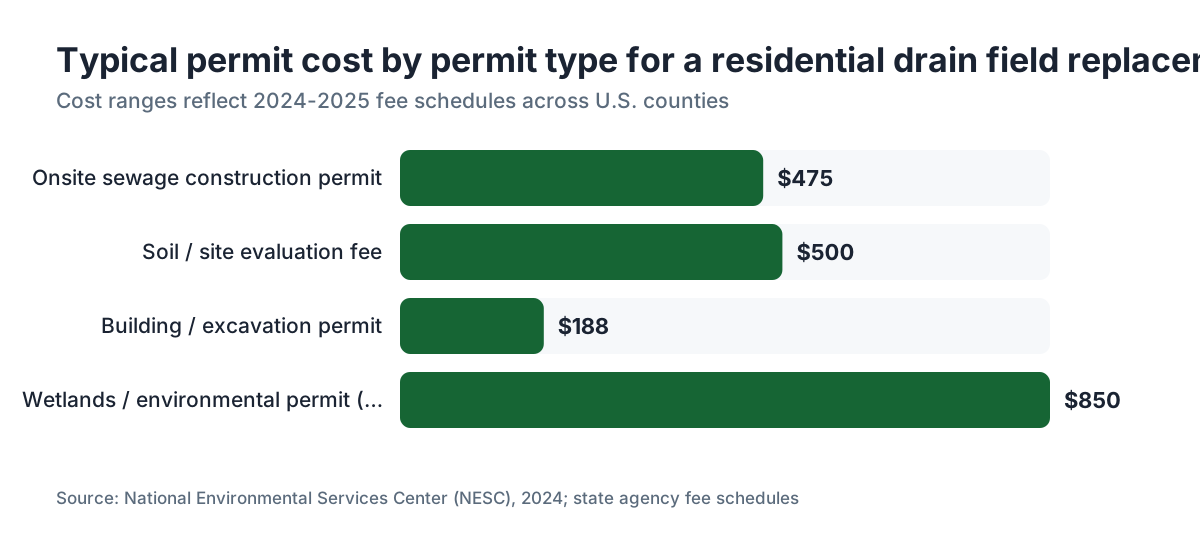
| Permit type | Who issues it | Typical cost | Typical timeline |
|---|---|---|---|
| Onsite sewage system construction | County health dept | $150 to $800 | 2 to 8 weeks |
| Soil/site evaluation (sometimes separate) | County health dept | $100 to $400 | 1 to 4 weeks |
| Building / excavation | County building dept | $75 to $300 | 1 to 3 weeks |
| Wetlands / environmental (if applicable) | State or Army Corps | $200 to $1,500+ | 4 to 24 weeks |
Those ranges come from fee schedules published by state environmental agencies and reflect conditions in 2024 and 2025 [5].
How much does a drain field replacement permit cost?
Permit fees alone typically run $300 to $1,200 for a residential drain field replacement, with outliers on both ends. A rural county with low overhead might charge $150 total. A coastal California county with layered environmental review can push past $2,000 before the first load of gravel shows up.
The fee usually has two parts: an application or review fee, and a per-inspection fee. Some counties bundle two inspections into the base fee. Others charge $50 to $150 per visit and want three or four of them, for the soil bed before aggregate goes in, the aggregate itself, the pipe placement, and the final cover.
Then there's the soil evaluation. A licensed soil scientist or evaluator charges $300 to $700 to run the percolation test or soil morphology assessment the application needs. That's separate from the permit fee, and separate again from what the contractor charges to design and build the field.
For the whole project's numbers, see our guide to the cost to install a septic system, and for the tank side specifically, the cost to put in a septic tank.
What does the permit application process actually look like?
Here's a realistic walk-through for a typical county.
Step one: hire a licensed designer or engineer. In most states, the application must include a system design stamped by a licensed pro, often called a "site evaluator," "onsite wastewater designer," or "sanitarian." Your contractor may hold that license or may bring in a designer as a subcontractor.
Step two: soil and site evaluation. The designer visits, digs test holes (usually 18 to 36 inches deep), and either runs a percolation test or, in states that use soil morphology design, reads the soil profile by eye. This sets the size and type of the replacement field. Some counties require the health department to watch the evaluation.
Step three: submit the application. You (or the contractor acting as your agent) send in the completed application, the site plan, the soil results, and the fee to the county health department. Most counties take online submissions now, though rural ones may still want paper.
Step four: review and approval. The health department reads the submittal. Reviews take a few days in small counties with no backlog and up to eight weeks in busy urban ones. Questions or requested revisions add time.
Step five: construction with inspections. Once the permit's in hand, work can start. The inspector shows up at least twice: once when the trench or bed is open and ready for aggregate, once after the pipe is laid and before cover goes on. Never cover the system until the inspector signs off.
Step six: final closeout. After the final inspection passes, the county closes the permit and files the as-built record. That record follows the property forever, and it's what future buyers and their lenders will hunt for.
Start to finish, from first phone call to a covered, approved field, plan on six to sixteen weeks depending on your county's review speed and the contractor's schedule.
What happens if you replace a drain field without a permit?
The fallout runs from annoying to genuinely expensive.
Most counties have ordinances allowing fines of $100 to $1,000 per day for unpermitted work on a sewage system, and some states can assess far higher penalties under their onsite wastewater statutes. The EPA's SepticSmart guidance points to "improper operation and maintenance" of septic systems as a leading cause of groundwater contamination, which is why regulators enforce this hard [1].
Beyond fines, the usual outcome is a stop-work or abatement order. You either get a retroactive permit (which means the inspector has to verify the buried work was built right, so you dig it back up for re-inspection) or you remove the whole thing and start over with a permit. Both cost more than doing it right the first time.
The real estate angle blindsides people. In most states, a homeowner must disclose known unpermitted work. Title searches and home inspections keep turning up septic permit records. If your replacement field has no permit on file, a buyer's lender may refuse to fund the deal until it's fixed. Closing day is the worst possible moment to learn that.
Dealing with a failing system that needs emergency work? Call the health department first. Many counties run an emergency or expedited review for a raw sewage backup that's an immediate health risk. You can often get an emergency authorization to do temporary remediation while the full permit works through the pipeline.
Are there any situations where a permit is not required?
Almost never for a full drain field replacement. But a few edge cases are worth knowing.
Minor maintenance that doesn't disturb the soil or change the footprint, like jetting a distribution line or swapping a distribution box, may not need a permit in some counties. Whether a given repair crosses into "construction" is a judgment call the health department makes, and it varies by place.
Some rural counties with thin regulatory staff have historically had loose enforcement. That's not the same as "no permit required." If the county code says you need a permit (and it almost certainly does), a lack of enforcement doesn't create legal permission.
Tribal lands run under tribal environmental codes and may permit differently. Properties in unincorporated areas sometimes answer directly to the state rather than a county. If you can't tell which agency covers your parcel, a call to the county assessor's office usually points you to the right regulator.
Assume a permit is required. Call the health department before you do anything. The call is free and takes ten minutes.
How do setback rules affect where you can put the replacement field?
Setbacks are the distances your drain field has to keep from wells, property lines, buildings, water bodies, and other features. State code sets them, and county ordinances sometimes make them tighter.
Typical minimums for a replacement field include at least 50 feet from any drinking water well, 10 feet from a property line, 10 feet from a structure, and 50 to 100 feet from a lake, stream, or wetland. Some states require 100 feet from a public water supply well [6].
On a big rural lot, setbacks rarely bite. On a quarter-acre suburban lot, or any property with an existing well, they can box in where a replacement field can go, or rule out a standard gravity-fed field entirely. When that happens, the designer may spec an alternative system: a mound, drip irrigation, or a nitrogen-reducing setup. All cost more, and one of them may be your only permitted option.
This is why the site evaluation comes first. You need to know what the setbacks allow before you design anything. A contractor who quotes a price without doing the site evaluation is guessing.
For a wider look at how a leach field works and why location matters this much, that article covers the fundamentals.
Does your contractor need special licensing to pull a drain field permit?
Yes, in most states. Installing an onsite sewage system is a licensed trade, and the person who pulls the permit usually has to hold a state license specific to onsite wastewater or septic systems, separate from a general plumbing or excavation license.
Texas is one example: the Texas Commission on Environmental Quality licenses "Installer I" and "Installer II" levels for onsite wastewater systems [7]. Florida is another: the Florida Department of Health issues a Septic Tank Contractor license under Chapter 489 of Florida Statutes [8]. Requirements usually mix field experience hours, an exam, and continuing education.
If a contractor tells you he'll do the replacement without pulling a permit because it's "just a drain field," walk away. Licensed contractors know unlicensed work on a regulated system can cost them their license. The ones who offer to skip the permit are often unlicensed or working in the gray.
Ask to see the state license number before you sign anything. You can verify it on your state licensing board's website in about two minutes. For the tank side, see our septic tank repair and septic system repair guides for what to expect from licensed contractors on those jobs.
How long does a drain field permit take to get approved?
Plan on four to twelve weeks from submission to permit in hand under normal conditions. That spread reflects the real gap in county health department staffing and backlog across the country.
Here's how the timeline breaks down. The soil evaluation and design work takes one to three weeks once a qualified evaluator is on your schedule. Many areas are short on licensed soil scientists and designers, so just getting an appointment can eat two to four weeks. After you submit, small counties with one or two staff sanitarians may turn reviews around in five to ten business days. Large counties with heavy volume, Maricopa County in Arizona or Los Angeles County in California for instance, routinely run six to ten weeks.
Every round of clarification or revision the department asks for adds one to three weeks. That's why experienced contractors file complete, well-documented applications the first time.
Some counties offer expedited or over-the-counter review for straightforward replacements on lots that already have a soil evaluation on file. If your original system was permitted in the last ten to fifteen years, the county may already hold the soil data and can approve a replacement in days instead of weeks.
Plan for the slow scenario unless you have a specific reason to expect the fast one. A contractor who promises a two-week turnaround in a busy county is setting you up to be disappointed.
What soil tests are required as part of the permit?
Two tests commonly support a drain field permit: the percolation test and the soil morphology (profile) evaluation. Many states now require or prefer the morphology approach; a few still mandate percolation testing or let you pick.
A percolation test measures how fast water drains through the soil, usually in minutes per inch. You pre-soak the test holes, then measure the drop rate over a set period. Results set the required square footage of trench or bed bottom. Soil that drains faster than 1 minute per inch may be too fast (groundwater contamination risk), and soil slower than 60 minutes per inch may be too slow (the system backs up or won't drain).
Soil morphology evaluation keeps gaining ground because a single perc test swings wildly with how wet the soil happens to be that day. A trained soil scientist reads the color, texture, and structure of the profile in test pits, watching for mottling (gray or orange streaks that mark the seasonal water table depth) and soil texture class. That gives a steadier read on what the soil does year-round.
Your designer will tell you which approach your county requires and either run or arrange the testing. Costs run $300 to $700 for a standard evaluation.
For how a septic tank inspection sizes up the full system before a replacement is planned, that guide walks through the process in detail.
How permitting works if you manage multiple properties or service jobs
For septic service operators handling permit applications across a book of client properties, the tracking and documentation load piles up fast. Each permit has its own application, timeline, inspection schedule, and closeout record, and they all move on different clocks at different county offices.
Some operators use SepticMind to track permit status and inspection windows alongside service schedules. That cuts the odds of a job getting covered before the inspector signs off, a mistake that means expensive re-excavation.
Whatever software or system you run, the discipline is the same. Never let a crew cover a drain field until the permit inspection card is signed. Keep a copy of every permit and as-built drawing in the client's file and in a cloud backup. County records get lost, and a homeowner who can't prove the field was permitted hits complications at resale.
What state-specific rules should you know about?
State onsite wastewater rules vary enough that what's true in one state can be flat wrong across the line. A few real differences.
California: counties handle permitting under a state regulatory framework, and requirements swing a lot from county to county. Coastal counties add California Coastal Commission review for properties inside the coastal zone.
Florida: the Florida Department of Health issues permits through its county health departments under Chapter 64E-6 of Florida Administrative Code. Florida stands out for requiring a licensed septic tank contractor (not a licensed plumber) to pull the permit [8].
Texas: TCEQ oversees onsite wastewater under 30 TAC Chapter 285 [7]. Texas runs two pathways: the Authorized Agent program (most counties) and the On-Site Sewage Facility Inspector program.
New York: Article 145 of the New York State Education Law requires a licensed professional engineer or registered architect to stamp system designs in most contexts, which adds cost compared with states that use a simpler sanitarian credential [9].
Oregon: Oregon DEQ's rules under OAR Chapter 340, Division 71 cover onsite wastewater and include the repair authorization track for partial repairs [3].
The pattern holds everywhere: look up your own state's rules at the state environmental quality or health department website. The EPA keeps a state-by-state directory of onsite wastewater program contacts that's a fine starting point [1].
Regular septic tank pumping and knowing how often to pump a septic tank are the habits that keep you from ever needing a replacement permit. A system pumped on schedule outlasts a neglected one by decades.
Frequently asked questions
Can I replace my own drain field without hiring a contractor?
In a handful of states, a homeowner can get an owner-builder permit and do the work on a primary residence. Even where that's legal, you still need the permit, must meet the same design and inspection rules, and must use licensed evaluators for the soil work. Most homeowners lack the equipment and experience to do this right. Check your state's onsite wastewater rules, then honestly weigh whether the savings justify the risk.
How much does it cost to replace a drain field total, more than the permit?
A conventional gravity-fed drain field replacement for a three-bedroom house typically runs $5,000 to $20,000 depending on soil, system size, access, and local labor. Alternative systems like mounds or drip fields can reach $15,000 to $30,000 or more. Permit and soil evaluation fees add $500 to $2,000 on top of construction. Get three licensed contractor bids after the soil evaluation is done, not before.
What if my drain field is failing but I can't afford to replace it right now?
Call your county health department first. Many counties can issue a temporary operating authorization while you arrange financing, especially for a primary residence. Some states run low-interest loan programs for septic repairs, and the USDA Rural Development Section 504 program offers grants and loans for eligible rural homeowners. Acting early gives you far more options than waiting until the system fails completely.
Does a drain field replacement require a new septic tank inspection?
Usually yes, as part of the permit process. The county typically wants to confirm the tank is in good shape before approving a new field, because a cracked or overloaded tank shortens the new field's life. If the tank hasn't been pumped recently, plan to have that done before or during the inspection. See our septic tank inspection guide for what that process covers.
Will my homeowner's insurance cover a drain field replacement?
Standard homeowner's insurance almost never covers drain field failure because it counts as a gradual maintenance issue, not a sudden event. Some policies cover sudden sewage backup damage to the interior with an add-on rider. A few insurers sell separate service line or septic coverage as an endorsement. Read your policy closely, and call your agent to ask specifically about onsite sewage system coverage before you assume you're covered.
How long does a replaced drain field last?
A properly designed, permitted, and installed conventional field lasts 20 to 30 years or longer if you maintain the tank (pump every 3 to 5 years for a typical household) and keep grease, wipes, and harsh chemicals out of the drains. Systems that fail early almost always do so because the tank wasn't pumped and solids carried over into the field, clogging the soil. The field itself doesn't wear out. The soil does.
What size drain field do I need for a replacement?
Field size comes from the soil absorption rate and the daily wastewater flow estimate, which is based mostly on bedroom count. Most state codes use a table combining bedroom count (a proxy for occupancy) with the soil's measured or morphology-based absorption rate. A three-bedroom house on moderately absorptive soil might need 300 to 500 square feet of trench-bottom area. The licensed designer calculates this in the permit application. It's not something you estimate ahead of time.
Can you get a permit for a drain field replacement in a wetland area?
It's very hard and sometimes impossible. Wetlands are regulated at the state level and federally under Section 404 of the Clean Water Act. If any part of the field falls in a regulated wetland or its buffer, you'll likely need Army Corps of Engineers authorization on top of the county permit, and the Corps may deny it. If your property has wetland constraints, talk to an environmental consultant early. Alternative systems may allow greater setback, but some lots simply can't support a legal replacement field.
How do I find out if my drain field has a permit already on file?
Contact your county health department and ask for records on your parcel by address or parcel number. Most counties that have permitted septic systems for more than 20 years hold records back to the 1970s or 1980s, though older ones may be incomplete or paper-only. If a permit exists, you may also find the original design and soil evaluation, which can speed up a replacement application because the soil data is already documented.
Do I need a permit just to add a second bathroom that increases load on my existing drain field?
In most jurisdictions, yes. Adding a bedroom or bathroom that pushes calculated wastewater flow above the system's permitted capacity requires a permit to evaluate whether the existing field can handle the extra load or needs to be expanded. This comes up constantly with ADU conversions and basement finishing. Don't assume the existing system is sized for the new load. A system built for a two-bedroom house may not carry four bedrooms.
What is a mound system and when does a permit require one instead of a conventional field?
A mound system places the drain field above natural grade inside a constructed sand and gravel mound, treating wastewater before it reaches native soil. Regulators call for a mound when the natural soil is too slow, too fast, or when seasonal high groundwater sits too close to the surface for a conventional trench. Mounds cost more, typically $10,000 to $25,000 for the field alone, but they're often the only permitted option on sites with poor soil or high water tables.
Can a permit be denied for a drain field replacement?
Yes. If the site evaluation shows the soil can't support any approved system type, if no location on the property meets setbacks, or if the lot is simply too small, the county can deny the permit. This is rare but happens on very small or constrained lots. A denial doesn't mean you're stuck with a failing system. The only option may be connecting to a public sewer if one's within reach, or applying for a setback variance, which most counties allow in limited cases.
What is the difference between a repair permit and a replacement permit?
A repair permit covers partial work: replacing a broken distribution pipe, fixing a cracked distribution box, or rehabbing a section of an existing field. A replacement permit covers building an entirely new drain field, either in a previously designated reserve area or a new location. Repair permits are usually faster and cheaper. The county decides which category your project falls into based on what the contractor proposes to do.
Sources
- U.S. EPA, SepticSmart Program: Onsite wastewater systems are regulated at the state and local level; improper operation and maintenance is a leading cause of groundwater contamination
- U.S. EPA, Private Drinking Water Wells: Approximately 20 percent of U.S. households rely on a private well for drinking water
- Oregon DEQ, Onsite Wastewater Management Program (OAR Chapter 340, Division 71): Oregon allows limited repairs under a repair authorization that is faster and cheaper than a full replacement permit for qualifying partial repairs
- U.S. Army Corps of Engineers, Regulatory Program (Section 404): The U.S. Army Corps of Engineers issues Section 404 permits for work affecting wetlands under the Clean Water Act
- National Environmental Services Center, Onsite Wastewater Permitting Overview: Permit fees for residential onsite sewage system construction range from approximately $150 to over $1,500 depending on jurisdiction, with soil evaluations adding $300 to $700
- U.S. EPA, How Your Septic System Works: Typical setback minimums include at least 50 feet from a drinking water well and 50 to 100 feet from surface water bodies
- Texas Commission on Environmental Quality, On-Site Sewage Facilities (30 TAC Chapter 285): TCEQ licenses Installer I and Installer II levels for onsite wastewater systems and oversees the program under 30 TAC Chapter 285
- Florida Department of Health, Onsite Sewage Program (Chapter 64E-6 FAC): Florida requires a licensed septic tank contractor to pull the permit for replacement work; permits are issued through county health departments
- New York State Education Department, Office of the Professions (Article 145): New York Article 145 of the Education Law requires a licensed professional engineer or registered architect to stamp system designs in most contexts
- USDA Rural Development, Single Family Housing Repair Loans & Grants (Section 504): USDA Section 504 offers grants and loans for septic repairs for eligible rural homeowners
- National Association of Wastewater Technicians (NAWT): Contractor licensing requirements for onsite wastewater installation vary by state and include combinations of field experience, exams, and continuing education
Last updated 2026-07-09