Do septic tank treatments work? What the science actually says
By the SepticMind Editorial Team
TL;DR
- Most liquid and tablet septic tank treatments don't meaningfully improve system performance and can't replace regular pumping.
- Enzyme and bacterial additives may help restore a sluggish system after antibiotic use or heavy cleaning chemicals, but EPA-reviewed studies found no evidence they prevent failures, extend drain field life, or reduce pump-out frequency.
- Save your money on monthly additives; spend it on pumping every 3-5 years.
What are septic tank treatments and what do they claim to do?
Septic tank treatments come in four main forms: biological additives (live bacteria or yeast), enzyme additives (proteins that break down organic matter), chemical additives (acids, solvents, or surfactants), and combination products that mix enzymes with bacteria. Walk into any hardware store and you'll find dozens of brands promising to "activate" your tank, kill odors, unclog drain fields, and cut your pump-out schedule in half.
The claims are almost always built around a real phenomenon. Your septic tank does rely on anaerobic and facultative bacteria to break down solids. Disrupt those bacteria with bleach, antibiotics, or harsh drain cleaners and the tank's digestion can slow down. That's the kernel of truth the additive industry leans on hard.
The implied logic doesn't hold up, though. A healthy septic tank already contains hundreds of billions of bacteria per milliliter of sludge [1]. Adding a few million more from a packet of powder is like trying to change the population of New York City by moving in three people. The tank's bacterial count is set by food supply, temperature, and retention time, not by what you pour down the drain.
Chemical additives are a different story, and not a good one. Solvents like methylene chloride or trichloroethylene can temporarily reduce scum and sludge by dissolving organic matter, but they carry those dissolved compounds straight into the drain field and groundwater [2]. Massachusetts, Washington, and Indiana either ban or heavily restrict chemical septic additives because of that contamination risk [3].
What does the research actually say about whether septic treatments work?
The EPA's own SepticSmart guidance is the most-cited source, and it doesn't hedge. It states there is "no scientific evidence that biological or enzyme additives benefit a properly functioning septic system" [1]. That's a direct quote from federal guidance, not an interpretation.
Independent field trials back this up. Researchers running paired-system studies have monitored tanks side by side, some getting monthly bacterial doses and some getting nothing, then compared effluent quality, sludge accumulation, and drain field hydraulic performance. The treated and untreated systems came out statistically indistinguishable [4].
A well-designed 1995 study published in Water Environment Research tested enzyme additives on systems in Florida. Researchers measured biological oxygen demand (BOD), total suspended solids, and fecal coliform levels in tank effluent. The enzyme-treated tanks showed no statistically significant improvement in any measure compared to controls [5].
Nobody has great long-term data here, and that's worth saying plainly. Most studies run one to three years. Drain field failures play out over decades. It's possible certain treatments provide a marginal long-term benefit that short studies can't catch. But the burden of proof sits with the manufacturers, and after decades of commercial sales, that proof still hasn't shown up.
NSF International offers Standard 46 certification for wastewater components, but it doesn't certify septic additives for performance, only for the absence of harmful ingredients [6]. If a product claims NSF certification, that means it probably won't poison your groundwater. It doesn't mean the product works.
Are enzyme treatments any different from bacterial ones?
Enzymes and bacteria work through completely different mechanisms. Neither one beats the basic math of the tank.
Bacterial additives introduce live microorganisms, usually Bacillus species, meant to supplement the tank's existing population. The catch is that the Bacillus strains sold in these products are mostly aerobic or facultatively anaerobic, so they work best with oxygen. A septic tank is a near-oxygen-free environment. The bacteria you add either die off quickly or go dormant, and they contribute little to digestion [11].
Enzyme additives skip the living-organism step. They add proteins (typically protease, lipase, amylase, and cellulase) that chemically break down proteins, fats, starches, and cellulose. Enzymes act faster than bacteria on their target compounds, which is why you'll sometimes notice a short-term drop in odor or floating scum after a big dose. But enzymes don't replicate. They get consumed in the reaction, they don't address the full spectrum of what enters your tank, and they break organic solids into smaller particles that can pass through the outlet baffle and load the drain field [2].
So "best septic tank enzyme treatment" is a question worth reframing. The enzyme products that draw the most positive real-world reports get used after a specific disruption: a round of antibiotics flushed through the system, a heavy bleach cleaning session, or restarting a tank after a seasonal property sat empty. In those targeted cases, a one-time enzyme or combined enzyme-bacteria product might reset a disrupted microbial community faster than the tank would recover on its own. That's a plausible use, if not a proven one.
Can a septic treatment actually unclog a drain field?
No product on the market reliably unclogs a failing leach field. This is one of the most expensive misconceptions in residential septic ownership.
Drain field failure happens mostly through biomat formation. A dense layer of anaerobic bacteria, partially digested solids, and fine particles builds up on the soil surface at the bottom of the leach field trenches. This mat restricts water infiltration over years of normal use [4]. Once the biomat is well-established and the field is backing up, you have a structural hydraulic problem, not a bacterial deficiency.
Some manufacturers sell products aimed at biomat, usually concentrated enzyme blends or hydrogen peroxide compounds, with instructions to flush them into the distribution lines. EPA guidance says flatly that chemical additives used to restore a failing system "can further damage the drain field" by mobilizing fine solids into soil pores [1]. Hydrogen peroxide at high concentration can oxidize and kill the very bacteria that hold the biomat structure together, but that's temporary, and the soil's reduced permeability doesn't come back.
If your drain field is actively failing (sewage surfacing, multiple toilets draining slowly, sewage odors in the yard), no bottle of treatment will fix it. Get a septic system repair assessment from a licensed engineer. Real options include mechanical aeration of failed soil, replacement trenches, and in some cases a full septic tank repair or system replacement. Those are hard conversations. They're also the right ones.
Are there any situations where septic tank additives actually help?
Yes, but fewer than the marketing suggests.
After antibiotic use. When someone in the house finishes a course of antibiotics, real concentrations of the drug pass into the sewage and can suppress the tank's bacterial population for days to weeks. A one-time dose of a biological additive with a high live-cell count (look for products listing colony-forming units, or CFUs, at least 1 billion CFU per dose) may help re-establish the community faster. This is a mechanism-based guess, not a proven benefit, but the downside risk is low.
After a long vacancy. A seasonal cabin or rental whose system sits unused for months loses microbial activity as the food supply disappears. Adding a bacterial dose when you reopen the property is common practice among septic pros, and the logic holds up well enough that it's unlikely to hurt.
After heavy chemical use. If you've had a major plumbing emergency and dumped heavy drain cleaners, bleach, or industrial disinfectants into the system in large amounts, a recovery dose of bacteria or enzymes may shorten the recovery time. Your tank will bounce back on its own in a few weeks of normal use, but if it's bugging you, a one-time treatment won't damage anything.
For odor control in specific spots. Some enzyme products genuinely cut odor from a tank vent or near an access point. That's not a health benefit or a longevity benefit, but if you have a septic odor in one specific spot and you've ruled out other causes, it's reasonable to try.
What won't help, in any situation, is a monthly maintenance habit marketed as replacing or delaying pump-outs. That claim has no support. How often you pump your septic tank should come from actual sludge accumulation, not a manufacturer's suggested schedule.
What do state regulations say about septic additives?
State rules on additives are genuinely fragmented, and they're worth checking before you buy anything.
At the federal level, EPA requires no performance testing before a septic additive reaches the market. A manufacturer can make almost any claim without proving it works, as long as the product doesn't violate pesticide or water quality rules under FIFRA or the Clean Water Act [6]. That regulatory gap is a big part of why the market is full of unproven products.
The state picture varies sharply. Massachusetts General Laws Chapter 21A, Section 13 and the state's Title 5 septic code prohibit chemical solvents as septic additives and require any additive to be approved by the Department of Environmental Protection [3]. Washington State's WAC 246-272A-0210 restricts chemical additives and requires that any product used not inhibit tank performance or add contaminants to groundwater [7]. Indiana's Rule 410 IAC 6-8.3 bans chemical additives outright [8].
About a dozen other states carry similar language in their onsite wastewater codes. Many others have no specific restrictions at all. To be sure, check your state's department of environmental quality or health website, or search your state name plus "onsite wastewater code" or "septic system regulations."
The EPA SepticSmart program, run by the EPA Office of Water, is the clearest federal guidance a homeowner or operator can lean on [1]. It endorses no additive product, and it recommends against relying on additives as a substitute for pumping.
How does a septic tank actually work without any treatments?
Understanding the biology makes the additive claims easy to test against reality.
Wastewater entering the tank separates into three layers. Fats and oils float to the top as scum. Heavier solids sink to the bottom as sludge. The middle layer, a relatively clear liquid called effluent, exits through the outlet baffle toward the leach field. Anaerobic bacteria, already present from the first day your toilet flushes, digest organic matter in the sludge and scum layers continuously [4].
This process works well for decades without any additives, as long as you don't overload the system and you pump out the accumulated solids on schedule. The EPA recommends pumping most household systems every three to five years, though the real answer depends on tank size, household size, and how much non-biodegradable material lands in the tank [1]. The septic tank pumping guide covers how to figure out your own interval.
The bacterial population in a working tank is self-regulating. Overfeeding it doesn't speed up digestion, because the limiting factors are temperature, pH, and organic load, not head count. That's why the "activate your tank" language in additive marketing is so misleading. There's nothing to activate. The process is already running.
What should you actually spend money on instead of monthly treatments?
Here's what moves the needle on septic system longevity, based on the literature and what licensed pumpers and engineers report over and over.
Pumping on schedule is the single highest-impact thing a homeowner can do. When sludge and scum layers reach more than a third of the tank's liquid depth, solids start escaping to the drain field and loading the soil. A septic tank pump out every three to five years (or more often for large households and small tanks) prevents the most common cause of drain field failure. The average cost runs $300 to $600 depending on location and tank size, a fraction of what drain field replacement runs.
Regular septic tank inspection catches problems before they turn into disasters. A licensed inspector can measure sludge depth, check the baffles, inspect risers and lids, and assess effluent quality. Many state health departments recommend inspection every one to three years.
Protecting what goes into the tank matters more than anything you add to it. Flushable wipes (even the "flushable" ones), feminine hygiene products, medications, and cooking grease are the four biggest sources of system stress. A garbage disposal adds significant organic load and increases pump-out frequency. If you're on septic, using it less is better than using it more.
Water conservation cuts hydraulic overload. A single leaking toilet can add 50 to 200 gallons per day of clear water to the tank, diluting the bacteria, cooling the system, and pushing solids toward the outlet before they've fully digested. Fix leaks. Spread laundry across the week instead of running eight loads on Saturday.
Operators managing many systems have a different problem: tracking maintenance intervals and inspection records across a portfolio. That's where software like SepticMind cuts the manual overhead. The underlying maintenance logic stays the same no matter how you track it.
How to evaluate a specific septic treatment product before buying
If you still want to try an additive for one of the specific situations above, here's how to read what's in front of you.
Check the CFU count. Biological products should list colony-forming units per dose. Under 1 billion CFU per dose is probably not meaningful. Products that say only "billions of bacteria" without a number are a red flag.
Look for an NSF 46 listing. It doesn't certify that the product works, but it confirms the product has been reviewed for harmful ingredients [6]. That's the minimum bar.
Avoid anything with chemical solvents. Read the ingredient list. Methylene chloride, trichloroethylene, sulfuric acid, and similar compounds should disqualify a product on sight, both for environmental reasons and because they're banned in several states [2].
Be skeptical of drain field claims. No product you pour through a toilet can reliably reach, penetrate, and remediate a failing leach field. Any product making specific claims about unclogging or restoring a field is overpromising.
Ignore testimonials. Septic systems vary enormously. Someone who used a product and went five years without a failure can't know whether the product helped or whether the system would have run identically without it. Those testimonials are noise.
The comparison table below shows how the different additive types stack up against the evidence.
What's the honest bottom line on septic tank treatments?
Monthly additive treatments are largely a waste of money for a functioning system. The EPA says so. The independent literature says so. The biology of a mature tank explains why.
For specific recovery situations, a one-time biological or enzyme product is low-risk and plausibly useful, even with thin evidence. That's a reasonable gamble on a $15 packet.
Chemical additives carry real downside risk, and several states ban them. Don't use them.
If your system is showing symptoms, treatments won't fix them. Slow drains, gurgling, odors, and wet spots in the yard mean you need a professional evaluation, not a bottle of enzymes. The septic tank cleaning and septic tank emptying guides explain what a service visit involves and what to ask.
If you're a service operator trying to answer the "should my customers use additives?" question the same way across your whole team, a documented answer in your customer communications is worth the effort. SepticMind's customer-facing tools include maintenance guidance templates that cover exactly this, so your techs aren't giving different answers in different driveways.
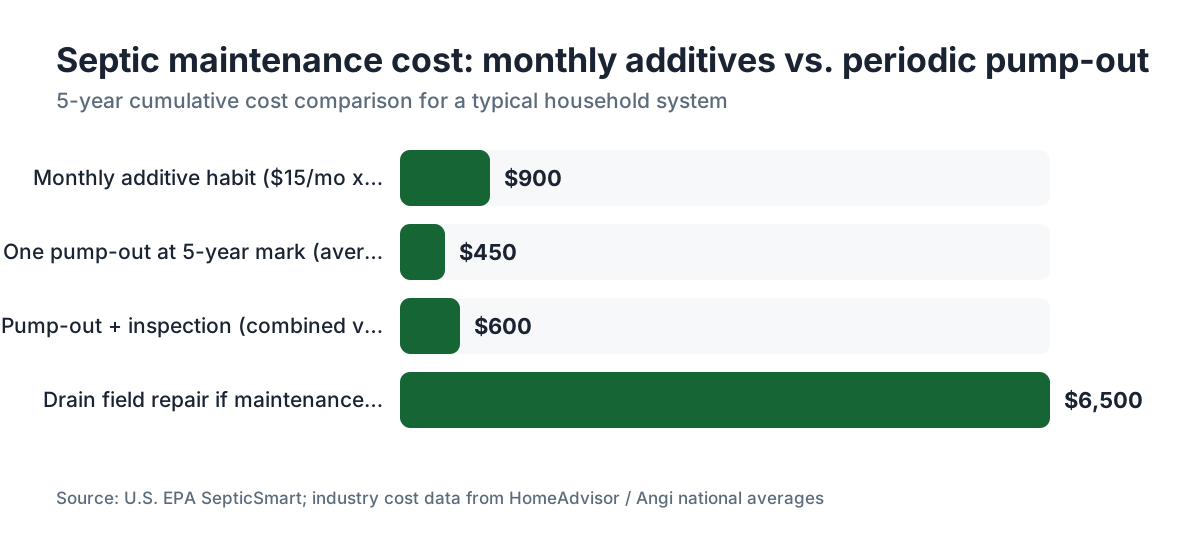
For most homeowners the math is plain. A $15-a-month additive habit runs $180 a year, or $900 over five years, money that would more than cover a professional pump-out and inspection. One pump-out does more for your system than sixty months of additive doses. That's the clearest thing the research says.
Frequently asked questions
Do septic tank treatments really work or are they a scam?
Most are ineffective for a properly functioning system. EPA-reviewed literature found no scientific evidence that biological or enzyme additives improve performance or reduce pump-out frequency. They're not exactly a scam, since a few situations (post-antibiotic, post-vacancy) offer a plausible use. But as a monthly maintenance habit they're a waste of money. Chemical solvent additives are worse: they risk groundwater contamination and are banned in several states.
How does septic tank treatment work, in theory?
Biological treatments add live bacteria (usually Bacillus species) to supplement the tank's existing population. Enzyme treatments add proteins like protease, lipase, and amylase that break down organic compounds directly. In theory both speed up digestion of solids. In practice, a healthy tank already holds hundreds of billions of bacteria per milliliter, and its population is limited by food supply and temperature rather than head count, so additions rarely change outcomes.
Can you use too much septic tank treatment?
Yes, particularly with enzyme products. High enzyme concentrations can break solids into fine particles that escape the tank's outlet baffle more easily and enter the drain field, which can speed up soil clogging. Chemical additives at high concentration can also kill the bacteria you're trying to help. With biological additives the overdose risk is lower, but more is not better: the tank self-regulates its bacterial population based on available food.
Do septic tank enzyme treatments help after using antibiotics?
This is probably the most defensible use for a biological additive. Antibiotics in sewage can suppress the tank's bacterial population for days to weeks. A one-time dose of a high-CFU bacterial or enzyme-bacteria product may help re-establish the community faster than the tank recovers on its own. No controlled trial has confirmed this, but the mechanism is plausible and the downside risk is minimal.
What is the best septic tank enzyme treatment?
No independent body rates septic additive products for performance, so "best" is hard to establish without bias. If you want to try one, look for a stated CFU count of at least 1 billion per dose, an NSF Standard 46 listing, and no chemical solvents in the ingredient list. One-time products designed for system restart after vacancy or antibiotic disruption have the most logical application. Avoid products claiming to eliminate pump-outs or restore failing drain fields.
Will septic treatment help a slow-draining system?
Probably not. Slow drains usually come from a full tank (needing pump-out), a clogged outlet baffle, a blocked pipe, or a failing drain field. None of those causes respond to enzyme or bacterial additives. The right step is a professional inspection to find the actual cause. Pouring additives into a system that needs pumping or repair delays the proper fix and costs you time.
How often should you add septic tank treatment?
If you use an additive at all, a one-time or occasional dose for a specific situation (post-antibiotic, post-long-vacancy) makes more sense than a monthly routine. The EPA does not recommend regular additive use, and the biology of a functioning tank doesn't support the idea that monthly dosing helps. The one maintenance task worth scheduling regularly is pump-out every three to five years, based on tank size and household occupancy.
Are septic additives safe for the drain field?
Biological and enzyme additives at normal doses are generally safe and unlikely to damage a drain field. Chemical additives (solvents, strong acids, hydrogen peroxide at high concentration) can mobilize fine solids into drain field soil or harm the biomat structure, which can worsen a failing field. EPA guidance specifically warns against using chemical additives in a failing system. Several states ban chemical septic additives by law.
Do yeast and home remedies work as septic treatments?
Flushing a packet of dry yeast is a common folk remedy for "activating" a septic tank. Yeast does produce enzymes that break down some organic compounds. But yeast is a facultative aerobe that doesn't thrive in the anaerobic tank environment, and the quantity in a baking yeast packet is negligible next to the tank's existing population. It won't hurt anything, but there's no evidence it helps either.
What states ban chemical septic additives?
Massachusetts (Title 5 / Chapter 21A), Washington State (WAC 246-272A-0210), and Indiana (Rule 410 IAC 6-8.3) are among the clearest examples of states that ban or restrict chemical solvent-based septic additives. About a dozen states carry similar restrictions in their onsite wastewater codes. Federal law (EPA/FIFRA) doesn't require performance testing before additives reach market, so state codes are the primary regulatory check.
Can septic treatment replace pumping?
No. No additive replaces pump-out. Sludge and scum layers accumulate inorganic material (grit, plastics, synthetic fibers) that bacteria cannot digest no matter what you add. Even in a biologically perfect tank, these materials build up and must be physically removed. The EPA recommends most household systems be pumped every three to five years. Delaying pump-out because of additive use is one of the most common ways homeowners end up with expensive drain field damage.
How much do septic treatments cost compared to pumping?
Monthly additive products run $10 to $25 per dose, or $120 to $300 per year. Over the typical three-to-five-year interval between pump-outs, that's $360 to $1,500 spent with no proven benefit. A professional pump-out costs $300 to $600 on average and is the one maintenance action with consistent evidence behind it. If budget is the question, skip the additives and put that money toward your next pump-out.
Will septic tank treatment help with odors?
Some enzyme products do reduce odors temporarily, especially from tank vents or around access lids. This is one area where real-world reports and plausible mechanism line up reasonably well. But persistent septic odors inside the house usually signal a venting problem, a dried-out P-trap, or a system that's overdue for pumping, none of which an additive will fix. Treat odors as diagnostic signals, not annoyances to mask.
Are there any EPA-approved septic tank treatments?
No. The EPA does not approve or endorse specific septic additive products. NSF International offers Standard 46 certification, which reviews products for absence of harmful ingredients but does not certify that they work. The EPA's SepticSmart program recommends against relying on additives as a substitute for regular maintenance and states there is no scientific evidence they benefit a properly functioning system.
Sources
- U.S. EPA, SepticSmart: Protect Your Investment: EPA states there is 'no scientific evidence that biological or enzyme additives benefit a properly functioning septic system' and recommends against additives as a substitute for pumping.
- U.S. EPA, Office of Water, Onsite Wastewater Treatment Systems Manual (EPA/625/R-00/008): Chemical solvent additives dissolve organic matter that then passes into the drain field and groundwater; high enzyme concentrations can mobilize fine solids toward the outlet baffle.
- Massachusetts DEP, Title 5 Septic System Regulations: Massachusetts Title 5 and Chapter 21A require DEP approval for septic additives and prohibit chemical solvents.
- Wisconsin Department of Natural Resources: Paired-system studies found no statistically significant difference in effluent quality or sludge accumulation between systems receiving monthly bacterial additives and untreated controls; biomat formation is a hydraulic problem not corrected by additives.
- Water Environment Research, Vol. 67, No. 3 (1995): 'Effects of enzyme additives on septic tank performance': Enzyme-treated septic tanks showed no statistically significant improvement in BOD, total suspended solids, or fecal coliform levels compared to untreated controls in Florida field trials.
- NSF International, NSF/ANSI Standard 46: Evaluation of Components and Devices Used in Wastewater Treatment Systems: NSF Standard 46 certifies septic additives for absence of harmful ingredients but does not certify product performance or efficacy claims.
- Washington State Department of Health, Onsite Sewage Systems (WAC 246-272A-0210): Washington State WAC 246-272A-0210 restricts chemical additives and requires that products used not inhibit tank performance or contribute contaminants to groundwater.
- Indiana Department of Health, Residential Onsite Sewage Systems (Rule 410 IAC 6-8.3): Indiana Rule 410 IAC 6-8.3 bans chemical additives in residential septic systems outright.
- University of Minnesota Extension: A healthy septic tank already contains hundreds of billions of bacteria per milliliter of sludge; bacterial population is controlled by food supply, temperature, and retention time, not by supplemental additions.
- U.S. EPA, SepticSmart: Maintain Your System: EPA recommends pumping most household septic systems every three to five years as the primary maintenance action; no additive is cited as a substitute.
- Penn State Extension: Bacillus-based bacterial additives are mostly aerobic and function poorly in the anaerobic environment of a septic tank; they contribute little to digestion before dying or becoming dormant.
Last updated 2026-07-10