Drain field solutions: every fix from a simple restore to full replacement
By the SepticMind Editorial Team
TL;DR
- A failing drain field can sometimes be restored with rest, more frequent pumping, aeration, or a distribution box fix.
- But a field sealed by biomat or drowned by hydraulic overload usually needs partial or full replacement.
- Costs run from $500 for maintenance to $20,000 or more for a new field.
- The right call depends on failure cause, soil, and local code.
What does a failing drain field actually look like?
The signs are hard to miss once you know them. Sewage odors drifting across the yard. Wet, spongy patches over the trenches. Toilets that gurgle and drain slow. Sewage backing up into the lowest fixtures in the house. Less obvious is a stripe of grass that is greener and taller than everything around it, which means effluent is surfacing and fertilizing the soil instead of soaking through it.
Not every symptom means the field is dead. Slow drains can come from a full septic tank, a crushed outlet baffle, or a clogged distribution box, none of which touch the field. That difference matters because the repair costs are worlds apart. A septic tank pump out costs $300 to $600. A new drain field costs $8,000 to $20,000 or more [1].
Before you spend a dollar on the field, have a licensed inspector or pumper confirm what is actually failing. A septic tank inspection that checks the distribution box, outlet tee, and effluent levels costs $100 to $300 and can stop you from chasing the wrong problem.
Why do drain fields fail in the first place?
The cause decides whether a fix is even possible. The most common failure is biomat formation. Over time, a greasy dark layer of anaerobic bacteria and organic solids builds up at the point where the trench meets the soil, and it slowly seals that surface. Effluent ponds, pressure climbs, and the liquid ends up going the only direction left: up and out [2].
Hydraulic overload is the second big one. A growing family, a new washer running loads every day, or a water softener dumping into the system can push two to three times the design flow through the field. Most residential fields are sized for 75 to 100 gallons per bedroom per day, and blowing past that consistently compacts the soil and swamps the thin aerobic zone the biomat depends on [3].
Tree roots, collapsed pipe, and bad installation fill out the list. Roots from willows, poplars, and maples are aggressive enough to crack distribution pipes and perforated laterals. A camera run through the laterals shows root intrusion in minutes.
Soil compaction gets overlooked. One pass from a loaded delivery truck or a backhoe over a lateral trench can crush the gravel bed and pipe for good. The EPA SepticSmart program tells homeowners to "keep cars, trucks, and heavy equipment off of your septic tank and drain field" to prevent exactly this [4].
Age matters too. A conventional gravel-and-pipe system has a design life of roughly 20 to 30 years with real maintenance [3]. Fields whose upstream tank never gets pumped, or that take grease, wipes, and garbage-disposal waste, quit a lot sooner.
Which drain field solutions actually work, and which are a waste of money?
There is a real spectrum here, and I want to be honest about where the evidence runs thin.
Resting the field. If biomat is the main problem and it has not fully sealed the soil, taking the field offline for weeks or months lets aerobic bacteria break down part of the mat. You need a second field or a pump-and-haul arrangement to make it through the rest period. Controlled success rates are not well documented, but soil scientists at Penn State Extension note that resting helps more in sandy or loamy soil than in clay [5].
Pumping the tank more often. This is not a fix for the field itself. It stops new solids from carrying over, which halts new biomat and gives the existing mat time to thin. If you cannot remember the last pump-out, start here. Most households need septic tank pumping every 3 to 5 years [6].
Field aerators (terralift and aeration injection). These machines inject compressed air into the soil around the laterals to fracture compacted zones, and some inject polystyrene beads to hold the channels open. A treatment runs $1,000 to $3,000. Some operators report good results in compacted loamy soil. Others see a bump that fades inside a year. Peer-reviewed data is thin. If a contractor cannot tell you which soil type makes the technique work, be skeptical.
Biological and enzyme additives. Hardware stores sell these "drain field restorers" for $30 to $100. The EPA's position is that most have not been proven effective and some may harm the system by mobilizing solids into the field [4]. Save your money.
Jetting and cleaning laterals. High-pressure jetting clears root intrusion and packed solids from perforated pipe. It is a legitimate step after root removal. It cannot fix saturated soil or a sealed soil interface.
Distribution box leveling or replacement. If one arm of the field is taking all the flow because the box settled crooked, re-leveling or swapping the box ($200 to $800) redirects flow to the sections that have been sitting idle. This is one of the cheapest interventions that actually extends field life, and it gets skipped constantly.
Partial field replacement. If only one or two laterals have failed, replacing those runs costs $2,000 to $6,000 instead of the full number. It only makes sense when a soil analysis confirms the rest of the field still percolates.
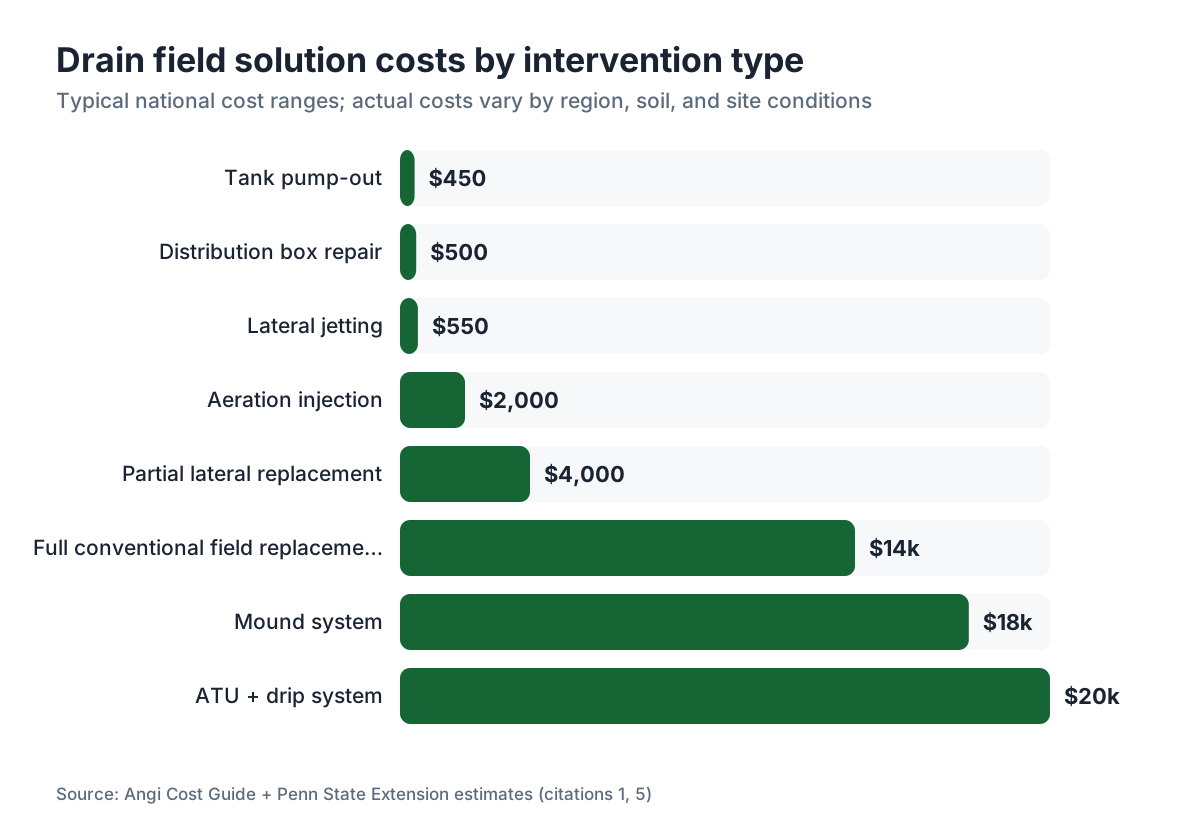
Full replacement. When the biomat is irreversible, the soil is saturated for good, or the system is just old, replacement is the answer. Budget $8,000 to $20,000 for a conventional gravel-and-pipe system, more on rocky or high-water-table sites [1]. The cost table below breaks it down.
What are the alternative system types when a conventional field cannot be replaced in the same spot?
Sometimes the original site is used up, the lot is too small for a new conventional field, or the soil flunks a percolation test. That is where alternative designs come in, and there are more options now than there were 20 years ago.
Mound systems. Sand and gravel get imported and built into a raised mound above the native soil. Effluent is dosed onto the mound, treated as it moves through the imported media, then soaks into the native soil at a slower rate. Mounds work well on high-water-table and thin-soil sites. Cost runs $10,000 to $20,000 or more depending on the lot [1].
Drip irrigation (low-pressure dose) systems. Effluent gets filtered and dosed in small, frequent shots through small-diameter tubing just under the surface. The slow, even dosing sidesteps the hydraulic overload that kills conventional fields. These need more attention, an effluent filter, and a dosing pump, but they fit sites with poor percolation or tight space. Costs start around $10,000 to $15,000.
Aerobic treatment units (ATUs). Instead of leaning on the soil for treatment, an ATU cleans wastewater to a higher standard before it ever reaches the field, which sharply cuts the organic load that forms biomat. ATUs are more complex and need service contracts (usually $100 to $300 per year), but they stretch field life and are required or preferred in some sensitive areas [7].
Chamber systems. Plastic arch chambers sit in the trench in place of gravel and perforated pipe, creating a void for effluent storage and soil contact. They perform on par with gravel systems in most soils, cost about the same, and go in faster. Many installers reach for them by default now [10].
The right answer leans heavily on your state's onsite wastewater code. Every state sets its own rules on approved system types, setbacks, and required soil tests. Your state department of environmental quality or health holds those rules. North Carolina's onsite wastewater regulations (15A NCAC 18E), for example, spell out minimum lot requirements, setbacks from wells and property lines, and approved system types with detailed soil classification [8]. Check the equivalent rules for your state before you plan a replacement.
How much do drain field solutions cost?
Cost swings hard by solution type, region, soil, and contractor. The table below gives realistic ranges from national contractor pricing and extension estimates [1][5].
| Solution | Typical cost range | Notes |
|---|---|---|
| Tank pump-out only | $300 to $600 | First step before any field work |
| Distribution box replacement | $200 to $800 | Often overlooked, high value |
| Lateral jetting/cleaning | $300 to $800 | Useful for roots, not soil failure |
| Terralift / aeration injection | $1,000 to $3,000 | Mixed evidence; soil-type dependent |
| Partial lateral replacement | $2,000 to $6,000 | Only if remaining field is viable |
| Full conventional field replacement | $8,000 to $20,000 | Wide range by region and site |
| Mound system | $10,000 to $25,000 | High water table or thin soil |
| ATU + drip system | $12,000 to $25,000+ | Difficult sites, sensitive areas |
Permits add $200 to $2,000 depending on the jurisdiction. Soil testing (perc tests, soil morphology analysis) adds $300 to $1,000. Excavation in rocky soil or on a tight-access lot can add 50 percent or more to any field install.
Get at least three quotes if you are weighing repair bids. Drain field pricing is inconsistent, and some operators mark up hard in markets with few competitors. A septic system repair contractor who pulls their own permits and keeps a licensed soil evaluator on staff is worth paying a little more for.
Can you add a second drain field instead of fixing the first one?
Yes, and in a lot of cases it is the smartest long-term move. Some states require a reserve field area at the time of original installation, precisely because primary fields eventually give out. If your lot has undisturbed soil that passes a perc test and meets setbacks from wells, property lines, and structures, a new field can often go in and get plumbed fairly quickly.
The old field then gets to rest. In sandy or loamy soil, a rested field can sometimes recover enough percolation over two to five years to serve as a backup again. No guarantees on that.
Lot size is usually the binding constraint. On a half-acre lot or smaller, with setbacks to a well, a house, and property lines already eating the available land, there may not be room for a second conventional field. That is when mound or drip systems, which have smaller footprints and can sometimes use less-than-ideal soil, become necessary.
Before you decide there is no room, have a licensed soil scientist or site evaluator walk the lot. They find suitable ground that a quick look misses all the time: upslope areas, side lots, sections that look marginal but pass soil morphology testing.
What is the drain field repair process from diagnosis to completion?
Here is how a proper repair sequence actually runs.
Step one is finding which part is failing. A pumper or inspector checks the tank level, inspects the baffles, probes the distribution box for solids or uneven flow, and reads the field surface. If the tank is fine and the box is level and clean, the field is the problem.
Step two is a soil evaluation if replacement looks likely. A licensed soil evaluator or engineer runs a perc test or soil morphology analysis on candidate replacement areas. It takes a day and costs $300 to $1,000. No installer can design a new system without it.
Step three is the permit. In most jurisdictions you cannot legally install a new field without one. The application needs the soil results, a site plan showing setbacks, and sometimes a licensed designer's stamp. Processing runs from a few days to several months depending on the county.
Step four is installation. Excavation, pipe or chamber laid in, a health department inspection, then backfill. A conventional field takes one to three days of active work.
Step five is startup. Load the system gradually over the first few weeks. Do not run ten loads of laundry the day after installation.
Recordkeeping matters through all of it. Photograph the as-built, keep the permit and inspection records, and note the GPS coordinates or measurements to the tank, distribution box, and field corners. Operators who juggle multiple properties use software like SepticMind to log these records and schedule the follow-up maintenance that heads off early failure.
How can you make a new or repaired drain field last as long as possible?
The habits that kill drain fields are well known and completely preventable.
Pump the tank on schedule. How often you pump the septic tank depends on household size and tank volume, but most systems need it every 3 to 5 years. Skip the pumps and solids carry into the field, building biomat faster than any soil can absorb [6].
Cut water use. Every extra gallon into the tank has to leave through the field. Spreading laundry across the week instead of all on Saturday drops the peak load meaningfully. Fix a running toilet the day you notice it. A single leaking flapper can add 100 to 200 gallons a day.
Protect the field physically. No vehicles, no heavy equipment, no livestock pens, no garden beds, no pavement over it. Plant grass, not trees or aggressive-rooted shrubs. The EPA SepticSmart program tells homeowners to "keep cars, trucks, and heavy equipment off of your septic tank and drain field" and to "plant only grass over and near your septic system" [4].
Keep garbage-disposal waste, grease, wipes, medications, and harsh chemicals out of the system. A garbage disposal roughly doubles the solids load into the tank and speeds up biomat formation [6].
Install an effluent filter on the tank outlet if you do not have one. These $50 to $150 filters catch solids before they reach the field and get cleaned at each pump-out. Cheapest high-value upgrade there is for an existing system.
Get the system inspected when you buy a house and at least every five years after. A septic tank inspection catches a cracked distribution box, a broken outlet tee, or partially clogged laterals before any of it turns catastrophic.
What permits and regulations govern drain field repair and replacement?
Drain field work is regulated at the state level, with local health departments usually running permitting and inspection. There is no single federal construction standard, but the EPA provides guidance under its Clean Water Act authority and through the SepticSmart program [4].
Every state has an onsite wastewater code covering minimum lot size, setbacks (commonly 10 feet from property lines, 50 to 100 feet from wells, 5 to 10 feet from structures), acceptable system types, soil testing, and installer licensing. These codes vary a lot. Some states let homeowners install their own systems. Others require a licensed contractor and a licensed soil evaluator for any permitted work [8].
The EPA reports that about one in five U.S. households depends on a septic or other onsite system, and protecting groundwater from failing systems drives most state requirements [2]. That groundwater mandate is the reason the rules are as strict as they are.
Before any repair beyond simple maintenance, call your county health department or department of environmental quality. Ask three things directly: what work needs a permit, what soil testing is required, and which system types are approved for your site. Skipping permits is not a savings play. Unpermitted work can bring fines, forced removal, and a mess when you sell the house.
Some states also run financial assistance programs for low-income homeowners with failing systems. USDA Rural Development offers grants and loans for wastewater repair in rural areas [9]. Check whether your county takes part.
How do you choose between repairing and fully replacing a drain field?
This is the decision most homeowners lose sleep over, and it comes down to a few honest factors.
If the failure is upstream of the field (full tank, broken baffle, crooked distribution box), fix that component first. The field may be fine.
If the field itself is failing, the question is reversibility. A biomat three years into forming in sandy loam might respond to rest and lighter loading. A biomat fifteen years deep in clay-heavy soil, on a system that was never pumped, in a field that stays saturated year-round, is not coming back.
Age is a decent proxy for reversibility. A field put in 15 years ago on a maintained system is worth trying to rehabilitate. A 30-year-old field that never got serviced probably is not.
Get the read from a licensed soil scientist or engineer rather than the contractor who wants to sell you a new field. Ask them straight: what is the realistic chance this field responds to rehabilitation, and how long would a rehabilitated field last versus a new one?
If replacement is coming either way, do it once and do it right. A well-designed, properly permitted field, maintained correctly, should give you another 20 to 30 years. Spending $2,000 on a stopgap that buys 18 months before you pay for the $15,000 replacement anyway is rarely the right math.
For homeowners sorting through bids and system options, and for operators tracking site histories and follow-ups across dozens of properties, SepticMind organizes the information that makes these decisions easier to document and act on.
What should you do right now if your drain field is failing?
Stop feeding the problem. Cut water use to the minimum: short showers, no extra laundry, no dishwasher. That alone can relieve hydraulic pressure and sometimes stop surfacing effluent within days.
Do not use the system at all if sewage is surfacing in the yard or backing up into the house. Surfacing sewage is a public health hazard. Keep kids and pets clear of the wet area. Call a pumper or inspector the same day.
Get the tank pumped even if you are not sure it is the tank. Pumping gives you a clean baseline and is the first move any competent contractor recommends anyway. See septic tank cleaning for what that service looks like.
If the field still will not drain after pumping, you have confirmed the field is the problem. Now call your local health department to learn what permits and soil testing you need before hiring anyone.
Get multiple written quotes that spell out the work, the permits being pulled, and the contractor's license number. A contractor who never mentions permits for a new or replacement field is one to walk away from.
And keep records. A drawing of where the tank, distribution box, and trenches sit, plus dates of any service, is worth real money when you sell the house or need an emergency repair years out.
Frequently asked questions
Can a drain field be restored without replacement?
Sometimes. If a full tank, a broken baffle, or a crooked distribution box is the cause, fixing that upstream part can restore normal field function for a fraction of replacement cost. A biomat-clogged field may respond to rest and reduced water use in well-draining soil. Severely saturated or clay-heavy fields with decades-old biomat rarely recover. Always confirm the actual cause before spending money on field treatments.
How long does a drain field last?
A conventional gravel-and-pipe field has a design life of roughly 20 to 30 years when the tank is pumped every 3 to 5 years and the system takes normal household loading. Fields that never get pumped, take grease or wipes, or run hydraulically overloaded can fail in 10 years or less. Maintenance is the single biggest variable in how long a field lives.
What is the cheapest drain field fix?
The cheapest fix is correcting whatever sits upstream of the field. Pumping a full tank ($300 to $600), replacing a broken outlet baffle ($100 to $300), or re-leveling a settled distribution box ($200 to $800) can clear symptoms that look like field failure. If the field itself is failing, distribution box repair and partial lateral replacement are the lowest-cost field moves, typically $2,000 to $6,000 versus $8,000 to $20,000 for full replacement.
How do I know if my drain field is failing or just the tank is full?
Have the tank inspected and pumped first. If drains and toilets return to normal after pumping, the tank was the problem. If sewage keeps surfacing in the yard or backing up into the house after the tank is pumped and the outlet baffle is intact, the field is failing. A camera inspection of the distribution box and laterals can pinpoint the issue within an hour.
Does homeowners insurance cover drain field replacement?
Standard policies usually exclude gradual deterioration, which covers most drain field failures. Some cover sudden and accidental damage, like a lateral pipe crushed by a vehicle. Riders or separate sewer and septic endorsements are available from some insurers. Read your policy carefully and call your insurer before assuming any repair is covered. Permits and documentation of the original installation help with any claim.
How long does drain field replacement take?
Soil testing and permitting take the longest, anywhere from two weeks to several months depending on your county. The physical install of a conventional field usually takes one to three days of active work. Complex sites needing a mound or ATU system may take a week or more of construction. Plan for the permit timeline. Rushing it rarely works, and unpermitted work creates bigger problems later.
Can heavy rain cause a drain field to fail?
Yes. Soil saturated by heavy or prolonged rain loses its ability to accept effluent, even in a healthy system. You may see temporary surfacing or slow drains during and after a major storm. That is not the same as permanent failure. If symptoms clear within a few days of dry weather, the field is probably fine. If problems stick around after the soil dries out, the field needs evaluation.
What plants can grow over a drain field?
Grass is ideal. It takes up moisture, has shallow roots that leave pipes alone, and tolerates nutrient-rich effluent. Native wildflowers and shallow-rooted perennials are generally fine. Avoid trees, shrubs, and any plant with aggressive roots, especially willows, poplars, and silver maples. Skip vegetable gardens over the field too. The EPA advises against edible plants in direct contact with soil that receives effluent [4].
How much does a new drain field cost per linear foot?
Conventional gravel-and-pipe laterals run $10 to $30 per linear foot for the trench, gravel, and pipe, but that excludes design, permitting, distribution box work, and site prep. Total installed cost for a typical three-bedroom system needing 300 to 500 linear feet of trench runs $8,000 to $20,000. Rocky terrain, high water tables, and difficult access can push costs well past that.
Can I install a drain field myself?
Some states allow homeowner installation with a permit. Others require a licensed contractor for all field work. Even where DIY is legal, you still need a permitted design based on a licensed soil evaluation, and the install has to pass a health department inspection before backfill. Errors in gravel depth, pipe slope, or trench width are common in DIY work and cause early failure. Check your state's onsite wastewater code first.
What is the difference between a drain field and a leach field?
They are the same thing. Both terms describe the network of perforated pipes or chambers buried in gravel-filled trenches that spread septic tank effluent into the soil for final treatment. Some regions say 'drain field,' others say 'leach field.' Your leach field is the last stage of your septic system, where soil bacteria and filtration remove pathogens before treated water reaches groundwater.
Will additives or treatments fix a failing drain field?
Most commercial additives, including enzyme products and bacterial cultures, have not been proven effective in controlled studies. The EPA states that biological additives have not been shown to restore failing fields and that some products may mobilize solids into the field, making things worse [4]. Save your money. Address the real cause: pump the tank, cut water use, or repair the distribution box.
How do I find out where my drain field is located?
Check with your local health department or county records office. A permit and as-built drawing should have been filed when the system went in. Your state may have an online property lookup for septic permits. A licensed pumper can also locate and probe the tank, then trace the outlet line to the distribution box and field. Once you find it, mark the corners permanently so you always know where not to dig or park.
Sources
- HomeAdvisor / Angi, Septic System Cost Guide: Drain field replacement costs $8,000 to $20,000 for conventional systems; mound systems $10,000 to $25,000
- U.S. EPA, Office of Wastewater Management, Septic Systems Overview: About one in five U.S. households relies on a septic or other onsite system; biomat formation is the primary mechanism of drain field failure
- Penn State Extension, Septic System Maintenance and Rehabilitation: Conventional drain fields are designed for 75 to 100 gallons per bedroom per day and have a design life of 20 to 30 years with proper maintenance
- U.S. EPA SepticSmart Program, Homeowners Guidance: EPA advises keeping vehicles off the drain field, planting only grass over the system, and states that biological additives have not been proven to improve system performance
- Penn State Extension, Rehabilitating a Failed Drainfield: Resting a failing drain field is more likely to succeed in sandy or loamy soils than in clay-heavy soils; terralift results are soil-type dependent
- U.S. EPA, How Your Septic System Works: Most septic systems require pumping every 3 to 5 years; garbage disposals roughly double solids loading and accelerate biomat formation
- U.S. EPA, Types of Septic Systems: Aerobic treatment units treat wastewater to a higher standard before field dispersal, reducing biomat-forming organic load; they require regular service contracts
- North Carolina Department of Environmental Quality, 15A NCAC 18E Onsite Wastewater Rules: North Carolina's onsite wastewater regulations specify minimum lot requirements, setback distances, approved system types, and soil classification requirements for drain field installation
- USDA Rural Development, Water and Waste Disposal Loan and Grant Program: USDA Rural Development offers grants and loans for wastewater system repair for low-income homeowners in rural areas
- University of Minnesota Extension, Septic System Drain Field Sizing and Design: Drain field sizing is based on soil percolation rates and household daily flow; chamber systems perform comparably to gravel systems in most soil types
Last updated 2026-07-09