Drain field chambers: what they are, how they work, and when to use them
By the SepticMind Editorial Team
TL;DR
- Drain field chambers are plastic arch-shaped units that replace gravel-and-pipe in a septic leach field.
- Effluent drains from the tank into the chambers, pools briefly on the open chamber floor, and soaks into the soil below.
- They install faster than gravel, need less digging, and the EPA lists them as an accepted alternative leach field technology for suitable soils.
What is a drain field, and what does it actually do?
A drain field, also called a leach field or soil absorption system, takes partially treated liquid wastewater (effluent) from the septic tank and spreads it into the ground so soil microbes and natural filtration finish the job. The tank handles solids. The field handles the water.
Effluent flows by gravity, or in some designs by a pump, into a network of trenches dug in your yard. Those trenches hold the distribution system, whether that is perforated pipe bedded in gravel or, increasingly, plastic chambers. The soil beneath and around the trenches does the real work: biological treatment happens in a thin biomat that forms just below the stone or chamber floor, and then the cleaned water percolates down toward the water table [1].
A septic drain field that fails usually does not fail because of the hardware. It fails because the biomat gets overloaded, the soil gets compacted or saturated, or the tank sends out solids it should have kept. Understanding how chambers fit this picture matters before you decide whether to install or retrofit one.
What are drain field chambers and how are they different from gravel systems?
A gravel trench works like this: a perforated pipe runs down the center of a stone-filled trench, effluent drips out of the pipe holes, trickles through 6 to 12 inches of washed stone, and enters the soil at the trench bottom and sidewalls. It works. But it means hauling and placing tons of crushed stone, and gravel can migrate into the soil over time.
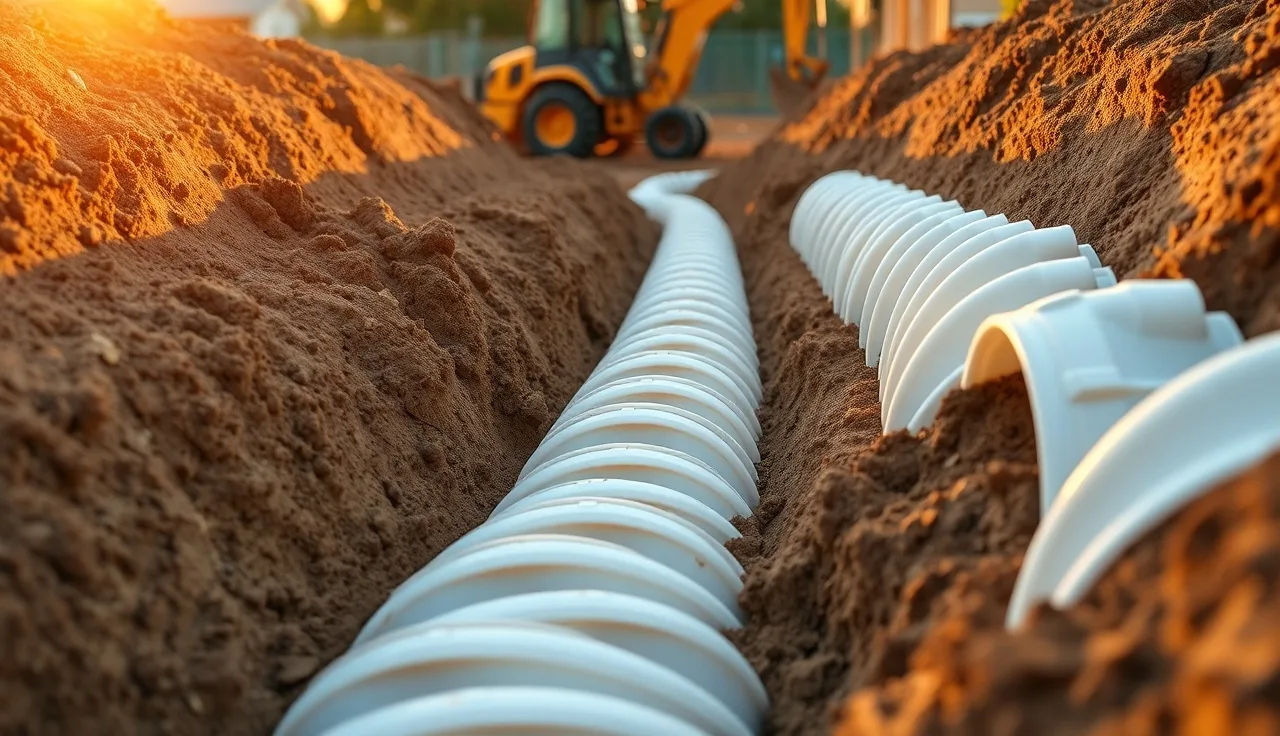
Chambers replace the gravel entirely. Each chamber is a ribbed, hollow plastic arch, roughly 12 to 34 inches wide and 12 inches tall, with an open bottom and perforated or open sidewalls near the soil. You snap them end-to-end in a trench to form a run. Effluent flows into the open interior, pools briefly, and seeps out through the open floor and sidewall openings into the surrounding soil [2].
The hollow interior creates a much larger open-air space above the soil than a gravel bed does. That air gap keeps the soil at the trench bottom aerobic longer, which helps the biomat stay thin and permeable. With gravel, the stone sits on the soil and can eventually clog it. With chambers, nothing presses against the infiltration surface except the effluent itself.
The most widely used chamber brand in North America is Infiltrator Water Technologies, but ADS, Cultec, and several other makers sell compatible products. All of them must prove equivalence to gravel systems under state onsite wastewater rules before an installer can use them legally on a permitted system [3].
How does a chamber drain field actually work, step by step?
Start at the septic tank. Wastewater from your house separates over 24 to 48 hours: solids sink to the bottom as sludge, grease and lighter material float as scum, and the clarified middle layer (effluent) flows out through the outlet baffle into the field.
The effluent travels through a distribution box or manifold that splits the flow evenly into each chamber run. Each run is a series of chambers, typically 8 to 20 feet long per trench, with end caps at both ends to keep soil out. Effluent fills the chamber interior and then contacts the native soil through the open bottom.
Soil microbes in the top few inches of native soil treat the effluent through aerobic and anaerobic processes. A biological mat (biomat) forms at this interface. A thin, healthy biomat is normal and actually improves treatment. A thick, black, clogged biomat means hydraulic overload or too many solids escaping the tank [1].
Here is the design edge. Because the chamber interior is hollow, the entire trench bottom works as the infiltration surface. In a gravel-and-pipe system the effective bottom area is the same width, but the pipe is a single point of distribution. Chambers spread effluent more evenly across the trench floor. The EPA notes that alternative systems including chamber designs suit many site conditions, particularly sites with high groundwater where keeping excavation shallow matters [1].
What are the main types of chambers available?
Chambers come in several sizes. Matching the size to your soil loading rate and trench dimensions is your designer's job, but knowing the categories helps you ask better questions.
| Chamber type | Typical width | Typical height | Common use |
|---|---|---|---|
| Standard arch | 12-13 in | 10-12 in | Tight lots, narrow trenches |
| Mid-size arch | 18-22 in | 11-13 in | Most residential installs |
| Wide arch | 30-34 in | 14-16 in | Large lots, lower-permeability soils |
| Gravelless pipe-in-a-sock | 8-10 in dia | N/A | Retrofit or tight clearance |
| Low-profile | 10-12 in | 6-8 in | Shallow water table applications |
Mid-size arches (the Infiltrator Quick4 Plus series is the most common example) are what most residential designers specify [2]. Wide-arch units cut the linear footage of trench you need because each foot of chamber covers more soil area, which helps on smaller lots.
Gravelless pipe in a geotextile sock is a different product category, but it works similarly and sometimes gets lumped in with chambers in state code tables. It is less common in new residential construction today but shows up in older permitted systems from the 1990s.
How much does a chamber drain field cost compared to a gravel system?
Drain field cost swings hard by region, soil type, required trench length, and whether you are doing a new install or a repair. Some honest ballparks still hold.
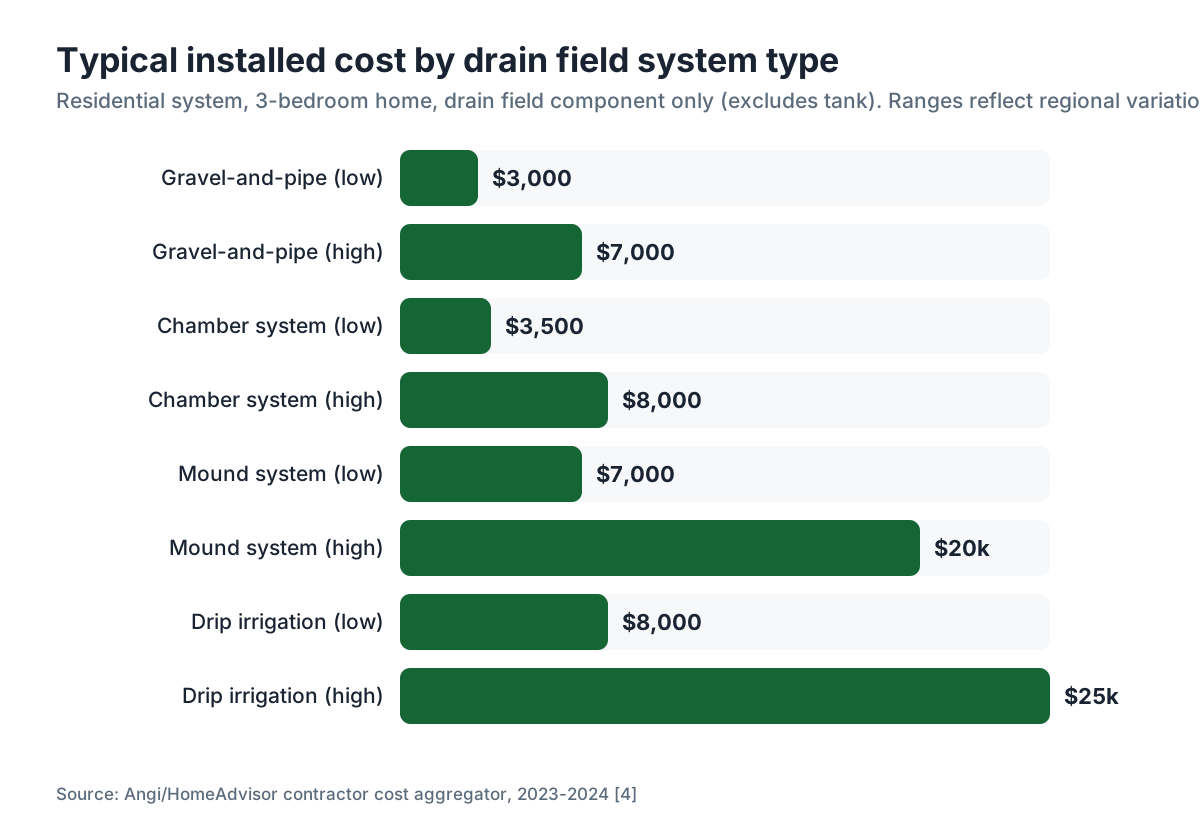
For a new residential system (3-bedroom house, typical perc test results), a gravel-and-pipe drain field in the Southeast or Midwest runs roughly $3,000 to $7,000 for the field component alone, separate from the tank [4]. A chamber system for the same house and site typically runs $3,500 to $8,000. The chamber hardware costs more than gravel, but you save on stone delivery and excavation time, so the total installed cost usually lands within 10 to 20 percent of a gravel system. Where crushed stone is expensive or trucking is a pain, chambers can be cheaper all-in.
For the full septic system including tank, you are looking at $10,000 to $25,000 or more depending on tank material, size, and whether you need a pump [4]. Our breakdown of the cost to install a septic system has region-by-region detail.
Replacing a failed gravel field with a new chamber system (repair or retrofit) often runs $5,000 to $15,000 depending on how much of the old system needs removal and how easy the new field area is to reach. Some states allow in-place rehabilitation without full removal if the original trenches can be pumped and rested [5].
Nobody keeps a full national cost database for this. The closest aggregated numbers come from contractor surveys by the National Onsite Wastewater Recycling Association (NOWRA) and state extension programs. Treat any online quote as a starting point, not a final number.
What sites are chambers best suited for, and where do they not work?
Chambers work best on permeable to moderately permeable soils (sandy loam, loamy sand, silt loam), reasonably flat terrain, and enough separation between the trench bottom and the seasonal high water table. Most state codes require at least 12 to 24 inches of unsaturated native soil below the chamber floor, though the exact number varies by state [3].
They also win on sites where minimizing dig volume matters. Because chambers create the void space that gravel would otherwise fill, you skip bringing in and spreading stone. That cuts excavation and trucking a lot. On remote lots or properties with tight access, that saving is real.
Chambers are a poor fit in soils with very fast permeability (coarse gravel or fractured bedrock) where effluent would race through without enough treatment before reaching groundwater. They are also wrong for certain mounded or at-grade systems where the chamber geometry creates frost exposure problems in cold climates. Slow clay soils usually call for a different approach entirely, such as a mound system, pressure distribution, or drip irrigation [1].
Your county or state health department issues a site-specific permit based on a soil evaluation and perc test (or soil morphology assessment). That document tells you which system type is approved for your lot. No installer can legally use chambers on a site where the permit says otherwise.
How long do drain field chambers last?
The plastic chamber itself, assuming it does not get crushed by vehicle traffic or bad backfill, should last at least 30 to 50 years. Infiltrator Water Technologies publishes a 30-year warranty on some of its chamber products [2]. The plastic is rarely the failure point.
What actually limits drain field life is the soil beneath it. When the biomat at the infiltration surface gets too thick (from hydraulic overloading, solids carryover from a neglected tank, or products that harm soil structure), the field loses the ability to accept effluent as fast as it arrives. That is a soil failure, not a chamber failure.
A well-designed chamber system on a properly maintained setup should easily reach 20 to 30 years before it needs any rehabilitation, and many go longer. The maintenance that matters: pumping the tank on schedule, keeping solids and grease out of the drains, and keeping vehicles and deep-rooted trees off the field. Our guide on how often to pump your septic tank has the specific intervals.
One honest caveat. There is limited long-term data directly comparing chamber field longevity to gravel fields at the population level. The chamber systems widely installed in the late 1990s and 2000s are only now hitting 25 to 30 years of age in real numbers. Early data look positive, but the literature does not yet have decades of head-to-head failure rate comparisons.
Does a chamber drain field need cleaning or maintenance?
The chambers themselves do not need periodic cleaning the way a septic tank does. There is no routine interval where you pump or flush the chamber runs under normal operation.
The septic tank upstream is what needs attention. Skip pumping (typically every 3 to 5 years for a residential system, depending on household size and tank capacity [1]) and sludge and scum will eventually spill into the chamber system. Once solids reach the chambers, they clog the soil interface in a way that is very hard to reverse. Septic tank pumping is the single most important thing you can do to protect any drain field.
If a chamber field starts to show failure signs (slow drains, surfacing effluent, sewage odors), a few fixes exist short of full replacement. Resting the field by alternating between two field areas (if your system has that design) gives the biomat time to break down aerobically. Hydro-jetting the chamber runs to break up surface biomat helps in some cases, though results vary. Products sold as drain field treatments or bacteria additives have mixed evidence; the EPA does not endorse any of them as a substitute for proper tank maintenance [1].
Some states and localities now treat septic drain field cleaning as a formal service category, and operators are starting to offer pressurized flushing of chamber runs as a maintenance item. If you run a service business tracking these calls, platforms like SepticMind can help you schedule and document drain field maintenance visits alongside your tank pumping routes.
For a closer look at what goes wrong and how to fix it, the septic system repair guide walks through diagnosis and remediation.
How do you install a chamber drain field?
A licensed onsite wastewater installer (or septic contractor) does this work under a permit in virtually every U.S. state. The general sequence:
- Soil evaluation and perc test. A licensed soil evaluator or engineer assesses soil type, depth to seasonal high water table, and depth to limiting layers (rock, hardpan). This determines whether chambers are allowed and what loading rate applies.
- System design. The designer sizes the field: number of trenches, trench length, chamber model, and spacing. Most residential chamber fields use trenches 3 to 5 feet wide and 3 feet deep, with 6-foot spacing between trench centerlines (check your state code; spacing rules vary).
- Permitting. The county or state health department reviews the design and issues an installation permit before any excavation.
- Excavation. A backhoe or mini-excavator digs the trenches to the specified depth. The trench bottom gets scarified (lightly raked) to break up any smeared, compacted surface left by the bucket, because a smooth smeared surface resists infiltration.
- Chamber placement. Chambers snap together end-to-end in the trench. Most designs have inlet knockouts at the top or end where the distribution pipe connects. End caps close each run.
- Inspection. Most states require a pre-backfill inspection by the health department or a third-party inspector before you cover the system.
- Backfill. Clean fill goes over the chambers to the original grade. You typically need at least 6 inches of cover over the chamber crown, and no more than 24 to 36 inches depending on the chamber's structural rating and your state's rules.
The whole install for a straightforward residential system usually takes one to two days once permits are in hand.
What regulations govern chamber drain field installation?
Septic regulation is almost entirely a state and local job in the United States. There is no single federal permitting requirement for individual onsite systems. The EPA sets guidance and general standards through its SepticSmart program and the 2002 Manual for Onsite Wastewater Treatment and Disposal Systems, but enforcement lives at the state or county level [1].
Every state has an onsite wastewater code that spells out approved system types, required setbacks (from wells, property lines, surface water), minimum soil cover depths, and equivalent loading rates for alternatives like chambers. Minnesota's Individual Sewage Treatment System code (Minn. R. 7080) lists accepted gravelless chamber products and their loading equivalencies [7]. Florida Rule 64E-6 does the same [8]. Virginia's alternative onsite sewage regulations (12VAC5-613) govern chamber systems there [9].
NSF/ANSI Standard 40 and Standard 61 cover materials, and NSF Standard 74 covers alternative onsite treatment components. Chamber products typically need third-party testing and listing under the relevant NSF or IAPMO standards before states will accept them [6].
Before you buy or install anything, pull your county health department's requirements. Some counties are stricter than the state minimum, particularly in drinking water wellhead protection zones or sensitive coastal watersheds. Installing without a permit can bring fines, mandatory removal, and problems selling the property later.
What are the signs that a drain field is failing, and what can you do about it?
A failing drain field (chamber or gravel) shows a predictable set of symptoms. Slow drains throughout the house when the tank is not full is an early sign. Gurgling in the pipes can mean the field is not accepting effluent fast enough. Wet, spongy, or unusually green grass over the field, especially in dry weather, means effluent is surfacing. Sewage odors outdoors near the field are a late-stage sign. Sewage backing up into the lowest drains in the house means the field has essentially quit [5].
Before you assume the field is done, rule out the simpler causes. A tank that has not been pumped recently mimics field failure. A cracked distribution box or broken outlet pipe can do the same. Start with a septic tank pump out and a visual check of the distribution system.
If the tank is fine and the field genuinely is failing, your options run from resting and rehabilitating the current field (if you have a dual-field or pump-divert design), to installing a new field in a permitted reserve area, to full repair or replacement. The septic system repair article covers the decision tree in detail.
The EPA states that "properly designed, installed, and maintained onsite systems are the most cost-effective method for wastewater treatment in rural areas," and field failure traces back to maintenance neglect far more often than to design flaws [1]. Worth remembering before you write off your chamber field and start pricing a full replacement.
Chamber drain fields vs. other alternative field systems: which one should you choose?
Chambers are one of several alternatives to traditional gravel-and-pipe systems. Here is a quick comparison of the most common options:
| System type | Best for | Key advantage | Key limitation |
|---|---|---|---|
| Gravel-and-pipe | Most standard soils | Low hardware cost, proven track record | Requires crushed stone delivery; less even distribution |
| Chamber (arch) | Permeable to moderate soils, lot access issues | No stone, fast install, large open infiltration area | Not suitable for fractured rock or very fast soils |
| Gravelless pipe in sock | Tight trenches, retrofits | Easy to ship and install in confined spaces | Less infiltration area than full arch chambers |
| Mound system | High water table, shallow soil | Works where in-ground systems cannot | Higher cost, needs pump, visible above grade |
| Drip irrigation | Restrictive soils, tight lots | Precise dosing, works in low-permeability soil | Complex, expensive, needs significant maintenance |
| Aerobic treatment unit (ATU) | Failing soil, near sensitive water | Produces near-potable quality effluent | Ongoing maintenance contract required, higher cost |
For most homeowners on a standard residential lot with moderate soils, chambers and gravel-and-pipe systems are both good choices. Chambers have taken serious market share over the past 20 years because they install faster and the plastic will not shift and compact the way stone can. If your designer or installer recommends chambers and the soil report supports it, there is no reason to push back toward gravel for its own sake.
For new construction, weigh septic tank installation options at the same time, since the tank type and size directly affect what loading rates the field must handle.
Frequently asked questions
What is a septic drain field and is it different from a leach field?
No meaningful difference. Drain field, leach field, and soil absorption system all describe the same thing: the network of trenches or beds that receives treated effluent from the septic tank and disperses it into the soil for final treatment and disposal. Terminology varies by region but the function is identical.
Can I install drain field chambers myself without a permit?
In most U.S. states, no. Onsite wastewater systems require a site evaluation, permitted design, and inspection before backfilling. Installing without a permit can result in fines, forced removal, and complications when you sell the property. A few rural counties have minimal oversight, but check your local health department before doing anything. The permit process also protects you if the system ever needs a warranty or insurance claim.
How many chambers does a typical residential drain field need?
It depends on household size, soil permeability, and the loading rate your state code assigns to the specific chamber model. A three-bedroom home typically generates around 450 gallons per day of design flow. With a standard mid-size chamber at a loading rate of 1.2 gallons per square foot per day, you need roughly 375 square feet of bottom infiltration area, which translates to about 30 to 60 chambers depending on the model size and trench layout.
Will drain field chambers crack or collapse under a driveway?
Most standard residential arch chambers are not rated for vehicular traffic loads. Driving over them with a car or truck can crack the arches and compromise the system. If you need to route a driveway over a drain field area, you need either traffic-rated chamber models (H-20 load rating) installed with extra cover depth, or you need to reroute the driveway. Never park on or repeatedly drive over a standard residential drain field.
How often does a septic tank need to be pumped to protect the drain field?
The EPA and most state guidelines recommend pumping every 3 to 5 years for a typical residential system, but the right interval depends on tank size and the number of occupants. A 1,000-gallon tank serving four people fills faster than the same tank serving one person. A service technician can measure sludge and scum depths to give you a site-specific interval. See the full guide on how often to pump a septic tank for household-size tables.
Can tree roots damage drain field chambers?
Yes. Tree roots seek moisture and will find their way into chamber joints and open sidewall areas over time. Willows, poplars, and silver maples are the worst offenders because their roots are aggressive and wide-ranging. Most codes require at least 10 feet of separation between drain field trenches and any tree, with larger setbacks for aggressive species. If roots have already infiltrated a system, hydro-jetting followed by root-killing foam is the typical service response.
Is a chamber drain field better than a gravel drain field?
For most residential installs in moderate soils, chambers offer a real edge in install speed, consistency of effluent distribution across the trench floor, and long-term structural stability since there is no stone to shift or compact over time. The plastic does not degrade the soil interface the way fine particles from deteriorating gravel can. That said, gravel systems have a longer field performance record. Both work well on suitable sites with proper tank maintenance.
What happens if I put too much water into a chamber drain field?
Hydraulic overloading is one of the fastest ways to kill any drain field. When water enters the system faster than the soil can absorb it, the biomat thickens rapidly, the soil saturates, and effluent backs up or surfaces. Common causes include water softener backwash cycling into the system, high-volume laundry days, leaky toilets adding hundreds of gallons daily, and large gatherings. Fix the source of excess water first before attempting any field rehabilitation.
Can a failed chamber drain field be cleaned or rehabilitated?
Sometimes. If the failure is early-stage biomat clogging and the soil itself is not permanently damaged, resting the field (diverting flow to a backup field), hydro-jetting the chamber runs, or soil fracturing (injecting air under pressure to break up the clogged zone) can restore function. Success depends on how advanced the failure is and what the underlying soil condition looks like. Full replacement is often the only viable option in cases of severe or long-standing failure.
What setback distances are required for a drain field from a well?
Setbacks vary by state, but a common minimum is 50 to 100 feet between a drain field and a drinking water well, with some states requiring 100 feet as the baseline and more in sensitive aquifer zones. The EPA recommends a minimum 50-foot setback from private wells as a general guideline, but your state code and permit govern the actual number. Always verify with your local health department, especially on small lots.
Do I need a separate reserve drain field area?
Many states require you to designate and protect a reserve drainfield area on your property at the time of permitting, equivalent in size to your primary field. The reserve area stays undisturbed and is never built on or paved. If your primary field fails, the reserve area is where the replacement system goes. Check your permit documents; if a reserve area is not marked, your replacement options if the field fails may be very limited.
What should I never flush or drain if I have a chamber drain field?
The list of things that damage any drain field is long: flushable wipes (they do not break down in the tank), cooking grease and fats, coffee grounds, medications, harsh chemical cleaners, paint, solvents, and any anti-bacterial products in large quantities. These either overwhelm the tank with solids that then pass to the field or kill the beneficial bacteria in both the tank and the soil biomat. Use toilet paper rated for septic systems and keep the garbage disposal use minimal.
How do I find out what type of drain field my property has?
Start with your county health department. Permitted septic system records are public documents in most states and include the original design drawings, soil evaluation, and inspection sign-offs. These will show whether you have chambers, gravel, or another system type. If you cannot find records, a septic inspector can probe the trench locations, expose a small section, and identify the system type. This is worth doing before you buy a property or plan any landscaping over the field area.
Sources
- U.S. EPA, SepticSmart: Proper Care and Maintenance of Your Septic System: The EPA SepticSmart program covers accepted alternative leach field technologies including chamber systems, proper tank pumping intervals, and the statement that 'properly designed, installed, and maintained onsite systems are the most cost-effective method for wastewater treatment in rural areas.'
- Infiltrator Water Technologies, Quick4 Plus Chamber Series product documentation: Infiltrator publishes chamber dimensions, installation specifications, and product warranty information for their residential arch chamber line.
- U.S. EPA, Onsite Wastewater Treatment Systems Manual (EPA/625/R-00/008): The EPA Onsite Wastewater Treatment Systems Manual describes design requirements for alternative soil absorption systems including chambers, minimum separation distances, and soil suitability criteria.
- HomeAdvisor / Angi, Septic System Installation Cost Guide (consumer cost aggregator, 2023-2024): Aggregated contractor cost data for drain field and full septic system installation across U.S. regions, cited as a ballpark range rather than a definitive source given survey methodology variation.
- U.S. EPA, SepticSmart: Signs of Septic System Failure: EPA guidance describes the common symptoms of drain field and septic system failure and the general options for repair, rehabilitation, and in-place rest of a failing field.
- NSF International, NSF/ANSI Standard 40 and Standard 74: Onsite Wastewater Treatment Systems: NSF Standard 74 covers testing and certification of alternative onsite treatment products including chamber systems; state agencies use NSF listings to approve specific chamber models.
- Minnesota Pollution Control Agency, Individual Sewage Treatment Systems (Minn. R. 7080): Minnesota Rule 7080 is an example of a state onsite wastewater code that lists approved gravelless chamber products and their hydraulic loading rate equivalencies for permitting purposes.
- Florida Department of Health, Rule 64E-6: Standards for Onsite Sewage Treatment and Disposal Systems: Florida Rule 64E-6 governs onsite system design, permitting, and approved alternative system components including chambers in Florida.
- Virginia Department of Health, Regulations for Alternative Onsite Sewage Systems (12VAC5-613): Virginia's onsite sewage regulations govern alternative system types including chamber drain fields, required setbacks, and loading rates applicable in Virginia.
- National Onsite Wastewater Recycling Association (NOWRA), Onsite Wastewater Industry Data: NOWRA industry data and contractor surveys provide the closest available aggregated cost and installation data for residential onsite wastewater systems in the U.S.
Last updated 2026-07-09