Drain field distribution box: what it does, how it fails, and what to do
By the SepticMind Editorial Team
TL;DR
- A drain field distribution box (D-box) is a small concrete or plastic chamber between your septic tank and leach field.
- It splits effluent equally among the drain field trenches.
- When it cracks, tilts, or clogs, one or more trenches flood while others starve, which kills a drain field early.
- Inspection runs $50 to $150; replacement runs $200 to $500 installed.
What is a drain field distribution box and what does it actually do?
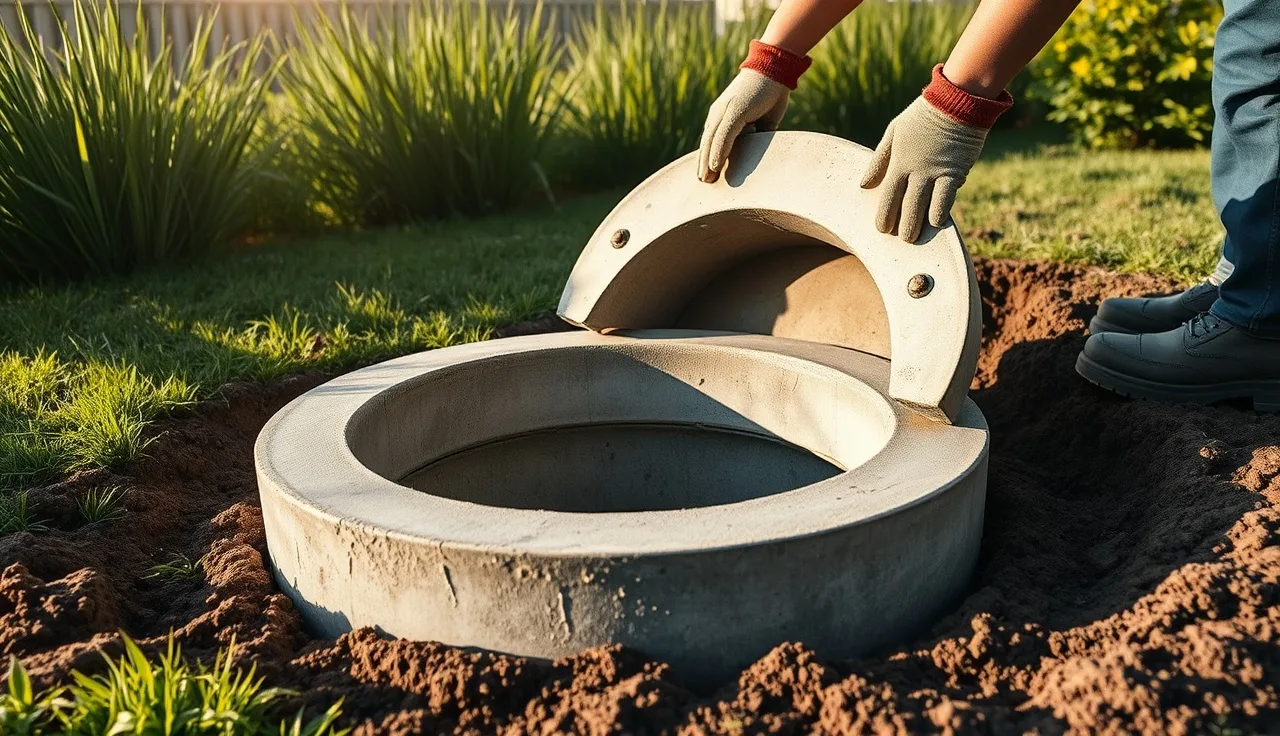
A distribution box, called a D-box on every job site, is a small watertight chamber buried between your septic tank and your leach field. Effluent flows from the tank into the box through one inlet pipe, fills the chamber to a common water level, then spills out through several outlet pipes, one for each trench or lateral in the field. That shared water level is the whole trick. Because every outlet sits at the same elevation, flow divides roughly equally across all the laterals with no valves, pumps, or electronics.
Most D-boxes are 12 to 24 inches square and 12 to 18 inches deep. Older ones are almost always precast concrete. Newer installs often use high-density polyethylene (HDPE) or PVC plastic, which shrugs off roots and corrosion better and is lighter to handle. A few big systems use fiberglass. [1]
The box sits at a carefully calculated elevation. Installers set it with a transit or laser level because even a quarter inch of tilt throws the water surface off plumb and dumps too much flow to the low side. That imbalance causes most D-box drain field failures.
Not every septic system has one. Pressure-dosed systems, drip-irrigation systems, and some chamber systems move flow mechanically and skip the gravity D-box. But most conventional gravity-fed drain fields in the United States rely on one, and the EPA estimates roughly 20 percent of U.S. households use onsite septic systems, most of them conventional gravity designs. [2]
How does a distribution box connect the septic tank to the leach field?
The flow path runs house drains, septic tank, D-box, leach field laterals, then soil. The tank does the heavy lifting. Solids settle to the bottom as sludge, fats float as scum, and partially clarified liquid (effluent) exits through an outlet baffle. A single pipe, usually 4-inch PVC or cast iron on older systems, carries that effluent downhill by gravity to the D-box inlet.
Inside the box, effluent pools until it reaches the elevation of the outlet pipes. Each outlet is cut into the sidewall at the same height. When liquid rises to that level, it flows into all laterals at once. The laterals run downhill into perforated pipe laid in gravel-filled trenches, where effluent percolates into the soil. That final soil step is what makes the system safe. [3]
The distance between tank and box varies. Most codes want the D-box at least 5 feet from the tank and at least 5 feet from the first lateral, and some states require greater setbacks. Check your state's onsite wastewater code before you dig. North Carolina's rules, for example, require the D-box to be accessible for inspection and maintenance, which effectively means it has to be near enough to the surface for a riser or access cover to reach grade. [4]
If your system went in before the 1980s, there's a decent chance the D-box is cast concrete and has sat undisturbed for decades. That's not automatically a problem. A well-set, intact concrete box can last 30 to 40 years or longer. The failure modes are specific and inspectable, which is why a septic tank inspection almost always includes locating and opening the D-box.
What are the signs that a distribution box is failing?
The clearest sign is wet, spongy, or smelly ground over one section of the drain field while the rest looks fine. A tilted or clogged box floods one or two laterals, so those trenches saturate and back up. You'll often see lush, bright green grass over just part of the field, or standing water and sewage odor in a specific spot. The starved laterals, meanwhile, dry out and lose their biological treatment layer.
Inside the house, a failing D-box eventually shows up as slow drains or gurgling toilets, though a dozen other things cause those too. A D-box problem tends to get worse in wet weather because the saturated trench can't take any more flow.
An inspector who opens the box and finds effluent standing high above the outlet pipes has a clog or a level problem. Tree roots growing through concrete cracks show up often. Roots chase moisture, and a box full of warm effluent is a target.
One failure mode is easy to miss: a cracked box letting groundwater in. In a high water table area, groundwater seeps through the cracks, raises the level inside the box, and shoves effluent back toward the tank or floods every lateral at once. A cracked box can also leak effluent straight into the soil before it reaches the laterals, which skips the treatment step entirely. [5]
Want to narrow the cause before you call a contractor? A bucket test helps. Have someone pour water into the system at a steady rate while you watch the open D-box. Uneven outlet flow shows up in real time.
How do you find the distribution box in your yard?
Start with your system's as-built drawing. Most county health departments require one filed when the system goes in, and many now post them online or send them on request. The as-built shows the D-box location off fixed points like the house foundation or property corners. No record on file? Try the previous owner's paperwork or the contractor who last pumped the tank.
With no records, the field work is simple. Find the septic tank outlet pipe (your pumping contractor can mark it), then probe the ground on a line toward the leach field. A steel probe rod, pushed in every foot or so along that line, hits the concrete or plastic top with a dull thud instead of the give of plain soil. The box usually sits 12 to 36 inches down, though systems with risers may have the lid at or near the surface.
Some homeowners run a metal detector over concrete boxes that have rebar or steel lid rings. Ground-penetrating radar is an option on tough sites where probing won't work. Budget an extra $100 to $200 for that service.
Once you find it, mark the spot for good. A recessed flush-mount lid or a riser pipe brings the access point to grade and saves excavation on every future inspection. Many states now require risers to grade on new D-box installs. Adding one to an older system is cheap next to the cost of digging it up over and over.
How do you inspect a distribution box yourself?
A basic homeowner inspection works once you've located and opened the box. Check four things: the liquid level, the level of the box itself, the condition of the concrete or plastic, and any roots or solids inside.
Liquid level: If the system isn't actively taking flow, the box may be dry or hold a little residual effluent. That's normal. If it's full to the brim with effluent sitting well above the outlets, you have a downstream problem (clogged laterals, saturated soil, or a tilted box dumping everything to one side).
Box level: Hold a small torpedo level against the outlet pipe stubs or the bottom of the box. More than 1/8 inch off level across the width is a real imbalance. Over the years, soil settlement and frost heave in northern states can tilt even a well-set box. [6]
Structural condition: Look for cracks in concrete, gaps where the inlet or outlet pipes pass through the wall, and spalling that exposes aggregate. Hairline cracks in old concrete are common and not always serious. Cracks wide enough to pass a credit card edge are a problem.
Roots and solids: Any root mass inside the box came through a crack. Even a small root will keep growing. Cut roots back and seal the crack, but the crack is the actual repair.
For a real estate transaction, expect an inspector to camera-scope the inlet pipe, eyeball the box, and sometimes dye-test the laterals. The septic tank inspection article walks through the full protocol.
What does it cost to repair or replace a distribution box?
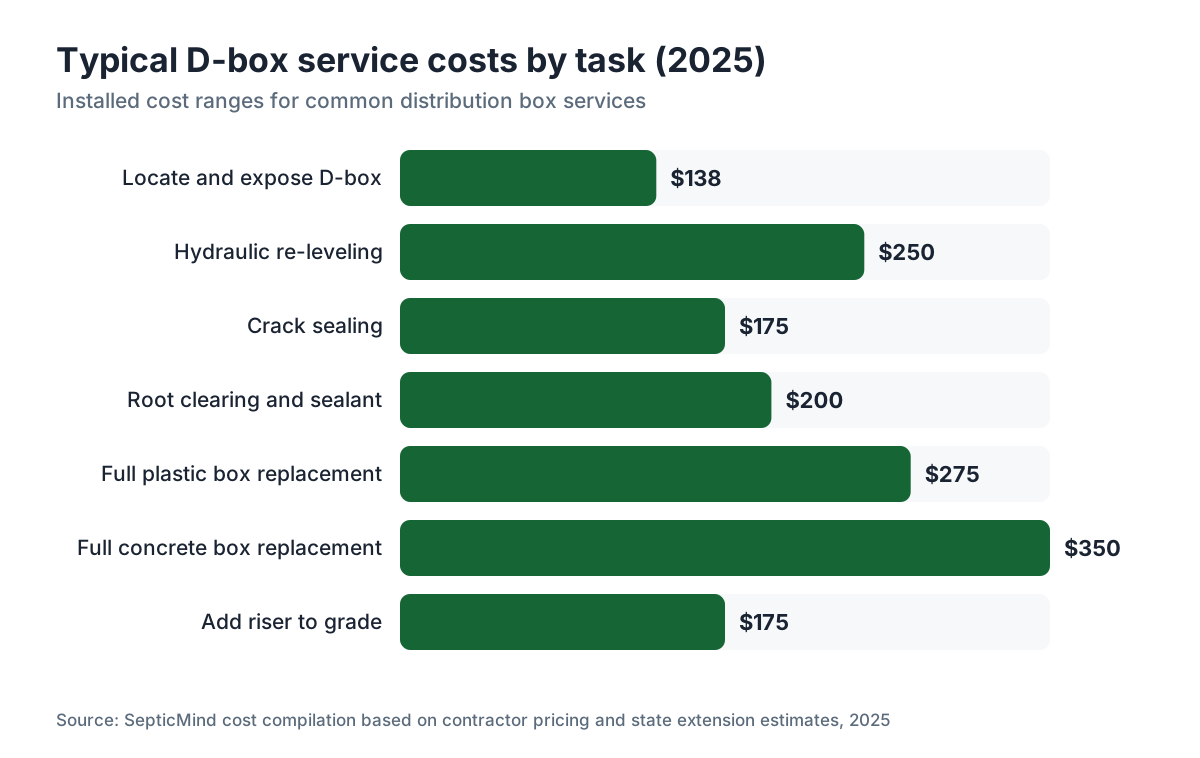
Costs swing with region, access difficulty, and whether you're patching a box or replacing it. Here are real ranges based on contractor pricing as of 2025:
| Service | Typical Cost Range |
|---|---|
| Locate and expose D-box (labor only) | $75, $200 |
| Hydraulic leveling / re-leveling | $150, $350 |
| Crack sealing with hydraulic cement | $100, $250 |
| Root clearing and sealant | $100, $300 |
| Full concrete D-box replacement | $200, $500 installed |
| Full plastic D-box replacement | $150, $400 installed |
| Adding a riser to grade | $100, $250 |
| Excavation if deeply buried (per hour) | $100, $200/hr |
The box itself is cheap. A precast concrete box runs $30 to $80; a plastic one runs $20 to $60. Labor and excavation eat the budget. A box 18 inches down in sandy soil is a two-hour job. One 36 inches down in heavy clay with a root-bound concrete lid is a different day entirely.
If the failing box has already let one or more laterals biomat-over (the gray slime layer that clogs the soil interface), the cost jumps hard, because now you're into septic system repair that may mean lateral replacement or field restoration. Catching a D-box problem early is genuinely much cheaper than a failed drain field.
One honest note on cost sources. There's no single national database for D-box repair pricing. The ranges above come from published contractor quotes and state extension estimates. Your local market may run 20 to 30 percent higher or lower.
How do you level or re-level a distribution box?
Re-leveling is a job most handy homeowners can pull off if the box is accessible and the soil cooperates. You have to excavate down to the full box, which usually means a hole roughly 3 feet square. Don't try to level a box you can only half see.
Once it's exposed, check all four corners with a level. The usual fix for a settled concrete box is hydraulic lifting: pack a non-shrink grout or concrete mix under the low corner or corners, let it cure, and re-check level before backfilling. Some contractors inject foam that expands under the box and lifts it precisely. That's faster but costs more in equipment. Plastic boxes are easier because you can pull them out entirely, correct the base, and reset them.
After re-leveling, re-check the inlet and outlet pipe connections every time. The soil shift that tilted the box may have cracked or unseated the pipe joints. Seal any gaps with hydraulic cement or PVC solvent cement as appropriate.
Backfill with clean soil or pea gravel around the walls, not heavy clay that holds water and drives frost heave in cold climates. Tamp in lifts instead of dumping everything at once.
If you're in a frost-prone state (Minnesota, Wisconsin, Maine, or similar), do this in late spring or early fall while the ground is workable. Frost heave is real. It will undo a re-leveling job if the box isn't set deep enough or the backfill holds too much water. [6]
Can tree roots damage a distribution box and how do you deal with them?
Yes, and it happens more than people expect. Willow, maple, poplar, and other water-seeking trees planted within 20 to 30 feet of a D-box are the usual offenders, though roots from trees much farther off can travel toward a moisture source. Concrete boxes are the most vulnerable because concrete is porous and develops hairline cracks over time that roots pry into.
Once roots are inside, they grow fast. A moderate root mass partly blocks outlet pipes and cuts flow to some laterals. A heavy infestation can fill the box, dislodge outlet pipes, and crack the box further.
Removal is physical work. A contractor uses a root saw, high-pressure jetting, or hand tools to clear the interior. Copper sulfate can kill roots in the box and pipes, but it also harms drain field soil bacteria if you overdo it. The EPA's SepticSmart program advises against flushing harsh chemicals into septic systems. [2] Use copper sulfate sparingly and only in the box itself, never dosed into the tank.
After clearing, the crack that let roots in has to be sealed with hydraulic cement, epoxy mortar, or a sealant rated for wastewater contact. If the concrete is deteriorated past a patch, replace the box. A cracked, patched, already-invaded box tends to fail again.
Long term: don't plant trees or big shrubs near the D-box. The EPA's SepticSmart guidance recommends keeping trees away from the septic system. [2] If existing trees are the problem, root barriers (solid plastic sheeting buried 24 to 36 inches deep between the tree and the box) can slow re-invasion.
How often should a distribution box be inspected?
Most homeowners never look at their D-box until something goes wrong, and that's a mistake. A D-box inspection takes 20 minutes once the box is located and accessible, and it gives you early warning of the failure modes that lead to $5,000 to $30,000 drain field replacements.
A sensible schedule: inspect the D-box every time you pump the tank. The EPA recommends pumping every 3 to 5 years for a typical household, though tank size and household size move that interval a lot. [2] Our guide on how often to pump septic tank covers the timing. Have your pumping contractor open the D-box on the same service call. Most will do it for little or no extra charge if the box is accessible.
For real estate deals, always include the D-box in the septic inspection scope. A seller's disclosure that the system was "inspected and pumped" may not mean the D-box got looked at. Ask specifically.
High water table, hard-freeze climate, or mature trees near the field? Then an annual visual check of the box is reasonable. Those are the conditions that speed up D-box trouble.
Septic service operators who manage large portfolios of residential systems often track D-box condition across dozens of properties. Tools like SepticMind can log inspection findings and flag boxes that showed level problems or cracking last visit, so technicians know which sites to hit first next cycle.
What's the difference between a distribution box and a distribution manifold or header pipe?
These terms get mixed up, and the difference matters when you're diagnosing a problem or planning a repair.
A distribution box (D-box) is a chamber. Effluent pools inside and overflows equally through multiple outlets. Distribution comes from the shared water surface inside the box.
A distribution manifold, sometimes called a header pipe or drop box header, is pipe-based. A single inlet feeds a larger-diameter header pipe, and individual laterals tee off the header at intervals. There's no pooling chamber. Distribution depends on pipe geometry and slope. Header systems are common in certain regional traditions and some older installs.
Drop boxes are a third variant, built for sloped sites. Instead of one D-box at the top of the field, drop boxes sit in series down the slope, each with an overflow that passes to the next box below. This lets the upper laterals saturate first before flow reaches the lower ones, which suits steep sites where a single D-box would send too much head pressure to the lowest lateral.
Serial distribution, where laterals connect end to end so effluent fills the first trench before spilling into the next, is yet another approach. Some states use it, but it's generally not recommended because it consistently overloads the first trench.
Not sure which type you have on an older system? A licensed inspector or your local health department can read it off the as-built drawing. The repair and maintenance approach changes with the system.
Can you replace a distribution box yourself, and when should you call a pro?
Homeowner replacement is legal in many states but regulated in most. A lot of states require a permit for any septic work beyond pumping, and some require a licensed contractor for any component replacement. Before you touch a shovel, call your county health department and ask specifically whether a homeowner permit is available for D-box replacement in your jurisdiction.
If the rules allow it, the work is doable for a handy homeowner with a small excavator or the patience to hand-dig. The steps: expose the box, carefully disconnect the inlet and outlet pipes (note and record their orientations), lift out the old box, set the new one on a compacted gravel base, reconnect pipes with watertight fittings, verify level in two directions, and backfill.
Here's what argues for a pro: pipe alignment is unforgiving. If the outlet pipes aren't seated squarely and at exactly the same elevation inside the new box, you've rebuilt the original problem. An experienced installer knocks this out in a couple of hours. A first-time DIY can burn a whole day and still need correction.
The other reason to call a pro is diagnosis. If the D-box is failing, know why before you drop in a new one. A contractor with a camera can tell you whether the laterals themselves are shot, whether there's a pipe break between tank and box, and whether the surrounding soil has deteriorated. Replace the D-box into an already-failed system and you get a new box and a dead leach field. The leach field article covers how field failure gets assessed.
On the permit question, the EPA's SepticSmart program tells homeowners to "have their system inspected by a qualified professional," and many state codes write that recommendation into law. [2] Your county health department is the final word.
How does a failing distribution box cause drain field failure?
This is the cascade to understand, because a $300 D-box fix left undone can turn into a $15,000 drain field replacement.
When a box tilts or one outlet partly clogs, the flow imbalance sends most of the effluent to one or two laterals. Those trenches get more organic loading than the soil can process. Anaerobic bacteria build a dense biomat (a black, gelatinous layer) at the gravel-soil interface. The biomat slowly seals the soil surface, cutting infiltration until the trench basically stops taking liquid. Then effluent backs up.
Meanwhile, the underloaded laterals get so little flow that their aerobic microbes die off. When you later try to shift flow back to those laterals, the soil may not bounce back quickly, because the biological treatment layer has to rebuild from scratch.
A 2007 study of septic failure modes found uneven effluent distribution among the leading preventable causes of premature drain field failure, alongside inadequate pumping frequency and surface water intrusion. [5] The EPA notes that "a failing septic system can contaminate nearby wells, surface water, and the ground" and that regular maintenance prevents most failures. [2]
The lesson is simple. D-box inspection is cheap insurance. If you're buying a home on septic and the seller can't say when the D-box was last inspected and leveled, price that uncertainty into your offer. A pre-purchase septic tank inspection that includes the D-box is money well spent.
What materials are distribution boxes made from, and which is better?
Precast concrete has been the standard for decades. It's heavy, which helps it stay put, and it's strong enough for light vehicle traffic with the right cover. The downsides: concrete is porous and eventually soaks up moisture, which speeds spalling; it cracks under root pressure or frost heave; and its weight makes it harder to seat perfectly level. Concrete boxes can last 20 to 40 years in good soil.
HDPE and PVC plastic boxes took hold in the 1990s and are now the default in many markets. Plastic is watertight by construction (no absorption), lighter to handle, easier to level precisely, and resistant to roots and corrosion. Smooth interiors don't harbor biofilm the way rough concrete does. The tradeoff: plastic can flex under heavy loads if the cover isn't rated for traffic, and some older formulations got brittle in the cold. Modern traffic-rated HDPE boxes handle both. [1]
Fiberglass boxes exist and work well but are less commonly stocked by local suppliers, which can mean lead time if you need one fast.
Replacing a concrete box? There's no real reason to install another concrete one unless your local supplier doesn't carry plastic or code specifies it (rare). An HDPE box of the same opening dimensions drops into the existing hole, connects to existing pipes with rubber couplings, and levels more easily. Installed price runs about the same either way; the material cost gap is small.
For new septic tank installation, most contractors default to plastic D-boxes now, whether the tank itself is concrete or plastic.
Frequently asked questions
How deep is a distribution box buried?
Most D-boxes sit 12 to 36 inches below grade, though depth depends on the local frost line, the slope between tank and field, and the installation practices of the day. Cold-climate systems tend to go deeper to fight frost heave. If yours has no riser to grade, a contractor can probe for it or pull it from as-built records. Adding a riser at the next inspection is worth the minor cost.
How long does a distribution box last?
A well-set concrete D-box in stable soil can last 30 to 40 years or more. Plastic HDPE boxes are expected to last a similar span under normal conditions. Failure usually comes from outside factors: tree root intrusion, frost heave that tilts or cracks the box, or soil settlement. Inspecting it every 3 to 5 years catches problems before they cut the box's useful life short.
What happens if effluent level is too high inside the distribution box?
Effluent sitting above the outlet pipes means flow is backing up. The usual causes are clogged or biomat-sealed laterals, a tilted box overloading one side, or a downstream obstruction. A high level at the D-box is a warning that the drain field is stressed. A contractor should camera the outlet pipes and check the laterals before you assume the field is dead. Sometimes the D-box fix clears the level problem.
Can I add more outlets to my distribution box to expand the drain field?
Yes, in principle. If you're adding a lateral or a new field section, a new outlet can be core-drilled into a concrete box or opened as a knockout in a plastic one. The catch: the new outlet has to sit at exactly the same elevation as the existing ones, or flow leaves through the lowest one first. This work should be permitted and inspected. Your county health department controls drain field expansion approval.
Does every septic system have a distribution box?
No. Pressure-dosed systems distribute flow through pressurized manifolds and skip the gravity D-box. Drip irrigation septic systems use emitters. Some chamber and mound systems have engineered distribution manifolds instead. Older systems with a single lateral sometimes have no distribution at all. Only gravity-fed systems with multiple laterals typically include a D-box, which still covers a large share of existing U.S. installations.
How do I know if my distribution box is level?
Open the access lid (excavate if you have to) and hold a standard torpedo level against the bottom of the box or across the outlet pipe stubs. Check both directions, side to side and front to back. If the reading is more than about 1/8 inch off across the width, the flow imbalance is enough to warrant re-leveling. A professional can verify it more precisely with a transit level.
Is it normal for a distribution box to have some water in it?
Yes. A small amount of residual effluent at or just below the outlet pipe level is normal after recent use. What's not normal is effluent sitting well above the outlets when the system hasn't been used heavily, or a bone-dry box in a system that's in regular use (which can mean the box shifted and lost its connection to the inlet pipe). Any pooling well above outlet level needs a look.
What is a leach field distribution box versus a septic leach field distribution box?
They're the same component. A leach field distribution box and a septic leach field distribution box are both the chamber that splits effluent from the septic tank among multiple drain field laterals. The naming just varies by region. Some areas say 'distribution box,' others say 'D-box,' and trade literature sometimes writes 'septic drain field distribution box' to keep it distinct from stormwater distribution structures.
How much does it cost to replace a distribution box?
The concrete box itself costs $30 to $80; plastic runs $20 to $60. Labor and excavation bring the installed total to roughly $200 to $500 for a straightforward job where the box is accessible. If the box is deeply buried, in tough soil, or if pipe connections need real rework, expect $500 to $900 or more. Getting the D-box right still costs far less than the drain field failure a neglected bad box causes.
Can a distribution box be repaired instead of replaced?
Often yes. Cracks in concrete can be sealed with hydraulic cement or epoxy mortar rated for wastewater contact. A tilted box can sometimes be re-leveled without full replacement. Root intrusion can be cleared and the crack sealed. Replacement makes more sense when the concrete is badly spalled and structurally weak, when multiple cracks are present, or when the box shifted so far that pipe connections can't be restored without excavating the full run anyway.
Should I be concerned about a distribution box near my well?
Yes. Most state codes require a minimum horizontal separation of 50 to 100 feet between any septic component, D-box included, and a private well. A cracked or leaking box closer than that setback becomes a direct pathway for pathogens to reach groundwater and possibly contaminate your drinking water. If your well and D-box sit close together, have both inspected. Your state's environmental or health agency sets the exact separation distance.
What's a drop box and how is it different from a regular distribution box?
A drop box works on sloped lots where a single D-box would push too much pressure head to the lowest lateral. Drop boxes sit in series down the slope: the first box serves the top lateral, and its overflow pipe leads to the second box for the next lateral down, and so on. This forces the upper laterals to fill first before the lower ones load. Leveling and maintenance are similar to a standard D-box, but you may have several boxes to inspect.
Can roots from a nearby tree destroy a distribution box?
Yes. Roots from willow, maple, poplar, and similar water-seeking species commonly work through hairline cracks into concrete D-boxes. Once inside, they block outlets, crack the box further, and can displace outlet pipes. Trees within 20 to 30 feet of the box carry the highest risk. Clearing roots and sealing cracks can extend the box's life, but if the concrete is structurally weak, replacement is the better long-term call. Plastic boxes resist root penetration better than concrete.
Sources
- University of Minnesota Extension, Septic System Owner's Guide: Description of D-box materials including precast concrete, HDPE, and PVC; installation and function in gravity-fed drain field systems.
- U.S. EPA, SepticSmart Program: EPA estimates roughly 20 percent of U.S. households use onsite septic systems; recommends pumping every 3 to 5 years; advises keeping trees away from septic systems and avoiding harsh chemical additives; recommends having systems inspected by a qualified professional.
- U.S. EPA, Onsite Wastewater Treatment Systems Manual (EPA/625/R-00/008): Flow path from septic tank through distribution box to leach field laterals and soil absorption; function of shared water surface level for equal distribution.
- U.S. EPA, A Homeowner's Guide to Septic Systems: A failing septic system can contaminate nearby wells, surface water, and the ground; uneven effluent distribution, inadequate pumping frequency, and surface water intrusion are leading preventable causes of drain field failure; groundwater infiltration through cracked components disrupts treatment.
- University of Wisconsin-Madison Division of Extension, Septic Systems and Cold Climate Maintenance: Frost heave in cold climates can tilt or crack distribution boxes; recommendations for backfill materials and seasonal timing of repair work.
- Virginia Department of Health, Sewage Handling and Disposal Regulations (12 VAC 5-610): State-level example of onsite wastewater code requiring minimum setbacks between septic components including distribution boxes and private wells (50 to 100 feet depending on component).
- Penn State Extension, Septic System Maintenance: Copper sulfate can be used to kill roots in distribution boxes but should be used conservatively to avoid harming soil bacteria in the drain field.
- University of Florida IFAS Extension, Septic Tank Systems for Small Property Owners: HDPE and PVC plastic distribution boxes are watertight by construction, resistant to root intrusion, and easier to level precisely compared to precast concrete.
- National Environmental Services Center (NESC), West Virginia University: A properly leveled D-box distributes flow equally among laterals; a small tilt can cause significant flow imbalance across laterals.
Last updated 2026-07-09