Drain field construction: how it works, what it costs, and how to get it right
By the SepticMind Editorial Team
TL;DR
- A drain field (leach field) is a network of perforated pipes buried in gravel-filled trenches that treat and disperse septic tank effluent into the soil.
- Construction runs $3,000 to $15,000 for a conventional system, takes one to three days of excavation, and requires a permit, a soil evaluation, and a licensed installer in nearly every U.S.
- jurisdiction.
What is a drain field and how does it treat wastewater?
A drain field is the last treatment stage in a conventional septic system. Also called a leach field or soil absorption system, it's where the water finally goes back into the ground.
Here's the path. Wastewater leaves your house and enters the septic tank, where things separate: solids sink, grease floats, and clarified liquid (effluent) sits in the middle. That effluent flows by gravity into the drain field, where perforated pipes spread it across a large patch of native soil. The soil filters pathogens, absorbs nutrients, and returns the water to the groundwater table or evaporates it through plant roots.
The biology matters more than the plumbing. The top few inches of native soil under the gravel bed hold aerobic bacteria and do the physical filtering that finishes what the tank started. The EPA calls this the real treatment engine: "The soil below the trench bottom provides the final treatment and disposal of the septic tank effluent" (EPA SepticSmart). Sit with that sentence for a second. The pipes and gravel are just delivery. The soil does the work.
Get the soil wrong and nothing downstream fixes it. That's why soil evaluation comes before any design, any permit, or any shovel hitting the ground.
What site evaluations and tests do you need before construction starts?
Two evaluations drive every drain field design: the percolation test (perc test) and the soil profile evaluation. Some states want both. Others accept a soil morphology evaluation alone from a licensed soil scientist. Either way, you need professional results in hand before you file a permit application.
The perc test measures how fast water moves through your soil. An evaluator digs test holes, pre-soaks them, then times how long the water level takes to drop one inch. Results come in minutes per inch (MPI). Most conventional systems need soil that percs between 1 MPI and 60 MPI. Faster than 1 MPI (very coarse sand or gravel) means effluent races through before it gets treated. Slower than 60 MPI (clay-heavy soil) and the system can't absorb the daily load. Some states push the ceiling to 120 MPI for alternative systems.
The soil profile evaluation is different. Here the evaluator digs a pit at least four feet deep (sometimes six) and reads the soil for limiting conditions: a seasonal high water table (you spot it by mottling or a grey and orange stained zone), bedrock, or a restrictive layer like hardpan. The vertical separation between your trench bottom and that limiting layer is often the one number that controls your whole design. North Carolina, for example, requires at least two feet of naturally occurring unsaturated soil below the trench bottom for a conventional system (15A NCAC 18A.1900).
Budget $300 to $1,500 for the soil evaluation and perc test together, depending on your state and how many test holes the code demands. A licensed soil scientist or a state-certified evaluator has to perform or supervise these tests in most places.
How is a drain field designed and what determines the size?
Size comes down to two numbers: daily wastewater flow and the soil's long-term acceptance rate (LTAR). The LTAR comes out of your perc test or soil morphology and tells you how many gallons of effluent one square foot of trench bottom can absorb per day without saturating.
Flow estimates come from bedroom count or fixture count, depending on your state's code. A three-bedroom home in most states carries a design flow of 300 to 450 gallons per day (GPD). Start with your local code tables, not rules of thumb, because state LTARs vary a lot.
The basic math is simple. Say your soil LTAR is 0.4 gallons per square foot per day and your design flow is 400 GPD. You need 400 divided by 0.4, which is 1,000 square feet of trench bottom. Trenches usually run 18 to 36 inches wide, so a 12-inch-wide trench bottom at 1,000 square feet works out to roughly 1,000 linear feet of trench, broken into parallel runs.
Setbacks eat your usable yard fast. Common minimums across state codes (EPA Septic System Owner's Manual):
| Feature | Minimum setback (typical range) |
|---|---|
| Drinking water well | 50 to 100 ft |
| Property line | 5 to 25 ft |
| Foundation / basement | 10 to 20 ft |
| Surface water / stream | 25 to 100 ft |
| Steep slope (>20%) | varies by state |
Slope matters too. Most codes cap a conventional gravity system at 25 to 30 percent slope. Steeper sites need a pressure-dosed or chambered alternative.
A licensed engineer or certified designer stamps the plans in most states. Don't size this on a napkin and hand it to a contractor.
What are the steps in actually building a drain field?
Permit first. No reputable contractor touches a shovel before the permit is in hand, because the permit ties your approved design to the inspections that make the system legal. In many counties the inspector has to visit before any trench gets backfilled, so you can't bury the work and call it done.
Here's the sequence a crew follows once permits clear:
- Layout and marking. The crew stakes the trench lines to the approved design, checks setbacks with a tape, and marks underground utilities. Call 811 before any excavation in the U.S.
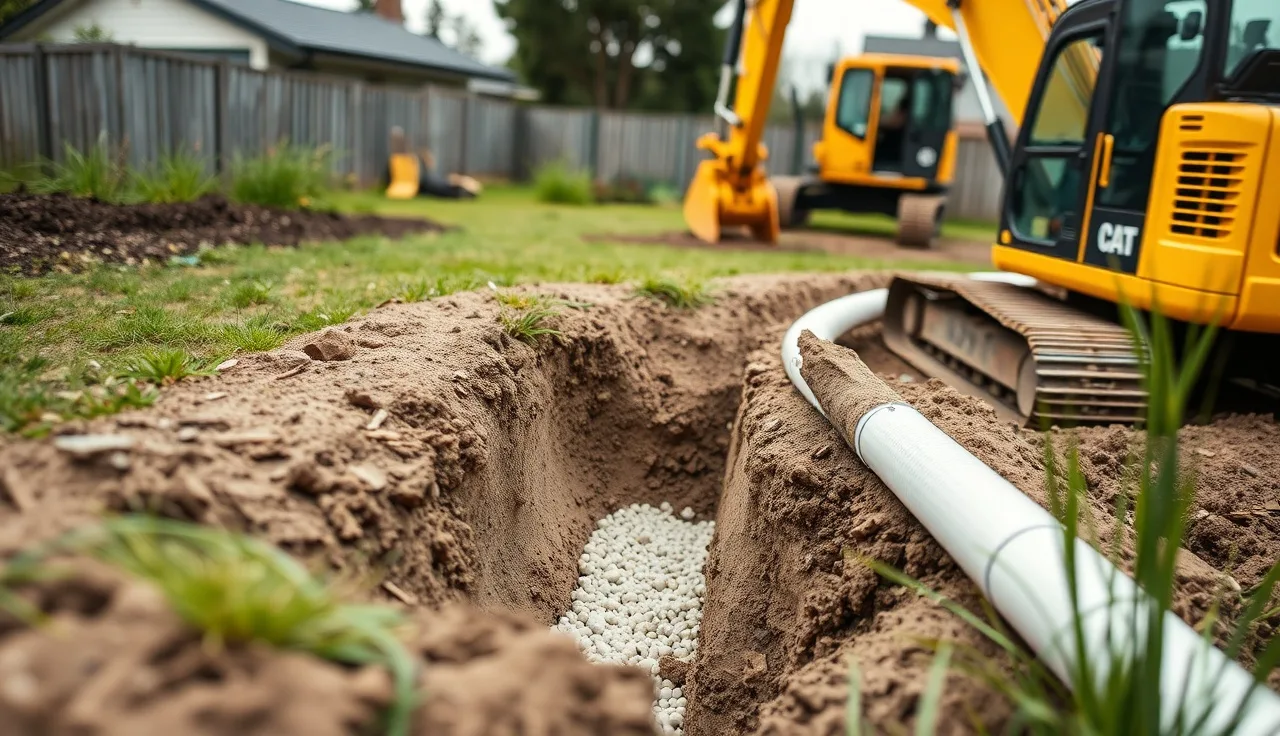
- Excavation. A backhoe or excavator digs to the permitted depth, usually 18 to 36 inches for a conventional system. Trench walls stay as undisturbed as possible. Smeared walls choke infiltration, so good operators work clean and don't over-dig.
- Gravel bed placement. Clean, washed aggregate (typically 3/8- to 1.5-inch crushed stone) goes in first, usually 6 to 12 inches below the pipe. Most state codes require double-washed stone so fines don't clog the soil interface.
- Pipe installation. Perforated PVC pipe (usually 4-inch) lays on the gravel, holes facing down under most current codes (some older codes said holes up, so check your jurisdiction). Pipe slopes 1/8 to 1/4 inch per foot toward the far end to spread flow evenly instead of racing it to the outlet.
- Gravel cover. More washed stone goes over and around the pipe, up to 2 inches above the top of the pipe.
- Filter fabric. Geotextile fabric goes over the gravel to keep fine soil from migrating down and clogging the aggregate. Cut-rate installers skip it. Don't let them.
- Backfill. Native soil goes on top. The finished surface gets crowned slightly to shed rain, since saturated soil above the trenches slows evapotranspiration.
- Inspection and connection. The inspector visits before final burial in most jurisdictions. Once it passes, the installer ties the distribution box (D-box) or manifold to the tank outlet and to each lateral.
Active crew time on a typical residential lot: one to three days, not counting the permit wait.
What does drain field construction cost?
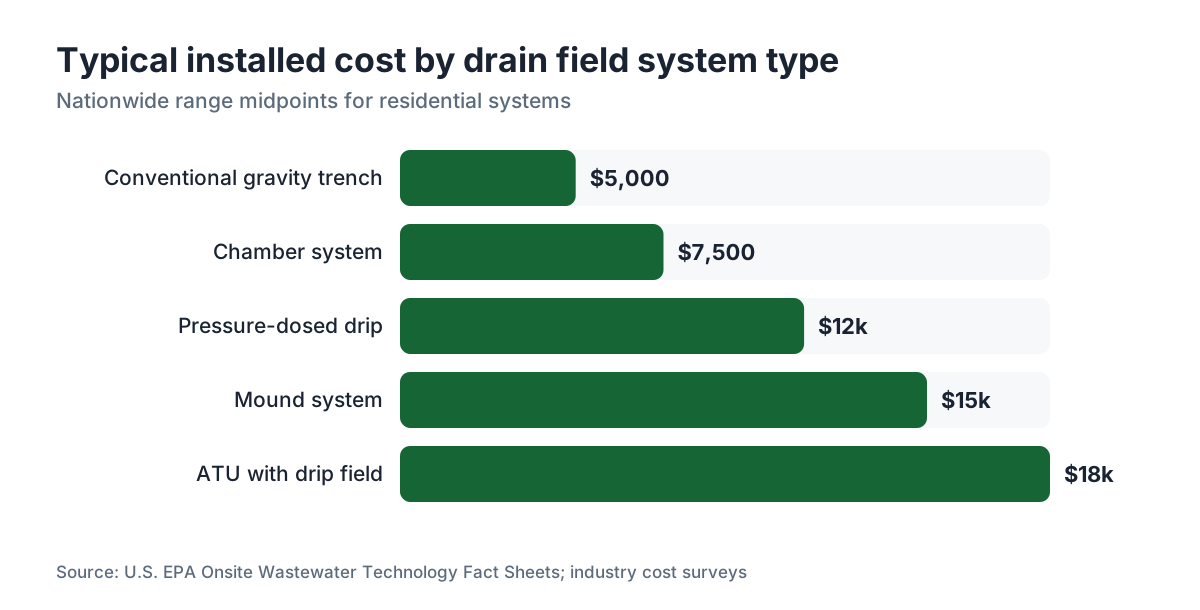
Expect $3,000 to $15,000 for most residential drain fields, with the number driven by region, soil, system size, and the type of system your site requires. Simple gravity trenches sit at the bottom of that range. Mound and aerobic systems run well past it.
Nationwide ranges by system type (EPA Onsite Wastewater Technology Fact Sheets and homeowner-reported costs):
| System type | Typical installed cost |
|---|---|
| Conventional gravity trench | $3,000 to $7,000 |
| Chamber system | $5,000 to $10,000 |
| Mound system | $10,000 to $20,000 |
| Drip irrigation (pressure-dosed) | $8,000 to $15,000 |
| Aerobic treatment unit (ATU) with drip | $12,000 to $25,000 |
What moves the number inside those ranges:
Soil conditions. Deep sandy soil with a good LTAR is cheap to design and quick to install. Clay, a high water table, or shallow bedrock forces a larger or elevated system, and every cubic yard of imported fill adds real money.
Size. A five-bedroom house at 600-plus GPD needs a much bigger absorption area than a two-bedroom cabin. Permit fees, inspection fees, and material all scale with size.
Site access. If the excavator can't reach the field without crossing a driveway or squeezing through a tight gate, expect mobilization surcharges.
Permit and engineering fees. Permits run $200 to $1,500. Stamped engineering runs $500 to $3,000 in states that require it.
For the full picture of a new system start to finish, see cost to install septic system.
What types of drain field systems exist beyond conventional trenches?
When soil or site conditions rule out a gravity trench, regulators walk through a hierarchy of alternatives. Here's what you're likely to meet.
Chamber systems swap gravel and pipe for plastic arch-shaped chambers set right in the trench. Effluent drips off the chamber walls into the soil below. The upside is a smaller footprint, roughly 20 to 40 percent smaller than a gravel system for the same flow, and no heavy aggregate to truck in. Infiltrator and similar brands are accepted in most state codes (Infiltrator Chamber System Design Manual).
Mound systems are for high water tables, shallow soil, or slow perc. The contractor builds a mound of imported fill (usually 2 to 4 feet above grade), puts the absorption bed inside it, and pumps effluent up from a dosing chamber. They cost a lot and you can see them from the yard, but they work on sites that would otherwise be unbuildable.
Pressure-dosed systems use a pump and small-diameter laterals to spread effluent evenly across the whole field at timed intervals, instead of letting gravity dump everything at the near end of the pipe. Dosing rests the field between cycles, which stretches system life on marginal soil.
Drip irrigation systems use emitters buried 6 to 18 inches down. They need advanced pretreatment (usually an ATU) so the emitters don't clog. They fit slopes, odd-shaped lots, and tight sites where normal trench geometry won't work.
Aerobic treatment units (ATUs) force air through the effluent to raise its quality, which shrinks the required absorption area in many states. They cost more upfront and come with a maintenance contract, but they're sometimes the only legal option on a small lot or near a water body.
For how these systems behave once they're running, the leach field guide covers operation and maintenance.
What are the permit and inspection requirements?
Every state in the U.S. requires a permit for new drain field construction. There is no jurisdiction where you can legally install one without prior approval. What changes is the issuing agency (county health department, state environmental agency, or a local building department) and how much detail the submittal needs.
A typical permit package includes:
- Site plan showing lot boundaries, setbacks, well location, house footprint, and the proposed field
- Soil evaluation and perc test results from a licensed evaluator
- System design calculations (stamped by a PE in many states)
- Installer's license number
Inspections usually happen at two points: before backfill, when the inspector checks trench depth, gravel, and pipe placement, and after final grading. Some counties add a third inspection when the tank gets connected.
Skipping the permit carries real cost: fines, mandatory system removal, and lost property insurability in some states. Home sales increasingly hinge on proof of a valid, functioning septic permit, and a system built without one can sink a closing. See septic tank inspection for what inspectors check on a finished system.
Operators juggling permits across multiple job sites can use software like SepticMind to hold permit deadlines, soil report attachments, and inspection sign-offs in one place. That matters when you're running a dozen installs at once.
What setbacks and code requirements apply to drain field placement?
Setbacks protect drinking water, keep effluent from surfacing, and preserve room for a reserve field. Most jurisdictions make you designate a reserve drain field area (often equal to 100 percent of the primary field) that stays undisturbed, so you have somewhere to go if the primary field fails.
Federal law sets no national drain field setbacks. The Safe Drinking Water Act gives EPA authority over public water systems, but onsite wastewater is a state matter (EPA Safe Drinking Water Act overview). Your actual setbacks come from your state's onsite wastewater code, and they vary.
Common patterns across state codes:
- Wells: 50 to 100 feet (some states reach 200 feet for large systems)
- Streams, lakes, wetlands: 25 to 200 feet depending on state and water body classification
- Property lines: 5 to 25 feet
- Basements and crawl spaces: 10 to 25 feet
- Swimming pools: 15 to 25 feet
- Irrigation ditches: 25 to 50 feet
Florida's Rule 64E-6 has detailed, publicly posted setback tables and is a good model. North Carolina's rules under 15A NCAC 18A.1900 are another state code people reference often.
Pull the actual code from your county health department. Don't rely on a neighbor's memory of what someone told them ten years ago. Codes change. What passed in 2005 may be illegal now.
What mistakes during drain field construction cause early failure?
Most premature failures trace back to a short list of construction errors. Some are cheap to dodge. Others don't show up for years.
Compaction is the big one. Driving heavy equipment over a future drain field, or parking on it during construction, crushes the soil structure that makes infiltration work. Compacted native soil can lose 60 to 90 percent of its permeability. Make your contractor route equipment around the field, not across it.
Wrong gravel. Crushed limestone or dirty aggregate carries fines that migrate into the soil and seal the interface. The spec is washed, double-washed crushed stone or approved aggregate. Look at it before it hits the trench.
Over-excavation and smearing. When a bucket drags along the trench bottom, it smears the soil into a low-permeability skin. A good operator lifts clean. If the inspector spots smearing at the pre-backfill visit, they can order the trench bottom scarified with a hand rake before the pipe goes in.
Skipping the D-box or setting it unlevel. The distribution box splits flow between laterals. Set it off-level and it sends 90 percent of the flow to one lateral, which saturates and fails while the others sit dry. A $50 four-foot level prevents the whole problem.
Too little cover. Pipe and gravel need enough soil over them to survive frost in cold climates. Minnesota, for one, requires at least 12 inches of cover over the distribution medium in systems without frost protection (Minn. R. 7080).
Roof drains or sump pumps tied into the septic system. This is illegal almost everywhere and it wrecks fields fast. Clear water hydraulically overloads the field and strips the biological treatment layer. If a prior owner did this, find and disconnect those lines before you build a new field.
How long does a drain field last and what affects its lifespan?
A well-designed, well-installed drain field on suitable soil should run 20 to 30 years, and plenty last longer. The EPA puts a realistic lifespan at 25 to 30 years for systems that get maintained. That number assumes you pump the tank on schedule, keep grease and garbage disposal waste out of the drain, and never park on the field.
What cuts life short:
- A tank that isn't pumped, so solids carry over into the field and build biomat
- High-volume water use that hydraulically overloads the system
- Roots from trees planted too close
- Soil compaction from vehicle traffic
- Non-biodegradable stuff (wipes, sanitary products, latex)
- Heavy detergent, bleach, and antibacterial use that kills the soil bacteria
Biomat is worth understanding. It's the dark, slimy layer that forms at the soil-gravel interface as anaerobic bacteria digest organic matter in the effluent. A thin biomat is normal and actually helps slow effluent movement for better treatment. A thick, sealed-off biomat means overloading, no rest, or a neglected tank, and it's the number one cause of field failure.
Keeping the septic tank pumped on schedule, usually every three to five years for a family of four, is the single most useful thing a homeowner can do to protect the field. See how often to pump septic tank for the full breakdown.
Can you repair or replace a drain field, or is full replacement always required?
Not always. Partial repair is sometimes on the table, though your options ride entirely on what failed and whether the site has soil and space for an alternative.
Resting. If the field failed from biomat buildup after a short-term overload, resting it for six to twelve months while you route flow elsewhere or pump often can let aerobic bacteria eat the biomat back down. This works sometimes. Nobody has clean data on success rates. Extension service publications put partial recovery at maybe 30 to 50 percent of cases where overloading was the actual cause.
Hydrojetting laterals. Pressurized water run through the laterals can break up biomat and fine-particle clogging at the pipe level. It won't save a genuinely saturated or soil-failed system, but it buys time on fields that failed from neglect rather than design limits.
Chamber retrofits. Some installers pull failed gravel-and-pipe out of a trench and drop chambers into the same footprint, cutting the effective area requirement and restoring function. It needs a permit and inspectors don't always accept it.
Full replacement. When the soil is genuinely saturated, the water table has climbed, or the site is simply used past its capacity, you replace. That means finding new ground on the property (the reason for the reserve area), designing a new system, pulling a new permit, and building from scratch. Costs track new construction.
For the repair options in depth, see septic system repair.
What should homeowners do after construction is complete?
The first year after a new drain field goes in is when the most preventable damage happens. The soil is disturbed, grass hasn't reestablished, and new owners sometimes don't even know what's buried out there.
Plant grass over the field right away. Grass roots pull up water and drive evapotranspiration. Bare soil compacts faster under rain. Skip deep-rooted plants, shrubs, and trees. Roots from willows, maples, and their kin can invade and crush laterals within five to ten years.
Mark the field boundaries. Set a few stakes or shoot photos with GPS coordinates so future landscaping, fence posts, or deck footings don't land over the pipes.
Keep vehicles off for good. This rule never relaxes, not even after the soil settles. The gravel bed in a trench compresses under vehicle weight, and one heavy truck crossing can crush a lateral or collapse a trench wall.
Get the as-built drawing and keep it. Your installer and the county health department should both have the final as-built. Get your own copy and file it with the house documents. A buyer's inspector will want it. A repair contractor will need it.
Set a maintenance reminder. Tank pumping on schedule (every three to five years) is the anchor habit. If you use a service company, ask them to note the field's age and condition in writing at each visit. Operators who want to track this across a customer base can log tank and field history in SepticMind's service log, which keeps the paper trail in one place across every job.
For routine care past pumping, the septic tank cleaning and septic tank emptying guides cover what each visit should include.
Frequently asked questions
How deep should drain field trenches be?
Most conventional systems set trench bottoms 18 to 36 inches below the surface. Exact depth depends on your soil's limiting layer (water table, bedrock, or restrictive horizon) and your state's minimum vertical separation requirement. Where water tables run high, shallow systems use mounds or raised beds instead of below-grade trenches.
How long does it take to install a drain field?
Active construction on a standard residential system takes one to three days once permits clear. Permitting and soil evaluation add two to eight weeks in most counties, longer in busy jurisdictions or if your evaluation turns up problems that force a design revision. Don't schedule the crew until the permit is approved.
Can I install a drain field myself?
In most states, no. Installation requires a licensed installer, a permitted design, and inspections. A few states let owner-builders install their own systems, but even those require a permitted design and county inspection. Installing without a permit risks fines, mandatory removal, and an inability to sell the property.
What is the minimum lot size needed for a drain field?
There's no universal minimum. What counts is whether your usable area, after setbacks from wells, property lines, water bodies, and structures, fits the required absorption area plus a reserve area. Many counties want at least one acre for a conventional system. Small or irregular lots may still qualify for alternative systems with smaller footprints.
What kind of soil is best for a drain field?
Sandy loam with a perc rate between 3 and 30 minutes per inch is ideal. It's fast enough to take the daily flow, slow enough to give real treatment, and easy to dig. Pure sand or gravel percs too fast. Heavy clay percs too slowly. Loam in the middle of that range usually produces the cheapest workable design.
How far does a drain field need to be from a well?
The most common minimum is 50 feet, but many states require 100 feet, and some reach 200 feet for large systems or sensitive aquifers. Your specific setback comes from your state or county health code, not a general rule. Always check the actual regulation for your jurisdiction before you finalize a site plan.
What happens if I build on or park on my drain field?
You compact the soil and can crush the pipe, and either one can fail the field within months. Compaction cuts permeability by 60 to 90 percent in some soils. No structures, no parking, no heavy equipment, no above-ground pools. A light lawn mower is fine. Keep the area clear of vehicle traffic permanently.
Does the drain field need to be level?
Not perfectly, but close. Pipe runs at a gentle slope (1/8 to 1/4 inch per foot) to spread flow along the lateral. The distribution box that splits flow between laterals must be level, or flow goes lopsided and overwhelms one lateral while others sit unused. A four-foot level during D-box installation costs almost nothing.
What is a reserve drain field area and do I need one?
A reserve area is undisturbed land set aside for a replacement field if the primary one fails. Most state codes require you to designate a reserve area (typically 50 to 100 percent of the primary field size) on the permit plan and leave it completely undisturbed. No building, no trees, no parking. Home sales have collapsed because a prior owner built a deck over the reserve area.
How do I know if my drain field is failing?
Common signs: wet, spongy, or foul-smelling ground over the field, sewage odors indoors, slow drains across the house, or effluent surfacing. A single slow drain usually means a clog, not field failure. Multiple slow drains plus wet ground over the field is a real red flag. Get a licensed inspector out promptly.
Can tree roots damage a drain field?
Yes, badly. Willows, maples, poplars, and other aggressive-rooted trees can invade perforated pipe and crush laterals within five to ten years if planted close enough. Most codes recommend keeping aggressive-rooted trees at least 30 to 50 feet from the field. Slow-growing ornamentals with compact roots are safer, but still not ideal directly over the field.
What is a distribution box (D-box) and where does it go in the system?
The distribution box is a small concrete or plastic chamber between the septic tank outlet and the drain field laterals. It takes all of the tank's effluent and splits it evenly between the laterals. It sits on level ground between the tank and the field, usually within 10 to 20 feet of the field's entry point. A tilted D-box is a leading cause of uneven loading and early partial-field failure.
How much gravel goes in a drain field trench?
A typical conventional trench gets 6 to 12 inches of washed aggregate below the pipe and 2 inches above it, for a total gravel depth of 8 to 14 inches. The gravel must be clean, washed crushed stone (3/8 to 1.5 inch), free of fines. Your permit spells out the exact dimensions. Geotextile filter fabric goes over the gravel before backfill.
Do I need to connect a pump to my drain field?
Only if gravity flow from tank to field isn't feasible, usually because the field sits uphill from the tank or the design calls for pressure dosing. Conventional gravity systems need no pump. Mound, pressure-dosed, and drip systems all require a pump and dosing chamber, which adds $1,000 to $3,000 to the installed cost and creates a maintenance item that needs attention over time.
Sources
- U.S. EPA, SepticSmart: How Your Septic System Works: The EPA states that soil below the trench bottom provides the final treatment and disposal of septic tank effluent; EPA also estimates a well-maintained drain field lifespan of 25-30 years.
- U.S. EPA, Septic System Owner's Manual (EPA/625/R-00/008): Common setback minimums from wells, property lines, surface water, and structures for drain field placement.
- U.S. EPA, Onsite Wastewater Treatment Systems Technology Fact Sheets: Drain field construction cost ranges by system type, from conventional gravity trenches to aerobic treatment units.
- Infiltrator Water Technologies, Chamber System Design Manual: Chamber systems can reduce required absorption area by 20-40 percent compared to conventional gravel-and-pipe systems.
- U.S. EPA, Safe Drinking Water Act Overview: Federal law delegates onsite wastewater (septic) setback regulation to individual states; no national drain field setback is established under federal law.
- Florida Department of Health, Rule 64E-6 FAC Onsite Sewage Treatment and Disposal Systems: Florida Rule 64E-6 provides detailed setback tables for drain fields from wells, water bodies, and structures.
- Minnesota Pollution Control Agency, Individual Sewage Treatment Systems Standards (Minn. R. 7080): Minnesota requires a minimum of 12 inches of cover over the distribution medium in systems without frost protection.
- U.S. EPA, Decentralized Wastewater Treatment Systems: A Program Strategy: Pressure-dosed systems using timed pump cycles extend field life on marginal soils by resting the absorption area between doses.
Last updated 2026-07-09