Drain field cloth: what it is, why it matters, and when to replace it
By the SepticMind Editorial Team
TL;DR
- Drain field cloth is a nonwoven geotextile fabric wrapped around the gravel and perforated pipe in a leach field.
- It holds native soil back while treated wastewater passes through.
- Clog it or install it wrong and the drain field fails.
- The fabric costs $0.10 to $0.50 per square foot.
- The failure it prevents costs thousands.
What is drain field cloth, exactly?
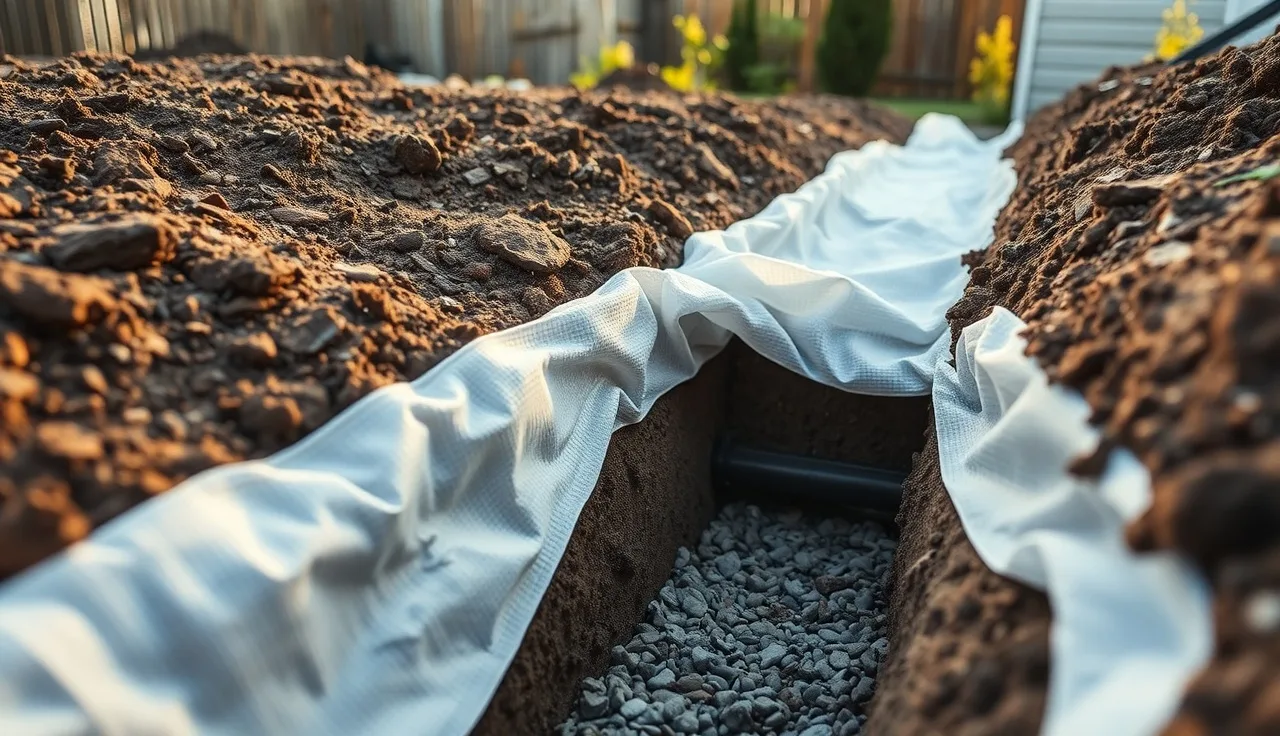
Drain field cloth is a permeable geotextile fabric, almost always nonwoven polypropylene or polyester, placed between the crushed stone in a leach field trench and the native soil around it. Its job is simple. Hold the soil back, let the water through.
The aggregate in a conventional leach field (usually 3/4-inch to 1.5-inch washed crushed stone) gives effluent void space to spread sideways and soak down. Without a barrier, fine soil particles work their way into those voids over time, especially during heavy rain or freeze-thaw cycles. Once the voids pack full, percolation stops. Then you have a failed drain field.
The fabric sits on top of the gravel layer and runs up the trench sidewalls. In gravelless systems, it wraps directly around the plastic chamber or the bundle of corrugated pipe that takes the place of stone. Installers call it filter fabric, drain field filter fabric, geotextile filter cloth, or just septic fabric. Same category of product.
It is not a liner. It does not hold water. If someone sells you a product they describe as making your drain field "waterproof" or "sealed," that is the wrong product and it will kill the system.
What types of drain field fabric are there?
Two broad families exist: nonwoven and woven. For drain fields, nonwoven almost always wins, and most state codes either name it outright or set performance criteria that nonwoven fabrics hit more reliably.
Nonwoven geotextile is bonded or needled synthetic fibers pressed into a felt-like mat. The pore structure is irregular and somewhat self-adjusting. As fine particles try to migrate through, they build a filter cake that gets more selective over time without sealing off completely. Good nonwoven fabric resists clogging better than woven in fine-grained soils.
Woven geotextile looks like mesh. Its pore sizes are uniform and predictable, which sounds like a virtue, but in soils with particle sizes that match those openings, woven fabric clogs faster. It is stronger in tension, which matters for road construction and rarely matters in a static burial job like a leach trench.
Gravelless systems use a third variation: a sock or sleeve that wraps around the corrugated pipe or around individual bundle strands. These are almost always nonwoven, sold pre-attached or in rolls sized to the pipe diameter.
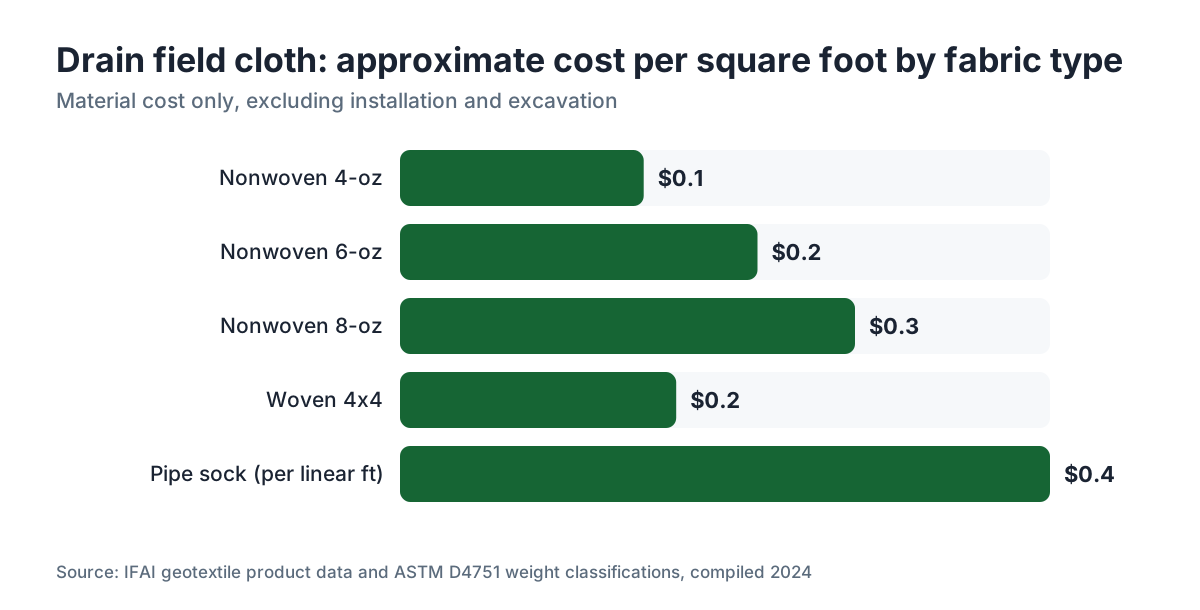
| Fabric type | Typical AOS (mm) | Common use case | Approximate cost per sq ft |
|---|---|---|---|
| Nonwoven, 4-oz | 0.15 to 0.22 | Standard trench, most soils | $0.10, $0.20 |
| Nonwoven, 6-oz | 0.10 to 0.18 | Fine sandy or silty soils | $0.15, $0.28 |
| Nonwoven, 8-oz | 0.07 to 0.15 | Very fine soils, tight specs | $0.20, $0.35 |
| Woven, 4×4 | 0.42 to 0.60 | Coarse gravelly soils | $0.12, $0.22 |
| Pipe sock (per ft) | varies | Gravelless / EZ-Flow | $0.30, $0.50/linear ft |
AOS stands for Apparent Opening Size. The ASTM test for AOS is D4751. Lower AOS numbers mean smaller pores and finer filtration. Matching AOS to your site soil is the technical heart of fabric selection [1].
Most residential installers buy whatever roll the supplier stocks, and for typical loamy or sandy soils that works fine. Trouble shows up in unusual soils: very fine silt, expansive clay, or decomposed granite. There, getting the AOS right earns its keep.
Does every drain field require geotextile fabric?
Most modern codes require it, but the exact rule depends on your state and often your county. The EPA SepticSmart program points homeowners toward state onsite wastewater programs as the authority on construction standards [2]. No single federal rule says "you must use fabric." Federal guidance filters through state design manuals instead.
Older systems installed before the 1990s often have no fabric at all. They relied on careful grading of the stone-to-soil interface and, honestly, on the stone just staying put. Plenty of those systems still work. Fabric became standard practice as gravelless and chamber systems took market share and installers saw how fast soil migration cut system life.
Gravelless chamber systems (Infiltrator, ADS, and others) still need fabric under most state codes, placed at the top of the chamber arch where it meets native backfill. The chambers keep out the gravel but they cannot stop fine particles from raining down out of the backfill above without the fabric [3].
If your state runs a detailed onsite code, look for the section on "aggregate," "trench construction," or "filter media." Most will name a minimum weight (often 4 oz/sq yd nonwoven) and a seam overlap (typically 12 inches). Your state extension service usually posts the readable version online.
How does drain field fabric fail?
Three mechanisms, and they rarely show up alone.
Biological clogging comes first. Biomat, the layer of microbial slime that builds at the soil-effluent interface, also colonizes fabric. A well-designed system leans on some biomat for extra filtration, but an overloaded system pumps out excess biomat that seals the fabric solid. This is the same process that chokes the soil interface, so fabric failure from biomat almost always points to a bigger system problem, not a fabric problem.
Soil migration through tears or gaps comes second. Cut the fabric around a pipe and leave the edges unlapped, and fine soil pours through the gap. Skip the required 12-inch seam overlap, and soil migrates at the seam. Drive equipment over the trench during backfill and tear the fabric, and that tear becomes a migration highway.
Third is installing it upside down. Some fabrics are directional: one side faces the soil, the other faces the aggregate. Flip it and the clogging rate climbs. Not every fabric is directional, but installers should check the manufacturer spec sheet.
A fourth failure mode is not really the fabric's fault: wrong fabric, wrong soil. Put a 4-oz fabric with 0.22 mm AOS into a fine silt where the soil D85 is 0.08 mm, and it clogs fast. The fabric filters too fine and cannot self-clean.
If your leach field shows surfacing effluent, slow drains, or gurgling, the fabric is one possible cause and rarely the only one. A septic system repair assessment should check loading rates, tank condition, and soil percolation before blaming the cloth.
Can you inspect or clean drain field cloth without digging?
Mostly no. The fabric is buried, usually 18 to 36 inches down. You cannot run a camera to it the way you can down a pipe, and you cannot inject a cleaning solution that reaches it evenly.
Some contractors sell "drain field rejuvenation" that pumps high-pressure air or water into the distribution pipes. It might break up biomat at the soil interface for a while and could, in theory, knock some biological clogging off the fabric surface. The honest answer: nobody has clean randomized controlled trial data showing these services restore long-term function. The closest published work is University of Wisconsin extension research on aerobic pretreatment reducing biomat, which found that effluent quality upstream matters more than any downstream fix [4].
If the fabric tore or went in wrong, no cleaning service fixes it. The only real fix is excavation and replacement.
During a routine septic tank pump out, a technician may spot early signs of drain field stress (a sluggish outlet tee, effluent backing into the tank) that hint at fabric or soil trouble downstream. Catch it before the soil matrix itself gives out and you keep more options open.
What does it cost to repair or replace drain field cloth?
The fabric material is cheap. The excavation is what hurts. A 4-oz nonwoven roll, 12.5 feet wide and 300 feet long (3,750 sq ft), runs $75 to $180 at landscape or septic supply houses, which pencils out to $0.02 to $0.05 per square foot in bulk. Even heavy 8-oz product stays under $0.40 per square foot retail.
Opening a drain field trench means a mini-excavator, an operator, disposal of old gravel if it's contaminated, and fresh stone plus fabric. For a single 100-foot trench, expect $3,000 to $8,000 in labor and materials depending on region, soil, and whether the existing pipe gets reused. Full drain field replacement runs wider. The EPA SepticSmart program puts the cost of replacing a failed septic system at $3,000 to $10,000 on average, and in tough soil or tight lots it climbs higher [2].
When you collect quotes for septic system repair, ask flat out whether the price includes new geotextile fabric or just gravel and pipe. Some contractors cut it to shave the bid. Fabric is a $50 material on a $5,000 job, and skipping it buys you a repeat failure in 10 to 15 years instead of 30.
For context, the cost to install a septic system from scratch is $15,000 to $30,000 in many markets now. Protecting that with proper fabric is obvious math.
How do you choose the right geotextile fabric for a drain field?
Start with your state code. It sets a minimum fabric weight (usually 4 oz/sq yd nonwoven) and may set an AOS range. If the code only says "approved filter fabric," you get some latitude.
Then match AOS to soil. Standard ASTM and geotechnical practice says the fabric AOS (O95, meaning 95% of openings are smaller than this value) should be smaller than the D85 of the retained soil (meaning 85% of soil particles are smaller than this size) [1]. Your county health department or installer may have soil gradation data from the perc test or soil evaluation done at permit time.
For most residential loamy or sandy soils, a 4-oz nonwoven with AOS around 0.15 to 0.22 mm is the workhorse. If site soils run notably fine (silty, fine sandy), step up to 6-oz or 8-oz with a lower AOS. If soils are coarse gravel over bedrock, filtration matters less and even a woven option can work.
Buy UV-stabilized fabric even though it goes underground. It sits in sunlight at the job site for hours before burial, and non-stabilized fabric can degrade in that window on a hot day.
For pipe socks on gravelless systems, match the sock diameter to the pipe outside diameter and buy it long enough to overlap at joints. A 6-inch OD corrugated pipe needs a sock with a 6 to 7 inch inner diameter. Don't stretch a 4-inch sock over a 6-inch pipe. That collapses the pore structure.
Operators running multiple job sites can track fabric specs alongside soil evaluations and install photos with field documentation tools like SepticMind, which ties site data to permit records. That kind of record-keeping pays off at re-inspection or resale.
How should drain field cloth be installed correctly?
Installation errors cause more premature fabric failures than anything else. The steps are simple and often rushed.
Trench prep first. The trench bottom and sidewalls should be clean of loose material, especially if the bucket smeared clay soils. Smeared clay drops percolation before the fabric ever goes in. Scarify the walls with a hand rake where the code requires it. Some states mandate this.
Lay fabric across the trench before any stone goes in. Cover the bottom and drape up both sidewalls, leaving enough overlap to fold back over the top of the gravel later. A common mistake is dumping gravel first, then trying to wrap fabric over the top only. That leaves the sidewalls and bottom bare.
Pipe goes in the gravel, not on top of the fabric. Order it this way: fabric against native soil, then gravel, then pipe bedded in gravel, then more gravel, then fabric folded back over the top. The U-shape wraps the entire aggregate zone.
Seam overlaps matter. Where rolls meet end-to-end or side-to-side, overlap at least 12 inches, and many codes call for 18. Don't staple or pin through the fabric with sharp fasteners that could tear it during backfill. Landscape fabric staples are fine if you drive them at an angle away from the fabric edge.
Backfill gently. Place the first 6 inches of soil over the fabric by hand or lower it with the bucket, don't dump it. Rocks or frozen clods dropped from height puncture the fabric or shove it out of place before soil weight anchors it.
Photograph it before backfill. If a warranty dispute or re-inspection ever comes up, you want proof the fabric was there and installed right. This is one of those things a septic tank inspection record can capture at installation if your jurisdiction requires an inspection before cover.
How long does drain field geotextile fabric last?
Installed right and not overloaded with biomat, polypropylene nonwoven geotextile has an estimated service life of 50 years or more in buried anaerobic conditions. The lack of oxygen and sunlight actually protects synthetics from UV and oxidative breakdown.
The Geosynthetic Institute has published guidance suggesting buried polypropylene geotextile keeps about 90% of its tensile strength after 100 years when soil pH stays between 4 and 9 and temperature stays below 25°C [5]. Most residential drain fields sit inside those limits.
The catch is biological clogging. Even a physically intact fabric is functionally dead once biomat seals it. The material might test fine for tensile strength while passing zero effluent. So fabric longevity is really a system longevity question. If the septic system is sized right, loaded properly, and the tank gets pumped on schedule (see how often to pump your septic tank), the fabric should outlive most homeowners.
The weak link is installation quality, not material durability. A torn fabric from a careless installer fails in year 5. A properly installed fabric in a well-maintained system runs 40 years without a second thought.
What happens if a drain field is built without any filter fabric?
In most jurisdictions, a drain field built without required geotextile fabric fails its construction inspection and gets redone. If it slips through and gets buried without inspection, the outcome depends on soil type and time.
In coarse gravel or sandy soils with large, uniform particles, the soil-to-stone interface stays fairly stable and the system may run well for years with no fabric. Old New England systems in glacial gravel soils often have none and still function.
In fine-grained or mixed soils, migration starts almost right away. Particles fill the aggregate voids over 5 to 15 years, percolation slows, and the drain field fails early. You may not notice until drains back up or you catch a sewage smell in the yard.
The EPA notes that a working septic system needs the soil to treat and disperse effluent. When the aggregate zone packs with fines, that dispersal path closes [2]. At that point you're looking at a septic system repair or a full drain field replacement, not a cheap fix.
Buying a home on septic? A quality septic tank inspection that includes drain field dye testing and probe inspection can sometimes catch early aggregate clogging before you close.
Are there alternatives to traditional geotextile filter fabric?
Yes, a few, and they're worth knowing.
Gravelless chamber systems (Infiltrator Wave, ADS Arc, and similar) drop the stone aggregate and the fabric wrapped around stone. The chamber itself makes the structural void space. You still need fabric at the top of the chamber where it meets native backfill, and the chamber companies supply or specify a compatible fabric for that spot [3]. These systems are approved in most states now and common for new installs because they cost less in material (no stone hauling) and go in faster.
Biodegradable coir fiber logs and bundles, made from coconut fiber, sometimes serve as a stone substitute on shallow or sensitive sites. They break down over time, which is a strike against them for a permanent system, and their filtration varies. More a niche product than a mainstream option.
Some states allow foam aggregate (expanded polystyrene beads or mats) in place of stone. These still need a filter fabric layer at the soil interface and follow the same fabric selection logic.
For straightforward new construction, properly installed nonwoven geotextile with conventional stone is still the baseline that regulators, installers, and warranty providers understand best. Alternatives make sense on constrained sites or when a contractor has deep experience with a specific system type. If you're weighing a full septic tank installation, get at least two quotes that name the system type and fabric spec explicitly so you're comparing the same thing.
If you're a service operator tracking installs across system types, a documentation layer that captures which system and fabric spec went in at each site saves headaches at re-inspection. SepticMind is built for that field-to-office data flow.
What do state codes and the EPA actually say about drain field fabric?
The EPA's SepticSmart program is homeowner-facing guidance, not a technical standard. It leans on system maintenance, proper loading, and professional inspection, and it defers to state codes for construction specifics [2]. There is no single federal construction standard for residential septic systems.
State onsite wastewater codes are the documents that run the show. Most follow one of two model frameworks: the National Environmental Services Center (NESC) small flows guidance or the state health department's own technical manual [8]. Common provisions across many state codes:
- Minimum fabric weight: 4 oz/sq yd nonwoven, or equivalent AOS performance
- Seam overlap: 12 to 18 inches
- Placement: fabric must wrap the entire aggregate zone (bottom and sides), more than cap the top
- Pipe socks on gravelless systems: specified by the system manufacturer and approved by the state
North Carolina's onsite wastewater rules (15A NCAC 18E) spell out geotextile fabric placement in detail for both conventional and chamber systems [6]. Minnesota's Private Sewage Treatment program likewise specifies fabric type and installation in its design standards [7]. Your state's department of environmental health or department of environmental quality is the right place to start.
Contractors, note this: the manufacturer's installation guide for the specific pipe or chamber system you're using also specifies fabric requirements, and those specs often run stricter than state minimums because they're tied to the product warranty.
Frequently asked questions
What is the difference between drain field cloth and a pond liner?
They are opposite products. Drain field cloth (geotextile) is permeable: it lets water pass while filtering out soil particles. A pond liner is impermeable, built to hold water in. Put a pond liner in a drain field and you stop all percolation and kill the system immediately. Never substitute one for the other.
Can I use landscape fabric instead of proper geotextile in a drain field?
Generally no. Consumer landscape fabric from the hardware store is made for weed suppression, not drainage filtration. It often has a much lower flow rate, clogs faster with fine particles, and may not meet the AOS or weight specs in your state's onsite code. Buy fabric rated for drainage or septic use with a published AOS and flow rate.
How much fabric does a typical drain field need?
A conventional 100-foot trench that is 3 feet wide and 3 feet deep needs fabric along the bottom (300 sq ft), up both sidewalls (600 sq ft), and across the top (300 sq ft), roughly 1,200 square feet total. A full three-trench system might use 3,000 to 4,000 square feet. At $0.10 to $0.20 per square foot, fabric is a small slice of total install cost.
Does drain field cloth need to be replaced when I pump my septic tank?
No. Pumping removes solids from the tank and has no direct connection to the geotextile buried in the drain field. The fabric only needs replacement if the drain field itself is dug up for repair or replacement. Regular pumping every 3 to 5 years actually protects the fabric by cutting the biological load that can clog it over time.
What are the signs that my drain field fabric has failed?
You won't see the fabric directly, but symptoms of aggregate clogging (which fabric failure speeds up) include slow drains throughout the house, sewage odors in the yard, wet or spongy ground over the drain field, and effluent surfacing. These overlap with other failures, so a professional inspection is needed to pin down the specific cause.
Can biomat on drain field fabric be cleaned or treated?
Products marketed for biomat treatment exist, but evidence for long-term restoration is thin. University of Wisconsin extension research found that improving upstream effluent quality through aerobic pretreatment beats downstream biomat treatments. Hydrogen peroxide injection has been used; results vary and the wrong concentration can damage soil structure. Fix root causes (tank pumping, loading rates) before spending on treatments.
Do chamber systems like Infiltrator still need geotextile fabric?
Yes, in most states. Infiltrator and similar chamber systems drop the stone aggregate and the fabric around the chamber sides, but fabric is still specified at the top of the chamber arch where native backfill meets the chamber opening. The manufacturer's installation guide and your state code set the fabric weight and placement for their approved product.
Is drain field cloth required by the EPA?
The EPA does not set specific construction standards for residential septic systems. It offers guidance through programs like SepticSmart and defers to state onsite wastewater codes. Those state codes typically require geotextile fabric in drain field construction. Check your state's department of environmental health or department of environmental quality for your jurisdiction's rules.
How deep should drain field fabric be buried?
The fabric sits inside the drain field trench, typically 18 to 36 inches below grade depending on local code and soil. The fabric wraps the gravel zone, so its depth follows the trench design. Above the fabric, native soil backfill goes in, and finished grade should slope away from the system to move surface water off the field.
What AOS rating should I specify for sandy soil?
For fine to medium sand with a D85 around 0.25 to 0.5 mm, a nonwoven geotextile with AOS (O95) of 0.15 to 0.30 mm is usually appropriate, following the ASTM D4751 rule that fabric AOS should be less than soil D85. A 4-oz or 6-oz nonwoven product usually lands in this range. Verify with site soil gradation data if you have it.
Can drain field cloth be reused if a drain field is renovated?
No. Once dug out, used fabric is typically torn, packed with biomat, and physically compromised. New fabric costs little next to the labor, so there's no practical reason to reuse it. Always specify new geotextile when a trench is opened for any reason.
Does the direction (which side faces up) matter for geotextile installation?
Some nonwoven fabrics are directional, with one side meant to face the retained soil. Check the manufacturer's data sheet; it will say if the product is directional. Reversed installation raises the clogging rate in some products. If the fabric has no directional marking and the data sheet doesn't specify, either side is fine.
What is a pipe sock and how does it differ from trench fabric?
A pipe sock is a tubular geotextile sleeve pulled over corrugated or perforated drain pipe, used in gravelless systems in place of loose stone and trench fabric. It filters at the pipe surface. Trench fabric is a flat sheet lining the whole trench perimeter. Both are nonwoven geotextile in most applications; the form factor changes with the system design.
If my drain field was installed in the 1980s without fabric, should I add it?
If the system works fine, digging up the drain field just to add fabric is not worth it. The excavation risk outweighs the benefit. If the system is failing and you're already excavating for repair, absolutely include proper geotextile in the rebuilt trench. A well-maintained tank (regular pumping) is the best protection for an older system without fabric.
Sources
- ASTM International, D4751 Standard Test Method for Determining Apparent Opening Size of a Geotextile: ASTM D4751 defines Apparent Opening Size (AOS) as the standard measure for geotextile filtration suitability; fabric AOS should be matched to retained soil D85 particle size.
- U.S. EPA, SepticSmart Program: EPA SepticSmart states that replacing a failed septic system costs $3,000, $10,000 on average and that proper soil dispersal is essential to system function; EPA defers to state codes for construction specifics.
- Infiltrator Water Technologies, Installation Instructions for Quick4 Chamber Systems: Chamber system manufacturers specify geotextile fabric placement at the top of the chamber arch where native backfill contacts the chamber, even though stone aggregate and sidewall fabric are eliminated.
- University of Wisconsin-Madison, Division of Extension, Onsite Wastewater Treatment Program: UW Extension research on aerobic pretreatment found that improving effluent quality upstream reduces biomat formation and is more effective than downstream biomat treatments for restoring drain field function.
- Geosynthetic Institute, GRI Test Methods and Practice Standards: Geosynthetic Institute guidance indicates buried polypropylene geotextile retains approximately 90% of tensile strength after 100 years in soil with pH 4 to 9 and temperatures below 25°C.
- North Carolina Department of Health and Human Services, 15A NCAC 18E Onsite Wastewater Rules: North Carolina's 15A NCAC 18E specifies geotextile fabric placement, weight, and seam overlap requirements for both conventional trench and chamber septic system drain fields.
- Minnesota Pollution Control Agency, Private Sewage Treatment Program Design Standards: Minnesota's Private Sewage Treatment program specifies fabric type, weight, and installation details for drain field construction in its onsite wastewater design standards.
- National Environmental Services Center (NESC), West Virginia University, Technical Resources on Onsite Systems: NESC guidance documents provide model onsite wastewater code frameworks that most state onsite codes have adopted, including geotextile fabric specifications for drain field construction.
- U.S. EPA, Onsite Wastewater Treatment Systems Manual (EPA/625/R-00/008): EPA Onsite Wastewater Treatment Systems Manual describes the role of filter media and soil interfaces in effluent treatment and dispersal in conventional and alternative drain field designs.
- Industrial Fabrics Association International (IFAI), Geotextile Filter Design Guidance: IFAI publications document nonwoven geotextile AOS ranges by fabric weight (4-oz, 6-oz, 8-oz) and describe filtration criterion matching procedures for civil and wastewater burial applications.
Last updated 2026-07-09