Tiny house septic system: what you actually need and what it costs
By the SepticMind Editorial Team
TL;DR
- A tiny house needs a real septic system unless you have municipal sewer access or qualify for a composting-toilet exemption.
- Costs run $3,000 to $15,000 for a conventional or alternative system.
- Minimum tank size is typically 500 to 1,000 gallons depending on state code.
- Lot constraints and soil type dictate which system works, not the size of the house.
Does a tiny house actually need a septic system?
Yes. In almost every jurisdiction, a dwelling that makes wastewater needs an approved way to treat it. A small house doesn't get a pass on that rule. What the health department cares about is whether the structure has a toilet, sink, or shower, and nearly every tiny house does.
There are two narrow exceptions worth knowing. First, a few counties allow a composting toilet paired with a simple greywater system (a small leach pit or surface disposal area) for properties that meet specific criteria, usually remote lots above a certain acreage with no potable well nearby. Second, if the tiny house is on wheels and parked at a licensed RV park with hookups, the park's system handles your waste. Neither scenario fits most tiny house owners who want to buy land and live there full time.
The EPA SepticSmart program puts it plainly: "Properly designed, installed, and maintained septic systems are cost-effective and long-lasting systems for wastewater treatment," and that applies to any dwelling generating sewage, no matter the square footage [1]. State onsite wastewater codes follow or exceed EPA guidance, and none of them carve out an exemption based on size. You're building a house. You need a wastewater system.
How is a tiny house septic system sized differently from a standard one?
Codes size septic systems on estimated daily flow, and they tie that flow to bedroom count, not square footage. A studio tiny house with no distinct bedroom might count as one bedroom. A single loft counts as one. Two sleeping lofts usually count as two bedrooms. The house being 300 square feet doesn't change the math the way people expect.
The standard engineering assumption is 110 gallons per day per bedroom, though this varies by state. A one-bedroom tiny house generates roughly 110 gpd; a two-bedroom, about 220 gpd. Minimum tank sizes in most states land at 1,000 gallons for any residential installation. Several states, including Texas under 30 TAC Chapter 285, allow a 500-gallon tank for a single-occupancy unit with documented low flow [2]. Check your specific state's onsite wastewater code before you assume the smaller tank is allowed.
The drain field (leach field) scales to daily flow too. Soil with average percolation might need 150 to 250 square feet of trench area per bedroom. For a one-bedroom tiny house, that's still a real chunk of land. If your lot is under a quarter acre, or if setback requirements from property lines, wells, and structures eat into your usable area, the drain field math becomes the binding constraint long before tank size matters.
One thing trips up tiny house buyers over and over. Some counties enforce a minimum system size regardless of bedroom count, because the health department views it as the smallest tank a licensed pumper truck can service safely. You may be required to install a 1,000-gallon tank even when the calculations would allow 500 gallons. Ask the county sanitarian before you buy the land, not after.
What are the septic system options for a tiny house?
The options break down the same way they do for any home. The difference is that tiny house lots are often more constrained, which pushes alternative systems into play more often.
Conventional gravity system. A septic tank sized to code feeds a gravity-fed drain field of perforated pipe in gravel trenches. This is the cheapest option when the site allows it. You need adequate lot size, workable setbacks, and a soil perc test that passes. Installed cost for a small conventional system suited to a tiny house typically runs $3,000 to $8,000 depending on region and site prep [3].
Mound system. If the water table is high or the soil percs too slowly, a mound system brings in engineered fill above grade and places the drain field inside it. Tiny houses on marshy or clay-heavy lots end up here. Full-size mounds run $10,000 to $20,000, but a tiny house with low daily flow can use a smaller mound, so installed cost often lands at $6,000 to $12,000 [3].
Aerobic treatment unit (ATU). An ATU adds an aeration chamber that partially treats effluent before it leaves the tank. Cleaner output means a smaller drain field, which matters on tight lots. ATUs cost more upfront (typically $5,000 to $15,000 for equipment alone) and require a service contract in most states. On a small lot, that tradeoff sometimes earns its keep.
Drip irrigation system. Treated effluent goes out through subsurface drip emitters. These work on lots with little drain field area and can wrap around landscaping. They need a pump and controls, so they aren't cheap, but they're often the only option on steep or rocky terrain.
Composting toilet plus greywater system. This pairing handles waste without a traditional septic tank. The composting toilet manages solids; a separately permitted greywater system handles sink and shower water. It isn't universally allowed for permanent dwellings. Where it is, it's the lowest-cost path, sometimes under $3,000 for equipment, but the permitting friction is real [4].
See septic tank installation and cost to install septic system for more on how these systems get priced and put in the ground.
What does a tiny house septic system cost?
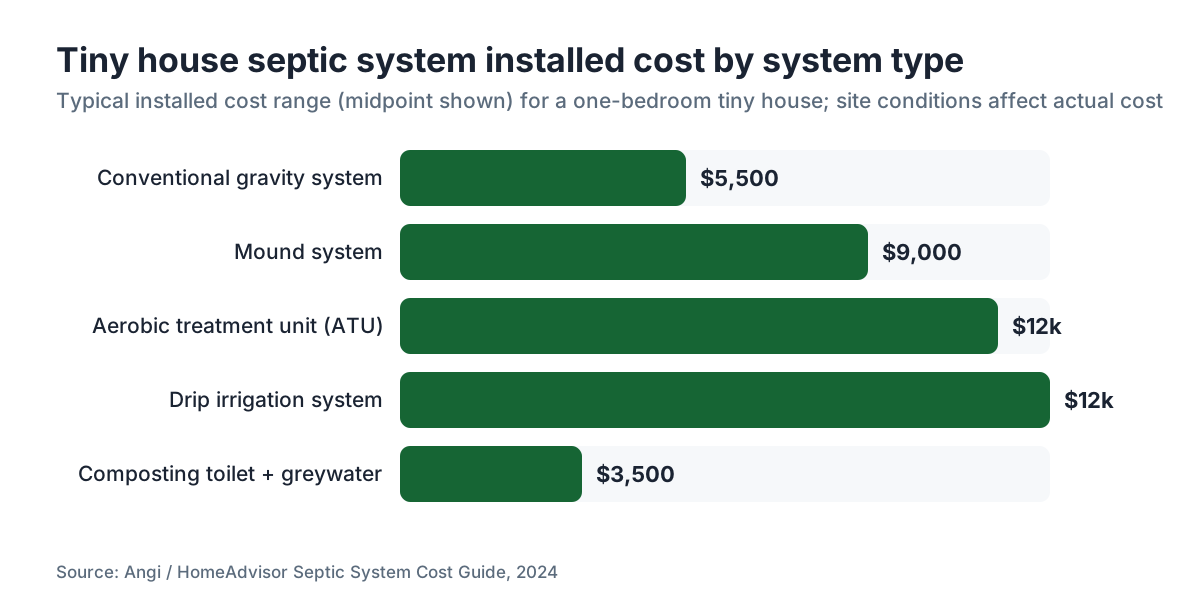
A tiny house septic system runs from about $3,000 on the low end (a small conventional system on a cooperative site) to $15,000 or more for an ATU or mound system on a difficult lot. The national average for a conventional residential system, regardless of house size, runs $5,000 to $12,000 according to contractor data compiled by Angi [3].
The biggest cost drivers are:
- Site prep and excavation. Rocky ground, high water tables, and remote locations add $1,000 to $5,000 before any system equipment goes in.
- Tank material and size. A 500-gallon concrete tank runs $500 to $900 for the tank itself. A 1,000-gallon polyethylene tank is $700 to $1,200. Concrete is heavier but often required by code.
- Drain field. Per linear foot of trench, expect $15 to $30 installed. A modest 150-foot drain field is $2,250 to $4,500 in labor and materials alone.
- Permits. Permit fees range from under $100 in some rural counties to over $1,000 in regulated states like California or Washington. The perc test itself costs $150 to $500.
- Access risers. A lid riser to grade is a smart add-on at $200 to $400. It makes future septic tank pump out a lift-the-lid job instead of a dig-up-the-yard job every few years.
Going with an ATU or drip system for a constrained lot? Budget $10,000 to $15,000 as a realistic midpoint and get three local bids. Costs swing more by county and contractor availability than by any national benchmark.
For more on budgeting the whole install, see cost to put in a septic tank.
| System type | Typical installed cost (tiny house) | Notes |
|---|---|---|
| Conventional gravity | $3,000 to $8,000 | Good soil, adequate lot |
| Mound system | $6,000 to $12,000 | High water table or slow perc |
| Aerobic treatment unit | $8,000 to $15,000 | Small lot, service contract required |
| Drip irrigation | $9,000 to $16,000 | Steep or rocky sites |
| Composting + greywater | $2,000 to $5,000 | Where permitted; not universally legal |
What permits do you need for a tiny house septic system?
Septic permits come from the county health department or the state's onsite wastewater division, not the building department, though both may be involved for a full dwelling permit. The typical sequence looks like this:
- Site evaluation and perc test. A licensed soil evaluator or engineer tests the percolation rate and notes the limiting layer depth (the point where soil stops absorbing water). This result drives the whole design. You can't skip it. It's required before any permit gets issued [5].
- System design. In most states, a licensed engineer or certified designer produces a site plan showing the tank location, setbacks, drain field layout, and elevation details. Some rural counties allow simpler self-submitted designs for small systems, but tiny house projects often draw extra scrutiny because the category is new enough that some inspectors apply conservative readings of the code.
- Permit application. Submit the design with the fee. Approval timelines run from two weeks to four months depending on county workload.
- Installation inspection. The county inspector signs off before backfill. Don't let a contractor rush this. Bury the system without inspection and you may have to dig it back up.
- Final permit issued. This becomes part of the property record and is required for a certificate of occupancy in most places.
Tiny houses on wheels (THOWs) classified as RVs rather than dwellings sit in a gray zone. If your local building department treats the THOW as a recreational vehicle, it may not require a permanent septic permit, but it also may not allow a permanent hookup to a septic system without reclassification. Sort out the classification first. The permit path follows from that decision.
What soil conditions determine which system you can use?
The perc test measures how fast water drains through your soil, reported in minutes per inch (mpi). Most state codes accept 1 to 60 mpi for a conventional system. Slower than 60 mpi usually means you need an alternative like a mound or ATU [5]. This single number does more to set your system type and cost than any other factor on the site.
Depth to the seasonal high water table matters just as much. Many state codes require at least 24 to 36 inches between the bottom of the drain field and the high water mark. Without that clearance, effluent can surface, which is both a health hazard and a code violation.
Soil texture is the third factor. Sandy soils drain fast, sometimes too fast, which can mean effluent reaches groundwater before it's fully treated. Clay soils drain slowly. Loamy or sandy loam soils are the sweet spot. The soil evaluation gives you a textural class and a limiting layer depth, and the designer uses both.
Here's the honest situation for a tiny house. The house makes less daily flow, but the minimum setbacks and treatment distances don't shrink to match. You still need 50 to 100 feet from a well to the drain field in most states. You still need 5 to 10 feet from a property line. A small house doesn't shrink those buffers. That's why tiny house lots under half an acre can be genuinely hard to work with, especially on the coasts where lots are small and expensive.
Buying land specifically for a tiny house? Pay for a perc test before you close. A failed perc on a remote lot can add $5,000 to $10,000 to your system cost, or make the lot undevelopable for a dwelling at all.
Can a tiny house use a shared or community septic system?
Yes, and for tiny house communities or villages it's often the most practical route. A shared system serves several dwellings and spreads the cost across everyone using it. State rules on shared systems vary a lot.
Some states classify a shared system serving more than two dwellings as a "small community system" with stricter engineering, inspection, and reporting requirements than a single-home system. Others treat it as a standard residential system as long as total daily flow stays under a threshold, often 1,000 to 2,000 gpd. A tiny house village of 10 units at 110 gpd each generates 1,100 gpd, which puts it right at that line in many codes [6].
Ownership and maintenance responsibility is the part that actually causes problems. You need a recorded easement on the property, a written maintenance agreement, and a clear cost-sharing plan for pumping and repairs. Without that paperwork, one owner's refusal to chip in can leave everyone's system unserviced.
Septic operators serving tiny house communities have started offering maintenance contracts that cover multiple small units under one service agreement. If you manage a community like this, tools that track service history and permit schedules across properties save real time. SepticMind is one platform operators use for that kind of multi-site tracking, though any organized maintenance log beats none.
For shared-system pump-out logistics, see septic tank pumping.
How often does a tiny house septic tank need to be pumped?
EPA's SepticSmart program recommends pumping a typical household tank every three to five years, with frequency tied to tank size and number of occupants [1]. A tiny house with two occupants and a 1,000-gallon tank probably lands at the four- to five-year end of that range. A 500-gallon tank with two occupants might need pumping every two to three years.
The math is not mysterious. Sludge and scum build up at a fairly predictable rate. Most engineering estimates put sludge accumulation at roughly 50 to 70 gallons per person per year. For a 1,000-gallon tank, two occupants add 100 to 140 gallons annually, hitting the pump-it threshold (usually when sludge and scum together fill 30% to 50% of tank capacity) in four to seven years [7].
Tiny house occupants tend to be more water-conscious, which slows accumulation a little. Don't let the small tank fool you into stretching to 10 years, though. Small tanks are less forgiving when they fill, because there's less buffer before solids start reaching the drain field.
Install a riser to grade at the tank lid so the pumper truck can reach it without digging. That $200 to $400 upgrade takes all the friction out of the service visit and makes it far more likely you'll stay on schedule. See how often to pump septic tank for the full maintenance timeline.
For the service itself, septic tank cleaning and septic tank emptying cover what to expect during a pump-out.
What can go wrong with a tiny house septic system, and how do you fix it?
Tiny systems fail the same ways big ones do, just faster sometimes, because there's less margin for error.
Drain field saturation. The most common failure. Solids escaped from an overfull tank, or the soil biomat built up until absorption stalled. Symptoms are slow drains, wet spots over the drain field, and sewage odors outside. Sometimes you can rest the field (divert to an alternate field if one exists) and it recovers. Often you're replacing the field, which runs $3,000 to $8,000 even for a small system. See leach field for how these failures work and what repair looks like.
Root intrusion. Trees planted too close to the tank or drain field send roots into pipe joints. Roots crack pipes, block flow, and can wreck a drain field trench over a few years. Keep trees at least 30 feet from the drain field; willows and poplars need 50 feet or more.
Tank structural failure. Concrete tanks crack from soil settling or freeze-thaw cycles. Poly tanks shift if the backfill wasn't done right. A cracked tank leaks untreated sewage into groundwater and is a health code violation. Septic tank repair or full septic system repair may be needed depending on how bad it is.
Pump failure (in pressurized systems). If your tiny house is on a mound or drip system with a pump, the pump can fail. Budget $300 to $800 for a replacement effluent pump. An alarm should warn you before the system backs up. No alarm float? Add one.
The single best thing you can do to avoid failures is pump on schedule and get a septic tank inspection every three to five years when you pump. A good inspector spots a failing baffle or a drain field showing early stress before it turns into an emergency.
Are there special considerations for off-grid tiny houses?
Off-grid tiny houses add wrinkles. Systems that need grid power need an alternative source, and remote sites can mean longer pump-truck travel and higher service costs.
On a gravity-fed conventional system, off-grid power isn't a septic concern at all. Gravity doesn't need electricity. Trouble starts when the site requires a pump. ATUs, mound systems, and drip systems all need reliable power. A 12V or 24V battery system with a small solar array can run most effluent pumps, which typically draw 300 to 600 watts only while cycling, not continuously. Check the pump manufacturer's spec sheet for the duty cycle so you size the battery bank right.
Water conservation matters more off-grid, because your supply (well, rainwater, or hauled water) is finite and you're probably living closer to the system. High-efficiency toilets (1.28 gallons per flush or less), low-flow showerheads, and greywater reuse for irrigation where it's legal all cut the hydraulic load and stretch drain field life.
Some states offer expedited or reduced-fee permitting for alternative systems on remote off-grid parcels. Montana, New Mexico, and Oregon have all modified their codes to create pathways for composting toilet plus greywater systems on remote dwellings [4][8]. These rules change often, so check with your state's department of environmental quality or its equivalent directly, not through a county page that may be stale.
For operators serving remote tiny house properties, planning service visits across long routes is where SepticMind's routing and scheduling features earn their spot, though any solid routing tool beats a paper schedule when properties sit 40 miles apart.
How do you find and hire the right contractor for a tiny house septic install?
Start with your state's licensing database. Septic installers must be licensed in every state, though the license name varies (some call them "onsite wastewater system contractors," others "septic installer" or "site contractor"). Your state's environmental quality or health department website has a lookup tool. Don't hire anyone unlicensed, no matter the price, because an unlicensed install won't pass inspection and can expose you to real liability when you sell.
Get at least three bids, and make sure every bid quotes the same system design. If one contractor bids a 500-gallon poly tank and another bids a 1,000-gallon concrete tank, the price gap isn't just labor. It's two different systems. Ask each contractor to quote identical specs, then compare labor and markup separately.
Ask one question directly: "Have you installed systems for tiny houses or small dwellings on lots under half an acre?" A contractor who has dealt with tight setbacks and cramped drain fields knows the permit friction and the workarounds. One who hasn't may underbid the job and hit surprises mid-install.
Ask for references from finished jobs, then actually call them. Ask how the contractor handled inspections and whether anything went sideways after backfill. One 10-minute call can save you a five-figure problem.
On timeline: from perc test to final permit, plan for two to six months in most places. In states with a health-department backlog (California and New York show up a lot here), plan for six to twelve months. Don't build the tiny house before the septic permit is approved unless you're certain a sewer connection is waiting.
Frequently asked questions
What is the minimum septic tank size for a tiny house?
Most states require a minimum 1,000-gallon tank for any residential installation regardless of house size. A handful of states, including Texas under 30 TAC Chapter 285, allow a 500-gallon tank for single-occupancy or very low-flow dwellings. Always verify with your county health department before buying a tank; some counties enforce minimums above the state baseline.
Can I use a composting toilet to avoid a septic system in my tiny house?
In some jurisdictions, yes. A composting toilet handles solid waste and can pair with a permitted greywater system for sink and shower water. But permanent dwellings in most states still require a permitted wastewater disposal system even with a composting toilet. Montana, Oregon, and New Mexico have some of the more permissive rules. Check your state's environmental quality department for current regulations before assuming this path is open.
How much does a tiny house septic system cost?
Expect $3,000 to $8,000 for a conventional gravity system on a cooperative site, $6,000 to $12,000 for a mound system, and $8,000 to $15,000 for an aerobic treatment unit or drip system. Permit fees, perc testing, and site prep add $500 to $2,000 more. The biggest variable is site conditions: rocky ground, high water tables, and remote locations push costs toward the top of each range.
Do tiny houses on wheels need a septic system?
THOWs (tiny houses on wheels) classified as RVs do not need a permanent septic system but must connect to an approved hookup when parked long-term. If the THOW is reclassified as a permanent dwelling by the local jurisdiction, it must meet the same wastewater requirements as any other house. RV parks handle waste through their own licensed systems. Check your county's classification rules before assuming THOW status exempts you.
Can I install a septic system myself on a tiny house property?
A few states allow owner-installed septic systems on the owner's primary residence with a permit. Most require a licensed contractor. Even where owner installation is legal, the permit process, inspection schedule, and soil work make it harder than it sounds. A botched install that fails inspection means excavating and redoing the work, which costs more than hiring a pro from the start.
How do I know if my land can support a septic system for a tiny house?
A perc test and soil evaluation are the only reliable way to find out. The test measures how fast water drains through your soil; most states require 1 to 60 minutes per inch for a conventional system. Soils outside that range need an alternative system. The evaluation also measures depth to seasonal high water table, which must meet minimum clearance. Budget $150 to $500 for the test, and do it before you buy the land.
What setback distances apply to a tiny house septic system?
Setbacks vary by state but typical minimums are: 50 to 100 feet from a potable well, 5 to 10 feet from a property line, 10 to 25 feet from a structure, and 50 to 100 feet from surface water. These distances don't shrink because the house is small. On lots under half an acre, setbacks are often the binding constraint that decides which system type works or whether the lot can support a dwelling at all.
How long does a tiny house septic system last?
A properly installed and maintained conventional system lasts 20 to 40 years. A concrete tank can last 40 to 50 years. The drain field is usually the limiting component; it lasts 20 to 30 years with regular pumping. Systems that are never pumped, or that get non-biodegradable solids, fail much sooner, sometimes under 10 years. Pumping on schedule is the single most effective way to extend system life.
Can a tiny house connect to an existing septic system on a property?
Sometimes. If the existing system has enough permitted capacity for the added daily flow, many counties will allow a connection. You need to verify the system's permitted capacity, confirm the tank and drain field are in good shape, and get health department approval. Adding a dwelling to an undersized or aging system without approval is a code violation and can push the original system into failure.
What water usage habits help a tiny house septic system last longer?
Space out laundry loads over the week instead of doing them all in one day; a single day of heavy water use can hydraulically overload a small drain field. Use high-efficiency toilets (1.28 gpf or less) and low-flow fixtures. Never put grease, medications, or "flushable" wipes into the system. Fix leaking toilets fast; a running toilet can add 200 gallons per day to a system sized for 110 gpd, a serious overload.
How does a tiny house septic system work in cold climates?
Standard concrete or poly tanks installed below the frost line work fine in cold climates. The concern is pipes freezing between the house and tank if they aren't buried deep enough, or if very low water use lets the pipe sit still and cold. Insulating the pipe run and keeping some daily flow helps. Mound systems in cold climates need foam insulation over the mound; most northern-state designs specify this automatically.
What is a greywater system and can it replace septic for a tiny house?
Greywater is wastewater from sinks, showers, and laundry, but not toilets. A greywater system treats and disperses this lower-risk water separately, cutting load on the main septic system or, where composting toilets handle solids, replacing it entirely. Arizona, California, and New Mexico have formal greywater codes. Most other states require a permit and set volume limits. Never assume greywater disposal is unregulated; unpermitted surface discharge is a violation in most states.
Do tiny house communities use shared septic systems?
Many do. A shared system serving a cluster of tiny houses spreads installation and maintenance costs across multiple units. States classify these differently: some treat them as residential, others as small community systems with stricter requirements. A village of 10 tiny houses at 110 gpd each generates 1,100 gpd, which can trigger small community system rules in some states. A recorded maintenance agreement and clear cost-sharing plan among owners is essential for these systems to work long-term.
What inspections are required for a tiny house septic system?
At minimum, the county health department requires a mid-installation inspection before backfill and a final inspection to issue the permit. Some states require a licensed inspector to check the system every one to three years after installation (Florida and Virginia run mandatory periodic inspection programs). For buyers, a pre-purchase septic inspection is worth the $200 to $500 cost. See our guide to septic tank inspection for what that inspection covers and the red flags to watch for.
Sources
- EPA SepticSmart Program: EPA guidance that properly designed, installed, and maintained septic systems apply to any dwelling generating sewage, and the recommended pump-out frequency of every three to five years.
- Texas Commission on Environmental Quality, On-Site Sewage Facilities (30 TAC Chapter 285): Texas allows a 500-gallon tank for single-occupancy units with documented low daily flow under 30 TAC Chapter 285.
- Angi (formerly HomeAdvisor) Septic System Installation Cost Guide: National average installed cost for a conventional residential septic system runs $5,000 to $12,000; mound systems $10,000 to $20,000.
- Oregon Department of Environmental Quality, Onsite Wastewater Program: Oregon has created permitting pathways for alternative systems including composting toilet plus greywater for remote dwellings.
- EPA Onsite Wastewater Treatment Systems Manual (EPA/625/R-00/008): Perc test required before system design; soil percolation rates of 1 to 60 mpi are the typical acceptable range for conventional systems; depth to seasonal high water table is a key design factor.
- EPA Septic Systems (Decentralized/Onsite Wastewater): Shared systems serving multiple dwellings are subject to state-specific classification thresholds, often 1,000 to 2,000 gpd.
- University of Minnesota Extension, Onsite Sewage Treatment Program: Sludge accumulates at approximately 50 to 70 gallons per person per year; pumping is recommended when sludge and scum occupy 30 to 50 percent of tank capacity.
- Montana Department of Environmental Quality, Water Protection: Montana has modified its code to provide pathways for composting toilet plus greywater systems for remote dwellings.
- New Mexico Environment Department: New Mexico has permitting rules for alternative onsite wastewater systems including composting toilets for remote residential properties.
- Virginia Department of Health, Onsite Sewage and Water Services: Virginia has a mandatory periodic inspection program for onsite sewage systems.
- Florida Department of Health, Onsite Sewage Programs: Florida requires periodic inspections of onsite sewage treatment and disposal systems.
- Arizona Department of Environmental Quality, Greywater: Arizona has a formal greywater reuse code that permits residential greywater systems under defined conditions.
Last updated 2026-07-09