Bio Clean septic tank treatment: does it actually work?
By the SepticMind Editorial Team

TL;DR
- Bio Clean is a powdered blend of bacteria and enzymes you add to your septic tank to help break down waste.
- Independent studies show bacterial additives can modestly support digestion in a healthy tank, but they don't replace pumping.
- The EPA says no additive has been proven to reduce pump-out frequency.
- Expect to pay $30 to $70 per treatment.
What is Bio Clean septic tank treatment and what's in it?
Bio Clean is a dry powder that mixes bacteria strains with concentrated enzymes, mainly proteases, lipases, amylases, and cellulases. The pitch is simple. You flush a measured dose down a drain, the bacteria colonize your tank and drain field, and the enzymes speed up the breakdown of solids, grease, and paper. The Bio-Clean brand has been sold since the 1970s, first for drain lines, later for full septic systems.
A single dose lists its bacteria count in the billions of colony-forming units (CFU). That sounds like a lot until you remember a healthy 1,000-gallon septic tank already holds trillions of anaerobic bacteria working around the clock. Here's the tension you need to understand before spending a dollar on any bio septic tank treatment: a working tank already has the biology. The real question is whether adding more strains actually moves the needle.
Bio Clean has no bleach, acids, or harsh chemicals. That matters. Some older septic "shock" products used caustic compounds to dissolve blockages and killed the beneficial bacteria in the process. On that narrow comparison, Bio Clean is the safer buy.
What does the science say about bacterial septic additives?
The research is thin, and the results are mixed. The most-cited independent review comes from University of Minnesota Extension, which looked at commercially available septic additives (bacterial, enzymatic, and chemical) and found no consistent evidence that any reduced sludge accumulation or extended pump-out intervals [1]. That work is over two decades old now, but newer literature hasn't overturned the core finding.
The U.S. Environmental Protection Agency puts it plainly. Its guidance states the EPA "does not recommend the use of biological or chemical additives as a substitute for proper maintenance" and notes additives have not been shown to eliminate the need for routine pumping [2]. That's not a ban. It's a specific caution against treating a bottle of bacteria as a stand-in for physical service.
A peer-reviewed study published in Bioresource Technology tested bacterial inoculants in lab-scale septic tanks. Added cultures did improve BOD (biochemical oxygen demand) reduction under controlled conditions, but the effect was modest and vanished when the tank got hit with high hydraulic loading [3]. Real tanks get stressed constantly. Garbage disposals, laundry marathons, houseguests. Lab benches don't capture any of that.
Nobody has solid field data on long-term, real-world sludge reduction from Bio Clean specifically. The most honest claim a vendor can make is that the product may help maintain the microbial population during rough patches, not that it replaces mechanical service. If a retailer promises more than that, walk.
How do you use Bio Clean in a septic tank?
The standard Bio Clean routine for a house goes like this. Mix about one quart of warm (not hot) water with the recommended powder dose, usually two heaping tablespoons for monthly maintenance. Pour it into a toilet or slow-running drain at night, when water use drops for the next six to eight hours. Low flow after dosing gives the bacteria time to settle into the tank instead of getting flushed straight through.
For a tank that's never been treated, Bio Clean calls for a heavier "seeding" week with daily doses. After that, monthly maintenance is the norm. Some plumbers who use bio-enzyme drain products run a similar ramp-up on a sluggish drain field, but that's a different job with different math.
A few rules that actually matter:
- Water temperature matters. Hot water kills the bacteria before they reach the tank. Use warm, never boiling.
- Antibacterial soaps, bleach cleaners, and prescription antibiotics moving through the system suppress the very bacteria you're trying to grow. True whether you dose Bio Clean or not.
- Don't dose right after a heavy bleach cleaning. Wait 48 hours.
- Store the powder cool and dry. Humidity kills viability faster than anything else.
Using it is easy. No special gear, no plumber, no cracking open the tank lid. That convenience is most of the appeal for homeowners who want to feel proactive between septic tank pump outs.
How much does Bio Clean cost and how long does a container last?
A 2-pound container of Bio Clean runs $35 to $55 at plumbing supply houses and online as of mid-2025. At the standard monthly maintenance dose, that size lasts roughly a year for a typical household. A 4-pound size sells for $65 to $90 and works out cheaper per dose.
Compare that to a routine septic tank pumping, which runs a national average of $300 to $500 for a standard 1,000-gallon tank [4]. If Bio Clean truly stretched pump-out intervals by even six months, the math would favor the additive. The problem is there's no reliable evidence it does. You're paying for insurance on a benefit nobody has proven.
Still, $40 to $80 a year is small money against the cost of septic ownership, where a system failure runs $5,000 to $20,000 to repair or replace [5]. As a modest hedge rather than a fix, the cost is easy to justify. But if anyone sells you Bio One septic tank treatment, or any bio-additive, with a promise it ends the need for pumping, close the tab. No product does that.
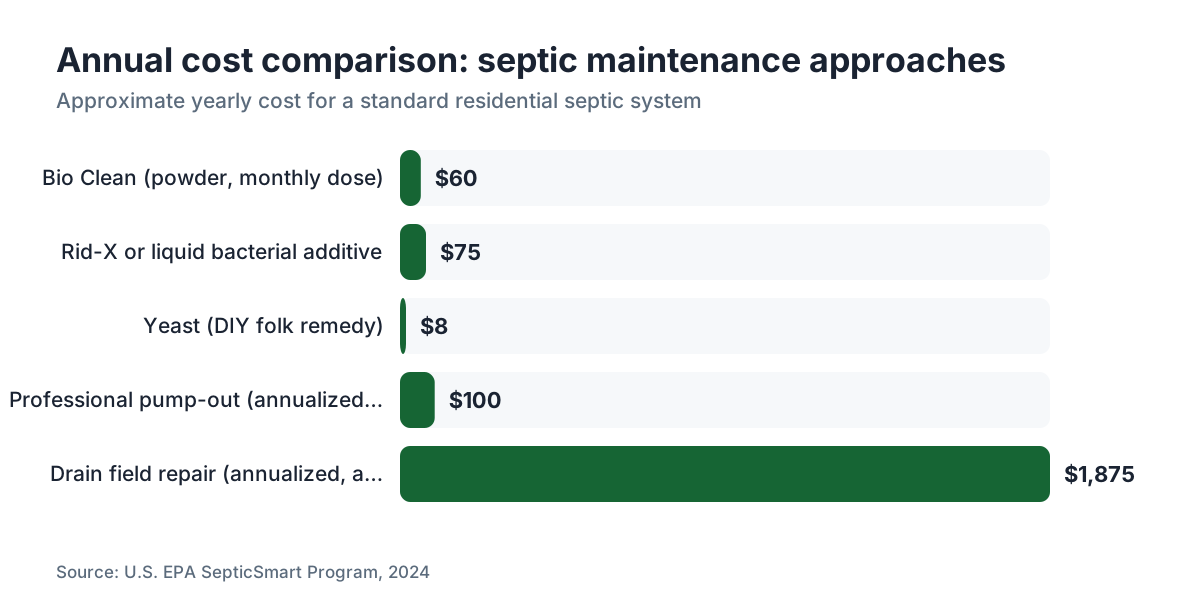
The table below puts Bio Clean's yearly cost next to the other common maintenance approaches.
How does Bio Clean compare to other septic additives?
The additive market breaks into three groups: biological products (bacteria and enzymes, like Bio Clean), chemical products (acids, solvents, or oxidizers, mostly bad for the tank), and yeast-based products (a folk remedy with almost no evidence behind it).
| Product Type | Example | Typical Annual Cost | EPA Endorsed? | Replaces Pumping? |
|---|---|---|---|---|
| Bacterial/enzymatic (powder) | Bio Clean | $40-$80 | No | No |
| Bacterial (liquid) | Bio One, Rid-X liquid | $50-$100 | No | No |
| Yeast | DIY (baker's yeast) | $5-$10 | No | No |
| Chemical shock | Various | $30-$60 | Not recommended | No |
| Professional pumping | Licensed hauler | $300-$500 per visit | Recommended | N/A |
Bio Clean sits in the safest category. No harsh chemicals, no documented harm to beneficial bacteria at recommended doses, plausible mechanism. Bio One septic tank treatment is another well-known name in the same biological group, sold heavily in Australia and increasingly in the U.S., with similar bacteria-and-enzyme chemistry. Rid-X is the mass-market version at hardware stores. None of them has published randomized controlled trial evidence showing measurable sludge reduction in real residential tanks.
Among the bacterial products, the differences come down to strain diversity, CFU count per dose, and enzyme concentration. Bio Clean tends to pack more enzyme than Rid-X, which may help with grease specifically. That claim holds up on the chemistry. Lipase enzymes really do hydrolyze fats. Whether that adds up to a cleaner tank over years is a separate question the field data doesn't answer.
Chemical products are a different animal. Sulfuric acid or strong solvents can kill the anaerobic bacteria your tank runs on and, in some cases, damage tank components. The Minnesota Extension review flagged chemical additives as potentially harmful to system performance [1]. Skip them.
Does Bio Clean help a failing drain field or leach field?
This is where the marketing gets loud and where you should be most skeptical. A leach field fails for a few reasons: hydraulic overload (too much water, too fast), biomat buildup (a bacterial slime layer plugging the soil pores), compaction, or physical pipe damage. Of those, biomat is the only one a bacterial additive could plausibly touch.
The theory: oxygen-tolerant or facultative strains outcompete the anaerobes building the biomat, or enzymes degrade the organic layer. Some aerobic treatment systems and drip irrigation setups do use targeted bacterial dosing in field-restoration protocols. But those are engineered systems with controlled conditions, not a passive backyard drain field.
For a truly failing leach field, Bio Clean or any bio septic tank treatment probably won't save it. A failing field has structural problems bacteria can't fix. If your drains back up, your yard is wet and smelly over the field, or a septic tank inspection shows effluent that isn't absorbing, call a licensed septic contractor. Not a bottle of powder.
There is one narrow, legitimate use. A field that's mildly stressed but not yet failing, where maintenance has slipped, sometimes responds to a rested-field protocol paired with bacterial dosing. The success rate in the literature is inconsistent. No state health department I'm aware of officially endorses additives as a field-restoration method; the standard guidance stays repair or replacement [6].
If you're facing septic system repair or septic tank repair, get a professional assessment first.
Is Bio Clean safe for all types of septic systems?
For conventional anaerobic septic tanks, Bio Clean is generally safe at recommended doses. The bacterial strains are non-pathogenic and occur naturally in soil and organic waste. The published literature has no documented cases of Bio Clean damaging a system.
Aerobic treatment units (ATUs) are trickier. These inject air to drive aerobic digestion, so they already run an oxygen-rich environment full of aerobic bacteria. Adding anaerobic strains may do nothing useful and could interfere with the designed process. Most ATU makers don't ban bacterial additives, but they don't endorse them either. Check your unit's manual or call the manufacturer before dosing.
Mound systems, drip irrigation, and constructed wetlands raise the same concern. Each treatment train is engineered for specific conditions. Dosing biological supplements without knowing the design is guesswork.
Big systems serving multiple dwellings, commercial buildings, or high-turnover vacation rentals need proper design, adequate tank sizing, and regular professional service far more than any additive. No amount of Bio Clean fixes a tank that's too small for its load.
Some states have explicit rules on additives. New Hampshire, for one, has prohibited certain chemical additives, and several states require any additive to meet National Sanitation Foundation (NSF) or similar standards before use [7]. Check your state's onsite wastewater code before dosing. Your state environmental or health department website is where to start.
What do state regulations say about septic additives?
State rules on additives vary widely, and checking yours matters. A handful of states have banned specific chemical additives outright. Most have no restriction on bacterial products but also offer no official endorsement.
Texas allows biological additives, but its state environmental code makes clear that additives don't substitute for required maintenance schedules [8]. California's regulations for onsite wastewater treatment systems focus on performance standards and don't address proprietary additives directly, which in practice leaves the call to county health departments.
The National Onsite Wastewater Recycling Association (NOWRA) has issued guidance that biological additives may be used as supplements but should not be sold as replacements for conventional maintenance [9]. That's the mainstream professional line.
NSF runs a certification program (NSF/ANSI 40 and related standards) for onsite wastewater treatment systems, but there's no NSF certification for septic additives as of this writing. So any "NSF certified" claim on an additive label deserves a hard look.
For operators managing many client systems, tracking which properties use additives and whether they show any difference in pump-out intervals or inspection results is genuinely useful data. Platforms like SepticMind let operators log service notes and products used at each property, which over time gives real-world signal no lab study provides.
Look up your state's onsite wastewater regulations, and don't rely on the manufacturer to tell you what's legal.
When should you use Bio Clean and when should you skip it?
Here's my honest take, built on what the evidence supports.
Use it if your tank is in good shape, you've pumped recently, you care about system health, and you want a cheap maintenance supplement. The risk is near zero. The benefit is plausible but unproven. If it buys you peace of mind as a minor line item, fine.
Skip it if you're behind on pumping and hoping Bio Clean bails you out. It won't. The how often to pump a septic tank answer for most homes is every 3 to 5 years, depending on tank size and occupancy [10]. No additive reliably changes that interval.
Skip it if you have an active problem. Slow drains, sewage odors, wet spots over the field, or gurgling all mean you need a septic tank cleaning or a professional inspection. Not a bag of powder.
Skip it if your household runs a water softener that dumps brine into the septic system. High salt damages the soil structure in the drain field no matter what's in your tank, and no bacterial additive fixes that.
One thing I'd recommend either way: keep a log of what goes into your system. The best-documented predictor of septic health is steady, moderate water use plus regular pumping. Everything else, additives included, is secondary.
How does regular pumping compare to relying on additives?
There's no contest. Pumping physically removes accumulated sludge and scum that bacteria can't digest fast enough to keep up with. Even a perfectly healthy tank with plenty of native bacteria builds up a non-digestible inorganic fraction: grit, synthetic fibers, and solids no enzyme touches.
The EPA recommends pumping a typical household septic tank every 3 to 5 years [2]. A septic tank emptying by a licensed hauler also gives you a direct look at tank condition, baffles, effluent quality, and the inlet and outlet pipes. No additive shows you any of that.
Some homeowners ask if consistent Bio Clean use lets them stretch the interval. The honest answer: there's no credible evidence it does, and betting on it with a system that costs thousands to repair is a bad wager. If your last pump-out showed good sludge levels and you want to push from 3 years to 4 while dosing a maintenance product, that's low-stakes. Pushing from 3 to 7 years on additive marketing is reckless.
For the full picture of what a pump-out involves, the septic tank pump out guide covers what to expect, what the technician should check, and what a healthy versus concerning tank looks like on inspection.
What mistakes do homeowners make with septic additives?
The biggest mistake is swapping additives for pumping. This is exactly what the EPA warns against, and it drives premature failures that end in septic tank installation costs when a new system is finally required [5].
Second: over-dosing. More is not better with bacterial additives. Dumping several doses at once doesn't speed up colonization. It just burns product and money. The bacteria need time and a stable environment to establish, not a flood of reinforcements.
Third: using additives as a diagnostic tool. "I added Bio Clean and the drains cleared up" is not proof the product worked. Maybe a partial blockage cleared on its own. Maybe you used less water that week. Correlation in a complex biological system is hard to read.
Fourth: ignoring what goes into the system. Flushing wipes (even the ones labeled "flushable"), feminine hygiene products, medications, paint, or bleach-heavy cleaners regularly will swamp any additive. The EPA lists household chemicals that harm septic systems, and that list is worth reading [2].
Fifth: buying the priciest product on the assumption that quality scales with price. In this market, the link between price and performance is poorly established. A $90 specialty product from a plumbing supply house hasn't been shown superior to a $15 box of Rid-X. It's just priced differently.
What do septic service professionals actually think of Bio Clean?
Opinions among licensed contractors split roughly three ways. Some recommend bacterial additives as a cheap maintenance supplement, genuinely believing the biology helps. Some stay neutral: they neither push nor discourage additives, but they make sure clients understand pumping is still required on schedule. A third group is openly skeptical, having pumped thousands of tanks over decades without seeing a clear pattern of better sludge levels in regularly dosed tanks.
No large-scale operator survey on additive efficacy has been published that I can point to. The closest thing is anecdotal: technicians who've tracked their own customers' tanks over years. Those informal observations don't consistently favor additives.
What pros do agree on: a well-maintained system with regular pumping and sensible water habits beats any chemical or biological supplement every time. The septic tank inspection data collected across years of service tells you far more than any product's marketing sheet.
For operators who want to track which client properties use additives and compare service intervals, systematic recordkeeping is the only way to get real signal. SepticMind's service management tools let operators log product use alongside inspection results, which is the kind of longitudinal data the industry mostly lacks.
Frequently asked questions
Does Bio Clean eliminate the need for septic tank pumping?
No. The EPA says no biological or chemical additive eliminates the need for routine pumping. Solids accumulate in every tank over time, including materials bacteria cannot digest. The standard interval of every 3 to 5 years applies whether you use Bio Clean or not. Treat it as a supplement, never a replacement for physical service.
How long does it take for Bio Clean to start working in a septic tank?
Bacterial populations establish within 48 to 72 hours under good conditions, meaning warm temperature, low chemical interference, and minimal water flow during the initial colonization window. The seeding protocol calls for daily dosing over the first week to build population. Whether that population meaningfully changes tank performance is a separate question the field evidence doesn't confidently answer.
Can you use Bio Clean with an aerobic septic system?
Use caution. Aerobic treatment units run on oxygen-rich, aerobic bacterial processes. Most Bio Clean strains are anaerobic or facultative. Adding them may not help and could interfere with the intended treatment. Check your ATU manufacturer's manual or call them before dosing. For conventional anaerobic tanks, Bio Clean is considered safe at recommended doses.
What is the difference between Bio Clean and Rid-X?
Both are bacteria-and-enzyme additives. Bio Clean sells mostly through plumbing supply houses and packs more enzyme, especially lipases for grease. Rid-X is the mass-market version at hardware stores. Neither has published randomized controlled trial data showing measurable sludge reduction in real residential tanks. Bio Clean costs more per dose, and whether the extra enzyme means better real-world performance is unproven.
How much does Bio Clean cost per year for a residential septic system?
A 2-pound container runs $35 to $55 and typically covers about a year of monthly maintenance doses for a standard household. Annual cost lands around $40 to $80. That compares to $300 to $500 for a professional pump-out, still required every 3 to 5 years. Think of the additive as a minor line item, not an investment that defers service.
Is Bio One septic tank treatment the same as Bio Clean?
No. They're different products from different manufacturers. Bio One is a separate brand, sold heavily in Australia and increasingly in the U.S., with a similar bacteria-and-enzyme formulation. Both fall in the same category: biological septic additives. Neither has been shown in independent field studies to measurably reduce sludge or extend pump-out intervals beyond what a healthy tank achieves on its own.
Can Bio Clean fix a failing drain field?
Unlikely in most cases. Drain field failure usually comes from biomat buildup, soil compaction, hydraulic overload, or physical pipe damage. Bacterial additives might theoretically touch mild biomat, but a truly failing field needs professional assessment, not a supplement. If you have wet spots, odors, or backed-up drains pointing to field problems, call a licensed septic contractor.
What household products kill the bacteria in a septic tank?
Regular use of bleach cleaners, antibacterial soaps, drain-clearing chemicals, and prescription antibiotics passed in urine all cut the bacterial population in your tank. True with or without Bio Clean. The EPA lists common household chemicals that harm septic systems. Moderate, targeted use of cleaning products is safer than frequent heavy doses of bleach or disinfectants.
Are septic additives regulated by the EPA or state agencies?
The EPA does not certify or approve septic additives. State rules vary: some ban specific chemical additives, a few require products to meet NSF standards, and most have no restriction on bacterial products but no endorsement either. Check your state's onsite wastewater regulations before using any additive. The safest move is to verify with your state environmental or health department.
How often should you add Bio Clean to a septic tank?
The standard maintenance protocol after the seeding week is once a month. Dose at night when water use stays low for six to eight hours, giving bacteria time to settle. More frequent dosing is not more effective and wastes product. Some homeowners dose quarterly instead of monthly with no clearly documented difference in outcomes.
Does Bio Clean work in cold climates where the septic tank temperature drops?
Bacterial activity slows sharply below 50°F and nearly stops below 40°F. Tanks buried below the frost line stay warmer than the air above, usually 50 to 60°F even in cold winters, which keeps minimal activity going. Bio Clean may be less effective in shallow or poorly insulated tanks in very cold climates. Store the product itself above freezing.
What is the best time of year to start using Bio Clean?
Spring or early summer is a sensible time to start the seeding protocol, when tank temperatures are rising and biological activity climbs naturally. Avoid starting during heavy household water use (big gatherings, irrigation), since high flow can flush bacteria through before they establish. Any season works for monthly maintenance once seeding is done.
Can using Bio Clean void a septic system warranty?
Possibly, for aerobic treatment units under manufacturer warranty. Some ATU makers specify approved maintenance products, and unapproved additives could affect coverage. For conventional concrete or fiberglass anaerobic tanks, no manufacturer warranty I'm aware of is voided by biological additives at recommended doses. When in doubt, read your system documentation or call the manufacturer.
Sources
- University of Minnesota Extension, Septic System Owner's Guide: A review of commercially available septic additives found no consistent evidence that any of them reduced sludge accumulation or extended pump-out intervals.
- U.S. EPA SepticSmart Program: The EPA does not recommend biological or chemical additives as a substitute for proper maintenance and states additives have not been shown to eliminate the need for routine pumping.
- Bioresource Technology (Elsevier journal): Bacterial inoculants improved BOD reduction under controlled lab conditions, though the effect was modest and diminished under high hydraulic loading.
- EPA SepticSmart, Homeowner's Guide to Septic Systems: National average cost of routine septic tank pumping is $300 to $500 for a standard 1,000-gallon tank.
- EPA SepticSmart, Costs of Septic System Failure: Septic system failures can cost $5,000 to $20,000 to repair or replace.
- National Environmental Services Center (NESC), West Virginia University: Standard guidance for failing drain fields remains repair or replacement; no state health department officially endorses bacterial additives as a field-restoration method.
- New Hampshire Department of Environmental Services: New Hampshire has prohibited certain chemical septic additives, and several states require additives to meet NSF or similar standards.
- Texas Commission on Environmental Quality, On-Site Sewage Facilities: Texas allows biological additives but its state environmental code makes clear that additives do not substitute for required maintenance schedules.
- National Onsite Wastewater Recycling Association (NOWRA): NOWRA has issued guidance stating that biological additives may be used as supplements but should not be represented as replacements for conventional maintenance.
- EPA SepticSmart, Pump Your Tank Regularly: The EPA recommends pumping a typical household septic tank every 3 to 5 years.
Last updated 2026-07-10