Best toilet paper for septic tanks: how to choose the right one
By the SepticMind Editorial Team
TL;DR
- Pick toilet paper labeled 'septic-safe' and confirm it with a jar test: drop four or five sheets in water, shake ten times, and check for breakup within 30 seconds.
- Single-ply and recycled-fiber brands dissolve fastest.
- Thick, quilted, or ultra-soft papers can take four minutes or longer to break apart and pile up as solids in your tank.
Why toilet paper choice actually matters for a septic system
Toilet paper is the only solid your septic system is built to take on a daily basis. It's also the thing homeowners never think about until a tank comes up full early. Every sheet you flush lands in the tank, where bacteria have to break it down before the liquid moves out to the drain field. Paper that dissolves slowly floats as a scum layer or settles into sludge. That buildup shortens the gap between septic tank pump-outs and, in the worst cases, pushes solids toward the drain field where they clog the soil.
The EPA's SepticSmart program calls out household products by name, noting that what goes down your drains affects how long your system lasts [1]. Toilet paper is the most-flushed solid in the house, so it carries more weight than any single cleaner or additive.
None of this means you're stuck with thin, scratchy paper. The question that matters is how fast the fibers come apart in water, not how many plies are printed on the package. Some 2-ply brands break down faster than budget 1-ply rolls because of how the fibers get processed. Ply count is a starting point. It's not a guarantee.
How fast does toilet paper actually dissolve? What the tests show
The most reliable home test is the same quick field check wastewater techs use. Put four or five sheets in a jar with about two cups of water, seal it, shake ten times, and watch. Paper that breaks into loose fibers within 15 to 30 seconds is a good candidate for a septic system. Paper that stays in recognizable sheets past 60 seconds is a problem.
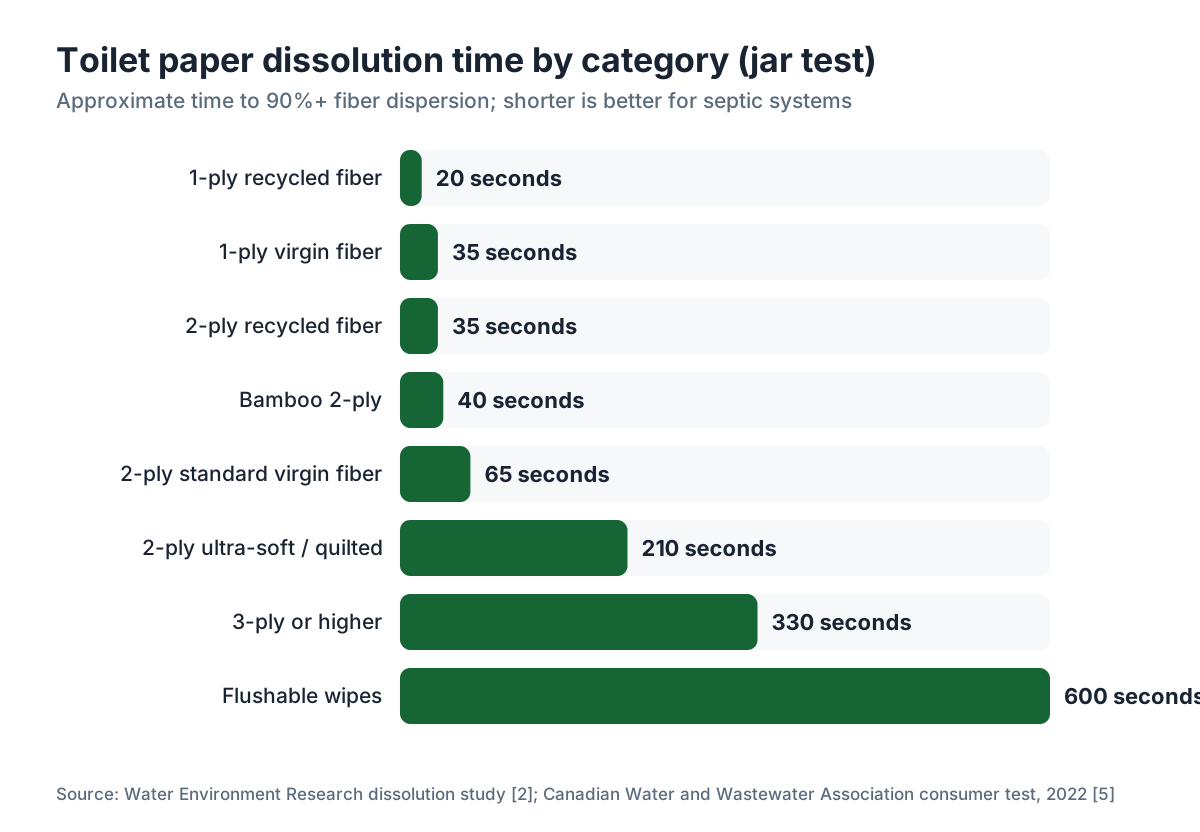
Researchers have measured this more carefully. A study in Water Environment Research found recycled-fiber toilet papers disintegrated much faster than virgin-fiber products in controlled flow tests. Some recycled brands hit 95 percent fiber dispersion in under 30 seconds. Some ultra-soft virgin-fiber brands took more than four minutes [2]. Four minutes is a long time for paper to hold together on its way to your tank.
The National Onsite Wastewater Recycling Association has pushed consumers to run exactly this mason-jar test before they settle on a brand [3]. No federal law forces a paper product to pass any dissolution standard before it can carry a 'septic safe' label, which means the label is marketing, not a certification. Your jar is more honest than the box.
Here is a rough comparison of common categories, drawn from published dissolution studies and extension guidance:
| Category | Typical dissolution (jar test) | Fiber type | Notes |
|---|---|---|---|
| 1-ply recycled fiber | 15-25 seconds | Recycled | Fastest; some feel rough |
| 1-ply virgin fiber | 20-40 seconds | Virgin | Good; widely available |
| 2-ply recycled fiber | 25-45 seconds | Recycled | Good balance of comfort and dissolving |
| 2-ply standard virgin fiber | 40-90 seconds | Virgin | Acceptable for most systems |
| 2-ply 'ultra-soft' / quilted | 2-5 minutes | Virgin, long-fiber | Problematic; accumulates in tank |
| 3-ply or higher | 3-8 minutes | Virgin, long-fiber | Avoid for septic |
| Flushable wipes (any brand) | Often 10+ minutes or never | Synthetic/composite | Never use with septic systems |
What does 'septic-safe' on the label actually mean?
By itself, not much. The United States has no federal standard a product must meet before it can print 'septic safe' or 'septic system approved' on the wrapper. The EPA does not license or approve any toilet paper brand [1]. The claim is voluntary, and the only test behind it is whatever the manufacturer chose to run in-house.
Some manufacturers do send products to third-party labs for dissolution testing. The protocols vary and aren't standardized across the industry. When a package says 'septic safe,' it usually means the maker ran some version of a slurry or dispersion test and the paper passed under those conditions. It does not mean the paper was tested in a real septic tank with live bacteria.
Use 'septic safe' as a first filter, not the final word. A brand that carries the label and also clears a short jar test earns your trust. A brand that carries the label but sits intact in your jar for two minutes deserves suspicion, whatever the wrapper says.
State agencies add another layer. Florida and North Carolina, among others, publish homeowner guidance on septic-compatible products, and several point you toward biodegradable, single-ply, or recycled-content paper [4][9]. Check your state's onsite wastewater program page for anything specific to your region.
Which specific toilet paper brands are best for septic systems?
This is where most guides oversell, because formulations change and store shelves vary by region. Instead of crowning a single winner, here's the honest framework from published testing, plus the categories that keep performing.
Recycled-fiber brands like Seventh Generation, Green Forest, and Caboo land near the top of independent dissolution tests and extension recommendations. They're made from shorter, already-broken-down fibers that scatter fast in water. Scott 1000 (the original single-ply, not the newer variants) has been a reference product in wastewater talk for years because of how quickly it lets go. Cottonelle Ultra and Charmin Ultra Soft sit at the other end. They're the long-fiber, quilted papers that hold together the longest.
A 2022 consumer test by a Canadian water authority found bamboo-based papers dissolved on par with recycled-fiber papers, generally in 30 to 45 seconds, which makes bamboo a real option for people who want a softer feel [5].
No independent, continuously updated database ranks every brand. The jar test is still the most practical verification you have. Buy a roll of whatever you're eyeing, run the test, and decide. Breaks up fast? You have your answer.
For operators running multiple service accounts, tracking which products a client uses can help predict pump-out timing. SepticMind lets operators log system notes per customer, so it's easy to flag high-solid-accumulation accounts for earlier scheduling.
Is 1-ply toilet paper always better for septic tanks than 2-ply?
Ply count matters less than fiber type and fiber length. 1-ply is a fine default because it uses less material per sheet and usually breaks down faster. But a well-made 2-ply recycled-fiber paper beats a poorly made 1-ply virgin-fiber paper in a dissolution test every time.
The reason is processing. Recycled fibers have already been broken down once, so they're shorter and weaker when wet. Virgin fibers, especially the long combed fibers in premium soft papers, form a strong wet web that resists breaking apart. A 2-ply sheet of recycled short fibers can fall apart in 30 seconds. A 1-ply sheet of long virgin fibers can hold together for 90.
So the rough hierarchy: recycled fiber beats virgin fiber, shorter fiber beats longer fiber, and lower ply beats higher ply when everything else is equal. Want to optimize purely for septic safety? 1-ply recycled fiber is the safest bet. Want comfort without much risk? 2-ply recycled fiber is a middle ground most systems handle without complaint.
The University of Florida IFAS Extension, in its homeowner guidance on septic care, recommends toilet paper that breaks down quickly and tells people to skip 'luxury' multi-ply products [6].
Can you really flush 'flushable' wipes if you have a septic system?
No. Full stop.
There's no nuance here. Flushable wipes are not safe for septic systems, whatever the packaging claims. Independent tests keep confirming it. Consumer Reports tested 23 flushable wipe products and found none of them broke apart the way toilet paper does in standard slosh-box testing [7]. The nonwovens industry groups INDA and EDANA run their own 'flushability' standard, but that standard doesn't replicate septic tank conditions and doesn't certify breakdown in an anaerobic environment.
In a tank, wipes just pile up. They form a dense mat that can clog the outlet baffle, fill the tank faster than normal, and force an emergency septic tank pump-out or a backup. Utilities and state agencies across the country keep issuing warnings about wipes jamming both private septic systems and municipal sewers [4].
Want the same clean feeling without the wipes? A bidet attachment does the job and adds essentially zero solids to your system. That's the honest alternative.
How much does the wrong toilet paper actually affect your pump-out schedule?
Hard to pin down. No controlled long-term study has compared pump-out intervals across households using different toilet paper brands under otherwise identical conditions. Nobody has good data on this exact question.
Here's what we do know. The EPA recommends pumping most residential tanks every three to five years, with the interval driven by tank size and household size [1]. A 1,000-gallon tank serving four people usually needs pumping every three to four years. Heavy solid accumulation from slow-dissolving paper or other junk shortens that window.
Extension services agree that anything flushed regularly that doesn't break down quickly adds to sludge and scum, the two layers a pumper measures to decide whether your tank needs service. If your paper is leaving intact fibers in the tank, those fibers add to sludge depth. A pumper who finds unusually high solids for your household size will ask what you're flushing.
A rough mental model: a household on fast-dissolving paper that avoids wipes, paper towels, and other non-degradables tends to stay on the normal schedule. A household on quilted ultra-soft paper plus the occasional wipe might add six months to a year of pump-out cost over a decade. At $300 to $600 per service call in most US markets, that adds up. Our guide on how often to pump a septic tank breaks it down by tank size and household size.
Paper isn't the only lever. Garbage disposals, harsh cleaners, and flushed medications all mess with the tank's bacteria. But paper is the cheapest thing to get right.
Does septic tank treatment or bacteria additive compensate for bad toilet paper?
Not reliably. Septic tank additives, biological or chemical, have been studied, and the evidence for them is thin. The EPA has stated that biological additives have not been proven to improve the performance of a properly functioning septic system and may, in some cases, upset the microbial balance [1]. A healthy tank already holds billions of naturally occurring bacteria working on the waste.
Some states go further. Montana's environmental agency has issued guidance that no additive substitutes for regular maintenance and proper use [8]. Several states ban the sale of certain chemical additives over groundwater contamination risk.
The practical point: dosing your tank with a bacterial supplement does not buy you the right to flush slow-dissolving paper. The microbes work at a fixed rate set by temperature, tank volume, and retention time. Overload them with material they can't process fast enough and it accumulates, no matter what's in the water.
If your system is struggling, the right move is a septic tank cleaning by a licensed pumper, an inspection of the baffle and outlet, and a switch to faster-dissolving paper. Additives are a distant fourth on that list.
What about bamboo toilet paper for septic systems?
Bamboo toilet paper has taken off over the last few years, and the septic-safety claims stuck to it are mostly legitimate. Bamboo fibers run naturally shorter than virgin wood pulp and don't need as much chemical processing to feel soft. The result is a paper that tends to scatter fast in water.
The 2022 Canadian water authority test mentioned earlier put bamboo products right alongside recycled-fiber papers, in the 30 to 45 second range for a standard jar test [5]. That lands bamboo in the acceptable-to-good tier for most septic systems.
Bamboo paper usually costs more than conventional recycled or 1-ply, running roughly $0.03 to $0.06 per sheet against $0.01 to $0.03 for budget recycled options. Whether the extra cost is worth it comes down to texture. On pure septic safety, a good recycled-fiber 2-ply and a good bamboo 2-ply are about even. Both beat quilted ultra-soft virgin-fiber paper by a wide margin.
One caveat. Not all bamboo papers are the same. Some makers blend bamboo with virgin wood pulp to cut cost, and those blends can dissolve slower. Check whether the product is 100 percent bamboo if fast breakdown is your priority.
How do you test toilet paper at home before committing to a brand?
The jar test is the most practical option and takes about two minutes. Here's the exact procedure:
- Fill a clear jar or glass with roughly two cups of tap water.
- Tear off four to five sheets of the toilet paper you want to test, about what a single use would involve.
- Add the sheets to the jar and seal it, or place your palm over the top.
- Shake vigorously ten times.
- Let it sit for 30 seconds, then look.
Good result: the sheets have broken into loose, dispersed fibers with no recognizable sheet structure left. Acceptable result: the sheets have partly broken up but some clumps remain, so shake again and check at 60 seconds. Problematic result: the sheets are largely intact after 60 seconds of soaking and shaking.
The test isn't perfect. A real tank has anaerobic bacteria, warmer temperatures, and longer retention time than your jar. But it reliably separates fast-dissolving papers from slow ones, which is exactly what you need to know.
You can also watch dissolution videos from state extension services or wastewater pros who have run the test across brands. North Carolina State Extension has published visual comparisons that help calibrate what 'good' looks like [4].
To see how what you flush plays out downstream, and how your septic drain field handles the load, it helps to picture the whole system, more than the tank.
What else should you avoid flushing with a septic system?
Toilet paper is one piece of a bigger set of habits that decide how your system runs. The septic-safe paper question usually leads homeowners to ask what else they should keep out.
The short list of things that should never enter a septic system: flushable wipes (see above), paper towels, cotton balls, feminine hygiene products, dental floss, medications, cooking grease, paint, and harsh chemical drain cleaners like lye or acid-based products. The EPA's SepticSmart guidelines cover this directly [1].
Household cleaners are a gray area. Normal use of toilet bowl cleaners, surface disinfectants, and laundry detergent is generally fine, because the amounts reaching your tank are small enough that the bacteria bounce back quickly. Dumping a whole bottle of bleach down a drain at once is a different story. Quantity and frequency are what matter.
Garbage disposals add a big solid load and are worth rethinking if you have a smaller tank or a system already under strain. Some states and counties restrict their use on septic properties.
If your system already shows symptoms like slow drains, gurgling, or odors, those point to a bigger issue. See our guides on septic system repair and septic tank repair for what those symptoms usually mean and when to call someone.
SepticMind's maintenance reminder tools help homeowners and operators stay on top of pump-out schedules and product-use logs, so problems don't slip through between service visits.
Frequently asked questions
Is Charmin safe for septic systems?
Standard Charmin 1-ply or basic 2-ply is generally acceptable, but Charmin Ultra Soft and Ultra Strong are among the slowest-dissolving products in independent jar tests, often taking two to five minutes to break up. If you want Charmin, stick to the basic line and run a jar test. The Ultra versions accumulate in tanks faster than most alternatives and are best avoided on a septic system.
What is the best 2-ply toilet paper for septic systems?
Recycled-fiber 2-ply brands like Seventh Generation and Green Forest perform well in dissolution tests, typically breaking up in 25 to 45 seconds in a jar test. They offer reasonable comfort without the slow-dissolving fibers in premium ultra-soft products. Scott 1000, while technically 1-ply, is another widely recommended option for its fast breakdown and long roll length.
Can I use regular toilet paper with a septic system?
Yes, with caveats. Standard single-ply or basic 2-ply toilet paper works fine in most septic systems. The ones to avoid are ultra-thick, quilted, or multi-ply luxury papers, which dissolve slowly and accumulate as solids. If your paper passes a 30-to-60-second jar test, it's suitable for regular septic use. Most mid-range grocery store brands fall into the acceptable range.
Are flushable wipes safe for septic systems?
No. Consumer Reports and multiple water authorities have tested flushable wipes and found most don't break apart in water the way toilet paper does. In a septic tank, wipes accumulate as a dense mat, clog outlet baffles, and force premature pump-outs. No wipe labeled flushable has been independently verified as safe for septic systems. Put them in the trash.
Does septic-safe toilet paper cost more than regular toilet paper?
Not necessarily. Some of the best-performing options, like Scott 1000 or store-brand single-ply recycled paper, cost less per sheet than premium soft brands. Bamboo-fiber papers tend to cost more, typically $0.03 to $0.06 per sheet versus $0.01 to $0.02 for budget recycled options. Switching to septic-safe paper rarely raises your grocery budget and may reduce pump-out frequency, saving money over time.
How often should I pump my septic tank if I use the right toilet paper?
The EPA recommends pumping most residential tanks every three to five years. Fast-dissolving paper helps you stay within that range rather than falling short. A 1,000-gallon tank serving a family of four typically needs pumping every three to four years regardless of paper choice. Good paper habits alone won't double your interval, but bad habits can shorten it noticeably. See our guide on how often to pump a septic tank.
Is bamboo toilet paper better for septic systems than recycled paper?
They're roughly equivalent in dissolution speed, both typically breaking up within 30 to 45 seconds in a jar test. Bamboo has shorter natural fibers that disperse easily, similar to recycled-fiber paper. The main difference is cost and feel: bamboo tends to be softer and pricier. If budget matters, recycled-fiber paper gives the same septic safety at a lower price point.
What does the EPA say about toilet paper and septic systems?
The EPA's SepticSmart program advises homeowners to be mindful of what they flush and warns against products that don't break down quickly. The EPA does not certify or endorse specific toilet paper brands, but recommends using paper that dissolves rapidly and avoiding wipes, paper towels, and other materials not designed to break down in a septic environment. Their guidance is at epa.gov/septic.
Can the wrong toilet paper damage my drain field?
Directly, it's unlikely. The damage path is indirect: slow-dissolving paper raises sludge and scum in the tank, so more solids can carry over toward the drain field if the tank isn't pumped on schedule. Over years, solid carryover clogs the soil absorption zone, which is one of the most expensive septic failures a homeowner can face. Fast-dissolving paper reduces that risk.
Is Scott 1000 toilet paper good for septic systems?
Yes. Scott 1000 is one of the most frequently cited toilet papers in wastewater discussions because it dissolves quickly, typically under 30 seconds in a jar test. It's single-ply, uses standard wood-fiber processing rather than long-fiber quilting, and is widely available. The trade-off is texture: it's thinner than premium brands. For pure septic safety, it's a reliable and affordable choice.
Do septic tank treatments or additives help break down toilet paper?
Not meaningfully. The EPA states that biological additives have not been proven to improve a properly functioning septic system. A healthy tank already holds the bacteria needed to break down organic material. No additive compensates for consistently flushing slow-dissolving paper. If you're relying on additives to fix a paper problem, you're spending money on a solution that doesn't work while the real issue continues.
What should I look for on toilet paper packaging if I have a septic system?
Look for 'septic safe' or 'rapid dissolving' labels as a starting filter, then verify with a jar test. Prefer single-ply or 2-ply recycled-fiber products. Avoid anything described as ultra-soft, ultra-strong, quilted, or 3-ply or higher. Biodegradable by itself doesn't mean fast-dissolving. The label is a starting point. The jar test is the real answer.
How do I know if my toilet paper is causing problems in my septic tank?
Signs of excess solid accumulation include slower-than-normal drains, gurgling in toilets or sinks, and odors near the tank or drain field. The most reliable check is having your tank pumped and asking the pumper to measure sludge and scum depth against what's normal for your tank size and household. If solids are unusually high, your paper choice is one of the first things to review.
Sources
- US EPA, SepticSmart homeowner guidance: EPA recommends pumping every 3-5 years; warns against flushing wipes, paper towels, and items that don't break down quickly; states biological additives have not been proven to improve properly functioning septic systems
- Water Environment Research, dissolution study on toilet paper fiber types: Recycled-fiber toilet papers disintegrated substantially faster than virgin-fiber products in controlled flow tests; some recycled brands reached 95% fiber dispersion under 30 seconds while some ultra-soft virgin-fiber brands took over four minutes
- National Onsite Wastewater Recycling Association (NOWRA), consumer guidance: NOWRA encourages consumers to perform a mason-jar dissolution test before selecting a toilet paper brand for use with a septic system
- NC State Extension, septic system homeowner care guidance: North Carolina State Extension has published guidance recommending fast-dissolving toilet paper and warning against wipes and non-biodegradable products in septic systems; includes visual dissolution comparisons
- Canadian Water and Wastewater Association, 2022 toilet paper dissolution consumer test: Bamboo-based toilet papers dissolved comparably to recycled-fiber papers, generally within 30 to 45 seconds in standard dissolution testing
- University of Florida IFAS Extension, septic system homeowner care: UF IFAS Extension recommends using toilet paper that breaks down quickly and avoiding luxury multi-ply products for homes on septic systems
- Consumer Reports, flushable wipes testing: Consumer Reports tested 23 flushable wipe products and found that none disintegrated the way toilet paper does in standard slosh-box testing
- Montana Department of Environmental Quality, septic system maintenance guidance: Montana DEQ has issued guidance stating that no additive can substitute for regular maintenance and proper use of a septic system
- Florida Department of Health, onsite sewage treatment and disposal guidance: Florida Department of Health publishes guidance for homeowners on septic-compatible products, recommending biodegradable and single-ply or recycled-content paper
- EPA, SepticSmart Week materials and household product guidance: EPA SepticSmart program specifically calls out household products including toilet paper as affecting system performance and longevity; does not certify or approve specific product brands
Last updated 2026-07-09