Bioactive septic tank treatment: what actually works
By the SepticMind Editorial Team
TL;DR
- Bioactive septic tank treatments add live bacteria and enzymes to break down solids in your tank.
- EPA and university extension research say a healthy tank doesn't need them.
- They can help after antibiotic use, pumping, or long dormancy.
- No product replaces pumping every 3 to 5 years.
- Buy products that name their bacterial strains and list a CFU count.
What is a bioactive septic tank treatment?
A bioactive septic tank treatment is a product you add through a toilet, drain, or tank access port that contains live bacteria, dormant bacterial spores, enzymes, or some mix of those. The point is to seed or reinforce the microbes already living in your tank so solids break down faster, sludge builds up more slowly, and cleaner effluent heads toward the drain field.
Most products fall into three buckets. Bacterial additives contain live or dormant cultures, usually measured in colony-forming units (CFUs). Enzyme additives contain preformed enzymes, most often proteases, lipases, and cellulases, with no live organisms. Combination products carry both.
The bacteria do the real biological work. Enzymes speed up specific chemical reactions but can't reproduce, so their effect fades fast. A product that lists only enzymes gives you a short burst, then nothing. If a label won't tell you the bacterial species or the CFU count, treat that as a warning.
Common genera on labels include Bacillus (spore-forming, survives well in a bottle), Pseudomonas, Enterococcus, and Lactobacillus. Bacillus-dominant formulas have the longest shelf lives and the most published research behind them in septic contexts [1].
Does the science actually support using these products?
The honest answer is that the evidence is thinner than the marketing, and most of it points the same direction: a healthy tank doesn't need help.
The EPA's SepticSmart program says most healthy septic systems already contain the bacteria they need to function and that additives are generally not necessary [2]. That's a measured statement, not a ban. It's also a long way from an endorsement.
The most-cited independent review is a 2000 report from the University of Minnesota Extension that looked at 19 categories of additives. Researchers concluded that biological additives showed no significant benefit on sludge reduction in functioning systems, and found no evidence of harm either [1]. A 2010 study in Bioresource Technology found that inoculating septic tanks with outside bacteria produced only marginal gains in biochemical oxygen demand (BOD) reduction against controls, and the difference shrank after 60 days once the tank's native microbes took back over [3].
Nobody has great long-term field data here. Most studies run under 90 days, use lab-scale or pilot tanks, and never get repeated across real homes with different soils, climates, and habits. The closest thing to a field consensus comes from state cooperative extension programs, and most say what the EPA says: a working system fed a normal household diet doesn't need supplemental bacteria.
The evidence gets more interesting in stressed systems. A tank just pumped, a household finishing a course of broad-spectrum antibiotics, or a vacation property restarted after months of sitting idle all create real conditions where the native population is depleted. A few small studies and a lot of practitioner experience suggest an inoculating dose in those moments can shorten recovery. That's a narrower, more defensible claim than the all-season maintenance pitch on most labels.
When does bioactive treatment genuinely help?
Four situations show up again and again in extension research and in the field where adding bacteria is a reasonable move.
First, right after a pump-out. Pumping removes roughly 90 percent of the liquid and solids, including most of the microbial biomass, so the tank restarts almost from zero. A bacterial inoculant added immediately after pumping helps rebuild the population faster. Some pumpers do this as a matter of course.
Second, after heavy antibiotic use in the house. Oral antibiotics pass through the body largely intact and reach the tank in concentrations that can knock back a chunk of the bacterial population. The effect is usually temporary. But if the system was already marginal, the timing matters, and a dose of spore-forming Bacillus after a round of antibiotics is cheap insurance.
Third, a restart after long dormancy. A seasonal cabin where no water enters the tank for weeks or months can see the bacteria crash from starvation and drying out. Seeding when you open the place back up makes sense.
Fourth, grease and fat buildup. Lipase-heavy enzyme products can help a tank work through heavy grease loading. This is really a kitchen-habit problem you should fix at the sink, but if someone has poured cooking grease down the drain for years, an enzyme treatment may chip away at the scum layer [4].
For daily upkeep on a healthy system with normal use, the honest answer is that you probably don't need it. Put the money toward your next septic tank pumping instead.
What about CLR septic tank treatment products?
CLR (Calcium, Lime, and Rust) is best known for its acidic descaling cleaners, but the company also sells a CLR Healthy Septic System Tank Treatment. It's a biological additive in powder or liquid form, sold as a monthly maintenance product.
The CLR septic tank treatment formula contains bacterial cultures and enzymes and is marketed for ongoing use to keep your tank's bacterial balance up. Like most consumer-grade products in the category, CLR doesn't publish its bacterial strains, species names, or CFU counts in any accessible product documentation, which makes an apples-to-apples comparison hard.
CLR septic tank treatment sells at major home improvement retailers and online for roughly $10 to $20 for a multi-dose supply, one of the cheaper options out there. The CLR Healthy Septic System Tank Treatment line is EPA Safer Choice listed for certain formulations, which speaks to ingredient safety, not to whether it works [5].
Here's the honest read on CLR and its peers. They're unlikely to hurt your system. They're unlikely to turn a poorly functioning one around. If you use them as a post-pump inoculant or a post-antibiotic recovery step, you're spending your money on something reasonable. Using them instead of pumping, or as a fix for a failing system, is where the money goes to waste.
For comparison, professional-grade biological treatments sold to septic operators usually come with published strain data (typically Bacillus subtilis, B. licheniformis, or B. amyloliquefaciens at 10^8 to 10^10 CFU per dose) and dose far higher than consumer retail products.
How do bioactive treatments compare to chemical and inorganic additives?
Not every septic additive is biological. Knowing the landscape helps you dodge the ones that do real damage.
Chemical solvents, especially products with methylene chloride or trichloroethylene, were once sold as septic cleaners. Many states ban or restrict them now because they kill tank bacteria, pass through to groundwater, and poison the drain field soil [6]. If a label leads with solvents, put it back on the shelf.
Acidic or alkaline pH adjusters can wreck the anaerobic digestion a healthy tank depends on. The sweet spot for anaerobic bacterial activity in a septic tank is roughly pH 6.8 to 7.4 [1]. Products that swing pH hard outside that band hurt more than they help.
Biological additives have a clean safety record by contrast. The University of Minnesota review found no documented harm to soils, groundwater, or tank infrastructure from biological products [1]. The problem was never safety. It's efficacy.
| Product type | Efficacy evidence | Safety profile | Typical cost (annual) |
|---|---|---|---|
| Biological (bacteria + enzymes) | Marginal in healthy tanks, modest in stressed tanks | Safe, no documented harm | $20 to $80 |
| Enzyme-only | Short-term activity, no sustained effect | Safe | $15 to $60 |
| Chemical solvents | No benefit; banned in many states | Harmful to system and groundwater | $15 to $40 |
| pH modifiers | No benefit; can harm digestion | Risk of disrupting biology | $10 to $30 |
| Yeast (home remedy) | No reliable evidence | Harmless | Near zero |
Yeast is the perennial internet tip. Saccharomyces cerevisiae, the baking kind, is not an anaerobic digester and doesn't last long in a septic tank. It's harmless. It's also doing nothing.
What ingredients should you look for on a product label?
If you're going to buy a bioactive treatment, reading the label critically takes about two minutes and separates decent products from marketing exercises.
Look for named bacterial species. "Proprietary blend of beneficial bacteria" tells you nothing. Bacillus subtilis, Bacillus licheniformis, Bacillus amyloliquefaciens, and Bacillus megaterium have the most published research in anaerobic digestion [3].
Look for a CFU count per dose. Consumer products list anywhere from 10^6 (1 million) to 10^9 (1 billion) CFU per dose. Professional formulations run higher. No CFU number means no meaningful quality benchmark.
Look for named enzymes and their targets: protease (proteins), lipase (fats), amylase (starches), cellulase (cellulose). Generic "enzyme blend" language is filler.
Check shelf life and storage. Live bacterial spore products usually keep for 18 to 24 months when stored below 77 degrees F. A product baking on a warm big-box shelf for two years may have almost no live count left by the time you open it.
If the product claims to replace pumping, end the need for inspection, or permanently fix a failing drain field, set it down. No biological additive does any of those things. A septic tank inspection by a licensed professional is the only way to actually know what's happening inside your system.
How should you use bioactive treatments correctly?
Application method matters more than most labels let on.
Flush-through application (dropping the product in a toilet and flushing) is the common consumer method, and it works, but the product has to survive your pipes and any cleaning chemicals left in the bowl. If you just used a bleach-based bowl cleaner, wait 48 to 72 hours before dosing with bacteria. Bleach at household strength kills a big share of live cultures before they ever reach the tank.
Direct tank port application is more reliable. If you know where your access risers are, open the port and add the treatment straight into the liquid. That skips the pipe-side chemistry and puts the bacteria in the tank right away. Many operators do it this way after a pump-out.
Timing matters too. Dosing right before five loads of hot laundry, or before three back-to-back showers, dilutes and flushes the product before it establishes. A quiet stretch of 12 to 24 hours with low water use gives the bacteria the best shot at settling in and multiplying.
Most labels say to dose monthly. The evidence doesn't clearly back monthly dosing for a healthy system. If you're dosing for recovery or a restart, a single loading dose with a repeat at 30 days is probably enough. More isn't better when there's no bacterial shortage to fix.
Keep a log of when you dose, when you pump, and when you had system events (antibiotics, a backup, a spike in water use). It's genuinely useful. Software like SepticMind helps operators and maintenance-minded homeowners track these intervals without leaning on memory.
Can bioactive treatment help a failing or stressed septic system?
This question comes up constantly, and it's where expectations most need a reality check.
A bottle of additive will not fix a failing system. Slow drains, sewage odors in the yard, wet spots over the drain field, backups in the house: those are physical problems. The most common cause of drain field failure is hydraulic overload or soil clogging from years of biomat buildup and solids carrying over from an overfull tank [7]. Bacteria can degrade organic material, but they can't un-compact soil, drain a saturated field, or fix a crushed distribution pipe.
What bioactive treatment can do in a marginal system is slow the rate of biomat thickening if solids are part of the problem, and support cleaner effluent leaving the tank if the tank's bacterial population is genuinely knocked down. That's a supporting role, not a repair.
If you're seeing symptoms, run the sequence in order. Get a septic tank pump out to clear the tank and check sludge and scum depths. Get a professional to inspect or camera the distribution system. Then assess the leach field. Bioactive treatment after the pump-out fits into that recovery plan. On its own, without touching the root cause, it just buys delay.
For older systems under real stress, a septic system repair evaluation is worth the money before you commit to any ongoing additive program.
Are there any state regulations on septic additives?
Yes, and they vary a lot. This is one area where you actually have to know your state's rules.
Some states ban or restrict certain chemical additives outright. Washington State prohibits chemical solvents, surfactants, and certain inorganic compounds as septic additives under WAC 246-272A [8]. Wisconsin's Chapter SPS 383 restricts what additives can be recommended or applied to permitted onsite systems [9].
Most states don't ban biological additives, but some require that a product be registered with the state environmental or health agency before it can be sold as a septic treatment. New Hampshire, Oklahoma, and Florida, among others, have registration requirements for septic additives.
The EPA has no single federal approval or ban list for septic additives, but its SepticSmart guidance gets used by states as a reference. EPA's position in its onsite wastewater guidance is that the use of chemical additives is not recommended and that biological additive efficacy stays unproven for most uses [2].
If you're a service operator recommending or applying products for pay, check your state's onsite wastewater code before you put any additive in a maintenance protocol. Recommending a banned chemical product, even by accident, can create liability. State onsite wastewater codes are usually held by the department of environmental quality, health, or natural resources.
What's the actual cost comparison: bioactive products vs. regular pumping?
Put real numbers on it and the trade-off gets clear fast.
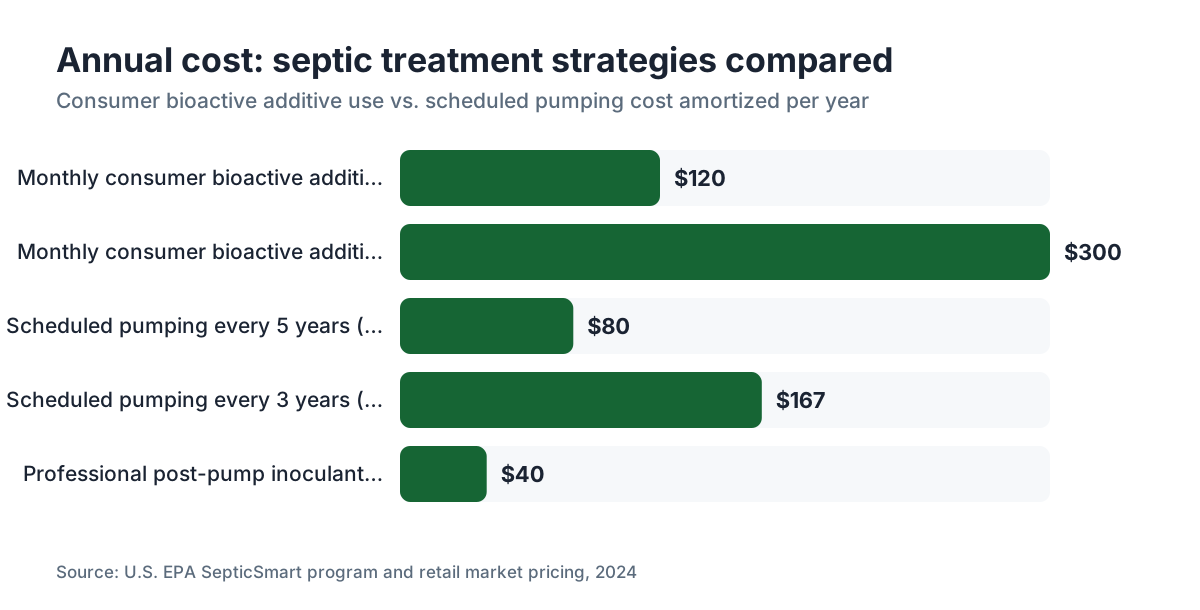
Regular septic tank pumping costs between $300 and $600 for most residential tanks in the U.S., with regional variation, and EPA and extension guidance is to pump every 3 to 5 years depending on household size and tank capacity [2]. A 1,000-gallon tank serving four people typically needs pumping every 3 to 4 years based on the sludge accumulation rates modeled in EPA's 2002 onsite wastewater treatment manual.
Monthly bioactive treatment at consumer retail prices runs $10 to $25 a month, or $120 to $300 a year. Over a 4-year pumping cycle, that's $480 to $1,200 on additive with limited evidence that it stretches the pump interval in any meaningful way.
The one scenario that changes the math is if a treatment, used consistently after pump-outs and during recovery events, genuinely pushes your pump interval from 3 years to 4 or 5. Some practitioners believe it can. No large controlled trial has proven it for consumer products.
For a homeowner on a budget, the priority order the evidence supports is simple. Pump on schedule. Protect the system from harmful inputs (no grease, no wipes, easy on the garbage disposal). Get a septic tank cleaning that includes a baffle inspection. And if you still want bioactive treatment, use it strategically around pump-outs and antibiotic courses, not as a year-round subscription.
Operators tracking fleet maintenance can use service management software to flag the right timing for both pump-outs and post-service inoculant doses. SepticMind is built for that kind of interval-based scheduling across many customer accounts.
For how often to pump septic tank guidance tied to your household size and tank volume, that article walks through the EPA's sludge accumulation model in detail.
What practices actually protect a septic system better than any additive?
This is the section that saves people the most money.
Water conservation is the single best protection for a septic system. Hydraulic overload, pushing more water through the tank than it was built to handle, is a leading cause of drain field saturation and failure [7]. Fixing leaky toilets, spreading laundry across the week instead of doing it all on Saturday, and installing low-flow fixtures all cut the daily hydraulic load directly.
Keeping non-degradables out matters just as much. Wipes labeled "flushable" don't break down in a septic tank on any timeline that helps you. They pile up, clog baffles, and carry solids to the drain field. Dental floss, cotton swabs, and medications do their own kinds of damage.
Keeping harsh chemicals out protects the bacterial population better than any additive can restore it. Bleach in moderate household amounts (one load of laundry, one bowl cleaning) is fine for a healthy tank. A tank hit regularly with large volumes of disinfectants, antibacterial soaps, or drain cleaners will have a chronically suppressed population that no monthly dose fully makes up for.
Pumping on schedule and inspecting baffles is not optional. The inlet and outlet baffles keep scum from floating into the drain field and sludge from getting pushed out during surges. A cracked or missing baffle, caught during a septic tank inspection, is a $100 to $300 fix that heads off a $10,000 to $30,000 drain field replacement [10].
Keep heavy vehicles and deep-rooted plants off the drain field. Compaction cuts the percolation rate the whole system runs on. Tree roots can find their way into distribution pipes within a few years of planting.
Frequently asked questions
Do I need to use a bioactive septic treatment every month?
Monthly use isn't supported by strong evidence for healthy systems. A targeted approach works better: use a bacterial inoculant after a pump-out, after a household antibiotic course, or when restarting a dormant system. For a well-maintained tank with normal household use, the money is better spent on scheduled pumping every 3 to 5 years.
Can bioactive treatments replace septic tank pumping?
No. No biological additive removes the accumulated inorganic solids, non-degradable materials, and inert sludge that build up in a tank over time. EPA recommends pumping every 3 to 5 years regardless of additive use. Products claiming to eliminate pumping are making a claim with no credible supporting evidence.
Is CLR healthy septic system tank treatment safe for my system?
CLR's septic treatment products contain biological cultures and enzymes and aren't known to harm septic systems. CLR septic tank treatment is EPA Safer Choice listed for certain formulations, which indicates ingredient safety screening. The main limitation is efficacy, not safety: like most consumer products, CLR lacks published strain or CFU data that would allow independent comparison.
What happens if I use too much bioactive treatment?
Overdosing a biological additive is unlikely to cause harm. Bacteria don't survive long without a food source, and excess populations simply die off. The practical risk is wasting money, not damaging your system. If you accidentally double-dosed, don't worry about it. Follow normal water use patterns and the tank biology will self-regulate.
Can I use bioactive treatments after using bleach or antibacterial cleaners?
Yes, but wait. Residual bleach in toilet bowl water can kill live bacterial cultures before they reach the tank. Wait 48 to 72 hours after using bleach-based cleaners before flushing a bioactive treatment. Better yet, add it directly through the tank access port if you have one, which bypasses pipe-side chemistry entirely.
Will a bioactive treatment fix a slow drain or sewage smell?
Probably not on its own. Slow drains usually point to a clogged pipe, a full tank, or a failing drain field, all physical problems. Sewage odors indoors suggest a venting issue or a dry trap. A bioactive product won't clear a pipe blockage or restore a saturated leach field. Get the tank pumped and inspected first before spending money on additives.
Are there states where certain septic additives are banned?
Yes. Washington State prohibits chemical solvents and certain inorganic additives under WAC 246-272A. Wisconsin's Chapter SPS 383 restricts additive recommendations for permitted systems. Several states require product registration before sale as a septic treatment. Biological additives are generally not banned, but check your state environmental or health department's onsite wastewater rules.
What's the difference between bacteria-based and enzyme-only septic treatments?
Enzyme-only products contain preformed enzymes that speed up specific biochemical reactions but can't reproduce, so their effect fades within days. Bacteria-based products contain living or dormant microorganisms that can multiply and sustain activity. For anything beyond a short-term digestive boost, look for products that contain both, with named bacterial species and a CFU count per dose.
How long does it take for a bioactive treatment to work?
Bacterial cultures begin multiplying within 24 to 48 hours if conditions in the tank (temperature, pH, absence of harsh chemicals) are favorable. Meaningful improvement in sludge digestion rates, if it happens, is measured over weeks to months rather than days. Don't expect a dramatic short-term change; the effect is gradual and cumulative.
Can I make a homemade bioactive septic treatment with yeast?
The baking yeast home remedy is widely shared online but has no credible evidence behind it. Saccharomyces cerevisiae is not an anaerobic digester and doesn't compete well in a septic tank environment. It's harmless but it doesn't provide the Bacillus-based or anaerobic bacterial strains that do the actual work of breaking down septic waste.
How do I know if my septic tank's bacterial population is actually depleted?
There's no consumer test for this. The practical indicators are: recent heavy antibiotic use, recent pump-out, extended dormancy, unusual sewage odor without a structural cause, or slower-than-normal solids breakdown observed during a pump-out. Short of lab analysis of tank effluent, these are the best proxies available to homeowners and most service technicians.
Do professional septic operators use different products than what's sold in stores?
Yes, typically. Professional-grade biological treatments come with published strain data, usually Bacillus subtilis or B. licheniformis, at concentrations of 10^8 to 10^10 CFU per dose, significantly higher than most consumer retail products. They're also often dosed by volume to tank size rather than by a one-size-fits-all consumer recommendation. Your pumper may offer a post-service inoculant worth asking about.
Sources
- University of Minnesota Extension, "Septic System Additives" review: Biological additives showed no significant benefit on sludge reduction in functioning systems and posed no documented harm; optimal anaerobic digestion pH is roughly 6.8 to 7.4
- U.S. EPA SepticSmart program, onsite wastewater guidance: Most healthy septic systems already contain the bacteria they need; the use of additives is generally not necessary; pumping recommended every 3 to 5 years
- Bioresource Technology journal, 2010, inoculation of septic tanks with exogenous bacteria: Exogenous bacterial inoculation produced marginal BOD reduction improvements that narrowed after 60 days as native microbial communities reestablished dominance; Bacillus species are most studied in anaerobic digestion contexts
- Penn State Extension, Septic System Maintenance: Lipase-containing enzyme products can help a tank process accumulated grease from kitchen overloading
- U.S. EPA Safer Choice program: Safer Choice listing indicates ingredient safety screening but does not certify product efficacy
- U.S. EPA, "A Homeowner's Guide to Septic Systems": Chemical solvents such as methylene chloride and trichloroethylene kill tank bacteria, pass through to groundwater, and create toxic conditions in drain field soil; use is banned or restricted in many states
- U.S. EPA, Onsite Wastewater Treatment Systems Manual (EPA/625/R-00/008): Hydraulic overload and biomat buildup from solids carry-over are leading causes of drain field failure; sludge accumulation rates modeled for pump interval recommendations
- Washington State Department of Health, WAC 246-272A onsite sewage system rules: Washington State prohibits chemical solvents, surfactants, and certain inorganic compounds as septic additives under WAC 246-272A
- University of Nebraska-Lincoln Extension, Septic System Inspection and Maintenance: A cracked or missing septic tank baffle is a $100 to $300 repair that can prevent a $10,000 to $30,000 drain field replacement
- National Environmental Services Center (NESC) at West Virginia University, Septic System Owner's Guide: Bacillus-dominant biological additive formulas have longer shelf lives and are most studied; consumer products typically carry 10^6 to 10^9 CFU per dose
Last updated 2026-07-09