Massachusetts septic system replacement cost: $15,000 to $35,000 explained
By the SepticMind Editorial Team
TL;DR
- Replacing a septic system in Massachusetts usually costs $15,000 to $35,000, and most homeowners land between $18,000 and $28,000.
- The spread comes from lot size, soil, system type, and town permit fees.
- Title 5 governs every replacement in the state.
- Tight soil, a high water table, or a nitrogen-sensitive watershed almost always pushes you toward the top of the range.
What does septic system replacement cost in Massachusetts?
Most Massachusetts homeowners pay $15,000 to $35,000 to replace a failed septic system, and difficult lots run higher. The Massachusetts Department of Environmental Protection's Title 5 regulations (310 CMR 15.000) set the design and construction standards every replacement must meet, and they are stricter than most other states [1]. That strictness is a big reason costs here beat the national average.
A basic gravity-fed system on a flat lot with good sandy soil sits at the low end, often $15,000 to $20,000. A system that needs a pump, a pressure-dosed leach field, or a nitrogen-reducing alternative technology like a Presby Environmental system or a SeptiTech unit reaches $25,000 to $35,000 fast. Add a tight lot, a high seasonal groundwater table, or a wetland buffer zone next door, and you can clear $40,000.
These are real quotes from the Massachusetts market, not national survey averages. County matters too. Contractors in Barnstable County (Cape Cod) and Dukes County (Martha's Vineyard) routinely charge more than contractors in Worcester or Hampshire counties, because demand is higher, local board of health rules are tighter, and working near coastal wetlands costs more.
Permit fees alone add $500 to $2,500 depending on the town. The local board of health has to approve the design before any work starts, and in some towns that approval takes four to eight weeks [1].
What factors drive the cost up or down?
Soil is the single biggest variable. Massachusetts soils range from fast-draining glacial outwash, which is ideal for a leach field, to dense glacial till and clay that barely percs. When a soil evaluation shows slow percolation, the engineer has to design a much larger leach area or specify an engineered system with pressure dosing. Both cost more. Percolation testing and deep-hole soil evaluation together run $800 to $2,000 before design even starts [2].
Lot size and setbacks dictate where the new system can go. Title 5 requires at minimum 10 feet from a property line, 25 feet from a private well, 50 feet from a surface water body, and 100 feet from a public well [1]. On a small or oddly shaped lot, the engineer may need a fancier design to squeeze in a compliant system, or you may need a variance from the board of health.
Household size matters, but not the way you think. Title 5 sizes systems by bedroom count, not actual water use. A three-bedroom house requires a minimum 1,000-gallon tank; a four-bedroom requires 1,500 gallons [1]. Adding a bedroom later triggers a system upgrade, so plan for that if a renovation is coming.
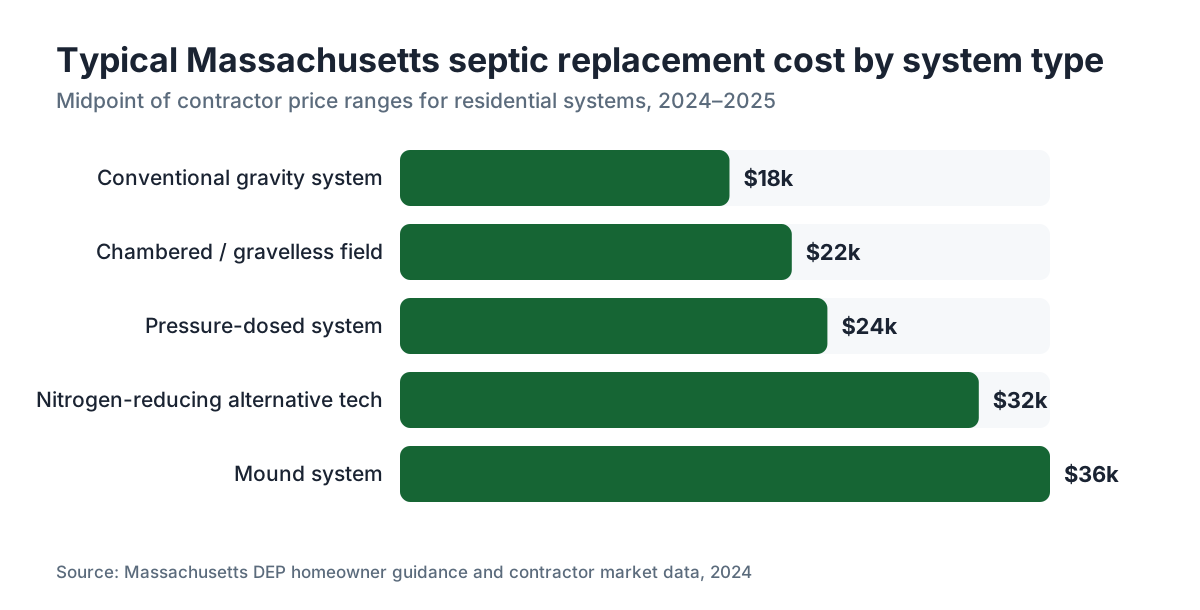
System type is the other big driver. Here is a quick comparison.
| System type | Typical MA cost range | When it's required |
|---|---|---|
| Conventional gravity system | $15,000 to $22,000 | Good soil, adequate lot size |
| Pressure-dosed system | $20,000 to $28,000 | Shallow depth to groundwater or soil |
| Chambered or gravelless field | $18,000 to $26,000 | Moderate soil, space constraints |
| Nitrogen-reducing alternative (e.g., Presby, SeptiTech) | $25,000 to $40,000 | Nitrogen-sensitive watersheds, Cape/Islands |
| Mound system | $28,000 to $45,000 | High groundwater, impermeable soil |
Labor in eastern Massachusetts, especially the South Shore, Cape Cod, and the North Shore, runs among the highest in the state. Plan on 15 to 25 percent more than western Massachusetts for the same scope.
What does Title 5 require for a septic replacement in Massachusetts?
Title 5 (310 CMR 15.000) is the Massachusetts state sanitary code for onsite wastewater, and it drives every design decision on your project. The EPA points to it as one of the more rigorous state septic codes in the country [3]. Every replacement gets designed by a licensed site evaluator and a professional engineer, submitted to the local board of health, and inspected by a board of health agent at several stages during construction.
The regulation requires a full system inspection report before a property sale, and it sets hard design standards: minimum tank size by bedroom count, minimum leach area by soil percolation rate, setbacks from wells and water bodies, and depth-to-groundwater minimums [1]. The state tightened several provisions in 2006 to manage nitrogen near Zone II drinking water protection areas and coastal embayments, which is a big reason Cape Cod replacements cost more.
If your existing system fails a Title 5 inspection, you generally have two years to replace it, though the board of health can shorten that window if there is an active public health risk [1]. "Failure" here has a precise definition. It includes backup into the building, discharge to the ground surface, and hydraulic failure of the leach field, among other conditions.
Massachusetts DEP publishes the full Title 5 text and a plain-language homeowner guide on its website [1]. Read the homeowner guide before you meet with an engineer. It will save you time and help you ask sharper questions.
How much does a Title 5 inspection cost before replacement?
A Title 5 inspection costs $300 to $700 in most Massachusetts towns, and inspectors on the Cape and Islands often charge $500 to $900. It has to be done by a state-licensed inspector, not a general home inspector [9].
The inspection covers the tank, the distribution box, and the leach field. Inspectors usually pump the tank during the visit, which adds $250 to $500. If the system passes, the report is valid for two years for a sale, or three years if the system was pumped within the prior year [9].
If it fails, the report documents which components failed and why. That report becomes the foundation for your engineer's replacement design. Do not throw it away. Your engineer needs it, your board of health needs it, and your lender may need it.
You can read about septic tank inspection costs and what inspectors actually look for if you want to understand what happens before any replacement decision gets made.
Can you replace just the leach field without replacing the tank?
Sometimes, yes. If the tank is structurally sound, has good baffles, and meets the minimum volume for your bedroom count, the engineer can design a replacement that keeps it. That cuts $3,000 to $8,000 off a full system replacement.
But there are catches. The tank still has to be inspected and pumped. If it has cracked walls, a collapsed inlet or outlet baffle, or is made of steel (which corrodes), it goes. Plenty of older Massachusetts tanks are steel or undersized concrete, and they usually get replaced in the same project. A septic tank repair or septic system repair may be all you need if the leach field still works.
The leach field is often the first thing to fail, especially in systems that never got pumped on schedule. When solids overflow the tank into the distribution box and field, the biomat that forms in the soil pores can make that soil permanently unable to absorb effluent. At that point there is no repair. The field has to be replaced, and it needs a new location.
If your lot has no second field area, the engineer looks at other routes: a mound system, a pressure-dosed system in a smaller footprint, or an alternative technology. All of them cost more.
What financing options are available for Massachusetts homeowners?
Septic replacement is not optional once Title 5 says you failed. That makes financing urgent for a lot of families.
The Massachusetts Clean Water Trust (formerly the State Revolving Fund) runs a septic loan program through local boards of health. Loans come at subsidized rates, often 2 to 5 percent, up to $25,000 per household, repayable over 20 years. Some towns run their own version with slightly different terms [4]. Not every town participates, so call your board of health first.
The USDA Rural Development program (Section 504) offers grants and loans for very low-income rural homeowners. Loans go up to $40,000 at 1 percent interest; grants up to $10,000 go to homeowners 62 and older who cannot repay a loan [5]. Eligibility is income-based and tied to rural area designations.
Home equity loans and HELOCs are the most common path for homeowners who do not qualify for state programs. Rates ride your credit and the market, and the interest is often deductible if the money goes to home improvement.
Some Cape and Islands towns run Title 5 betterment programs, where the town finances the work and you repay it through a property tax surcharge over 10 to 20 years. Ask your local DPW.
The EPA SepticSmart program notes that "properly maintained septic systems protect public health, our water resources, and property values" and pushes homeowners to plan for replacement before failure forces an emergency job [3]. An emergency job always costs more than a planned one.
How do you get an accurate quote from a Massachusetts septic contractor?
Get at least three quotes, and make sure all three price the same engineered design. That is the only way to compare apples to apples. Call contractors and describe your situation over the phone, and you will get ballpark numbers that swing $10,000 or more, because each one is guessing at different assumptions.
The process runs like this. You hire a licensed site evaluator or engineer to do the soil evaluation and design. The design goes to the board of health for approval. Once it is approved, you send the approved design to contractors for bids. Now you can compare price on identical scope.
Engineering and design fees run $2,000 to $6,000 for a typical residential replacement, and that cost is not baked into most contractor quotes. It is a separate line item you pay the engineer directly [2].
When you read quotes, look for these line items: tank excavation and removal, new tank supply and installation, distribution box, leach field materials and labor, trucking and disposal of excavated material, backfill, loam and seeding, and permit fees. If a quote looks suspiciously low, ask which of those items it left out.
SepticMind's service operator tools help septic contractors manage job estimates, inspection records, and permit documentation in one place, which can cut the back-and-forth on your project if your contractor uses it.
Verify that your contractor holds a valid Massachusetts Disposal System Installer license. The state issues it through the Board of Registration of Disposal System Contractors, and you can check license status through the Massachusetts Division of Professional Licensure [6].
What hidden costs should you budget for?
The quoted price rarely covers everything. Here are the costs that ambush homeowners.
Rock or ledge removal. Massachusetts is glacial terrain, and ledge is common in a lot of towns. Hitting ledge during excavation can add $3,000 to $15,000, and there is no reliable way to know it is down there until the excavator hits it. Some engineers write a ledge contingency into the contract. Make sure yours does.
Drainage and grading. After the system goes in, the torn-up area needs topsoil, grading, and seeding or sod. That often runs $1,500 to $4,000 and is sometimes left out of the base quote.
Tree removal. If trees fall inside the setback zone for the new field, they come out. Stump grinding and removal adds $500 to $3,000 depending on size and count.
Pumping during construction. The existing tank gets pumped before it is decommissioned. That runs $250 to $500. If the job stretches over several days, you may need portable sanitation on site, another $150 to $300.
Replanning after a failed perc. If the first soil evaluation finds no suitable spot for a conventional system, you pay for a second evaluation or an alternative system design. That adds $1,000 to $3,000 in engineering fees.
Once the system is in, set a pumping schedule and keep it. Most Massachusetts systems should be pumped every three to five years, and frequent pumping is cheap insurance on a $25,000 investment [7]. Learn more about how often to pump your septic tank and what changes that interval.
Does homeowners insurance cover septic replacement in Massachusetts?
Standard homeowners policies in Massachusetts do not cover septic replacement from normal wear, aging, or gradual failure. Full stop. This blindsides a lot of people.
Some policies cover sudden and accidental damage, like a contractor puncturing a tank with an excavator. The slow biomat failure of a leach field that has been overloaded for ten years is not that. Home warranty plans vary a lot; most either exclude septic outright or cap coverage at a small slice of replacement cost.
A few specialty products marketed as "septic insurance" or "service line coverage" exist, but read the fine print. Coverage limits of $5,000 to $10,000 are common, and they usually exclude the leach field, which is where most of the replacement cost lives.
Plan on paying for replacement yourself. The financing options above (state loan programs, USDA, HELOCs) are your realistic tools.
How long does septic replacement take in Massachusetts?
From the moment you decide to replace to the moment the health agent signs off, plan on three to six months. That sounds long, but permitting and scheduling are the slow parts, not the digging.
Soil evaluation and engineering: two to six weeks depending on engineer availability and how tricky the soil is.
Board of health review and approval: two to eight weeks. Some towns hold one meeting a month, which stretches this out.
Contractor scheduling: one to six weeks. In peak season (May through October), the good contractors book out fast.
Actual construction: two to five days for a standard replacement. Complex systems, ledge removal, or mounding can run one to two weeks.
Final inspection and signoff: one to two weeks after construction.
Winter is a mixed bag here. You can install in winter if the ground is not deeply frozen, and some contractors like it because scheduling is easier. But frozen ground makes excavation harder and may force frost protection for new components. Engineers and boards of health generally prefer spring through fall installs.
What should you do right after a failed Title 5 inspection?
First, do not panic. A failed inspection is common, and the fix follows a well-worn path. Second, do not try to repair the system yourself. Any work on a Title 5 system without permits is illegal and can foul up the replacement permitting.
Call a licensed site evaluator or septic engineer within a few days of getting the failed report. They will review it and schedule the soil evaluation. The two-year replacement window sounds generous, but engineering, permitting, and contractor scheduling eat time fast, especially if your board of health meets rarely or you are in a high-demand area like the Cape.
Tell your board of health you got a failed report. They usually already know, because the inspector files the report with them, but confirming receipt and your intent to replace shows good faith and can buy you a little timeline flexibility.
Keep the system working in the meantime. Pump the tank if it has not been pumped recently. Cut water use: fix leaky faucets, spread laundry across the week, and use water-efficient fixtures. The goal is to stop effluent from backing up into the house or surfacing in the yard while you work through the process.
Regular septic tank pumping and septic tank cleaning during the interim can buy time and keep the system technically functional. Pumping runs $300 to $600 in Massachusetts. That is cheap if it heads off a public health emergency before the new system is in.
Are there ways to reduce the cost of septic replacement in Massachusetts?
Yes, though the honest answer is that Title 5 leaves less room for cost-cutting than most homeowners hope.
Choose a conventional system if your soil and lot allow it. Do not let a contractor upsell you to an alternative technology you do not need. The engineer's design drives this, not the contractor. If the design calls for a conventional system and a contractor quotes alternative tech without explanation, ask why.
Get multiple bids. A $5,000 to $8,000 spread between contractors bidding the same approved design is normal and is legitimate price shopping. Contractors carry different overhead, equipment, and supplier relationships.
Time the job for late fall or early winter if you can. Contractor demand drops, and some shops discount work in that window.
Apply for state loan programs early. The interest savings over 20 years on a $25,000 loan at 3 percent versus 8 percent (home equity) is roughly $9,000 to $10,000 in real money. That is worth the paperwork.
Maintain the new system from day one. A system pumped on schedule and kept clear of grease, wipes, and excessive water can last 25 to 40 years. A neglected one may need a new leach field in 10 to 15. A septic tank pump out every three to five years is trivial next to another field replacement.
Weighing full replacement against targeted repair? See our comparison of septic system repair options and their costs.
Frequently asked questions
Why does septic replacement cost so much more in Massachusetts than in other states?
Title 5 requires licensed engineers to design every system, licensed inspectors to certify it, and multiple board-of-health inspections during construction. Those requirements add $3,000 to $8,000 in professional fees before a shovel hits the ground. Add high northeast labor costs, strict setbacks that force more complex designs, and nitrogen rules near coastal areas, and Massachusetts stays among the most expensive states for septic work.
How long does a new septic system last in Massachusetts?
A well-maintained conventional system usually lasts 25 to 40 years here. The leach field sets the clock. Skipping tank pumping is the top cause of early field failure, because solids overflow and clog the soil. Systems in nitrogen-sensitive watersheds that use alternative technology have mechanical parts (pumps, timers, blowers) that need service or replacement every 7 to 15 years.
Can I get a variance to reduce the cost of my replacement system?
Yes. Title 5 lets local boards of health grant variances from certain setback and design requirements when strict compliance is physically impossible on a lot. Variances are not guaranteed and usually require a hearing, sometimes neighbor notification, and a technical justification from your engineer. A variance does not cut construction cost directly, but it can allow a simpler design on a tight lot, which can beat the cost of a fully alternative system.
Do I need a new septic system to sell my house in Massachusetts?
Not necessarily, but you do need a passing Title 5 inspection report dated within two years, or three years with recent pumping. If the inspection fails, you either replace the system before closing or escrow funds for replacement and disclose the failure to the buyer. Some buyers take on a failed system at a price reduction; others walk. A failed inspection rarely kills a sale outright, but it always complicates it.
What is the Massachusetts septic loan program and how do I apply?
The Massachusetts Clean Water Trust's septic loan program provides low-interest loans (often 2 to 5 percent) up to $25,000 for homeowners replacing failed Title 5 systems. You apply through your local board of health or municipality, not directly to the state. Not every town participates. Call your board of health first to confirm availability and get the application, then expect a two to six week approval once you submit a complete one.
How much does engineering and design cost for a Massachusetts septic replacement?
Engineering and design usually costs $2,000 to $6,000 for a standard residential replacement in Massachusetts. That covers the soil evaluation (deep test holes and possibly a perc test), system design, permit drawings, and the engineer's time for board-of-health review. Complex systems on difficult lots can push fees past $8,000. Engineering is billed separately from contractor costs and paid directly to the engineer or site evaluator.
What happens if I can't afford to replace my failed septic system right away?
Title 5 gives you two years to replace a conditionally failed system, but the board of health can shorten that if there is an active public health risk like surface breakout. In the interim, pump the tank more often to cut leach field loading, reduce household water use, and avoid flushing anything that speeds failure. Apply for state and federal loan programs right away. The USDA Section 504 program offers grants up to $10,000 for very low-income homeowners over 62.
Is a mound system always the most expensive option in Massachusetts?
Mound systems are among the most expensive, usually $28,000 to $45,000, because they require importing large amounts of engineered fill and building an above-grade system. But in situations where nitrogen-reducing systems are also required (Cape Cod, the Islands, certain watersheds), that alternative technology can approach or beat mound costs. Your engineer will tell you which options are legally permissible on your specific lot.
Do Massachusetts towns have different rules than state Title 5 requirements?
Yes. Local boards of health can adopt rules stricter than Title 5 but never more permissive. Barnstable County towns on Cape Cod carry some of the strictest local rules in the state, especially around nitrogen. Falmouth, Sandwich, and several other towns require nitrogen-reducing systems in certain watersheds regardless of what state Title 5 would otherwise allow. Always check the local board of health before assuming the state minimum applies.
What is the cost difference between replacing just the leach field versus the whole system?
Leach field-only replacement usually costs $8,000 to $18,000 in Massachusetts if the tank can stay. Full replacement (tank plus field) runs $15,000 to $35,000. The savings from keeping the tank are real but hinge entirely on the tank's condition. Most engineers insist on a camera or physical inspection of the tank before committing to a partial job. A steel tank, an undersized tank, or one with bad baffles should be replaced with the field.
How do I find a licensed septic installer in Massachusetts?
The Massachusetts Division of Professional Licensure maintains the license registry for Disposal System Contractors, and you can verify any installer's status on its site. Your engineer or local board of health can also refer licensed contractors active in your town. Always verify the license before you sign a contract. Working with an unlicensed contractor on a Title 5 system can void your permits and create personal liability.
Will my property value go up after septic replacement?
Generally yes, though pinning down the exact figure is hard because septic condition is rarely isolated in home sale data. A passing Title 5 report clears a major obstacle to sale and removes a known negotiating chip for buyers. Properties with failed systems routinely sell $10,000 to $30,000 below comparable homes with passing systems in Massachusetts markets. A new system erases that discount and adds the assurance of 25 to 40 years of remaining life.
Can alternative septic technologies reduce long-term costs despite higher upfront prices?
In nitrogen-sensitive areas where alternative technology is required by the board of health, you have no choice, so the upfront comparison is moot. Where it is optional, alternative systems cost more to install and require annual maintenance contracts with the manufacturer or a certified operator, adding $300 to $800 a year. The environmental benefits are real, but if a conventional system is permitted on your lot, it will almost always be the lower total-cost option over 30 years.
Sources
- Massachusetts DEP, Title 5 Regulations (310 CMR 15.000): Title 5 setback requirements, minimum tank sizes by bedroom count, definition of system failure, and two-year replacement timeline for failed systems
- Massachusetts DEP, Homeowner's Guide to Septic Systems: Engineering and soil evaluation costs for Massachusetts residential septic replacements and the design approval process
- US EPA, SepticSmart Program: EPA statement that properly maintained septic systems protect public health, water resources, and property values; Massachusetts Title 5 described as a rigorous state code
- Massachusetts Clean Water Trust, Septic Loan Program: State revolving fund septic loan program offering subsidized rates, up to $25,000 per household, administered through local boards of health
- USDA Rural Development, Section 504 Home Repair Program: USDA Section 504 loans up to $40,000 at 1 percent interest and grants up to $10,000 for eligible very low-income rural homeowners age 62 and older
- Massachusetts Division of Professional Licensure, Disposal System Contractors: Massachusetts requires a Board of Registration Disposal System Installer license for septic system construction; license status verifiable through DPL
- US EPA, How to Care for Your Septic System: EPA guidance recommending septic tanks be pumped every three to five years as part of routine maintenance to protect the leach field
- Massachusetts DEP, Innovative and Alternative Septic Systems: Title 5 provisions for alternative technology systems, nitrogen-reducing requirements in sensitive watersheds including Barnstable County
- Massachusetts DEP, Title 5 Inspection Program: Inspection report validity periods (two years for sale, three years with recent pumping) and requirement for licensed inspector
- University of Massachusetts Extension: Background on Massachusetts soil types, leach field lifespan, and the role of pumping frequency in system longevity
Last updated 2026-07-09