How long is a perc test good for? State rules explained
By the SepticMind Editorial Team

TL;DR
- A perc test usually stays valid for 2 to 5 years, though the rules swing hard by state and county.
- Some jurisdictions accept results for up to 10 years, and a few never expire them if the site is undisturbed.
- The clock runs from the test date, not your permit date, so an old test can force a new site evaluation costing $150 to $3,000 before you break ground.
What is a perc test and why does it expire at all?
A percolation test measures how fast water moves through soil. A technician digs test holes, saturates them, then times how many minutes it takes for the water level to drop one inch. That rate, expressed in minutes per inch (MPI), tells the designer how big a drain field you need and whether a conventional gravity-fed septic system will work on your land at all. [1]
Results expire for a practical reason, not a bureaucratic one. Soil conditions move. A drought year reads differently than a wet one. Development uphill shifts the local water table. A lot can sit untouched for years while its soil profile changes, and a test run in August may not reflect what the ground does in February. Health departments want the data driving a septic design to still be current.
There's a regulatory rationale too. Old tests were sometimes used to justify undersized systems, which meant drain fields that failed early. Putting an expiration date on results forces a fresh look before a permit issues. Some states police this harder than others, and the gap between them is wider than most homeowners expect.
How long is a perc test actually valid in most states?
It depends entirely on where the property sits. There is no federal standard. The EPA sets broad guidance for onsite wastewater systems through its septic program but leaves validity periods to state and local health authorities. [2]
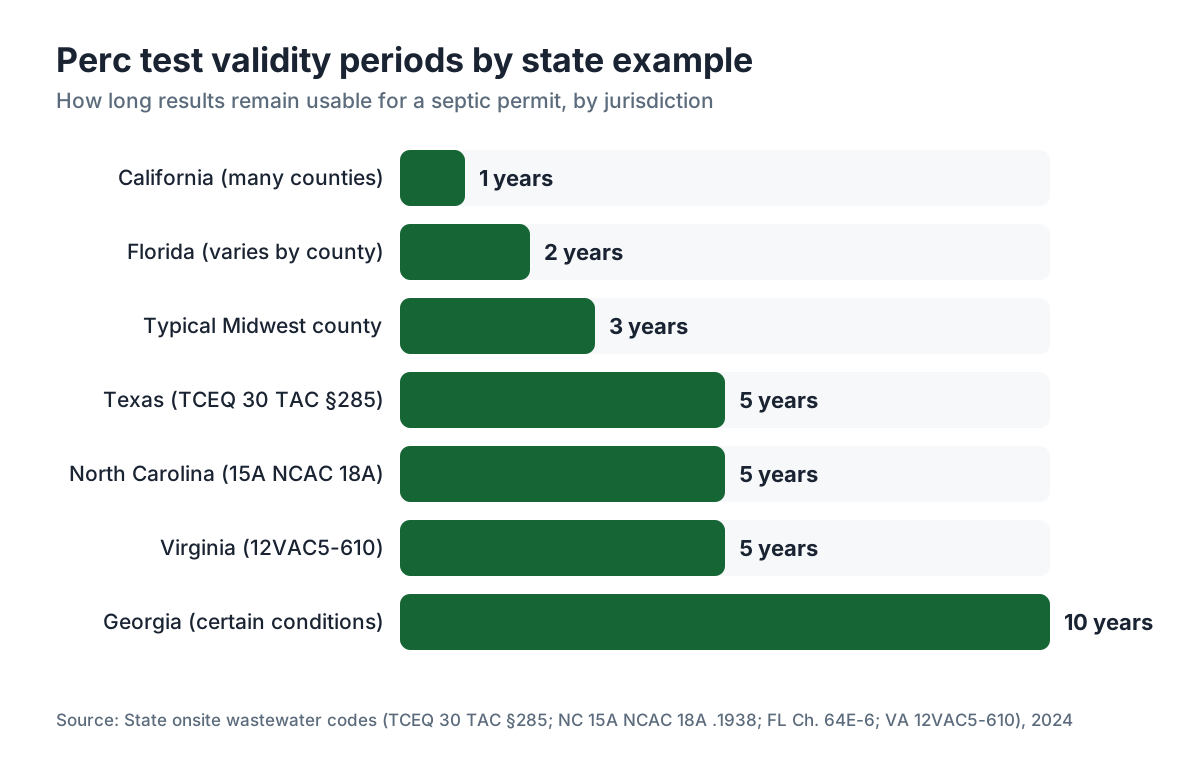
A pattern does exist, though. The most common window across U.S. counties is two to five years, and five years is the single most frequently cited limit in state regulations. Here's a rough breakdown pulled from publicly available state codes:
| Validity Period | Example States / Notes |
|---|---|
| 1 year | Some California counties; Nevada in certain soil classes |
| 2 years | Several New England counties; parts of Florida |
| 3 years | Common in Midwest rural counties |
| 5 years | Texas [3], North Carolina [4], many Mid-Atlantic states |
| 7 to 10 years | Georgia under certain conditions; some Montana counties |
| Indefinite / no expiration | A few rural western counties if no site changes occur |
Texas sets a five-year limit under 30 TAC §285 for standard site evaluations. [3] North Carolina's rules under 15A NCAC 18A .1938 also allow five years. [4] California is the wild card: some counties give you two years, others one, and a handful tie validity to the permit application rather than a fixed clock.
Here's the safe assumption if you can't find your county's rule fast. Treat anything older than two years as needing confirmation before you spend a dime on septic design. A five-minute call to your county sanitarian's office settles it for your parcel.
What events can void a perc test before it officially expires?
Expiration dates are the easy part. A test that's technically still valid can get rejected if things have changed on or near the property. Most health departments keep the right to demand a retest regardless of age when any of these apply.
Grading or land disturbance is the big one. If someone has moved dirt, dug a pond, or changed drainage patterns since the original test, the soil profile that test measured may no longer exist. Officials see this often on lots that sat vacant for years while nearby development reshaped the land.
A change in system type matters too. If the original test supported a conventional gravity system but you now want a mound or drip irrigation, some states require new testing, because different systems carry different loading rates and setbacks.
A change in intended use can also void it. A test done when the lot was zoned for a single-family home may not support the design flows for a duplex or a small commercial building, even when the soil data itself hasn't budged.
Documented site changes count: wetland expansion, or a rise in the seasonal high water table. Several southeastern states require wet-season testing, and a test run in August in Georgia may get challenged by an officer who sees standing water in February.
Last, a change in the rules. If regulations tightened after your test was done, the old results may fail current standards even though they haven't technically expired.
Does a perc test expiration date reset when you apply for a permit?
No, and this is where homeowners get burned. The validity clock almost always runs from the date the test was conducted, not from when you use it. Applying for a permit does not extend the test's life. If your test was done four years ago in a county with a three-year limit, it's expired, permit process or not.
A few states tie the validity window to permit application or approval instead of the test date, which works differently. In those cases, a permit approved before expiration can sometimes carry a test result forward through construction. That's the exception.
The practical lesson is simple. If you bought raw land with a perc test in the disclosure package, check its date immediately, then call the county to confirm the current validity window. Don't assume the test is good just because the seller framed it that way. Real estate agents cite perc tests as proof a lot is buildable all the time without checking whether the results still sit inside the regulatory window.
How much does it cost to get a new perc test if yours has expired?
This is the part that stings. A fresh perc test runs from $150 on the low end in rural counties with simple procedures to $3,000 or more in areas with hard geology or states that require a licensed engineer to conduct the evaluation. [5]
The wide range comes from a few things. Some counties run the test themselves and charge a modest permit fee. Others require a licensed soil scientist or professional engineer, whose time plus lab analysis drives the cost up. Difficult soils, high water tables, and long required saturation periods (some counties mandate 24 hours before testing) push the number higher. A large or variable site that needs multiple test holes costs more again.
For context, the cost to install a septic system runs from roughly $3,000 to $15,000 or more depending on system type and region. [6] A retest fee of $500 to $1,000 is real money, but it's small next to what you'd spend designing to the wrong soil data and fixing a failed drain field later. A failed leach field replacement alone commonly runs $5,000 to $20,000. [7]
If your test expired by only a few months, ask the health department straight up whether they'll accept it with a written statement that site conditions haven't changed. Some will. Some won't. Asking costs nothing.
Can you extend a perc test without redoing the full test?
In some jurisdictions, yes. A handful of states allow a soil evaluation update or site re-inspection, where a licensed professional revisits the site, confirms nothing has changed, and signs off on extending the existing results. This usually costs less than a full retest because it skips the dig and the saturation protocol.
North Carolina lets the original soil scientist or a licensed contractor submit a written statement confirming the site is unchanged, which can restart the clock without full retesting under certain conditions. [4] Other states have no such provision, so you start from scratch.
Where the extension exists, it usually requires the original test to fall inside a specific lookback period, often no more than twice the standard validity window. A test that's eight years old in a five-year state probably can't be extended. It just gets redone.
Operators who run scheduling and workflow platforms like SepticMind can set automated reminders tied to test dates, which is one practical way service companies track these windows across a large portfolio of properties.
Does an expired perc test mean the land can't be built on?
No. Expiration means the results can no longer be used to pull a permit, not that the land is unbuildable. A lot that passed once will almost certainly pass again unless something dramatic changed in the soil or water table. Passing is what matters. The expiration is paperwork, not a condemnation.
The real risk runs the other way: a lot that failed its original test. Owners of those parcels sometimes wait, hoping time changes the outcome. It won't. Soil permeability comes from geology, not the calendar. A clay-heavy site that couldn't absorb water in 2018 reads the same in 2025. The one exception is major land improvement, like deep tilling and soil amendment, which some jurisdictions accept as remediation.
For buyers, a disclosed failed perc test is a hard signal, not a negotiating footnote. Some lots genuinely can't support conventional septic, and alternative systems (mound, aerobic treatment unit, drip irrigation) need more land, more maintenance, and much higher install costs. The cost to put in a septic tank can double or triple with an alternative system. [5]
How is a perc test different from a full soil evaluation, and does that change the expiration?
A perc test is one measurement: the timed drop of water in a test hole. A full soil evaluation (also called a soil morphology assessment or site evaluation) goes further. A trained soil scientist examines the soil profile at multiple depths, finds the seasonal high water table through indicators like mottling and gley colors, characterizes texture and structure, and maps setbacks from wells, property lines, and surface water. [1] This distinction trips up a lot of buyers.
Many states have dropped the standalone perc test and now require the full soil evaluation instead. The EPA's Onsite Wastewater Treatment Systems Manual notes that percolation tests alone can mislead in fine-textured soils or during unusually wet or dry conditions, and that morphological methods often give more reliable long-term predictions of soil hydraulic loading capacity. [1]
Expiration rules usually apply the same to both, though a full evaluation done by a licensed soil scientist tends to get more deference from a health department when you ask about an extension. In states that let soil morphology replace a perc test entirely (North Carolina, Virginia, and many others), the validity periods match but the process to get new results differs. Check your state's onsite wastewater regulations. Most live on the state health department or environmental quality agency website.
What should you do before buying land with an existing perc test?
Four steps, in order.
Get the actual test report, not the seller's verbal summary. A real report lists the date, the test hole locations, the observed percolation rate in minutes per inch, who conducted the test (licensed soil scientist, county health officer, engineer), and the issuing agency's review stamp if one was required. If the seller can't produce this document, assume the test may not exist in a usable form.
Call the county health department or environmental health office and read them the report date and parcel number. Ask whether the results still sit inside the validity window and whether anything on the site or in the rules has changed since the test. This call takes ten minutes and costs nothing.
Check whether the test covered the right system type and design flow. A test sized for a two-bedroom house may not legally support the four-bedroom structure you're planning, even when the soil data is identical.
If there's any doubt, negotiate a contingency. A contract clause letting you commission a fresh site evaluation before closing is standard practice in rural land deals and protects you from buying a lot that can't legally get a septic permit. A septic tank inspection of an existing system on an adjacent lot can also give you proxy data on how the local soil performs.
There's no shame in asking the seller to pay for a fresh test as a condition of sale, especially when the existing test is close to expiration.
Do perc test rules differ for commercial versus residential properties?
Yes, and commercial rules are usually stricter. Residential design flows come from a simple formula tied to bedroom count, typically 100 to 150 gallons per bedroom per day as a default. [1] Commercial properties have far more variable flows, so health departments often require engineered designs backed by tougher site evaluation.
For commercial uses, some states require the perc test or soil evaluation to be conducted and stamped by a licensed professional engineer rather than a soil scientist or county technician. That changes both the cost and the renewal process. A commercial test may be site-specific and tied to one design, and modifying that design can trigger a full reassessment no matter when the original test was done.
The expiration period for a commercial perc test is often the same as residential in the same jurisdiction. The stakes of letting one lapse mid-project are higher, though, because the permitting chain (building permit, health permit, sometimes environmental review) is more tangled. If you run a septic service company serving commercial clients, tracking test expiration dates systematically across a client portfolio is where workflow tools earn their cost.
How do you find your state's specific perc test validity rules?
Go to the primary source, in this order of authority.
Your county's environmental health or public health department website. Most post their onsite wastewater regulations or at least a permit guide. Search the county name plus terms like "onsite sewage", "septic permit", or "soil evaluation".
Your state's environmental or health agency. Most states centralize their onsite wastewater rules in one regulation. Examples: the Texas Commission on Environmental Quality under 30 TAC Chapter 285 [3]; North Carolina DHHS under 15A NCAC 18A Subchapter .1900 [4]; the Florida Department of Health under Chapter 64E-6 FAC [9]; the Virginia Department of Health under 12VAC5-610 [10]. All are searchable on the agency sites.
The EPA's septic program pages cover onsite wastewater generally and reference state variation in testing standards. [2]
If you're a soil scientist or contractor working across counties, the National Onsite Wastewater Recycling Association keeps state-by-state regulatory summaries that get updated periodically. [8]
One caution: skip third-party real estate or legal sites for validity periods. They're often out of date or mix one state's rules with another's. The primary source is the only one worth trusting here.
Frequently asked questions
How long is a perc test good for in Texas?
Texas sets a five-year validity period for standard site evaluations under 30 TAC §285. If your evaluation is older than five years, you'll need a fresh test before the Texas Commission on Environmental Quality or a local authorized agent issues an on-site sewage facility permit. Significant site changes can invalidate the results earlier regardless of age.
How long is a perc test good for in North Carolina?
North Carolina allows perc test and soil evaluation results to be used for five years under 15A NCAC 18A .1938. Under certain conditions, a licensed soil scientist can submit a written site-unchanged statement to extend results without a full retest. Contact your county health department to confirm whether an extension is available for your specific parcel.
How long is a perc test good for in California?
California has no single statewide rule. Validity periods are set county by county. Most California counties set the window at one to two years, and some tie expiration to permit issuance rather than test date. Call your county environmental health department with the test date and parcel number to get a definitive answer before spending money on septic design.
Can a seller use an old perc test to market a lot as buildable?
A seller can put a historical perc test in a disclosure package, but a buyer shouldn't accept it as proof of current buildability without confirming the test still sits inside the county's validity window and that no site changes have occurred. An expired test has no permit value. Always call the county health department before closing on raw land.
What happens if I start building and my perc test expires mid-construction?
It depends on the jurisdiction. In many states, once a permit issues on valid test results, construction can proceed even if the underlying test would have expired by the time you finish. In others, a lapsed test can stall inspections. Ask your county at permit issuance exactly what happens to permit validity if construction runs past the test's expiration date.
How long does a perc test take to complete?
The physical test usually takes four to eight hours on site, including the required pre-saturation period. Some jurisdictions require the test holes to soak 24 hours before the timed measurement, which stretches it to two days. Add two to four weeks to schedule with the county or a licensed soil scientist, plus another week or two for the written report.
Can I do my own perc test, or does it have to be done by a professional?
Most states require the test to be conducted or witnessed by a licensed professional: a soil scientist, sanitarian, or professional engineer. Some rural counties still allow owner-conducted tests with county oversight, but those are increasingly rare and often accepted only for simple systems. A test you dig yourself without official oversight has no permit value in most jurisdictions.
What perc rate is needed to pass for a standard septic system?
Most states set the passing rate at 60 minutes per inch or faster, meaning water drops at least one inch in 60 minutes. Some states are more permissive (up to 120 MPI), others stricter. Very fast rates (under 1 MPI) can also fail, signaling soil too coarse to treat wastewater. Check your state's onsite wastewater code for the exact thresholds.
Does a perc test tell me how big my septic drain field needs to be?
Yes, that's one of its main outputs. The percolation rate, combined with the design flow (based on bedrooms or fixture units), sets the required absorption area for the drain field. Slower soil means more square footage of leach field. Your county health department or design engineer plugs the MPI rate directly into the sizing formula set by state regulation.
If my perc test expired, do I have to pay the full cost again?
Usually yes, though some jurisdictions offer a reduced-fee site re-inspection if the original test isn't too far past the validity window and conditions appear unchanged. A full retest with a licensed soil scientist typically runs $250 to $1,500 depending on location and soil complexity. Ask the county whether a re-inspection option exists before scheduling a complete redo.
Does a perc test expiration affect an existing septic system, or only new construction?
Perc tests apply to new system permitting and to major repairs or replacements that need a new design. An existing, permitted septic system on a developed property is not affected by test expiration. The test is a design-phase document. If you're replacing a failed drain field, though, some counties require updated soil testing before approving the replacement design.
Are perc test results transferable if I sell the property?
Yes. Perc test results run with the land, not the person who paid for them. A buyer can use a seller's valid test results to apply for a septic permit, as long as the test still sits inside the jurisdiction's validity window and was conducted by a qualified professional. Confirm the test hasn't expired and that no site conditions have materially changed since it was done.
What's the difference between a perc test and a perk test?
They're the same thing. "Perc" is short for percolation and "perk" is a phonetic spelling of the same word. Both refer to the soil percolation test used to determine drain field sizing and septic system suitability. You'll see both spellings in regulations, real estate listings, and contractor invoices. The procedure, validity rules, and permit implications are identical regardless of spelling.
Sources
- EPA, Onsite Wastewater Treatment Systems Manual (EPA/625/R-00/008): Percolation test measures water drop rate in minutes per inch; soil morphology methods often give more reliable long-term predictions than perc tests alone; design flows typically 100-150 gallons per bedroom per day
- EPA Septic (Onsite Wastewater) Program: EPA sets broad guidance for onsite wastewater systems but leaves validity periods and testing protocols to state and local health authorities
- Texas Commission on Environmental Quality, 30 TAC Chapter 285 (On-Site Sewage Facilities): Texas sets a five-year validity period for standard site evaluations under 30 TAC Chapter 285
- North Carolina DHHS, 15A NCAC 18A .1938 (Sewage Treatment and Disposal Systems): North Carolina allows perc test and soil evaluation results for five years; licensed soil scientist may submit a site-unchanged statement to extend under certain conditions
- HomeAdvisor / Angi, Perc Test Cost Guide: Perc test cost ranges from approximately $150 to $3,000 depending on jurisdiction, soil complexity, and professional licensing requirements
- HomeAdvisor / Angi, Septic System Installation Cost Guide: Cost to install a septic system ranges from roughly $3,000 to $15,000 or more depending on system type and region
- HomeAdvisor / Angi, Drain Field Replacement Cost Guide: Failed leach field replacement commonly runs $5,000 to $20,000
- National Onsite Wastewater Recycling Association (NOWRA): NOWRA maintains state-by-state regulatory summaries for onsite wastewater professionals
- Florida Department of Health, Chapter 64E-6 Florida Administrative Code, Standards for Onsite Sewage Treatment and Disposal Systems: Florida regulates onsite wastewater systems including perc test requirements under Chapter 64E-6 FAC; validity periods set at county level
- Virginia Department of Health, Sewage Handling and Disposal Regulations (12VAC5-610): Virginia uses soil morphology evaluations as primary method for septic system siting, with validity periods set in state onsite wastewater regulations
Last updated 2026-07-09