Concrete septic tanks: everything a homeowner needs to know
By the SepticMind Editorial Team
TL;DR
- Concrete is the most common septic tank material in the U.S.
- A standard 1,000-gallon concrete tank costs $700 to $2,000 for the unit alone and lasts 40 to 50 years if you pump it every 3 to 5 years.
- The tank is heavy and durable.
- Two failure modes matter: cracking from ground movement and acid corrosion of the concrete above the waterline.
What is a concrete septic tank and how does it work?
A concrete septic tank is a buried, watertight box made of precast reinforced concrete. It holds household wastewater and partly treats it before the liquid flows to the drain field. Wastewater enters one end. Solids sink to the bottom as sludge, grease floats to the top as scum, and the clear liquid in the middle (effluent) leaves through an outlet baffle to the septic drain field.
The tank does not clean the water. It separates solids from liquid so the drain field is not buried in particles. Bacteria inside break down some of the organic material, but the real treatment happens in the soil under the field.
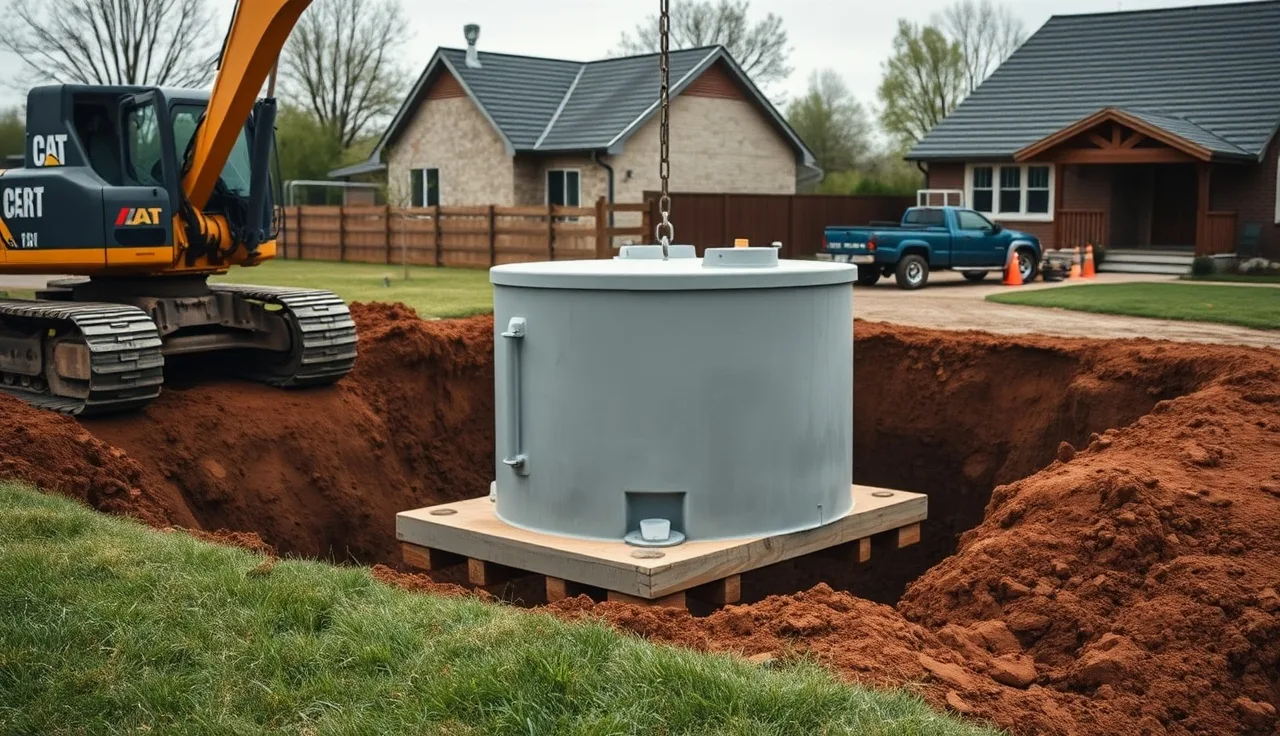
Most concrete tanks are cast at a plant, hauled to the site on a flatbed, and lowered into an excavated pit with a crane or excavator. Plant casting is tightly controlled compared to pouring concrete in place, which is why precast is the standard today [1].
The tank sits entirely underground, usually 6 to 24 inches below grade. Modern designs have two or three compartments. Single-compartment tanks show up in homes built before the 1970s. Two-compartment tanks are the baseline in most states now because they hold solids back better before effluent reaches the field [2].
How long do concrete septic tanks last?
A well-built concrete septic tank lasts 40 to 50 years, sometimes longer. That lifespan is why concrete owns the market. Plastic and fiberglass are lighter and easier to install, but most contractors and code officials treat concrete as the proven long-haul choice.
Lifespan is not a promise, though. Three things cut it short.
First, hydrogen sulfide corrosion. Bacteria inside the tank give off hydrogen sulfide gas. That gas meets moisture on the concrete above the waterline and turns into sulfuric acid, which eats concrete. Open the lid and you'll see it as a soft, sandy, crumbling texture on the top walls or the underside of the lid. Tanks poured before the late 1980s often used weaker mixes (3,000 psi or less) and corrode faster [3].
Second, ground movement and freeze-thaw. Concrete is rigid. Soil settles, roots push, trucks roll over the lid, and freeze-thaw cycling cracks the walls. A crack that lets groundwater in is a real problem. Groundwater dilutes the tank contents and can flood the drain field.
Third, a weak original mix. Not all precast tanks are equal. A high water-to-cement ratio makes the concrete weaker and more porous. Tanks built to ASTM C1227, the standard for precast concrete septic tanks, use mixes above 4,000 psi with set aggregate and curing rules [4].
Here's the honest read. A tank installed in the 1990s or later, built to state code and pumped on schedule, will likely give you 40 to 50 years with no structural work. A tank from the 1960s or 1970s is on borrowed time. Have an inspector check the wall thickness and concrete integrity at your next pump-out.
What sizes do concrete septic tanks come in, and which do you need?
Concrete septic tanks run from about 750 gallons to 2,500 gallons for homes, with bigger precast tanks made for commercial jobs. The 1,000-gallon concrete tank is the most widely installed residential size in the country [1].
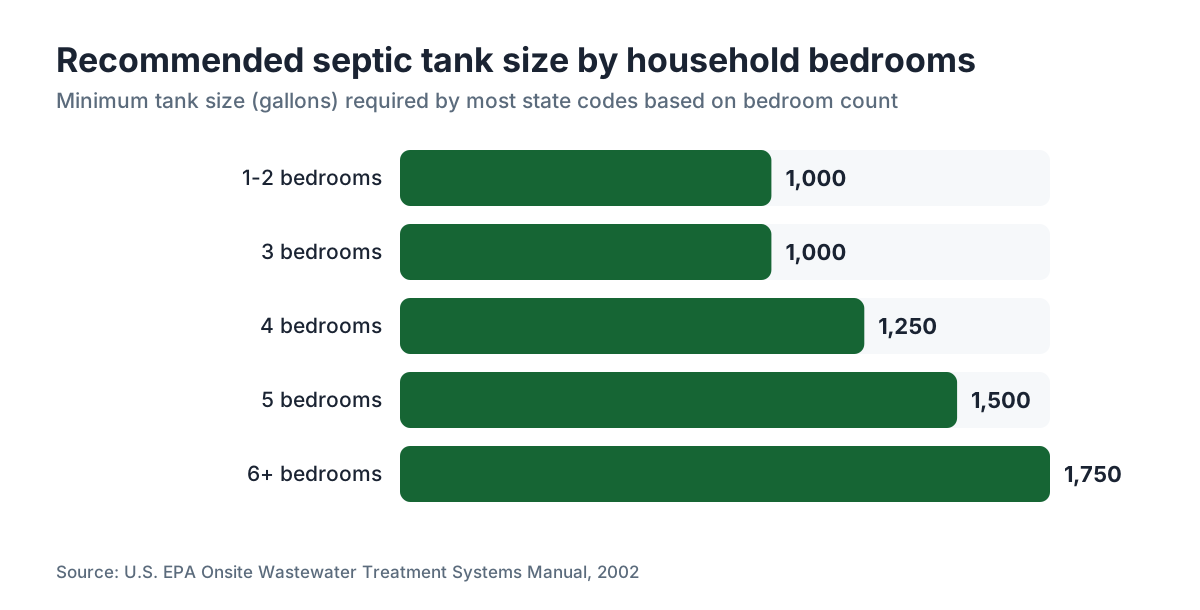
Your state or county sets the required size by the number of bedrooms in the house, not the number of people living there. Bedrooms stand in for peak flow. EPA design guidance ties tank size to daily flow estimates, and most states set a 1,000-gallon floor no matter how small the home.
| Bedrooms | Typical daily flow (gal/day) | Minimum tank size (most states) |
|---|---|---|
| 1-2 | 150-300 | 750-1,000 gal |
| 3 | 300-450 | 1,000 gal |
| 4 | 450-600 | 1,200-1,500 gal |
| 5 | 600-750 | 1,500 gal |
| 6+ | 750+ | 1,500-2,000+ gal |
Source: EPA Onsite Wastewater Treatment Systems Manual [2]
The sizing rule of thumb: a tank should hold at least two to three days of peak daily flow so solids have time to settle. Going bigger is almost never a mistake, especially if you plan to add bedrooms, host big gatherings, or run a garbage disposal. Disposals add a lot of solids, and some codes require a larger tank if one is installed.
Weight drives the install. A 1,000-gallon precast tank weighs roughly 8,000 to 9,000 pounds empty. A 1,500-gallon tank hits 12,000 pounds or more. You need crane access or a heavy-lift excavator. Tight lots, narrow driveways, and low wires can blow up the install cost or push you toward a lighter plastic tank.
What does a concrete septic tank cost?
The tank is only one line on the invoice. Here's how the money splits.
A 1,000-gallon precast concrete tank costs $700 to $2,000 for the unit alone, depending on your region, the plant, and whether a riser and lid come with it. A 1,500-gallon tank runs $1,200 to $2,800. Those are tank-only prices from a precast plant. They do not include delivery, excavation, or labor.
A full septic system installed (tank plus drain field, distribution box, and all labor) runs $5,000 to $20,000 or more, with most standard single-family jobs landing between $8,000 and $15,000 [5]. Replacing the tank alone costs $3,000 to $8,000 for removal, disposal, and the new unit. Getting rid of the old concrete tank adds $300 to $800, depending on whether it can be crushed on-site or has to be hauled off.
Our guide on the cost to install septic system breaks it down by region and system type.
Things that push the price up:
- Rock or bad soil that needs blasting or heavy excavation
- High groundwater that forces a mound system instead of a conventional field
- Remote sites that add delivery miles for the precast tank
- Two-compartment tank requirements (some states mandate them)
- A septic tank riser, which costs $300 to $600 and pays for itself at every future pump-out
For a tank replacement, get at least two quotes from licensed septic contractors and ask whether your state requires a permit (most do). Permits usually run $100 to $500.
How do you maintain a concrete septic tank?
Concrete tanks are low-maintenance by design. Low-maintenance is not no-maintenance. The EPA's SepticSmart program puts it plainly: pump regularly, use water efficiently, and watch what you flush. Those three habits keep the system alive [6].
Pumping is the center of it. Sludge and scum pile up over time. Once sludge reaches the outlet baffle, solids slip into the drain field and start killing it. How often you pump depends on household size and tank volume, and our how often to pump septic tank guide walks through it. Standard advice is every 3 to 5 years for a 1,000-gallon tank serving four people. Bigger households or smaller tanks need it sooner. Hire a licensed pumper for septic tank pumping. This is not a DIY job.
At each pump-out, a good tech checks the baffles. On concrete tanks the inlet and outlet baffles are often concrete themselves on older units, or concrete T-baffles. They corrode from hydrogen sulfide faster than the tank walls and may need swapping every 10 to 20 years. A PVC sanitary tee is a cheap repair that buys you years.
Watch the drains. The EPA is blunt about it: "Never flush wipes, even 'flushable' ones, feminine products, pharmaceuticals, or harsh chemicals" [6]. Those things either pile up as solids or kill the bacteria doing the work.
Keep vehicles and heavy equipment off the tank. The design accounts for the soil load on top. It does not account for a 40,000-pound dump truck. Cracked lids are the usual result, and a cracked lid is both a safety hazard (the tank holds toxic gas) and a way for water to get in.
Keep deep-rooted trees and shrubs away from the tank. Roots find any crack in the concrete and can split a tank open over the years.
What are the signs that a concrete septic tank is failing?
Concrete tanks rarely fail without warning. The signs build over months or years, and catching them early is the difference between a $500 baffle repair and a $12,000 replacement.
Slow drains across the whole house, not one fixture, point to a full tank or a blocked outlet. Backups that clear for a while and then return are the classic pattern. A strong sewage smell in the yard, near the tank or field, means gas is escaping through a crack or a bad lid.
Soggy ground or a bright green stripe of grass over the tank or field means effluent is surfacing. That's a health hazard, not a lawn quirk. Sewage-tainted groundwater can reach a drinking well. The EPA notes that improperly treated wastewater is a direct risk to human health and to local water bodies [6].
Opening the tank tells you more. When the tech has it open, look for:
- Spalling or a sandy texture on the upper interior walls (acid corrosion)
- Cracks in the walls or floor
- Missing or broken baffles
- A lid crumbling at the edges
- Rainwater filling the tank (groundwater intrusion)
Structural cracks can sometimes be sealed with hydraulic cement, epoxy injection, or a coating. But heavy corrosion of the upper section usually means replacement beats repair on cost. Our septic tank repair guide covers what's fixable and what isn't.
Don't sit on a failing tank. Most states require prompt repair or replacement once a system is documented as failing, and the fines are real. North Carolina, for one, can issue civil penalties up to $25,000 for willful violation of its onsite wastewater rules [7].
Concrete vs. plastic vs. fiberglass septic tanks: which is better?
All three materials can build a code-compliant, durable tank. The pick comes down to your site, local code, and budget.
| Factor | Concrete | Plastic (polyethylene) | Fiberglass |
|---|---|---|---|
| Typical lifespan | 40-50+ years | 30-40 years | 30-50 years |
| Weight (1,000 gal) | 8,000-9,000 lbs | 300-600 lbs | 500-900 lbs |
| Crack/break risk | Cracks under ground movement | Can warp or collapse | Can crack under pressure |
| Flotation risk | Very low | High (needs anchoring) | Moderate |
| Installation cost | Moderate | Lower (lighter) | Similar to plastic |
| Repair options | Good (concrete patching) | Limited | Limited |
| Code acceptance | Universal | Not all states/counties | Not all states/counties |
Concrete wins on permanence and code acceptance. Nearly every jurisdiction in the U.S. accepts concrete tanks, and some rural counties still won't accept plastic at all. The weight that makes concrete a pain to install also holds it down against buoyancy, which matters where the water table is high. A plastic tank in a high-water lot needs engineered anchor straps or it floats up out of the ground when it's empty during a flood.
Plastic and fiberglass win on install simplicity and access. A 300-pound plastic tank goes into a tight space without a crane. If your lot is hard to reach, plastic may be the only practical option.
For most homeowners on a standard lot, concrete is the right default. The extra install cost is small against the price of a whole system, and the longevity and repair options earn it. But if a contractor tells you access needs a $3,000 crane rental, price a plastic alternative before you sign.
What inspections are required for a concrete septic tank?
Inspections hit at three points in a tank's life: install, routine service, and home sale.
At install, a local health or building department inspector usually signs off on the open excavation first (to check soil and groundwater) and again after the tank is set (to confirm depth, inlet and outlet placement, and sealed pipe penetrations). Nothing gets backfilled until the inspection passes. The rules vary by state, but most track the state department of environmental quality or health guidance [2].
During routine service, a licensed pumper does a functional check: baffles, liquid level against the outlet, and any obvious structural trouble. It isn't a formal engineering inspection, but it catches most problems while they're small. Ask your pumper to put the findings in writing every visit.
At home sale, most buyers ask for a septic inspection during due diligence. A full inspection covers the tank (opened and looked at), the distribution box, the drain field, and the permit and inspection records. In Massachusetts, a Title 5 inspection is required by state law before a property transfer when the property has an onsite system [8]. Plenty of other states have similar rules. Failing a pre-sale inspection means fixing the system before closing or cutting the price, so knowing your tank's condition before you list is money in your pocket.
Homeowners who track service history, keep pump-out receipts, and know the tank's age and size breeze through these inspections. Those with no records who can't even find the tank have a rough time. If you don't know where the tank is, your county health department often has the as-built from the original permit. SepticMind's service record tools let operators log and share inspection findings digitally, which kills exactly this kind of scramble at resale.
Can a concrete septic tank be repaired, or does it need to be replaced?
Most concrete tank problems are repairable, and repair almost always beats replacement on cost if the shell is sound.
Baffle replacement is the most common fix. Concrete T-baffles corrode from hydrogen sulfide over 10 to 20 years. A licensed pumper pulls the old baffle and installs a PVC sanitary tee in under an hour while the tank is already open. Figure $150 to $400 per baffle.
Minor cracks and surface spalling take hydraulic cement or polyurethane sealant on the interior. These slow or stop water intrusion, but they aren't permanent structural fixes. A crack that has shifted or is still moving won't hold a surface patch for long.
Inlet and outlet pipe penetrations often leak at the joint where the pipe meets the concrete wall. That's a classic groundwater entry point. A flexible rubber fernco coupling or an expanding gasket boot seals the joint right.
Lid replacement is simple. A cracked or crumbling lid is a safety hazard (a person can fall through) and lets surface water in. Precast replacement lids come from the same plants that make tanks, usually $100 to $300 plus labor. Install a septic tank riser at the same time. It brings the access to grade so you're not digging up the lawn at every pump-out.
So when do you replace instead? If the lower walls or floor are actively cracking, if big sections are spalling and exposing rebar, or if the tank has sunk or tilted out of level, replace it. A shifted tank may have broken the inlet or outlet connection, which means raw sewage is going straight into the soil with no treatment. Our septic system repair guide shows how a full assessment works.
Get a second opinion before you agree to a replacement. Some contractors reach for replacement because it's the bigger job. An inspector who doesn't do installs gives you a straighter answer.
How is a concrete septic tank installed?
The install follows a set sequence, though the details hinge on your site, soil, and local code.
A site evaluation comes first, before any permit. A licensed site evaluator (a soil scientist or septic designer, depending on the state) runs a percolation test or soil profile to see whether the soil will take treated effluent and at what rate. That evaluation sets the system type, tank size, and field dimensions [2].
Once permits clear, excavation starts. The hole goes to the depth the design calls for, usually so the top of the tank sits 6 to 18 inches below finish grade. A gravel bed at the bottom levels the tank and drains water away from the floor.
The precast tank arrives on a flatbed and drops into place with a crane or excavator, using chains hooked to lift loops cast into the concrete. A 1,000-gallon tank needs real equipment. Don't let anyone tell you otherwise. Set level, the inlet and outlet pipes get connected with flexible couplings. Then the local authority inspects before any backfill.
Backfill goes in layers, compacted carefully so it doesn't shift the tank. The distribution box and drain field go in at the same time or right after.
Our septic tank installation guide covers the full job. For a standard 3-bedroom home on flat, accessible land, a two-person crew takes one to three days. Rocky ground, a high water table, or a complex design stretches the timeline and the bill.
For every line item from permit to final inspection, see our cost to put in a septic tank guide.
How often should you pump a concrete septic tank?
The EPA recommends inspecting and pumping a septic tank every 3 to 5 years for a typical household [6]. That range isn't one-size-fits-all. The real interval depends on tank volume, how many people live there, garbage disposal use, and any commercial activity on the property.
Here's the working rule from extension guidance: pump when sludge reaches one-third of the tank's working volume, or when scum comes within 3 inches of the bottom of the outlet baffle [9]. A good tech measures sludge depth every visit. If yours doesn't, ask.
Pump too rarely and solids escape to the field. Pump too often and you waste money but do no harm. With drain field replacement running $5,000 to $20,000, leaning toward more frequent pumping is defensible math [10].
A 1,000-gallon concrete tank serving a family of four with no disposal usually needs pumping every 3 to 4 years. Add a garbage disposal and that tightens to every 2 to 3 years. Drop to two people and you might stretch to 5.
Keep records. Log the date and volume pumped each visit. When you sell the house or face a formal inspection, a documented pump history is worth real money in negotiation. See septic tank pump out and septic tank cleaning for what a thorough service includes and what to expect from the tech.
Operators running multiple accounts use software like SepticMind to automate pumping reminders and maintenance schedules, so customers stay on track without leaning on memory.
What are common problems specific to older concrete septic tanks?
Tanks installed before 1980 need a closer eye. Here's what tends to go wrong, and why.
Corrosion of the upper section is the big one in old tanks. Concrete mixes before the mid-1980s often ran higher water-cement ratios, which makes for more porous concrete. Hydrogen sulfide attacks porous concrete faster. Own a tank from the 1960s or 1970s? Don't skip inspections.
Single-compartment design holds solids back worse than a modern two-compartment tank. Old single-compartment tanks send more suspended solids to the field, which speeds up biomat buildup. If you have chronic field problems and an old tank, the tank design may be the root cause, not the field.
Concrete baffles have almost certainly failed in any tank over 30 years old. Original concrete T-baffles rarely last past 20 years of hydrogen sulfide exposure. If nobody has replaced them, your tank is probably running without working baffles, which lets scum into the outlet pipe. This is fixable without replacing the tank.
Pipe penetrations leak. The rubber gaskets and lead caulking in old installs break down over time, and groundwater gets in. Watch for a tank that fills back up fast after pumping. That's a sign of infiltration.
Pre-1980 tanks were sometimes set in shallow holes without proper bedding, so uneven settling is more common. A tank that has settled crooked can break the inlet or outlet connection.
None of this means an old tank has to go right now. Have it inspected by a licensed pro, more than pumped. A professional inspection costs $200 to $600 and gives you a solid basis for the repair-or-replace call.
Frequently asked questions
How much does a 1000 gallon concrete septic tank cost?
The tank unit alone costs $700 to $2,000, depending on your region and whether a riser and lid are included. Delivery, excavation, and installation add $2,000 to $6,000 on top for a replacement. For a full new system with drain field and all labor, budget $8,000 to $15,000 for a standard single-family home.
How long does a concrete septic tank last?
A properly built and maintained concrete septic tank lasts 40 to 50 years, sometimes longer. The main threats to longevity are hydrogen sulfide corrosion of the upper walls, freeze-thaw cracking, and a weak original mix. Tanks built after 1990 to modern precast standards (ASTM C1227) tend to outlast older designs by a meaningful margin.
Can a concrete septic tank crack and what do you do about it?
Yes. Concrete tanks crack from ground movement, freeze-thaw cycles, vehicle loads, and root pressure. Minor surface cracks take hydraulic cement or epoxy. Cracks that have shifted or that let groundwater in at high volume usually mean the structure is compromised enough that replacement is smarter than repair. Get an independent assessment before you commit to either path.
Is a concrete septic tank better than plastic?
For most sites, yes. Concrete is accepted everywhere, weighs enough to resist flotation in high-water soils, and has better long-term repair options. Plastic tanks weigh 300 to 600 pounds versus 8,000 to 9,000 pounds for a concrete 1,000-gallon unit, so they're easier to install on tight lots. If your site has crane access restrictions, price plastic seriously.
How do you find a buried concrete septic tank?
Start with your county health department. Most have the original permit with an as-built drawing showing the tank location. If records are missing, a septic inspector can use a soil probe, a pipe camera from the house cleanout, or a signal transmitter run through the sewer line to find the tank. Some use a metal detector to locate the rebar in the concrete lid.
Do concrete septic tanks need to be pumped?
Yes, every concrete septic tank needs periodic pumping regardless of size. The EPA recommends every 3 to 5 years for most households. Sludge and scum build up and must come out before they reach the outlet baffle and escape to the drain field. Skipping pumping is the single most common cause of premature drain field failure.
What is the weight of a 1000 gallon concrete septic tank?
A standard 1,000-gallon precast concrete septic tank weighs roughly 8,000 to 9,000 pounds empty. Some units run heavier depending on wall thickness and mix design. That weight requires a crane or heavy excavator for placement and limits installation on sites with poor vehicle access.
How do I know if my concrete septic tank is full?
The clearest signs are slow drains throughout the house, gurgling from the plumbing, and sewage odors in the yard or near drains. A full tank doesn't mean replacement; it means it needs pumping. Have a licensed pumper open the tank and measure sludge depth. If sludge has reached one-third of the tank volume, it's time to pump.
Can tree roots damage a concrete septic tank?
Yes. Roots find hairline cracks in the wall or around pipe penetrations, and over years they widen those cracks a lot. Keep aggressive-rooted trees (willows, poplars, silver maples) at least 20 to 30 feet from the tank. If roots have already gotten in, they need to be cut out and the penetration sealed before they cause more structural damage.
What permits are required to install or replace a concrete septic tank?
In nearly every state, installing or replacing a septic tank requires a permit from the local health or building department. Permits run $100 to $500. The process usually requires a site evaluation showing the soil can support the system, an approved design from a licensed septic designer, and inspections at installation. Working without a permit risks fines and trouble at resale.
How deep is a concrete septic tank buried?
Most concrete septic tanks sit with the top 6 to 24 inches below grade. Actual depth depends on the elevation of the house sewer pipe (the inlet has to be lower than the pipe from the house), local frost depth, and the drain field design. Tanks in cold climates are sometimes buried deeper to stay below the frost line.
Does a concrete septic tank affect home value or sale?
A working, well-maintained concrete tank has no negative effect on home value. A failing or undocumented system is a different story. Many states require a septic inspection before property transfer, and a failed inspection can kill a sale or force a big repair escrow. Keeping pump-out records and inspecting the system before you list wipes out that surprise.
What happens if a concrete septic tank collapses?
A collapsed concrete tank is a serious hazard. The void it leaves can cause ground subsidence and a sinkhole risk for anyone walking over it. Sewage escapes straight into the surrounding soil with no treatment. If you notice unexplained ground settling above the tank, keep people off that area and call a licensed septic contractor immediately for an emergency assessment.
Sources
- National Precast Concrete Association, Septic Tanks: Precast concrete is the industry-standard manufacturing method for septic tanks; 1,000 gallons is the most widely installed residential size.
- U.S. EPA, Onsite Wastewater Treatment Systems Manual (EPA/625/R-00/008): Tank sizing is based on bedroom count and daily flow estimates; two-compartment tanks provide better solids retention; site evaluation required before installation.
- University of Minnesota Extension, Septic System Owner's Guide: Hydrogen sulfide corrosion attacks concrete above the waterline, producing sulfuric acid that degrades older lower-strength concrete mixes.
- ASTM International, ASTM C1227 Standard Specification for Precast Concrete Septic Tanks: ASTM C1227 sets minimum concrete compressive strength and mix design requirements for precast septic tanks.
- Angi, Septic System Installation Cost Guide: Total installed cost for a full septic system ranges from $5,000 to $20,000, with most residential installs between $8,000 and $15,000.
- U.S. EPA, SepticSmart Program: EPA recommends inspecting and pumping septic tanks every 3 to 5 years; warns against flushing wipes, pharmaceuticals, and harsh chemicals; notes that improperly treated wastewater poses direct risks to human health.
- North Carolina Department of Environmental Quality, Wastewater Section: North Carolina can issue civil penalties up to $25,000 for willful violation of onsite wastewater rules.
- Massachusetts Department of Environmental Protection, Title 5 (310 CMR 15.000): Massachusetts Title 5 requires a septic inspection before property transfer for properties with onsite septic systems.
- Penn State Extension, Septic System Maintenance: Sludge should be pumped when it reaches one-third of tank working volume or scum is within 3 inches of the outlet baffle.
- U.S. EPA, Septic Systems Program: Drain field replacement can cost $5,000 to $20,000; inadequate pumping frequency is a leading cause of premature drain field failure.
Last updated 2026-07-09