Consumer reports best septic tank treatment: what actually works
By the SepticMind Editorial Team
TL;DR
- Consumer Reports has not published a dedicated septic treatment ranking, but EPA and university studies have.
- Biological additives (bacterial or enzymatic products) show the most promise for maintaining healthy sludge digestion, though a properly sized, pumped tank needs no additive at all.
- Chemical additives can harm drain fields.
- If you use anything, choose a bacterial-enzyme blend and skip the solvents entirely.
Has Consumer Reports actually rated septic tank treatments?
Short answer: not in any current, publicly available report. Consumer Reports has tested household products from dishwashers to water filters, but as of mid-2026 the organization has not published a head-to-head septic treatment comparison with lab data behind it. If you landed here chasing a Consumer Reports ranking, a product marketing claim probably sent you. It either misquotes an old blurb or passes off general plumbing coverage as a dedicated septic additive test.
That matters. The phrase "Consumer Reports best septic tank treatment" gets searched thousands of times a month, and plenty of retail product pages imply CR endorsement they don't have. No major independent consumer lab has run the kind of controlled, multi-product septic trial that CR runs on robotic vacuums.
What does exist is solid government and university research, and it beats a star rating anyway. It tells you what mechanisms actually work inside a septic tank, and which product categories to avoid entirely [1][2]. The rest of this guide is built on those sources.
What types of septic tank treatments are on the market?
The industry sorts septic additives into three buckets [2].
Biological additives contain bacteria, yeast, or enzymes meant to seed or supplement the microbial community already living in your tank. These are the most studied and the least harmful category.
Inorganic chemical additives use acids or alkalis to break down solids. They disrupt tank chemistry and can kill beneficial bacteria. Avoid them.
Organic solvent additives (methylene chloride, 1,1,1-trichloroethane, and similar) dissolve grease and solids. They also pass right through the tank into the drain field, where they contaminate groundwater and kill the soil bacteria that make absorption work. Several states have banned specific solvents outright. These are the worst category, full stop.
Almost every product sold at hardware stores and big-box retailers is biological. That is the category worth evaluating. The solvent products mostly vanished from mainstream retail after EPA pressure in the 1990s, though they occasionally resurface under new brand names.
| Category | Mechanism | Tank safety | Soil / groundwater risk | Verdict |
|---|---|---|---|---|
| Bacterial / enzymatic | Seed native microbes | Low | Low | Worth considering |
| Inorganic chemical | Acid/alkali digestion | High (kills bacteria) | Moderate | Avoid |
| Organic solvents | Dissolve fats/solids | High | High (groundwater) | Never use |
What does EPA say about septic tank additives?
EPA's SepticSmart program is the federal reference point. It says plainly that a properly maintained septic system does not need additives to function, but it stops short of banning biological products outright because the harm evidence for that category is thin [1]. EPA's position has held for decades: the bacteria in a healthy tank handle normal household waste, and adding more bacteria rarely changes the outcome.
EPA does call out chemical and solvent additives directly. Its SepticSmart guidance warns that "chemical additives can be harmful to your septic system and the environment" and recommends against any product that promises to eliminate the need for pumping [1]. Flag that second point. Any product claiming you can go ten-plus years without pumping is making a claim EPA rejects.
On drain field treatments, EPA is just as direct. Pouring foreign chemicals or heavy biological loads into a failing leach field rarely brings it back. If your leach field is failing, the fix is almost always mechanical or hydraulic, not chemical [3].
The SepticSmart program also pushes pump schedules. A family of four in a 1,000-gallon tank should pump every three to five years. That one act does more for your system than any additive [1].
What does independent research say about biological additives?
The most-cited work here is a 1994 review of septic additives in the scientific literature, later extended by the Small Flows Clearinghouse. Both found no consistent, statistically significant improvement in effluent quality when biological additives went into properly functioning tanks [2]. A tank with healthy bacteria gains little from more bacteria, the same way a well-fed lawn shrugs off one extra bag of fertilizer.
A 2010 review by the Water Environment Research Foundation (now the Water Research Foundation) reached a similar conclusion for normally operating systems, but flagged an exception: tanks recovering from antibiotic overload or a long vacant stretch (vacation homes, inherited properties) showed modest improvement with bacterial inoculation [4]. That nuance matters. If your household recently ran a long course of antibiotics, or the tank sat empty for a year, a one-time biological dose has some evidence behind it.
Nobody has great data on repeated monthly dosing, which is what most product labels recommend. The closest study found that monthly bacterial additives did not reduce sludge accumulation rates in a controlled six-tank trial run by a North Carolina State University extension team [5]. Sludge kept building at the same rate with or without additives, which means you still need to pump the tank on schedule.
One honest takeaway: the research does not show that a quality bacterial-enzyme additive hurts a healthy tank. It just doesn't reliably help one either.
Which product ingredients should you actually look for?
If you decide to use a biological additive, the label ingredients tell you most of what you need to know.
Look for live bacterial strains, specifically Bacillus species. They are spore-forming, so they survive shipping and storage. Some products use Lactobacillus or other lactic acid bacteria, which fit poorly with the anaerobic environment of a septic tank. Enzyme types that help: protease (protein breakdown), lipase (fat breakdown), cellulase (paper breakdown), and amylase (starch). A product with all four covers the main waste streams.
Avoid products with:
- Surfactants or detergents as active ingredients (they disrupt tank chemistry)
- Undisclosed "proprietary" active components (you can't evaluate what you can't see)
- Claims that the product eliminates pumping (no product does)
- Sodium hydroxide or sulfuric acid (inorganic chemical types)
Dose size matters less than bacterial viability. A product with 2 billion CFU (colony-forming units) of live Bacillus that was stored correctly beats a product claiming 10 billion CFU that baked in a hot warehouse for six months. Buy from retailers with high turnover and check expiration dates.
A reputable biological product runs from about $10 for a single-dose packet to $40-60 for a six-month supply [6]. There is no evidence that the priciest products outperform mid-range ones.
Are there any states that regulate or ban septic additives?
Yes, and more than most homeowners realize. Washington State bans the sale and use of septic tank additives that contain organic solvents and hazardous chemicals under WAC 246-272A [7]. Massachusetts restricts certain chemical additives under Title 5 (310 CMR 15.000), its onsite septic code [8]. Florida's Department of Health advises against chemical additives in its onsite sewage program guidance [12].
New Hampshire, California, and several other states require or recommend that homeowners check with their local health department before using any additive, particularly on systems in sensitive watershed zones.
Here's the practical part. Before buying anything, spend three minutes on your state's onsite wastewater or health department website. Some states keep a list of registered or prohibited products. If your state has no restriction, that doesn't mean the product works. It means the state hasn't gotten around to banning it.
Local health departments sometimes go further than state rules. A county with a wellhead protection overlay or a nitrogen-sensitive estuary may prohibit all additive use regardless of the state baseline. Worth a call before you spend money.
Does a healthy septic system need any treatment product at all?
For most households with a properly sized tank and a working drain field: no. A correctly designed septic system is a biological reactor that seeds itself from the first flush. The bacteria in human waste are exactly the bacteria the tank needs. As long as you don't kill them (bleach dumps, antibiotic overuse, garbage-disposal grease loads), they persist indefinitely [11].
The single highest-return maintenance act is regular pumping. A 1,000-gallon tank serving two to four people needs pumping every three to five years; a 1,500-gallon tank serving four to six people, every four to six years [1]. Skip pumps and sludge builds until solids flow into the drain field and clog the soil pores. No additive reverses that. Read more about timing at how often to pump a septic tank.
Beyond pumping, the practices that protect your system cost nothing. Don't flush wipes (even "flushable" ones). Don't pour cooking grease down the drain. Fix water-wasting leaks (a running toilet sends 200+ gallons a day through a tank designed for 50-100 gallons per person). Get a septic tank inspection every three to five years.
If you want to track your maintenance schedule and get reminders, tools like SepticMind let homeowners log pump dates and set service alerts without babysitting a spreadsheet.
When does using a septic treatment product actually make sense?
A handful of specific scenarios make a biological additive worth trying.
After antibiotic treatment. A household where someone ran a full course of broad-spectrum antibiotics may see reduced bacterial populations in the tank. A single dose of a Bacillus-based product two to three weeks after the course ends is a reasonable precaution.
Reopening a vacation property. A tank that sat unused for six or more months with no fresh waste input loses some bacterial population. Dosing once before you resume full use makes sense.
After a tank pump-out. Some pumpers add a starter dose of bacteria after emptying a tank, especially if they used a cleaning spray inside it. The evidence here is thin, but the cost is low and the risk is basically zero.
Mild early-stage sluggishness. If drains are slightly slow and the tank isn't due for pumping, a lipase-heavy enzyme product might help break down a grease buildup. If the slowness lasts more than two weeks, stop treating and get the tank inspected. Slow drains often signal a hydraulic problem no product fixes. See septic tank repair for what a failing system actually needs.
None of these justify ongoing monthly treatment for years on end.
How do the top-selling biological products compare?
No independent lab has run a multi-product controlled trial on the products sold at retail today, so a straight performance ranking isn't possible without inventing numbers. What can be compared is formulation transparency, which is a fair proxy for product quality.
| Product type | Bacterial strains listed | Enzyme types listed | CFU claim | Price/month (approx.) | Ingredient transparency |
|---|---|---|---|---|---|
| Powder packets (generic) | Often Bacillus subtilis only | 1-2 enzymes | 1-5 billion | $3-8 | Low |
| Branded liquid (national brand) | 3-5 Bacillus species | 4+ enzymes | 5-10 billion | $8-15 | Medium |
| Professional-grade tablets | 5-8 Bacillus species | 4+ enzymes | 10-50 billion | $12-20 | High |
| Yeast-based (DIY) | Saccharomyces cerevisiae | None listed | Not stated | $1-2 | Very low |
Brewer's yeast, the classic DIY pick, does produce some enzymatic activity, but Saccharomyces is not native to septic environments and doesn't persist the way Bacillus spores do. The studies that found minimal benefit from additives often used yeast-based or single-strain products. Multi-strain Bacillus blends with multiple enzyme types are the more defensible choice if you're going to use anything at all [4].
One more catch: CFU counts on labels are usually measured at time of manufacture, not point of sale. Storage conditions matter as much as the number on the box.
What should a homeowner do instead of relying on treatments?
The EPA SepticSmart program lays out a four-point maintenance checklist with more evidence behind it than any product: inspect and pump often, use water efficiently, dispose of waste properly, and maintain the drain field [1]. Those four actions, done consistently, keep a septic system running 25 to 40 years. A system that gets treated monthly but never pumped and never inspected fails far sooner.
Water efficiency is underrated. A running toilet or a single dripping fixture can hydraulically overload a drain field before any solid buildup becomes a problem. Fix leaks. Install low-flow fixtures. Spread laundry across the week instead of running eight loads on Saturday.
For the septic tank cleaning side, ask your pumper to record sludge and scum depths at each pump-out and keep the numbers. A tank where sludge grows faster than expected tells you something about your household's usage or the bacterial health of the tank, and it's data you can act on. A product receipt tells you nothing.
Seeing wet spots in the yard, sewage odors, or gurgling drains? No treatment product belongs at that stage. You need a professional inspection and likely septic system repair work, not a bottle of bacteria.
How much do septic tank treatment products cost compared to real maintenance?
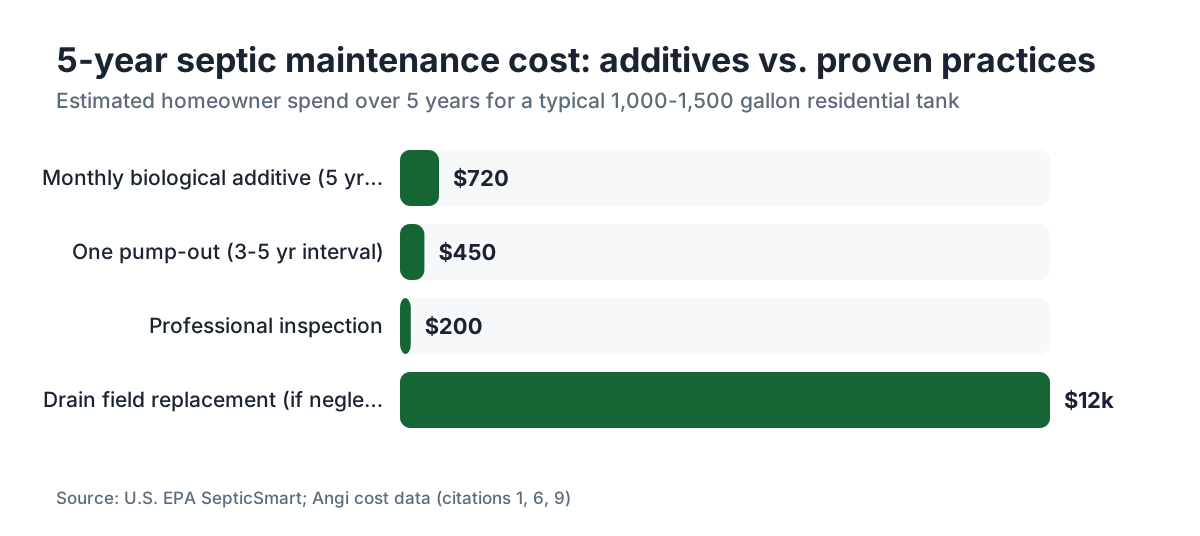
A year of monthly biological treatment runs $36 to $240, depending on the product [6]. Over five years, that's $180 to $1,200. A tank pump-out typically runs $300 to $600 for a standard residential tank, though costs swing by region and tank size [9]. A professional septic tank inspection adds $100 to $300.
The math is unflattering for additives. You spend up to $1,200 on treatment products over five years, and you still spend $300 to $600 on pumping. The products don't cut pumping frequency in any study. That additive money would pay for the pump-out twice over, with cash left for a septic tank inspection that might catch a problem before it becomes a drain field replacement.
Drain field replacement is where the numbers get serious. Replacing a conventional leach field runs $5,000 to $20,000 or more depending on soil conditions, lot constraints, and local permitting [10]. Replacing the whole system runs higher. See cost to install a septic system for current estimates. That figure makes the $300 pump-out look like one of the best deals in home maintenance.
Spend on pumping and inspection. If you have money left over and want the peace of mind of a biological product, buy a reputable multi-strain Bacillus tablet once or twice a year. Just don't skip the pump thinking the tablet covered it.
What questions should you ask a septic service professional about treatments?
A good pumper or onsite wastewater professional is your best source of product advice, because they see your specific system, not a generic tank. Here are the questions worth asking.
"What's the current sludge-to-tank ratio?" If sludge sits under 33 percent of tank volume, no additive is likely to help or hurt. If it's near 50 percent, you need a pump more than a product.
"Have you seen this brand work on systems in this area?" Local knowledge matters. A pro who services 200 tanks a year in your county has observational data no lab study can match.
"Does my county restrict any additive types?" A licensed pumper usually knows the local health department rules.
"Is my drain field absorbing normally?" If the answer is uncertain, a dye test or inspection is the right next step, not a product. Check leach field details if your professional raises field concerns.
Service professionals who track customer systems digitally, using platforms like SepticMind, can pull up a tank's pumping history on-site and give advice grounded in that specific system's record rather than a generic recommendation.
Be skeptical of any professional who pushes a high-margin treatment product hard. The right recommendation is almost always: pump regularly, inspect the system, watch what goes down the drain. That advice doesn't come in a bottle.
Frequently asked questions
Has Consumer Reports published a best septic tank treatment list?
No. As of mid-2026, Consumer Reports has not published a dedicated, lab-tested ranking of septic tank treatment products. Product marketing sometimes implies CR endorsement without one. The most reliable research comes from EPA's SepticSmart program and university extension studies, which consistently find that properly maintained tanks don't require additives and that chemical products can cause harm.
Do septic tank treatments actually work?
For biological (bacterial and enzyme) products, the evidence is mixed. Studies from the Water Environment Research Foundation and university extension programs find minimal benefit in normally functioning tanks, but modest improvement in tanks recovering from antibiotic use or long vacancy. Chemical and solvent additives are either ineffective or actively harmful. No product has been shown to eliminate the need for regular pumping.
What is the best septic tank treatment you can buy?
Among biological products, multi-strain Bacillus blends with at least four enzyme types (protease, lipase, cellulase, amylase) are the most defensible choice based on ingredient science. They align best with how septic tanks actually process waste. No specific brand stands out because no independent head-to-head trial exists. Price range for quality products runs $8 to $20 per month.
Can septic tank treatments damage my drain field?
Yes, if you use chemical or solvent-based products. Organic solvents pass through the tank into the soil absorption field and can kill the soil bacteria that make absorption work, while also contaminating groundwater. Inorganic chemicals disrupt tank pH and microbial balance. Biological products are generally safe for the drain field, but they don't repair a failing one either.
How often should I add bacteria to my septic tank?
Most product labels say monthly, but no study confirms monthly dosing reduces sludge accumulation or improves effluent quality in healthy tanks. If you use a biological product at all, once or twice a year in scenarios like post-antibiotic recovery or reopening a vacation property is better supported by the evidence than a monthly routine.
Does adding yeast to a septic tank help?
Brewer's yeast (Saccharomyces cerevisiae) is a long-standing DIY recommendation. It does produce some enzymatic activity, but Saccharomyces is not native to the anaerobic environment of a septic tank and does not persist the way bacterial spores do. Studies that found minimal benefit from additives often tested yeast-based products. A multi-strain Bacillus product is more appropriate if you want biological supplementation.
Are septic tank additives banned in any states?
Yes. Washington State bans additives containing organic solvents and hazardous chemicals under WAC 246-272A. Massachusetts restricts certain chemical additives under Title 5 (310 CMR 15.000). Florida, New Hampshire, California, and others advise against chemical additives or require local health department consultation. Check your state's onsite wastewater program before buying any product.
What does EPA recommend for septic tank maintenance?
EPA's SepticSmart program recommends four practices: inspect and pump on schedule (every three to five years for a typical household), use water efficiently, dispose of waste properly (nothing other than human waste and toilet paper), and maintain the drain field area. EPA does not recommend additives for normally functioning systems and warns against any product claiming to eliminate pumping.
Can a septic treatment product replace pumping?
No. No product reduces the rate at which inorganic solids, hair, and non-digestible matter accumulate in a tank. Biological products can help break down organic solids, but they produce residue that still accumulates as sludge. EPA explicitly states that no additive eliminates the need for pumping, and no peer-reviewed study has found otherwise. Skipping pumps remains the most common cause of premature system failure.
What is the risk of using the wrong septic additive?
Using solvent-based additives risks contaminating your drain field soil and groundwater, potentially requiring a full field replacement costing $5,000 to $20,000 or more. Inorganic chemical additives can kill beneficial tank bacteria and disrupt the digestion process, leading to faster sludge buildup and early pump-outs. Some products also void system warranties or create liability under state environmental codes.
How much do septic treatments cost compared to pumping?
A year of monthly biological treatment costs $36 to $240. A standard residential pump-out costs $300 to $600. Over five years, treatment costs can reach $1,200 while you still need the $300 to $600 pump-out anyway, since no additive extends the pump interval. From a pure cost-benefit view, the money spent on additives is better put toward the pump-out and an inspection.
Are there septic treatments that help a failing drain field?
No product reliably rehabilitates a hydraulically failing drain field. Biomat (clogged soil) responds to resting the field and sometimes aeration treatments, but not to tank additives. If your field is failing, you need a professional assessment and likely mechanical intervention. Adding more bacteria to a tank whose field has sealed soil pores doesn't unclog those pores.
How do I know if my septic tank needs treatment versus just pumping?
If drains are slow, there are odors near the tank or field, or the ground over the drain field is wet, those are signs of a system problem no additive addresses. Get the tank inspected and pumped first. If the system functions normally after pumping, it probably doesn't need any treatment product. Treatment products are maintenance supplements, not diagnostic tools.
What ingredients should I avoid in septic tank products?
Avoid anything with methylene chloride, 1,1,1-trichloroethane, or other chlorinated solvents (they contaminate groundwater), sodium hydroxide or sulfuric acid (inorganic acids/alkalis that kill beneficial bacteria), and undisclosed proprietary active ingredients (you can't evaluate what isn't listed). Also avoid any product claiming to permanently eliminate pumping needs.
Sources
- U.S. EPA SepticSmart Program: EPA states a properly maintained septic system does not need additives, warns against chemical additives, and recommends pumping every 3-5 years for a typical household.
- EPA, Onsite Wastewater Treatment Systems Manual (EPA/625/R-00/008): EPA classifies septic additives into biological, inorganic chemical, and organic solvent categories and notes organic solvents pose groundwater contamination risks.
- U.S. EPA, How Your Septic System Works: EPA notes that introducing foreign chemicals into a failing drain field rarely rehabilitates it and that most field failures are hydraulic or mechanical in nature.
- Water Research Foundation (formerly Water Environment Research Foundation), Septic System Additive Research: A 2010 WRF review found minimal benefit from biological additives in normally operating systems but modest improvement in tanks recovering from antibiotic overload or long vacancy.
- NC State University Extension, Onsite Wastewater Program: NC State extension research found monthly bacterial additives did not reduce sludge accumulation rates compared to untreated control tanks in a controlled multi-tank trial.
- Angi, Septic Tank Treatment Cost Guide: Retail biological septic treatment products range from approximately $10 per single dose to $40-60 for a six-month supply; branded products cost $8-20 per month.
- Washington State Legislature, WAC 246-272A: Washington State bans the sale and use of septic tank additives containing organic solvents and hazardous chemicals under WAC 246-272A.
- Massachusetts Title 5 Regulations, 310 CMR 15.000: Massachusetts Title 5 (310 CMR 15.000) restricts certain chemical additives in onsite septic systems.
- U.S. EPA SepticSmart, Septic System Costs: Typical septic tank pump-out costs $300 to $600 for a standard residential system, varying by region and tank size.
- Penn State Extension, Septic System Maintenance: Drain field replacement costs range from $5,000 to $20,000 or more depending on soil conditions, site constraints, and local permitting requirements.
- University of Minnesota Extension, Septic System Owner's Guide: University of Minnesota Extension advises that bacterial additives provide little benefit to healthy systems and that the naturally occurring bacteria in household waste are sufficient for normal operation.
- Florida Department of Health, Onsite Sewage Program: Florida DOH guidance advises against chemical additives in septic systems and recommends consulting local health departments before using any product.
Last updated 2026-07-09