Perc tested land: what it means, what it costs, and what to do if you fail
By the SepticMind Editorial Team

TL;DR
- A percolation (perc) test measures how fast water drains through soil to determine whether a lot can legally support a septic drain field.
- Tests cost $150 to $1,500, take one to three days, and are required in most U.S.
- counties before a septic permit is issued.
- Failing doesn't always kill a deal.
- Alternative systems often work on difficult soils.
What does 'perc tested land' actually mean?
Perc tested land is a parcel that has gone through a soil percolation test, a standardized procedure that measures how quickly water absorbs into the ground. The result tells the county health department whether the soil can handle the liquid effluent a septic drain field must disperse over decades of use. Without that answer, no health department in the country will issue a septic permit, and without a septic permit, you can't legally build a home on a lot that isn't served by municipal sewer.
The phrase shows up constantly in real estate listings, and it's used two ways. Sometimes it means the land was tested and passed. Sometimes it just means a test happened, with no promise about the result. Before you put earnest money down, get the actual numbers.
The test has nothing to do with water quality. It's purely about drainage rate. Clay-heavy soils drain slowly. Sandy or gravelly soils drain fast. Both extremes cause problems. Drain too fast and effluent slips past the treatment zone before bacteria kill the pathogens. Drain too slowly and effluent ponds, which is a public health hazard. Most regulations set a passing window somewhere between 1 minute per inch and 60 minutes per inch, though the exact range varies by state [1].
Perc tests go by a few names. You'll see "perk test," "percolation test," "soil absorption test," and "soil evaluation" all pointing at the same general idea. Some states have moved entirely to soil morphology evaluations, where a licensed soil scientist reads the soil profile visually, which can replace or supplement the traditional water-timing method. The goal underneath is identical.
How does a percolation test work, step by step?
A perc test runs in three phases: site prep, saturation, and timing. The whole thing hinges on doing the middle phase honestly.
First, whoever runs the test digs or augers test holes, typically 6 to 12 inches in diameter, at several spots across the proposed drain field area. Most health departments require at least two holes. Some require four to six. The depth follows local code but usually matches the planned trench depth, often 18 to 36 inches below grade.
Second, the holes get pre-soaked. The tester fills each hole with water and lets it absorb overnight, sometimes for a full 24 hours. This mimics saturated soil, the worst case a drain field faces during a wet season. Skipping or shortcutting the pre-soak produces artificially fast results, and it's a common source of test fraud that comes back to bite buyers years later.
Third, the timing begins. The tester fills the hole to a set depth, usually 6 inches of water above a reference point, and measures how far the level drops over a fixed interval, commonly 30 minutes but sometimes 10 or 15 minutes depending on state protocol. That drop, in inches per time interval, is the perc rate. If water drops 3 inches in 30 minutes, the rate is 10 minutes per inch (MPI). Most states express results as minutes per inch.
The test usually repeats two or three times per hole until consecutive readings land within 10 to 20 percent of each other, which signals stable conditions. The slowest or average rate from each hole then sizes the drain field. Faster perc rates mean smaller, cheaper fields. Slower rates mean larger systems, sometimes too large to fit a small lot [2].
Who conducts the test matters. In many states, a licensed soil scientist, professional engineer, or registered sanitarian must be present, and the county health department may send its own inspector too. In other states, a licensed septic contractor can run the test with health department oversight. Either way, the results go into an official report that lives in county records.
What perc test results mean: passing rates, failing rates, and the gray zone
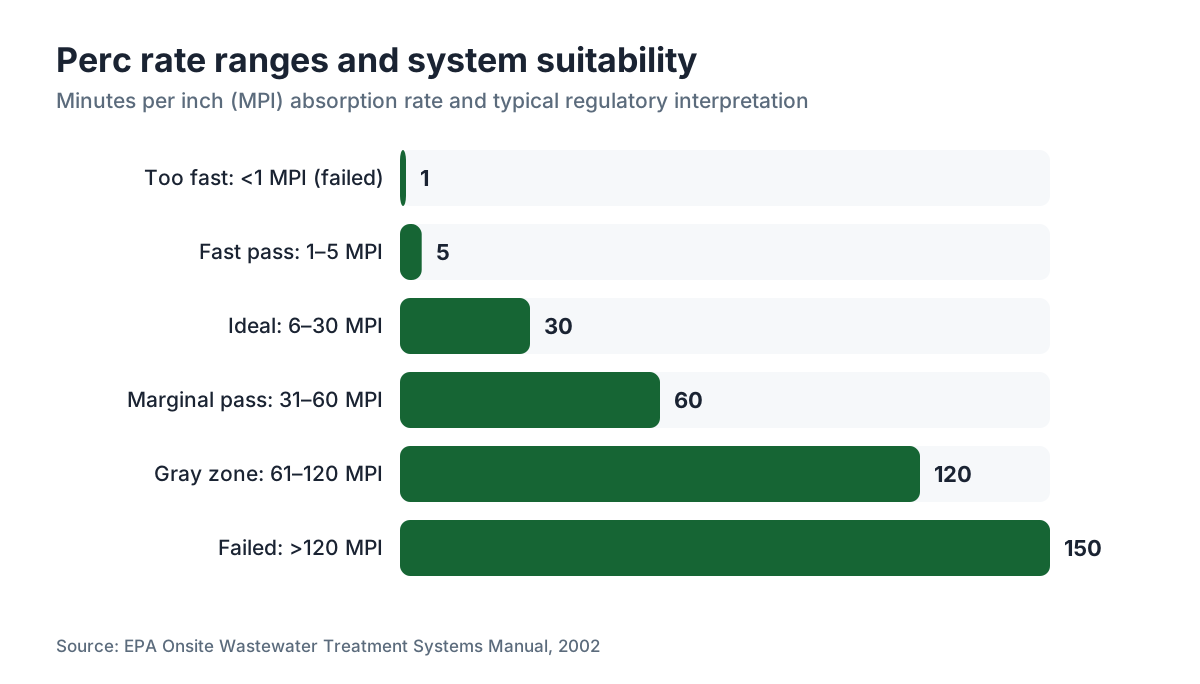
There is no national passing standard. Each state sets its own range, and counties sometimes stack extra restrictions on top of state minimums. You'll still see fairly consistent patterns across most U.S. jurisdictions [1][3].
| Perc Rate (min/inch) | Typical Interpretation | Notes |
|---|---|---|
| Less than 1 MPI | Too fast (failed) | Sand or gravel; effluent bypasses treatment zone |
| 1 to 5 MPI | Fast pass | Small drain fields; good conventional system candidate |
| 6 to 30 MPI | Solid pass | Ideal range for conventional systems |
| 31 to 60 MPI | Marginal pass | Larger field required; some states allow, some don't |
| 61 to 120 MPI | Gray zone / conditional | May require alternative systems; state-dependent |
| Over 120 MPI | Failed (most states) | Soil too impermeable for conventional drain field |
The sweet spot in most state codes is 1 to 60 MPI. Below 1 MPI, the soil drains so fast that pathogens never get filtered before reaching groundwater. The EPA's SepticSmart program notes that improperly treated effluent reaching groundwater is a leading source of nitrate contamination in rural wells [4]. Above 60 MPI, and certainly above 120 MPI, the soil is usually too dense to swallow a household's daily wastewater.
The gray zone between 60 and 120 MPI is where a lot of negotiations happen. Some states allow alternative drain field designs (mound systems, drip irrigation systems, aerobic treatment units) for soils in this range. Others draw a hard line at 60 MPI. If you're buying land in that gray zone, the real question isn't "did it pass?" It's "what systems does the county allow at this rate, and what will they cost?"
A perc rate alone doesn't tell the whole story. Soil morphology matters just as much: the layering of the soil profile, the presence of mottling (rust-colored spots that flag a seasonal high water table), and the depth to restrictive layers like bedrock or hardpan. A soil with a 20 MPI rate that hits bedrock at 18 inches is harder to work with than a 45 MPI soil with 6 feet of usable profile. Many states now require both a perc test and a soil profile evaluation for exactly this reason [3].
How much does a perc test cost?
Perc tests in the U.S. typically run $150 to $1,500, with most buyers paying somewhere in the $300 to $700 range for a standard residential evaluation [5]. The wide spread comes from a few real variables.
Labor drives most of it. A simple two-hole test on flat, accessible land in a state where a licensed contractor can run the process costs far less than a six-hole test on a steep, wooded hillside that needs a soil scientist, a backhoe, and a full day of county inspector time.
State and county permit fees pile on. Some health departments charge $50 to $200 just to review and file the results. Others bundle the fee into a broader site evaluation permit that runs $400 to $800 before any testing labor starts.
Who you hire matters. Independent soil scientists tend to charge more than septic contractors, but their reports are more detailed and hold up better if a result gets challenged. In states that require a licensed professional engineer to certify the report, add $200 to $500 in PE review fees.
If the site needs a full soil morphology evaluation alongside the perc test, which is increasingly common in states like North Carolina, Virginia, and Pennsylvania, budget $600 to $1,500 total. These evaluations take longer, require specialized training, and paint a fuller picture of the site's septic potential.
One cost people forget: re-testing after a failed or inconclusive result. If you want to try a different spot on the parcel, or if conditions during the first test were shaky (frozen soil, recent drought), you pay again. Budget for the possibility.
When does land need to be perc tested?
Any undeveloped lot that will rely on an on-site septic system needs a perc test before a building permit or septic installation permit gets issued. That's the practical rule covering the vast majority of situations.
Beyond new construction, perc testing shows up in a few other spots. If an existing home needs a replacement drain field after the original one fails, many counties require a fresh soil evaluation before approving the new design. Our guide to leach field issues covers that scenario in depth.
Some states require a perc test when a property changes hands and the septic system passes a certain age, typically 20 to 30 years, though this is more often handled through a standard septic tank inspection than a new perc test.
Real estate transactions are probably the most common trigger for perc test conversations. A listing described as "perc tested" or "approved for septic" is worth more than raw undeveloped land because some of the permitting risk is already gone. Buyers should still confirm three things: when the test was done, what system it approved, and whether that approval is still valid (most county approvals expire after two to five years).
In some rural counties, sellers aren't required to disclose failed perc tests. That puts the burden on you. Make any offer on undeveloped rural land contingent on a satisfactory soil evaluation.
What happens if a perc test fails?
A failed perc test doesn't automatically make land unbuildable. It does change the math, and sometimes by a lot.
The first move is testing a different area of the parcel. Soil conditions shift across even a small lot. A dense clay layer in one corner might give way to a better profile 50 feet away. If the parcel is large enough, there's real value in hiring a soil scientist to walk the whole site before committing to a test location.
The second move is an alternative septic system. Most states permit these on soils that flunk conventional perc standards.
Mound systems build an engineered fill above grade so effluent discharges into imported sand rather than native soil. They work in slowly draining soils and where the seasonal water table sits high. They cost more, typically $10,000 to $20,000 above a conventional system, and they need more upkeep.
Aerobic treatment units (ATUs) treat effluent to a higher quality before dispersal, which allows smaller, shallower drain fields on marginal soils. Many states allow ATUs where conventional systems won't pass [6].
Drip irrigation systems spread effluent in small doses through subsurface tubing, easing peak loading on soil that absorbs slowly. They're common in Texas and a few other states with permitting frameworks built for them.
Holding tanks (no-discharge systems) are a last resort. They store all wastewater and need regular pump-outs, which gets expensive fast. Some counties permit them for seasonal cabins or as a stopgap while a permanent solution gets engineered.
If every option runs out and the land genuinely can't support any on-site system, the parcel is effectively unbuildable for a home without sewer access. That's a real outcome on some lots, mostly small parcels with high water tables, shallow bedrock, or strict lot-size-to-system-size ratios. It's rare. It happens. It's the reason you make perc test approval a contingency in any rural land purchase contract.
For context on what a full septic system installation costs once a site does pass, the range is $3,000 to $15,000 for conventional systems depending on size and local labor [7].
How long does perc test approval stay valid?
Most county health departments issue a perc test approval or a "site suitability" letter that expires. The most common windows are two to five years, though some states run shorter (one year in parts of California for certain jurisdictions) and a few offer indefinite approval tied to a recorded plat.
After expiration, you usually re-apply and pay another permit fee. Whether you need a full re-test depends on how much time has passed and what's changed on the site. If the land has been disturbed, graded, excavated, or flooded, most health departments require a new test no matter how old the original approval is.
Buyers of land where the seller advertises an existing perc approval need to check two things: the date of the original test and the county's current expiration policy. A five-year-old approval in a county that now runs a two-year cycle is worthless. Call the health department directly. Don't rely on the seller's agent for this.
One issue people underrate: codes change. A lot tested and approved under 1995 rules might not meet current nitrogen-reduction or setback requirements. That old approval may be grandfathered, or it may not. Get the current code in writing before you assume an old test result transfers to a new permit.
Perc test vs. soil evaluation: are they the same thing?
They're related but not identical, and the distinction matters more in some states than others.
A traditional perc test is purely quantitative. You time how fast water drops. That number drives the system design.
A soil morphology evaluation (also called a soil profile analysis or soil assessment) is qualitative. A soil scientist digs a pit, reads the horizons, identifies restrictive layers, notes mottling depth to estimate the seasonal high water table, and classifies the soil by USDA texture class. It doesn't produce a minutes-per-inch number, but it tells you far more about how the drain field will perform over the long haul [3].
Many states now require both, or let a morphology-only evaluation replace the perc test when a licensed soil scientist runs it. The reasoning: a skilled evaluator reading a soil profile predicts drainage behavior more accurately than a timed water test, which can be gamed by testing after a drought when the soil is artificially thirsty.
Virginia, North Carolina, Florida, and several New England states lean heavily toward soil morphology evaluations. Texas still relies on perc tests for most counties. California's approach swings wildly by county.
The practical takeaway for buyers and sellers: don't assume an old perc test result and a current soil evaluation are interchangeable. Ask the local health department exactly what they'll accept.
Can you build on land that hasn't been perc tested?
Technically, yes, in limited cases. If the lot connects to a municipal sewer, no perc test is needed. If the lot sits in a jurisdiction that has pre-approved certain areas for septic based on regional soil surveys (some rural counties do this), individual lot testing may not be required before a permit gets issued. And in a handful of very rural, lightly regulated areas, the permitting process is loose enough that building happens before testing. That's a risk that catches up with owners eventually.
For any lot you're actually thinking about buying for a home, treat a satisfactory perc test or soil evaluation as non-negotiable. Buying untested rural land and hoping for the best is one of the more expensive mistakes people make in rural real estate. The cost to discover you can't build a conventional system, after you already own the land, runs from a few thousand dollars for an alternative system upcharge to a parcel worth a fraction of what you paid.
If you're already there, wrestling with a failing or absent drain field on land you own, the next step is understanding your septic system repair options before the problem gets worse.
How to find out if a specific parcel has been perc tested
Start with the county health department. In most counties, perc test results and site suitability determinations are public records, filed by parcel number or tax map ID. Call or visit the environmental health or on-site wastewater division (the name varies by county). Many now run online portals where you can look up permit history by address or parcel number.
If the seller claims the land is perc-approved, ask for the actual test report, not their word. The report should list the test date, the name and license number of whoever conducted it, the specific hole locations, the pre-soak protocol used, the measured drop rates, and the health department's determination. A real report has all of that. A one-page summary or a verbal claim doesn't cut it.
Your title company or real estate attorney may also have access to recorded easements or encumbrances tied to septic approvals. In some states, septic site approvals get recorded against the deed.
If you're evaluating land in a state or county you don't know, the state's environmental or health agency website usually publishes its on-site wastewater rules online. The EPA's SepticSmart resources are a reasonable starting point for the federal guidance that state rules typically build on [4].
For operators managing multiple properties or service territories, tools like SepticMind can centralize permit and inspection records so you're not chasing county portals for every parcel you service.
What does perc tested land cost vs. untested land, and is the premium worth it?
Perc-tested land with a current, valid approval commands a real premium in rural markets. The exact figure is hard to pin down because comparable sales data for undeveloped rural parcels is thin, but $5,000 to $20,000 per lot is a reasonable range for the value a clean soil evaluation adds to a residential lot in most U.S. markets.
The premium buys risk removal. A buyer of untested land absorbs the cost and uncertainty of the evaluation, plus the odds of failed tests, alternative system upcosts, or, worst case, an unbuildable lot. A seller who already cleared that hurdle can reasonably price the certainty in.
From a buyer's seat, the calculation is simple: what's the probability of a problem, and what would that problem cost? If the local geology is generally friendly and the seller has already run one test showing a passing rate, paying a small premium is rational. If you're buying in an area known for shallow bedrock or heavy clay (think parts of the Appalachians, the upper Midwest lake country, or coastal wetlands), the risk is higher and the premium deserves harder scrutiny.
One thing worth knowing: a perc approval doesn't cap system costs. A marginal pass (say, 50 MPI) may still require a larger drain field than a strong pass (15 MPI), which means higher installation costs. Two lots can both read "perc tested and approved" with a $5,000 gap in septic system cost between them. Always ask what size system the approval covers.
For a full breakdown of what you'll spend once you're ready to build, see our guide to cost to install a septic system.
How do perc test requirements vary by state?
There is no federal percolation test standard. The EPA provides guidance and funding but defers to states on the technical requirements for on-site wastewater systems [4]. Every state has its own onsite wastewater code, and within states, county health departments often layer on their own rules.
A few patterns hold across most states: pre-soaking is required, multiple test holes are required, and someone credentialed either conducts or witnesses the test. Beyond that, the variations get real.
Minimum lot size requirements work alongside perc tests. Texas, for example, requires 1-acre minimum lots in many counties for an on-site system [9]. In other states, well-performing soil can support a system on a smaller lot.
Setback requirements (distance from wells, property lines, water bodies) interact with whether a perc-passing site can legally fit a drain field. You can have perfect soil and still fail permitting because the buildable envelope leaves no room for a code-compliant field layout.
Seasonal testing restrictions come into play. Some states require testing during or after a wet season (typically late fall through early spring) to force saturated-condition results. Testing during summer drought can produce an artificially fast rate that doesn't reflect real performance.
Licensing requirements for testers vary widely. Some states let any registered sanitarian run a test. Others require a professional soil scientist credentialed through the Soil Science Society of America or an equivalent state board [11].
The takeaway for buyers and sellers: don't assume the rules you heard about in one state apply anywhere else. A Georgia regulation, a Colorado standard, and a Massachusetts protocol can look completely different on the ground. Always verify with the specific county health department for the parcel in question [8].
Frequently asked questions
How long does a perc test take to complete?
The full process takes one to three days. Test holes usually get dug on day one, pre-soaked overnight (sometimes 24 hours), then timed on day two or three. Some counties require a full 24-hour pre-soak before any timing begins. If the health department inspector has to be present for the timing phase, scheduling can stretch the total timeline by a week or more in busy counties.
Can I do a perc test myself on my own property?
In a few states, a property owner can run an informal test, but official results the health department accepts almost always require a licensed professional (a soil scientist, sanitarian, or PE) to conduct or certify the test. A DIY test gives you a rough read on soil drainage before paying for the formal evaluation, but it won't satisfy any permitting requirement. Check your county's rules before spending time on a self-test.
What is a good perc rate for a septic system?
Most engineers and health departments treat 1 to 30 minutes per inch (MPI) as a solid result for a conventional drain field. Rates of 6 to 20 MPI are ideal, fast enough to take daily household loads, slow enough to let the soil treat the effluent. Above 60 MPI, many states require alternative or engineered systems. Below 1 MPI, the soil may drain too fast to filter pathogens before effluent reaches groundwater.
Does a perc test guarantee a septic system will work long-term?
No. A perc test passes or fails a site at one point in time under specific conditions. It doesn't predict 30-year performance. Drain fields fail even on good perc soils from system overloading, biomat buildup after infrequent pumping, grease accumulation, or tree root intrusion. Regular maintenance, including septic tank pumping every 3 to 5 years, determines long-term system health, not the initial test result.
How many test holes are required for a perc test?
Most state codes require a minimum of two test holes, with many requiring three to six depending on lot size, the variability of soil observed during digging, and local health department rules. Each hole must reach the proposed installation depth, typically 18 to 36 inches. If results vary widely between holes, the health department may require more testing to characterize the site accurately.
What causes a perc test to fail?
The two most common causes are soil that drains too slowly (dense clay, compacted subsoil, or a restrictive hardpan layer) and soil that drains too fast (coarse sand or gravel with little filtration capacity). A high seasonal water table, flagged by mottled or gleyed soil, can also cause failure even when dry-season drainage looks fine. Shallow bedrock that limits trench depth is another frequent cause of site rejection.
How much does it cost to install a septic system after a successful perc test?
Conventional septic system installation typically runs $3,000 to $15,000 for most residential lots, depending on system size, local labor rates, and site conditions. A marginal perc rate (30 to 60 MPI) usually means a larger drain field, adding $2,000 to $5,000. Alternative systems like mound systems or aerobic treatment units cost $15,000 to $30,000 or more. See our full breakdown of septic system installation costs for details.
Is a perc test required when buying land?
Most lenders and counties require proof of septic suitability before issuing a construction loan or building permit, but there's no universal federal requirement triggering a perc test at the time of sale. Buyers of raw undeveloped land should make any offer contingent on a satisfactory soil evaluation, because an undisclosed failed test is a legal gray area in many states. Some states require seller disclosure of known failed tests. Others don't.
Can land fail a perc test and still be approved for a septic system?
Yes, often. A failed conventional perc test doesn't automatically mean the land can't be developed. Many states approve alternative systems (mound systems, aerobic treatment units, drip irrigation systems) for soils that fail the conventional test. The health department's rejection of one system design is the start of the conversation, not the end. An experienced soil scientist or licensed designer can often find an engineered solution, though it will cost more.
How do I know if a perc test result on a property I'm buying is still valid?
Call the county health department and ask for the parcel's permit history using the tax map ID or parcel number. Confirm the test date, who conducted it, what system it approved, and the current expiration policy. Most approvals expire in two to five years. If the approval is expired or was issued under older rules, you may need a new evaluation before the county issues a current permit, even if the seller's paperwork looks clean.
What is a soil morphology evaluation and how is it different from a perc test?
A soil morphology evaluation is a visual and tactile assessment of the soil profile done by a soil scientist. Instead of timing water absorption, the evaluator reads soil color, texture, layering, and signs of seasonal saturation (mottling, gleying) to judge site suitability. Many states now use this method in place of or alongside traditional perc tests, because experienced evaluators predict drainage behavior more reliably than a timed test run under variable conditions.
What setbacks affect where a drain field can go on perc-tested land?
Even on a lot with excellent soil, required setbacks can shrink the usable area dramatically. Common minimum setbacks include 50 to 100 feet from private wells, 10 to 25 feet from property lines, 50 to 100 feet from surface water, and 5 to 10 feet from structures. State and county rules vary a lot. You can have a passing perc rate but no legal spot for a compliant drain field on a small or oddly shaped parcel.
Does the season affect perc test results?
Yes, substantially. Tests run during or after a wet season produce results closer to worst-case performance, which is why many state codes require winter or early spring testing, or specify that soil must be at or near field capacity during the test. Tests done during summer drought can produce artificially fast absorption rates that don't reflect real performance. A test done under non-representative conditions may pass a site that performs poorly once a home is occupied and rainfall returns to normal.
Sources
- EPA, "Onsite Wastewater Treatment Systems Manual" (EPA/625/R-00/008): Perc rate ranges and their implications for conventional drain field design; typical passing window of 1 to 60 minutes per inch
- University of Minnesota Extension, "Percolation Tests and Soil Borings": Step-by-step perc test procedure including pre-soaking requirements and consecutive reading stability criteria
- Virginia Department of Health, "Sewage Handling and Disposal Regulations" (12VAC5-610): Soil morphology evaluation requirements alongside or in place of traditional perc tests; depth to restrictive layer considerations
- EPA SepticSmart Program: Improperly treated effluent reaching groundwater is a leading source of nitrate contamination in rural wells; EPA defers on-site wastewater technical standards to states
- HomeAdvisor / Angi, "How Much Does a Perc Test Cost?": Perc test cost range of $150 to $1,500 with most residential tests falling in the $300, $700 range
- National Environmental Services Center (NESC), West Virginia University, "Aerobic Treatment Units": Aerobic treatment units treat effluent to higher quality, allowing installation on soils that fail conventional perc standards
- HomeAdvisor / Angi, "How Much Does a Septic System Cost?": Conventional septic system installation cost range of $3,000 to $15,000 depending on size and local labor
- National Onsite Wastewater Recycling Association (NOWRA), State Regulations Directory: On-site wastewater regulations vary by state; licensing requirements for perc test conductors differ across jurisdictions
- Texas Commission on Environmental Quality (TCEQ), "On-Site Sewage Facilities Rules" (30 TAC Chapter 285): Texas minimum lot size requirements and perc test protocols for on-site sewage facility permits
- North Carolina Department of Environmental Quality, "Laws and Rules for Sewage Treatment and Disposal Systems" (15A NCAC 18A .1900): North Carolina's use of soil morphology evaluations as the primary site assessment method for septic suitability
- Soil Science Society of America, "What is a Soil Scientist?": Professional Soil Scientist (PSS) credential requirements and role in conducting morphology evaluations for on-site wastewater systems
Last updated 2026-07-09