Perc tested meaning: what a percolation test tells you
By the SepticMind Editorial Team
TL;DR
- A perc test (percolation test) measures how quickly water drains through your soil.
- Counties and states require it before approving a septic system permit.
- Results are expressed in minutes per inch: most conventional systems need soil that absorbs water at 1 to 60 minutes per inch.
- Soil that drains too fast or too slow usually can't support a standard drain field.
What does 'perc tested' actually mean?
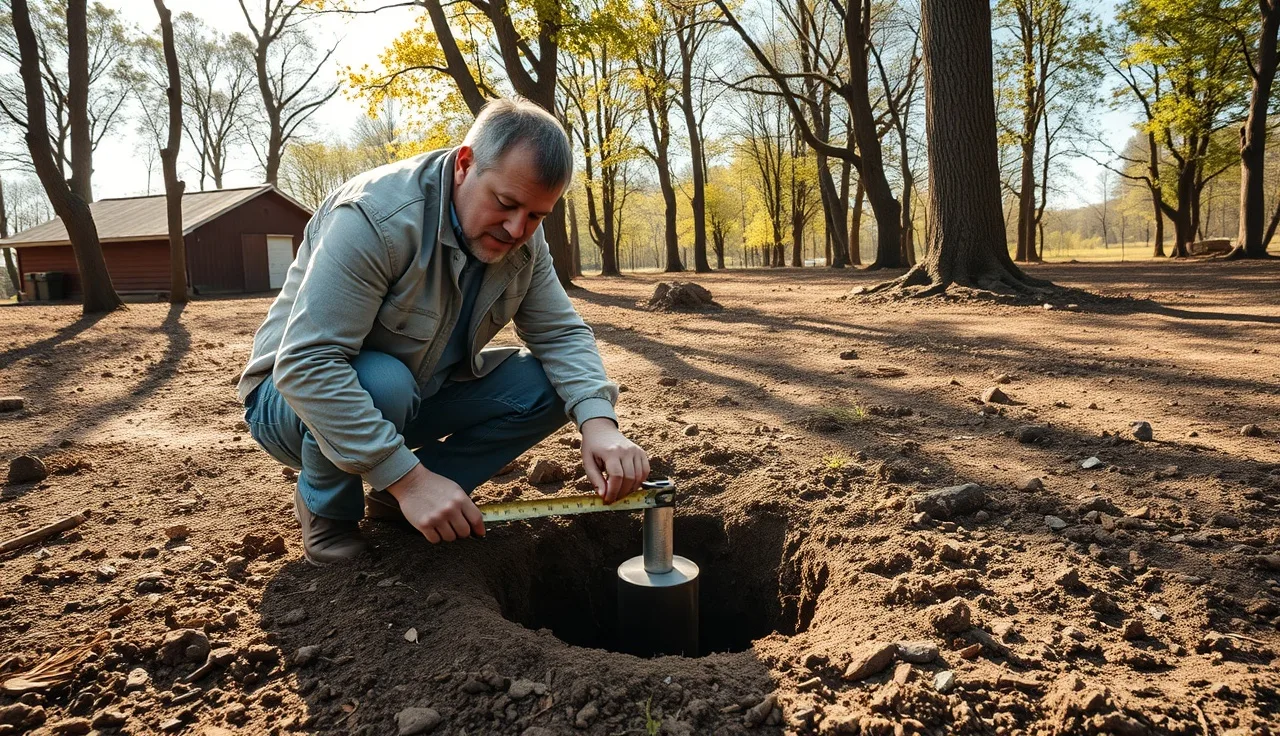
Perc tested means a parcel of land has gone through a percolation test, a field measurement that tells a licensed soil evaluator how fast water moves through the soil at the depth where a septic drain field would be installed. The word "percolation" comes from the Latin for filtering through a porous material, and that's exactly what you're measuring: how readily your soil accepts and disperses wastewater effluent.
When a listing says a property is "perc tested" or "perc approved," someone has already run the test and the local health department has issued a site evaluation letter or a septic permit approval showing the soil passed. That's real due diligence with a dollar value, because roughly 20 to 25 percent of sites tested in marginal soil regions fail outright, according to state health department data from New Hampshire and Vermont [9].
The test matters because a drain field (also called a leach field) is not a tank you can just drop in the ground anywhere. It relies entirely on the native soil to treat and disperse wastewater. If the soil is clay-heavy and nearly impermeable, effluent pools and surfaces. If it's pure gravel or coarse sand, wastewater races through without enough treatment before it reaches groundwater. You need the Goldilocks middle, and a perc test tells you if you have it [1].
How is a percolation test done, step by step?
The procedure varies slightly by state, but the core method is standardized enough that most jurisdictions follow a process close to the one described in the EPA's onsite wastewater guidance [1]. Here's what actually happens on your lot.
First, a licensed soil scientist or site evaluator digs or bores several test holes, typically 6 to 12 inches in diameter and set at the proposed drain field depth, usually 18 to 36 inches below grade. The number of holes required varies. Many states require a minimum of three per site. Others require one per bedroom the system is designed to serve.
Next comes the pre-soak. The evaluator fills each hole with water and lets it soak, sometimes for 12 to 24 hours. This step is non-negotiable in most states because dry soil absorbs water deceptively fast. Pre-soaking swells the soil to approximate its worst-case saturated condition, which is the condition that counts [10].
On test day, the evaluator fills each hole to a set depth (often 6 inches of water above a reference point), then measures how far the water level drops over a fixed interval, commonly 30 minutes for slower soils or 10 minutes for faster ones. That drop, measured in inches, converts directly into a perc rate expressed as minutes per inch (MPI). If the water drops 1 inch in 30 minutes, the perc rate is 30 MPI.
Results from all holes get reviewed together. Some states average them. Others require every hole to pass. The final number goes into a site evaluation report that your county health department uses to issue (or deny) a septic permit [2].
One thing catches property owners off guard: the test can only run during certain seasons. Most states prohibit testing when the ground is frozen or in extremely dry summer conditions. If you're trying to close on raw land in January in a cold climate, you may be waiting until spring.
What perc test results mean: passing, failing, and the numbers in between
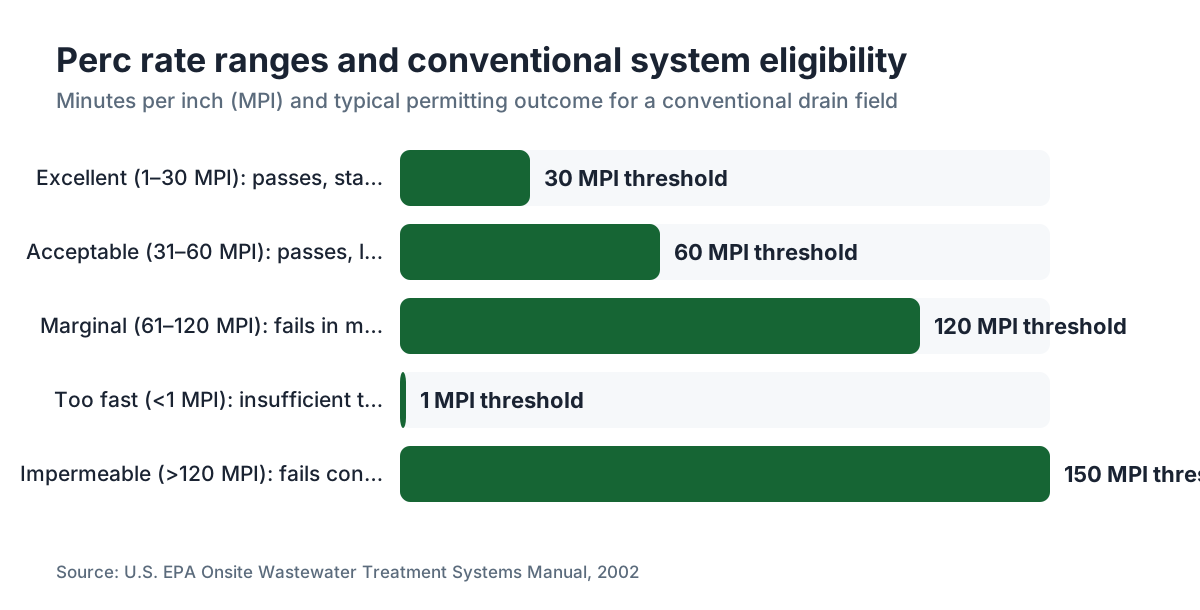
Perc rates are expressed in minutes per inch. A low number means fast drainage. A high number means slow drainage. Here's how the range breaks down for conventional septic systems [1][3]:
| Perc rate (min/inch) | What it means | Typical outcome |
|---|---|---|
| Less than 1 MPI | Drains almost instantly (gravel, coarse sand) | Usually fails; too fast for treatment |
| 1 to 30 MPI | Fast to moderate absorption | Passes; standard system works well |
| 31 to 60 MPI | Moderate to slow absorption | Passes in most states; system sizing increases |
| 61 to 120 MPI | Slow absorption | Fails in many states; alternative system may qualify |
| Over 120 MPI | Very slow / nearly impermeable | Almost always fails conventional systems |
The 60 MPI cutoff is the most common pass/fail line in the U.S., but it is not universal. Some states draw the line at 30 MPI for standard systems and allow 60 MPI only with engineered designs. Others go to 90 MPI with mound or drip-irrigation systems. Check your state's onsite wastewater code. The variation is real and it costs real money.
A site that passes at 45 MPI is fine, but it needs a larger drain field than a site at 15 MPI. The sizing formula in most state codes ties directly to the perc rate: slower soil requires more square footage of trench bottom to handle the same daily wastewater flow [3]. That larger field costs more to install and eats more of your lot.
Soil that percs too fast (under 1 MPI) is also a problem, even though it sounds like a win. Water racing through gravel hasn't had enough contact time with soil microbes to receive adequate treatment before it hits groundwater. The EPA notes that soil treatment is the single most important factor in a septic system's ability to protect public health [1].
What is the difference between a perc test and a soil evaluation?
A perc test is a single hydraulic measurement. A soil evaluation is broader. This distinction confuses a lot of homeowners, and getting it wrong can cost you a lot.
A soil evaluation (also called a soil morphology assessment or a soil profile analysis) means a licensed soil scientist reads the physical and biological character of the soil by digging a test pit and studying the horizon layers. They look at soil texture (sand, silt, clay), structure, color, and most of all, signs of seasonal high water table called redoximorphic features or mottling [4].
Mottling matters enormously. Those reddish-brown or gray spots in the soil profile are evidence that the water table rises to that depth seasonally. If mottling shows up at 18 inches, your system can't sit at 18 inches, because effluent would stall in saturated soil and reach groundwater untreated. Most states set a minimum vertical separation between the bottom of the drain field and seasonal high groundwater, often 18 to 24 inches [2].
Most states now require both a perc test and a soil profile review before issuing a permit. Some have moved entirely to soil morphology evaluations and use the perc test only as a secondary check, because experienced soil scientists found that a perc test alone misses site problems a trained eye catches on sight. If a seller says a property is "perc tested" but it has never had a full soil evaluation, you may still be buying a site that can't legally be permitted [4].
Who can perform a perc test, and who orders it?
In most states, only a licensed professional can run a perc test the health department will accept. Depending on the state, that's a licensed soil scientist, a professional engineer, a certified sanitarian, or a licensed site evaluator. Some states have their own specific license category for this work. Homeowners usually cannot conduct their own test and submit the results for permitting.
Who orders the test depends on the situation. If you're buying raw land, you or the seller orders it during due diligence. If you're adding a bedroom to an existing home, your county health department may require a new or updated evaluation to confirm the system can handle the added load. If you're getting a property inspected before purchase, a septic tank inspection may flag whether a current perc approval is on file.
Costs vary. A standalone perc test in states where it's still a simple field procedure runs roughly $150 to $300. A full soil evaluation with perc testing, soil pit analysis, and report preparation typically runs $500 to $1,500 depending on lot complexity and the professional's travel time. In difficult terrain (steep slopes, rocky soils, remote lots) you can see $2,000 or more. These are real market rates as of 2024, but call local evaluators for your area.
The county health department usually charges a permit application fee on top of this. A range of $50 to $500 is typical, though it runs higher in some jurisdictions [5].
What happens if a property fails a perc test?
Failing doesn't always mean the land is unbuildable. It means a conventional gravity-fed septic system probably won't work there. You have options, but each one adds cost and complexity.
Alternative systems built for low-perc soils include mound systems (the drain field sits above grade in imported sand fill), drip irrigation systems (effluent is pressure-dosed through small emitters into shallow soil), aerobic treatment units (ATUs) that biologically treat wastewater before dispersal, and constructed wetlands. Many states explicitly approve these alternatives for sites that fail conventional perc standards [3].
A mound system on a marginal site might add $5,000 to $15,000 to your septic tank installation cost compared to a conventional system. An ATU adds ongoing maintenance, often a service contract of $200 to $500 per year, because the mechanical components need regular inspection.
Some parcels simply can't be developed for a residence. If the seasonal high water table sits too close to the surface across the whole lot, if the lot is too small to fit an alternative system with required setbacks, or if the soil is both too impermeable and too shallow, the site may be permanently undevelopable for a home with onsite sewage disposal. That's exactly why a perc test during due diligence earns its keep. Far better to find out before you close.
If you're already on a property with a struggling system and the original site evaluation looks questionable, a septic system repair consultation may start by re-evaluating whether the original siting was appropriate.
Does a perc test expire?
Yes, and the expiration period varies quite a bit by state.
Most states set perc test validity at 2 to 5 years. Some require a new evaluation if construction hasn't started within that window, on the grounds that land disturbance, drainage changes, or seasonal variation could have altered soil conditions. A few states (notably some in the Mid-Atlantic and Southeast) have moved to longer validity periods of up to 10 years for sites with detailed soil morphology reports on file [2].
For real estate deals, the practical rule is simple. If the perc approval was issued more than five years ago, call the county health department and confirm it's still valid before you close. Don't assume. Deals fall apart every year because a buyer assumed a ten-year-old perc letter was still good, and the county wanted a full re-evaluation.
Permit approvals and perc letters are also tied to the house design proposed at the time of testing. If you buy a lot with a 3-bedroom perc approval and want to build a 5-bedroom house, you almost certainly need a new evaluation at the higher design flow.
How does a perc test affect property value and real estate deals?
A current, passing perc approval can add real value to raw land, because it turns speculative acreage into a lot that's actually buildable. In rural markets where many parcels lack well or septic access, a perc-approved lot commands a premium. Buyers in those markets regularly pay 15 to 30 percent more for a lot with an approved site plan on file versus an untested parcel of the same size, though I'm not aware of a clean national study on this. It's what rural real estate agents and appraisers in the Northeast and Mid-Atlantic consistently report.
From the seller's side, a current perc approval removes the biggest contingency buyers write into raw land contracts. That makes your property faster to close and gives the buyer less room to push on price.
For buyers: always make the purchase contingent on a satisfactory perc test and soil evaluation if one isn't already on file. Get it done early in due diligence, not the week before closing. The $500 to $1,500 cost is trivial next to owning a lot you can't build on.
For deals involving existing homes on septic, the perc test is less central, but the system's design capacity and condition matter a great deal. A septic tank inspection by a qualified inspector should be part of any home purchase involving onsite sewage, and it should include verification that the installed system matches the approved permit.
How does the perc rate determine drain field size?
The relationship between perc rate and drain field size is direct and written into every state's septic code. The slower the soil absorbs water, the more trench bottom area you need to disperse the same daily flow of wastewater without saturating the soil.
Most state formulas work like this: multiply the design daily flow (based on number of bedrooms) by a loading rate factor derived from the perc rate. A 3-bedroom home is typically designed for 300 to 450 gallons per day. At a 10 MPI perc rate, a state might allow 0.8 to 1.0 gallon per square foot per day of trench bottom, which works out to roughly 300 to 375 square feet of trench. At 50 MPI, the loading rate might drop to 0.3 to 0.4 gallons per square foot per day, requiring 750 to 1,000 square feet of trench bottom for the same house [3].
That difference in trench area drives real cost differences. More trench means more excavation, more gravel, more pipe, and a larger lot footprint. If your lot is small, a slow perc rate can make the site impractical even when it technically passes.
Understanding the drain field helps here. The leach field is where the real work of wastewater treatment happens, and its design depends entirely on what the perc test and soil evaluation reveal about the native soil.
What are the environmental and health reasons states require perc tests?
A working septic system treats wastewater before it reaches groundwater, and the soil does most of that treatment. The perc test is the check that makes sure the soil can actually do the job. The EPA describes onsite systems that fail to treat effluent as a direct threat to drinking water and public health [1].
Groundwater contamination from failing septic systems is a documented public health problem. The EPA's SepticSmart program reports that about one in five U.S. homes uses an onsite wastewater system, and improperly sited or maintained systems push nutrient pollution, bacteria, and viral pathogens into private wells and surface water [1]. Nitrogen from septic effluent is a major driver of harmful algal blooms in coastal areas; the EPA's Chesapeake Bay Program has documented that link for years [6].
The perc test requirement grew out of these concerns in the mid-20th century. Before standardized testing, systems went in wherever the installer could dig, which led to widespread groundwater contamination in areas with heavy development. State regulations codified testing starting in the 1960s and 1970s, and tightened further once the Clean Water Act framework took shape after 1972 [6].
For homeowners, that history has a practical takeaway: a perc test isn't bureaucratic friction. It's the baseline check that your system won't contaminate your own well or your neighbor's. If you're on a leach field installed before modern perc standards, it's worth knowing when it was permitted and whether the original soil evaluation still holds up.
How does a perc test fit into the full septic permitting process?
The perc test is usually the first technical hurdle in getting a septic permit, but it's rarely the last step.
A typical permitting sequence runs like this. The property owner hires a licensed evaluator, who conducts the soil evaluation and perc test and submits a site evaluation report to the county or state health department. If the site passes, the health department issues a site approval, which is specific to a certain house size and system type. The owner then hires a licensed septic designer or engineer to produce a system design based on the approved site data. That design goes back to the health department for a construction permit. Once the system is installed, a health department inspector signs off. Only then can a certificate of occupancy be issued for a new home.
That process can take anywhere from a few weeks in a streamlined rural county to six months or more in jurisdictions with detailed environmental review. Some states, like Massachusetts, add a Title 5 inspection layer for existing systems being transferred in a sale, separate from the original permitting perc test [7].
For operators managing multiple site evaluations across different counties, tracking permit status, perc expiration dates, and system approvals is the kind of workflow that purpose-built software handles far better than spreadsheets. Tools like SepticMind exist to help operators stay on top of these permit chains across a client base without things slipping through the cracks.
Once you have a permit and you're planning installation, reviewing the cost to install a septic system in detail makes sense, because the perc results directly shape those costs.
How much does a perc test cost, and is it worth doing before buying land?
A perc test costs $150 to $300 for a simple standalone test in states that still permit that format. A full site evaluation (soil pits, perc test, written report, permit application) runs $500 to $1,500 in most markets, with higher costs in complex terrain or high-cost labor markets. Add the county permit application fee, which runs from $50 to $500 or more [5].
Is it worth doing before buying land? Always. Here's the math. Raw land parcels sell for anywhere from $20,000 for a rural acre in Appalachia to $500,000 or more per acre in high-demand suburban markets. A $1,000 perc evaluation that reveals an unbuildable site saves you the entire purchase price, plus closing costs, holding costs, and years of frustration trying to sell land you can't develop.
For sellers of raw land, the calculus works the same way. A current perc approval usually pays for itself in a faster close and a higher sale price. Buyers who don't have to absorb perc risk will pay more.
One caveat: a passing perc test doesn't guarantee you'll get a permit for every house design. The approval is specific to a maximum number of bedrooms and a system type. If you want to build bigger than the site approval covers, you're back at the table with the health department.
For context on total system costs once you have an approved site, see our guide to the cost to put in a septic tank.
What state regulations govern perc testing?
Perc testing is regulated at the state level, with counties often layering on additional requirements. There is no single federal perc test standard, though the EPA provides guidance that most state codes draw from [1].
Each state's onsite wastewater or "individual sewage disposal" code specifies who may conduct the test, the exact procedure (pre-soak duration, hole dimensions, measurement intervals), pass/fail thresholds, alternative system pathways for failing sites, and permit validity periods [2][3].
A few examples of how state rules differ:
- Massachusetts requires a Title 5 soil evaluation under 310 CMR 15.000. The passing perc rate for a conventional system is 60 MPI, and seasonal testing windows are tightly defined [7].
- North Carolina's rules under 15A NCAC 18A .1900 classify soils into groups and tie system type to soil classification rather than a single MPI cutoff [8].
- California's individual county environmental health departments each administer local onsite wastewater codes, so a perc requirement in San Diego County can differ from one in Placer County [5].
The state environmental health or department of health website is always the authoritative source for your jurisdiction. Extension programs at state land-grant universities often publish readable guides to the local permitting process; the University of Minnesota Extension has a thorough one for the Upper Midwest [4].
For operators managing jobs across multiple jurisdictions, keeping a live reference to each county's current code version isn't a nice-to-have, it's a liability issue. SepticMind's operator platform includes regulatory reference tools to track jurisdiction-specific requirements across a service territory.
Frequently asked questions
What does it mean when a property listing says 'perc approved'?
Perc approved means a licensed evaluator has already tested the soil on that parcel, it passed the percolation test, and the county health department has issued a site approval for a septic system. That approval is typically specific to a certain number of bedrooms and a system type. Always verify the approval is still current (most expire in 2 to 5 years) with the local health department before relying on it.
Can a property fail a perc test and still be buildable?
Yes. A failed conventional perc test doesn't automatically make land unbuildable. Many states allow alternative systems for sites with slow-draining soil: mound systems, aerobic treatment units, drip irrigation systems, and constructed wetlands are all approved alternatives in various states. The trade-off is higher installation cost and, for mechanical systems, ongoing maintenance contracts. The specific alternatives allowed depend entirely on your state's onsite wastewater code.
How long does a perc test take?
The field work spans two days in most cases. Day one is pre-soaking the test holes, which takes 12 to 24 hours. Day two is the actual measurement, which typically takes 2 to 4 hours depending on the number of holes and how slowly the soil drains. Getting results into a written report and submitted to the health department adds another few days to two weeks depending on the evaluator's schedule.
What is a good perc test result?
For a conventional gravity septic system, a perc rate of 1 to 30 minutes per inch is excellent and allows a compact, cost-effective drain field. Rates of 31 to 60 MPI are acceptable in most states but require a larger field. Under 1 MPI (drains almost instantly) and over 60 MPI (very slow) both present problems, though alternative systems can often handle the slow end of the range.
Who pays for the perc test, buyer or seller?
It depends on how the purchase contract is written. For vacant land transactions, buyers commonly request a perc test contingency and pay for the test themselves during due diligence. Sellers who want a premium often have a current test on file before listing. There's no legal requirement either way; it's a negotiated term. If the seller pays, confirm the test was done by a licensed evaluator and that the health department has a copy on file.
Does an existing home need a new perc test when it's sold?
Usually not. A home with an existing, permitted septic system doesn't need a new perc test at sale because the system is already in place. What you do want is a full septic inspection to confirm the system is functioning and was properly permitted. Some states, like Massachusetts with its Title 5 rules, require that inspection at time of sale. A perc test only becomes relevant again if you're adding bedrooms or if the system fails and needs full replacement.
Can you do a DIY perc test?
You can run an informal perc test yourself using the same basic method (dig a hole, soak it, measure the drop rate), and it's useful for getting a rough sense of your soil before spending money on a professional evaluation. But no county health department in the U.S. will accept DIY results for permitting. The official test must be conducted by a licensed evaluator whose credentials the department has approved. DIY testing is for curiosity and early screening only.
What soil types tend to fail perc tests?
Dense clay soils fail most often because they absorb water extremely slowly, often over 120 minutes per inch. Shallow soils over bedrock fail because there's not enough depth for a drain field and required separation from rock. Conversely, pure gravel or coarse sands may absorb water too fast (under 1 MPI) for adequate wastewater treatment. Loamy soils with a mix of sand, silt, and organic matter tend to perc best for conventional systems.
How is a perc test different from a percolation pond or stormwater test?
They measure the same physical property (soil infiltration rate) but serve different regulatory purposes. A septic perc test is evaluated under state onsite wastewater codes and determines whether a drain field can treat and disperse sewage effluent safely. Stormwater infiltration testing uses similar methods but is governed by stormwater management regulations and focuses on runoff volumes rather than wastewater treatment adequacy. Don't assume a stormwater test satisfies a septic permitting requirement.
What is the difference between a perc test and a perk test?
Nothing. 'Perk' is just an alternate spelling of 'perc,' both short for percolation. You'll see both spellings in real estate listings and contractor quotes. Some regions favor one spelling over the other purely by convention. The test, the method, and the regulatory meaning are identical regardless of spelling.
How often does a perc test need to be repeated?
Most states set a validity window of 2 to 5 years. If construction hasn't started within that window, a re-evaluation is required. Some states allow longer validity periods for sites with detailed soil morphology reports on file. The practical trigger for a new test is: the old permit expired, you're changing the house design to a higher bedroom count, or significant land disturbance (grading, filling, drainage changes) has occurred since the original test.
What happens during a perc test on a steep slope or hilly lot?
Slope adds complexity. Steep grades create lateral water movement that can skew perc results, and most state codes set maximum slope limits for conventional drain fields (often 20 to 30 percent). On a steep lot, the evaluator places test holes at proposed trench locations rather than at random. Sites over the maximum slope for conventional systems may still be approvable with a contour-designed mound system or drip irrigation, which can handle grades up to 45 percent in some state codes.
Is a perc test required for a holding tank or composting toilet installation?
Generally no. Holding tanks and composting toilets don't discharge to a drain field, so there's no soil absorption component to test. Some states still require a site evaluation to confirm no conventional system is feasible before they'll permit a holding tank, because holding tanks require regular pump-outs and are considered a last resort. Check your county health department's rules; requirements vary significantly.
Sources
- U.S. EPA SepticSmart Program, Onsite Wastewater Treatment Systems: Properly functioning septic systems treat wastewater before it reaches groundwater, and adequate soil treatment is the most important factor in protecting public health; also, one in five U.S. homes uses an onsite wastewater system.
- U.S. EPA, Onsite Wastewater Treatment Systems Manual (EPA/625/R-00/008): State codes specify pre-soak procedures, perc test validity periods, and minimum vertical separation from seasonal high groundwater (often 18 to 24 inches).
- U.S. EPA, Design Manual: Onsite Wastewater Treatment and Disposal Systems: Drain field sizing formulas tie directly to perc rate; slower soil requires more trench bottom square footage. Alternative systems are approvable for sites that fail conventional perc standards.
- University of Minnesota Extension: Soil morphology evaluations (soil texture, structure, color, mottling/redoximorphic features) are required alongside or instead of perc tests in many states; mottling indicates seasonal high water table.
- California State Water Resources Control Board, Onsite Wastewater Treatment Systems: In California, individual county environmental health departments administer local onsite wastewater codes; permit application fees and perc test requirements vary by county.
- U.S. EPA, Chesapeake Bay Program: Nitrogen from septic effluent is a major documented driver of nutrient pollution and harmful algal blooms in the Chesapeake Bay watershed; the Clean Water Act framework post-1972 tightened state regulations on onsite wastewater systems.
- Massachusetts Department of Environmental Protection, Title 5 (310 CMR 15.000): Massachusetts Title 5 requires a soil evaluation under 310 CMR 15.000; passing perc rate for a conventional system is 60 MPI; Title 5 inspection is required at time of property sale.
- North Carolina Department of Health and Human Services, Environmental Health (15A NCAC 18A .1900): North Carolina's rules under 15A NCAC 18A .1900 classify soils into groups and tie permitted system type to soil classification rather than a single MPI cutoff.
- New Hampshire Department of Environmental Services, Subsurface Systems: State health department data from New Hampshire indicate roughly 20 to 25 percent of sites tested in marginal soil regions fail conventional perc standards outright.
- Penn State Extension: Pre-soaking test holes for 12 to 24 hours is required in most states to simulate saturated soil conditions; dry soil absorbs water deceptively fast without pre-soaking.
Last updated 2026-07-09