Perc test cost: what you'll pay and what affects the price
By the SepticMind Editorial Team

TL;DR
- A percolation test (perc test) typically costs $150 to $1,500, with most homeowners paying $300 to $700.
- The wide range comes from how many test holes your lot needs, whether a licensed engineer must witness the test, county permit fees, and whether your soil fails and forces alternative-system evaluation.
- Budget for the high end if your lot has clay-heavy or rocky soil.
What is a perc test and why do you need one?
A perc test, short for percolation test, measures how fast water drains through your soil. Regulators use the result, expressed as minutes per inch (MPI), to decide whether your land can support a conventional septic drain field and how large that field has to be. No passing perc test, no permit for a conventional system. That's the whole point. You're not buying it for fun.
Every state that allows on-site wastewater disposal requires some soil evaluation before a new system gets permitted. The EPA's SepticSmart program puts it plainly: soil texture, depth to groundwater, and distance to surface water are the variables that decide whether a site can support an on-site system at all [1]. The perc test is how your county confirms those variables tell a safe story.
The test itself is simple. A technician digs or bores test holes to the depth where your drain field laterals would sit, usually 18 to 36 inches down depending on your state's code. The hole gets pre-soaked for a set period, often 12 to 24 hours, to mimic saturated soil. Then water is added to a standard level and the drop is timed over set intervals. If water drops one inch in 60 minutes or faster, most states call that a passing rate for a standard leach field [2].
Buying raw land, building new, or replacing a failed system? A perc test is almost certainly required before any permit gets issued. Some states also demand a fresh soil evaluation if the original test is more than five or ten years old.
How much does a perc test cost on average?
The national range for a perc test is $150 to $1,500. Most residential lots land between $300 and $700 for the complete test: the technician's time, the field or lab evaluation, and the written report. That's the honest middle.
Here's where the money goes:
| Cost component | Typical range |
|---|---|
| Technician or engineer site visit | $100 to $400 |
| County permit/application fee | $50 to $300 |
| Test hole excavation (if mechanical) | $75 to $250 |
| Soil morphology or perc report | Included to $200 extra |
| Witnessing fee (if county inspector required) | $50 to $150 |
| Failed test: alternative system evaluation | $500 to $3,000+ |
A simple lot in a cooperative rural county, where a soil scientist or septic contractor runs the test without a county inspector standing there, often comes in at $250 to $400 all-in. A lot in a state like North Carolina or Virginia, where a licensed soil scientist has to perform and certify the evaluation, or a county with steep permit fees, can run $800 to $1,200 before any complications. Multiple test locations or a full soil morphology report to check seasonal high water table adds $200 to $500 more.
Nobody has clean national survey data on this. The closest useful benchmarks come from state extension services and county health department fee schedules, both public records you can look up before you hire anyone [3].
What factors make a perc test more or less expensive?
The biggest cost driver is who has to be there. Some counties let a licensed septic contractor or engineer run the test and submit results. Others require a county environmental health officer to witness every hole. The witnessing rule alone adds a scheduling delay and sometimes a separate inspection fee. Call your county health department before you hire anyone. That one conversation tells you whether you're looking at a $400 job or an $800 job.
Lot size and terrain matter. A standard residential lot usually needs two to four test holes. A bigger parcel, or one with varying slope and soil types, may need six to eight to give the county a defensible picture of the whole site. Each extra hole takes time to dig, pre-soak, and measure.
Soil type is the wildcard. Sandy loam drains fast and testing tends to go smoothly. Heavy clay drains slowly and often needs extended pre-soaking, sometimes 24 hours instead of 12, which can force two site visits and two charges. Rocky or ledge-heavy lots may need a backhoe or hydraulic auger instead of a shovel, and that equipment costs money.
Geography swings the number too. Rural Midwest counties often have low permit fees and plenty of competing soil testers. Suburban counties in the mid-Atlantic or Pacific Northwest carry more regulatory steps and higher labor rates.
Pre-soak timing is the quiet cost. Most state codes require the holes to be saturated the day before the timed measurement. If the technician makes two trips, some charge for two half-days and others bundle it. Ask before you hire.
What's the difference between a perc test and a full soil evaluation?
This distinction costs people money when they miss it upfront. A perc test is specifically the timed water-infiltration measurement. A full soil evaluation, sometimes called a site and soil evaluation or an onsite wastewater suitability assessment, includes soil morphology (reading soil color, structure, and texture through a profile pit or boring), seasonal high water table determination, setback measurements, and often a site plan sketch.
Many states have moved away from relying on perc numbers alone. They now require the full evaluation because a perc test can lie: run one during a dry summer on cracked clay and it shows deceptively fast drainage that won't hold up in a wet spring. The EPA notes that soil morphology and site conditions predict long-term system performance better than perc rate alone [1].
If your state or county requires the full evaluation, that's the number to budget around, not the bare perc test. Full evaluations run $400 to $1,500 for a typical residential lot, and the report is usually the document the county health department actually stamps and files. The perc result is one data point inside it.
Ask your county health department the direct question: "Do you accept a perc test only, or do you require a full site and soil evaluation?" The answer decides what you hire and how much you pay.
What happens if your lot fails the perc test?
A failed perc test doesn't automatically mean you can't build. It means a conventional gravity-fed drain field probably won't work here. Most states allow alternative designs for sites that fail standard perc: mound systems, drip irrigation, aerobic treatment units, and engineered sand filters are the common ones [4].
The catch is that evaluating your lot for an alternative costs more. You may need an engineer to design a custom system, plus extra soil borings, groundwater monitoring, and a separate permit application. Alternative systems also cost a lot more to install. A mound system typically runs $10,000 to $30,000 installed, against $5,000 to $15,000 for a conventional gravity system [5]. Our guide to cost to install septic system breaks down the full picture.
Buying land and the perc test fails? That's material information for your negotiation. A lot that can't support any on-site wastewater system has sharply reduced value, or none, if there's no municipal sewer option. Make the sale contingent on a passing soil evaluation before you close.
Some lots fail because the test ran at the wrong time of year or in the wrong spot on the parcel. A soil scientist can sometimes find a location with better drainage. That second-opinion evaluation adds cost but can save a deal.
Who is qualified to perform a perc test?
This varies by state, and getting it wrong means the county rejects your results. In many states, a licensed soil scientist or professional engineer has to perform the soil evaluation. Virginia, North Carolina, and Georgia are examples where only a state-licensed evaluator's report is valid [3][6].
In other states, a licensed septic system designer or installer can run the test with a county inspector witnessing. In a handful of lightly regulated rural counties, almost anyone can dig the holes and time the drop, as long as a county official watches the process.
The practical move: go to your county health department's website or call them before you hire. They'll tell you exactly what credentials the tester needs and whether county staff have to be present. Hiring the wrong person and having results rejected is a real way to burn $300 to $500 and several weeks.
For new construction or land purchases, many buyers hire a licensed soil scientist or engineer even when the county doesn't require it, because the report is more defensible and sometimes accepted across multiple jurisdictions.
SepticMind's directory resources help operators in some states track which licensed evaluators are active in a given county, useful if you're juggling multiple site evaluations and need to coordinate scheduling.
How do perc test costs compare across different states?
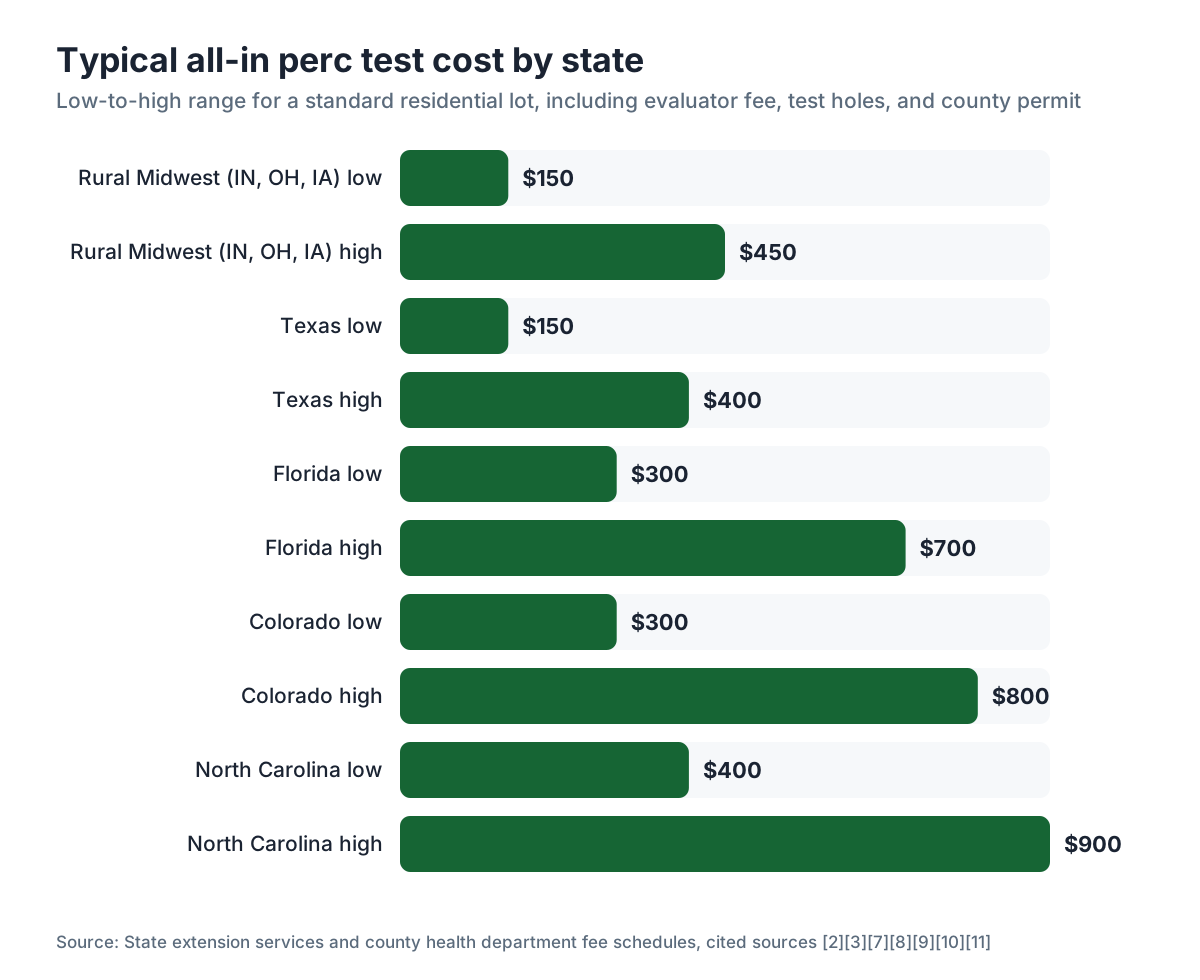
State regulation drives cost variation more than anything else. Here's an honest comparison built from public county fee schedules and state extension guidance:
| State | Typical all-in cost | Key notes |
|---|---|---|
| Texas | $150 to $400 | Licensed engineers or sanitarians required; rural county fees low |
| North Carolina | $400 to $900 | Licensed soil scientist required; multiple soil pits standard |
| Virginia | $500 to $1,200 | State-licensed evaluator required; detailed morphology report |
| Florida | $300 to $700 | County health departments issue permits; fees vary by county |
| New York | $400 to $1,000 | County health department oversight; perc plus soil profile common |
| Colorado | $300 to $800 | Licensed engineer or soil scientist; high-altitude sites add cost |
| Georgia | $400 to $900 | Licensed soil classifier required since 2000 |
| Rural Midwest (IN, OH, IA) | $150 to $450 | Simpler process; contractor-run tests often accepted |
These ranges come from state extension publications and posted county fee schedules, not invented averages. The real number for your parcel depends on lot size, complexity, and the firm you hire [7][8][9].
In a state with strict credentialing and tricky soil, the $1,000 to $1,500 range is realistic, and you shouldn't be shocked by it. Budget to the high end. Get surprised the good way.
Can you do a perc test yourself?
Technically, yes. You can dig a hole, fill it with water, and time the drop. That's the physical process. But "can I do it myself for a permit?" is almost certainly no.
Every state that requires a perc test for permitting also requires it to be performed or witnessed by a qualified professional, with results submitted on a specific form to the county or state health department. A self-run test has no regulatory standing. You can't file it. The county won't take it.
DIY testing does make sense as a preliminary screen before you spend money on a pro. If you're eyeing a piece of land and want a rough read on whether the soil is obviously bad, dig a test hole, saturate it, and watch how fast water drops. Water still sitting in the hole 24 hours later is a loud signal the lot has drainage problems. But that's due diligence, not a substitute for the real test.
Some septic system designers will do a preliminary site walkthrough for $100 to $200 before the formal test. That walk can tell you whether the test is likely to go well, which saves money if the site is clearly unsuitable and you're still negotiating on a land purchase.
How does the perc test connect to your total septic system cost?
The perc test is the first cost in a chain. It feeds the drain field design, which drives how much of the whole installation you pay for. Passing doesn't lock in your budget. The actual MPI result sets the drain field size, and slow-draining soil needs more linear feet of drain line, more gravel, and more labor.
A standard drain field for a 3-bedroom home might need 300 to 500 linear feet of leach field trench if the soil percs at 30 MPI. The same house on soil that percs at 55 MPI might need 600 to 900 linear feet, which can add $3,000 to $8,000 to the installation [5]. The perc number, more than a pass or fail, shapes the entire downstream budget.
Planning a new install? Start with our guide to septic tank installation to see the full cost sequence. The perc test is step one, but budgeting for it in isolation guarantees you'll be surprised by every step after.
For lots with marginal drainage, a second soil evaluation from a different licensed pro before you commit to an alternative system is often worth the $400 to $600. Alternative systems carry higher install and maintenance costs, so confirming you actually need one before designing for it is money well spent. You'll also want to understand your leach field options before the designer starts drawing.
How to get an accurate perc test quote
Get at least three quotes. This isn't filler advice. Perc testing is a local market with wide price dispersion, and the first number you hear is rarely the competitive rate for your area.
When you call, hand the tester everything: the parcel address or GPS coordinates, the lot size, whether vegetation or structures complicate access, and the purpose (new construction, replacement, or land sale due diligence). If you already know the county's credential and witnessing rules, say so, so nobody hits a surprise.
Ask the pointed questions. Does the quote include pre-soaking the holes the day before? Does it include the written report? If a county inspector has to witness, is scheduling that on you or on them? What happens if the test fails, and does that change what they deliver?
Check whether the county health department publishes a list of approved or licensed soil evaluators. Many do, and working from that list makes sure you hire someone whose paperwork the county will actually accept. Your county environmental health department is the right first call, and most will give you the permit fee, the credential requirement, and the accepted-tester list in one phone call.
If you're a service operator scheduling perc tests across multiple clients and sites, tracking status and documentation across jobs is where a platform like SepticMind cuts the administrative drag of coordinating evaluators, county offices, and homeowners.
How long does a perc test take, and how long are results valid?
The physical test takes one to two days. Day one is usually pre-soaking the holes. Day two is the timed measurement, two to four hours on site depending on how many holes and how fast the soil drains. Your total timeline from scheduling to a written report in hand is typically one to three weeks, mostly driven by the tester's availability and whether the county needs to schedule an inspector.
Result validity is a real budget item people overlook. Most states require perc tests or site evaluations to be no older than five years for a new permit application, but this varies. Some states accept results indefinitely if the parcel hasn't changed. Others set hard expiration dates of two to five years [2]. Buying land that already has a perc test on file at the county? Find out when it was done and whether the county will still accept it before you pay for a new one.
New York generally requires a new test if the prior one is more than five years old or if site conditions changed materially [10]. Florida's validity periods vary by county [8]. Always confirm with your specific county health department.
One practical note: perc tests done in the dry season on certain soils can read misleadingly optimistic. A good soil scientist accounts for seasonal high water table in the evaluation. If yours doesn't mention it, ask.
Frequently asked questions
How much does a perc test cost for a 1-acre lot?
For a typical 1-acre residential lot, expect $300 to $700 all-in: the technician's time, two to four test holes, pre-soaking, the timed measurement, and the written report. County permit fees add $50 to $300 on top depending on your jurisdiction. Lot size matters less than soil complexity and local credentialing rules in setting the final price.
Does a perc test cost change if the soil fails?
The initial test costs the same whether it passes or fails. But a failure usually means additional evaluation for an alternative system design, which runs $500 to $3,000 more. A licensed engineer may need to design a custom mound or drip system, requiring extra soil borings, a site plan, and a separate permit. Budget for this contingency before you commit to buying land.
Who pays for the perc test, the buyer or the seller?
In most transactions the buyer pays as part of a due diligence contingency period. It's negotiable, though. If the seller already has a valid perc test and the county will accept it, the buyer may rely on those results at no cost. Always confirm the test's validity date with the county health department before accepting seller-provided results.
How long is a perc test result valid?
It depends on your state and county. Most jurisdictions accept results for three to five years if site conditions haven't changed. Some states set no expiration for undisturbed lots. Others, like many New York counties, require a new test after five years or if major site changes happen. Check with your county health department before paying for a new test on land that already has one on file.
Can I get a perc test done in winter?
It depends on your region. Testing in frozen or snow-covered ground is generally not accepted because the soil doesn't reflect normal drainage. Most northern states either prohibit winter testing or warn that results may not be representative. In the South and mild-climate West, year-round testing is usually fine. Check your state's onsite wastewater regulations or ask your county health department for the accepted testing season.
Does a perc test tell you the size of septic system you need?
The perc rate in minutes per inch (MPI) is combined with your home's bedroom count to calculate the required drain field size. A slower rate means a larger, pricier field. The soil evaluator's report translates the raw MPI into a minimum drain field area, and the system designer uses that to spec the full system. A passing perc test is necessary but not enough on its own to know your full install cost.
What is a good perc test result?
Most states treat 1 to 60 minutes per inch (MPI) as passing for a conventional drain field. The sweet spot is 10 to 30 MPI, meaning water drops one inch every 10 to 30 minutes. Faster than 1 MPI is too sandy and may not filter effluent properly. Slower than 60 MPI is too dense and water won't drain adequately. Some states use different thresholds, so check your state's onsite wastewater code.
Is a perc test the same thing as a soil test?
No. A perc test measures water infiltration rate. An agricultural soil test measures nutrient content, pH, and organic matter. A full site and soil evaluation for septic permitting includes perc testing plus soil morphology (reading color, structure, and texture to determine drainage class and seasonal water table). Many states now require the full evaluation rather than a bare perc test, so the terms get used loosely in ways that confuse buyers.
Do I need a perc test to replace an existing septic system?
Sometimes. If you're replacing a failed system and the county has existing soil evaluation data on file for your parcel, they may accept it for the new permit. If that data is too old, missing, or the failure suggests the original system was sited badly, a new perc test or full soil evaluation is likely required. Call your county health department before assuming old records will do. Requirements for replacement systems vary by county.
How do I find a licensed perc tester in my area?
Start with your county health department or environmental health office. Most publish a list of licensed or approved soil evaluators and system designers. State licensing boards for soil scientists or professional engineers also keep public directories. Searching 'licensed soil scientist' or 'onsite wastewater evaluator' plus your county name usually surfaces local firms fast. Verify the person holds the exact credential your county requires before scheduling.
What should I bring or do to prepare for a perc test?
Not much falls on you. Give the tester clear access to the proposed drain field area: gates unlocked, animals secured, equipment moved off the test spot. If you know roughly where the field will go from the site plan, mark it. Some testers ask you to arrange water delivery to pre-soak holes on large lots without a nearby spigot. Confirm those logistics when you book.
Can a perc test be wrong or inaccurate?
Yes, and this gets under-discussed. Dry-season testing on cracking clay can read falsely fast. Testing after an unusually wet stretch can read falsely slow. Improper pre-soaking, wrong hole depth, or soil disturbance from digging all affect accuracy. This is one reason many states now require full soil morphology evaluations instead of relying on perc alone: trained soil scientists spot misleading site conditions a simple timed test would miss.
Does the perc test fee include the permit fee?
Usually not, unless the tester says so. The perc test fee covers the soil evaluator's time and their report. The permit fee is paid separately to your county or state health department when you apply for a septic installation or alteration permit. Permit fees range from $50 to $300 or more depending on jurisdiction. Always confirm what's included in any quote before assuming the permit cost is covered.
Sources
- EPA SepticSmart: How Your Septic System Works: Soil texture, depth to groundwater, and distance to surface water are foundational variables for on-site system suitability; soil morphology is a more reliable long-term predictor than perc rate alone.
- North Carolina Department of Health and Human Services, Division of Public Health (Onsite Water Protection): Pre-soaking requirements, minimum hole depth, and standard MPI thresholds for conventional systems in state onsite wastewater codes.
- Virginia Department of Health, Office of Environmental Health Services: Sewage Handling and Disposal: Virginia requires a state-licensed soil evaluator to perform and certify the site evaluation; published guidance on evaluator credentials and county fee schedules.
- EPA: Types of Septic Systems: Mound systems, drip irrigation systems, aerobic treatment units, and engineered sand filter systems are recognized alternatives for sites that fail conventional perc requirements.
- Penn State Extension: On-lot Sewage Systems: Perc rate (MPI) determines drain field sizing; slower-draining soils require more linear feet of trench, increasing installation cost; mound systems cost significantly more than conventional gravity systems.
- Georgia Secretary of State: Professional Licensing (Soil Classifier): Georgia has required a licensed soil classifier to perform site evaluations for on-site wastewater permitting since 2000.
- University of Minnesota Extension: Septic Systems: Perc test methodology, pre-soaking requirements, and cost variation across Midwest counties based on regulatory structure.
- Florida Department of Health: Onsite Sewage Programs: Florida county health departments issue permits for on-site systems; permit fees and soil evaluation requirements vary by county; county fee schedules are public records.
- Texas Commission on Environmental Quality: On-Site Sewage Facilities: Texas requires licensed engineers or sanitarians to design on-site sewage facilities; rural county fees are generally lower than urban counties.
- New York State Department of Health: Environmental Health: New York generally requires a new perc test if the prior test is more than five years old or if site conditions have materially changed.
- Colorado Department of Public Health and Environment: Onsite Wastewater Treatment Systems: Colorado requires a licensed professional engineer or soil scientist for site evaluations; high-altitude and rocky lot conditions add complexity and cost.
Last updated 2026-07-10