Perc test Maryland: rules, costs, and what happens next
By the SepticMind Editorial Team

TL;DR
- A percolation (perc) test in Maryland measures how fast soil absorbs water to determine if a lot can support a septic system.
- Tests run $700, $2,500, are regulated by the Maryland Department of the Environment, and must be witnessed by a county health department official or licensed site evaluator.
- Failing soils can sometimes be addressed with alternative drainfield designs.
What is a perc test and why does Maryland require one?
A percolation test, almost always called a perc test, measures how quickly water drains through soil at a specific depth. The result tells the health department whether the ground can safely absorb the treated effluent that comes out of a septic drainfield. If the soil drains too slowly, pathogens stay near the surface. If it drains too fast, effluent can reach groundwater before treatment is complete.
Maryland requires a perc test before any new septic system can be permitted.
The Maryland Department of the Environment sets the statewide framework under COMAR 26.04.02, and each of Maryland's 24 jurisdictions (23 counties plus Baltimore City) administers the tests locally through its environmental health office. [1] You can't get a building permit for a home on a lot without public sewer access until you clear this hurdle.
The test is also required when you're subdividing land, converting an agricultural structure to a residence, or repairing a failed drainfield on a lot that was never formally evaluated. Some counties require a fresh evaluation even if an old perc approval exists but has gone stale, typically after five to ten years.
Who can perform a perc test in Maryland?
Maryland splits the job in two: the person who digs and observes the test, and the person who officially approves the results. Under COMAR 26.04.02.07, a licensed onsite system inspector or licensed professional engineer with relevant credentials can conduct the field investigation, but a county health department sanitarian must witness or approve the final site evaluation for most routine permits. [1]
Most homeowners and developers hire a licensed site evaluator or environmental consultant to prepare the site evaluation report. That consultant arranges the test holes, does the soil characterization (they look at soil texture, color, and mottling to find the seasonal high water table), and submits the package to the county. The county then schedules its own field review.
A few counties, including Montgomery and Prince George's, run large in-house staffs and may handle parts of the evaluation themselves. Others lean heavily on private consultants.
Either way, expect two to four weeks of scheduling lag just to get on the county's calendar, especially between April and October when demand is highest.
How is a Maryland perc test actually done?
The process in Maryland is more involved than the single-hole "pour water and time it" version many people imagine. The state uses a full site evaluation that pairs the perc test with a soil profile analysis.
First, a backhoe digs several test pits, usually two to four feet wide and deep enough to expose a complete soil profile, often four to six feet. The evaluator reads soil color, structure, and signs of periodic saturation (called redoximorphic features or mottling) to estimate where the seasonal high water table sits. Maryland's minimum vertical separation between the bottom of the drainfield and the seasonal high water table is typically 12 to 18 inches depending on system type, so this step controls the whole design. [2]
Then the perc test holes themselves get dug, usually six to twelve inches in diameter and at the proposed drainfield depth. They're pre-soaked for at least four hours (sometimes overnight) to saturate the soil before timing begins. Once pre-soaking is done, water is added to a standard level and the drop over 30 or 60 minutes is measured. Maryland reports results in minutes per inch (MPI). A rate between 1 and 60 MPI is generally acceptable for a conventional drainfield; slower than 60 MPI is considered failing for conventional systems under state guidance. [2]
The field portion, digging plus testing plus the county witness, usually takes four to eight hours on site. Report preparation and county review pile on after that.
How much does a perc test cost in Maryland?
Expect to pay somewhere between $700 and $2,500 for a complete perc test and site evaluation in Maryland. The range is wide because costs depend on lot size, soil complexity, travel distance, how many test pits the county requires, and whether a backhoe rental is baked in.
Here's how the pieces break down.
| Component | Typical cost range |
|---|---|
| Licensed site evaluator / consultant fee | $500, $1,500 |
| Backhoe rental or excavation | $150, $500 |
| County application / review fee | $50, $300 |
| Perc test witnessing fee (some counties) | $100, $200 |
| Total | $700, $2,500 |
Those are 2024 figures gathered from publicly posted county fee schedules and consultant price ranges; they shift with local demand and fuel costs. Howard County, Montgomery County, and Anne Arundel County tend toward the higher end because of pricier labor markets and tougher county review requirements.
One thing worth knowing: if your lot already has a formal soil evaluation that passed, you may only need a design engineer to work from that old report rather than repeating the full test. Confirm with your county health department before spending the money.
If you get permitted and build, the perc test cost folds into the larger bill for the whole system. See our guide on cost to install septic system for the full picture.
What do Maryland perc test results actually mean?
Results are expressed in minutes per inch (MPI), which describes how many minutes it takes for water to drop one inch in the test hole. Lower numbers mean faster drainage.
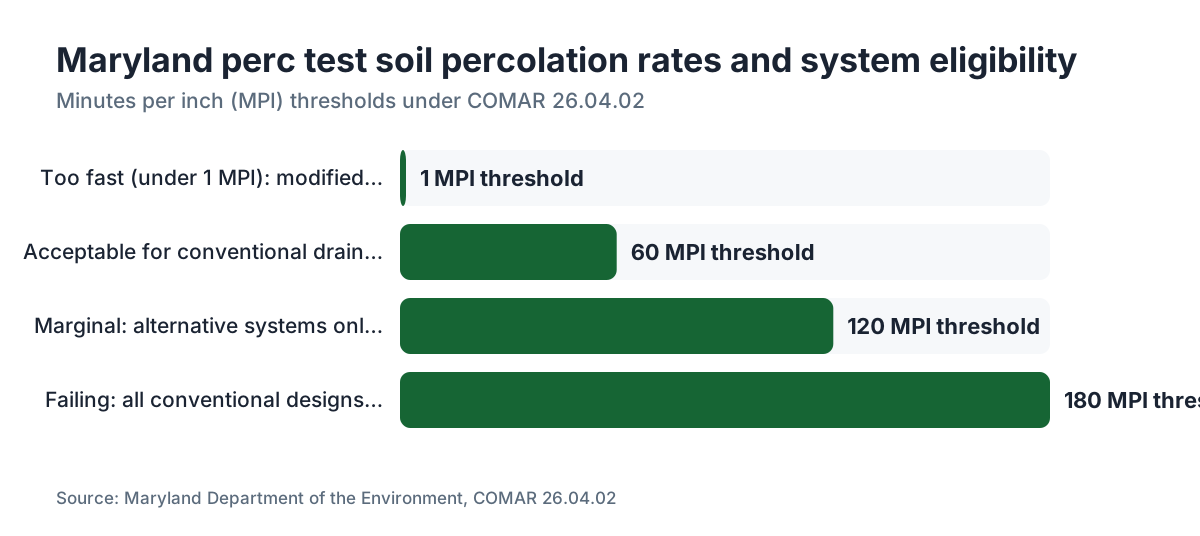
Maryland's guidance under COMAR 26.04.02 sets these general thresholds for conventional gravity drainfields: [1]
| Result (MPI) | Interpretation |
|---|---|
| Less than 1 | Too fast; likely coarse sand or gravel. Effluent may reach groundwater undertreated. May still pass with a modified design. |
| 1 to 60 | Generally acceptable for conventional drainfield |
| 61 to 120 | Marginal; may qualify for alternative systems only |
| Greater than 120 | Failing for all conventional designs; alternative system or lot rejection |
But MPI is only part of the story.
The seasonal high water table reading from the soil profile often controls the outcome more than the perc rate does. A lot with a 45 MPI rate but a seasonal water table at 18 inches below grade might still fail because the system can't hold the required separation distance.
Maryland also weighs the lot's proximity to wells, streams, wetlands, and the Chesapeake Bay Critical Area when reviewing results. A technically acceptable perc rate doesn't guarantee permit approval if the setback distances can't be met. [3]
What happens if a perc test fails in Maryland?
A failing result doesn't always mean the lot is unbuildable. It means a conventional gravity-fed drainfield won't work. Maryland authorizes several alternative system designs for lots with hard soils. [1][2]
The most common options:
Mound systems build the drainfield above grade using imported fill soil, creating the vertical separation distance that the native soil can't provide. They work on lots with high water tables or slow-perc soils. They cost more, typically $15,000, $30,000 for the drainfield component alone, and they eat more land area.
Low-pressure pipe (LPP) systems distribute effluent in small, timed doses across a wider area to prevent hydraulic overload of slow soils. Some Maryland counties accept these for soils testing between 60 and 120 MPI.
At-grade systems place the distribution pipes directly on the native soil surface under a layer of fill, suited for sites with very shallow seasonal water tables.
Advanced treatment units (ATUs) pre-treat effluent to a higher standard before it reaches the drainfield, which allows tighter setback distances and sometimes qualifies marginal soils. Maryland keeps a formal approval list of ATUs. [3]
If none of the alternatives fit the lot's size, shape, and setback constraints, the county can formally deny the permit. At that point your realistic options are connecting to public sewer if a line runs nearby, selling the land as unbuildable, or requesting a hardship variance (rarely granted, and never quick).
For context on what drainfield repair looks like on an existing system, our leach field guide covers the failure modes and fix options.
How long does the perc test process take in Maryland from start to permit?
Budget two to four months from the day you hire a consultant to the day you hold an approved site evaluation. That assumes no major complications.
Here's a realistic timeline.
Week 1 to 2: Hire a site evaluator, pull a county application, and get on the schedule for site prep. Some counties require you to notify them at least five business days before any digging.
Week 2 to 6: Pre-site preparation (clearing brush, marking lot lines, sometimes obtaining a zoning confirmation). Field work happens in this window once the county can schedule a witness.
Week 6 to 10: The consultant prepares the site evaluation report and submits it. County review times vary widely. Anne Arundel County has posted review times of four to six weeks for a standard residential lot. Montgomery County's review can run eight weeks or longer during peak season.
Week 10 to 16: The county issues approval (or requests more information, which restarts the clock). Approval is then valid for a set period, often three to five years depending on county, before the lot must be re-evaluated.
If the lot sits in Maryland's Chesapeake Bay Critical Area or within 1,000 feet of tidal waters, expect extra review layers through the Critical Area Commission that can add four to eight weeks. [3]
Does Maryland have any special rules for the Chesapeake Bay Critical Area?
Yes, and they matter for a big slice of the state. The Chesapeake Bay Critical Area law (Maryland Code, Natural Resources Article, Title 8, Subtitle 18) sets a 1,000-foot buffer from tidal waters and tidal wetlands where stricter land use and environmental standards apply. [3] Any new septic system inside this zone has to meet enhanced nutrient removal (ENR) performance standards, meaning nitrogen in the final effluent must fall below 4 mg/L, compared to the roughly 30 to 40 mg/L that comes out of a conventional septic tank.
The Maryland Department of the Environment's Office of Water Programs coordinates with the Critical Area Commission on these permits. In practice, that almost always means an advanced treatment unit is required even if the perc test would otherwise support a conventional drainfield. The ENR requirement alone adds $5,000, $15,000 to system costs before you count installation labor.
Properties already on septic within the Critical Area also face upgrade requirements when they change ownership or expand the dwelling.
If you're buying land near the Bay, the Critical Area layer is one of the first things to check, before you spend a dime on a perc test.
How do Maryland's county perc test rules differ from each other?
COMAR 26.04.02 sets the floor, but counties have real room to stack requirements on top of it. The differences that actually hit your wallet and calendar:
Fee schedules vary a lot. Frederick County's 2024 site evaluation fee was around $175 while Montgomery County's base fee ran closer to $280, with additional review fees layered on top.
Scheduling and staffing. Rural counties like Garrett, Allegany, and Somerset run smaller environmental health offices and may schedule perc test witnessing only on certain days of the week. In summer, waits of four to six weeks for a county-witnessed test are common.
Additional county overlays. Some counties have their own wellhead protection zones, floodplain setbacks, or agricultural zoning buffers that add constraints the state code doesn't touch.
Property age and existing systems. Baltimore County and Carroll County run active programs requiring perc re-evaluation when older systems in certain watersheds are replaced, even when the lot was evaluated decades ago.
Call your county health department's environmental health division first, not last. The information on state websites often lags current local practice by a year or two.
Do I need a perc test if I'm buying land in Maryland?
If you're buying undeveloped land and plan to build a home or any structure that needs wastewater disposal, yes, you absolutely need to know the perc status before closing.
A lot without a passed perc evaluation or an existing approved septic permit may be worth far less than the listing price suggests, or worth nothing to you as a building site.
The right sequence: order a title search to see if any prior site evaluations were recorded, then contact the county environmental health office and ask whether any approved evaluations exist on file for that parcel. Many Maryland counties keep digital records going back to the 1990s. If a passed evaluation exists and still sits inside its validity window, you may be able to build on it without repeating the test.
If no evaluation exists, or if the existing approval has expired, make your purchase contract contingent on a passed perc test. Walk away from any seller who refuses that contingency on undeveloped land without sewer access. The due diligence period for a perc evaluation is typically 45 to 90 days; negotiate that timeline into the contract.
For context on what the full build-out costs once you pass, see our guide on cost to put in a septic tank and septic tank installation.
How does the EPA's guidance relate to Maryland perc tests?
The EPA doesn't run state perc tests, but it sets the research and policy context Maryland's regulations are built around. The EPA's SepticSmart program notes that "proper siting and design of a septic system is essential to protect public health and water quality" and points to state environmental agencies as the controlling authority for individual system permits. [4]
EPA's Office of Water has published design manuals for onsite wastewater systems that Maryland references when it updates COMAR 26.04.02. EPA's guidance on minimum vertical separation distances and soil loading rates (effluent volume per square foot of drainfield) feeds directly into Maryland's design standards. [5]
For operators managing multiple properties or clients across Maryland counties, keeping site evaluation records organized matters more than most people expect. SepticMind's service tracking tools let operators attach scanned site evaluation reports and county approval letters to individual property records, which cuts the scramble when a permit question surfaces years later.
Practically: the EPA guidance is worth reading if you want to understand why Maryland's rules are what they are. For your specific lot, the county environmental health office is the only authority that matters.
What should I do after passing a Maryland perc test?
Passing is the beginning, not the end.
Get the site evaluation recorded. Some counties require the approved site plan to be recorded with the land records before a building permit can issue. Don't assume your consultant did this; confirm it.
Hire a licensed system designer or engineer to turn the site evaluation into an actual septic system design. The design must match the approved test location exactly, including the drainfield footprint and depth. Moving the drainfield even 20 feet from the approved location can void the permit.
Apply for the septic construction permit through your county. This is a separate permit from the site evaluation approval. Some counties issue them fast; others have multi-week queues.
Once the system is built and inspected, get the as-built drawing filed with the county. That document protects you years later if the system needs repair or expansion. Without it, nobody knows exactly where your leach field sits, and excavating blind near drainfield lines causes real damage.
After the system is running, the usual maintenance rules apply: pump the tank every three to five years (more often for garbage disposal users or large households), watch what goes down the drains, and schedule a septic tank inspection before any real estate transaction. Our guide on how often to pump septic tank covers that schedule in detail.
Frequently asked questions
How long is a perc test approval valid in Maryland?
Approval validity varies by county, typically three to five years. After that window, the site evaluation expires and you may need to repeat the test before a building permit is issued. Some counties allow a desk review of existing data rather than a full re-test if site conditions haven't changed. Always confirm with your specific county environmental health office.
Can I do my own perc test in Maryland?
No. Maryland requires a licensed site evaluator or professional engineer to conduct the formal site evaluation, and a county health department official must witness or formally approve the results. A homeowner can dig test pits informally to get a rough idea of soil conditions, but those observations have no legal standing for permitting purposes.
What soil types tend to fail Maryland perc tests?
Heavy clay soils common in the Piedmont and Coastal Plain regions of Maryland are the most frequent cause of failure. They absorb water very slowly, often testing above 120 MPI. Soils with a shallow seasonal high water table, common on the Eastern Shore and low-lying areas near the Bay, also fail frequently even when the perc rate itself is acceptable.
Does Maryland require a perc test for a replacement septic system?
Sometimes. If the existing system was properly permitted and the drainfield location isn't changing, you may be able to repair or replace components without a new perc test. But if you're relocating the drainfield, expanding capacity, or if the original lot was never formally evaluated, the county will require a new site evaluation. Contact your county health department before assuming the old approval covers a replacement.
How many perc test holes does Maryland require?
There's no single statewide number; it depends on lot size, variability of soil conditions, and the proposed drainfield size. A typical residential lot might require two to four percolation test holes plus two to four soil profile pits. The county may require additional holes if soil conditions vary across the proposed drainfield area or if initial results are borderline.
What is the difference between a perc test and a soil evaluation in Maryland?
In Maryland, a perc test is one component of a broader site evaluation. The site evaluation also includes soil profile analysis (examining color, texture, and mottling to locate the seasonal high water table), topographic assessment, setback measurements, and lot size calculations. You can pass the perc test numerically and still fail the site evaluation because of water table depth or setback conflicts.
Can a perc test result be appealed in Maryland?
Yes. If your county denies a septic permit based on site evaluation results, you can request an administrative review through the county health officer and ultimately appeal to the Maryland Office of Administrative Hearings. The appeals process typically takes several months and involves hiring an expert to argue alternative interpretations of the soil data. Most consultants recommend exhausting alternative system designs before going the appeal route.
What time of year is best to schedule a Maryland perc test?
March through May is often best. Soils are moist from winter precipitation, which gives more consistent pre-soaking results, and county schedules haven't hit the summer backlog yet. Avoid July through September when county witnessing wait times stretch the longest. Some consultants prefer fall testing on slow-draining soils to get the most accurate seasonal water table reading before spring water tables rise.
Does a perc test result transfer with the land if I sell the property?
Generally yes, if the approval is still within its validity period and has been recorded with the county or land records. The approval runs with the parcel, not the owner. Buyers should confirm with the county that the approval is current, covers the specific buildable area on the lot, and that no changes to the lot (grading, new structures, wetland delineation updates) have affected its status.
What does it cost to install a septic system in Maryland after passing a perc test?
A conventional gravity-fed system on a standard lot typically runs $10,000, $20,000 including tank, drainfield, and installation. Mound systems for marginal soils add $10,000, $20,000 to that. Advanced treatment units required in the Chesapeake Bay Critical Area add another $5,000, $15,000. Design fees, permit fees, and site prep are on top of those figures. See our full guide on cost to install septic system for a county-level breakdown.
How is the Maryland perc test different from tests in other states?
Maryland's process is more rigorous than many states because it combines the percolation rate measurement with a mandatory soil profile analysis and seasonal high water table determination. Many states accept a simple timed perc test without requiring the soil profile work. Maryland's Chesapeake Bay water quality objectives drive the added scrutiny, since failed or undersized drainfields are a measurable source of nitrogen reaching the Bay.
What county office handles perc tests in Maryland?
Each county's environmental health or environmental services division within the local health department handles perc test applications, scheduling, and permit review. In most counties you can find the application forms on the county health department website. The Maryland Department of the Environment sets the rules but does not process individual residential lot applications; that's a county function.
Sources
- Maryland Department of the Environment, Code of Maryland Regulations (COMAR) 26.04.02, On-Site Sewage Disposal: Maryland statewide framework for perc testing, site evaluation requirements, and MPI thresholds for conventional drainfields under COMAR 26.04.02
- University of Maryland Extension, Soil Evaluation and Septic System Design in Maryland: Explanation of Maryland soil profile analysis requirements, mottling assessment for seasonal high water table, and percolation test methodology for residential lots
- Maryland Critical Area Commission, Chesapeake Bay Critical Area Law Overview: 1,000-foot Critical Area buffer from tidal waters and enhanced nutrient removal (ENR) requirements for septic systems within the Critical Area
- U.S. EPA SepticSmart Program, Proper Siting and Design of Septic Systems: EPA SepticSmart statement that proper siting and design is essential to protect public health and water quality, with state agencies as controlling authority
- U.S. EPA Office of Water, Onsite Wastewater Treatment Systems Manual (EPA/625/R-00/008): EPA design guidance on minimum vertical separation distances and soil loading rates referenced by Maryland in COMAR updates
- Maryland Department of the Environment, Maryland Nitrogen Reduction Program for Onsite Sewage Disposal Systems: ENR performance standard of below 4 mg/L nitrogen for systems in the Chesapeake Bay Critical Area
- Montgomery County Maryland, Department of Environmental Protection, Septic System Information: Montgomery County review timeline for site evaluations running eight or more weeks during peak season
- Maryland Department of the Environment, Approved Alternative Onsite System Technologies List: Maryland maintains a formal approval list of advanced treatment units (ATUs) for use on qualifying lots
- Maryland Code, Natural Resources Article, Title 8, Subtitle 18, Chesapeake Bay Critical Area Protection Program: Statutory basis for the 1,000-foot Chesapeake Bay Critical Area buffer and associated environmental protection requirements
Last updated 2026-07-10