Perc test companies: what they do, what they cost, and how to find one
By the SepticMind Editorial Team

TL;DR
- A perc test measures how fast soil absorbs water, which decides whether a property can support a septic drain field and what size system it needs.
- Licensed soil evaluators, sanitarians, or engineers run the test.
- Cost ranges from $150 to $1,500 across the U.S.
- depending on state rules, site complexity, and the number of test holes required.
- Most counties require a permit before any testing starts.
What is a perc test and why does it matter for septic systems?
A percolation test, almost always shortened to perc test, measures how fast water drains through soil at the exact spot where a drain field (also called a leach field) will go. The result is a number in minutes per inch (MPI). That number tells a designer how large the drain field has to be to handle the daily wastewater flow from a house.
No passing perc test, no permit. You cannot install a conventional septic system in any U.S. state without one. That single fact makes the perc test the first thing to sort out on any property that lacks municipal sewer.
Soil that drains too slowly (usually above 60 MPI, though thresholds vary by state) fails a conventional perc test. Soil that drains too fast, like coarse gravel, also fails in many jurisdictions because wastewater blows through before the soil can treat it. When soil falls outside acceptable limits, you're looking at an alternative or engineered system, which costs a lot more. The leach field design flows directly from perc results, so bad data early turns into expensive mistakes later.
Who is qualified to run a perc test?
This varies more than most people expect, and it's the first thing to check before you hire anyone. The person who can legally run your test depends entirely on your state and county.
In many states, only a licensed professional soil scientist, a licensed site evaluator, or a licensed engineer with onsite wastewater credentials can conduct a percolation test the county health department will accept. Virginia, North Carolina, and most New England states, for example, require a Registered Soil Scientist or a Licensed Onsite Soil Evaluator [1]. In other states, a licensed septic contractor can run the test under specific conditions.
Some counties have their own inspector conduct the test. Others require the county inspector to witness the test in person even when a private professional sets it up. Call your county health department or environmental health office before you book anyone. Ask two questions: who is authorized to perform the test, and does the county need to witness it? The answers narrow your search fast.
Septic contractors, plumbers, and general home inspectors are not automatically qualified. A few septic contractors hold dual licensure that covers soil evaluation, but verify that for the specific person doing the work, not the company name on the truck.
What do perc test companies actually do on your property?
The full process usually takes two site visits, sometimes three. Here's the sequence from first shovel to finished report.
First, the evaluator digs or drills test holes, typically 6 to 12 inches wide and 24 to 36 inches deep, at spots that represent the proposed drain field area. Many states require a soil profile examination alongside the perc test. The evaluator reads the soil layers, notes color changes (mottling that flags a seasonal high water table), texture, and depth to limiting layers like bedrock or clay [2]. That soil morphology data goes into the report next to the perc numbers.
Before the timed test, the holes get pre-soaked for a set period, often 12 to 24 hours depending on the state protocol [12]. This is why most companies schedule two visits: one to dig and soak, one to run the test.
On test day, the evaluator fills each hole to a set level and measures how far the water drops over a fixed interval, usually 30 minutes. That drop, converted to minutes per inch, is the percolation rate. The evaluator averages results across multiple holes and writes it up.
Most state-approved reports include GPS coordinates or a site sketch, the MPI reading for each hole, soil profile descriptions, and the evaluator's opinion on system type and drain field sizing. That document goes to the county for permit review.
How much does a perc test cost?
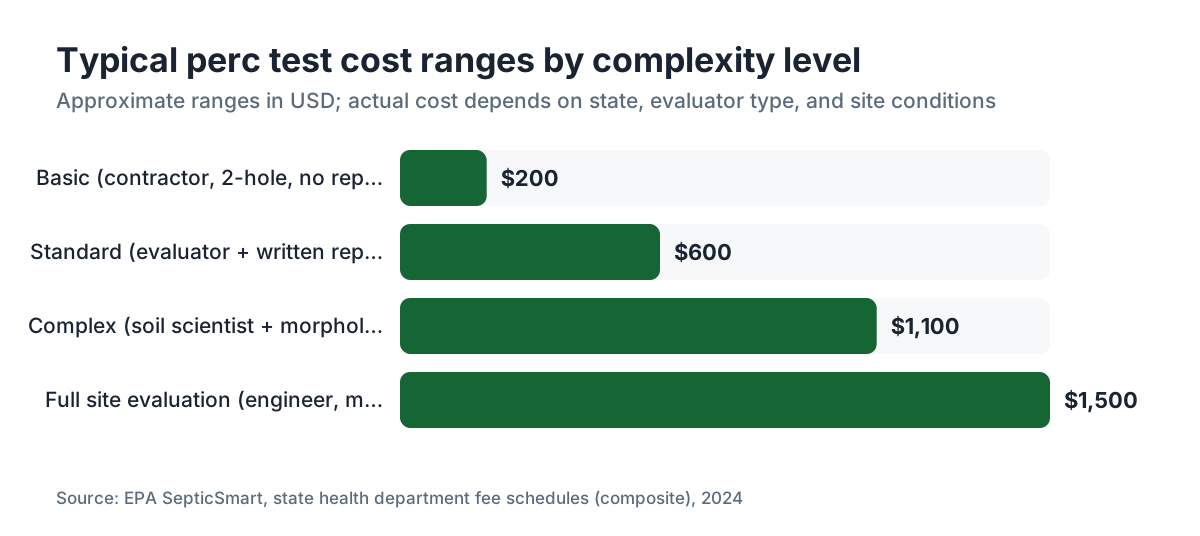
The honest range is $150 to $1,500, and both ends are real. Where you land depends on who runs the test, how many holes the county wants, and how hard the site is to work.
On the low end, you'll find rural counties in the Southeast and Midwest where a licensed septic contractor runs a basic two-hole test in a few hours. On the high end, New England and Mid-Atlantic states often require a licensed soil scientist to spend a full day on site, dig multiple test pits, file a formal soil report, and coordinate a county witness visit. That stacks up fast.
The table below breaks down the common cost drivers.
| Factor | Effect on cost |
|---|---|
| Number of test holes required | $50 to $150 per additional hole |
| Soil morphology report required | Adds $200 to $500 |
| County witness visit (separate fee) | $50 to $300 from the county |
| Site access difficulty (steep slopes, dense brush) | Adds $100 to $400 |
| Rural vs. suburban market | Rural often 20 to 30% lower |
| Engineer vs. soil scientist vs. contractor | Engineers usually charge most |
| Two-visit protocol (pre-soak + test day) | Expect both visits billed |
These figures come from contractor quotes and county health department published fee schedules across several states. No single national database tracks perc pricing, so treat the range as a guide, not a quote.
The perc test is a small slice of total septic cost. A conventional system installation runs $3,000 to $15,000 or more depending on size and location [4]. Shaving $200 off the evaluator to save money is rarely smart if it leaves you with a contested report or a forced redesign.
How do you find a reputable perc test company or evaluator?
Start with your county health department. Most keep a list of licensed soil evaluators or site evaluators approved to test in that jurisdiction. The list is free, current, and already filtered for local licensure. It's the best first move by a wide margin.
The National Society of Professional Soil Scientists and the Soil Science Society of America keep professional directories, though coverage varies by region [5]. State onsite wastewater associations, like the Virginia Onsite Wastewater Recycling Association or the North Carolina Septic Tank Association, often list members too.
Check these before you book:
- Ask for the evaluator's license number and verify it with the state licensing board. Most states have an online lookup tool.
- Ask how many tests they've run in your specific county. County health departments have quirks, and someone who works there often knows what the reviewer wants to see.
- Ask whether the fee includes the written report or just the field work. Some charge separately for the document.
- Get the report turnaround time in writing. If you're under contract to buy land, days matter.
Searching "perc test company near me" or "soil evaluator [your county]" surfaces names, but always cross-reference the state license lookup. Anyone can put up a website. Your county's approved list is the filter that counts.
What perc test results mean for your septic system design
The MPI number is more than a pass or fail. It sets the size and type of drain field a designer has to specify, right down to trench length.
Most state health codes set acceptable perc ranges somewhere between 1 MPI and 60 MPI for conventional gravity systems, though the exact numbers differ. EPA's SepticSmart program puts it plainly: "soil that accepts water too quickly may not adequately treat wastewater, while soil that accepts water too slowly may not drain a system properly" [6]. Both extremes push you toward engineered alternatives.
The sizing logic runs like this: slower-draining soil (higher MPI) needs more drain field square footage per bedroom or per gallon of daily flow. A house generating 300 gallons per day in 20 MPI soil needs a different trench length than the same house in 5 MPI soil. Your state's onsite wastewater code has the exact sizing tables.
When soil fails outright, common alternatives include mound systems (fill soil imported to build suitable conditions above the natural soil), drip irrigation systems, aerobic treatment units, and constructed wetlands. These cost meaningfully more, often $10,000 to $30,000 or beyond for the system alone. That's exactly why a realistic perc expectation before buying land matters so much.
A good evaluator won't just hand you numbers. They'll tell you what system the results support and flag any marginal readings worth a second look. If an evaluator can't explain what the results mean for your design, that tells you something.
When do you need a perc test?
Four situations trigger one, and they cover most of the field.
Buying raw land to build on: any lot without existing sewer service needs a passing perc test before a lender, a county, or a sensible buyer should commit. Many real estate contracts include a perc test contingency for exactly this reason.
Building a new home on an existing lot: same deal. The permit process for a new septic tank installation won't move without the perc test report.
Replacing a failed drain field: if your system has failed and you're installing a new leach field, most counties require a fresh perc test to confirm the new spot works. Old test results, if they exist at all, may be decades old and from a different corner of the lot.
Adding bedrooms or significant wastewater flow: expanding a home sometimes triggers a requirement to verify the existing drain field, sized for fewer occupants, still has enough soil capacity. Not every county requires this, but many do.
You don't need a perc test to have your existing system pumped or maintained. Septic tank pumping and routine inspections are separate from the permitting process that drives perc testing.
How long does a perc test take from scheduling to final report?
The field work, pre-soak and test day together, takes one to three calendar days. But from the moment you call a company to the moment you hold a stamped report, budget two to six weeks in most markets. County wait times, not the digging, drive the calendar.
Here's how the timeline breaks down:
- Permit application to the county: one to ten business days to process, longer in busy construction seasons.
- Scheduling the evaluator: one to two weeks in most areas, longer in spring when demand peaks.
- Pre-soak period: typically 12 to 24 hours, longer if the state protocol requires extended saturation.
- Test day: two to four hours on site.
- Report preparation and submission: three to ten business days depending on the evaluator's workload.
- County review of the report: one to three weeks, sometimes longer.
Under a 30-day due diligence period, a perc test can get tight. Some evaluators offer expedited scheduling for a fee. County review is harder to rush. Start the day your offer is accepted, not the day before your contingency expires.
Can a perc test fail, and what happens next?
Yes, and a meaningful share of tested lots come back outside the range for conventional systems. The failure rate swings hard by geology. No national figure exists, but in clay-heavy areas across parts of the Southeast and Midwest, local practitioners report conventional-system failure rates of 20 to 40 percent of lots tested.
A failed conventional perc test is not the end of the road. Here's what usually happens next.
First, confirm the test ran under the right conditions. If the site was unusually wet, after heavy rain or during snowmelt, results can come back artificially slow. Some states allow retesting under drier conditions. Ask the evaluator whether test-day conditions could have skewed the reading.
Second, ask whether alternative system designs are approved in your county. Most state codes allow mound systems, sand filter systems, drip systems, and aerobic treatment units on sites where conventional systems can't work [7]. The cost to install a septic system climbs with these alternatives, but they're often viable.
Third, if you're in a real estate deal, a failed perc test gives you grounds to renegotiate the price or walk away under most contingency clauses. The alternative system cost belongs in what the land is actually worth.
A lot that truly can't support any onsite system, because the water table is too high everywhere or bedrock too shallow everywhere, cannot legally be built on in most states. That's a hard outcome. It's also information you need before you buy, not after.
What questions should you ask a perc test company before hiring them?
Here's a short checklist that covers what actually matters. Run through it on the first call.
Are you licensed for soil evaluation in this county specifically? (Confirm the license number and look it up.)
How many perc tests have you run in this county in the last year? (Local experience with the health department reviewer counts.)
What does your fee include? (Field work only, or report preparation and county submittal too?)
Will you coordinate the county witness visit if one is required, or is that on me?
What's your timeline from scheduling to submitted report?
What happens if the results come back marginal? Do you have experience designing or recommending alternative systems?
Do you provide a written contract before starting? (Get the scope and price in writing.)
Can you give me contact info for two recent clients in this area whose tests you ran? (References still matter.)
If an evaluator resists the license question or goes vague about what's included in the fee, move on. This isn't a commodity purchase where the lowest number wins.
How do perc test requirements vary by state?
A lot. There is no federal perc test standard. EPA provides guidance, but the actual testing protocols, acceptable MPI ranges, who can conduct the test, and how results translate to system design all get set at the state level, usually in the state's onsite wastewater treatment code [8].
A few concrete examples show the spread.
Texas regulates onsite sewage facilities under 30 TAC Chapter 285, administered by the Texas Commission on Environmental Quality. The state lets licensed sanitarians and engineers conduct tests, and acceptable rates for conventional systems typically run 1 to 120 MPI depending on system type [9].
North Carolina requires Licensed Soil Scientists or Registered Environmental Health Specialists to evaluate sites under 15A NCAC 18A .1900 [10]. The state uses a classification system (suitable, provisionally suitable, unsuitable) rather than a single MPI cutoff.
Massachusetts Title 5 (310 CMR 15.000) governs onsite systems there and requires a percolation test witnessed by a Registered Sanitarian or the local Board of Health agent, with acceptable rates between 2 and 60 MPI for gravity systems [11].
New York runs testing through county health departments under state guidance, which means requirements can differ noticeably between neighboring counties.
Look up your state's onsite wastewater code before assuming anything you read online (this article included) applies exactly to your situation. Your county health department's environmental health division is the authoritative source for local rules.
How does a perc test relate to a full septic inspection?
They're different jobs, and it's worth being clear on the line between them. A perc test evaluates raw soil before a system exists. A septic tank inspection checks an existing system to see whether it's working. You get a perc test before installation. You get an inspection on a system already in the ground.
Buyers of existing homes with existing septic systems almost never need a new perc test. What they need is a thorough inspection of the tank and drain field to confirm the system runs and is sized right for the home. Buyers and their agents mix up the two all the time.
The exception: if you're buying an existing home with an old or failed system and plan to replace the drain field, you may need a new perc test for the replacement site even if the house and tank stay put.
For operators and contractors juggling multiple client sites, keeping these workflows separate matters for scheduling and paperwork. Software like SepticMind can track which properties have valid perc test records on file versus which are due for inspections, so nothing slips through during a busy construction season.
If you're trying to figure out how often routine maintenance should happen on an existing system, that's a separate question. See the guidance on how often to pump a septic tank for the maintenance side.
Red flags when hiring a perc test company
A few patterns should make you stop and reconsider. Any one of these is worth a hard look.
No license number offered. If someone won't hand you their state evaluator or soil scientist license number, that's a serious problem. Most states have an online license lookup. Use it.
Guaranteed passing results. No legitimate evaluator promises a passing test. The soil is what it is. Anyone who implies they can get you a pass regardless of soil conditions is either cutting corners on protocol or committing fraud. A compromised perc test can void your permit later, which gets expensive.
Very low price with no written scope. A $75 quote when similar work in your area runs $400 signals something is getting skipped, maybe the pre-soak, maybe the soil profile report, maybe county coordination.
No county coordination. In states that require a county witness, skipping that step produces a report the health department won't accept.
Unwillingness to provide references or explain the process. A pro who has done this for years can walk you through test day without hesitating.
Rushing the pre-soak. The pre-soak exists to standardize soil moisture. Cutting it short produces artificially fast results that don't reflect true soil behavior, which is bad for the future system even when it helps the permit sail through.
Frequently asked questions
How much does a perc test cost on average?
Most perc tests run between $150 and $1,500. Simple two-hole tests by a septic contractor in rural parts of the South or Midwest tend to land at the low end. Complex evaluations in New England or the Mid-Atlantic that require a licensed soil scientist, a formal soil morphology report, and a county witness visit typically hit $600 to $1,500 or more. Get a written quote that spells out exactly what's included.
Can anyone do a perc test, or does it have to be a licensed professional?
Requirements vary by state and county. Many states require a licensed soil scientist, registered site evaluator, or licensed engineer with onsite wastewater credentials. Other states allow licensed septic contractors to conduct tests. Some counties require their own inspector to witness the test regardless of who runs it. Call your county health department before booking anyone to confirm who is authorized in your jurisdiction.
How do I find a perc test company near me?
Start with your county health department; most keep a list of approved soil evaluators. The National Society of Professional Soil Scientists and your state's onsite wastewater association also keep professional directories. Once you have names, verify license numbers through your state's licensing board online lookup. Local experience with your specific county's health department reviewer is worth weighting heavily.
How long does a perc test take?
Field work takes one to two days: a pre-soak of 12 to 24 hours followed by the timed test. From initial call to final stamped report in hand, budget two to six weeks in most markets. County permit processing and reviewer wait times drive most of the calendar. In spring building season, evaluators and county offices run busiest, so schedule early.
What happens if my property fails a perc test?
A failed conventional perc test doesn't necessarily mean no system is possible. Most states approve alternative designs including mound systems, drip irrigation systems, sand filters, and aerobic treatment units for sites where conventional gravity systems won't work. Ask your evaluator what alternatives your state allows. If you're buying land under contract, a failed test usually triggers a contingency that lets you renegotiate or exit the deal.
Do I need a new perc test when replacing a failed drain field?
Usually yes. Most counties require a fresh perc test for the new drain field location, even if the tank and house stay the same. The original test may be decades old, may not cover the new proposed area, and the county's current standards may differ from when the original test was done. Confirm with your county health department before assuming old test records are enough.
What is an acceptable perc test result?
Acceptable ranges differ by state and system type. For conventional gravity drain fields, most states set acceptable rates somewhere between 1 and 60 minutes per inch (MPI). Soil that drains faster than 1 MPI may not treat wastewater adequately; soil slower than 60 MPI typically can't handle daily flow. Your state's onsite wastewater code has the specific thresholds. Check the code or ask your evaluator directly.
Is a perc test required when buying land?
Not legally required in every state, but practically essential before committing to raw land without sewer service. Most real estate contracts for undeveloped land include a perc test contingency. Without a passing test, you can't get a septic permit, which means you can't build. Lenders and title companies increasingly flag this too. If a seller won't allow a perc test contingency on undeveloped land, that's a serious red flag.
How is a perc test different from a soil test?
A perc test measures water absorption rate (percolation rate) for septic system siting. A soil test in the agricultural sense measures nutrient content, pH, and composition for planting. Some states use a broader soil evaluation that includes both percolation measurements and a soil morphology profile (soil layers, color, texture, depth to limiting layers). The evaluator's report often covers both, but the perc rate is the key number for septic permitting.
Do perc test results expire?
Yes, in most jurisdictions. Typical validity periods run two to five years, though some counties accept older results if conditions haven't changed. If you have a test on file from a previous owner or a stalled building project, check with your county health department whether it's still valid before relying on it. Expired results mean scheduling and paying for a new test before a permit gets issued.
What is the difference between a perc test and a site evaluation?
A perc test is one component of a full site evaluation. A complete site evaluation typically includes the percolation test, a soil profile description (layers, color changes, texture), measurement of seasonal high water table indicators, and an assessment of setbacks from wells, property lines, and water bodies. Many states now require the full site evaluation rather than just the perc test before issuing a septic permit.
Can I do a perc test myself to save money?
In a few states with minimal regulations, a property owner can run an informal perc test, but the results won't be accepted for a permit. For permit purposes, the test must be conducted (or at least witnessed) by whoever the state or county authorizes, which is almost never an unlicensed homeowner. Self-testing to get a rough sense of soil drainage before calling a professional is possible, but it has no legal standing.
What time of year is best to schedule a perc test?
Late fall through early winter is often ideal in temperate climates. Soil moisture is more consistent, evaluators are less busy than in spring, and you keep time to address results before spring construction windows. Avoid testing right after heavy rain when soils are saturated, since artificially slow results can trigger an unnecessary failure. Some states specify that tests cannot run when soil is frozen.
Sources
- Virginia DEQ, Onsite Sewage and Water Programs: Virginia requires a Certified Professional Soil Scientist or Licensed Onsite Soil Evaluator to conduct site evaluations for septic permits.
- University of Minnesota Extension, Soil Morphology and Septic System Siting: Soil morphology examination including mottling depth and texture is conducted alongside percolation testing to determine seasonal high water table and limiting layers.
- EPA SepticSmart, Septic System Costs: EPA SepticSmart notes conventional septic system installation costs typically range from $3,000 to $10,000 or more depending on system type and site conditions.
- National Society of Professional Soil Scientists, Member Directory: NSPSS maintains a directory of professional soil scientists available to help property owners locate licensed evaluators.
- EPA SepticSmart Program: EPA SepticSmart states: 'soil that accepts water too quickly may not adequately treat wastewater, while soil that accepts water too slowly may not drain a system properly.'
- EPA, Onsite Wastewater Treatment Systems Manual: EPA's onsite wastewater manual documents alternative system types including mound systems, drip irrigation, sand filters, and aerobic treatment units for sites where conventional gravity systems are not suitable.
- EPA SepticSmart, State Septic Regulations Overview: There is no federal percolation test standard; testing protocols, acceptable MPI ranges, and qualified evaluator credentials are set by individual state onsite wastewater codes.
- Texas Commission on Environmental Quality, 30 TAC Chapter 285: Texas regulates onsite sewage facilities under 30 TAC Chapter 285, with acceptable percolation rates for some system types ranging from 1 to 120 MPI depending on system design.
- North Carolina DHHS, On-Site Water Protection, 15A NCAC 18A .1900: North Carolina requires Licensed Soil Scientists or Registered Environmental Health Specialists to evaluate sites under 15A NCAC 18A .1900, using a suitable/provisionally suitable/unsuitable classification.
- Massachusetts DEP, Title 5 Regulations, 310 CMR 15.000: Massachusetts Title 5 (310 CMR 15.000) requires percolation tests to be witnessed by a Registered Sanitarian or local Board of Health agent, with acceptable rates between 2 and 60 MPI for gravity systems.
- Penn State Extension, Percolation Testing for On-Lot Sewage Systems: Pre-soaking test holes for 12 to 24 hours before measuring percolation rate is required by most state protocols to standardize soil moisture conditions and produce repeatable results.
Last updated 2026-07-10