Perc test Florida: what it costs, how it works, and what to do if you fail
By the SepticMind Editorial Team
TL;DR
- A Florida perc (percolation) test measures how fast your soil absorbs water to decide if it can support a septic drain field.
- Tests fall under Florida Administrative Code Rule 64E-6 and must be run by a licensed professional.
- They cost $150 to $500 and take one to six hours on site.
- Failing soil rarely means no septic system at all.
What is a perc test and why does Florida require one?
A perc test, short for percolation test, measures how fast water drains through your soil. That number tells the county health department whether your lot can support a standard onsite sewage treatment and disposal system (OSTDS), which is what Florida officially calls a septic system.
You can't just dig a hole and guess. Under Florida Administrative Code Rule 64E-6, every new septic installation needs a soil evaluation before the county issues a permit [1]. That evaluation includes a perc test (sometimes called a permeability test in the official documents) plus a soil profile that checks soil texture, color, and the depth of the seasonal high water table.
The water table piece matters as much as the drain rate. Florida is flat, and the water table sits shallow across huge parts of the state. Your soil can drain beautifully and you can still get denied. If the seasonal high water table sits 18 inches down, a conventional in-ground drainfield is out and you're looking at a mound or raised system instead.
So why the professional oversight? A homeowner eyeballing a coffee-can test out back doesn't produce the standardized data the county needs to size a system that protects the Floridan Aquifer, which supplies drinking water to millions of people across the state.
Who can legally perform a perc test in Florida?
In Florida, soil evaluations and perc tests for OSTDS permits have to be done by one of four people: a Florida-licensed Professional Engineer (PE), a Florida-registered Sanitarian, a Master Septic Tank Contractor holding the soil evaluation endorsement, or a county Environmental Health specialist employed by a Florida Department of Health (FDOH) county office [1].
This is a hard legal requirement, not a suggestion. Results from a soil scientist or contractor without one of these credentials will not be accepted by the county health department for permit purposes.
Most homeowners hire a licensed septic contractor who holds the soil evaluation endorsement, because that same person can pull the permit and install the system. A PE gets brought in on commercial sites or tricky lots that need engineering documentation. Some counties have FDOH environmental health staff who run the test for a fee, which often beats a private contractor on price.
Call your county's Environmental Health office first. They'll tell you exactly whose evaluations they accept and whether county staff can do the work themselves.
How does a Florida perc test actually work?
The test itself is simple. The paperwork around it is not. Here's what happens on site.
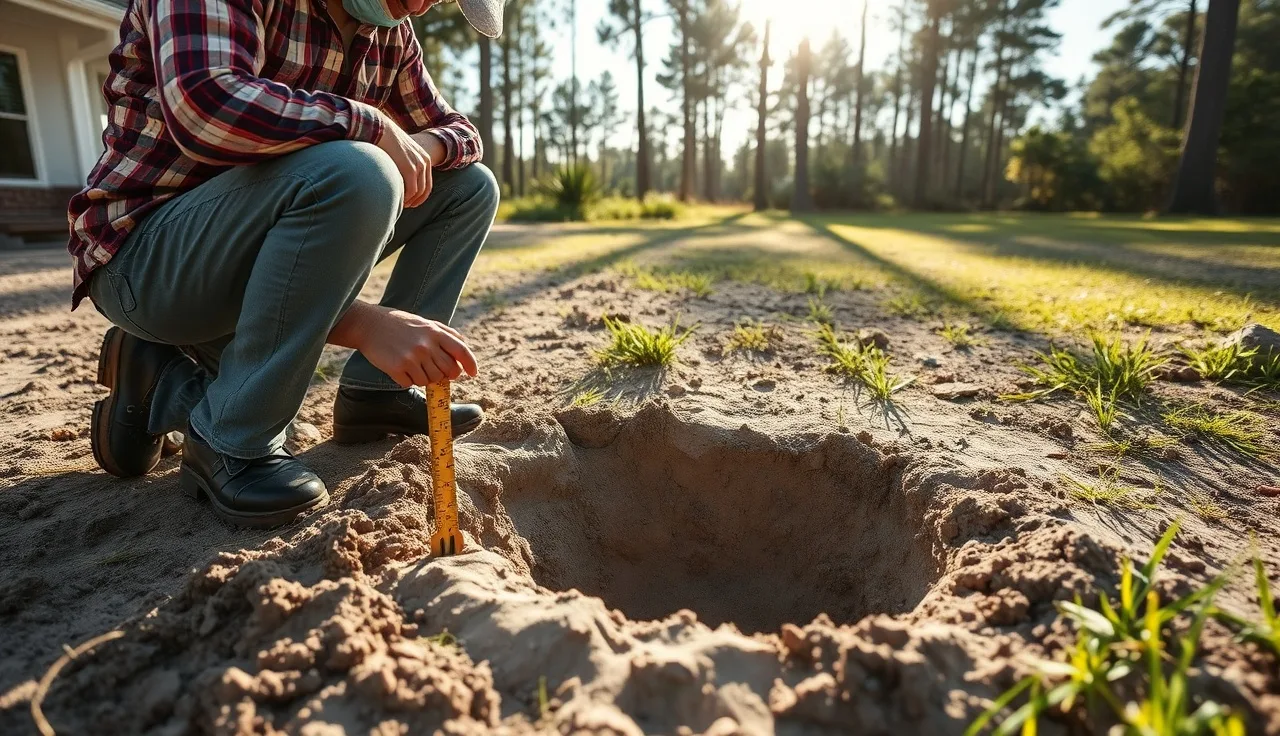
The evaluator digs or bores at least two test holes on the proposed drainfield area. Each hole runs 6 to 12 inches wide and goes down to the depth of the proposed drainfield absorption surface, usually 18 to 36 inches depending on the design. Exact depths and procedures follow FDOH guidance under Rule 64E-6.004 [1].
Then comes the pre-soak. The evaluator fills the hole with water several times over at least four hours (sometimes overnight in clay-heavy soils) so the soil sits at or near saturation before timing starts. Skip the pre-soak and you get artificially fast numbers, which is exactly why a licensed evaluator takes that step seriously.
Once the soil is saturated, the evaluator fills the hole to a set level and times how many minutes it takes the water to drop one inch. That figure, in minutes per inch (mpi), is your percolation rate.
Rule 64E-6 combines that rate with the soil profile data to set the system type and the required square footage of drainfield absorption area. A fast rate means water moves through quickly. A slow rate means it lingers. Both extremes cause trouble.
What perc rates does Florida consider passing, failing, or borderline?
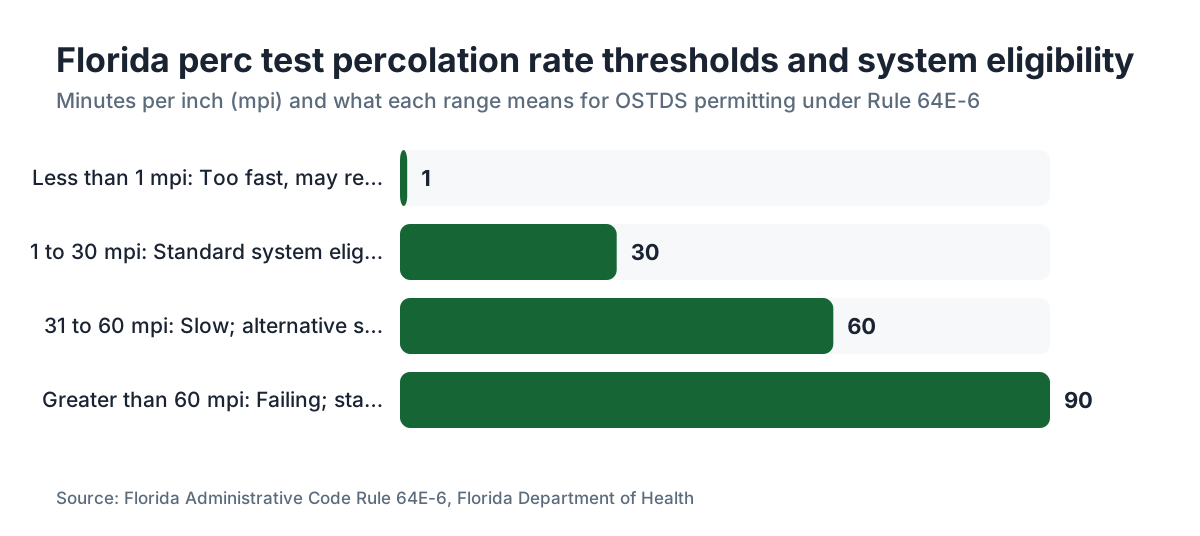
Florida judges soil permeability alongside soil texture and water table depth, not the perc number by itself. With that caveat, here are the general thresholds that shape system design under Rule 64E-6 [1]:
| Percolation Rate (min/inch) | Florida Interpretation |
|---|---|
| Less than 1 | Too fast (excessively permeable; may allow inadequate treatment before effluent reaches groundwater) |
| 1 to 30 | Acceptable range for standard or modified systems |
| 31 to 60 | Slow; may require enhanced treatment or alternative system |
| Greater than 60 | Typically failing; standard drainfield not permitted |
Too fast is a real problem here. Sandy soils that drain in under one minute per inch don't hold effluent long enough for biological treatment before it hits groundwater. In those cases the state can require a deeper system, a larger absorption area, or advanced treatment [7].
Soils between 30 and 60 mpi aren't automatic failures. The county health department may approve an alternative or innovative system: aerobic treatment units (ATUs), drip irrigation, mound systems, or other designs built for slower soil [2].
One number from the perc test does not seal your fate. The full soil evaluation report (texture, seasonal high water table depth, available lot area) is what decides which system, if any, gets approved.
How much does a perc test cost in Florida?
Expect to pay between $150 and $500 for a standard residential perc test and soil evaluation in Florida, based on typical contractor pricing reported across Florida counties. The range is wide because pricing tracks the contractor's travel distance, lot complexity, number of test holes, and whether the county charges a separate evaluation fee.
Some county FDOH offices do the soil evaluation themselves for a flat fee in the $100 to $200 range, often cheaper than a private contractor. Call your county health department and ask.
A few things push the number up:
- Multiple test holes required by lot size or uneven terrain
- Heavily wooded lots that need clearing before the evaluator can reach the test area
- Suspected wetland soils that force extended pre-soak periods
- A separate charge for the written report versus the on-site visit
If you're also hiring a licensed contractor to pull the permit and install the system, the perc test cost usually rides inside the overall septic tank installation quote. Ask for it itemized so you know what you're paying for.
Here's what I'd avoid: a contractor who quotes a rock-bottom perc test fee, then loads up the permit application and system sizing. Get the full cost from site evaluation through permit issuance in writing before anyone starts digging.
How long does the perc test process take in Florida?
The on-site portion, including pre-soaking and timing, usually takes three to six hours. Some evaluators split it over two days when an overnight pre-soak gives cleaner numbers in clay soils.
The slow part is the bureaucracy. After the evaluator submits results to the county health department, review and site evaluation approval runs anywhere from a few days to several weeks depending on the county and its backlog. In fast-growing counties like Hillsborough, St. Johns, and Osceola, permit queues have stretched to four to six weeks in busy seasons.
Here's a realistic timeline from starting the process to receiving a site evaluation approval:
| Step | Typical Time |
|---|---|
| Schedule evaluator | 1 to 14 days (varies by contractor availability) |
| On-site perc test and soil evaluation | Half day to 1 full day |
| Evaluator submits report to county | 1 to 7 days after site visit |
| County health department review | 5 to 30 business days |
| Site evaluation approval issued | Same day as review completion |
| Total, best case | 2 to 4 weeks |
| Total, busy county | 6 to 10 weeks |
Buying land with a perc-test contingency in the contract? Build in at least 60 days to be safe, especially in South Florida counties where FDOH offices run lean.
What happens if your Florida lot fails the perc test?
A failed perc test does not mean the lot is unbuildable or that you'll never have a septic system. It means a conventional gravity-fed drainfield is off the table. Rule 64E-6 approves a range of alternative system types for tough soil [1].
Here are the common paths after a failing result.
Mound or raised systems. If the trouble is a shallow water table or slow soil, a mound builds the drainfield above grade using imported sandy fill. This is one of the most common fixes in Central and North Florida. It costs more, often $8,000 to $20,000 on top of a conventional system depending on how much fill you need.
Aerobic Treatment Units (ATUs). ATUs treat wastewater to a higher standard before dispersal, which relaxes some soil requirements. They're common in South Florida and coastal counties. They also need a maintenance contract and more frequent inspections [8].
Drip irrigation systems. These push treated effluent through shallow drip lines and can work in soils that reject a standard drainfield. They require advanced treatment upstream.
A different spot on the same lot. Sometimes another location passes where the first holes failed. If the lot has more than one candidate area, test a second before writing off the whole parcel.
If none of the alternatives work and the county confirms the lot can't support any OSTDS, that's a hard failure. The lot then has to tie into public sewer (if it's available) or it isn't buildable for a septic-served structure. That's a real risk on some Florida coastal and wetland-adjacent parcels, and it's the whole reason you run the perc test before you close on raw land.
See the cost to install septic system guide for budget ranges across system types.
Do you need a perc test for an existing home or just for new construction?
For new construction, or for adding a new OSTDS where none existed, yes, a perc test is required before you get a permit [1].
For an existing home with an existing permitted septic system, you generally don't need a new perc test just to pump, repair, or maintain it. The original site evaluation on file with the county covers the existing design.
A few situations do trigger new or updated testing on an existing property:
- You're adding bedrooms or square footage that pushes estimated daily flow past the existing system's permitted capacity
- The drainfield has failed and you want to move it to a new spot on the lot
- You're replacing an unpermitted system with a permitted one
- The original system never had a permit and you're bringing the property into compliance
For a routine septic tank inspection during a home sale, a perc test usually isn't required. The inspector judges the existing system's condition, not the soil's theoretical capacity. Some buyers ask for one if they suspect the system is undersized, but it's not standard.
Buying a home on septic? The single most useful move is pulling the original OSTDS permit from the county health department. It shows the permitted capacity in gallons per day and the original soil evaluation results.
Which Florida county health department handles perc test permits?
Perc tests and OSTDS permitting in Florida run through the Florida Department of Health (FDOH) at the county level, not the county building department. This trips people up constantly.
Every Florida county has an Environmental Health division inside its FDOH office that handles OSTDS permits, site evaluations, and perc tests [3]. You apply in the county where the property sits.
A few examples:
- Miami-Dade County: FDOH-Miami-Dade, Environmental Health Division
- Orange County: FDOH-Orange, Environmental Health
- Pinellas County: FDOH-Pinellas, Environmental Health
- Lee County: FDOH-Lee, Environmental Health
The state's OSTDS rules are uniform under Rule 64E-6, but individual counties sometimes add local amendments, especially in areas with sensitive water resources. The Florida Keys (Monroe County) has some of the strictest onsite sewage rules in the state because of the coral reef ecosystem next door.
Find your county's FDOH Environmental Health contact through the FDOH county offices directory [3]. Call before you hire anyone. Some counties run their own evaluation service, and both the wait times and the fees differ a lot from what a private contractor charges.
What's the difference between a perc test and a full site evaluation in Florida?
People use the terms interchangeably. They're not the same thing.
A perc test is specifically the timed water infiltration measurement in drilled or dug holes. It produces the minutes-per-inch number and nothing else.
A full site evaluation (the FDOH-required document) includes those perc results plus a soil profile: what soil layers exist, at what depths, what color they are (color signals oxygen content and drainage history), and the estimated seasonal high water table depth. That last number comes from reading soil mottling, the reddish-orange or gray streaking left behind by years of alternating wet and dry conditions.
Florida wants all of it, not the perc rate alone, because the seasonal high water table depth controls the required vertical separation between the drainfield and groundwater. The state requires a minimum of 24 inches of separation in most cases [1]. Plenty of Florida lots wash out on this before they ever wash out on the perc rate.
So when you hire someone for your perc test, make sure the quote covers the full soil evaluation and written report, more than the hole-timing part. The county needs the complete evaluation document to issue a site evaluation approval.
Can I do a DIY perc test in Florida before hiring a professional?
You can run an informal test to get a rough read on your soil before spending money on a licensed evaluation. The county won't accept it for permitting, but it helps you decide whether a site is worth pursuing at all.
The simple version: dig a hole about 12 inches deep and 6 inches across. Fill it with water and let it drain out completely. Fill it again and time how many minutes the water takes to drop one inch. Repeat two or three times. That gives you a crude mpi number.
Water still sitting there after 90 minutes with no visible movement? The soil is probably clay-heavy and slow. Drains in under a minute? Very sandy. Neither is an automatic dealbreaker under Florida rules, but both are flags to raise with a licensed evaluator before you close on land or lock in a building plan.
For pre-purchase due diligence, that informal test plus the county's flood zone maps and wetland data (available through Florida DEP's mapping tools [4]) gives you a decent picture.
For anything headed to the county health department, there's no shortcut. You need a licensed professional.
How Florida's perc test rules connect to drainfield sizing
Once you have the perc results and soil profile, the licensed evaluator uses them to calculate the required drainfield square footage. Rule 64E-6.008 sets the design daily sewage flow rates by bedroom count, and drainfield size scales from there [1].
A standard single-family home is estimated at 75 to 100 gallons per day per bedroom under Florida's design tables. A three-bedroom home has to handle roughly 225 to 300 gallons per day. The perc rate then sets how many square feet of drainfield absorption area you need to move that daily load.
Faster soils need less area per gallon. Slower soils need more. That's why mound systems on poor-perc soils end up with physically large drainfields.
It's also why adding a bedroom to a septic home can trigger a system upgrade. If the original drainfield was sized for a two-bedroom load and you convert a bonus room into a third bedroom, the county may require a bigger drainfield to match the new permitted daily flow.
Drainfield already struggling? The leach field guide covers failure signs and repair options. Tracking a maintenance schedule? How often to pump septic tank walks through the pumping intervals that keep drainfields from overloading early.
SepticMind's operator tools help licensed contractors track soil evaluation records, permit timelines, and system sizing notes across client properties in one place, which matters when you're juggling dozens of permits across different Florida counties at once.
What should a homeowner bring to or ask a Florida perc test appointment?
You don't have to be present for the perc test, but showing up pays off. Here's what to have ready.
For new land: Bring the lot survey with property boundaries clearly marked. The evaluator needs the property lines, easements, and setbacks to identify legal drainfield placement areas. Florida setback rules require drainfields to sit at least 75 feet from surface water, 50 feet from a private well, and at least 10 feet from property lines under Rule 64E-6.005 [1].
For a new home on an existing lot: Bring the site plan showing the proposed house footprint, driveway, and any outbuildings. The evaluator has to see where the building will sit to figure out where the drainfield can go.
Questions worth asking:
- What's the estimated seasonal high water table depth here?
- Do the results support a conventional system, or are we likely looking at an alternative design?
- What system types would you recommend for these soil conditions?
- Roughly what drainfield square footage will the results require?
- How soon can you submit results to the county, and what's your estimate on review time?
Get these answers on site, before the evaluator drives off, and you save yourself a week of email tag.
Frequently asked questions
How much does a perc test cost in Florida?
Most residential perc tests in Florida cost between $150 and $500, depending on the county, contractor, and lot complexity. Some county FDOH offices run their own evaluations for $100 to $200. On a full septic installation, the perc test is usually bundled into the contractor's total quote, so ask for it itemized.
How long is a perc test result valid in Florida?
Florida OSTDS site evaluation approvals are valid for one year from the date the county health department issues them. If you don't pull a system permit within that year, you'll need a new site evaluation. Some counties extend the approval if you can document that lot conditions haven't changed, but that's at the health department's discretion.
Can I install a septic system in Florida without a perc test?
No. Florida Administrative Code Rule 64E-6 requires a site evaluation including percolation testing before a permit is issued for any new OSTDS installation. Installing a system without a permit is illegal and can bring fines, a forced removal order, and trouble selling the property. There's no legal workaround.
What happens if my Florida lot fails the perc test?
A failed result means a standard gravity drainfield isn't permitted, but it doesn't automatically mean no system is possible. Florida approves alternatives including mound systems, aerobic treatment units, and drip irrigation for tough soils. A different area of the same lot may also pass. Only if every alternative is exhausted is the lot considered unbuildable for an onsite system.
Who can perform a perc test in Florida?
Only a licensed Professional Engineer, a registered Sanitarian, a Master Septic Tank Contractor with a soil evaluation endorsement, or a Florida Department of Health county Environmental Health specialist can run an OSTDS soil evaluation and perc test for permitting in Florida. Results from unlicensed individuals will not be accepted by the county health department.
Is a perc test required when buying a home with an existing septic system in Florida?
Usually not. A standard purchase inspection judges the existing system's current condition, not the soil. A new perc test is only needed if you plan to move the drainfield, expand the system, or bring an unpermitted system into compliance. Ask the county health department for the original OSTDS permit file, which includes the first soil evaluation.
What is the passing perc rate for a septic system in Florida?
Florida uses a range, not a single pass/fail number. A rate between 1 and 30 minutes per inch generally supports a standard system. Rates from 31 to 60 mpi may qualify for an alternative system. Faster than 1 mpi can also be a problem because the soil doesn't treat effluent well enough. The full soil profile and water table depth get weighed alongside the rate.
Which Florida agency regulates perc tests and septic permits?
The Florida Department of Health (FDOH) regulates onsite sewage systems through its county Environmental Health offices, under Florida Administrative Code Rule 64E-6. This is not the building department. Every county has its own FDOH Environmental Health division where you apply for OSTDS permits and submit site evaluation results.
How does Florida's shallow water table affect perc test results?
Florida's seasonal high water table depth is often a bigger obstacle than the perc rate. The state requires at least 24 inches of vertical separation between the bottom of the drainfield absorption surface and the seasonal high water table. In many low-lying counties, this rule wipes out conventional in-ground drainfields entirely, making a mound or raised system the default.
Do Florida Keys or coastal properties have stricter perc test rules?
Yes. Monroe County (Florida Keys) has some of the most restrictive OSTDS rules in the state because of the coral reef ecosystem and the aquifer. Many Keys parcels aren't approvable for new septic at all and must connect to centralized wastewater systems. Always check with the FDOH-Monroe Environmental Health office before buying raw land there.
Can a perc test be done in the rain or wet season in Florida?
A test can run during wet season, and it's arguably more telling because it shows soil behavior close to saturated conditions. Florida's wet season usually runs June through September. Experienced evaluators account for current moisture. Testing during or right after heavy rain doesn't invalidate results, but the evaluator should note conditions in the report.
How does a perc test result affect what size septic system I need?
The perc rate plus your home's bedroom count sets the required drainfield square footage under Rule 64E-6. Florida designs for roughly 75 to 100 gallons per day per bedroom. Slower soils need more absorption area per gallon, which means a larger and more expensive drainfield. A slow perc result often raises the overall system cost by a lot.
What Florida setback rules affect where a drainfield can go after a perc test?
Rule 64E-6.005 requires drainfields to sit at least 75 feet from surface water bodies, 50 feet from a private drinking water well, 200 feet from a public well, and 10 feet from property lines. Driveways, structures, and easements also restrict placement. On small or oddly shaped lots, these setbacks can rule out most of the lot even when the soil passes the perc test.
Sources
- Florida Department of Health, Florida Administrative Code Rule 64E-6 (Onsite Sewage Treatment and Disposal Systems): Florida requires a licensed site evaluation including percolation testing before any OSTDS permit is issued; sets design flow rates, setbacks, vertical separation requirements, and approved system types
- U.S. EPA, Septic Systems Overview: EPA SepticSmart resources confirm that soil evaluation is foundational to proper septic system siting and that alternative systems exist for soils that fail standard percolation requirements
- Florida Department of Health, County Health Departments Directory: FDOH county Environmental Health offices handle OSTDS permitting including site evaluations and perc test review in all 67 Florida counties
- Florida Department of Environmental Protection, Mapping and GIS Data: Florida DEP provides mapping tools for wetlands and surface water resources relevant to OSTDS setback and site suitability assessment
- University of Florida IFAS Extension, Onsite Sewage Treatment and Disposal Systems: UF/IFAS extension materials explain Florida soil evaluation methodology including percolation testing procedures and interpretation of results for septic permitting
- Florida Department of Health, OSTDS Program Overview: Florida's OSTDS program processes permits for roughly 2.6 million onsite sewage systems statewide, making it one of the largest such programs in the U.S.
- U.S. EPA, Septic System Siting and Soil Evaluation Guidance: EPA guidance specifies that percolation rates faster than 1 minute per inch indicate inadequate treatment time in overly permeable soils, a concern in Florida's sandy geology
- Florida Department of Health, Aerobic Treatment Units Guidance: Florida FDOH approves aerobic treatment units as an alternative OSTDS technology for sites where conventional drainfields are not approvable due to soil or water table conditions
Last updated 2026-07-09