Perc test meaning: what it is, how it works, and what it means for your property
By the SepticMind Editorial Team

TL;DR
- A percolation test (perc test) measures how fast water drains through your soil.
- Counties require it before approving a septic permit.
- Results come in minutes per inch: fast soil passes easily, slow or clay-heavy soil can fail.
- A failed perc test rarely kills a project outright, but it narrows your options and can add $5,000 to $15,000 in system costs.
What does perc test mean?
Perc test is short for percolation test. Percolation means the movement of water through soil, and the test measures exactly that: how many minutes it takes water in a test hole to drop one inch. That number tells the health department whether your soil can accept and treat the effluent flowing out of a septic system's leach field.
The official term on permit forms is usually "soil percolation test" or "soil absorption test." Some states and engineers prefer the wider term "soil evaluation," which adds a soil profile analysis on top of the perc test. Homeowners use perc test and soil evaluation interchangeably. They aren't technically the same thing, and that gap matters more than most people realize.
Here's why the result carries so much weight. A septic tank installation is only half the system. The drain field, where treated wastewater re-enters the ground, depends entirely on the soil doing its job. If water can't soak in, sewage backs up. If it soaks in too fast, pathogens reach groundwater before the soil can filter them. The perc test is the one measurement that catches both failures before you build. [1]
Why is a perc test required before building a septic system?
Every state requires some form of site evaluation before it issues a septic permit, and most include percolation testing in that process. The requirement traces back to a plain fact: badly sited septic systems are a leading source of groundwater and surface water pollution in rural areas. [2]
The EPA's SepticSmart program states that "more than one in five U.S. households depend on septic systems," and failing systems can push pathogens, nitrates, and household chemicals straight into drinking water sources. [2] A perc test is the first defense against putting a drain field in soil that can't carry the load.
The process works like this. You apply for a building or septic permit. The county, a licensed soil scientist, or a licensed engineer runs the test. The results decide what type of system, if any, you can install. No passing result on file means no permit. No permit means no construction. That simple.
Some states have moved past the basic perc test toward morphological soil evaluations, which read soil texture, structure, color, and wetness indicators instead of relying only on timed water absorption. North Carolina phased out the traditional perc test in favor of soil morphology evaluations for most new systems. [3] But across most of the country, the timed percolation test is still the standard.
How is a perc test actually done?
The procedure is more standardized than most people expect, though the exact requirements shift by state and local code.
The steps go like this. The tester digs or bores several holes in the proposed drain field area, usually 6 to 12 inches wide and 12 to 36 inches deep, depending on your jurisdiction. Multiple holes are required because soil varies across a single lot. Most states want at least two to five holes per test area. [4]
Next comes the pre-soak, and this is the part people skip in their backyard experiments. The soil has to be saturated before the timed test starts, because a real drain field runs under saturated conditions. Pre-soaking usually takes 12 to 24 hours, which is why a proper perc test almost never finishes in a single visit. [10] Many jurisdictions require the holes filled repeatedly the day before and again the morning of.
Once the soil is saturated, the tester marks the starting water depth and times how long the level takes to drop a set amount, usually one inch. That gets repeated several times (often three to six cycles) to settle on a stable average. The final number is minutes per inch, or MPI.
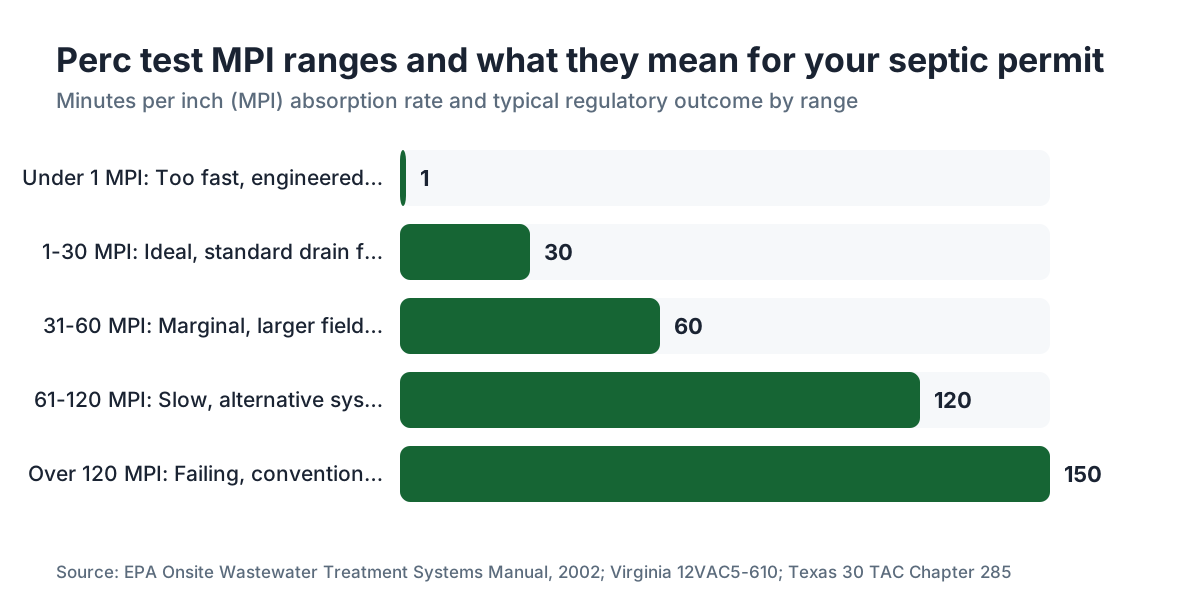
Here's what those MPI numbers mean in plain terms:
| MPI Result | Soil Absorption | Typical Outcome |
|---|---|---|
| Less than 1 MPI | Too fast (gravelly/sandy) | May require engineered system; pathogens reach groundwater too quickly |
| 1 to 30 MPI | Ideal range | Standard drain field permitted in most states |
| 31 to 60 MPI | Marginal | Some states allow with larger drain field or mounded system |
| 61 to 120 MPI | Slow (clay-heavy) | Restricted; may require alternative system |
| Over 120 MPI | Failing | Most states reject standard septic; alternative or engineered system required |
The cutoffs move by state. Virginia caps conventional trench systems at 60 MPI. Texas uses 120 MPI as the upper limit for some system types. Always check your local health department's table. [4][5]
What soil conditions cause a perc test to fail?
A failed perc test almost always comes back to soil texture and structure. Clay is the usual villain. Clay particles are tiny and pack tight, leaving almost no pore space for water to move. A heavy clay site can read 200 or 300 MPI, which is effectively a brick wall for septic purposes.
High groundwater is the second common cause. If your hole hits the water table before it reaches the required depth, the test can't run properly, and the site may be disqualified no matter how good the soil above looks. Seasonal high water tables get measured separately, often through soil color (gray and mottled soil signals anaerobic conditions from seasonal saturation) rather than a timed drop.
Shallow bedrock creates the same trap. Two feet of soil over solid rock leaves no room for a trench, and no percolation speed on earth fixes that.
The opposite failure, soil that drinks water too fast (under 1 MPI), is less common but real. Sandy or gravelly soil lets water pass so quickly that pathogens never get contact time with the soil before reaching groundwater. Some states ban standard systems on these soils and require pressure-dosed or drip-irrigation designs with added treatment.
One thing worth knowing: heavy rain in the days before a test slows absorption and can make a marginal site read like a failing one. Good soil evaluators note the weather and reschedule when conditions are clearly abnormal. If you think your test happened in bad conditions, say so and ask the evaluator directly.
How much does a perc test cost?
Costs vary enough that any single number lies to you. So here's the range and what drives it.
A standard perc test done by a county health official (site visit, hole prep, written report) runs $150 to $500 in most of the country. [6] When a private soil scientist or licensed engineer runs it, which many states require for anything beyond a basic residential lot, expect $500 to $1,500 or more for a full soil evaluation with report and site sketch. Complex lots, large acreage, or sites needing multiple test areas can push the total to $2,000 or $3,000.
County permit fees for processing the results are separate. Budget another $50 to $300 on top of the professional fee.
If the site needs a backhoe to dig test pits instead of hand-augered holes, you pay for equipment or operator time, often $300 to $600 extra.
Put it in context. Installing a septic system for a standard home runs $3,000 to $15,000 depending on system type and site conditions (see our cost to install a septic system guide). Spending $300 to $1,500 on a perc test before you close on land or lock in a building plan is one of the smartest checks you can write. A failing result found after purchase can drop a lot's buildable value close to zero.
Operators juggling site evaluations across many clients can track permit status, test results, and scheduling in SepticMind so nothing slips through the cracks.
How long does a perc test take?
The test day itself takes two to four hours of active work on site. Getting from scheduling to a written result usually takes one to three weeks.
Here's the breakdown. County health departments carry scheduling backlogs, worst in spring and summer when building peaks. A two-week wait for an appointment is normal in busy areas. Some places move faster. Some crawl.
The test spans at least two days when it's done right. Day one is the pre-soak, which means multiple water additions over several hours. Day two (sometimes the same day, if the pre-soak runs first thing in the morning) is the timed test. Count on two to four hours on site that day.
Then the evaluator writes the report. A county official's report usually flows straight into the permit file. A private soil scientist may take another week to deliver a formal written report and site sketch.
Total calendar time from "I want a perc test" to "I have a result I can hand the county" is two to four weeks in most areas, longer during a late-spring backlog.
Can you do your own perc test, or do you need a licensed professional?
Almost everywhere, no. You can't run it yourself and have it count for a permit.
States and counties require perc tests (or soil evaluations) to be run by a licensed soil scientist, a licensed engineer, or a certified county health official. That person signs the report and carries professional liability for the findings. A homeowner-run test has no legal standing.
Some jurisdictions let the property owner be present and help with labor (digging, hauling water) under the licensed evaluator's supervision, which can shave a little off the cost. Ask your county health department whether that's allowed before you assume it.
You can absolutely run a rough informal test on your own land to get a preliminary read before paying for the official one. Dig a hole about 12 inches deep, fill it, let it drain fully, fill it again, and time how long one inch takes to drop. That gives you a ballpark. Treat it as a gut check, never a result. Real protocols involve set depths, multiple holes, precise measurements, and proper pre-saturation that a casual backyard test won't match. [4]
What happens if your land fails a perc test?
A failed perc test is serious, but it's rarely the end of the road. What it means depends heavily on why it failed and what alternatives your state allows.
If the problem is slow absorption (high MPI), the common fix is an alternative septic system. Mound systems raise the drain field above the natural soil using engineered fill with better absorption. Aerobic treatment units (ATUs) pre-treat wastewater harder before it hits the soil, cutting the absorption demand. Drip-irrigation systems spread effluent in tiny doses across a wide area. All of them cost more than a conventional system, sometimes a lot more. A mound system can add $5,000 to $15,000 over a conventional install. [7]
If the problem is a shallow water table or seasonal saturation, you may need a raised system design and possibly a land use restriction. Some counties allow development with an engineered alternative. Others deny the permit flat out.
If there's simply no workable spot on the parcel, you could be looking at a lot that can't support any septic system. This happens more with small or oddly shaped lots. Then your options shrink to connecting to public sewer (if it's close enough), buying an adjacent parcel for more usable ground, or accepting that the lot can't be built on.
Before you give up after a failed test, get a second evaluation from a different licensed soil scientist. Soil conditions vary across a lot, and the first area tested may not be the best one. A sharp soil scientist hunts for better-drained pockets or areas with thicker suitable soil the first test missed. [3]
What's the difference between a perc test and a soil evaluation?
A perc test is one specific measurement: the timed rate of water absorption, reported as an MPI number. A soil evaluation is broader. It includes the perc test but also reads soil texture, structure, color and mottling, restrictive layers like hardpan or bedrock, depth to seasonal high groundwater, and the slope of the land. This distinction trips up a lot of buyers.
A soil scientist running a full evaluation builds a picture of how the whole site will function, more than one number.
Many states have shifted toward full soil evaluations because MPI alone can mislead you. A site with fast percolation might fail on groundwater depth. A site with slow percolation might pass if the soil has good structure and the right profile. The EPA's guidance on onsite wastewater systems backs this fuller site assessment. [9]
For the homeowner, the practical split is this. If your county requires only a perc test, you get one number and a pass/fail. If it requires a full soil evaluation, you get a site-specific design recommendation, which is far more useful when planning your septic tank installation or working with a designer on an alternative system.
How do perc test results affect what type of septic system you can install?
The MPI result maps directly to permitted system types in most state codes. A conventional gravity-fed drain field, the cheapest and most common, is allowed only when the MPI lands in your state's acceptable range (typically 1 to 60 MPI, sometimes up to 120). Slower soil also means a bigger field: slow absorption requires more linear footage of trench to handle the same daily flow. [5]
When MPI falls outside the conventional range, the engineer or health department works down a list of alternatives:
- Pressure distribution systems pump effluent to distribution laterals under low pressure, spreading the load evenly. Good for marginally slow soils.
- Mound systems build an elevated drain field from engineered sand fill above the native soil. Used when the native soil is too slow or the water table too shallow.
- Aerobic treatment units add aeration and sometimes disinfection before effluent reaches the soil, making systems work where a conventional field couldn't.
- Drip irrigation systems apply tiny amounts of effluent across a large area through emitters, letting very slow soil function.
The total cost to put in a septic tank and drain field climbs with every step down this list. A conventional system might run $4,000 to $8,000 installed. An ATU with drip irrigation can hit $15,000 to $30,000 or more. [7] Knowing your MPI before you design the system is exactly why the perc test comes first.
When do you need a perc test, and when do you not?
You need a perc test (or equivalent soil evaluation) any time you install a new septic system on a lot that doesn't already have one, and often when you substantially modify or replace an existing drain field. Buying raw land? You'll need a perc test before or shortly after purchase if you plan to build. Adding a bedroom or big square footage to a septic home? Some states require re-evaluation of the existing system's capacity.
You generally don't need a new perc test for routine maintenance like septic tank pumping, septic tank cleaning, or tank repairs. Those don't touch the drain field's permitted status.
Buying an existing home with a working septic system and an existing permit on file? You typically don't need a new perc test. The septic tank inspection before purchase checks whether the current system works, not whether a new one could be sited.
Exceptions exist. Some states require an updated soil evaluation if a system has sat unused for years, if the lot got significantly regraded, or if the original test ran under a much older version of the code. Check with your local health department if you're unsure.
Perc test results usually don't expire, though some jurisdictions put a five- to ten-year validity window on older tests, especially if conditions may have changed (new construction nearby, altered drainage, and the like).
How to find a licensed perc test professional in your area
Start with your county or local health department's environmental health or onsite wastewater division. They either run the tests themselves or keep a list of licensed soil scientists and engineers approved to work in your jurisdiction. That list is the right first stop, because not every soil scientist holds a septic siting license in every state.
Licensed professional soil scientists (LPSS or a similar credential depending on state) do most of this work. The Soil Science Society of America keeps a national registry of Certified Professional Soil Scientists. [8] Environmental engineers with an onsite wastewater specialty perform these evaluations too.
When you call, ask four things. Are you licensed in this county? Do you handle the permit paperwork, or do I? What does your fee include? How soon do I get the written report? A clear answer to all four tells you they do this for a living.
Septic operators coordinating site evaluations alongside septic tank inspection work can keep evaluation status, permit tracking, and follow-ups organized in SepticMind instead of chasing spreadsheets.
Walk away from anyone who offers a perc test over the phone, guarantees a pass before seeing your site, or can't produce a state license number on request. In a field where the professional's signature carries legal weight, those are the clear red flags.
Frequently asked questions
What does MPI mean in a perc test result?
MPI stands for minutes per inch, the core measurement in a percolation test. It's how many minutes water in the test hole takes to drop one inch after the soil is saturated. Lower numbers mean faster drainage. Most states require results between 1 and 60 MPI for a standard gravity drain field, though the acceptable range varies by jurisdiction.
How long are perc test results valid?
In most states, perc test results don't technically expire and stay on file with the county indefinitely. Some jurisdictions put a five- to ten-year validity window on older tests, especially if site conditions have changed. Check with your local health department if the test on record is more than ten years old or if significant grading or drainage changes have happened on the property since.
Can you build a house if your land fails a perc test?
Sometimes yes, sometimes no. A failed conventional perc test often means you need an alternative system such as a mound, aerobic treatment unit, or drip-irrigation setup instead of a standard drain field. These cost more but may still allow building. If no system type works on the parcel, the lot may be unbuildable on septic, and connecting to public sewer would be the only path.
Does rain affect perc test results?
Yes. Heavy rainfall in the days before a test can temporarily saturate the soil and slow absorption, making a marginal site read like a failure. Most licensed evaluators note unusual weather in their report. If you believe your test ran in atypical wet conditions, raise it with the evaluator. Some jurisdictions allow a retest, particularly right after a heavy rain event.
How many holes are dug for a perc test?
Most state regulations require a minimum of two to five test holes per evaluation area. The exact number depends on lot size, jurisdiction rules, and site variability. Multiple holes are required because soil conditions can differ across even a small lot. The final MPI result is typically averaged across the holes or based on the most representative reading, as set by your state's onsite wastewater code.
What is the difference between a perc test and a perk test?
There is no difference. Perk test is just an alternate spelling of perc test, both informal shorthand for percolation test. You'll see both spellings from homeowners, contractors, and even some county health departments. Perc is the more common spelling in professional and regulatory contexts, but searching either version gets you to the same information.
Does a perc test tell you where to put the septic tank?
No. The perc test evaluates where the drain field can go, not where the tank sits. Tank location depends on the house plumbing layout, setbacks from wells, property lines, and structures, plus practical access for pumping trucks. The drain field location is what the perc test governs. A full site plan from a licensed designer ties both elements into one permitted layout.
What soil type passes a perc test most easily?
Sandy loam and loamy soil usually produce the best results, landing comfortably in the 5 to 30 MPI range that most states favor for conventional systems. Pure sand absorbs too fast and can fail for the opposite reason: not enough treatment contact time. Heavy clay fails on the slow end. A mixed loam with decent structure is the sweet spot for a standard gravity drain field.
Who pays for the perc test, the buyer or the seller?
This is a negotiated term in real estate deals, not a legal requirement. On raw land sales, the buyer typically pays for a perc test during due diligence, often with a contingency to exit the deal if the test fails. On home sales with existing septic, a perc test usually isn't required; a septic inspection is what buyers request. Confirm your contract's contingency language before scheduling any testing.
How does a perc test relate to getting a building permit?
In most counties, the health department issues a septic permit based on perc test results before or alongside the building department's construction permit. The building permit for a new home is frequently held until an approved septic permit is on file. The sequence: perc test conducted, health department reviews and issues a septic permit, building department issues the building permit. Skip the septic step and construction stalls.
Can an existing home's septic system fail a perc test after years of use?
Existing systems don't get re-tested with perc tests during normal operation. If a drain field fails (backups, wet spots, odors), the investigation focuses on the system's current condition, not a new perc test. But if you need to replace a failed drain field, your county may require a new soil evaluation to site the replacement area, especially if the codes have changed since the original install.
Is a perc test required when replacing a septic drain field?
Often yes. When a drain field fails and needs full replacement, most counties require a new soil evaluation to locate and size the replacement area. If your system has a designated repair area on the original permit, that area may be used without a new test. If no repair area exists, or if you're siting the replacement somewhere new, a fresh perc test or soil evaluation is typically required before the county issues a repair permit.
What's the typical depth of a perc test hole?
Most state regulations specify test hole depths between 12 and 36 inches, often matching the proposed depth of the drain field trench. Some jurisdictions require deeper test pits dug by backhoe to read the soil profile, groundwater depth, and restrictive layers below the trench zone. The exact depth requirement lives in your state's onsite wastewater regulations, so confirm with your county health department before scheduling.
Sources
- EPA, Onsite Wastewater Treatment Systems Manual (2002): Soil evaluation and percolation testing are required to determine whether a site can support a septic drain field without groundwater contamination risk
- EPA SepticSmart program, EPA.gov: More than one in five U.S. households depend on septic systems; failing systems can contaminate groundwater
- North Carolina Department of Health and Human Services, On-Site Water Protection Program: North Carolina phased out traditional timed perc tests in favor of soil morphology evaluations for most new septic system permits
- Virginia Department of Health, Sewage Handling and Disposal Regulations (12VAC5-610): Virginia regulations specify test hole dimensions, pre-soak requirements, and MPI thresholds for conventional and alternative septic systems
- Texas Commission on Environmental Quality, On-Site Sewage Facilities rules (30 TAC Chapter 285): Texas uses 120 MPI as an upper threshold for some alternative system types; drain field sizing requirements scale with MPI
- University of Minnesota Extension, Septic System Owner's Guide: Perc test and soil evaluation costs generally range from $150 to $1,500 depending on jurisdiction and professional type
- Penn State Extension, Septic System Alternatives: Alternative septic systems such as mounds and aerobic treatment units cost significantly more than conventional drain fields, often $5,000 to $15,000 more
- Soil Science Society of America, Certified Professional Soil Scientist registry: SSSA maintains a national registry of Certified Professional Soil Scientists (CPSS) who are qualified to perform soil evaluations for septic siting
- EPA, Septic Systems Guidance and Management: EPA encourages full soil evaluations over simple perc tests for better site characterization and system design
- National Environmental Services Center (NESC), West Virginia University: Standard perc test protocol involves pre-soaking holes for 12 to 24 hours before the timed measurement begins, to simulate operating conditions
Last updated 2026-07-09