How to take care of a septic system: the complete homeowner guide
By the SepticMind Editorial Team
TL;DR
- Septic care comes down to four habits: pump the tank every 3 to 5 years, watch what goes down the drain, keep the drain field free of traffic and excess water, and get a professional inspection every 1 to 3 years.
- Do those four things and a well-built system lasts 25 to 40 years without a catastrophic failure.
Why does septic system care actually matter?
About one in five U.S. households runs on a septic system instead of a public sewer, according to the EPA [1]. That's roughly 26 million homes treating their own wastewater on-site. A sewer connection makes your problem end at the street. A septic system is yours from the toilet to the soil, and if it fails, you pay for it.
A conventional system has two working parts. The tank holds solids and lets liquids separate. The drain field (also called the leach field) lets clarified wastewater soak into the soil and get filtered. Both parts can last decades with ordinary care. Both can fail in a few years if you ignore them.
The math is blunt. A routine pump-out costs $300 to $600 in most markets [2]. Replacing a failed system runs $3,000 to $10,000 for a conventional setup, and advanced treatment systems or bad soil can push that past $30,000 [1]. Pay a few hundred dollars on schedule, or pay tens of thousands later.
There's a public health angle too. Failing systems leak pathogens and nitrates into groundwater. If your well sits within 50 to 100 feet of a failing drain field, drinking water contamination is real, not hypothetical.
How does a septic system actually work?
Knowing the basics makes the care advice click instead of feeling like arbitrary rules.
Wastewater from the house flows into the tank. Solids settle to the bottom as sludge. Grease and lighter material float to the top as scum. The middle layer (called effluent) flows out through an outlet baffle to the drain field, where perforated pipes spread it into gravel trenches. From there it percolates down through the soil, which works as a biological filter that removes bacteria, viruses, and nutrients.
The tank is not a magic disappearing box. Sludge builds up. Skip pumping long enough and the sludge and scum fill so much of the tank that solids start riding out with the effluent into the field. Solids clog the soil pores. Once that happens, the field is usually done, and you're looking at a full replacement.
Alternative systems add mechanical parts: aerobic treatment units (ATUs), mound systems, drip irrigation, and constructed wetlands. Motors, pumps, and aerators fail, so these need service more often, usually annually. Check your permit for the maintenance contract your county may require [3].
For a deeper look at what happens underground, see our guide to the leach field.
How often should you pump your septic tank?
The EPA SepticSmart program recommends inspecting a standard system every 3 years and pumping every 3 to 5 years [1]. That range is real, not a hedge. Your right interval depends on four things: tank size, household size, how much wastewater you make, and how many solids are in it.
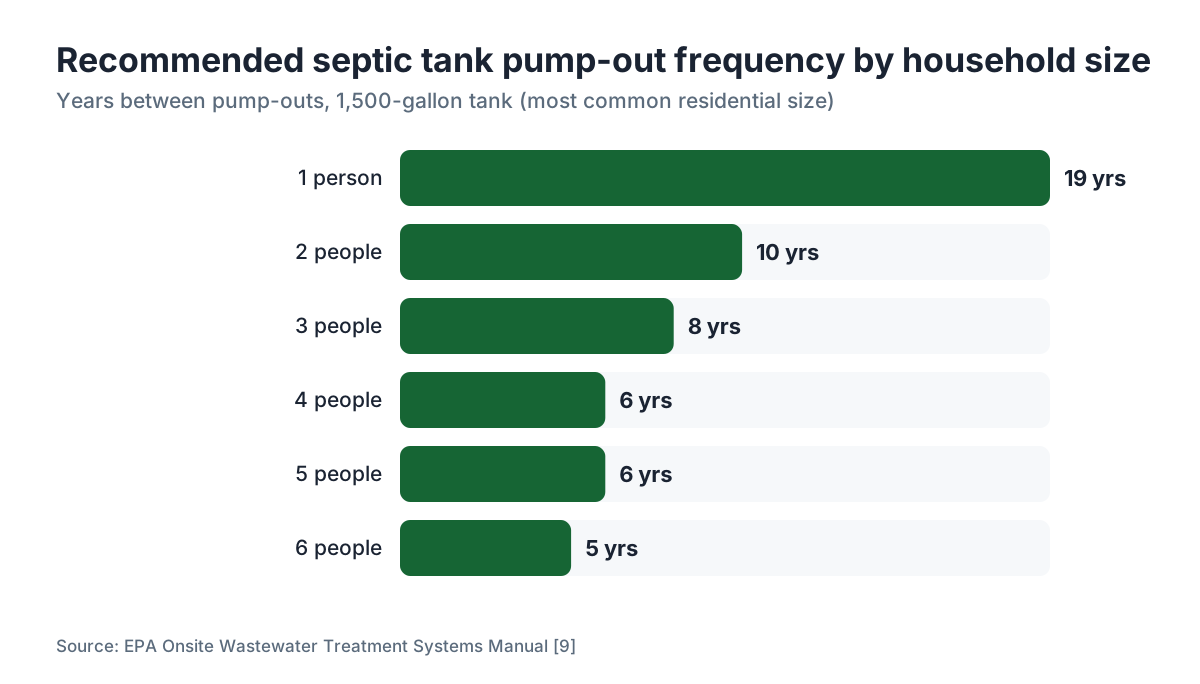
The table below gives EPA's own pumping estimates based on those variables [9].
| Household size | 1,000-gal tank | 1,500-gal tank | 2,000-gal tank |
|---|---|---|---|
| 1 person | 12 years | 19 years | 25 years |
| 2 people | 6 years | 10 years | 13 years |
| 4 people | 4 years | 6 years | 8 years |
| 6 people | 3 years | 5 years | 6 years |
Source: EPA Onsite Wastewater Treatment Systems Manual [9]
A couple of honest caveats. That table assumes average water use and no garbage disposal. Run a disposal hard and you can knock a year or two off those intervals. Big family, endless laundry? Same deal.
You can find out exactly how full your tank is. A pumper checks sludge depth with a measuring tool called a "sludge judge." The rule of thumb among service providers: when sludge fills more than a third of the tank, it's time to pump. Don't wait for a backup to tell you.
For a full breakdown of intervals and what affects them, see how often to pump septic tank. For what a pump-out actually involves, see septic tank pump out.
What should you never flush or pour down the drain?
The fastest way to wreck a septic system is to treat it like a trash can. Your tank runs on living bacteria that break down organic waste. Kill those bacteria, or bury them under material they can't process, and everything downstream suffers.
Here's what to keep out.
Things that kill the bacteria in your tank:
- Antibacterial soaps and cleaners in large amounts. Normal hand-washing is fine. Pouring a bottle of disinfectant down the drain is not.
- Bleach in quantity. Occasional toilet-bowl cleaning with standard amounts won't hurt. Routine heavy use throws off the microbial balance.
- Drain-clearing chemicals like Drano or Liquid-Plumr. Caustic enough to damage the tank's bacteria and sometimes the tank itself.
- Prescription medications and antibiotics.
Things that physically clog the system:
- Wipes of any kind, even ones labeled "flushable." They don't break down fast enough. The Water Research Foundation found that marketed flushable wipes broadly failed the flushability tests water utilities use [4].
- Paper towels, feminine hygiene products, condoms, cotton swabs.
- Cigarette butts.
- Cat litter, even the "flushable" kind.
Things that choke the drain field:
- Cooking grease and oils. They solidify in the tank, build the scum layer faster than bacteria can eat it, and eventually reach the field.
- Coffee grounds. Dense and slow to break down.
- Paint, solvents, gasoline, any chemical. Beyond killing bacteria, these contaminate groundwater and put you in violation of your state's environmental code [3].
Garbage disposals deserve a separate word. They're legal and common on septic, but they load the tank with a lot more solids. Use one daily for heavy scraps and you should expect to pump more often, probably every 2 to 3 years for a family of four.
How do you protect the drain field from damage?
The drain field is the most expensive and least forgiving part of the system. Most homeowners forget it exists until it fails. Caring for it is mostly about what you don't do to it.
Don't park or drive on it. Compaction crushes the pore spaces the effluent needs to percolate through. One pass by a heavy truck can measurably reduce soil permeability. Keep vehicles off the area entirely.
Don't plant trees or shrubs near it. Roots follow moisture and find their way into perforated pipes given time, and root intrusion is one of the most common causes of field failure in older systems. The EPA recommends keeping trees at least 30 feet from the drain field [1]. Grass is fine and actually helps. Shallow roots hold the soil without invading pipes, and the turf pulls up moisture and nutrients.
Redirect surface water away from the field. Saturated soil can't accept more water. If your downspouts, sump pump discharge, or yard grading aim water at the field, it waterlogs and backs up into the house. Grade so water flows away.
Don't build over it. No decks, no sheds, no concrete pads. You need access for maintenance, and covering the field traps moisture and blocks the oxygen soil bacteria need.
Be careful with raised garden beds. Growing food directly over the field is a bad idea because pathogens can persist in the soil. If you want something besides turf, pick drought-tolerant ornamentals with shallow roots.
For problems that have already started, see septic system repair and leach field for field-specific issues.
How much water use is too much for a septic system?
Septic systems are designed around an expected daily flow, usually figured at 50 to 100 gallons per person per day depending on the state's design standards [9]. Blow past the system's design capacity regularly and you flood the drain field before the soil can process what's already there.
A few situations push households over the limit without anyone noticing.
- Leaky toilets. A running toilet can waste 200 gallons a day, per EPA WaterSense [5]. That's a second person's daily flow going straight to the tank and field.
- All the laundry on one day. Eight to ten loads on a single Saturday sends a surge through the system. Spread it across the week.
- Big gatherings. A party with 40 guests on a system built for four is a real stress test. Host large events often? Tell your service provider.
- High-flow fixtures. Remodeling? WaterSense toilets use 1.28 gallons per flush versus the old 3.5 to 7 gallons. Low-flow showerheads and front-loading washers cut the daily load too.
Fix leaky faucets and toilets fast. This is about more than the water bill. On a septic system, a drip or a running toilet loads your drain field directly, day and night.
Do septic additives actually help?
Homeowners ask this constantly, and the honest answer is: probably not, and possibly harmful.
The additive market sells biological products (bacteria and enzymes) and chemical products. The pitch is that extra bacteria break down waste faster and let you stretch the interval between pump-outs. Sounds reasonable. The research doesn't back it.
The University of Minnesota Extension reviewed the literature and found no scientific evidence that biological additives improve system performance or extend the time between pump-outs [6]. A healthy tank already holds billions of bacteria seeded naturally from human waste. Dumping more in doesn't meaningfully change the biology.
Chemical additives are worse. Some use organic solvents to break up grease, which sounds handy, but those solvents can carry contaminants into the drain field and groundwater. EPA guidance specifically cautions against chemical additives for that reason [1].
Some states go further. Washington's Department of Ecology treats certain septic additives as potential sources of groundwater pollution [7].
Save the money. Pump on schedule, watch what you flush, protect the field. That's the whole job. Additives don't replace pumping and won't fix a failing system.
What does a professional septic inspection involve?
An inspection is not a pump-out. A pump-out removes solids. An inspection judges the condition and function of the system.
A thorough inspection, done by a licensed inspector or certified pumper, usually covers:
- Locating and uncovering the tank lids
- Checking inlet and outlet baffles (cracked or missing baffles are a common failure point)
- Measuring sludge and scum depth
- Inspecting the tank for cracks, root intrusion, and proper liquid level
- Flow-testing by running water to check for backups or slow drainage
- Assessing the distribution box, if there is one
- Eyeballing the drain field surface for soft spots, odors, or surfacing effluent
For a home sale, most buyers require a Title 5 inspection or the equivalent, a state-specific standardized assessment. Massachusetts Title 5, for example, requires inspection by a certified inspector and specific tests before a property transfer [8].
Frequency rules vary by state, but the EPA recommends inspection at least every 3 years for systems without mechanical components [1]. Systems with pumps, aerators, or other mechanical parts should be inspected annually.
For what inspectors look for and what it costs, see septic tank inspection.
Managing inspection workflows across many properties? SepticMind's scheduling and recordkeeping tools track inspection cycles and generate compliance reports at scale.
What are the warning signs of a failing septic system?
Catch a problem early and you might replace one component. Catch it late and you replace the whole system.
Watch for these.
Inside the house:
- Slow drains throughout the house, especially several fixtures slow at once. One slow sink is a clog. All of them points to the septic system.
- Gurgling in the drains or toilets.
- Sewage odors indoors.
- Sewage backing up into tubs, toilets, or floor drains.
Outside the house:
- Bright green, lush grass over the field, especially when the rest of the lawn is dry. Effluent is surfacing and fertilizing the grass.
- Soggy, spongy ground over the field.
- Standing water or pooling liquid with an odor near the tank or field.
- Sewage smell outdoors near the tank or field.
Any of these means calling a licensed septic contractor, not waiting to see if it clears up. Surfacing effluent is a public health issue in most states and has to be addressed promptly [3].
Past the warning signs already? See septic tank repair and septic system repair for what repair looks like and what it costs.
How much does septic system care cost over time?
Here's a realistic 20-year picture of a well-maintained system next to a neglected one.
| Expense | Well-maintained system | Neglected system |
|---|---|---|
| Pump-outs (every 3-5 yrs) | $1,800 to $4,000 | $0 to $600 (too infrequent) |
| Inspections | $500 to $1,500 | $0 |
| Minor repairs (baffles, risers) | $200 to $800 | Skipped |
| Drain field repair or replacement | Unlikely | $5,000 to $30,000+ |
| Full system replacement | Unlikely | $10,000 to $50,000+ |
| 20-year total (realistic range) | $2,500 to $6,300 | $10,000 to $50,000+ |
Pumping runs about $400 to $500 nationally for a standard tank, from roughly $250 in rural markets to over $800 in high-cost urban areas [2]. Tank size, access difficulty, and local disposal fees all move the price.
For current cost data on full installations, see cost to install septic system and cost to put in a septic tank.
For tank-specific cleaning costs and what that service includes, see septic tank cleaning and septic tank emptying.
What records should you keep, and why do they matter?
Keeping a maintenance file is one of those small habits that pays off big when you sell the house or need a repair.
Your file should include:
- The original permit and as-built drawing showing tank location, size, and drain field layout. Don't have it? Call your county health department or permitting office. They're usually required to keep it on file [3].
- Every pump-out receipt, with the date, volume removed, and any notes from the hauler about conditions inside the tank.
- Inspection reports.
- Repair records: what was fixed, who did it, and the permit number if one was required.
- The system type and any manufacturer specs for advanced treatment components.
Why it matters: at a home sale, many states require proof of recent maintenance. Massachusetts Title 5 requires a system inspection within 2 years of sale (or within 6 months if the sale terms trigger it), and the results become part of the public record [8]. Buyers and their inspectors will ask.
Inherited a home with no records? A licensed inspector can often rebuild the basic picture by probing for the tank, measuring depth, and assessing the field. It won't hand you a pumping history, but it sets a baseline.
For operators managing records across dozens or hundreds of accounts, SepticMind's platform stores pump-out histories, inspection records, and compliance documents in one place so nothing slips between service calls.
Are there any state or local rules about septic maintenance you must follow?
Yes, and they vary a lot by state and county. This is not optional reading.
Most states regulate septic through their department of environmental quality, department of health, or department of natural resources. The base framework usually comes from state onsite wastewater treatment regulations, and counties often stack extra requirements on top [3].
Common mandatory rules include:
- Required inspection intervals (some counties require inspections every 3 to 5 years whether or not you're selling)
- Mandatory maintenance contracts for advanced treatment systems (ATUs, aerobic systems)
- Required pump-out frequencies for certain system types or locations near waterways
- Permits before any repair or modification
- Licensed contractor requirements. In most states, pump-outs must go through a licensed septage hauler, and repairs need a licensed installer or contractor [3].
The EPA's SepticSmart program is a starting point for federal guidance, but the EPA is clear that primary regulatory authority rests with states and localities [1]. Search your state's environmental agency plus your county health department for the rules that apply to your address.
Breaking maintenance rules can bring fines, mandatory repair orders, and in some cases a ban on using the property until the system is brought into compliance. In shoreline or sensitive watershed zones, enforcement gets stricter.
Unsure what applies to you? Call your county health department. They generally want to help homeowners comply, not hand out fines.
What's a practical annual maintenance checklist for septic system owners?
Most of septic care isn't dramatic. It's small habits, done consistently.
Every month:
- Check for slow drains or gurgling. Don't ignore them.
- After heavy rain, confirm no surface water is pooling near the tank or drain field.
Every 6 months:
- Walk the drain field. Look for lush patches, soft spots, or odors.
- Check risers or access lids for damage or tampering.
- Confirm no new landscaping, parking, or construction has crept onto the field.
Every year (or per your system's schedule):
- If you have an ATU or aerobic system, confirm the maintenance contract is current and the service visit actually happened.
- Clean any effluent filters in the tank outlet. Many newer systems have them. They're cheap to clean but cause backups if ignored.
Every 3 to 5 years:
- Schedule a professional inspection and pump-out. Don't wait for trouble.
- Review your records and make sure everything is documented.
- Confirm your county hasn't changed any local inspection requirements.
For pump-out scheduling and what to expect from the service call, see septic tank pumping and septic tank pump out.
Frequently asked questions
How do I take care of my septic system on a daily basis?
Day to day, the biggest habits are: flush only toilet paper and human waste, spread laundry across the week instead of doing it all on one day, fix leaky toilets fast, and keep grease and harsh chemicals out of every drain. None of it is complicated. Skipping those habits consistently is how most systems get in trouble faster than they should.
How long does a septic system last if you take care of it?
A well-maintained conventional system, meaning regular pump-outs, no abuse of the drain field, and protection from vehicle traffic and tree roots, can last 25 to 40 years or more. A concrete tank that's well built can outlast the house. The drain field is usually the limiting part. Neglected systems can fail in under 10 years.
Can you use a garbage disposal if you have a septic system?
Yes, but with a real caveat. Disposals add a lot more solids to the tank, so you'll pump more often. A family of four using a disposal heavily should probably pump every 2 to 3 years instead of every 4 to 5. With a small tank or an older system, some contractors will tell you to skip daily disposal use altogether.
What happens if you never pump your septic tank?
Sludge and scum build until solids overflow into the drain field. Once solids clog the soil pores, the field usually can't recover and needs replacement, which runs $5,000 to $30,000 or more depending on soil and system type. You'll likely see sewage backing up into the house before it gets that far.
Is it safe to do laundry with a septic system?
Yes. A few tips: spread loads over several days instead of eight on Saturday, use liquid detergent instead of powder (powder filler can clog soil in the drain field), and match the load size setting to the load to avoid wasting water. High-efficiency front-loaders use far less water per load, which is a real advantage on septic.
Do I need to add bacteria or enzymes to my septic tank?
No. University of Minnesota Extension reviewed the literature and found no evidence that biological additives improve performance or extend pump intervals. A healthy tank already holds billions of naturally occurring bacteria from human waste. Chemical additives are worse: some contain solvents that can contaminate groundwater. Save the money and put it toward a pump-out on schedule.
How do I find my septic tank if I don't know where it is?
Start with your county health department or permit office, which should have the original installation permit and a site diagram on file. If that doesn't exist, trace the sewer line from the house, which usually exits through the basement or crawl space and runs in a straight line to the tank. A septic service provider can also locate it with a probe or electronic locator.
What are the best plants to grow over a drain field?
Grass is the best choice. Shallow roots hold the soil without invading pipes, and it pulls up moisture and nutrients from the effluent. Avoid trees and shrubs, especially willows, maples, and other water-seeking species. Ornamental perennials with shallow, non-invasive roots are acceptable, but skip vegetables, since pathogens can persist in the soil near an active field.
Can heavy rain damage a septic system?
Yes. A saturated field can't accept more water. During extended heavy rain, cut back on indoor water use for a few days to give the field time to drain between inputs. Also check that gutters, downspouts, and yard grading aren't aiming surface water at the field. Chronic saturation from poor grading is a common cause of premature field failure.
Does homeowner's insurance cover septic system failures?
Usually no. Standard homeowner's policies exclude septic systems or treat them as maintenance items. Some insurers offer separate service line or systems breakdown coverage as an add-on, and a few home warranty products cover septic components. Read the exclusions carefully, because many policies exclude the drain field or cover only sudden mechanical failures, not gradual failure from neglect.
How often should a septic system be inspected?
The EPA recommends professional inspection every 3 years for conventional systems without mechanical components. Systems with pumps, aerators, or other mechanical parts should be inspected annually. Some states and counties set their own mandatory schedules, which can be stricter. Check with your county health department for the requirement that applies to your specific system and location.
What's the difference between pumping and cleaning a septic tank?
Pumping removes the liquid and accumulated solids (sludge and scum) from the tank. Cleaning goes further: the pumper rinses and inspects the interior walls, checks the baffles, and may break up hardened sludge before vacuuming. Most providers roll these into one service call. For a full breakdown, see our guide to septic tank cleaning.
Sources
- EPA, SepticSmart: Protect Your Investment: One in five U.S. households uses a septic system; EPA recommends inspection every 3 years and pumping every 3-5 years; keep trees 30 feet from drain field; caution against chemical additives
- Angi (formerly HomeAdvisor), Septic Tank Pumping Cost Guide: National average septic tank pump-out cost ranges from roughly $300 to $600, varying by tank size, access, and region
- EPA, How Your Septic System Works: Primary regulatory authority for septic systems rests with states and localities; advanced systems often require annual maintenance contracts; permits required for repairs and modifications
- Water Research Foundation, Flushability Assessment of Wipes Products: Marketed flushable wipes broadly failed standardized flushability tests used by water utilities
- EPA WaterSense, Fix a Leak Week: A running toilet can waste approximately 200 gallons of water per day
- Washington State Department of Ecology: Washington classifies certain septic additives as potential sources of groundwater contamination
- Massachusetts Department of Environmental Protection, Title 5 Septic System Regulations: Massachusetts Title 5 requires septic system inspection within 2 years of property sale by a certified inspector; results become part of the public record
- EPA, Onsite Wastewater Treatment Systems Manual: Pumping frequency estimates by household size and tank size; states design septic systems around 50-100 gallons per person per day flow rates
Last updated 2026-07-10