Perc test Alabama: what homeowners need to know
By the SepticMind Editorial Team
TL;DR
- An Alabama perc test measures how fast soil absorbs water to decide whether a lot can hold a septic system.
- The Alabama Department of Public Health regulates it.
- A licensed engineer or a county health department sanitarian runs it.
- Tests cost $200 to $500 and results are required before ADPH issues a septic permit.
- Sandy soils usually pass.
- Heavy clay or rock often fails.
What is a perc test and why does Alabama require one?
A perc test, short for percolation test, measures how fast water drains through your soil. The number it produces is called a percolation rate. That rate tells a designer how large a drain field your lot needs and whether a conventional septic system can work there at all.
Alabama requires the test because a drain field that floods or backs up is a public health problem, full stop. The Alabama Department of Public Health (ADPH) administers onsite sewage rules under the Alabama Onsite Wastewater Board and its regulations in the Alabama Administrative Code, Chapter 420-3-1. That code makes a site evaluation, which includes soil percolation data, a prerequisite for any new septic permit [1].
No passing perc test on file means no Onsite Sewage System Permit. No permit, no septic installation. No septic installation, no Certificate of Occupancy on a new home. That chain of dependencies is why buyers of raw land almost always make their offer contingent on passing a perc test.
The test also matters if you're expanding an existing home and adding bedrooms. Bedroom count drives system size. More bedrooms means more projected daily wastewater flow, which means the drain field sizing calculation starts over.
Who performs perc tests in Alabama?
Two groups can legally run a site evaluation with percolation testing in Alabama: licensed professional engineers (PEs) with appropriate environmental credentials, and sanitarians employed by your county health department. Homeowners cannot run their own test for a permit.
County sanitarians work through the local ADPH county health department office. Their fees are set by the state and usually run lower than a private engineer, often $150 to $300 for the site evaluation, though that varies by county. The catch is scheduling. County offices are busy, and wait times can run two to six weeks in many rural counties.
Private licensed engineers or certified onsite system designers can do the work faster, usually within one to two weeks. Their fees run higher, typically $300 to $600 for the full site evaluation that includes percolation testing and soil morphology. If your soil is unusual or your lot has a complex slope, a private engineer is often worth the extra cost. They can design an alternative system on the spot rather than making you schedule a second trip.
The test must be witnessed or performed by one of those two categories of licensed professionals to be accepted by ADPH [1].
How does the Alabama perc test actually work?
The process has three phases: site preparation, soil morphology evaluation, and the percolation test itself.
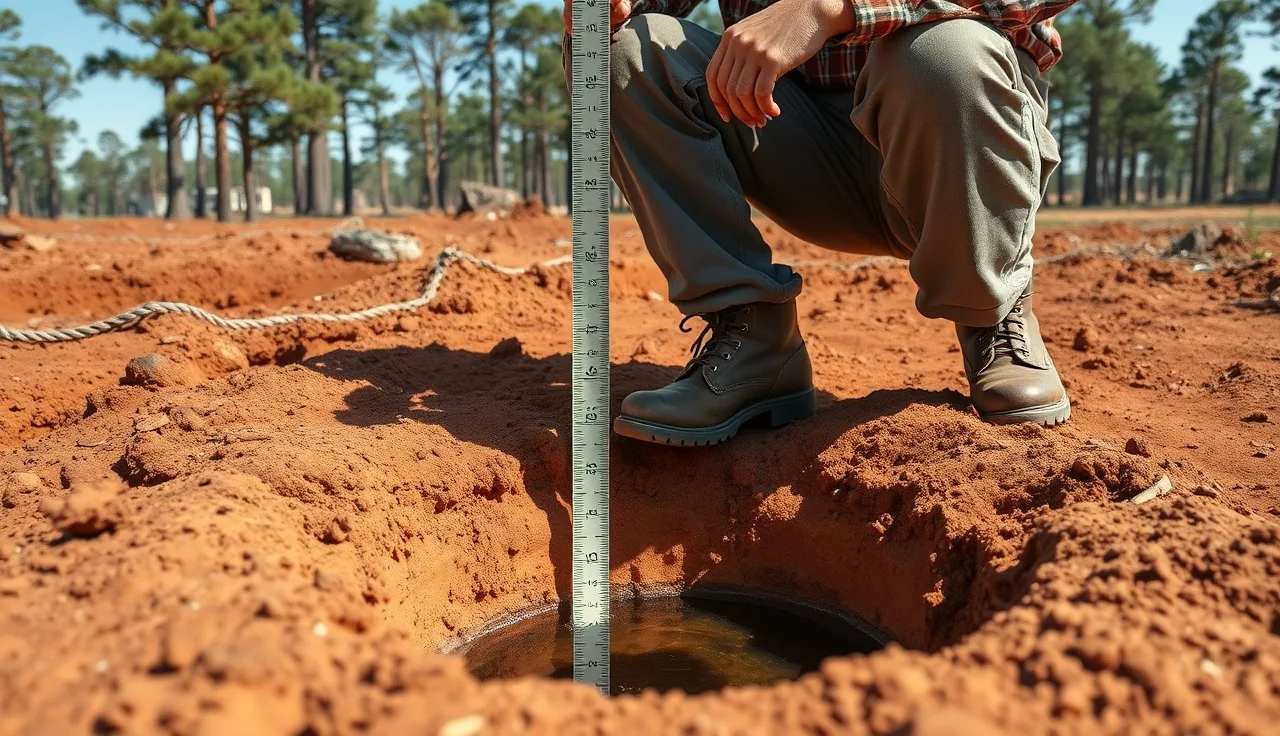
Site preparation happens the day before testing. The tester digs or augers test holes, typically six to twelve inches in diameter and twelve to thirty-six inches deep, at spots that represent the proposed drain field. The holes get pre-soaked: filled with water and left to drain overnight. That pre-soak matters because Alabama's method requires the soil to sit at or near saturation before the timed test begins, which reflects worst-case wet season conditions.
Soil morphology evaluation happens alongside the perc test. The sanitarian or engineer examines a soil profile pit, usually dug two to five feet deep, and records soil color, texture, mottling, and restrictive layers. Mottling (gray or orange splotches in the soil) points to a seasonal high water table, which can disqualify a site even if the perc rate is fine. A seasonal high water table less than twelve inches from the proposed trench bottom is typically a disqualifying condition in Alabama [1].
The percolation test itself is timed. The tester fills the pre-soaked hole with water to a set depth, usually six inches, and measures how far the water level drops over a fixed interval, usually thirty minutes. That measurement converts to a perc rate in minutes per inch (mpi). A fast-draining sandy soil might show 5 mpi. Tight clay might show 120 mpi or more.
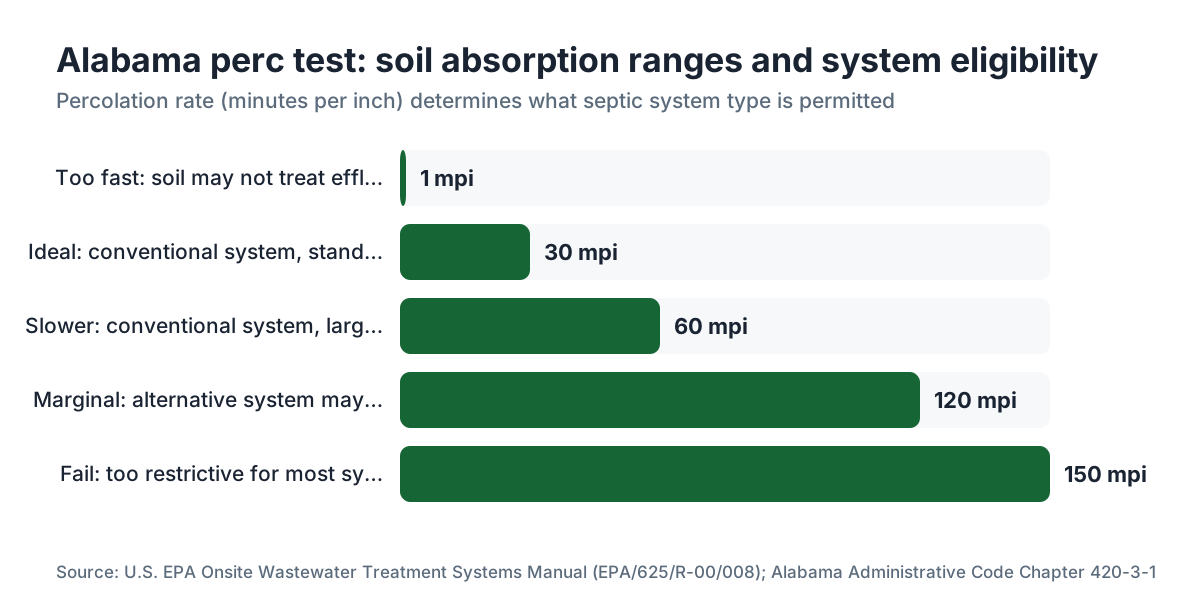
Alabama code sets the acceptable range for conventional drain fields. Soils absorbing faster than 1 mpi are too fast, because treated effluent passes through before soil bacteria can treat it. Soils absorbing slower than 60 mpi are too slow for a conventional system, though alternative systems can sometimes work in the 60 to 120 mpi range. Results outside those bounds require a different design or may result in a denial [6].
What perc rates pass or fail in Alabama?
Alabama's onsite sewage rules tie acceptable perc rates to system type. The ranges below map how it works. A perc rate of 1 to 30 mpi is the sweet spot for a standard drain field.
| Perc rate (min/inch) | Conventional system | Alternative system | Notes |
|---|---|---|---|
| Less than 1 | Fail | Sometimes OK with special design | Too fast; soil may not treat effluent |
| 1 to 30 | Pass | Pass | Ideal range; standard drain field sizing |
| 31 to 60 | Pass (larger field) | Pass | Slower drainage requires more square footage |
| 61 to 120 | Fail (conventional) | Possible with engineer design | Marginal; mound or drip irrigation systems sometimes approved |
| Greater than 120 | Fail | Usually fail | Soil too restrictive; lot often unbuildable with any onsite system |
These are the general thresholds derived from ADPH onsite rules [1]. The specific numbers can shift slightly depending on which county health department runs the evaluation and whether the site has mitigating factors, so confirm current thresholds with your local ADPH office.
Drain field size is also a function of perc rate. A faster perc rate means a smaller required field per bedroom. A slower rate in the passing range means more linear feet of drain trench. On a small lot, a slow-but-passing perc rate can still kill a project when there isn't enough usable area for the required field plus setbacks.
How much does a perc test cost in Alabama?
Expect to pay $200 to $500 for a standard perc test and site evaluation in Alabama. That range covers the most common case: a single-family residential lot with straightforward soil, done either by the county health department or a private evaluator.
County health department fees tend to land in the lower part of that range, often $150 to $250, but you're paying with time as well as money since scheduling can be slow. Private engineers typically charge $300 to $500 for the same scope, with the higher end reflecting complex sites, long drive times in rural areas, or rush scheduling.
Some private firms bundle perc testing with a full site plan and septic system design for a flat fee. That package might run $800 to $1,500 but saves you from hiring separately for the design phase. If you're buying land specifically to build, that bundle can be worth it because you get permit-ready drawings in one engagement.
The perc test fee does not include the septic permit itself, which ADPH charges separately. Permit fees in Alabama have historically run $50 to $150 depending on system size and county, but confirm the current schedule with your county health department. These numbers drift over time.
For a full picture of what comes after a passing test, see our guide on cost to install septic system and septic tank installation.
How long does the perc test process take in Alabama?
The physical test takes one to two days: a prep day for digging and pre-soaking holes, and a test day for the timed measurements and soil profile. That's the easy part.
Scheduling dominates the real timeline. County health departments in rural Alabama counties can be booked out four to eight weeks, especially in spring and fall when land buyers are most active. Private engineers can often schedule within one to two weeks.
Results turnaround depends on who ran the test. County sanitarians typically issue results within two to three weeks. Private engineers often turn results around in three to five business days.
Once you have passing results, ADPH permit processing takes another two to four weeks in most counties. The full cycle from scheduling the test to holding a permit can run six to twelve weeks through the county system, or four to six weeks with a private engineer.
Plan accordingly. If you have a closing deadline or a construction start date, build these timelines into your schedule before you go under contract on raw land.
What happens if your Alabama perc test fails?
A failed perc test doesn't automatically mean your lot is unbuildable. It means a conventional gravity-fed drain field won't work. You have several options, though none are cheap or guaranteed.
Soil modification is the first thing people ask about. In limited cases, importing sandy fill or breaking up restrictive soil layers can improve percolation enough to qualify. ADPH rules govern when modified soil evaluations are acceptable, and the modification has to be finished before a re-test. Not every county sanitarian will approve this approach, and hauling and placing suitable fill can run several thousand dollars.
Alternative systems are the more common path. Alabama allows several when conventional systems won't work. Mound systems raise the drain field above native soil on a constructed fill mound, useful when the water table is high or soil is slow. Low-pressure pipe (LPP) systems spread effluent more evenly and can work in marginal soils. Aerobic treatment units (ATUs) produce higher-quality effluent that can sometimes discharge into soil that would fail for a conventional system. Drip irrigation systems are another option in certain soil conditions [2].
Every alternative system needs an engineered design, which adds cost. A mound system can run $15,000 to $30,000 installed versus $8,000 to $15,000 for a conventional system in Alabama. If the lot is otherwise valuable, it might still pencil out. If it's raw land you're weighing, factor that added cost into your offer.
Some lots simply can't support any onsite system given the mix of soil, lot size, setbacks, and topography. Then the real options are connecting to a public sewer if one runs nearby, or not building at all. That's a hard truth. Better to know it before you close.
If you end up modifying or repairing an existing system, our articles on septic system repair and septic tank repair cover what those jobs involve.
What are the setback and site requirements in Alabama?
Passing the perc test is only part of qualifying a site. The proposed system also has to meet setback distances from wells, property lines, structures, and surface water. Alabama's setback minimums under the onsite sewage code include [1]:
- Septic tank: minimum 5 feet from any structure, 50 feet from a water well
- Drain field: minimum 10 feet from property lines, 100 feet from a public water supply well, 50 feet from a private well, 50 feet from surface water
- Seasonal high water table: drain field bottom must be at least 12 inches above the seasonal high water table
These are the general minimums. Local county amendments can be stricter, and ADPH can add conditions based on site-specific findings. Verify exact current setbacks with your county health department, because the code does get amended.
Lot size matters in a practical sense too. Even if your soil passes and the setbacks work on paper, you need enough contiguous usable area for the tank, the drain field, and a reserved repair area (a replacement drain field). Lots under one acre can get tight in some soil conditions. Steep slopes, flood zones, and existing easements eat into usable area fast.
How do you find a licensed perc test evaluator in Alabama?
Your first call should be to your county's ADPH health department office. Every Alabama county has one, and their sanitarians handle perc testing and site evaluations as a core function. The ADPH website lists county health department contact information [3].
For a private evaluator, look for licensed professional engineers (PEs) registered with the Alabama Board of Licensure for Professional Engineers and Land Surveyors, specifically those with environmental or civil backgrounds and experience in onsite wastewater. The board maintains a licensee lookup tool on its website [8].
Some onsite system installers work with or can recommend licensed evaluators. That's a fine starting point, but make sure the evaluator is independent from whoever installs the system. A conflict of interest doesn't help you on a decision that affects whether your lot is buildable.
SepticMind keeps a directory that septic service operators use to track service areas and evaluator contacts. It's one more place to find a local professional if you're struggling in a rural county.
Ask any evaluator about their familiarity with your county's ADPH office and any county-specific quirks in how results are submitted. The state code is uniform, but local offices have procedural variations that an experienced local evaluator already knows.
Does Alabama require a perc test when buying or selling land?
Alabama has no statewide law requiring a perc test for real estate transactions on already-developed properties. But if you're buying undeveloped land to build on, getting a perc test before closing is one of the smartest moves you can make.
A passing result tells you the lot is buildable with a septic system. A failing result, found before closing, gives you room to walk away, cut the price, or require the seller to fund an engineered alternative system design. Finding a failed perc test after closing is a much worse spot to be in.
For land already developed with an existing septic system, the pre-sale evaluation is usually a septic system inspection, not a perc test. A septic tank inspection checks the condition of the existing system, looks at the tank for damage and proper function, and hunts for signs of drain field failure. Many lenders and buyers request this as a condition of sale even when it's not legally required.
Real estate agents representing buyers of undeveloped land in Alabama should routinely recommend a perc test contingency in the purchase agreement. If your agent doesn't raise it, raise it yourself.
What is the best time of year to schedule a perc test in Alabama?
Alabama's onsite sewage rules require perc tests to run under saturated or near-saturated soil to simulate the worst case for drain field performance. That's why the pre-soak requirement exists.
The practical upshot: results are most conservative, and most representative of real-world performance, when the test happens during a wet period. ADPH sanitarians can test year-round, but results from dry summer conditions can show better percolation than the soil actually delivers in wet winter or spring. Some county sanitarians are more conservative about dry-season results than others.
On scheduling, spring (March through May) and fall (September through November) tend to be busiest, because that's when land buyers and builders are most active. Book in late fall or winter and you'll often get a faster appointment, soil conditions will sit closer to worst-case, and the results will be less likely to be questioned later.
Avoid scheduling right after an unusually dry stretch if you can. The pre-soak helps, but severely drought-stressed soils can still show artificially fast perc rates that don't reflect typical conditions [9].
How does the perc test connect to drain field sizing and system design?
The perc rate is the key input to drain field sizing. Alabama's onsite sewage code ties required square footage of drain field per bedroom (or per daily gallon of design flow) directly to the perc rate.
Here's a rough example. At a perc rate of 10 mpi, a three-bedroom home might need about 450 square feet of drain field absorption area. At 45 mpi, that same home might need 750 square feet or more, because the slower-absorbing soil needs more surface area to handle the same daily flow. The exact numbers depend on ADPH's sizing tables in the current code, and the designer applies those tables to your specific soil data [1].
Drain field depth and trench spacing are part of the design too. A system built for marginal soil might use narrower trenches and more of them, or a different distribution method, compared to a system in sandy loam.
This is where your long-term maintenance picture starts. A properly sized drain field in well-draining soil is far more forgiving than a marginally sized system in slow soil. The latter has little tolerance for overloading, grease, or neglected septic tank pumping. Regular pump-outs, typically every three to five years for a household of four, help protect the drain field regardless of soil type. See our guide on how often to pump septic tank for specifics.
The leach field article on this site goes deeper into how drain fields work and what makes them fail early.
How do Alabama's perc test rules compare to EPA guidance?
The EPA's SepticSmart program treats percolation testing as a standard site evaluation tool and emphasizes that proper siting is the foundation of a working septic system. EPA guidance states that "a site evaluation, including soil testing, is necessary to determine the best type of system for a site" [5].
Alabama's rules line up with that guidance and with the general framework most southeastern states use. The specific thresholds (1 mpi minimum, 60 mpi maximum for conventional systems) and the required setbacks are Alabama-specific, set in state code, not by EPA directly. Federal law sets a baseline through the Clean Water Act, but onsite sewage regulation is mostly a state and local job.
Alabama is stricter than some states in one way: it requires a professional witness for every perc test used in permitting. A handful of states allow self-conducted perc tests under certain conditions. Alabama does not, and that's worth knowing if you're used to the rules in another state.
The EPA's SepticSmart resources, on the EPA website, make useful background reading for homeowners. They don't replace Alabama-specific guidance from ADPH [5].
Frequently asked questions
Can I do my own perc test in Alabama?
No. Alabama requires perc tests to be conducted or witnessed by a licensed professional, either a county health department sanitarian or a licensed professional engineer. A self-conducted test will not be accepted by ADPH for permitting purposes. You can dig exploratory holes yourself to get a rough sense of your soil before paying for an official test, but that informal work carries no permit weight.
How long is a perc test result valid in Alabama?
Alabama perc test results and site evaluation approvals are generally valid for five years for permitting purposes, though you should confirm the current policy with your local county health department because this can vary. If you receive a site approval but don't pull a permit within that window, you may need to repeat the evaluation. Major site changes like grading or land clearing can also void existing results.
What is the difference between a perc test and a soil profile evaluation in Alabama?
A soil profile evaluation examines a soil pit to assess texture, color, mottling, and restrictive layers. A perc test measures actual water absorption rate with a timed test. In Alabama, ADPH requires both as part of the site evaluation. The soil profile can disqualify a site based on high water table indicators (mottling, gray colors) even if the perc rate is acceptable. The two tests work together; one alone isn't sufficient.
How many perc test holes are required in Alabama?
Alabama's onsite sewage rules typically require a minimum of two to three test holes in the proposed drain field area, placed to represent the range of soil conditions across the site. The exact number can increase depending on lot size, variability in soil conditions, and the evaluator's judgment. All holes must be pre-soaked the day before the timed test runs.
Can an Alabama perc test fail because of high groundwater?
Yes. Even if the percolation rate itself falls in the acceptable range, a site can fail if the seasonal high water table is too shallow. Alabama requires at least 12 inches of separation between the bottom of drain field trenches and the seasonal high water table. Evidence of a high water table shows up in the soil profile as gray or orange mottling and is evaluated separately from the timed perc rate.
What alternative septic systems are allowed in Alabama when a site fails a perc test?
Alabama allows several alternative systems for marginal or failing sites. Mound systems place the drain field in elevated fill above native soil. Low-pressure pipe (LPP) systems distribute effluent evenly in shallow trenches. Aerobic treatment units (ATUs) treat effluent to a higher standard before soil dispersal. Drip irrigation systems deliver treated effluent through subsurface emitters. Each requires an engineered design approved by ADPH and costs more than a conventional system.
Does a perc test result transfer to a new property buyer in Alabama?
Generally yes, if the results are still within their validity period (typically five years) and the lot conditions haven't changed. A new buyer can use an existing site approval on file with the county health department to apply for a septic permit without repeating the test. Confirm this with the local ADPH office, since any significant site disturbance or the passage of the approval period would require a fresh evaluation.
What does it cost to install a septic system in Alabama after a passing perc test?
A conventional septic system in Alabama typically costs $8,000 to $15,000 installed, covering the tank, distribution box, and drain field. Alternative systems cost significantly more: mound systems often run $15,000 to $30,000, and ATU-based systems can reach $20,000 to $35,000. Costs vary by county, site conditions, system size, and current labor and materials prices. See our full guide on cost to install a septic system for a detailed breakdown.
Which Alabama county health department handles perc tests?
Every Alabama county has an ADPH county health department that handles perc test scheduling and site evaluations. You contact the health department in the county where the land is located, not where you live. ADPH's website lists all 67 county health department offices with contact information. Rural county offices can have long wait times, so call early in your land-buying process.
Can I appeal a failed perc test result in Alabama?
Yes. If a county sanitarian denies your site evaluation, you can request a review through ADPH or hire a licensed private engineer to conduct an independent evaluation. In some cases, an engineer's more detailed soil analysis or a proposed alternative system design can lead to an approval where the initial county evaluation resulted in denial. The appeal process and timelines are managed through ADPH's regional offices.
Does Alabama require a perc test for an addition that adds bedrooms?
Yes, typically. Adding bedrooms increases your projected daily wastewater flow, which affects required system capacity. ADPH may require a new site evaluation or at minimum a review of the existing system's capacity against the new bedroom count before issuing a permit for the addition. If your existing drain field is already sized to the minimum, a bedroom addition could require field expansion, which brings drain field area and perc testing back into play.
Is a perc test the same as a perk test?
Yes, completely. 'Perk test' is just a phonetic spelling of 'perc test,' which is itself an abbreviation of percolation test. You'll see both spellings in Alabama real estate listings and contractor quotes. They refer to the identical soil absorption test required by ADPH before septic permits are issued.
Sources
- Alabama Department of Public Health, Alabama Administrative Code Chapter 420-3-1, Onsite Sewage Systems: ADPH administers onsite sewage permitting and requires a site evaluation including percolation testing before any septic permit is issued; sets acceptable perc rate ranges, setback distances, and seasonal high water table minimums
- Alabama Department of Public Health, Onsite Sewage Program: Alabama permits several alternative onsite sewage systems including mound systems, LPP, ATUs, and drip irrigation for sites where conventional systems are not feasible
- Alabama Department of Public Health, County Health Departments Directory: All 67 Alabama county health departments handle perc test scheduling and site evaluations for onsite sewage permitting
- U.S. Environmental Protection Agency, SepticSmart Program: EPA states that 'a site evaluation, including soil testing, is necessary to determine the best type of system for a site'; onsite sewage regulation is primarily a state and local function under federal Clean Water Act framework
- U.S. EPA, Onsite Wastewater Treatment Systems Manual (EPA/625/R-00/008): Percolation rates below 1 mpi indicate soil too coarse to adequately treat effluent; rates above 60 mpi generally indicate soil too restrictive for conventional drain field absorption
- Auburn University Alabama Cooperative Extension System, On-Site Sewage Disposal: Soil morphology evaluation including mottling patterns is used to determine seasonal high water table depth in Alabama site evaluations; mottling within 12 inches of drain field depth disqualifies conventional system
- Alabama Board of Licensure for Professional Engineers and Land Surveyors: The board licenses professional engineers in Alabama and maintains a public licensee lookup tool used to verify credentials for onsite wastewater evaluators
- National Environmental Services Center (NESC), West Virginia University: Standard perc test methodology requires pre-soaking test holes to near-saturation the day before timed measurements; results expressed in minutes per inch of water level drop
Last updated 2026-07-09