Leaching field: how it works, sizing, and when to replace it
By the SepticMind Editorial Team
TL;DR
- A leaching field (also called a drain field or leach field) is the underground network of perforated pipes and gravel or plastic chambers that takes clarified wastewater from your septic tank and releases it into the soil for filtering.
- Most fields last 20 to 30 years.
- The three things that kill them: biomat buildup, hydraulic overload, and compaction.
What is a leaching field and what does it actually do?
A leaching field is the last treatment stage in a conventional septic system. Wastewater leaves the house, enters the septic tank where solids sink and grease floats, and the clear liquid in the middle (effluent) flows out to the field. There it seeps through pipe perforations, filters down through gravel or crushed stone, and enters native soil. The soil does the real work. Bacteria, protozoa, and plain physical filtration strip out pathogens, nitrates, and organic matter before the water reaches groundwater.
The EPA puts it plainly: effluent "percolates through the soil, which provides final treatment by removing harmful bacteria, viruses, and nutrients" [1]. That's the entire job. Your leaching field is not a passive pipe dump. It's a living biological system, and once you get that, most of the ways it fails start to make sense.
People use "leaching field," "leach field," and "drain field" for the same thing. The term shifts by region. New England leans toward "leaching field." Much of the South says "drain field." The function is identical. See our companion article on leach field for a side-by-side breakdown of the terminology and regional code differences.
How does a leaching field work step by step?
Start at the septic tank outlet. Effluent flows by gravity (or a pump in some setups) through a distribution box that splits the flow evenly among the lateral lines. Each lateral is a 4-inch perforated pipe in a trench roughly 18 to 36 inches deep, sloped at 1/8 inch per foot, packed in washed gravel or stone [2]. The holes face down or sideways, never up, so effluent trickles out slowly instead of flooding the trench.
Under the gravel sits undisturbed native soil. This is where treatment happens. A biologically active layer called the biomat forms at the gravel-to-soil boundary. The biomat is a thin skin of microorganisms and organic material that slows percolation just enough to let aerobic bacteria treat the effluent before it moves deeper. That sounds like a problem because biomat is also the thing that eventually clogs a field. But a thin, healthy biomat is normal. You want it there.
From that boundary, treated water sinks toward groundwater, moves sideways to plant roots, evaporates, or keeps filtering through deeper soil. A working leaching field removes more than 99% of fecal coliforms from effluent before the water reaches groundwater at a proper setback distance [3].
What determines leaching field size?
Leaching field size comes down to two numbers: how much wastewater your household makes per day, and how fast your soil absorbs water, measured as a percolation rate.
Daily flow is usually estimated at 75 to 150 gallons per bedroom per day, depending on state code. A 3-bedroom house typically gets designed for 300 to 450 gallons per day [4]. Some states count actual fixtures instead of bedrooms, but the bedroom standard is the common one.
The perc rate comes from a percolation test run by a licensed engineer or soil scientist. It measures how many minutes it takes for one inch of water to drop in a test hole. Fast soil (say 1 minute per inch) drains so quickly there's not enough contact time to treat the effluent, so codes set a floor. Slow soil (60-plus minutes per inch) can't take effluent fast enough without saturating. Most state codes set the acceptable window at 3 to 60 minutes per inch [5].
With those two numbers, the designer calculates the absorption area. The math is roughly: daily flow in gallons divided by the soil application rate in gallons per square foot per day. Application rates run from about 0.2 to 1.2 gallons per square foot per day depending on perc rate. A typical 3-bedroom home in average soil lands at 600 to 1,200 square feet of trench bottom area.
Sizing also builds in a reserve area, usually 50 to 100% of the primary field, left untouched for future replacement. Most homeowners have no idea this reserve exists or where it sits. Pave it or build on it and you've created an expensive problem for later.
| Perc Rate (min/inch) | Typical Soil Type | Application Rate (gal/sq ft/day) |
|---|---|---|
| 1-5 | Coarse sand/gravel | 0.8-1.2 |
| 6-15 | Sandy loam | 0.6-0.8 |
| 16-30 | Loam | 0.4-0.6 |
| 31-45 | Clay loam | 0.3-0.4 |
| 46-60 | Silty clay | 0.2-0.3 |
| >60 | Heavy clay | Typically not approvable |
These ranges reflect common state guidance and EPA design recommendations [4][5].
What are the different types of leaching fields?
Conventional gravel trenches are the most common design, but they're not the only one. Soil, lot size, and local code decide what's allowed.
Chamber systems swap the gravel bed for plastic arch-shaped chambers. Effluent flows into the open-bottomed chambers and soaks into the soil beneath. They cost less to install because you skip the gravel trucking, and they're easier to inspect. Approved in most states, they've become the default in a lot of markets over the past 20 years [4].
Seepage pits are large vertical holes lined with open-joint block or perforated concrete. They're a deep infiltration pit, handy when surface area is tight but depth to groundwater and bedrock allows it. Many states have restricted or banned new seepage pits because they skip shallow soil treatment and risk contaminating groundwater.
Drip irrigation systems dose effluent in tiny timed pulses through pressurized micro-tubing set just below the surface. They need a pump, controls, and a filter. They work on slopes and in poor soils where conventional trenches fail. Expensive to install and maintain, but they genuinely work where nothing simpler will.
Mound systems build the leaching field above grade using imported sand fill when the native soil is too shallow, too slow, or the water table sits too high. Effluent gets pumped up to the mound. Mounds run more (often 50 to 100% above a conventional system) and need more upkeep, but sometimes they're the only thing a tough lot will pass [6].
How long does a leaching field last?
It varies a lot, but 20 to 30 years is a fair median for a well-designed, well-maintained system [7]. Some fields go 40 years. Others quit at 10. The spread comes from soil type, how hard you load it, maintenance, and luck.
The biggest thing you control is how well you maintain the septic tank. A tank that doesn't get pumped lets solids carry over into the field. Those solids clog the gravel pores and speed up biomat growth until the soil stops accepting water. There's no undo button on that without serious remediation or replacement. Pumping your tank on schedule, usually every 3 to 5 years depending on household size and tank volume, is the cheapest insurance you can buy for the field. See how often to pump septic tank for a detailed schedule.
Florida's Department of Health, reviewing failure data, tied most drain field failures to inadequate tank maintenance, hydraulic overloading, or bad original design [7]. That's useful, because two of those three are preventable.
Age catches up eventually. Even a perfect field sees biomat build past the soil's recovery point. No additive, enzyme, or bacterial treatment reliably brings a truly failed field back. The research on those products is thin. Save your money.
What are the signs that your leaching field is failing?
Wet, spongy, or permanently soggy ground over the field is the clearest sign. You'll often smell it before you see it: sewage odor outside, worst after rain or heavy water use. Grass over the field that's much greener and taller than the rest of the lawn means effluent is surfacing just below the roots.
Inside, slow drains and gurgling toilets are early warnings. Those can also mean a clogged pipe or a full tank, so don't panic yet. Get the tank inspected and pumped first (septic tank inspection covers what that involves). If the symptoms hang around after a fresh pump-out, the trouble has moved downstream into the field.
Sewage backing up into the lowest drains, like a basement floor drain or a first-floor toilet, is more serious. At that point the system can't take any more flow.
One sign people miss: rising nitrate readings in a well test. If you're on a well and your field is old or was undersized, annual water testing can catch degradation before there's sewage in the yard.
Seeing several of these at once? Stop putting water down the drain as much as you can and call a licensed inspector. No laundry, no dishwasher, short showers only. Every gallon you push through a failing field makes recovery harder.
What causes a leaching field to fail?
Biomat overgrowth is the main cause in most failures. That thin, healthy biomat at the soil boundary? When solids carry over from a neglected tank, or the field gets overloaded with water again and again, the biomat thickens into an impermeable black layer. Water stops passing. The field saturates. Done.
Hydraulic overloading is more water going in than the soil can take. A household that doubled after installation, a water softener regenerating every night, a running toilet leaking 200 gallons a day, or a house full of guests for a week can all tip a marginal field over the edge. Fix a running toilet and you might save the whole field.
Compaction from driving or parking over the field crushes the gravel bed and the soil pores under it. This is permanent. A car weighs roughly 4,000 pounds, and that load on saturated soil is enough to collapse trench walls and the pipe.
Tree roots chasing moisture will find perforated pipe. Willows, poplars, and silver maples are aggressive enough to invade and block laterals within a few years of planting. Keep them well away from the field.
Freezing can crack pipe and shift gravel in very cold climates when the field is too shallow or lacks insulating snow cover or vegetation. That's a design issue more than a maintenance one.
Bad original design finishes the list: wrong soil application rate, undersizing, wrong gravel, a distribution box that isn't level. Any of those can doom a field from day one. If yours fails within 5 to 7 years of installation, look hard at design and installation quality before you just replace it with the same thing.
Can a failing leaching field be repaired or does it need full replacement?
Everyone wants this answered before they spend $10,000 to $30,000. The honest version: sometimes, and only under specific conditions.
If the field is failing mostly from hydraulic overload and the biomat hasn't gone fully impermeable, resting it (routing flow to an alternate field or cutting water use way down) for 3 to 12 months lets aerobic bacteria break down some biomat. This works better than people expect. It also requires either a backup system to handle sewage during the rest or a real drop in how many people are living there.
Hydrojetting the laterals clears solids out of the pipes. It doesn't fix the soil boundary, but it can restore flow through a partly clogged pipe. It buys time.
Soil fracturing tools like the Terralift inject compressed air into the soil around the field to break up compaction and biomat. Some installers report good results on fields that failed from compaction or moderate biomat. The technology is real and has been around since the 1990s, but peer-reviewed outcome data is limited. It usually runs $1,500 to $5,000 and might add 5 to 15 years in the right conditions, or do close to nothing on a field that's genuinely exhausted.
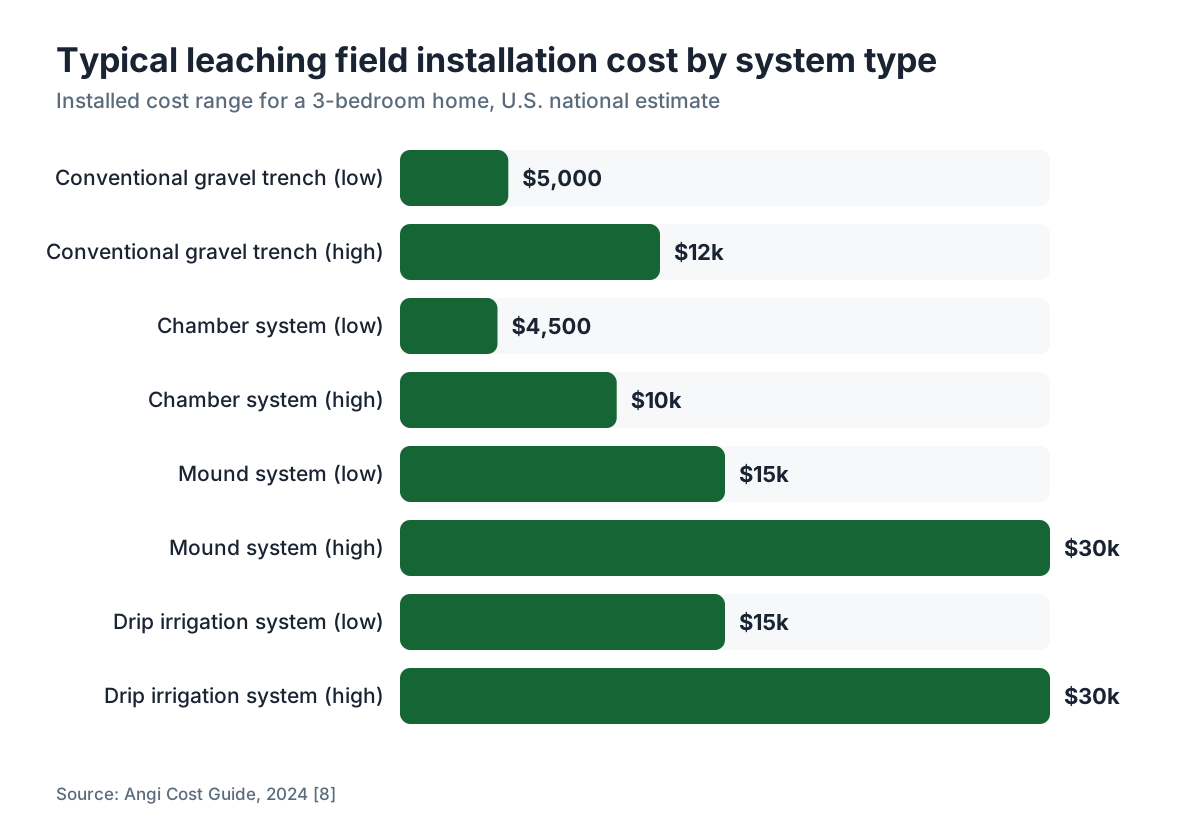
Full replacement is the reliable move when the biomat is irreversible throughout, the soil is wrong for the system, the design was undersized, or the reserve area is sitting there ready. Full replacement for a 3-bedroom home runs roughly $8,000 to $20,000 for a conventional system in most U.S. markets, though mounds, drip systems, and hard sites push past $30,000 [8]. See cost to install septic system for a breakdown by type and region.
Weighing repair against replacement? Factor in the age of the rest of the system. Putting a fresh field on a 35-year-old tank that's near its own end is usually false economy. Get a septic tank inspection and judge the whole system before you commit.
What can damage your leaching field that homeowners don't expect?
Water softeners are a real threat that gets ignored. A salt-based softener regenerates with a brine flush, typically 50 to 100 gallons of high-sodium water, often overnight. Sodium ions can deflocculate clay soils, making the particles swell and close off pores. University of Wisconsin Extension has documented field failures tied directly to softener discharge in clay-heavy soils [9]. If you run a softener and your soil is clay, route the brine somewhere else or switch to a demand-initiated model.
Garbage disposals dump a meaningful load of suspended solids into the tank. EPA's SepticSmart program advises against running a disposal on septic, or at least upsizing the tank if you insist on one [1]. That solid load goes somewhere, and some of it ends up in the field.
Household chemicals scare people more than they should for a healthy system. One load of laundry with normal bleach won't kill anything. But a steady habit of pouring bleach, drain cleaner, or antibacterial products in large amounts can knock back the bacteria in both the tank and the field soil. A household dumping a quart of drain cleaner monthly is asking for trouble.
Roof and surface runoff aimed at the field saturates the soil from above, so it can't accept effluent from below. Downspout extensions, grading, and curtain drains matter here. Your field needs the soil above it as dry as you can keep it.
Operators managing multiple properties can track these risk factors, schedule preventive pumping, and flag at-risk accounts with SepticMind's service scheduling tools, built specifically for septic operations.
How do you maintain a leaching field correctly?
The list is shorter than people expect, and most of it is about what NOT to do.
Do pump the septic tank on schedule. It's the single most effective thing you can do for field life. Every 3 to 5 years for a typical family of four with a 1,000-gallon tank is standard guidance [1][10]. Pump more often with a garbage disposal, a big household, or a small tank. See septic tank pumping for the full guide.
Do protect the field from compaction. Stake or plant the boundaries if you have to. No vehicles, no sheds, no above-ground pools.
Do plant only grass or shallow-rooted native groundcovers over it. Deep-rooted plants and trees belong somewhere else.
Do fix leaks fast. A running toilet can add 100 to 200 gallons a day. For a household making 500 gallons a day, that's a 20 to 40% jump. Small leak, big impact.
Do divert surface water away. Grade the surrounding ground so rain runs away from the field, not toward it.
Don't use septic additives. EPA and several university extension programs evaluated commercial additives and found no reliable evidence they improve performance or extend life [1][9]. Some caustic ones actually harm the tank and field. Skip them.
Don't flush anything but toilet paper and human waste. Wipes labeled "flushable" aren't. Neither are feminine hygiene products, medications, or paper towels.
Want a maintenance log and reminders for your own system? SepticMind has homeowner tracking tools at septicmind.com.
What permits and regulations govern leaching fields?
Leaching fields are regulated at the state and local level in the U.S. EPA sets general guidance and funds research but doesn't issue permits for individual systems. Your county health department or department of environmental quality is almost always the permitting authority.
Every state has an onsite wastewater code that spells out minimum setbacks (typically 10 feet from property lines, 50 to 100 feet from wells, 25 feet from water features), soil requirements, accepted system types, and designer licensing. These codes vary a lot. North Carolina's rules run hundreds of pages and are among the most detailed in the country. Montana's rural standards are much simpler.
Installing or replacing a leaching field without a permit is a serious mistake. You risk a system that misses setbacks, liability if it contaminates a neighbor's well, and real fines. More practically, an unpermitted system creates title problems when you sell. Many states require a septic inspection and certification at sale, and an unpermitted field fails that check.
Planning a replacement or new install? The process usually runs: site evaluation by a licensed designer or soil scientist, soil and perc testing, design submission to the county health department, permit issuance, installation by a licensed contractor, inspection before backfill, and final approval. In most places that takes 4 to 12 weeks from start to finish, not counting contractor scheduling [5].
EPA's SepticSmart program at epa.gov/septic has consumer guidance and links to state resources [1].
How much does a leaching field cost to install or replace?
Cost depends on system type, soil, site access, and regional labor rates. There's no national average worth much because the spread is so wide.
A conventional gravel trench system for a 3-bedroom home in average soil with decent access runs $5,000 to $12,000 for the field itself, not counting the tank or distribution box [8]. Chamber systems tend to land at the lower end because gravel delivery is the priciest line item in a conventional install. Design and permit fees add $500 to $2,500 on top.
A mound system adds a lot. Total installed costs of $15,000 to $30,000 are common because of the engineered fill, the pump, and the bigger footprint. Drip irrigation systems run about the same.
Replacing a failed field costs more than a fresh install on a raw lot, because of demo and disposal of the old system, possible soil remediation, and the tight space with existing landscaping and structures. Budget 20 to 40% more than a comparable new install.
Many states offer low-interest loans or grants for septic repair or replacement, especially in areas with documented water quality problems. Check your state environmental agency's website and look for programs run through USDA Rural Development, which funds septic repair loans in rural areas [11].
For full system costs, see cost to put in a septic tank and cost to install septic system.
What's the difference between a leaching field, a drain field, and a leach field?
All three terms describe the same component. The difference is regional, sometimes generational.
"Drain field" is the common term in the South and Midwest. "Leach field" shows up across much of the West and Midwest. "Leaching field" dominates in New England and parts of the Mid-Atlantic. Some state codes use one term only. Others use all three in the same document.
There's no technical distinction. A leaching field in Massachusetts is the same physical thing as a drain field in Georgia. Reading a state code, permit, or contractor quote? Use whatever term that document uses. In conversation, any licensed septic pro will understand all three.
For a closer look at the term and how regional codes handle it, see leach field.
Frequently asked questions
How big does a leaching field need to be for a 3-bedroom house?
A 3-bedroom house in average soil typically needs 600 to 1,200 square feet of trench bottom area. The exact number depends on your daily flow estimate (usually 300 to 450 gallons per day for three bedrooms) and your soil's percolation rate from a perc test. Fast-draining sandy soils need less area. Slow clay soils need more, if they're approvable at all.
Can you build over or park on a leaching field?
No. Any vehicle traffic over a leaching field compacts the soil and can collapse the trenches and pipes. Structures block inspection, ventilation, and water uptake by plants. Even storing firewood or heavy equipment seasonally causes damage. Mark your field boundaries and keep them clear for good. The reserve area for future replacement needs the same protection.
How do I find my leaching field if I don't know where it is?
Start with the as-built drawing, which your county health department should have on file for permitted systems. If there's no drawing, a septic pro can locate the field by probing the ground after pumping the tank and tracing flow from the outlet. Some inspectors use pipe cameras or electronic locators. Know where your field is before you plant trees or plan additions.
Do septic additives help a leaching field recover?
No reliable evidence supports it. EPA and University of Wisconsin Extension both reviewed commercial septic additives and found no proven benefit. Some caustic additives harm the bacterial ecosystem in the tank and field. A truly failed field needs physical remediation or replacement, not a bottle of bacteria. Save the $30 to $100 per treatment.
How long can I rest a leaching field to let it recover?
A rest period of 3 to 12 months can let aerobic bacteria break down moderate biomat if the field isn't fully saturated. This requires routing household sewage elsewhere (a second field, a holding tank, or a big cut in water use). It works best in coarser soils with lighter biomat. Heavily clogged clay-soil fields rarely recover fully from resting alone.
What trees and plants are safe to grow near a leaching field?
Grass and shallow-rooted groundcovers are safest directly over the field. Avoid willows, poplars, silver maples, and any tree or shrub known for aggressive roots within at least 20 to 30 feet of the field boundary. Vegetable gardens are also a problem directly over the field because of pathogen exposure. Native grasses and wildflowers with fibrous, shallow roots are generally fine.
What is the setback distance required between a leaching field and a well?
Most state codes require 50 to 100 feet between a leaching field and a private drinking water well. Some states set 100 feet as the minimum regardless of direction. Others allow closer placement if the well is upgradient of the field. Check your specific state code. EPA recommends the maximum feasible separation, plus annual water testing if you have any doubt.
Does a leaching field need to be pumped or cleaned?
The field itself doesn't get pumped. The septic tank gets pumped, and that's the maintenance that protects the field. If the field's distribution pipes become blocked, a contractor can hydrojet them. There's no routine cleaning service for the field itself. The best field maintenance is keeping solids from leaving the tank in the first place, through regular pump-outs.
What happens to a leaching field in heavy rain?
Heavy rain saturates the soil above and around the field, cutting its ability to accept effluent. During long wet spells, a system under normal load may show failure symptoms (slow drains, surface saturation) that clear up once the soil dries out. If it keeps happening, the field may be undersized, or surface drainage needs to be redirected away from the field area.
How do I know if my leaching field failure is covered by homeowner's insurance?
Standard homeowner's policies usually exclude septic failures, treating them as maintenance. Some policies cover sudden and accidental damage (a pipe collapsed by tree roots, say) but exclude gradual failure and wear. A small number of insurers offer septic riders or endorsements for extra premium. Read your policy and ask your agent specifically about underground service line coverage.
Can a leaching field be installed in clay soil?
Clay soil with a perc rate above 60 minutes per inch is usually not approvable for a conventional leaching field under most state codes. If your site has marginal clay (30 to 60 minutes per inch), an engineer may design a mound system, drip system, or modified trench that meets treatment requirements. The key is enough contact time in enough absorptive area to treat the daily load safely.
Is a leaching field the same as a cesspool?
No. A cesspool is a pit that takes raw sewage directly, with no septic tank pretreatment. Cesspools are banned for new construction in most U.S. states and have been for decades. A leaching field takes only clarified effluent that's already had solids removed in a tank. The treatment quality and environmental safety are far apart. If you have a cesspool, contact your health department about replacement requirements.
Sources
- U.S. EPA, SepticSmart Program: Effluent percolates through the soil, which provides final treatment by removing harmful bacteria, viruses, and nutrients; EPA advises against garbage disposals and septic additives on septic systems.
- U.S. EPA, Onsite Wastewater Treatment Systems Manual (EPA/625/R-00/008): Conventional trench laterals are 4-inch perforated pipe in gravel, installed 18 to 36 inches deep at 1/8-inch-per-foot slope.
- EPA, Onsite Wastewater Treatment Systems Manual: A properly functioning soil absorption system removes more than 99% of fecal coliforms from effluent at adequate setback distances.
- U.S. EPA, Onsite Wastewater Treatment Systems Manual: Daily wastewater flow for sizing is commonly estimated at 75 to 150 gallons per bedroom per day; chamber systems are a widely approved alternative to gravel trench design.
- U.S. EPA, Onsite Wastewater Treatment Systems Manual: Acceptable percolation rates for conventional systems generally fall between 3 and 60 minutes per inch; permitting and site evaluation timelines vary by state.
- U.S. EPA, Onsite Wastewater Treatment Systems Manual: Mound systems use imported sand fill and a pump to treat effluent where native soil is too shallow, too slow, or the water table is too high.
- Florida Department of Health, Onsite Sewage Program: Most drain field failures are associated with inadequate tank maintenance, hydraulic overloading, or improper original design; median field life is 20 to 30 years.
- Angi, Septic System Installation Cost Guide: Conventional leaching field installation for a 3-bedroom home ranges from $5,000 to $12,000; mound and drip systems range from $15,000 to $30,000 or more.
- University of Wisconsin-Madison Division of Extension: Commercial septic additives show no reliable evidence of improving system performance; water softener brine discharge has been linked to field failure in clay-heavy soils.
- U.S. EPA, How to Care for Your Septic System: EPA recommends pumping the septic tank every 3 to 5 years for a typical household as the primary maintenance action to protect the drain field.
- USDA Rural Development, Water and Environmental Programs: USDA Rural Development administers low-interest loan and grant programs for septic system repair and replacement in rural areas.
Last updated 2026-07-09