Leach field treatment: what actually works and what doesn't
By the SepticMind Editorial Team
TL;DR
- Leach field treatment means using biological additives, aeration, or resting periods to restore a clogged or slow drain field.
- Biological products have some evidence behind them; chemical additives mostly don't.
- The single most effective treatment is fixing whatever caused the failure (usually overloading or skipped pumping) before spending money on products.
What is leach field treatment, exactly?
A leach field (also called a drain field or soil absorption system) treats and disperses wastewater after the septic tank has separated solids. Over time, a dense microbial layer called a biomat builds up at the soil-trench interface. That biomat slows or stops liquid from soaking into the surrounding soil, which is when you start seeing wet spots, sewage odors, or backups inside the house.
Leach field treatment refers to anything done to restore that soil's ability to absorb water. The term covers several approaches: bacterial or enzyme additives poured down the drain, mechanical aeration of the soil, complete resting of the field (load redistribution), chemical oxidizers, and full physical rehabilitation of the trench media.
The EPA SepticSmart program says most drain field failures trace back to a few preventable causes: solids overflowing from an un-pumped tank, too much water loading, and flushing items that disrupt the microbial balance. [1] Treatment products address the symptom, not the root cause. So figuring out what actually failed is the starting point.
Why do leach fields fail in the first place?
The right treatment depends on which problem you have. Get the diagnosis wrong and you'll spend money on the wrong fix.
The most common cause is solids carryover. When a tank isn't pumped on schedule (every 3 to 5 years for most households [1]), the sludge layer rises until partly-digested solids wash into the field with the effluent. Those solids build up the biomat faster than the soil bacteria can break it down.
Hydraulic overloading is the second big one. Extra guests, a leaking toilet running for weeks, or a new family member can push far more water than the field was designed to handle. The soil stays saturated, anaerobic bacteria take over, and the biomat thickens.
Tree root intrusion punctures or collapses perforated pipes. Compaction from vehicles or heavy equipment crushes the gravel bed and squeezes out the air pockets soil needs to accept liquid. Aging infrastructure, especially old clay tile or thin-wall ABS pipe, can simply collapse over decades.
Some soils fail because they were always marginal. A clay-heavy soil that barely passed the original perc test can take years to fail completely, but it will fail under normal use. No additive fixes a fundamentally wrong soil type or an undersized field. Those need physical repair or replacement. See our guide on leach field problems for a full diagnostic walkthrough.
Do septic leach field treatment products actually work?
This is where the marketing and the evidence part ways. Hundreds of products claim to "restore" or "rejuvenate" a drain field. The honest answer: some biological products show modest benefit under specific conditions, and most chemical products show little to none.
The EPA's review of septic additives found no peer-reviewed evidence that enzyme or yeast-based additives meaningfully improve a functioning system. It did allow that certain bacterial inoculants may help a biomat-impacted field recover faster when combined with reduced hydraulic loading. [2] That last phrase is doing a lot of work. The field still needs rest or reduced use to recover; the bacteria just speed the decomposition of the mat.
A study from the University of Minnesota Extension tested several commercial biological additives in clogged drain fields. The conclusion: "biological additives alone, without hydraulic resting, did not produce measurable improvement in soil infiltration rates over a 12-week period." Resting alone improved infiltration in a majority of test sites. [3]
Chemical oxidizers like hydrogen peroxide were popular in the 1990s. Field trials showed they could temporarily break up biomat, but follow-up sampling found they also killed the beneficial soil bacteria needed for long-term treatment, sometimes making the problem worse within a year. The EPA now advises against most chemical drain-field additives. [2]
Here's the bottom line. If you want to try a biological additive, use one with Bacillus species bacteria (more than enzymes), and cut hydraulic load by at least 30% for 4 to 6 weeks at the same time. Without the hydraulic reduction, you're mostly wasting money.
What is the best leach field treatment for a clogged system?
"Best" depends on severity. Here's how the options stack up by situation.
Resting or load redistribution (mild to moderate failure)
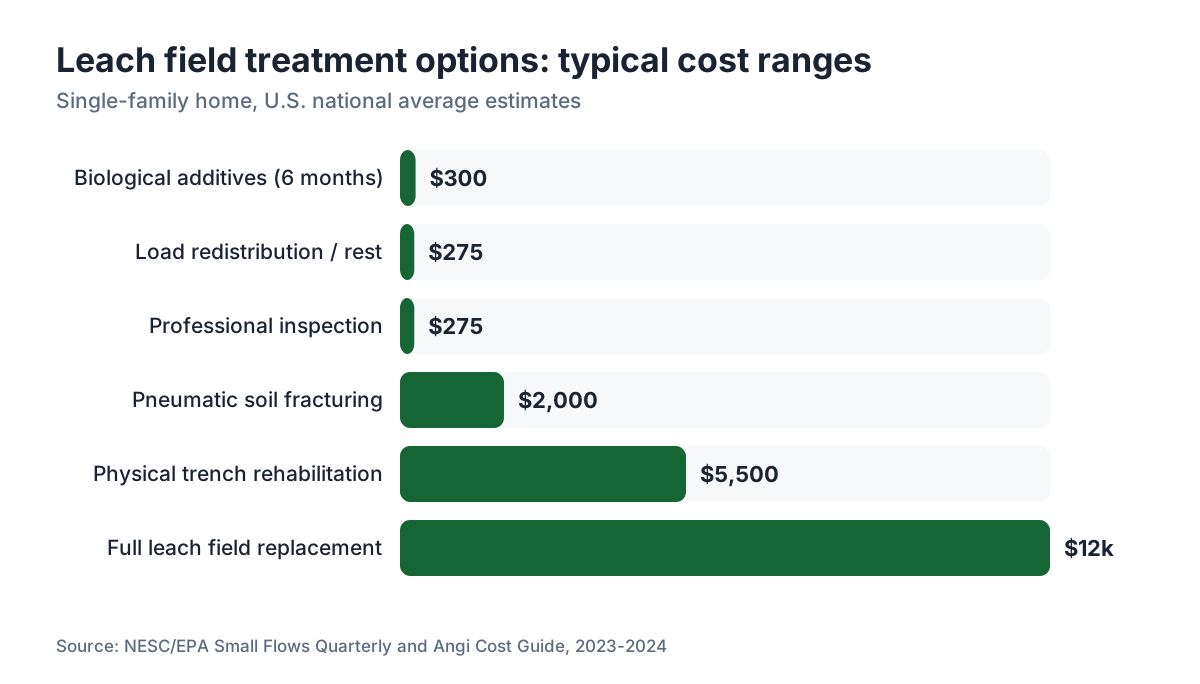
If you have a two-zone system with a distribution box, a licensed installer can redirect all flow to the second zone while the first rests. Aerobic decomposition can break down a biomat in 6 to 12 months of rest. Cost: the service call to redirect flow, typically $150 to $400. This treatment has the best evidence base and the lowest cost.
Aeration (moderate failure)
Some contractors use a process called Terralift or similar pneumatic fracturing. A probe drives into the soil next to the trench, injects compressed air to fracture the surrounding soil, and sometimes blows in small polystyrene beads to hold the fractures open. Some operators report 3 to 7 years of extended life. Independent data is thin, but the logic holds: it attacks the compaction and anaerobic conditions directly. Cost runs $1,000 to $3,000 depending on field size. [4]
Biological additives (mild failure or maintenance)
For a field that's sluggish but not surfacing, a high-count Bacillus-based product dosed monthly over 3 to 6 months is a reasonable low-risk attempt, especially after you've pumped the tank and fixed any water leaks. Expect to spend $30 to $80 per month on product. Don't expect miracles.
Physical rehabilitation (moderate to severe failure)
A licensed contractor digs out the trench, replaces the gravel or pipe, and sometimes adds a textile filter fabric to slow future biomat. This is essentially a partial replacement without full permitting in many states. Cost: $3,000 to $8,000 for a typical single-home field. [4]
Full replacement (severe or aged-out failure)
When the soil itself is beyond saving or the system is grossly undersized, the only real fix is a new field. Costs run $5,000 to $20,000+ depending on soil, field size, and local permitting. See our breakdown of cost to install septic system for what drives that range.
| Treatment | Best for | Typical cost | Evidence quality |
|---|---|---|---|
| Load redistribution / rest | Two-zone systems, mild clog | $150, $400 | Good |
| Biological additives | Maintenance, mild biomat | $30, $80/mo | Moderate (with resting) |
| Pneumatic fracturing | Compacted soils, moderate failure | $1,000, $3,000 | Limited but logical |
| Physical rehab (trench) | Moderate-severe, intact soil | $3,000, $8,000 | Good |
| Full replacement | Severe failure, bad soil | $5,000, $20,000+ | Definitive |
How do you know if treatment is working or if you need replacement?
This is the question installers ask before recommending anything. A few field tests clear it up fast.
The simplest observation tells you the most: after 4 to 6 weeks of reduced water use, is the saturated wet area shrinking? If yes, the soil can recover and non-invasive treatment makes sense. If the wet area is holding steady or growing despite lighter loads, the soil is likely permanently compromised.
A licensed inspector can run a drawdown test on the distribution box: block the outlet, fill the box with water, and watch how fast it drops. Rates below roughly 0.5 gallons per minute per 100 square feet of field area suggest severe clogging. Some states require this test before approving any repair permit. Check your state's onsite wastewater code; North Carolina's rules, for example, specify minimum infiltration rates by soil type. [5]
Soil coring around the trench reveals whether the biomat has migrated into the native soil beyond the gravel layer. If it has, physical rehabilitation has a lower success rate. At that point, replacement or expansion is the more reliable path.
If the field is older than 25 to 30 years, even a successful treatment buys limited time. Most conventional systems are designed for a 20 to 30-year life. Treatment on an old field might get you 2 to 5 more years. Weigh that against putting that money toward a new system.
How to build a septic leach field: the basics every homeowner should understand
You're unlikely to build a leach field yourself, but understanding construction helps you judge whether a repair or replacement proposal makes sense.
A conventional leach field is perforated pipes laid in gravel-filled trenches, typically 2 to 3 feet wide and 18 to 36 inches deep. The pipes sit on a gravel bed, are surrounded by gravel, and are covered with a geotextile fabric to keep soil from migrating into the gravel. Effluent from the septic tank flows into a distribution box, then out to each trench through the perforated pipes, where it seeps through the gravel and into the native soil.
Sizing depends on the percolation rate of the native soil (measured in minutes per inch) and the estimated daily flow based on bedroom count. Most state codes use a formula somewhere around 1 to 1.5 gallons per day per square foot of trench bottom, adjusted for soil type. A three-bedroom home generating roughly 300 gallons per day might need 400 to 600 square feet of trench bottom in moderately permeable soil. [6]
Proper construction requires a perc test or soil morphology evaluation by a licensed soil scientist, a permit from your local health department, installation by a licensed septic contractor, and a final inspection before cover. Skip any of those steps and you lose your ability to get permits later, plus you create liability when you sell the home.
For new construction or replacement, our article on septic tank installation covers the full process including permitting timelines and contractor selection.
What routine maintenance prevents leach field failure?
The best leach field treatment is the one you never need because the field never failed. A few habits matter more than anything else.
Pump the tank on schedule. The EPA recommends pumping every 3 to 5 years for most households. [1] A pumping record is the best proof that solids carryover hasn't been loading your field. Our guide on how often to pump septic tank covers household-size adjustments. After any pump-out, have the contractor inspect the baffles. A missing or deteriorated outlet baffle is the single most common cause of premature field failure.
Fix leaks immediately. A running toilet adds 200 gallons per day to your system. That one fixture can double the hydraulic load on a smaller field and push it into saturation within weeks.
Watch what goes down the drain. Grease, "flushable" wipes, and heavy garbage disposal use all raise the solids load and speed up biomat formation. The EPA SepticSmart campaign puts it plainly: "Toilets are not trash cans." [1]
Keep the field area clear. No vehicles, no heavy equipment, no deep-rooted trees within 10 feet of the trench lines. Compaction and root intrusion are slow, invisible killers.
Divert surface water away. Downspouts, sump pump discharge, and landscaping that slopes toward the field all add hydraulic load and can saturate the soil from above. A simple grading correction costs almost nothing.
A septic tank inspection every 1 to 3 years catches baffle, riser, and distribution box problems before they turn into field problems. It's the cheapest form of leach field treatment there is.
What does leach field treatment cost?
Costs vary by treatment type, contractor, and region. Here are the honest ranges based on industry data and contractor surveys, not manufacturer claims.
Biological additives from a hardware store or online: $20 to $80 per dose, with typical monthly ongoing costs of $30 to $80 if you're treating an active problem. Total for a 6-month treatment attempt: $150 to $500.
Professional inspection to diagnose the field: $150 to $400. Treat it as a sunk cost before spending anything else. [4]
Pneumatic soil fracturing (Terralift or similar): $1,000 to $3,000 for a standard single-family field.
Physical trench rehabilitation: $3,000 to $8,000 depending on trench length and access.
Full leach field replacement: $5,000 to $20,000 for conventional systems. Alternative systems on difficult soils (mound systems, drip irrigation, aerobic treatment units) can run $15,000 to $30,000 or more. [7]
One thing to factor in: most states require a permit for any repair beyond simple additive use. Permit fees add $100 to $500 to most repair projects, but the permit also means the work gets inspected, which protects you at resale.
Some states run low-interest loan programs for septic repairs. The USDA Rural Development program offers loans and grants for septic repair in eligible rural areas. [8] Check with your county health department for state-specific programs before you assume you're on your own for the full cost.
Are there any leach field treatment products worth buying?
If you've already pumped the tank, fixed any leaks, and reduced water use, a biological additive is a reasonable low-risk next step for a mildly sluggish field. The products with the best independent track record contain live Bacillus bacteria at concentrations above 100 million CFU per dose. Enzyme-only products don't introduce live organisms and have weaker evidence.
The National Small Flows Clearinghouse (now part of the EPA's water programs) reviewed over 100 additive products and found that none produced dramatic results, but a subset of high-CFU bacterial products showed measurable improvement in oxygen demand and infiltration when used alongside load reduction. [2]
Avoid products that claim to "dissolve" the biomat chemically or that contain surfactants. Surfactants can help liquid move through the soil temporarily, but they also disrupt the microbial community and can carry partially-treated effluent deeper into the soil profile and toward groundwater.
For operators tracking multiple client systems, scheduling proactive additive programs alongside pump-out reminders is something SepticMind handles as part of its service management workflow, which makes it easier to document what's been tried when a field eventually needs a permit inspection.
Buying from a licensed septic supplier rather than a big-box store sometimes gets you higher-concentration commercial-grade biologicals that aren't on consumer shelves. Ask your pumping contractor what they use on problem fields.
What are your legal and permitting obligations for leach field repair?
Most states treat leach field repair as regulated activity under their onsite wastewater codes. Pouring a biological additive down your drain doesn't require a permit anywhere. But excavating, replacing pipe or gravel, altering the distribution box, or adding trench area almost always does.
The general rule: if you're putting a shovel in the ground near the drain field, call your local health department first. Working without a permit can trigger a stop-work order, fines, and an order to redo the work to code. It also creates a disclosure problem when you sell the home. Unpermitted septic work shows up in inspection reports and can kill a sale.
The EPA's SepticSmart resources link to state-by-state contact lists for onsite wastewater programs. [1] Your county health department is usually the local permitting authority; in some states it's a regional water board.
Florida's rules under Chapter 64E-6 of the Florida Administrative Code, for example, require a repair permit for any modification to an existing system, including trench rehabilitation, and require a licensed contractor to do the work. [9] Most states have similar requirements, though the threshold for what triggers a permit varies.
If you're selling a home with a known leach field problem, most states require disclosure. Some states, California among them, require a septic inspection as part of any home sale in certain counties. [10] Getting the repair permitted and documented before listing is far cheaper than a post-contract price negotiation.
For a broader view of the repair process from inspection through permitting, see our coverage of septic system repair.
When should you stop treating and just replace the leach field?
Knowing when to stop matters as much as knowing what to try. Some situations are just throwing good money after bad.
If the field is surfacing (sewage visibly ponding on the ground), you have a public health emergency, not a maintenance question. In most states, surfacing sewage requires immediate reporting to the health department. You can't treat your way out of that in the short term. You need a licensed professional on-site, likely a temporary pump-and-haul arrangement while a replacement is permitted.
If soil coring shows biomat penetration more than 12 inches into the native soil beyond the trench, physical rehabilitation has poor odds. The treatment zone is too far gone.
If the system is more than 25 years old and this is the second or third treatment attempt, replacement is almost certainly the right economic choice. Repair costs of $2,000 to $4,000 every few years add up fast against a replacement that should last another 25 to 30 years.
If a perc re-test shows the native soil now fails minimum infiltration rates (typically 1 minute per inch to 60 minutes per inch depending on state code), you may not be able to replace in place anyway. An alternative system (mound, drip, or aerobic) may be the only permitted option, and those require engineering regardless.
Get two contractor opinions before you commit to replacement. Get the health department involved early too; they sometimes have variance processes that allow rehabilitation approaches not listed in the standard code.
Frequently asked questions
Can I treat my leach field myself or do I need a professional?
Pouring a biological additive down a drain is a DIY task. Anything involving digging, redirecting flow, or altering pipes requires a licensed contractor and usually a permit. Start with the DIY steps (pump the tank, fix leaks, reduce water use, try a Bacillus-based additive) and call a pro if those don't move the needle within 6 to 8 weeks.
How long does it take for a leach field to recover with treatment?
A mildly clogged field given proper rest (50% or greater load reduction) and biological treatment can show measurable improvement in 4 to 12 weeks. A severely failed field may take 6 to 12 months of rest to recover, and some never do. Physical rehabilitation shows faster results, typically 2 to 4 weeks to confirm restored infiltration, but costs significantly more.
Do enzyme-based septic additives help the leach field?
Enzyme additives break down organic material but don't introduce live bacteria. Since the biomat is a microbial community, more than an organic mass, enzyme-only products have weaker evidence than live bacterial products. The EPA's additive review found no peer-reviewed support for enzyme additives improving drain field performance on their own.
What household chemicals kill leach field bacteria?
Bleach, drain cleaners (especially lye or sulfuric acid), antibacterial soaps in large quantities, paint, solvents, and pesticides all harm the bacterial communities in both the tank and the field. Occasional normal household use of bleach won't destroy the system, but regular heavy use can suppress beneficial bacteria and slow biomat decomposition.
Can a leach field be repaired without full replacement?
Yes, in many cases. Options include redistributing flow to a resting zone, pneumatic soil fracturing, and physical trench rehabilitation (excavate, replace media, reinstall pipe). Success depends on soil condition, field age, and failure cause. A drawdown test and soil coring by a licensed inspector can tell you whether the native soil is still viable before you commit to a repair approach.
How do I know if my leach field is failing?
The main signs are wet or soggy ground over the field (especially when it hasn't rained), sewage odors outdoors or in the house, slow drains or backups inside, and unusually lush or green grass directly over the field lines. Any single sign warrants investigation; sewage surfacing or indoor backups require immediate professional attention.
Does pumping the septic tank help a failing leach field?
Yes, but indirectly. Pumping removes the solids load that's been feeding the biomat and gives the field a chance to recover. It won't instantly unclog the field, but it stops the damage from continuing. A pump-out should always be the first step before you try any other leach field treatment, and it gives the pumper a chance to inspect the baffles.
How much does leach field repair cost versus replacement?
Repair ranges from $150 for a flow redistribution call to $8,000 for physical trench rehabilitation. Full replacement runs $5,000 to $20,000 for conventional systems, and up to $30,000+ for alternative systems on difficult soils. If the field is older than 25 years or has already had multiple repair attempts, replacement often makes more economic sense over a 5- to 10-year horizon.
Is Rid-X or similar products safe for a leach field?
Rid-X and similar consumer products are generally not harmful to a functioning system. They contain Bacillus bacteria and enzymes and won't damage pipes or soil. The evidence that they significantly help a problem field is weak, though. The EPA does not endorse them as a substitute for regular pumping. Using them between pump-outs as a low-cost maintenance step is reasonable, but don't expect them to rescue a failing field alone.
Can tree roots be treated without digging up the leach field?
Copper sulfate foaming is sometimes used to kill roots in distribution pipes without excavation, but it's a temporary fix. Roots regrow. Copper sulfate is also toxic to soil bacteria and restricted or prohibited in some states. The only lasting solution for significant root intrusion is excavating and removing the roots, repairing or replacing damaged pipe, and cutting down the offending trees.
Do I need a permit to add biological additives to my septic system?
No. Additives poured down a drain don't require any permit. Permits are triggered by physical work on the system: excavating, modifying pipe, altering the distribution box, adding trench area, or replacing components. Check with your county health department before starting any work beyond additive use to confirm what requires permitting in your jurisdiction.
How long does a leach field last with proper maintenance?
A properly designed and maintained conventional leach field typically lasts 25 to 30 years. Some last longer in favorable soils with consistent pumping schedules. Poorly maintained systems in clay-heavy soils can fail in under 10 years. The biggest maintenance lever is sticking to a 3- to 5-year pump schedule, which prevents the solids carryover responsible for most premature failures.
What is the best time of year to treat or repair a leach field?
Late summer and early fall are generally best. Soils are warm, which supports bacterial activity for biological treatments. The ground isn't frozen for any physical work. Saturated spring soils make excavation messy and can cause trench sidewall smearing that reduces long-term infiltration. Avoid scheduling any digging during or right after prolonged rain events.
Sources
- U.S. EPA, SepticSmart Program: EPA recommends pumping every 3-5 years; most drain field failures trace to un-pumped tanks, excess water loading, and improper flushing habits.
- U.S. EPA, Onsite Wastewater Treatment Systems Manual (EPA/625/R-00/008): EPA review found no peer-reviewed evidence that enzyme additives improve functioning systems; chemical oxidizers can harm soil bacteria; certain high-CFU bacterial products showed some benefit alongside load reduction.
- National Environmental Services Center (NESC) / EPA Small Flows Quarterly, Leach Field Rehabilitation Costs: Professional inspection costs $150-$400; pneumatic soil fracturing runs $1,000-$3,000; physical trench rehabilitation runs $3,000-$8,000 for single-family systems.
- North Carolina Department of Health and Human Services, On-Site Water Protection Program (15A NCAC 18E): North Carolina onsite wastewater rules specify minimum soil infiltration rates by soil type for repair and permitting.
- U.S. EPA, Onsite Wastewater Treatment Systems Manual: Conventional leach field sizing uses approximately 1-1.5 gallons per day per square foot of trench bottom, adjusted for soil percolation rate; three-bedroom home generates roughly 300 gallons per day.
- HomeAdvisor / Angi, Septic System Installation and Replacement Cost Guide: Full leach field replacement costs $5,000-$20,000 for conventional systems; alternative systems on difficult soils can run $15,000-$30,000 or more.
- USDA Rural Development, Water and Waste Disposal Loan and Grant Program: USDA Rural Development offers loans and grants for septic repair and replacement in eligible rural areas.
- Florida Department of Health, Chapter 64E-6 Florida Administrative Code, Standards for Onsite Sewage Treatment and Disposal Systems: Florida requires a repair permit for any modification to an existing septic system, including trench rehabilitation, performed by a licensed contractor.
- California State Water Resources Control Board, Onsite Wastewater Treatment Systems Policy: Some California counties require a septic inspection as part of any home sale; the State Water Board oversees the policy framework for onsite wastewater treatment.
Last updated 2026-07-09