Leach field inspection: what it covers, costs, and red flags
By the SepticMind Editorial Team
TL;DR
- A leach field inspection checks whether effluent is spreading evenly through your drain field and the soil is still soaking it up.
- Inspectors probe the soil, check the distribution box, and sometimes run a camera down the laterals.
- Cost runs $100 to $900 depending on method.
- A failing field usually means biomat buildup, hydraulic overload, or broken pipe, each with a different repair path.
What does a leach field inspection actually check?
A leach field inspection is a different job than a septic tank inspection. The tank holds solids and partly treated liquid. The leach field, also called a drain field or absorption field, is where that liquid finally gets treated and returned to the groundwater. It's a network of perforated pipes or chambers sitting in gravel trenches. When it fails, the effluent has nowhere else to go.
A basic inspection checks five things: the condition of the distribution box (or D-box) that splits flow across the laterals, the surface of the field for soft spots or surfacing effluent, soil moisture in and around the trenches, flow at each outlet pipe, and whether the system still accepts liquid at a reasonable rate. A thorough inspection adds a dye test, a hydraulic load test, or a camera run down the laterals.
The EPA's SepticSmart program describes a working drain field as one that "allows the liquid (effluent) to slowly trickle from the pipes out into the gravel and down through the soil" [1]. Break any link in that chain and the inspection catches it, as long as the inspector knows what to look for.
Here's what people miss. A leach field can look perfectly fine on the surface and still be failing underneath. Saturated soil doesn't always wick up to the grass. Biomat, the gray-black gelatinous layer that forms when anaerobic bacteria clog the soil pores, builds from the bottom up. A field can be 80% clogged with no standing water at all, right up until the day it surfaces.
When should you get a leach field inspection?
Four situations call for one. Home purchase is the first. Warning signs are the second. Age past 20 years is the third. And any big jump in water use is the fourth.
Start with home purchase. Most states require a septic inspection at or before closing, and many inspectors probe the leach field as part of that. But what counts as a "septic inspection" varies wildly by state. Some require only a visual look at the tank. If your state doesn't mandate a leach field probe, pay for it separately. A $200 to $400 add-on beats inheriting a failed field.
Second, warning signs. Slow drains across the whole house (more than one fixture), gurgling when several fixtures run at once, wet or spongy ground over the field, an oddly lush green strip in the yard, or any sewage smell outside. These aren't subtle. They're the system telling you it's in trouble.
Third, age. Leach fields don't last forever. Conventional gravity systems often run 25 to 30 years with good care; some go longer, some fail sooner. If yours is past 20 to 25 years and hasn't been checked lately, check it. The National Environmental Services Center at West Virginia University notes that most drain field failures come from lack of maintenance and hydraulic overloading, not age by itself [2].
Fourth, before any real change to water use. Adding a bedroom. Installing a garbage disposal. Rerouting a water softener that used to bypass the system. Adding people to the house. Loading a field past its design capacity is the most common reason a healthy field dies young.
What types of leach field inspections are there?
Not every inspection is the same. The type sets both what you learn and what you pay.
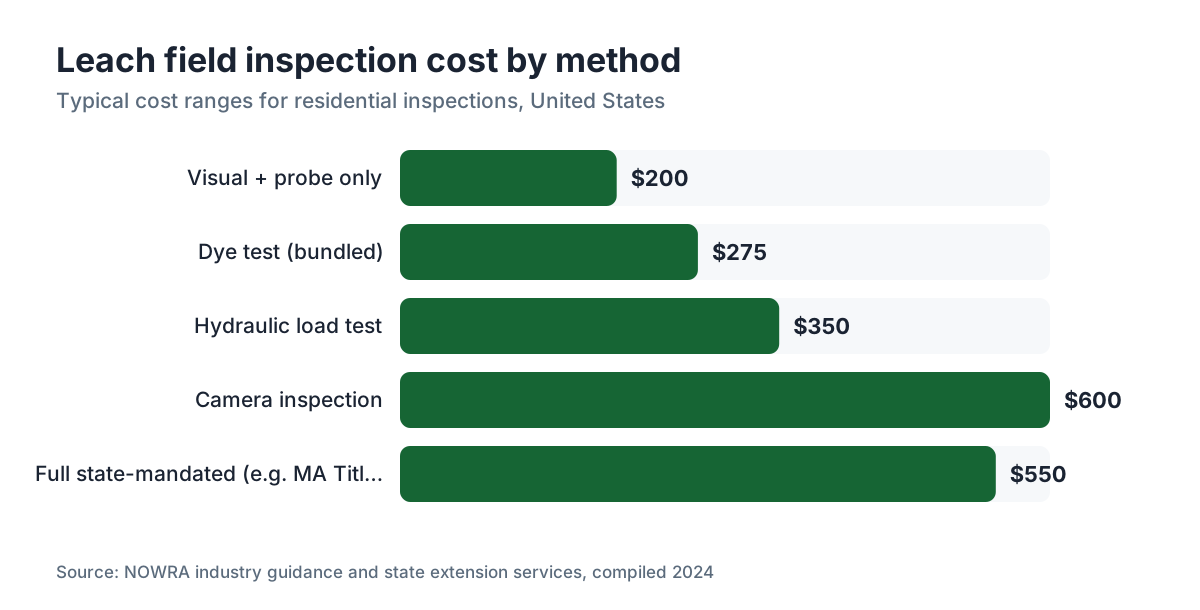
Visual and probe inspection ($100 to $300): The inspector walks the field, probes soil moisture at several points, checks the D-box for even flow and solids, and reads the surface. Cheapest option. It catches obvious failures and misses buried pipe damage and early biomat.
Dye test (often bundled for $150 to $400 total): Fluorescent dye goes through the system and the inspector watches for it to appear on the surface or in nearby water. It confirms surface breakout but doesn't find the cause. Some states still accept it for real estate deals; others dropped it because it gives false comfort when a field is failing underground.
Hydraulic load test ($200 to $500): Water gets pumped in at a controlled rate to measure how fast the soil takes it. This is closer to a perc test than a standard inspection. Useful when you're stuck on repair versus replace.
Camera inspection of laterals ($300 to $900): A small camera runs down each lateral to look for root intrusion, pipe collapse, sediment, or broken joints. Most diagnostic option there is. You get video of exactly where and what the problem is. If an inspector recommends repair work and you haven't seen camera footage, ask for it.
Full Title 5 or equivalent state inspection (varies, often $400 to $700): Several states, including Massachusetts under its Title 5 regulation [3], require a set protocol that includes pumping the tank, checking every component, and running a flow test on the distribution system. Home sales, renovations, or failure complaints trigger these.
How much does a leach field inspection cost?
A leach field inspection costs $100 to $900. The number depends on method, region, and whether the tank needs pumping first. Here's the honest breakdown.
| Inspection type | Typical cost range | What drives the high end |
|---|---|---|
| Visual + probe only | $100 to $300 | Rural location, extra laterals |
| Dye test (bundled) | $150 to $400 | Multiple access points |
| Hydraulic load test | $200 to $500 | Long fields, pumping required |
| Camera inspection | $300 to $900 | Multiple laterals, full video report |
| Full state-mandated (e.g. MA Title 5) | $400 to $700+ | Tank pumping included |
If the tank hasn't been pumped recently, most inspectors require a pump-out first. That adds $250 to $600 depending on tank size and your area. Don't skip it. You can't judge how much solids are reaching the field without knowing the tank's condition. A septic tank pump out is part of the diagnosis, not a cost to dodge.
Geography moves the price a lot. Inspectors in rural areas with long drives, or in states with stiff licensing rules, charge more. The Pacific Northwest and New England run toward the high end. The Southeast and Midwest tend to be cheaper for the same work.
One honest caveat: nobody keeps a reliable national database of leach field inspection prices. The ranges above come from state extension guidance, contractor pricing surveys, and published state program data. Your quote may land outside them.
What are the signs a leach field is failing?
The clearest sign is effluent surfacing. Gray or dark water pooling over the field, or a sewage smell outdoors, means the field is rejecting liquid. That's a public health problem, not a maintenance chore. The EPA lists "wastewater surfacing over the drainfield" as a failure indicator [1].
Wet or spongy ground over the field, with no recent rain, means the soil is saturated. It might not look like sewage, but the water in those trenches has climbed to the surface. Walk the field after a dry week. If parts of it feel like a sponge, you have a problem.
Slow drains across the whole house, plus gurgling when you flush or run the washer, can mean the field isn't taking flow fast enough and back-pressure is building. One slow fixture usually means a clog in that fixture's drain, not a field issue. It's when every fixture drags at once that the field becomes the suspect.
An unusually green strip or rectangle of grass matching the field layout is an early warning. Effluent acts like fertilizer. A little extra green is normal. Grass that's a dramatically different color from the rest of the lawn is not.
Watch your neighbors too. Field failures often track soil and water table conditions across a whole area. If three houses on your street replaced their fields in the last five years, yours may be next.
What causes leach field failure?
The cause matters because each one points to a different repair.
Biomat clogging is the most common. Biomat is a dense dark layer of organic matter and anaerobic bacteria that builds at the soil-pipe interface. A healthy system grows a thin biomat that actually helps treat the effluent. Too much of it, fed by excess solids or fats reaching the field, blocks absorption. Biomat failures sometimes respond to field resting (routing flow to a different section), aeration, or bacterial additives, though the evidence on additives is thin.
Hydraulic overloading happens when more water enters the field than the soil can take. A leaking toilet, high-flow fixtures, or a sudden jump in household size all push more volume than the field was sized for. This one is sometimes reversible if the overloading stops and the soil gets time to dry.
Physical pipe damage from tree roots, vehicles driving over the field, or soil settlement can crush laterals and cut off flow to part of the field. A camera is the only reliable way to see it.
High groundwater seasonally saturates the soil under the field and wipes out the unsaturated zone the system needs to treat effluent. This is a site problem, not a maintenance failure. It usually means raising the field or building an engineered alternative.
Grease and solids carryover from an under-maintained tank lets material reach the field that should have stayed behind. That's why septic tank pumping and septic tank cleaning on a schedule, usually every 3 to 5 years, is the single best thing you can do to protect field life [4]. The EPA says regular pumping can extend system life by decades [1].
How do inspectors find problems that aren't visible on the surface?
This is where technique separates a real inspector from someone who just walks around and looks.
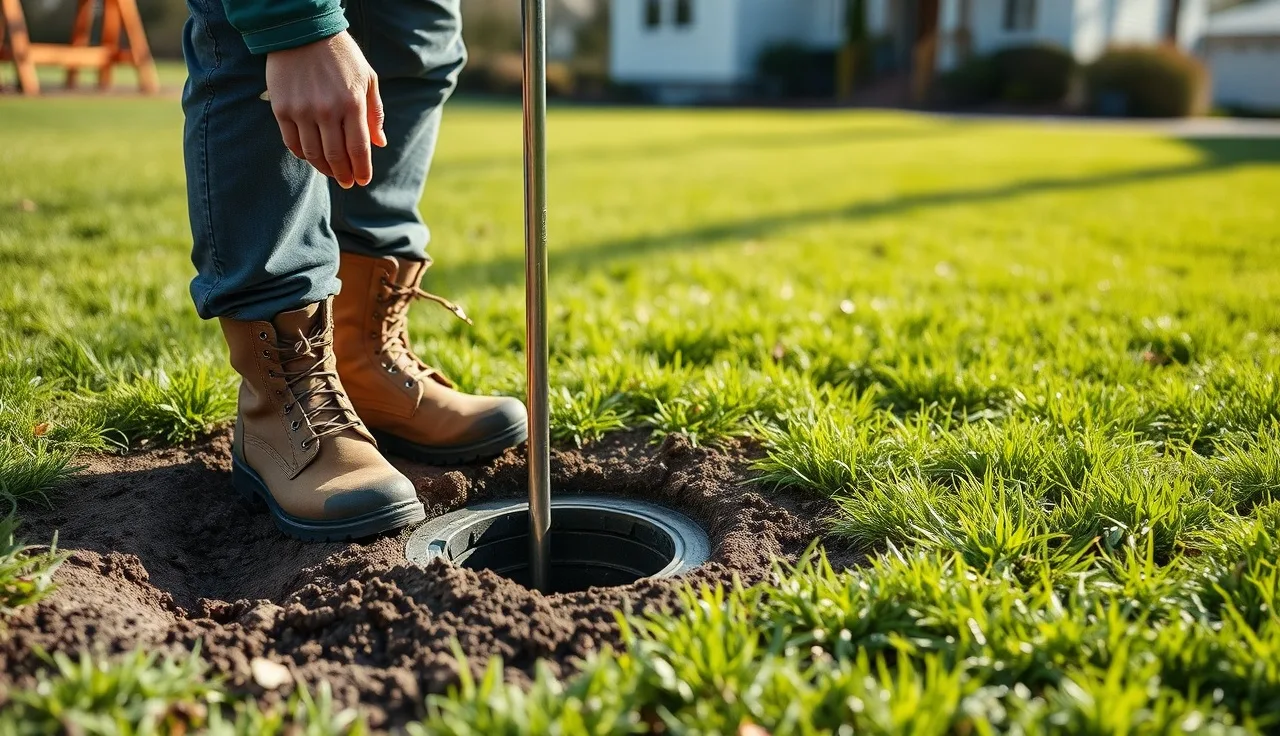
Probing is basic and it works. A metal probe rod pushed into the ground at points along the trench lines tells an experienced inspector a lot. Dry, firm soil means the field is accepting. Wet, soft soil means it's saturated. Black, foul-smelling gunk on the probe tip means biomat down at depth.
Checking the distribution box is often the most useful 10 minutes of the whole visit. The D-box splits outflow from the tank to each lateral. If one outlet runs much harder than the others, that lateral's trench is still taking flow. If one outlet has water backed up to the rim, that lateral is clogged solid. The distribution pattern tells the inspector which zones are failing and sometimes why.
Camera inspection is the diagnostic gold standard for pipe condition. A pushrod camera runs down each lateral from the clean-out or exposed end and records the inside. Root intrusion shows as root masses in the pipe. Collapse shows as a crushed section. Sediment shows as buildup along the pipe bottom.
Some inspectors use ground-penetrating radar (GPR) to find field components in older systems where the as-built drawings are lost. That's more common on commercial jobs or contested cases.
Service companies running large portfolios of septic systems use tools like SepticMind to track inspection histories, flag systems due for re-inspection, and store camera footage alongside field notes, which makes it easier to catch a fading field before it quits.
To see what's happening in the tank before the field inspection, read septic tank inspection.
What happens if your leach field fails inspection?
Don't panic. "Failing" doesn't always mean immediate replacement. It means the inspector found a problem, and the problem has a size.
Minor issues, like a cracked distribution box, uneven flow from a blocked outlet, or a single section of damaged pipe, can often be repaired. A septic system repair on those components might run $500 to $2,500 depending on access and scope. Get camera evidence of the specific problem before you agree to any repair.
Moderate issues, like biomat clogging in part of the field, may respond to field resting, aeration (pumping air into the soil to wake up aerobic bacteria), or redirecting flow to a reserve area if your lot has one. Results from aeration and bacterial treatments vary. The science suggests aeration beats enzyme additives, but neither is a guaranteed fix [2].
Severe failure, where the whole field is saturated, biomat runs throughout, or the soil has lost absorption from compaction or clay blinding, usually means replacement. A new conventional leach field costs $3,000 to $15,000. An engineered alternative (mound, drip irrigation, aerobic treatment unit) runs $10,000 to $20,000 or more [5]. See cost to install septic system for the full picture.
If you're at a home sale and the field fails, you have options: negotiate a price cut, require the seller to fix or replace before closing, or walk away. Never take a seller's word that it's "borderline" without your own independent inspection.
How is a leach field inspection different from a perc test?
People mix these up constantly, and they're completely different jobs done at different points in a property's life.
A percolation test (perc test) runs on undisturbed soil before a septic system is designed and built. It measures how fast water drains through the native soil, in minutes per inch. The result decides whether the site can support a septic system and, if so, what size and type. A perc test is a site evaluation tool, not a performance check.
A leach field inspection runs on an existing, working system. It checks whether the installed parts are doing their job, whether the soil around the pipes still accepts effluent, and whether the distribution network has physical damage.
You'd get a perc test when buying raw land, when adding a bedroom that may require proving more capacity, or when designing a replacement on a failed field. You'd get a leach field inspection when buying a home with an existing system, when chasing slow drains or surface sewage, or during routine maintenance.
State health departments regulate both. Most states publish standards for perc test methods and inspection protocols through their environmental or public health agencies [6].
What should you do to prepare before an inspector arrives?
A little prep makes the inspection more accurate and sometimes cheaper.
Find your as-built drawing or site plan. Most homes permitted after the mid-1980s have one on file with the county health department or town building office. No copy? Call and ask. The as-built shows where the tank, D-box, and lateral lines sit. Without it, the inspector may burn 30 to 60 minutes locating components by probing, and they'll bill for that time.
Don't do laundry or run the dishwasher the morning of the inspection. You want the field rested, not loaded with fresh flow. The inspector adds their own controlled flow; adding yours muddies the reading.
Clear the access ports. If risers hide under sod or mulch, dig them out the day before. It's your time and your money.
Write down the symptoms you've seen and when they started. Inspectors can't read minds. If the grass got greener six months ago, or the downstairs toilet started gurgling in March, say so. It shapes where they look first.
Ask for a written report. Not every inspector hands one over automatically. A report with photos, probe locations, D-box flow notes, and a clear pass, fail, or conditional call is worth far more than a verbal opinion, especially if you're buying or selling.
How often should a leach field be inspected?
There's no universal rule, but here's a framework that works.
For a well-maintained system on a house occupied at steady levels, evaluate the leach field every 3 to 5 years alongside a regular tank pump-out. The University of Minnesota Extension recommends inspecting the entire system every 3 years for systems without mechanical parts [7].
For systems with mechanical parts (pumps, aerobic treatment units, drip systems), the state permit usually requires annual or semi-annual inspection.
For older systems past 20 years, do annual visual checks and a thorough probe inspection every 2 to 3 years. You want to catch early biomat, not a blowout.
At sale, one inspection at listing and one at closing is standard in states with mandatory inspection laws. See how often to pump septic tank for related maintenance intervals.
Had a stress event? A flood that raised the water table over the field, a stretch of unusually high water use, or a known gap in maintenance. Inspect sooner. Systems are tough but they don't forgive long neglect.
Are there DIY leach field inspection steps homeowners can do themselves?
Yes, some. But let's be straight about the limits.
You can do a visual surface check yourself. Walk the field on a dry day, ideally a week after the last rain. Look for soft spots, wet areas, odors, or color differences in the grass. Check around the D-box lid for backup or smell. Look at the cleanout ports on the laterals if you can reach them. Twenty minutes, no cost.
You can also check the D-box if it has a riser. Open the lid and look at the outlet pipes. Are they all flowing? Is any one backing up? Is the box full of solids that shouldn't be there? If solids are reaching the D-box, you probably have a tank that needs pumping, and maybe a damaged tank baffle. See septic tank repair if you find a broken inlet or outlet baffle.
What you can't do yourself: probe soil accurately without training and calibrated feel, read hydraulic load test results, run a camera down the laterals, or collect legally defensible data for a real estate deal. Hire a licensed pro for those.
Some states require inspections by licensed inspectors only. Check your state's department of health or environmental quality site before assuming a homeowner check satisfies a regulatory or lender requirement.
Frequently asked questions
How long does a leach field inspection take?
A basic visual and probe inspection takes 1 to 2 hours for a standard residential system. Add 30 to 60 minutes if the inspector has to locate buried components without as-built drawings. A camera inspection of multiple laterals can take 3 to 4 hours. Full state-mandated inspections that include tank pumping usually take half a day, since you're waiting on the pump truck.
Can a leach field be repaired or does it always need to be replaced?
It depends on the cause. Physical damage to a D-box or single lateral pipe is often repairable for $500 to $2,500. Partial biomat clogging may respond to field resting or aeration. Full hydraulic failure across the entire field almost always needs replacement. A camera inspection before any repair decision is the only way to know what you're really dealing with.
What does surfacing effluent over the leach field mean legally?
In most states, surfacing sewage is a health code violation requiring immediate action. Many state codes require the owner to report it to the local health department and begin remediation within a set window, often 30 days. Some states require the system to be taken out of service until repaired. Check your state's onsite wastewater regulations for the specific obligation.
Does homeowners insurance cover leach field failure?
Standard homeowners policies typically exclude septic failures, especially those tied to wear and tear or neglect. Some insurers offer septic riders or separate service line coverage that may cover sudden accidental damage, not gradual failure. Read the exclusions closely. A few states run funding programs for low-income households facing septic failure; the EPA SepticSmart program links to several of these.
How do I find the location of my leach field?
Start with the county health department or town building office; they hold as-built drawings for permitted systems. If none exists, your local septic pumper can often find the tank and trace the distribution pipes from there. A probe rod or metal detector can find gravel trenches. Ground-penetrating radar is the tool for fully lost systems.
Is a leach field inspection required when selling a house?
It depends on your state. Massachusetts requires a full Title 5 inspection before sale. New Hampshire, Maine, and several other states have similar rules. Many states leave it to local ordinance or lender requirements. FHA and VA loans often require a full septic inspection. Even where it's not legally required, a buyer's due diligence almost always should include one.
What is a distribution box and why does it matter for an inspection?
The distribution box, or D-box, is a small concrete or plastic box that takes effluent from the tank and splits it evenly across each lateral in the field. If the D-box is cracked, tilted, or clogged, flow goes uneven: one lateral overloads while others starve. Inspectors always check D-box flow because uneven distribution is one of the most common and most fixable causes of early field failure.
Can tree roots damage a leach field?
Yes. Roots from willows, maples, and other water-seeking trees intrude into perforated laterals, blocking flow and eventually crushing sections of pipe. Camera inspection is the only reliable way to confirm root intrusion. The fix ranges from hydro-jetting to clear roots, to cutting and replacing sections of pipe, depending on severity. Avoid planting trees within 20 to 30 feet of the field.
What should a leach field inspection report include?
A good written report includes the inspection date and method, the inspector's license number, a sketch or reference to the as-built plan, probe or camera findings at each lateral, D-box flow observations, a description of surface conditions, a clear pass, conditional pass, or fail call, and specific next steps. Photos of any concerning findings should be attached.
How much does it cost to replace a leach field after it fails?
A conventional replacement field typically costs $3,000 to $15,000, depending on site conditions, field size, excavation difficulty, and local permitting fees. If the original soil won't perc or the lot lacks space, an engineered alternative (mound, drip, or aerobic) runs $10,000 to $20,000 or more. Permitting, soil testing, and designer fees add $500 to $2,000 on top. See our guide to cost to install septic system for a full breakdown.
Does a new septic system come with a leach field warranty?
Most installers offer a workmanship warranty of 1 to 2 years on the installation. Pipe and chamber makers typically warrant materials for 20 to 50 years against manufacturing defects. Neither covers failure from hydraulic overloading, high groundwater, or poor maintenance. A few states require installer bonds. Read the contract closely; the phrase 'subject to proper use and maintenance' usually means overloading voids coverage.
What is the difference between a leach field and a mound system?
A conventional leach field is buried in natural soil at or slightly below grade. A mound system is a raised, engineered alternative built above grade with imported sand fill, used when native soil is too shallow, too tight, or the water table is too high for a conventional field. Mound systems pump effluent uphill and need more maintenance, but they serve sites a gravity field cannot.
Sources
- U.S. EPA, SepticSmart homeowner guidance: EPA describes a functioning drain field as allowing effluent to slowly trickle from pipes into gravel and down through soil; also lists wastewater surfacing over the drainfield as a failure indicator and states regular pumping can extend system life by decades.
- National Environmental Services Center (NESC), West Virginia University, Septic System Owner's Manual: Most drain field failures stem from lack of maintenance and hydraulic overloading rather than age alone; aeration works better than enzyme additives for biomat reversal but neither is guaranteed.
- Massachusetts Department of Environmental Protection, Title 5 Regulations (310 CMR 15.000): Massachusetts Title 5 requires a specific inspection protocol triggered by home sales, renovations, or failure complaints, including pumping the tank and a flow test of the distribution system.
- U.S. EPA, SepticSmart: Protect Your Investment: Regular septic tank pumping, typically every 3 to 5 years, is the single most effective way to protect leach field life by preventing solids carryover.
- U.S. EPA, Decentralized Wastewater Treatment Systems: A Program Strategy: Engineered alternative septic systems including mound systems and aerobic treatment units can cost $10,000, $20,000 or more to install.
- U.S. EPA, Onsite Wastewater Treatment Systems Manual (EPA/625/R-00/008): State health departments regulate both perc tests and septic inspection protocols through environmental or public health agencies with published standards.
- University of Minnesota Extension, Septic System Owner's Guide: University of Minnesota Extension recommends inspecting the entire septic system every 3 years for systems without mechanical components.
- New Hampshire Department of Environmental Services: New Hampshire has state-level requirements for septic inspections triggered by certain real estate transactions and system alterations.
- National Onsite Wastewater Recycling Association (NOWRA), Model Code: Leach field inspection methods include visual probe, dye test, hydraulic load test, and camera inspection, with camera inspection being the most diagnostic option for pipe condition.
- Virginia Department of Health, Onsite Sewage and Water Services: State onsite wastewater codes regulate inspection protocols and inspector licensing requirements for leach field assessments.
Last updated 2026-07-09