Leach field materials: what they are and how to choose them
By the SepticMind Editorial Team
TL;DR
- Leach fields use perforated pipe laid in gravel-filled trenches, plastic chambers, or fabric-wrapped aggregate to spread septic effluent into soil.
- Gravel-and-pipe is the oldest standard.
- Chamber systems and gravelless fabric pipe now dominate new installs because they take less digging, meet EPA guidelines, and cost $3,000 to $10,000 depending on lot size and soil.
What materials make up a leach field?
A leach field, also called a drain field or soil absorption system, is the final treatment stage of a conventional septic system. Effluent flows from the septic tank into a distribution network that spreads it across a large soil area, where microbes finish breaking it down before the water reaches groundwater.
Every leach field has the same functional parts: distribution pipe, an aggregate or void-space layer to hold effluent briefly, and a fabric or soil barrier that keeps fines from migrating up into the distribution zone. The materials filling those roles have changed a lot since the 1950s.
The four material categories you will meet in practice are:
- Perforated PVC or corrugated HDPE pipe in crushed stone (gravel-and-pipe, the traditional standard)
- Plastic chamber systems with open-bottom arches replacing both pipe and gravel
- Gravelless fabric-wrapped pipe (also called EZflow or bundled synthetic aggregate)
- Drip-dispersal tubing for pressure-dosed or advanced systems
Each has its place. Your soil type, local code, lot size, and budget decide which one the designer reaches for first. The EPA's SepticSmart program guidance notes that "proper siting, design, and installation of onsite systems depends on soil characteristics" [1], and that principle governs which material actually works on a given parcel.
What is the traditional gravel-and-pipe leach field and what does it cost?
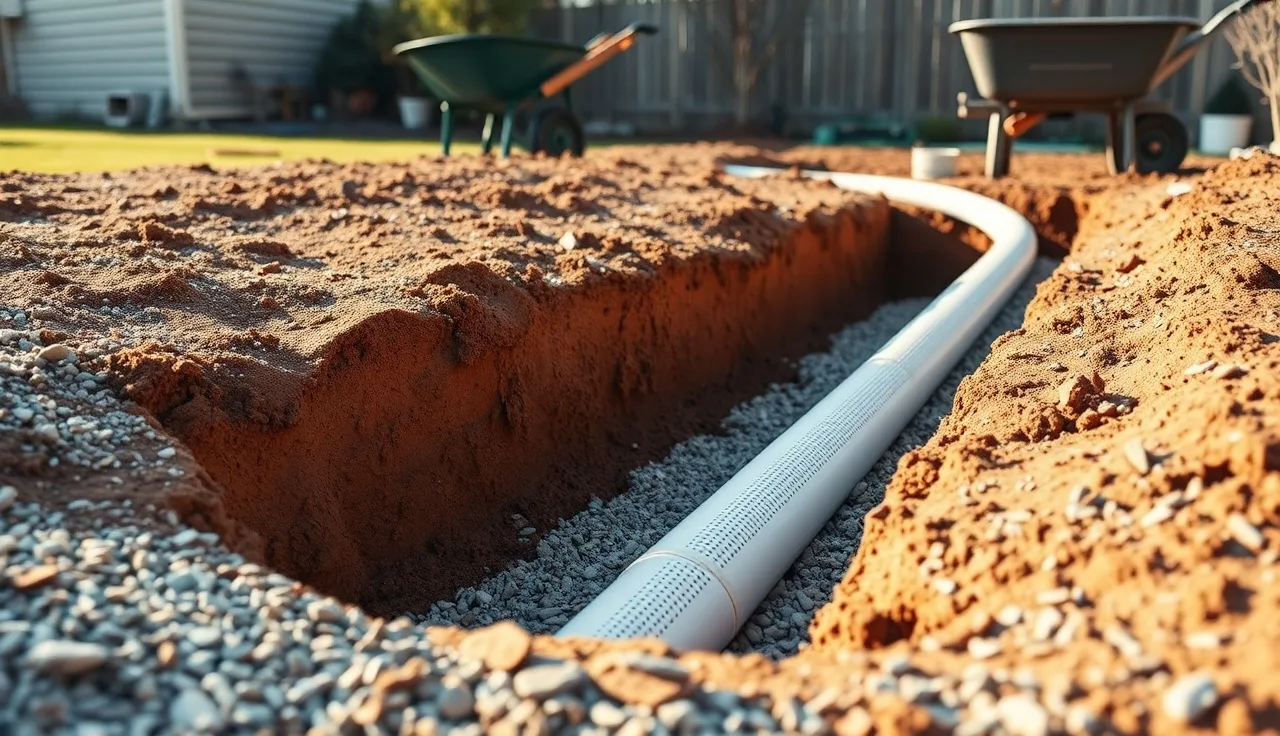
Gravel-and-pipe is what most people picture. A backhoe digs trenches 18 to 36 inches wide and 18 to 36 inches deep (depths vary by code and frost line). Workers lay 6 to 12 inches of washed crushed stone on the trench bottom, place 4-inch perforated PVC or SDR-35 pipe on top, cover it with more stone to just above the pipe crown, and finish with a layer of geotextile fabric before backfilling with soil.
The stone works as a hydraulic buffer. Effluent drips from the pipe perforations, pools briefly in the void spaces, then percolates into the trench sidewalls and bottom. That contact zone, called the biomat zone, is where most treatment actually happens.
Pipe specs matter. Most state codes require Schedule 40 or SDR-35 perforated PVC with holes sized 3/8 to 1/2 inch. Corrugated HDPE pipe is also widely accepted and cheaper per foot, but some states restrict it in certain soil types because it can deform under heavy backfill [2].
A conventional gravel-and-pipe system runs $3,000 to $7,000 for a typical 3-bedroom home in well-draining soil, though the range really is wide. Rocky soil or difficult access pushes costs up. A large lot with sandy loam in a contractor-competitive market can hit the low end. See cost to install septic system for a fuller breakdown.
Gravel-and-pipe systems are time-tested and every septic installer knows them. The downside is that they use a lot of stone (adding trucking cost and weight to the soil) and they can fail faster in heavy-clay soils where the stone-soil interface clogs before the native percolation rate can keep up.
How do plastic chamber systems work and are they better than gravel?
Chamber systems, most commonly the Infiltrator Quick4 series or ADS Arc36, replace both the gravel and the pipe with a ribbed plastic arch. You dig the trench, set the chambers end-to-end directly on native soil, and backfill. Effluent enters the chamber, pools on the bare soil floor, and percolates down and out through the open bottom and sidewall louvers.
The key advantage is void space. A standard 34-inch wide Quick4 chamber holds about 6.5 gallons per linear foot with no gravel at all [3]. That storage absorbs peak morning flow surges without flooding the system.
Installation is faster. No stone delivery means fewer truck trips, less compaction risk from heavy loads, and lower install cost in most markets, typically $500 to $1,500 less than a comparable gravel system.
State acceptance is nearly universal now. As of 2024, Infiltrator chamber systems carry NSF/ANSI 61 testing and are approved in all 50 states plus Canada [3]. Some states do require a thin layer of sand on the trench bottom for chamber installs in very coarse or very fine soils.
Does chamber outperform gravel long-term? Honest answer: the data suggest roughly equal service life of 20 to 30 years in similar soils when both are properly sized, with chambers sometimes doing better in marginal soils because the larger open-bottom area spreads hydraulic load more evenly. Nobody has published a rigorous randomized comparison, but university extension offices in several states have run side-by-side monitoring. University of Minnesota Extension found no significant performance difference through 10 years [4].
The one real weakness of chambers: in soils with very high seasonal water tables, a chamber can fill with groundwater from below and carry effluent out the ends. A gravel trench with a tight inspection port is easier to troubleshoot in that scenario.
What is gravelless fabric pipe and when does it make sense?
Gravelless pipe (the dominant brand is Infiltrator EZflow, but similar products exist under names like PipePak and SB2) wraps a perforated HDPE core pipe in a sleeve of recycled polystyrene beads bonded in geotextile fabric. The beads act like gravel, giving void space and lateral distribution, while the fabric keeps soil fines out.
A typical EZflow bundle is 9 inches in diameter and ships in 10-foot sections. One worker can carry a section. That alone explains why contractors like it for hand-dug or tight-access installs, hillside lots, or retrofits where a backhoe cannot reach.
Compare the fabric wraps to gravel in lab permeameter tests and flow rates come out close. The EPA's Office of Water lists gravelless alternatives as an accepted technology in its onsite wastewater treatment systems guidance [1].
Installed gravelless pipe runs $8 to $15 per linear foot, versus $5 to $12 for gravel-and-pipe in most regions. The labor savings on difficult sites usually offset the higher material cost.
Long-term durability is the main open question. Polystyrene beads can break down over decades, and there is less 30-year field data for gravelless systems than for gravel. Most manufacturers offer 10-year limited warranties. For a standard suburban install with easy machine access, I lean toward gravel or chambers. For a hillside or narrow side-yard retrofit, gravelless pipe is often the only practical choice.
What pipe material is used inside a leach field and does it matter?
The three pipe materials used in leach field distribution are PVC, HDPE, and ABS. PVC (Schedule 40 or SDR-35) is the most common. It is rigid, smooth-walled, cheap, and easy to inspect with a sewer camera. HDPE corrugated pipe is lighter and flexible, which helps on uneven terrain, but it compresses under point loads, so it needs enough stone cover or direct-burial bedding. ABS shows up in older systems and is largely obsolete for new installs.
Perforation pattern matters more than material. Holes should face down in a properly installed trench so effluent drips onto the stone or chamber floor rather than shooting sideways into the backfill. A lot of do-it-yourself installs get this backwards. A misoriented pipe does not fail overnight, but it does speed up clogging at the trench wall.
Distribution boxes (D-boxes) split flow from the tank outlet into multiple laterals. Cast-in-place concrete D-boxes ruled for decades. Molded PVC and HDPE boxes are now standard. Plastic boxes resist sulfide corrosion better than concrete, which tends to crack over 20 to 30 years. If you are replacing a failed leach field, swapping in a new plastic D-box is worth the extra $50 even if the old concrete one looks fine. See septic system repair for what typically gets replaced in a field restoration.
End caps and vent pipes round out the material list. Open-end capped pipe with 4-inch PVC vent stacks above grade improves aerobic conditions in the trench, which can extend system life, though most residential installs skip vents and still work fine.
What aggregate specifications does a leach field require?
Where gravel is used, the spec is almost always washed, crushed stone, 3/4 inch to 1.5 inch in diameter, with no more than 1 percent fines by weight passing a No. 200 sieve [2]. That "no fines" requirement is the whole ballgame. Dirty gravel, bank-run stone, or river gravel with silt will clog the biomat zone within 5 to 10 years. The gravel does not treat the wastewater. It keeps the treatment zone open.
Depth requirements come from state code, not a national standard. Most states require a minimum of 6 inches of stone below the pipe and 2 inches above it, up to the geotextile barrier. Some states require up to 12 inches below. Check your state's onsite wastewater code or your county health department's specifications before ordering.
| State group | Min. stone below pipe | Min. stone above pipe | Trench width (typical) |
|---|---|---|---|
| Most eastern states | 6 in | 2 in | 24-36 in |
| Most western states | 6-12 in | 2 in | 18-36 in |
| High-water-table states (FL, SC) | Mounded above grade | N/A | System-specific |
Pea gravel (under 3/4 inch) is banned in most states for leach fields because small particles pack too tightly. Limestone is sometimes banned in aggressive-acid-soil areas because it dissolves. Crushed granite or basalt is the safe choice everywhere.
A ton of clean 3/4-inch crushed stone covers roughly 65 to 80 linear feet of standard trench at the minimum spec depth, assuming a 36-inch wide trench. A 500-linear-foot system needs 7 to 8 tons, delivered.
What is geotextile fabric and why is it used in leach fields?
Geotextile fabric, also called filter fabric or septic fabric, separates the gravel layer from the soil backfill above it. Without it, soil fines migrate down into the stone voids during rainfall and freeze-thaw cycles, cutting void space and hydraulic capacity over time.
The standard spec is a nonwoven polypropylene fabric with an apparent opening size (AOS) of 0.212 mm (US No. 70 sieve) or finer. This is sometimes labeled as 4-oz or 6-oz nonwoven geotextile. Do not substitute landscape fabric or weed barrier from a home improvement store. Those products are too porous and too thin.
The fabric goes on top of the gravel, not underneath it. Some older installations mistakenly placed fabric under the stone to protect it from the native trench bottom. That is wrong. It cuts off the percolation path into native soil, which is exactly where effluent needs to go.
Fabric costs roughly $0.15 to $0.30 per square foot in contractor quantities. For a typical residential system this adds $100 to $300 to total material cost. It is one of the cheapest components and one of the most important to get right.
If you run a septic service operation and track material specs across jobs, platforms like SepticMind help you log material types and installation details per system, which pays off when a field fails and you need to reconstruct what went in the ground.
How do leach field materials differ for mound and drip systems?
Not every lot can use a conventional in-ground leach field. Seasonal high water tables, shallow bedrock, or slow-draining soils force alternative designs, and those designs use different materials.
Mound systems build a raised sand bed above the native soil surface. The fill is engineered medium sand (ASTM C33 or equivalent, 0.25 to 2.0 mm), placed at least 2 feet above the limiting layer. Perforated pipe runs through the sand mound, and the whole assembly gets covered with topsoil and seeded. Mound systems require pressure-dosed delivery from a pump chamber, so they add a pump, float switches, and a control panel to the material list. Cost is roughly 40 to 80 percent higher than a conventional system for the same home size [5].
Drip dispersal systems use 1/2-inch to 3/4-inch polyethylene drip tubing buried 6 to 18 inches deep. Emitters dose effluent in small, timed bursts across a much larger area than a trench system. The tubing itself is the distribution medium. No gravel or chamber goes in the field. What it needs instead is pre-treatment to at least secondary level (typically an aerobic treatment unit or recirculating sand filter) so the emitters do not clog. Drip tubing costs $1.50 to $3.00 per linear foot. A full system for a 3-bedroom home might need 1,000 to 2,000 linear feet.
For a leach field in marginal soil, your designer will specify which system type fits the site. Getting that wrong at the design stage is expensive to fix later.
How long do different leach field materials last?
The honest answer is that a leach field's lifespan depends more on loading rate and maintenance than on pipe material. A PVC gravel system that is properly sized and gets regular septic tank pumping can last 30 to 50 years. The same design overloaded with a garbage disposal and never pumped can fail in 10 years.
With that caveat, here is what the evidence says about material-specific durability:
PVC pipe: essentially indefinite service life when buried and out of sunlight. SDR-35 PVC has been in the ground since the 1970s and shows minimal degradation in soil chemistry typical of leach fields.
HDPE chambers: Infiltrator and ADS publish design lives of 50+ years. Independent testing by Penn State Extension found no structural degradation in chambers exhumed after 15 years [6].
Polystyrene gravelless bundles: 20 to 30 years is a reasonable expectation based on current data. The bead cores can compress over time under vehicle traffic if protective setbacks are ignored.
Crushed stone: permanent, assuming no fines contamination. The gravel itself does not wear out. The biomat that forms on it eventually can, but proper rest periods (in alternating-field systems) can rejuvenate it.
Geotextile fabric: 20 to 50 years depending on UV exposure (in ground, UV is not a factor) and soil chemistry. Generally outlasts the system.
The single biggest driver of premature failure in every material category is solids carryover from an under-pumped tank. Keep up with how often to pump septic tank recommendations (every 3 to 5 years for a typical household) and the pipe and aggregate almost never fail first.
What materials are banned or restricted in leach fields?
Several materials that sound reasonable are actually banned in most state codes.
Rubber tires: tire-chip aggregate was tested as a gravel substitute in the 1990s and still shows up in some older DIY systems. The EPA and most states have prohibited it for new installs because tire crumb leaches zinc and aromatic hydrocarbons into groundwater [7].
Recycled glass cullet: tested in some states as aggregate. Not widely approved, because of long-term fines generation as glass degrades.
Sea shells: used anecdotally in coastal areas. Most state codes prohibit them because shell dissolves in acidic leachate and generates fines.
Corrugated metal pipe: once common for distribution, now banned everywhere for subsurface effluent contact because it corrodes within 5 to 15 years in sewage conditions.
Ordinary gravel (bank run or pit run): not a banned material by itself, but failing the fines specification makes it unacceptable. Many inspectors will reject a load on-site if the stone is visibly dirty.
Flexible polyethylene landscape drain pipe (the black corrugated stuff sold at hardware stores): sometimes called "French drain pipe," it is not rated for effluent and not approved for leach fields in any state. Perforation spacing and size do not meet septic field specs.
The safest rule: use only products on your state's approved materials list or tested to NSF/ANSI standards. NSF has tested and listed chamber products, gravelless pipe, and geotextile fabrics under its wastewater component standards [8].
How do soil type and perc test results affect material choice?
Soil is the final treatment medium in any leach field, so its characteristics set the ceiling for what materials can achieve.
Percolation rate (perc rate) is measured in minutes per inch (MPI): how long water takes to drop 1 inch in a test hole. Most state codes accept soil between 1 MPI (very fast, sandy) and 60 MPI (slow, silty clay). Soils faster than 1 MPI need pretreatment or extra materials because effluent passes through before adequate treatment. Soils slower than 60 MPI cannot absorb enough water for a conventional system at all.
For fast-draining sandy soils (1 to 10 MPI): gravel and pipe work well. Some designers add a basal layer of medium sand to slow transmission and improve treatment contact time.
For medium soils (10 to 30 MPI): the sweet spot where every material type works. Chambers are the contractor's first pick here because of their lower cost and faster install.
For slow soils (30 to 60 MPI): gravelless fabric pipe is sometimes preferred because its larger contact surface spreads load better. Mound systems are required in many states for soils at the slow end of this range.
For marginal soils at or near 60 MPI: pressure-dosed systems with timer controls cut the hydraulic load per dose, giving soil more time to absorb each increment. The pipe is usually 1.5-inch or 2-inch Schedule 40 PVC with small orifices.
A licensed soil scientist or certified soil evaluator should read test results. Perc tests alone are not enough under many current state codes. Soil profile analysis and textural classification are also required. Septic tank inspection and soil testing go hand-in-hand on any replacement project.
What does a new leach field cost broken down by material type?
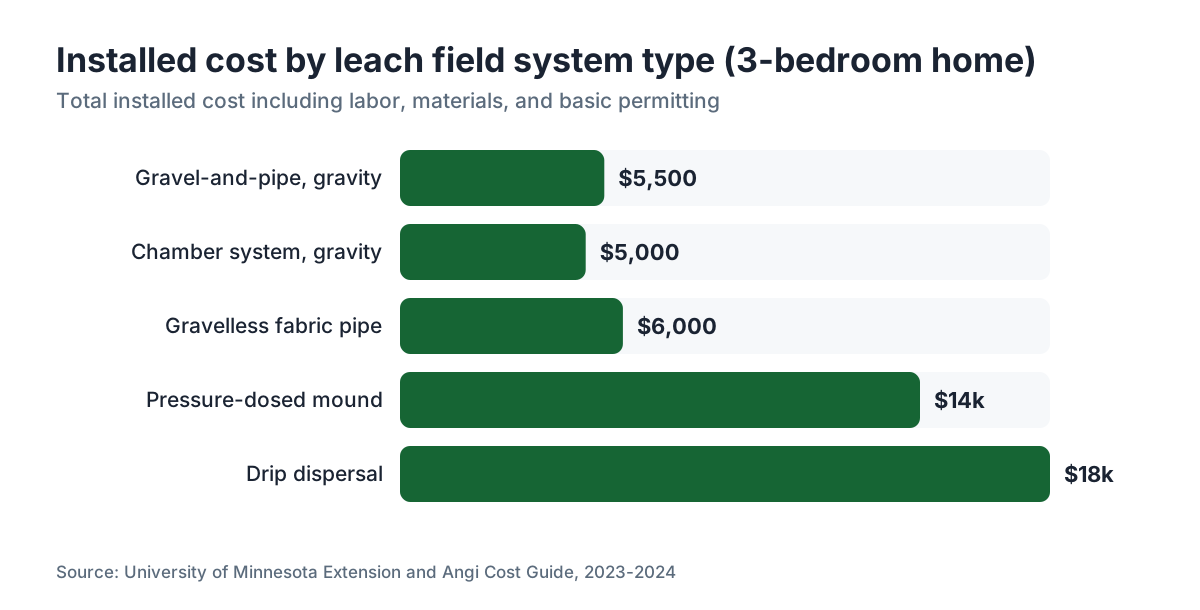
Costs below are national ranges from contractor reports and state extension estimates as of 2023 to 2024 [5][9]. Labor is included. Every market is different. Get three quotes.
| System type | Material cost (3BR home) | Total installed cost | Relative labor |
|---|---|---|---|
| Gravel-and-pipe, gravity | $1,200 - $2,500 | $3,500 - $7,500 | Moderate |
| Chamber system, gravity | $1,500 - $2,800 | $3,000 - $7,000 | Lower |
| Gravelless fabric pipe | $1,800 - $3,200 | $4,000 - $8,000 | Lower on difficult sites |
| Pressure-dosed mound | $3,500 - $6,000 | $8,000 - $20,000 | High |
| Drip dispersal | $5,000 - $10,000 | $10,000 - $25,000 | High |
The mound and drip numbers include the pump chamber, pump, and controls those systems require.
Material cost as a share of total project cost runs roughly 30 to 45 percent for gravity systems, dropping to 20 to 30 percent for mound and drip systems where labor and equipment time dominate.
One cost most homeowners miss: the inspection and permit fee. Counties typically charge $200 to $800 for a drain field permit, and the inspector has to visit twice, once to approve the trench before backfill and once after completion. Budget for both.
For a detailed view of full system installation costs, see cost to install septic system or cost to put in a septic tank.
Can you repair or add to an existing leach field without replacing all the materials?
Yes, in some cases. The repair strategy depends entirely on why the field is failing.
If failure is a biomat clog (the most common cause, where the biozone at the stone-soil interface seals off): aerobic treatment upstream, load reduction, or letting the field rest while an alternate field absorbs load can restore function. No new materials required.
If pipe has cracked or separated: a camera inspection finds the break, and the affected section of perforated PVC can be dug up and spliced with a new segment and PVC couplings. This is a $500 to $2,000 repair versus a full replacement.
If the D-box has failed (cracked, shifted, or corroded): replace just the D-box. A PVC D-box costs $40 to $80 at a supply house. The job takes a couple of hours.
If the system is undersized for current household size: adding a second field in series or parallel is feasible if the lot has room that perc-tests well. The new field can use chamber or gravelless materials even if the original was gravel-and-pipe. Mixing material types across separate fields is fine.
If gravel has been contaminated with fines or the geotextile fabric has collapsed into the stone: full excavation and replacement is the only fix. There is no way to clean contaminated aggregate in place. See septic system repair for a fuller picture of what triggers full replacement.
Regular tank pumping is the best way to avoid needing any of this. SepticMind's scheduling tools help service operators track pump-out intervals across their customer base, which means fewer callbacks for field failures that were really just tank overflows.
What should homeowners check to know their leach field materials are holding up?
You cannot see most leach field materials without excavating, but you can watch for the signs that they are starting to fail.
Soft or spongy ground over the field: standing effluent has saturated the soil above the trenches. This means hydraulic overload or a clogged distribution zone.
Lush, unusually green grass in stripes: effluent is reaching the root zone and fertilizing turf. This is often the first visible sign of a field that is stressed but not yet failed.
Slow drains in the house with no obvious pipe clog: back-pressure from a saturated field shows up at fixtures before sewage surfaces outside.
Sewage odor near the field: usually means the biomat is not treating effluent before it surfaces. Call a professional.
If you have not had a septic tank inspection in more than three years, start there. The inspector will check liquid levels in the tank outlet baffle, which is the first indicator of field stress. Pair that with a septic tank pump out to start the observation period with a fresh baseline.
For surface inspections of the field itself, look for the observation ports (4-inch cleanout caps that should be visible at the head of each lateral). A flashlight and a measuring tape let you check liquid depth in the lateral. Standing water above the pipe invert is not normal and warrants investigation.
Frequently asked questions
What is the best material for a leach field?
For a typical residential lot with medium-draining soil, plastic chamber systems (like Infiltrator Quick4) offer the best mix of cost, ease of install, and proven performance. They are approved in all 50 states, cost slightly less than gravel-and-pipe on most sites, and provide equal or better hydraulic storage. For difficult-access or hillside sites, gravelless fabric pipe is often the practical winner.
How deep should gravel be in a leach field trench?
Most state codes require a minimum of 6 inches of washed crushed stone below the perforated pipe and at least 2 inches above it, capped with geotextile fabric before soil backfill. Some states and some soil types require 12 inches below. Check your specific state's onsite wastewater regulations or your county health department spec sheet before ordering stone.
Can I use regular gravel from a landscaping supplier for a leach field?
No. Leach fields require washed, crushed stone sized 3/4 inch to 1.5 inch with less than 1 percent fines. Landscaping gravel, pea gravel, river gravel, and bank-run stone all carry too many fines or too-small particles, which compress and clog the distribution zone. Most inspectors will reject a load that does not meet the spec on-site.
Are plastic chambers better than gravel for a septic drain field?
In most conditions, chambers perform just as well and often install faster and cheaper. They give more void storage per linear foot than gravel-and-pipe. University of Minnesota Extension monitoring over 10 years found no significant performance difference between chambers and gravel systems in comparable soils. Chambers can be vulnerable in soils with very high seasonal water tables where groundwater rises into the chamber.
What kind of pipe is used in a leach field?
Standard residential leach fields use 4-inch perforated PVC (Schedule 40 or SDR-35) or corrugated HDPE pipe. PVC is preferred for its rigidity and camera-inspectability. Holes should face down so effluent drips to the stone bed rather than spraying sideways. Corrugated metal pipe is banned in all U.S. states for septic effluent contact because it corrodes rapidly.
How much gravel does a leach field need?
A ton of washed 3/4-inch crushed stone covers roughly 65 to 80 linear feet of standard 36-inch-wide trench at minimum spec depth. A 500-linear-foot system typically needs 7 to 8 tons delivered. Your designer's trench layout drawing gives you the exact linear footage, which you can use to calculate stone tonnage based on your trench width and specified depth.
What is gravelless pipe and is it approved?
Gravelless pipe (brands include EZflow and PipePak) wraps a perforated HDPE core in recycled polystyrene beads bonded in geotextile. It replaces both gravel and pipe in one product. It is lighter, easier to handle on difficult sites, and approved in most states. Service life is estimated at 20 to 30 years, compared to 30-plus years for stone. It costs slightly more per linear foot than gravel-and-pipe.
Can I mix chamber systems with gravel in the same leach field?
You generally should not mix material types within a single distribution zone because they have different hydraulic characteristics that cause uneven loading. But if you are adding a new lateral or a second field to an existing gravel-based system, using chambers for the new field is typically acceptable as long as the new field runs off its own distribution line from the D-box.
Why is geotextile fabric used in a leach field and does it matter?
Geotextile fabric (nonwoven polypropylene, 4-oz or heavier) goes on top of the gravel layer to stop soil fines from migrating down into the stone voids. Without it, freeze-thaw cycles and rain events push topsoil into the aggregate, cutting void space and eventually shutting off percolation. It costs $0.15 to $0.30 per square foot and adds minimal cost but noticeably extends system life.
What leach field materials are banned or should I avoid?
Avoid corrugated metal pipe (corrodes in 5 to 15 years), rubber tire chips (leaches zinc and hydrocarbons, banned by most states since the 2000s), black corrugated polyethylene landscape drain pipe (not rated for effluent, wrong perforation spec), sea shells (dissolves in acidic leachate), and any stone with significant fines. Always check your state's approved materials list and use only NSF-tested products.
Do I need a permit to replace leach field materials?
Yes, in every U.S. state. Replacing a leach field is a regulated alteration of your septic system. You will need a permit from your county or state health department, a licensed designer to prepare a plan, and at least one inspection before backfill. Permit fees range from $200 to $800 in most jurisdictions. Doing work without a permit can bring fines and a required full removal.
How does soil perc rate affect which leach field material I should use?
Fast soils (1 to 10 MPI) work with any material but may need a sand buffer layer. Medium soils (10 to 30 MPI) are the best fit for chambers. Slow soils (30 to 60 MPI) may benefit from gravelless pipe's larger contact surface or require a pressure-dosed mound system. Soils slower than 60 MPI cannot support a conventional leach field and need an engineered alternative such as a mound or drip system.
What is the lifespan of different leach field materials?
PVC pipe lasts indefinitely when buried. HDPE chambers are rated 50-plus years by manufacturers; Penn State Extension found no degradation in chambers exhumed after 15 years. Gravelless polystyrene bundles are estimated at 20 to 30 years. Crushed stone itself is permanent; the biomat that forms around it can be rejuvenated with rest periods. All materials last much longer with regular septic tank pumping every 3 to 5 years.
What materials are used in a mound septic system?
A mound system uses engineered medium sand (ASTM C33, 0.25 to 2.0 mm) placed above the native soil to provide the treatment zone. Perforated PVC pipe distributes effluent through the sand under pressure from a pump. The sand mound gets topped with topsoil and grassed. The system also needs a pump chamber, submersible effluent pump, float switches, and an electrical control panel on top of standard septic tank components.
Sources
- U.S. EPA SepticSmart: Homeowner's Guide to Septic Systems: EPA guidance that proper siting, design, and installation of onsite systems depends on soil characteristics, and that gravelless alternatives are recognized technology
- U.S. EPA Office of Water, Onsite Wastewater Treatment Systems Manual (EPA/625/R-00/008): Aggregate specification of 3/4 inch to 1.5 inch washed crushed stone with no more than 1 percent fines for leach trench systems
- Infiltrator Water Technologies, Quick4 Chamber Specifications and State Approvals: Quick4 chamber provides approximately 6.5 gallons of storage per linear foot and is approved in all 50 states and Canada
- University of Minnesota Extension, Septic System Owner's Guide: Side-by-side monitoring of chamber and gravel systems found no significant performance difference through 10 years in comparable soils
- University of Minnesota Extension, Septic System Costs and Maintenance: Mound systems cost approximately 40 to 80 percent more than conventional systems for equivalent home size; conventional gravel system cost ranges
- Penn State Extension, Onsite Sewage Disposal: Plastic Chamber Leachfield Systems: No structural degradation found in HDPE chambers exhumed after 15 years of service
- U.S. EPA, Scrap Tires: Handbook on Recycling Applications and Management for the U.S. and Canada: Tire chip aggregate leaches zinc and aromatic hydrocarbons into groundwater; most states prohibit use in septic leach fields
- NSF International, NSF/ANSI 61: Drinking Water System Components and Wastewater Treatment System Components: NSF testing and listing of chamber products, gravelless pipe, and geotextile fabrics under wastewater component standards
- HomeAdvisor / Angi, Septic System Installation Cost Guide (2024): National cost ranges for installed leach field systems by type, including gravel, chamber, mound, and drip dispersal
- North Carolina Department of Health and Human Services, Wastewater Section: Rules for Sewage Treatment and Disposal Systems: State code examples for trench depth, stone specifications, and geotextile requirements for leach field installation
- Virginia Department of Health, Sewage Handling and Disposal Regulations (12VAC5-610): State regulations specifying perforated pipe standards, aggregate gradation, and approved alternative products for drain fields
- Texas Commission on Environmental Quality (TCEQ), On-Site Sewage Facilities Rules (30 TAC 285): State onsite wastewater rules covering approved materials, installation specs, and inspector requirements for leach fields
Last updated 2026-07-09