Leach field issues: causes, signs, and how to fix them
By the SepticMind Editorial Team
TL;DR
- A failing leach field is the most common way a septic system dies.
- The usual causes are biomat buildup, soil compaction, root intrusion, and too much water.
- Watch for soggy ground, sewage smells, slow drains, and backups.
- Fixes run from $0 (resting the field) to $20,000 or more for full replacement.
- Act early.
- It almost always saves money.
What is a leach field and why does it fail?
A leach field (also called a drain field or absorption field) is a grid of perforated pipes buried in gravel trenches. It takes the clarified liquid from your septic tank and lets it soak slowly into the soil. The soil is the real treatment engine. Bacteria and physical filtering strip out pathogens and nutrients before the water reaches groundwater. When the soil stops absorbing, the whole system backs up.
Most fields are built to last 20 to 30 years with decent care. Plenty die younger. The EPA estimates that 10 to 20 percent of the roughly 26 million onsite septic systems in the United States are not working the way they should, and drain field failure is the top reason [1]. That is not a minor headache. A dead leach field can contaminate a drinking well, create a health hazard in your yard, and cost you five figures.
The soil does all the heavy lifting. Once it clogs, compacts, or floods, there is no quick fix. Knowing why fields fail is the only way to prevent one, or at least catch trouble while you still have cheap options.
What are the most common causes of leach field problems?
Biomat buildup is the single biggest killer. A biomat is a dark, slimy layer of anaerobic bacteria and their waste that forms where the pipe meets the soil. Every field grows some. That is normal. The problem starts when it gets thick enough to seal the soil pores shut. Biomat almost always means too much organic matter is reaching the field, and that points straight back to the tank. Skip pumping long enough and murky, solid-laden effluent flows into the field instead of relatively clear liquid [2].
Hydraulic overload is simple: more water goes in than the soil can take. It can be a one-time thing (a houseful of guests for a week, a toilet running for months) or a chronic one (a family that outgrew the system it inherited). Soil needs time to drain between doses. Flood it around the clock and it stays saturated, which kills the aerobic bacteria near the surface that keep things moving.
Soil compaction is permanent. Park a car on your drain field once and you have probably cut the soil permeability roughly in half. Heavy equipment is worse. The gravel bed under a leach field pipe is supposed to be loose and full of air. Compaction crushes out the pore space the water travels through, and it does not bounce back [8].
Root intrusion from trees and big shrubs is slow and relentless. Roots chase moisture, and a leach field is a steady water source. They sneak in through pipe joints, grow inside the pipe, and eventually choke the flow or split the pipe. Willow, poplar, and silver maple are the worst. Even small ornamental trees set too close cause trouble in five to ten years.
Bad installation can hide for years. Pipes laid without enough slope (the rule of thumb is 1/8 to 1/4 inch of drop per foot of run), trenches too shallow for the frost line, or a distribution box set out of level all cause uneven loading. One section gets hammered while another barely sees a drop.
A high water table can flood a field from below, usually in spring. If the water table sits within a foot or two of the trench bottom on a regular basis, the field was probably sited wrong from day one. Most states set a minimum separation between the trench bottom and seasonal high water [3].
What are the warning signs of a failing leach field?
The signs show up in a rough order, subtle first, obvious last. The subtle ones are easy to wave off. The obvious ones mean you are already in trouble.
Slow drains all over the house are often the first clue. One slow drain is a clog in that fixture. Slow drains everywhere, toilets especially, point downstream to the septic system.
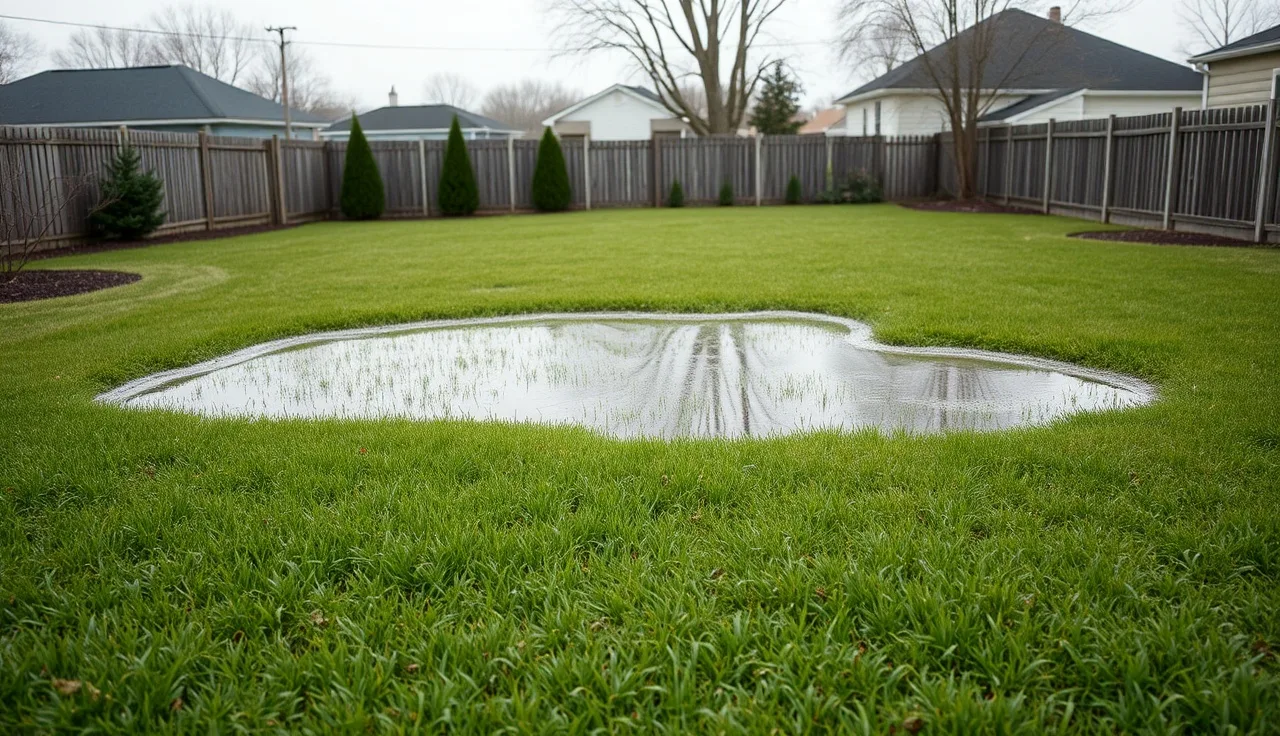
Soggy or spongy ground over the field means effluent is surfacing instead of soaking in. You might notice the grass over the field is greener and taller than the rest of the lawn. Sounds nice. It actually means liquid waste is fertilizing your yard from just under the surface.
Sewage smell outdoors near the field or tank means gas is escaping where it should not. A healthy field works aerobically near the surface. A saturated one goes anaerobic, and hydrogen sulfide (that rotten-egg smell) builds up.
Sewage smell indoors is more urgent. It can mean the system is backed up far enough to push gas back through your drain traps.
Backup in the lowest fixtures (basement drains, ground-floor toilets) is a late-stage sign. The field is likely saturated and the effluent has nowhere to go.
Standing water or surfacing sewage is a health emergency. Raw effluent on the ground is a direct contamination risk and is illegal in every state. Call a licensed septic pro the same day [4].
Spot any of these and a septic tank inspection done right away is the move. A tech can camera the pipes, check the distribution box, and probe the soil to tell you whether you have a tank problem, a field problem, or both.
How can you tell if the problem is the tank or the leach field?
This one matters a lot, because a tank problem is usually cheap and a field problem is usually not. A good septic tech can tell the difference in about 30 minutes on site.
The simplest test costs one pump-out. Have the tank pumped. If the drains clear and stay clear for weeks, the tank was the problem (full or blocked). If they back up again within a day or two, the field is saturated and not recovering. The water has nowhere to go.
A tech can also open the distribution box (D-box), the concrete or plastic box that splits flow among the trenches. If sewage is backed up to the inlet pipe, the field cannot take flow. If the D-box is dry or nearly dry, the problem is upstream in the tank or inlet.
Probing the field with a thin steel rod tells you how wet the ground is. Soil that feels like pudding at six to twelve inches down is waterlogged. Soil that pushes back with normal resistance is dry and doing its job.
Groundwater testing can show whether the field is fouling a nearby well. Some states require it before they will permit a repair or replacement [3].
Can a leach field be repaired, or does it need to be replaced?
Honest answer: it depends on why it failed. Some causes reverse. Some do not.
Resting the field is the cheapest first try. If the field is overloaded but not permanently clogged, four to eight weeks of minimal water use can let it dry out and partly recover. This works best after a short surge (a burst pipe, a crowd of guests), not after months of chronic overuse.
Hydro-jetting the pipes clears root intrusion and some biomat from inside the distribution pipes. It does nothing for the soil, but it restores flow so water reaches every part of the field instead of pooling in one spot.
Terralift or aeration pushes compressed air, sometimes with polystyrene pellets, into the soil around the trenches to fracture compacted ground and open new pore space. Results are all over the map. Some homeowners see real improvement, some see nothing. There is little peer-reviewed data on how long any gain lasts. Cost runs $1,000 to $4,000 by field size.
Biological additives get sold as a way to dissolve biomat. The EPA's SepticSmart program says the evidence for additives is weak and warns that some products can damage system components. I would not spend a dollar on them until everything else has been tried.
Partial replacement means digging out and rebuilding one or two dead trenches while leaving the healthy sections alone. It makes sense when only part of the field has failed.
Full replacement is the nuclear option, and sometimes the only one. A new field runs $3,000 to $20,000 or more depending on your lot, soil, and the technology you need [5]. If your soil fails a fresh perc test, you may be forced into an alternative: a mound system, drip irrigation, an aerobic treatment unit, or a constructed wetland. All of them cost more than a conventional field.
For repair questions beyond the field itself, septic system repair covers tank and pipe work too.
How much does leach field repair or replacement cost?
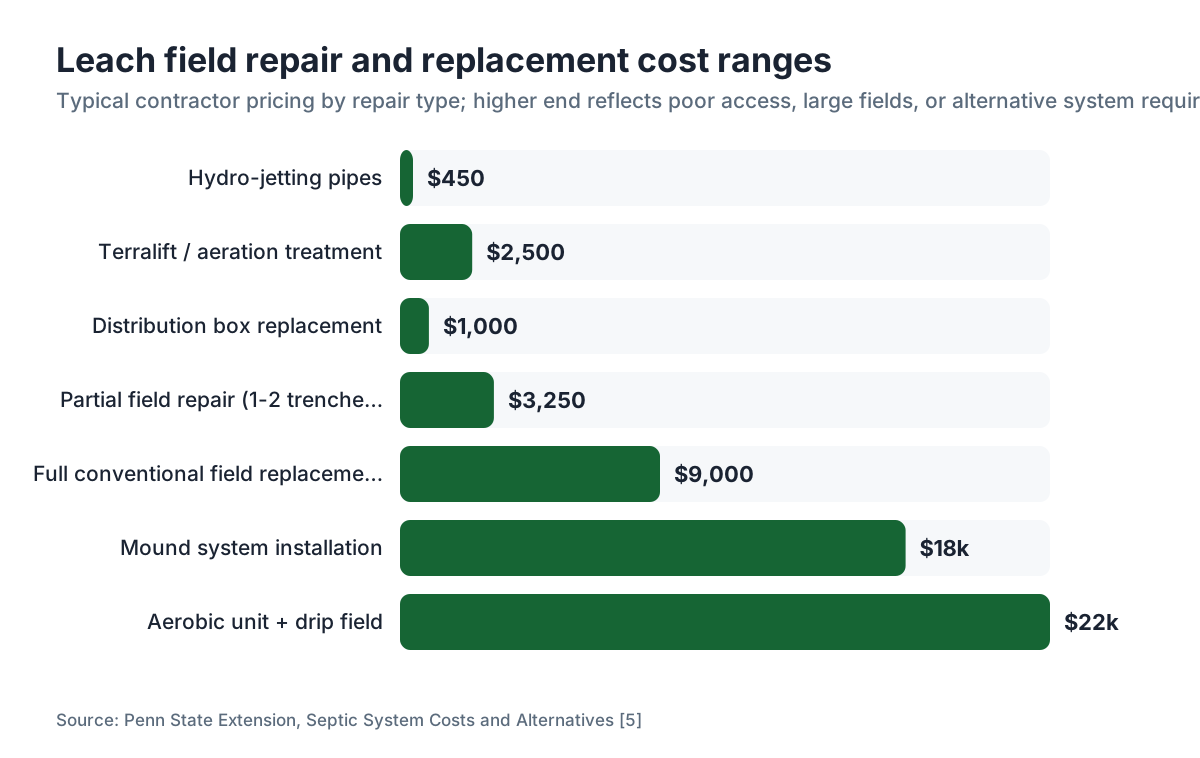
Cost swings so hard by region and site that any single number lies to you. Here is an honest breakdown built on typical contractor pricing and published state guidance [5][6]:
| Repair type | Typical cost range | Notes |
|---|---|---|
| Field resting (no contractor) | $0 | Only works for hydraulic overload |
| Hydro-jetting | $300 to $600 | Clears pipe interiors only |
| Terralift / aeration | $1,000 to $4,000 | Inconsistent results |
| Distribution box replacement | $500 to $1,500 | Often paired with other repairs |
| Partial field repair (1-2 trenches) | $1,500 to $5,000 | Depends on trench length and access |
| Full conventional field replacement | $3,000 to $15,000 | Standard soil, accessible lot |
| Mound system (poor soil or high water table) | $10,000 to $25,000+ | Required in many northern states |
| Aerobic treatment unit + drip field | $15,000 to $30,000+ | Required where lot space is limited |
Permits add $200 to $1,500 in most states. Engineering or design fees add $500 to $2,000 when a licensed engineer has to stamp the plan, which many states require for alternative systems.
Homeowners ask about DIY replacement. The digging and pipe laying are not rocket science, but nearly every state requires a permit and inspection, and most want the design done by a licensed engineer or soil scientist. Installing without a permit turns into a real problem at resale, and it can leave you legally on the hook if the field later contaminates a neighbor's well. Get the permit. The cost to install a septic system article breaks down full installation pricing if you are starting fresh.
For the tank side of the bill, septic tank repair covers tank-specific work that sometimes rides along with a field repair.
What should you never do if your leach field is failing?
A handful of moves feel helpful and actually make things worse, or hand you a legal mess.
Do not pump the tank over and over as a fix. Pumping buys temporary relief by giving the system a buffer. If the field is saturated, the tank refills and the problem is back in days. Pumping every few weeks to keep a dead field limping is expensive and fixes nothing. See septic tank pumping for what pumping really does and when it makes sense.
Do not use chemical drain cleaners. Bleach, lye-based cleaners, and solvents kill the bacteria your tank and field run on. One heavy slug of bleach can set the whole system back weeks. That is doubly bad when the field is already stressed.
Do not drive over the field. Any vehicle, a riding mower included, adds compaction. In wet conditions, a single pass can do damage that lasts decades [8].
Do not plant trees or big shrubs near it. The safe distance depends on species and state, but 50 feet is a sane buffer for large trees. Grass and small ornamentals are the right call over a field.
Do not dump water on it all at once. Water softeners that backwash many gallons in one shot, sump pumps piped into the septic, and hot tubs drained into the system all flood a field fast. Roof drains should never touch a septic system.
Do not ignore surfacing sewage. It does not fix itself, it is a health hazard, and in most states it triggers a legal duty to repair.
How does a high water table affect your leach field?
A seasonal high water table is one of the most overlooked causes of leach field failure, mostly because it is invisible. Homeowners rarely realize it is even happening.
When the water table climbs to within a foot or two of the trench bottoms, there is simply no room for effluent to drain. The soil is already full from below. No amount of maintenance fixes this. The field is in the wrong place for the conditions.
This is supposed to get caught during permitting. Most states require a site evaluation that measures depth to the seasonal high water table (SHWT). The minimum separation between the trench bottom and the SHWT runs from 12 inches to 48 inches depending on state and local code [3]. Some sites just cannot support a conventional in-ground field and need a mound system that lifts the drain field above natural grade.
If your field works fine all summer and floods every spring, a high water table is the likely culprit. A licensed soil scientist can run a site evaluation and measure SHWT. Some states publish seasonal high water table maps for a rough baseline [9]. The fix usually means a mound system or another elevated alternative. Expensive, but permanent.
Shifting precipitation patterns are making this more common in some regions. A field that had plenty of separation from the water table in 1985 may not have it anymore.
How does what you flush affect your leach field?
The leach field is downstream of everything you do at the sink and toilet. What goes down your drains reaches the field within 24 to 72 hours of leaving the tank. A few categories deserve real attention.
Fats, oils, and grease (FOG) do the most damage. They do not break down well in the tank. They float, pile up, and eventually slide into the field in slugs that clog soil pores almost instantly. Cooking grease down the drain is a direct hit on your field.
Garbage disposals raise the solids going to the tank by 50 percent or more according to extension research [7]. That means a faster-filling tank, more solids carrying over to the field, and quicker biomat growth. Plenty of septic pros tell people to skip the disposal on a septic system, or at least pump more often if they use one.
Antibacterial soaps and disinfectants in bulk kill the bacteria in the tank and the field's soil layer. A little antibacterial hand soap is not going to wreck anything. Routinely dumping bleach or quaternary ammonium cleaners does depress bacterial activity.
Pharmaceuticals (antibiotics, hormones, and chemotherapy drugs especially) pass through the body into the waste stream. Their effect on septic bacteria is still being studied, but there is enough concern that the EPA recommends not flushing medications [4].
Non-flushables ("flushable" wipes, paper towels, tampons, dental floss) do not break down in the tank. They pile up, eat space, and can plug the outlet baffle, which sends solids straight to the field. This one is a free fix. Just stop flushing them.
How often should you have your septic system inspected to prevent leach field problems?
Regular inspection is far cheaper than a field repair. EPA SepticSmart guidance says to have your system inspected by a pro every one to three years and pumped every three to five years for a typical household, though the right interval depends on household size, tank size, and how hard you use it [2].
For four people with a 1,000-gallon tank and a garbage disposal, every two to three years for pumping is about right. For a single person or a couple with the same tank, every four to five years is probably fine. The only way to be sure is to have the tank checked and see how full it actually is. How often to pump your septic tank walks through the math.
A full inspection should check the distribution box for level and cracks, probe the field for saturation, look at the tank inlet and outlet baffles, and eyeball the field pipes if they are reachable. Some inspectors camera the inlet and outlet pipes to catch cracks or root intrusion early.
Septic service operators managing many customer systems often track inspection schedules and field-condition history digitally. SepticMind is one platform built for this. It flags customers who are overdue and documents field condition over time, which pays off when a homeowner needs maintenance records for a home sale.
Do not wait for symptoms. By the time the grass is green over the field or the drains slow down, the problem has been building for months. A septic tank pump out done on schedule is the best money you can spend on field life.
What permits and regulations apply to leach field repairs?
This varies by state and often by county, but the general shape holds everywhere. Almost every state requires a permit for any leach field repair beyond minor pipe work inside the existing footprint. Full replacement always needs one. The process usually runs a site evaluation (perc test and soil profile), a design signed off by a licensed engineer or sanitarian, and one or more inspections during construction.
Many states adopt or reference the EPA's onsite wastewater treatment design guidance for treatment and disposal standards [1]. State codes vary a lot. Some let homeowners do their own septic work on a primary residence with a permit. Others require a licensed contractor for everything.
When you sell, most states require either a current septic inspection or disclosure of known problems. A field repaired without permits can blow up a closing. Lenders increasingly want a passing septic inspection before they fund. Get the permit.
If your field is failing and you cannot cover replacement right now, some states run low-interest loan or grant programs for septic repair, aimed at lower-income households. The USDA Rural Development Section 504 program covers septic repairs in rural areas [6]. Check your state environmental or health agency site for local programs.
What alternative systems work when a conventional leach field is not possible?
Not every lot can carry a conventional gravity-fed leach field. Poor soil (too sandy, too heavy with clay, or too shallow to bedrock), a high water table, or a small lot can all rule out a standard system. Alternatives exist. They cost more and ask for more maintenance.
Mound systems build the drain field above natural grade using imported sand and soil. They work well over high water tables or shallow bedrock. Cost runs $10,000 to $25,000 installed, and the mound itself needs careful landscaping to keep it from eroding.
Drip irrigation systems dose small amounts of effluent through a web of drip emitters, giving the soil time to absorb each dose. They need an aerobic treatment unit or other secondary treatment ahead of the emitters, so the full system is pricey: $15,000 to $30,000 or more. They are common in Texas and other places with thin soils.
Aerobic treatment units (ATUs) force air through the wastewater to treat it to a higher level before it hits the field or drip lines. Cleaner effluent absorbs more easily, so the field can be smaller. ATUs have moving parts (air pumps, timers) that need maintenance contracts, usually $100 to $300 a year.
Constructed wetlands use plants and gravel to treat effluent through natural processes. Some states allow them, and they can work well in rural settings with room to spare. They are uncommon and need state approval.
Cluster systems tie several homes or a small development into a shared drain field run by an HOA or utility district. These get designed at the community level and are generally off the table for a single existing home.
If you are planning a new install on a lot where the soil is a question mark, a septic tank installation pro can tell you what your site can support before you commit to a design.
Frequently asked questions
How long does a leach field last?
A well-designed, well-maintained leach field usually lasts 20 to 30 years. Some go longer. Fields that get undertreated effluent from an overfull tank, that get driven over, or that face regular hydraulic overload can fail inside 10 years. Regular septic tank pumping is the single biggest factor in how long a field lives.
Can you restore a failed leach field without replacing it?
Sometimes. If the failure is hydraulic overload, resting the field with minimal water use for four to eight weeks can bring back partial function. Hydro-jetting clears roots from the pipes. Aeration breaks up compacted soil with mixed results. Soil clogged with biomat after months of saturation rarely recovers fully. Success depends on the cause, how long it has been failing, and your soil type.
What is the smell from a leach field, and is it dangerous?
The main odor is hydrogen sulfide, made by anaerobic bacteria in saturated or struggling soil. Outdoors near the field, faint occasional whiffs are not unusual. Strong, persistent odors, or any smell inside the house, are warning signs of failure. Hydrogen sulfide is toxic at high concentrations, but outdoor levels near a home drain field are almost always well below harmful thresholds.
Does heavy rain damage a leach field?
Heavy or long rainfall can temporarily saturate the soil and lift the water table, cutting the field's absorption capacity. This is usually temporary. Once the soil drains, performance returns. If your field fails or surfaces effluent after every big storm, it may sit too close to the seasonal high water table, which is a siting problem, not a maintenance one.
Can tree roots really destroy a leach field?
Yes. Roots from willow, poplar, silver maple, and elm can invade pipe joints within a few years if the tree is close enough. Inside the pipe, roots form mats that block flow and eventually crack the pipe. Shrubs and ornamentals cause slower damage. Keep all trees 30 to 50 feet from the field and plant only shallow-rooted grass over it.
How do I know where my leach field is located?
Start with your home's as-built septic plan, usually on file with your county health or environmental department. If you cannot find it, a septic contractor can locate the tank and trace the distribution pipes with a metal probe or electronic locator. The field is typically downhill from the tank, away from the house and wells, in an open grassy area.
Will homeowner's insurance cover leach field replacement?
Standard homeowner's policies exclude septic failures caused by gradual wear, which covers most leach field deaths. Some policies cover sudden and accidental damage, like a pipe broken by roots that caused a confirmed sudden collapse. Specialty septic riders exist but are not widely sold. Read your policy and ask your insurer about septic coverage before you need it.
Is a failing leach field a health hazard?
Yes, once effluent surfaces or reaches groundwater. Septic effluent carries pathogens including E. coli, hepatitis A virus, and parasites. Surfacing sewage is a direct-contact risk, especially for kids and pets. Contaminated groundwater can reach drinking wells. Most states treat surfacing sewage as a public health emergency requiring immediate cleanup. Do not treat it as cosmetic.
Can a garbage disposal harm my leach field?
It raises the risk. Disposals add a lot of organic solids to the tank, which speeds filling and increases the chance of solids carrying over to the field. If you run a disposal on a septic system, the EPA and most extension programs suggest pumping more often, roughly every one to two years instead of every three to five, to offset the extra load.
What is a distribution box and how does it affect the leach field?
A distribution box (D-box) is a concrete or plastic chamber that takes flow from the tank and splits it evenly among the field's pipe runs. If it settles out of level, one trench takes all the flow and floods while others stay dry. A cracked D-box can let soil in and block the inlet. Checking and leveling the D-box is a routine part of a full septic inspection.
How much water use is too much for a leach field?
Conventional fields are sized by bedroom count, usually assuming 100 to 150 gallons per bedroom per day. A family consistently pushing past that with long showers, several laundry loads a day, or water-hungry appliances risks hydraulic overload. Spreading high-water activities across the week instead of piling them onto one day gives the soil recovery time and makes a real difference.
Do septic additives help a failing leach field?
The EPA and most state environmental agencies say the evidence is thin. Bacteria and enzyme products have not been shown in controlled studies to reliably improve failing fields, and some chemical additives can damage soil structure or pass through to groundwater. EPA SepticSmart specifically warns against leaning on additives instead of proper maintenance and pumping.
What happens if I ignore a failing leach field?
It gets worse, never better. A partially failing field saturates more completely over time, backs up into the tank, and eventually into the house. You may face regulatory action if surfacing sewage gets reported. Contaminated well water is possible on small lots. Ignoring it also shrinks your options. A field caught early may be partly repairable. One left failing for years almost certainly needs full replacement.
Sources
- U.S. EPA, Onsite Wastewater Treatment Systems Manual (EPA/625/R-00/008): The EPA estimates that 10 to 20 percent of the approximately 26 million onsite septic systems in the United States are functioning inadequately; drain field failure is the leading cause.
- U.S. EPA, SepticSmart Program guidance: EPA SepticSmart recommends inspection every one to three years and pumping every three to five years; notes weak evidence for additive effectiveness and cautions against relying on them.
- U.S. EPA, Septic Systems Overview: Site Evaluation Requirements: Most states require minimum separation distances between the drain field trench bottom and the seasonal high water table, typically 12 to 48 inches depending on jurisdiction.
- U.S. EPA, What To Do and Not To Do, SepticSmart: EPA recommends not flushing pharmaceuticals; surfacing sewage is a public health hazard and regulatory violation requiring immediate action.
- Penn State Extension, Septic System Costs and Alternatives: Full conventional leach field replacement costs range from approximately $3,000 to $15,000; mound systems and alternative technologies run $10,000 to $30,000 or more depending on site conditions.
- USDA Rural Development, Section 504 Home Repair Loans and Grants: USDA Rural Development Section 504 program provides loans and grants for septic system repairs for income-qualifying rural homeowners.
- University of Minnesota Extension, Septic System Owner's Guide: Garbage disposals can increase solids load to the septic tank by 50 percent or more, accelerating biomat formation in the drain field.
- North Carolina State Extension, Septic System Maintenance: Protecting Your Drain Field: Driving or parking vehicles on a drain field causes soil compaction that can permanently reduce soil permeability and damage the gravel bed.
- Oregon DEQ, Onsite Septic Systems: Seasonal High Water Table Requirements: Oregon and many other states require site evaluation including measurement of seasonal high water table depth before permitting drain field installation or replacement.
- U.S. EPA, 40 CFR Part 503, Standards for the Use or Disposal of Sewage Sludge: Federal regulatory framework referenced by state onsite wastewater codes for treatment and disposal standards.
- Purdue Extension, Your Septic System: A Reference Guide for Homeowners (ID-71): Leach fields are designed assuming approximately 100 to 150 gallons per bedroom per day; exceeding this regularly creates hydraulic overload conditions.
Last updated 2026-07-10