Leach field installation: costs, steps, and what can go wrong
By the SepticMind Editorial Team
TL;DR
- Installing a leach field (also called a drain field) costs $2,000 to $20,000 or more depending on lot size, soil type, and system design.
- The process needs a perc test, permits, trenching, gravel or chamber placement, and inspection before any soil goes back.
- Budget 6 to 16 weeks from application to a system you can actually use.
What is a leach field and what does it actually do?
A leach field is the underground network of perforated pipes, gravel, and soil that takes clarified wastewater from your septic tank and spreads it slowly into the ground. Bacteria and the soil do the real work. Organic matter and pathogens get filtered and broken down as the liquid moves down through several feet of native soil before it ever reaches groundwater. [1]
The tank handles solids. The leach field handles liquid. That split matters because most failures homeowners call "the tank is broken" are actually field failures. The tank is often fine. The field is saturated, compacted, or clogged with biomat.
A conventional system uses gravity to move effluent from the tank to a distribution box, then out through the trench pipes. Pressure-dosed systems add a pump that pushes effluent in timed doses, which rests the soil between doses and stretches field life. Alternative designs like mound systems, drip irrigation fields, and aerobic treatment units exist for lots where a conventional field won't pass inspection. [2]
If you want the fuller picture of how the whole system ties together, the leach field overview covers the science and terminology in more depth.
What permits do you need before installing a leach field?
Every state requires a permit for a new septic install, and most counties tack on their own local permit. You apply through your county health department or environmental agency, not through a contractor. The contractor works under your permit, not theirs. [3]
The application almost always requires a site evaluation that includes a percolation test (perc test) and a soil profile analysis. Some states require a licensed soil evaluator or professional engineer to sign off on those results before the application moves. Once you submit, approval runs from two weeks in a rural county with light workload to three months in an area with staff shortages or a complicated site.
Building permits may also apply if you're connecting to a new structure or excavating near a foundation. Check with your county building department separately from the health department. They don't always talk to each other.
The EPA's SepticSmart program tells homeowners to "always check with your local health department before installing, repairing, or replacing a septic system" because setback rules, minimum lot sizes, and buffer distances from wells and property lines change a lot from one jurisdiction to the next. [1] Those setbacks don't bend. A field placed too close to a well or a property line fails inspection no matter how well it was built.
Fines for unpermitted installs vary by state, but $500 to $5,000 per violation is common, and some states make you remove and reinstall a non-compliant system on your own dime.
How does a perc test work and what results do you need to pass?
A percolation test measures how fast water moves through your soil. The installer or soil evaluator digs test holes, saturates them with water over 24 hours, then times how long a fixed amount of water takes to soak away. Results come out in minutes per inch (mpi): how many minutes it takes for the water level to drop one inch. [4]
Most state codes accept perc rates between 1 mpi and 60 mpi for a conventional gravity system. Soil that drinks faster than 1 mpi (very coarse sand or gravel) can let effluent race through without enough treatment. Soil slower than 60 mpi (heavy clay) can't take effluent fast enough and pushes it back up to the surface.
Here's what different perc rates generally mean for the design:
| Perc Rate (mpi) | Soil Type | Typical Outcome |
|---|---|---|
| Less than 1 | Very coarse gravel | Likely fails; effluent untreated |
| 1 to 30 | Sandy loam, loam | Good for conventional gravity field |
| 31 to 60 | Silt loam, some clay | May need larger field or pressure dosing |
| 61 to 120 | Clay loam | Alternative system required in most states |
| Over 120 | Heavy clay | Often fails; mound or advanced treatment needed |
The soil profile analysis runs alongside the perc test. An evaluator digs a pit, usually 5 to 8 feet deep, and reads it for seasonal high groundwater marks (mottled, gray-streaked soil), restrictive layers like hardpan or bedrock, and the distance to the seasonal water table. Most states require at least 2 to 4 feet of vertical separation between the bottom of your trench and the seasonal high water table. [4]
Fail the perc test and you still have moves. A mound system builds a raised bed of imported sand over the failing native soil. An aerobic treatment unit (ATU) makes cleaner effluent that some states let you discharge to a smaller or shallower field. Neither is cheap. Both beat no permit and no system.
What are the actual steps of leach field installation?
The sequence below is what a licensed installer does on a conventional gravity system. Alternative systems add steps (pump, electrical, media placement) but follow the same logic.
1. Site staking and layout. The installer marks the tank, the distribution box, and each trench run off the approved design. Call 811 (the national one-call utility marking service) at least three business days before any digging. [5]
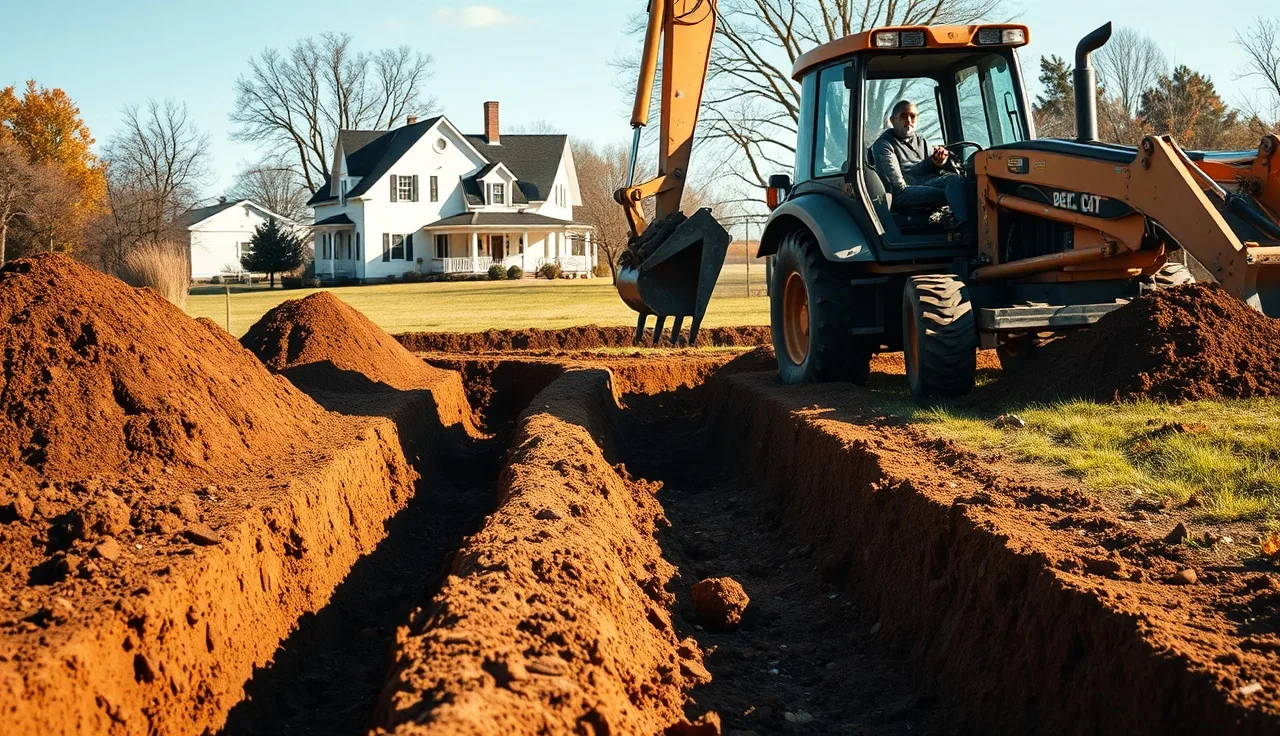
2. Excavation. A backhoe digs the trenches to the approved depth, usually 18 to 36 inches depending on climate and design. Trench bottoms have to be level or on a very slight grade. Trenches run 1.5 to 3 feet wide and sit at least 6 feet apart center to center. Total trench footage depends on your home's calculated daily flow and the perc rate. A 3-bedroom home in average soil often needs 300 to 500 linear feet of trench.
3. Gravel or chamber placement. In a conventional system, 12 inches of clean, washed drain rock (3/4 to 1.5 inch) goes into the trench bottom before the pipe. Pipe sits on the gravel, more gravel covers it to 2 inches above the pipe, then geotextile fabric goes on top to keep soil out of the stone. Chamber systems (corrugated plastic arches like the Infiltrator brand) skip the gravel entirely and cut install time a lot. Many installers reach for them on suitable soil.
4. Distribution box installation. The d-box takes effluent from the tank and splits it evenly to each trench. Getting the d-box dead level matters. A quarter-inch tilt sends all the flow to one trench while the others sit dry, and that overloaded trench dies in a few years.
5. Pipe connection and inspection. Before any backfill, the health inspector shows up to check trench depth, gravel depth, pipe slope, d-box level, and setbacks. Do not backfill before inspection. Most jurisdictions will make you dig it all back up if you do.
6. Backfill and grading. Once inspection passes, soil goes back over the fabric in lifts, compacted lightly, never with heavy equipment sitting directly over the trenches. Final grade should slope away from the trench area so surface water sheds off the field instead of soaking into it.
7. Final inspection and startup. Some counties require a final walk-through. You can put the system into service right after final approval.
How much does leach field installation cost?
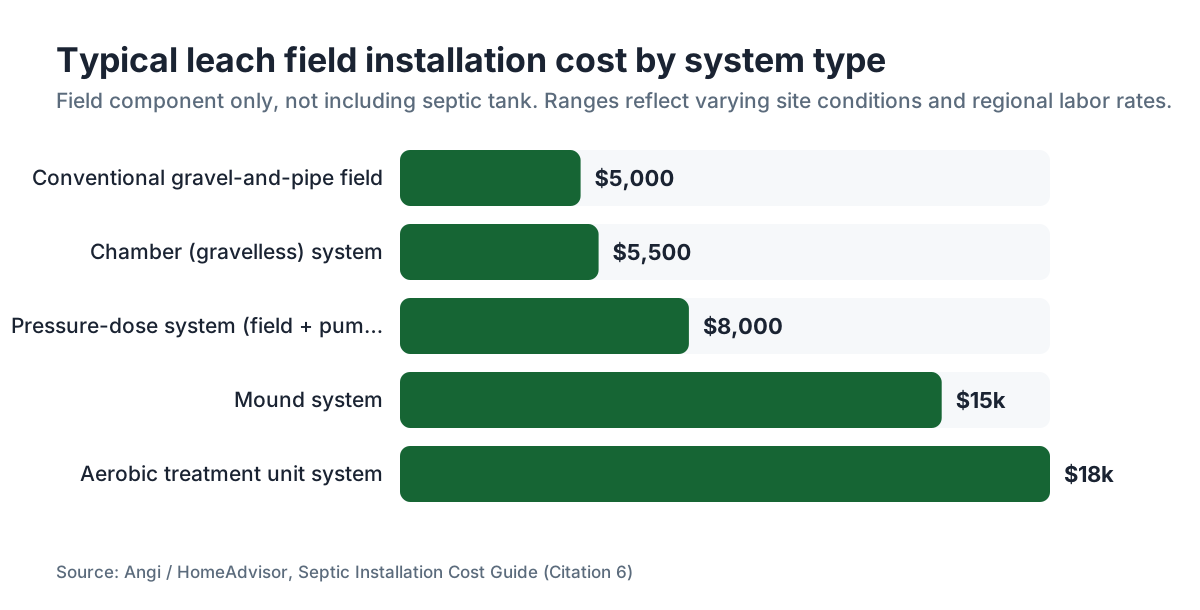
The range is wide and it's real: a straightforward conventional gravity field on a flat lot with passing soil runs $3,000 to $7,000 for the field alone, tank not included. Add the tank and the full system runs $6,000 to $15,000 for most homes. [6]
Hard sites drive the number fast. A mound system adds $5,000 to $15,000 over a conventional field because you're buying and placing several truckloads of imported sand. Pressure-dose systems add $2,000 to $5,000 for the pump, dose tank, and controls. Aerobic treatment units add $8,000 to $15,000 depending on brand and local approval.
For the fuller picture of what drives total system cost, see the cost to install septic system guide.
Cost factors that move the number most:
- Lot access. If a large excavator can't reach the field area, cost climbs because smaller equipment takes longer.
- Rock or ledge. Blasting or hand-digging rock adds $50 to $200 per linear foot easily.
- Permit fees. County fees run from under $200 in some rural areas to $1,500 or more in heavily regulated counties.
- Soil import. Mound and some alternative designs need certified sand from approved sources. Trucking alone can add thousands.
- Inspection fees. Usually $100 to $400 per visit. Some inspectors charge for re-inspections when the first visit finds a problem.
Get three bids from licensed installers. Each bid should reference the same approved design drawing. If two bids describe different designs, ask why. A 20 to 30 percent spread between comparable bids is normal and usually comes down to labor efficiency and equipment ownership, not shortcuts.
How big does a leach field need to be?
Size comes from two inputs: estimated daily sewage flow and the soil's absorption capacity from the perc test. The formula is set in state design standards and the EPA's Onsite Wastewater Treatment Systems Manual. [2]
Daily flow by household size is the starting point. Many states use 150 gallons per day per bedroom as the design figure, so a 3-bedroom home has a design flow of 450 gallons per day (gpd). Some states use fixture counts or occupancy instead. Check your state's rules.
Absorption area then comes from dividing daily flow by the long-term acceptance rate (LTAR) for your soil, which is derived from the perc test. A soil with a perc rate of 30 mpi might carry an LTAR of 0.5 gallons per square foot per day. For 450 gpd at that LTAR: 450 / 0.5 = 900 square feet of trench bottom area.
If your trenches are 2 feet wide, 900 square feet of bottom means 450 linear feet of trench. Space those runs 6 feet center to center and your field footprint runs roughly 450 feet long by 6 to 12 feet wide, or splits into several parallel runs.
Many installers and engineers add a 20 to 25 percent reserve area to the approved design. That reserve isn't built right away. It's held as undisturbed, unpaved ground so a future repair field can go in without a variance. Protecting that reserve area is one of the smartest things a homeowner can do after installation.
How long does leach field installation take?
The physical install on a straightforward site takes one to three days. What eats weeks or months is everything before the first shovelful.
A realistic timeline:
- Site evaluation and perc test scheduling: 1 to 3 weeks after you contact an evaluator.
- Permit application review: 2 to 8 weeks, sometimes longer in backed-up counties.
- Contractor scheduling after permit approval: 1 to 4 weeks depending on season (spring and fall are busiest).
- Physical installation: 1 to 3 days.
- Inspection scheduling: 1 to 5 days after the installer calls it in.
Realistic window from first call to usable system: 6 to 16 weeks. Plan for it if you're buying a property that needs a new system or replacing a failing one. An emergency variance for an active sewage backup that's a public health hazard can compress the permit step to a few days in some counties, but don't count on it.
Weather matters. Most inspectors and codes ban installation when the ground is frozen or saturated, because you can't read the soil's drainage behavior and backfill over frozen ground leaves voids as the frost pulls out. In the northern half of the country, a permit approved in December may not turn into a dig date until March or April.
What are the most common leach field installation mistakes?
These aren't hypothetical. Licensed inspectors and engineers flag them over and over on failed systems.
Driving over the field during installation. A loaded dump truck or backhoe run over the trench area compacts the soil and wrecks the pore structure that absorption depends on. Compacted soil never fully comes back. Some installers keep equipment at the trench edge and move gravel with conveyors or wheelbarrows. That's worth asking about.
Installing in wet conditions. Working in saturated soil smears the trench walls into a glaze (installers call it smearing or puddling) that cuts absorption hard. The EPA's design manual addresses this directly: install when soil is "friable," not wet or sticky. [2]
A d-box that isn't level. Even a small tilt. One trench gets flooded while the others sit dry. The flooded trench builds biomat, clogs, and fails. The homeowner sees surfacing in one corner and figures the whole field is used up, when three-quarters of it never got a drop.
Wrong gravel. Dirty crushed stone with fines, undersized stone, or recycled concrete aggregate won't drain and clogs fast. Specs almost always call for clean, washed, rounded drain rock, typically 3/4 to 1.5 inch. Match the delivery tickets to the spec.
No geotextile fabric. Skip the filter fabric over the gravel and fine soil migrates into the stone over the years, choking off void space. It's a slow failure, not a sudden one, but it's easy to prevent.
Covering before inspection. The number one reason for a failed inspection that forces expensive re-excavation. Inspectors need to see the trench bottom, gravel depth, pipe, and d-box before any soil goes back. Call for inspection the day the work is ready, not after you've buried it.
What's the difference between a conventional field, chamber system, and mound system?
These are the three designs most homeowners run into, though state-approved alternatives also include drip irrigation fields, textile filters, and recirculating sand filters.
Conventional gravel-and-pipe system. The oldest and most common design. Stone is the infiltration medium. Works well on sites with good soil, enough depth to groundwater, and passing perc rates. Material cost is low but labor cost is higher because gravel is heavy and slow to place. A lifespan of 20 to 30 years with good maintenance is typical.
Chamber systems (gravelless). Plastic arch chambers (Infiltrator, ADS, and similar brands) replace the gravel. The void inside the arches acts like the stone void, and the open bottom lets effluent touch native soil directly. Chambers are lighter, faster to install, and approved in every state. They usually need a slightly smaller footprint than an equivalent gravel system because absorption is more efficient. The EPA evaluated chamber systems in its design manual and found performance comparable to conventional systems in appropriate soils. [2] Cost often lands at or slightly below gravel on labor once you factor in delivery.
Mound systems. Called for when native soil fails for any reason: too slow, too fast, too shallow to groundwater, or a restrictive layer too near the surface. The installer strips the topsoil, places 2 to 4 feet of clean sand from an approved source, and builds the absorption field on top of that imported media. A pump doses the field in timed intervals. Mound systems work and last, but they're visible (a raised, grass-covered berm in the yard), cost more, and need pump maintenance. Some homeowners hate the look but have no other option on their lot.
For lots that don't qualify for any of these, aerobic treatment units (ATUs) treat effluent to a higher standard before it reaches the field, which can win approval for a smaller or shallower field. ATUs add mechanical parts (air compressors, pumps) and need more frequent service.
How do you maintain a leach field after installation?
Good maintenance is mostly about keeping the system from getting overloaded or abused. The field itself asks for very little if it was installed right.
Pump the septic tank on schedule. Solids that slip out of the tank into the field are the top cause of early failure. A tank stuffed with accumulated solids sends partly-settled sewage out to the field, which coats the soil pores with biomat far faster than a healthy tank would. Most households need pumping every 3 to 5 years, with the exact interval depending on household size and tank volume. See the how often to pump septic tank guide for specifics, or the septic tank pumping overview for what a service visit looks like.
Keep cars, trucks, ATVs, and heavy equipment off the field for good. One pass with a loaded vehicle can compact the soil enough to cut absorption 30 to 50 percent in that zone.
Don't plant trees or deep-rooted shrubs over the field. Grass or shallow-rooted perennials are fine. Tree roots chase moisture, and a septic field is very moist. A mature root system can invade every pipe in the field in 5 to 10 years.
Don't route surface water (downspouts, sump pump discharge, swales) onto the field. Extra water saturates the soil and kills the air space aerobic bacteria need to treat effluent.
Keep grease, paint, solvents, medications, and big slugs of harsh cleaners out of the drain. They kill the good bacteria in the tank and field. Garbage disposals add a lot of solids load. If you run one, pump your tank more often.
Managing a service fleet, or want to track service records and customer maintenance schedules across many properties? SepticMind has tools built for septic operators to run that workflow.
Know where your field is and what's buried. Keep the as-built drawing from your installation. Homeowners who don't know where the field sits wreck it all the time building sheds, pouring patios, or planting landscaping right over the trenches.
How do you know if a leach field is failing?
Failures rarely hit overnight. There's usually a slide, and catching it early saves money.
Early signs:
- Slow-draining fixtures throughout the house (more than one drain, which points past a simple clog).
- Gurgling in toilets or drains when other fixtures run.
- Sewage odors inside, especially in basements or ground-floor bathrooms.
Late-stage signs:
- Wet, spongy ground over the field even in dry weather.
- Sewage surfacing as a brown or gray puddle on the field.
- Bright green, unusually lush grass in stripes over the trench lines (a classic tell that effluent is surfacing underground but not quite breaking through).
- Sewage backing up into the lowest fixtures in the house.
See any late-stage sign and you should cut water use to the bone and call a licensed installer or engineer the same day. A saturated field can sometimes recover with rest, but it needs a professional look first. A septic system repair pro can camera the pipes, check the d-box, and dig a test pit to tell whether the problem is a clogged inlet pipe, a bad d-box, or true soil failure.
Not every wet field is dead. Sometimes it's a single crushed pipe, a failed d-box outlet, or tree root intrusion that's fixable. True biomat failure across the whole field usually means replacement, but partial failures with a good reserve area can sometimes be handled by shifting flow to unused trenches. Get a diagnosis before you assume you need a full replacement.
Can you install a leach field yourself?
Technically, in some states, a homeowner can pull their own permit and do their own septic work on a primary residence. In practice, very few should.
The reasons to hire a licensed contractor go past the digging. Permit applications in most states need a licensed designer's stamp. The soil evaluation usually needs a licensed soil evaluator or engineer. The installation itself needs licensed contractors in at least 34 states, and that count keeps climbing as states tighten onsite wastewater rules. [3]
Even where DIY is legal, the risks are real. A d-box that's a quarter-inch out of level isn't obvious to someone without experience. Gravel depth is easy to shortcut when you're tired and it's your own project. Inspectors tend to give licensed contractors the benefit of the doubt on marginal calls. Homeowners get looked at harder.
What a homeowner can reasonably handle: protect the reserve area, keep vegetation over the field, call 811 before any landscaping, and keep detailed service records. The rest is worth paying for.
Frequently asked questions
How long does a leach field last?
A well-installed conventional leach field on appropriate soil lasts 20 to 30 years with proper tank maintenance. Some run 40 years or more. Fields fed by an overfull tank, or fields that got compacted or overloaded, can fail in under 10 years. Regular septic tank pumping is the single biggest factor in how long a field lives.
What is the minimum distance a leach field must be from a well?
Most state codes require at least 50 to 100 feet of horizontal separation between a leach field and a drinking water well, with 100 feet the most common minimum. Some states require 150 feet on coarse or sandy soils where contaminants travel faster. Local health departments set the exact number, so check your county's onsite wastewater code before you finalize any design.
Can a leach field be replaced without replacing the septic tank?
Yes, and it's common. If the tank is structurally sound, sized right, and undamaged, replacing only the leach field makes financial sense. A licensed installer will inspect the tank, check the inlet and outlet baffles, and confirm the tank is watertight before connecting a new field. See the septic tank inspection overview for what that evaluation covers.
What happens if you build over a leach field?
Building over a leach field is almost always a code violation and does real damage. Structures block evapotranspiration, add loading that crushes trench gravel and pipes, and cut off access for future repair. Concrete patios and asphalt driveways are the worst because they add weight and shut down oxygen exchange. Most permits flatly prohibit any permanent structure over the field.
How do I find out where my leach field is located?
Start with the as-built drawing filed with your county health department at original installation. Most counties keep these and will provide copies. Your county GIS or property records portal may also show the system footprint. A licensed installer can probe the yard with a thin steel rod to find trenches, or use a pipe locator to trace the lines out from the distribution box.
Does a leach field need to be pumped or cleaned?
Leach fields aren't pumped or cleaned. The septic tank ahead of the field is what gets pumped, typically every 3 to 5 years. The field is a passive infiltration system and doesn't collect solids the way a tank does. Some failing fields get treated with jetting or biological additives, but those are repairs, not routine maintenance, and their effectiveness is debated among professionals.
What is a reserve drain field area and do I need one?
A reserve drain field area is undisturbed, undeveloped land next to the installed field, sized to take a replacement system if the primary field fails. Most state codes require a designated reserve area as part of the original permit. Keep it clear of structures, paving, trees, and heavy equipment. Lose your reserve area to landscaping or construction and you're looking at a variance or much higher repair costs later.
Can heavy rain cause a leach field to fail?
Heavy rain can temporarily swamp a leach field by saturating the surrounding soil, which stops effluent from draining. That usually shows up as slow drains or brief surfacing that clears once the rain stops and the soil drains. If problems drag on into dry weather, the rain just exposed an underlying failure. Chronic surface water hitting the field (from grading, downspouts, or poor drainage) causes long-term damage and should be corrected.
How do leach field inspection requirements vary by state?
Every state requires a permit and at least one construction inspection before backfill, but the details vary a lot. Some states license the installer at the state level, others at the county level. Some mandate a final inspection with a functional test, others rely on the installer's affidavit. The EPA's SepticSmart program recommends checking with your local health department before any installation or repair.
What is the difference between a leach field and a drain field?
They're the same thing. Leach field, drain field, absorption field, and disposal field all mean the subsurface trenches or chambers that take clarified effluent from the septic tank and spread it into the soil. Regional habits differ: the Southeast often says drain field, the Northeast and Midwest lean toward leach field, but engineers, installers, and codes use all the terms interchangeably.
Can a leach field be installed on a small lot?
Small lots complicate septic design because setbacks from wells, property lines, structures, and surface water eat available area fast. Some states set minimum lot sizes for conventional septic (often half an acre or more), while others allow engineered solutions on smaller parcels. Alternative systems like drip irrigation fields or advanced treatment units can sometimes fit where conventional fields can't. A licensed soil evaluator can assess your specific lot.
What should I ask a contractor before hiring them for leach field installation?
Ask for their state license number and verify it with the licensing board. Ask who handles the permit application and whether design is included. Ask what system type they're proposing and why, given your soil results. Ask for references from similar jobs in the past two years. Ask exactly what inspection process they follow and whether they call for inspection before backfilling. Get the warranty terms in writing.
Sources
- US EPA, SepticSmart: How Your Septic System Works: EPA SepticSmart advises homeowners to check with local health departments before installing, repairing, or replacing a septic system, and describes the role of soil in treating effluent.
- US EPA, Onsite Wastewater Treatment Systems Manual (EPA/625/R-00/008): EPA design manual specifies perc test procedures, soil evaluation methods, long-term acceptance rate calculations, chamber system performance, and prohibition on installation in wet or saturated soils.
- National Environmental Services Center (NESC) at West Virginia University: Installer licensing requirements for septic systems exist in at least 34 states; permit applications typically require a licensed designer's stamp.
- University of Minnesota Extension: Perc test procedures, acceptable perc rate ranges (1 to 60 mpi for conventional systems), and vertical separation requirements from seasonal high water table.
- Common Ground Alliance, Call 811 Before You Dig: Federal law and state laws require calling 811 at least three business days before any excavation to have underground utilities marked.
- Angi, Septic System Installation Cost Guide: Conventional leach field installation costs $3,000 to $7,000 for the field alone; full septic system installation ranges $6,000 to $15,000 for most residential properties.
- North Carolina Department of Environmental Quality: State regulatory agency guidance on permit requirements, setback distances from wells and property lines, and reserve area requirements.
- Oregon Department of Environmental Quality: State-level permit and inspection process requirements including mandatory pre-backfill inspection and licensed installer requirements.
- Penn State Extension: 150 gallons per day per bedroom as a common design flow figure; maintenance guidance including tank pumping intervals and root intrusion risks.
- University of Missouri Extension, Septic Systems and Their Maintenance: Biomat formation as primary cause of drain field failure; effects of compaction, tree root intrusion, and surface water on field performance.
- Infiltrator Water Technologies: Chamber systems approved in all 50 states; installation efficiency and footprint comparison to conventional gravel systems.
- Texas Commission on Environmental Quality: State regulatory requirements for mound systems, alternative treatment units, and reserve area designation in onsite wastewater permits.
Last updated 2026-07-10