Leach field piping: materials, layout, and when to replace it
By the SepticMind Editorial Team
TL;DR
- Leach field piping carries clarified wastewater from your septic tank into perforated pipes buried in gravel-filled trenches, where soil finishes the treatment.
- Pipe material, trench depth, and spacing all come from your state's onsite wastewater code.
- Most systems use 4-inch perforated PVC or corrugated PE pipe.
- A failed field costs $3,000 to $20,000 or more to replace.
What is leach field piping and what does it actually do?
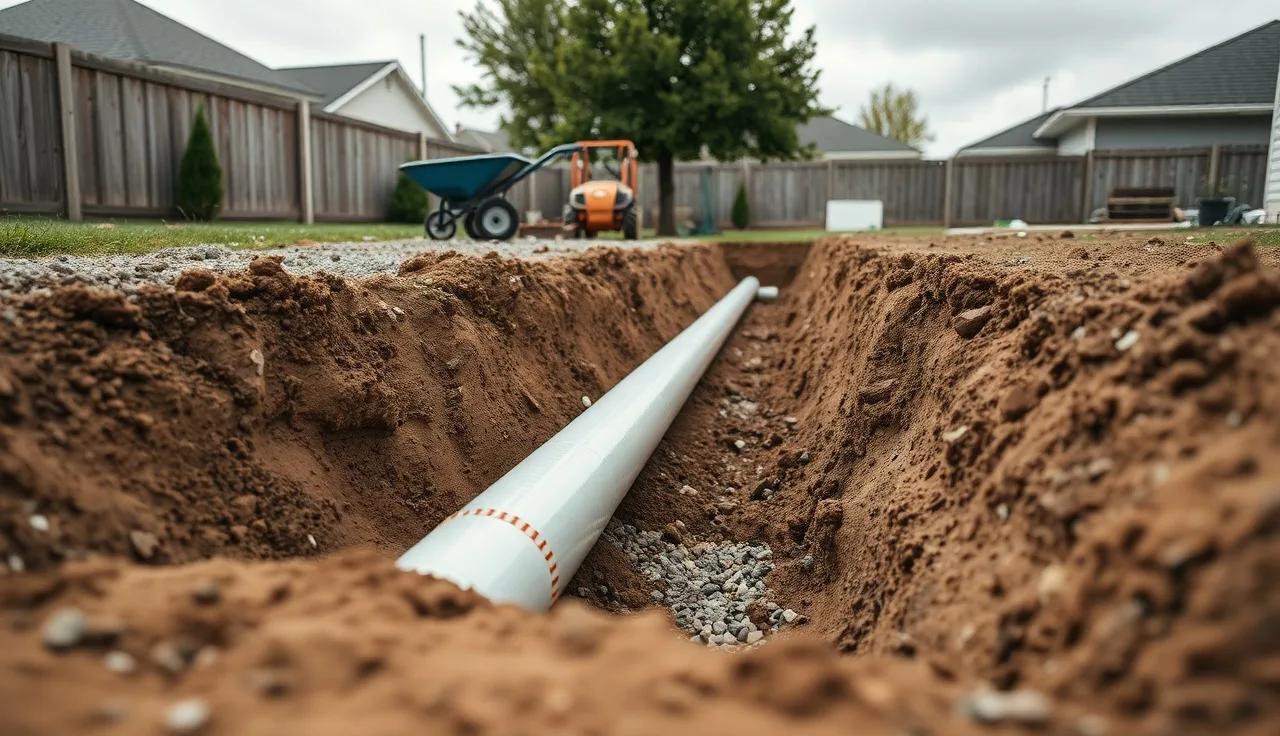
The leach field, also called a drain field or absorption field, is the last treatment stage in a conventional septic system. Effluent leaves the tank already partly treated, flows through a distribution network, and enters perforated pipes buried in gravel-filled trenches. From there the liquid percolates down through the soil, which strips out pathogens, nutrients, and leftover organic matter before the water reaches groundwater.
The piping does two jobs. Solid-wall distribution pipe moves effluent from the tank to the trenches without letting it escape early. Perforated lateral pipes, once the effluent reaches the trenches, let it drip out slowly and evenly down the length of each run. That even spread is what keeps one spot of soil from getting flooded and staying wet.
A conventional system usually has one septic tank, a distribution box or a set of drop boxes, and two to five lateral trenches running parallel across the absorption area. The EPA's SepticSmart program treats the conventional system as the baseline that every other onsite design gets measured against [1]. Learn the piping and the rest of the system makes sense fast.
For how the whole thing fits together, see our guide to the leach field.
What types of pipe are used in leach fields?
Three pipe materials cover almost everything you'll dig up in the field.
Perforated PVC (polyvinyl chloride) is the default in new construction. It's rigid, smooth-walled, shrugs off roots better than corrugated pipe, and holds its shape under backfill. Most state codes call for Schedule 40 or SDR 35 PVC on the distribution and lateral runs. Four-inch diameter is standard. Some high-volume systems step up to six inches.
Corrugated polyethylene (PE) pipe, sometimes called flex pipe or ADS pipe after the biggest maker, went in everywhere from the 1970s through the 1990s. It's flexible, cheap, and light. The corrugations are the problem. Silt and biomat pile up in the valleys, and roots find the perforations easy to slip through. Plenty of the failing fields you'll see today are corrugated PE from that stretch.
Clay or concrete tile turns up in systems built before the 1960s, and into the 1970s in a few regions. Short sections of tile got butted together with small gaps that worked as the perforations. These can still run fine decades on, but once they fail, replacement beats repair every time because matching parts basically don't exist anymore.
The table below lays out the practical differences.
| Material | Common diameter | Typical install era | Root resistance | Notes |
|---|---|---|---|---|
| PVC (SDR 35 / Sch 40) | 4 in | 1990s to present | Good | Current standard in most states |
| Corrugated PE | 4 in | 1970s to 1990s | Fair to poor | Still sold; skip it for new installs |
| Clay tile | 4 in | Pre-1970 | Poor | Largely obsolete; fragile |
| Concrete tile | 4 in | Pre-1970 | Poor | Heavy; breaks under vehicle loads |
State codes spell out which materials pass. North Carolina's onsite wastewater rules, for one, list approved distribution pipe materials and require the perforations to face downward [2]. Check your state's regulations before you spec any pipe.
How deep and how wide should leach field trenches be?
Trench depth and width aren't guesses. They come from your state's onsite wastewater code, which pulls from your soil test (percolation test or soil morphology evaluation) and the required separation between the bottom of the aggregate and the seasonal high water table or a restrictive layer.
Typical residential trench dimensions in most states:
- Trench width: 18 to 36 inches, usually 24
- Trench depth: 18 to 36 inches to the bottom of the aggregate; the pipe sits in the upper part of that aggregate
- Aggregate below the pipe: at least 6 inches in most codes
- Aggregate above the pipe: at least 2 inches in most codes
- Soil cover over the aggregate: 6 to 18 inches, enough to hold a lawn but shallow enough for evapotranspiration
The pipe rests in the trench on a bed of clean, washed gravel or crushed stone, usually 1.5-inch nominal. The perforations point down. That throws people who assume the holes face up to let water drain out, but holes-down means effluent drips onto the stone bed and spreads instead of squirting straight into the soil cover above.
Separation distance protects groundwater. The EPA's 1980 Design Manual for Onsite Wastewater Treatment and Disposal Systems, still cited constantly, recommends at least 2 feet of unsaturated soil below the trench bottom for adequate treatment [3]. Many states go tighter. Florida's 64E-6 rules require 24 inches between the bottom of the drainfield and the seasonal high water table [4].
Spacing matters too. Most codes want at least 6 feet between trench centerlines so each trench gets its own absorption footprint and doesn't fight its neighbor for soil.
How is the distribution pipe laid out to split flow evenly?
Getting effluent to spread evenly across every lateral is harder than it looks. If one trench takes twice the flow of another, it saturates and fails while the rest sit half-idle. Three approaches handle the split: gravity drop boxes, a distribution box (D-box), and pressure dosing.
Drop boxes feed the trenches in series. Effluent enters the first box; when that trench is temporarily full during heavy use, it spills into the second box and on down the line. Drop boxes let each trench rest fully between doses. They're common in the Southeast and hold up well on sloped sites.
Distribution boxes split flow to every lateral at once from a single central point. They only work if the box is dead level and all the outlet inverts match. A D-box that has settled even a quarter inch shoves most of the flow into one or two laterals and starves the rest. This is one of the most common reasons a field dies years before it should.
Pressure-dosed systems run a pump chamber downstream of the tank and deliver timed doses through small-diameter, pressure-rated manifold pipe to every lateral at once. Pressure drives the flow instead of gravity, so even distribution holds up whether the pipes are perfectly level or not. EPA guidance on pressure distribution notes that dosing can double the working life of an absorption field compared to gravity flow [3].
The solid-wall pipe running from the tank to the field (the effluent line) is usually 4-inch PVC set at 1/8 to 1/4 inch of fall per foot. Too flat and solids settle. Too steep and the liquid outruns the solids, which can cause trouble at the far end.
What are the signs that leach field piping has failed?
Most piping failures show up as one of four patterns.
Sewage surfacing. Wet, soggy, or foul-smelling ground over the field is the textbook sign. Effluent is either backing up through saturated soil or coming straight up through the trench cover. This is a public health problem, not a nuisance. The EPA treats surfacing sewage as a sign the system needs immediate attention [1].
Slow drains and backups inside. If every drain in the house runs slow and nothing is clogged, suspect the field before you call a plumber. The effluent has nowhere to go, so the head backs up all the way to the fixtures.
Lush, fast-growing grass over the trenches. A thin, uniformly bright strip that grows faster than the rest of the lawn usually means effluent is surfacing just under the root zone and fertilizing the grass. Pretty. Also a failure signal.
Pipe crush, offset, or root intrusion. A camera run through the distribution line can show sections that have shifted apart, collapsed under vehicle traffic, or filled with tree roots. Mechanical failure like this is a different animal from biomat saturation, and it's often fixable without tearing out the whole field.
One distinction worth holding onto: a saturated field sometimes recovers if you find and fix the upstream cause (failed tank baffles, too much water, wipes clogging the tank outlet) and then rest the field for several weeks. Pumping the tank is often the right first move before you write off the field. Our guide to septic tank pumping walks through that.
When you can't tell whether it's the pipe or the soil, a licensed inspector can pressure-test the laterals or camera them and separate a mechanical break from true soil failure.
What causes leach field pipes to fail in the first place?
Biomat leads the list. Biomat is a biological slime layer, mostly anaerobic bacteria and their byproducts, that forms at the soil-aggregate interface as effluent seeps out. A thin biomat actually helps treatment by slowing flow and giving soil bacteria contact time. A thick, continuous biomat seals the trench bottom and walls, and nothing moves through anymore.
Biomat thickens when a system takes more flow than it was built for, when effluent quality is poor (often a neglected tank with dead baffles), or when the field runs nonstop with no rest. Research from University of Minnesota Extension shows that cutting hydraulic loading and letting the field dry out on cycles can partly restore soil permeability in biomatted systems [5].
Tree roots are the second big cause. Willows, poplars, silver maples, any tree with aggressive surface roots can push into perforated pipe through the smallest opening. Inside, roots build masses that slow flow, trap solids, and eventually block the pipe cold. Most codes require fields to carry only shallow-rooted grass and bar trees within 10 to 50 feet, depending on the code.
Physical damage from traffic gets overlooked. Driving a car, riding a mower, or parking a loaded truck over the field can crack PVC laterals, crush the gravel bed, and wreck the soil structure that makes absorption work. That's why most codes ban any hard cover (driveways, patios, sheds) over the absorption area.
Some systems just wear out. A well-kept conventional gravity system built for a family of four has a design life of about 20 to 30 years, though plenty last longer and some fail under 10 depending on soil, maintenance, and water use.
Can you repair leach field piping without replacing the whole field?
Sometimes yes, sometimes no. It comes down to one question: is the problem the pipe or the soil?
Repairable situations:
A crushed or offset section of distribution pipe between the tank and the D-box is easy to dig up and swap. A D-box that has settled and tilted can often be releveled or shimmed; if it's cracked, a new one runs a few hundred dollars. A single lateral crushed by traffic can be dug out, replaced with fresh pipe and clean aggregate, and backfilled. These repairs pay off and can add years to a system.
Not repairable:
If the soil itself has failed, no new pipe fixes it. Biomat-sealed soil doesn't care about a new lateral. At that point you need either new absorption area (a second field, if your lot has the room and the soil) or an alternative treatment that lightens the hydraulic and organic load before effluent hits the soil.
Some contractors push aerobic treatment unit (ATU) retrofits, which upgrade the tank to cleaner effluent, plus field-restoration products. The evidence on chemical or biological additives is thin at best. The EPA has reviewed many of these products and says plainly it "does not recommend the use of additives" and that some can harm system performance or the environment [1]. Pumping air through the existing laterals has shown some promise in research settings, but it's not a mainstream repair.
To sort a pipe problem from a full replacement, a septic system repair pro who can camera the laterals is worth the diagnostic fee.
How much does it cost to replace leach field piping?
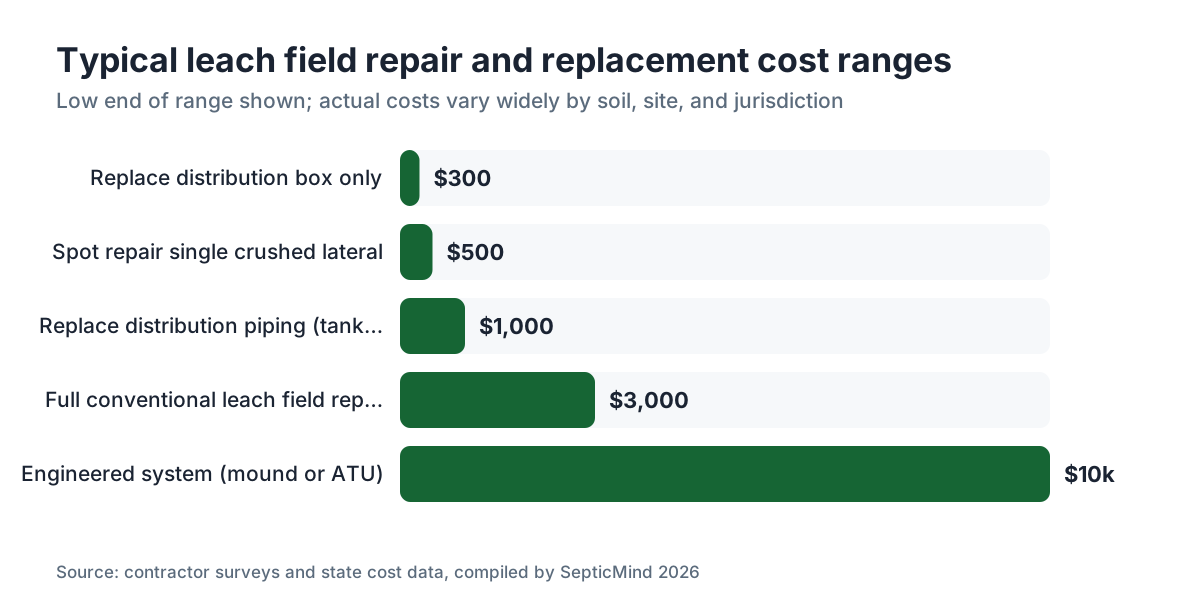
Replacement cost swings hard with your soil, lot size, site access, local permit fees, and what code demands where you live. Here are honest ranges from contractor surveys and state cost data.
| Scope of work | Typical cost range |
|---|---|
| Replace distribution box only | $300 to $800 |
| Repair single crushed lateral (spot excavation) | $500 to $2,000 |
| Replace distribution piping from tank to field | $1,000 to $3,000 |
| Full leach field replacement (conventional system) | $3,000 to $15,000 |
| Full leach field replacement (engineered system, mound, ATU) | $10,000 to $30,000+ |
The wide range on full replacement is real. A flat lot with sandy loam, easy equipment access, and a rural county with low permit fees might land near $4,000. A sloped lot with clay soil and a high water table that forces a mound system, in a suburban county with strict engineering rules, can blow past $25,000. Some states, Massachusetts among them, require a licensed engineer to stamp the design, which adds $1,000 to $2,500.
Permits are not optional. Every state requires a permit for a new field, and most require one for any repair that touches absorption area. Skip it and you're looking at fines, forced removal, and a mess when you try to sell. Our overview of cost to install septic system breaks it down wider.
If you need to know whether your budget covers a new tank on top of a new field, the guide on cost to put in a septic tank has current numbers.
What pipe specifications does your state code actually require?
State onsite wastewater codes are the controlling document. Federal EPA guidance sets a floor, but states write the enforceable rules, and those rules differ in ways that hit your project.
A few examples:
North Carolina (15A NCAC 18A .1900 series) requires distribution laterals to be 4-inch minimum, perforated, and laid level or at no more than 1/8-inch-per-foot slope, perforations down. Aggregate has to be clean washed stone, 3/4 to 1.5 inch [2].
Florida (64E-6 F.A.C.) requires a minimum 2-foot separation between the drainfield bottom and the seasonal high water table and lists acceptable pipe materials including PVC ASTM D2729 [4].
California hands most authority to individual counties under state Environmental Health rules, which means Sonoma County can look meaningfully different from Riverside County [10].
New York State Department of Health Part 75 spells out pipe size, aggregate specs, and setbacks from wells, property lines, and foundations [6].
The EPA's SepticSmart resources send homeowners to their state environmental or health agency as the first stop for local rules [1]. Your county health department's onsite wastewater or environmental health division is usually the fastest route to the exact code language for your lot.
Planning a new install and want to understand the inspection steps before permits issue? See our guide to septic tank inspection.
How do you maintain leach field piping to extend its life?
Most leach field maintenance is really upstream maintenance. The single best thing a homeowner can do for the laterals is keep the septic tank healthy so only clarified effluent reaches the field.
Pump the tank on schedule. The EPA recommends pumping every 3 to 5 years for a typical household, with the real interval driven by tank size and how many people live there [1]. A tank that runs too long passes solids into the distribution system, clogs the aggregate, and speeds up biomat. For your schedule, see how often to pump septic tank.
Watch what goes down the drain. Cooking grease, wipes (even the "flushable" ones), leftover medications, and heavy doses of household chemicals all knock back the bacteria in the tank and degrade effluent before it ever reaches the pipes.
Manage water use. Spread laundry across the week instead of six loads on Saturday. Fix dripping faucets and running toilets. A leaking toilet flapper can waste 200 gallons a day, enough to hydraulically drown a properly sized field [1].
Keep roots away. Planting near the field? Stick with shallow grasses and wildflowers. Take out any tree within 20 feet of the field edge, especially willows and silver maples.
Never drive over the field. Mark the corners with low stakes so contractors, delivery trucks, and your own truck stay off it. One pass with a loaded pickup can crush a lateral and undo decades of care.
Operators running multiple systems need a way to track inspection dates, maintenance intervals, and permit status across a fleet of properties. SepticMind's operations software keeps all of that in one place instead of scattered across paper logs and spreadsheets.
Inspect the distribution box every time you pump the tank. Confirming the box is level and all outlets are clear takes five minutes and can catch uneven loading before it becomes a dead lateral.
What happens during a leach field piping inspection?
A leach field inspection runs anywhere from a simple dye test to a full camera pass on every lateral, depending on why you're doing it and what your state requires.
For a real estate sale, most state inspection standards have the inspector locate the components, check tank condition and baffle integrity, and watch whether the field surfaces or backs up under a hydraulic load test (running water into the house for 15 to 30 minutes while watching the field). That's a functional test, not a structural one. It can miss a field that's close to failure but not obviously failing yet.
A deeper inspection means digging an observation port at the end of one or more laterals to check whether effluent is moving through and not ponding at the outlet. Some inspectors thread a borescope into the laterals from a cleanout to look for biomat, offset joints, or roots.
Pressure testing, where a section of lateral gets plugged and pressurized with air or water to check for leaks or breaks, is rare on residential jobs but shows up in some states for new installs or major repairs.
Massachusetts Title 5, one of the most detailed protocols in the country, requires a licensed inspector to assess the distribution system and record the condition of every observed component in a standardized report. Massachusetts requires this inspection before a property sale [7].
Knowing what an inspector checks helps whether you're buying a home on septic or trying to read a report you already have. The septic tank inspection guide covers the full process.
What is the difference between standard leach field pipe and chamber systems?
This one comes up a lot, because chamber systems have taken over a big share of new construction since the early 2000s.
A standard field uses perforated pipe sitting on washed gravel. The aggregate holds the pipe above the trench bottom, opens up void space for effluent to spread, and gives biofilm surface area for treatment before liquid reaches native soil.
A chamber system swaps the pipe-and-gravel setup for arched plastic chambers that snap together end-to-end in the trench. Effluent from the distribution pipe enters the chamber, pools on the trench bottom, and soaks into the native soil through the open bottom. No gravel at all.
What chambers buy you: less excavation, no aggregate to truck in, easier installs on tight-access sites, and good soil contact through the open bottom. Many states now accept chambers as equivalent to conventional aggregate systems. Infiltrator Water Technologies, the dominant maker, has published design data showing chambers match or beat aggregate trenches on hydraulic performance in side-by-side tests [8].
The tradeoffs: chambers usually cost more per linear foot than pipe and gravel, and they need careful installation (level seating, solid connections) to avoid uneven settlement. Roots can still work in through the open bottom.
For pipe specs, chambers still use 4-inch solid PVC for the distribution run from the tank to the first chamber; the chambers themselves stand in for the perforated laterals. So the upstream piping standards still apply.
Frequently asked questions
What size pipe is used in a leach field?
Four-inch diameter is standard for both distribution pipe and perforated laterals in residential systems. Some high-capacity or commercial installations use 6-inch pipe. Most state onsite wastewater codes set 4-inch as the minimum. The distribution pipe from the tank to the field is solid-wall PVC; the laterals inside the trenches are perforated PVC or corrugated PE.
How deep is leach field pipe buried?
Typically 18 to 36 inches to the bottom of the gravel bed, with the perforated pipe sitting in the upper part of that aggregate layer. Actual depth depends on your state code and the required separation between the trench bottom and your seasonal high water table or a restrictive soil layer. Shallow systems (12 to 18 inches) exist in warm climates with favorable soils.
Which direction do the holes in leach field pipe face?
Perforations face down. This surprises most people. Holes-down means effluent drips onto the gravel bed below the pipe and spreads slowly across the trench bottom. Holes-up would push effluent up into the soil cover above the pipe, skipping the treatment aggregate and the deep soil entirely. Most state codes specifically require downward-facing perforations.
How long does leach field piping last?
The pipe itself, if it's PVC and not crushed or root-damaged, can last 50 years or more. The limiting factor is almost always the soil, not the pipe. A conventional gravity system has a design life of about 20 to 30 years before biomat cuts soil permeability enough to fail. Good tank maintenance and avoiding hydraulic overload are the biggest factors in reaching that.
Can you clean out leach field pipes without replacing them?
If the blockage is mechanical, like roots or a partial pipe collapse, a pro can sometimes hydro-jet or cable the lateral and restore flow. If the blockage is biomat in the surrounding soil, cleaning the pipe does nothing, because the soil itself is sealed. Hydro-jetting is worth trying before full replacement when a camera shows a pipe-level obstruction rather than soil saturation.
What is the minimum distance between leach field trenches?
Most state codes require at least 6 feet between trench centerlines. Some specify a minimum edge-to-edge spacing of 4 to 6 feet instead. This spacing keeps adjacent trenches from sharing absorption area and competing hydraulically, which would drop total capacity below what the design needs. Your county health department's onsite wastewater code has the exact figure for your area.
How much slope does leach field pipe need?
Lateral pipes in a gravity system should be essentially level, no more than 1/8 inch of fall per foot. The goal is uniform distribution down the whole trench; too much slope dumps effluent at the downhill end. The solid distribution pipe running from the tank to the field needs 1/8 to 1/4 inch per foot to keep flow moving and stop solids settling in the line.
What kind of gravel goes around leach field pipes?
Clean, washed crushed stone or rounded gravel, typically 3/4-inch to 1.5-inch nominal. The aggregate must be washed (free of fines and dust) because fine particles migrate into the soil and seal it. Using the wrong aggregate, like pea gravel or unwashed stone, is one of the leading install errors behind early failure. Most state codes specify aggregate size and require certified-clean material.
Can tree roots really destroy leach field pipes?
Yes, and faster than most people expect. Aggressive-rooting trees like willows, poplars, and silver maples can push roots into perforated laterals within a few years of planting. Once inside, roots grow fast, fill the pipe, and cause total blockage. Most codes bar trees within 10 to 50 feet of a field. If you have mature trees near an older field, a camera inspection is the only way to know its current condition.
Is it legal to drive over a leach field?
No. Nearly every state onsite wastewater code bars vehicles, structures, and hard surfaces over the absorption area. Vehicle weight compresses the soil structure, cuts pore space, and can crush laterals. Even a single pass from a heavy delivery truck can crack PVC and compact the aggregate. Mark the boundaries and keep all traffic off it, including riding mowers on soft ground.
How do I find my leach field pipes if I don't have a site plan?
Start by requesting the as-built permit drawing from your county health department; most jurisdictions kept records of permitted systems. If no drawing exists, a septic inspector can locate the tank by probing the yard and trace the distribution line with a metal detector or a sonde transmitter run through the pipe. A locating service can also use ground-penetrating radar. Never dig near utilities without calling 811 first.
What is the difference between a leach field and a drain field?
Nothing. They're the same thing. Leach field, drain field, absorption field, and seepage field all name the network of perforated pipes buried in aggregate-filled trenches that take septic tank effluent and spread it into the soil for final treatment. Regional terms vary, but the engineering is identical. Some pros say 'seepage bed' when the system is one wide excavation rather than separate trenches.
Does pumping the septic tank help a failing leach field?
Pumping the tank is the right first response when you suspect field trouble, because it clears accumulated solids that could be overloading the system and improves effluent quality right away. If the field is failing on poor effluent (broken baffles passing solids), pumping plus baffle repair can let it recover. If the soil has permanently sealed after years of biomat, pumping buys time but doesn't fix the root problem.
Sources
- U.S. EPA, SepticSmart Program: EPA does not recommend septic system additives; surfacing sewage requires immediate attention; recommends pumping every 3-5 years; leaking toilet can waste 200 gallons per day.
- North Carolina Department of Health and Human Services, Onsite Wastewater Rules (15A NCAC 18A .1900): NC rules require 4-inch minimum perforated distribution laterals laid at no more than 1/8-inch-per-foot slope, perforations down, on clean washed stone 3/4 to 1.5 inch.
- U.S. EPA, Design Manual: Onsite Wastewater Treatment and Disposal Systems (1980): Minimum 2 feet of unsaturated soil below trench bottom recommended for adequate treatment; pressure dosing can double effective life of absorption field compared to gravity distribution.
- Florida Department of Health, 64E-6 F.A.C. Onsite Sewage Treatment and Disposal Systems: Florida requires 24-inch separation between drainfield bottom and seasonal high water table; specifies approved pipe materials including PVC ASTM D2729.
- University of Minnesota Extension, Septic System Owner's Guide: Reducing hydraulic loading and allowing periodic drying cycles can partially restore soil permeability in biomatted systems.
- New York State Department of Health, Part 75 Individual Household Systems: NY Part 75 specifies pipe size, aggregate specifications, and setback distances from wells, property lines, and foundations for onsite wastewater systems.
- Massachusetts Department of Environmental Protection, Title 5 Inspection Program: Massachusetts Title 5 requires a licensed inspector to assess distribution system components and record findings in a standardized report before property sale.
- Infiltrator Water Technologies, Chamber System Design and Installation Guide: Infiltrator has published design data showing equivalent or better hydraulic performance of chamber systems compared to conventional aggregate trench systems.
- U.S. EPA, Onsite Wastewater Treatment Systems Manual (2002): Conventional septic system design guidance including trench dimensions, aggregate specifications, and distribution system design criteria.
- California State Water Resources Control Board, OWTS Policy: California delegates onsite wastewater authority to individual counties, resulting in jurisdiction-specific pipe and design requirements.
Last updated 2026-07-09