Leach field pipe: types, sizes, and what actually works
By the SepticMind Editorial Team
TL;DR
- Leach field pipe spreads septic effluent across a drain field so soil can treat it.
- Two options dominate: perforated PVC (rigid, 4-inch schedule 40 or SDR 35) and corrugated HDPE.
- Gravelless chamber systems skip pipe-in-gravel entirely.
- Pipe choice drives cost, longevity, and whether your local code allows it.
- Most residential laterals run 4-inch diameter, 100 feet or less per trench.
What is leach field pipe and what does it actually do?
Leach field pipe is the perforated pipe that carries clarified septic effluent from the distribution box out through a series of trenches. Effluent seeps through the holes and into the surrounding soil. The soil does the real work: it filters pathogens, breaks down nutrients, and returns cleaned water to the groundwater table.
The pipe is close to a delivery mechanism. It holds effluent long enough for it to drain through the perforations at a slow, even rate across the trench. Do that well and the biomat that forms at the soil interface stays thin and permeable. Do it poorly, and you get pooling, channeling, and a drain field that dies years before its time.
For how the whole system fits together, see our guide on the leach field.
The EPA's SepticSmart program describes the drain field as the component where "wastewater percolates into the soil, naturally removing harmful coliform bacteria, viruses, and nutrients" [1]. That only works if the pipe spreads effluent evenly and stays clear.
What types of leach field pipe are used in residential septic systems?
Three pipe families dominate residential drain field installs in the United States. Each has real trade-offs.
Perforated PVC (SDR 35 or Schedule 40)
This is the default in most jurisdictions. Perforated PVC is rigid, smooth-walled, dimensionally consistent, and it resists root intrusion better than corrugated pipe because roots have fewer crevices to grip. Schedule 40 has thicker walls (pressure-rated). SDR 35 has thinner walls sized for gravity drainage. Both come in 4-inch and 6-inch diameters. Most state onsite wastewater codes accept perforated PVC by default, no variance needed [2].
Corrugated perforated HDPE ("flex pipe")
High-density polyethylene corrugated pipe is lighter and cheaper than PVC, which makes it tempting on tight budgets or hard-to-reach sites. The corrugations create small ridges inside the pipe that collect sediment and give roots a foothold. Extension studies have shown higher clogging rates in corrugated pipe than in smooth-wall PVC over 10-plus-year timelines, though the sample sizes are small and not uniformly controlled. I'd use corrugated HDPE only when code allows it and the budget demands it.
Gravelless leach field pipe systems (chambers and bundled media)
Gravelless systems replace the pipe-in-gravel trench with either plastic arch chambers (Infiltrator, Cultec) or pipe wrapped in synthetic media (geotextile-wrapped EZ Flow, Baughman Tile ADS). The EPA's guidance on innovative and alternative systems accepts gravelless designs as an alternative to conventional gravel-and-pipe when properly designed [3]. They cost less in labor because they skip gravel hauling, and University of Minnesota Extension work shows equal or better hydraulic performance per linear foot of trench compared to gravel [4].
| Pipe type | Typical diameter | Approx. material cost per linear foot | Root resistance | Code acceptance |
|---|---|---|---|---|
| Perforated PVC SDR 35 | 4 in | $0.50 to $1.20 | High | Near-universal |
| Perforated PVC Sch 40 | 4 in | $0.80 to $1.60 | High | Near-universal |
| Corrugated HDPE | 4 in | $0.30 to $0.70 | Moderate | Most states |
| Gravelless chamber | N/A (arch) | $2 to $5 per sq ft of trench bottom | High | Most states, check local |
| Bundled synthetic media | 4 in wrapped | $1 to $3 | Moderate to high | Varies by state |
Material costs above are wholesale supply-house estimates. They do not include gravel, fabric, or labor. Regional pricing varies a lot.
What size pipe does a leach field use?
Four-inch diameter is the residential standard. It shows up in nearly every state onsite wastewater code because 4-inch pipe carries enough flow for a typical household while staying manageable to install by hand in a trench.
Six-inch pipe shows up in two spots: larger commercial systems, and states or localities that require upsizing on long lateral runs to hold grade and hydraulic capacity. Some designers pair a 4-inch distribution lateral with a 6-inch header off the distribution box.
Slope matters as much as diameter. The National Environmental Services Center (NESC) model T-2 design standards recommend a slope between 1/16 inch and 1/4 inch per foot for septic laterals [5]. Slope above 1/4 inch per foot pushes effluent toward the low end, dumping the hydraulic load on the last third of the trench. Slope below 1/16 inch per foot risks standing water and poor distribution.
Trench length per lateral varies by state code and soil perc rate. A common cap is 100 feet per lateral for a single-family home, though some codes allow up to 150 feet. Longer laterals are not better. They often produce uneven distribution unless a pressure-dosed pump system feeds them.
How is leach field pipe installed correctly?
The install sequence matters more than most homeowners realize. A correctly sized pipe with bad grade or poor soil prep will fail early.
The trench is dug to a set depth (typically 18 to 36 inches, soil permitting) and width (usually 12 to 36 inches by code). A 6-inch bed of clean, washed stone (3/4 inch to 1.5 inch diameter) goes at the bottom. The perforated pipe sits on top of that stone bed with perforations facing down. That runs counter to intuition but it's correct: effluent fills the void space in the gravel first and drains through the bottom perforations evenly before it overflows out the sides.
A layer of geotextile fabric goes over the pipe and stone to keep soil from migrating into the gravel. Then backfill covers everything. The trench crown should sit slightly above grade to allow for settling.
Gravelless chamber systems skip the stone. You place chambers end-to-end in a trench dug to the correct depth. Chambers arch over the effluent distribution point and create a void space that mimics what gravel would do. Installation is faster, and that speed is real: Infiltrator Water Technologies has published data showing about a 50% cut in heavy equipment time versus conventional gravel systems [6].
A few things that actually kill leach fields early: heavy vehicle traffic over the trenches (compacts soil, crushes pipe), planting trees or shrubs above the field, and surface water running into the trenches from bad grading. No pipe material overcomes those.
What is the difference between a septic tank and a leach field, and do you always need a leach field?
The septic tank and the leach field are separate components with different jobs. The tank holds sewage long enough for solids to settle and scum to float, leaving a clarified liquid in the middle layer called effluent. That effluent then flows by gravity (or pump) to the leach field for soil treatment.
You do not always need a conventional leach field. A septic tank without one is possible in these cases:
- Mound systems replace in-ground trenches with a raised sand and soil bed above grade, used when the water table or bedrock sits too shallow for conventional trenches.
- Aerobic treatment units (ATUs) treat effluent to a higher standard before surface or subsurface disposal, sometimes cutting the required disposal area.
- Drip irrigation systems spread treated effluent through shallow, small-diameter tubes across a wider area.
- Holding tanks have no disposal component at all. They just store waste until pumped out. They cost a lot to run long-term and are usually allowed only as a temporary or last-resort fix.
The phrase "septic tank without leach field" usually means one of the mound or ATU alternatives above. None of them skip the need for soil or engineered treatment. They just change the geometry or the treatment level.
For cost context on full system installation, see our cost to install septic system and septic tank installation guides.
How long does leach field pipe last?
PVC pipe in good soil and a well-maintained system can last 25 to 40 years or more. The material itself does not degrade quickly. What fails is usually the soil interface (biomat clogging) or physical damage, not the pipe corroding.
Corrugated HDPE has a shorter track record in the literature. Guidance from USDA and extension programs puts its effective service life at 20 to 30 years under normal conditions [7], though some installs have run longer without trouble. The corrugations are the weak point. They hold biofilm and give roots more surface to colonize.
Three things shorten pipe life more than material choice:
- Overloading from an undersized or under-pumped tank that passes solids into the field.
- Root intrusion from trees or large shrubs within 10 to 20 feet of the trenches.
- Soil saturation from high seasonal water tables that stops effluent from draining.
Keeping the tank pumped on schedule is the single highest-leverage thing you can do to protect the leach field pipe. See how often to pump septic tank for the specifics. The EPA recommends pumping most household tanks every 3 to 5 years [1].
What does it cost to replace leach field pipe?
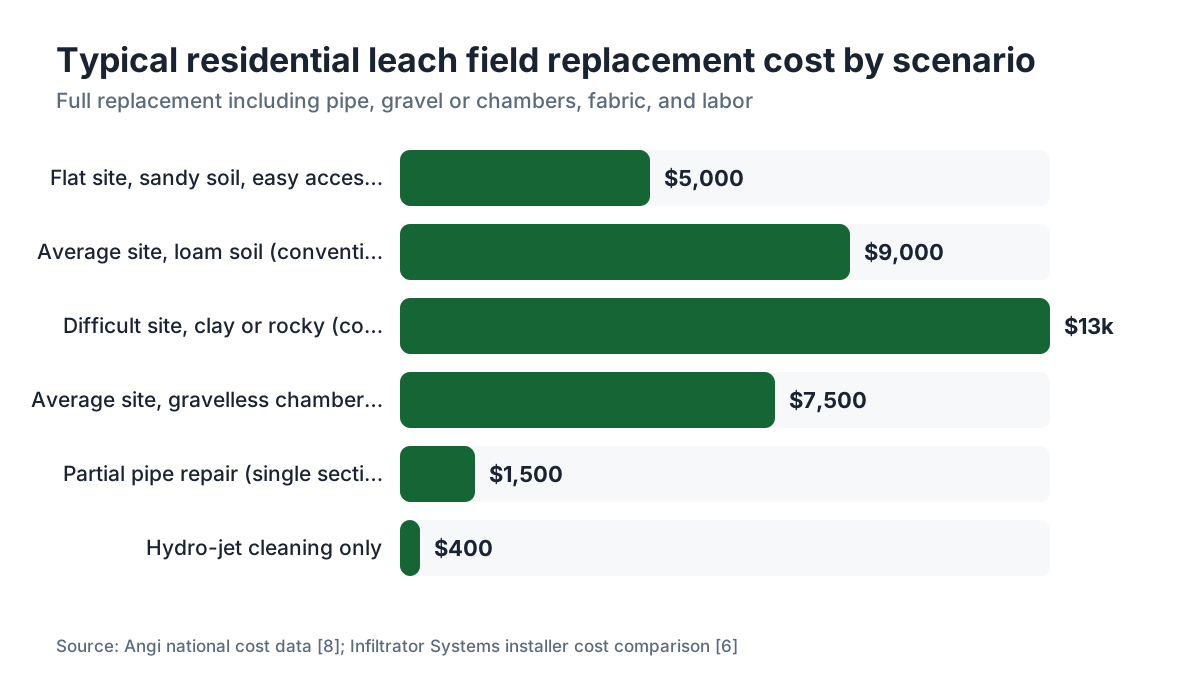
Full leach field replacement, including new pipe, gravel, fabric, and labor, typically runs $3,000 to $15,000 for a conventional single-family system, depending on size, site access, and local labor rates [8]. That wide range is real, not a hedge. A 3-bedroom home on flat sandy soil with easy equipment access might land at $4,000 to $6,000. The same-sized system on a rocky New England hillside can clear $12,000 without much trouble.
Gravelless chamber systems often land at the lower end because gravel hauling is the expensive part of a conventional install. Expect to pay roughly 10 to 20% less on materials and labor for a comparably sized chamber system versus conventional pipe-in-gravel, based on installer quotes and Infiltrator's own cost comparison data [6].
Partial pipe repair (replacing a crushed or root-invaded section) costs $500 to $2,500 depending on how much excavation it takes. Hydro-jetting a partially blocked lateral runs $200 to $600. Neither fix touches a systemically failed biomat. That needs full replacement, or resting and aerating the failed sections.
For broader cost context, our cost to put in a septic tank guide covers what the tank itself adds to the project.
If you manage multiple properties or customer accounts, SepticMind helps service operators track field condition history and schedule preventive maintenance across their customer base. That tends to catch pipe and field problems before they turn into full replacements.
How do you know if leach field pipe is failing or blocked?
The classic warning signs of leach field pipe failure are not subtle once they arrive: slow drains throughout the house, sewage odor near the drain field, and wet or spongy ground above the trenches. Sewage surfacing above the trenches is the endpoint, not the start. By then something has been wrong for months or years.
Earlier indicators:
- Toilets or floor drains backing up after heavy rain (high water table forcing effluent back)
- One trench staying wet while its neighbors stay dry (pipe clog or distribution problem)
- Unusually green or lush grass over one section of the field (effluent fertilizing the surface)
- Gurgling from fixtures when no one is running water
A septic tank inspection with a camera scope of the outlet baffle and laterals confirms whether the problem is in the pipe (blockage, root intrusion, collapse) or in the soil (biomat failure). Those are different problems with different fixes. Scope inspection usually costs $150 to $400 on top of a standard pump-out.
If the field is failing from biomat, no amount of pipe cleaning fixes it. The biomat seals the soil-pipe interface and blocks percolation whether the pipe is clear or not. That takes field resting, aeration, or replacement.
Can you repair or clean leach field pipe without replacing the whole system?
Sometimes, yes. The right answer depends on what's actually wrong.
Root intrusion in an otherwise intact pipe is a fair candidate for hydro-jetting plus root-killing foam (metam sodium or copper sulfate, where local rules allow). The catch with root treatment is that roots usually come back within 2 to 5 years if the tree is still nearby. It buys time, not a permanent fix.
A crushed or offset pipe section from vehicle damage or frost heave can be dug up and replaced in sections without touching the rest of the field. That's real, cost-effective repair. See our septic system repair guide for a fuller breakdown of when repair beats full replacement.
Biofilm or sediment buildup from a tank that wasn't pumped often enough can sometimes be flushed. But if the gravel bed is saturated with sludge that slipped past a failed baffle, hydro-jetting clears the pipe and not the gravel. At that point the system needs more than pipe cleaning. See septic tank repair for the tank-side issues that set off field pipe problems.
A note on additives: no credible peer-reviewed evidence shows that enzyme or bacterial septic additives restore a failed biomat or clean a blocked pipe. The EPA advisory states plainly that no scientific evidence supports the use of additives to extend system life [1]. Save that money.
What do state codes and the EPA actually require for leach field pipe?
Federal law does not directly regulate septic pipe specs. The EPA sets guidance through programs like SepticSmart and publishes the Onsite Wastewater Treatment Systems Manual, but enforcement authority sits entirely with states and, in many states, county health departments [9].
The result is a patchwork. Most states have adopted a version of the standards from the American Society of Civil Engineers or the NSF/ANSI 61 family for plastic pipe, but the specific allowances vary. Florida's Chapter 64E-6 and California's Title 22 are two of the more detailed state codes. Both permit perforated PVC and HDPE but call for specific perforation patterns and minimum pipe stiffness ratings [10][11].
Gravelless systems need a variance or specific approval in some states and are pre-approved in others. Before you spec any pipe type other than conventional perforated PVC on a new install, check your state environmental agency's onsite wastewater regulations. NESC's site (nesc.wvu.edu) keeps a running list of state contacts [5].
One hard rule shows up in nearly every state code: the pipe goes in with perforations pointing down (for gravel-bed systems) or as the manufacturer specifies for gravelless systems, and the slope has to fall within the allowable range. Inspectors do fail installs for wrong perforation orientation. Confirm it with your local inspector before backfill.
What is the best leach field pipe for a new installation?
Perforated PVC SDR 35 is the best default for most new residential installs. It's accepted everywhere, durable, smooth-walled, and installers know it cold. You pay a modest premium over corrugated HDPE and get better root resistance, easier scoping if problems show up later, and no arguments with inspectors.
For sites where gravel cost or delivery is a big driver, a gravelless chamber system is genuinely competitive. University of Minnesota Extension research found chamber systems performed at least as well as conventional gravel-and-pipe for hydraulic loading in comparable soils [4]. The 10 to 20% cost savings on labor and materials is real.
Corrugated HDPE is fine for budget-constrained secondary trenches or replacement runs where cost is the binding constraint and the soil is well-drained sandy loam. I would not spec it on a clay-dominant site or near large trees.
Whatever pipe you use, design and install quality matter far more than the brand. A correctly sloped, properly bedded SDR 35 trench beats a misgraded chamber system every time. Spend the money on a competent installer and a proper perc test before you worry about pipe brand.
For service operators tracking installs and maintenance intervals across many properties, SepticMind can log pipe type, install date, and field condition notes so nothing slips when a customer calls years later.
Frequently asked questions
What size pipe is used for a leach field?
Four-inch diameter perforated pipe is the residential standard in nearly every state. Six-inch pipe is used for larger commercial systems or long lateral runs where hydraulic capacity requires upsizing. Pipe slope should fall between 1/16 inch and 1/4 inch per foot to keep distribution even across the trench length.
Can I use regular PVC pipe for a leach field?
No. Regular solid-wall PVC has no perforations, so effluent cannot exit into the gravel bed. You need perforated PVC, specifically SDR 35 or Schedule 40 with the perforation pattern your local code specifies. Solid pipe makes the field act as a closed conduit and it fails immediately.
Which way do the holes face in leach field pipe?
Perforations face down in a conventional gravel-bed trench. It seems backward but it's correct: effluent fills the gravel void space below the pipe before draining out, which spreads the hydraulic load more evenly across the trench. For gravelless chamber systems, follow the manufacturer's orientation instructions, which vary by product.
How deep should leach field pipe be buried?
Most state codes require at least 6 inches of soil cover over the pipe, with a typical install depth of 18 to 36 inches from the surface to the trench bottom. Shallower installation risks frost damage in cold climates. Deeper installation can put the pipe below the aerobic zone where soil treatment works best.
How many feet of leach field pipe do I need?
Total footage depends on your household size, soil percolation rate, and state code. A common baseline is roughly 150 to 300 linear feet of trench for a 3-bedroom home on average soil (30-minute perc), spread across multiple 60-to-100-foot laterals. A licensed designer running a perc test and soil evaluation gives you the exact number code requires.
What is gravelless leach field pipe and is it better?
Gravelless systems replace the pipe-in-gravel trench with plastic arch chambers or pipe wrapped in synthetic media. They skip gravel hauling, which can cut installation cost by 10 to 20 percent. University of Minnesota Extension research found chamber systems perform as well as conventional gravel-and-pipe in comparable soils. They're accepted in most states, but check local code first.
Can tree roots damage leach field pipe?
Yes. Roots follow moisture gradients and will enter pipe through perforations or joints, eventually blocking flow. Trees within 10 to 20 feet of the trench lines are the main risk. Smooth-wall PVC resists root entry better than corrugated pipe because roots have fewer crevices to grip. Hydro-jetting and root-killing foam give temporary relief, but roots usually return if the tree stays.
How do I know if my leach field pipe is clogged or broken?
Signs include slow drains throughout the house, sewage odors near the drain field, wet or spongy ground over the trenches, and unusually green grass in one area. A camera scope through the cleanout or distribution box laterals confirms whether the problem is inside the pipe (blockage, root intrusion, collapse) or in the soil (biomat). Scoping usually costs $150 to $400.
What is the difference between a septic tank and a leach field pipe?
The septic tank is a watertight container that separates solids from liquid and holds sewage while biological activity breaks down waste. Leach field pipe carries the clarified liquid effluent from the tank out through underground trenches where it seeps into the soil for final treatment. They're sequential: the tank comes first, the leach field pipe second.
Can you have a septic tank without a leach field?
You can, if you use an alternative disposal method: mound systems, aerobic treatment units, drip irrigation dispersal, or (as a last resort) a holding tank. None of these skip the need for treated effluent to go somewhere. They just change the disposal geometry or treatment level. Holding tanks with no dispersal require frequent pump-outs and are rarely permitted for permanent use.
How much does it cost to replace leach field pipe?
Full replacement of a residential leach field, including new pipe, gravel, fabric, and labor, typically runs $3,000 to $15,000. The range reflects site access, soil conditions, system size, and local labor rates. Partial pipe repair (excavating and replacing one damaged section) costs $500 to $2,500. Hydro-jetting a blocked lateral alone runs $200 to $600.
Does the EPA regulate what type of leach field pipe I have to use?
Not directly. The EPA publishes guidance through SepticSmart and its Onsite Wastewater Treatment Systems Manual, but pipe specifications are regulated by state and county health departments. Most states permit perforated PVC and HDPE; gravelless systems need specific approval in some jurisdictions. Always check your state's onsite wastewater code and your local health department before spec'ing materials.
How often should I have my leach field inspected?
A formal inspection every 3 to 5 years, timed with your septic tank pump-out, is a reasonable baseline for most residential systems. Systems with pressure-dosed dispersal, ATUs, or mound components should be inspected annually because their mechanical parts require it. Early inspection catches distribution problems in the pipe before they become full field failures. See our septic tank inspection guide for what an inspection covers.
What pipe material lasts longest in a leach field?
Perforated PVC (SDR 35 or Schedule 40) has the strongest longevity record, with well-maintained installations lasting 25 to 40 years or more. The pipe material itself rarely fails; it's usually the surrounding soil that limits system life. Corrugated HDPE typically sees 20 to 30 years in practice. Gravelless chambers have a shorter field history but manufacturer ratings generally claim 30-plus years.
Sources
- U.S. EPA, SepticSmart homeowner guidance: The EPA recommends pumping most household septic tanks every 3 to 5 years and states that 'wastewater percolates into the soil, naturally removing harmful coliform bacteria, viruses, and nutrients.' EPA also states no scientific evidence supports additives to extend system life.
- U.S. EPA, Onsite Wastewater Treatment Systems Manual (EPA/625/R-00/008): Perforated PVC is recognized as standard pipe material for conventional subsurface drainfield laterals in residential onsite systems.
- U.S. EPA, Innovative and Alternative Onsite Wastewater Treatment Systems guidance: The EPA acknowledges gravelless chamber and bundled-media systems as accepted alternatives to conventional gravel-and-pipe when properly designed.
- University of Minnesota Extension, Septic System Owner's Guide: University of Minnesota Extension research found that chamber systems performed at least as well as conventional gravel-and-pipe for hydraulic loading in comparable soils.
- National Environmental Services Center (NESC), West Virginia University, model design standards for onsite wastewater systems: NESC model T-2 design standards recommend a lateral pipe slope between 1/16 inch and 1/4 inch per foot for septic drain field laterals.
- Infiltrator Water Technologies, chamber system installation and cost comparison documentation: Infiltrator published data showing approximately 50% reduction in heavy equipment time and 10 to 20% lower overall installed cost for chamber systems versus conventional gravel systems.
- Angi, Septic System Cost Guide (national average data): Full leach field replacement including pipe, gravel, fabric, and labor typically runs $3,000 to $15,000 for a single-family residential system nationally.
- U.S. EPA, Septic Systems Overview: regulatory authority: Federal law does not directly regulate septic system pipe specifications; enforcement authority for onsite wastewater treatment rests with states and local health departments.
- Florida Department of Health, Chapter 64E-6 F.A.C., Standards for Onsite Sewage Treatment and Disposal Systems: Florida's Chapter 64E-6 permits perforated PVC and HDPE pipe but requires specific perforation patterns and minimum pipe stiffness ratings for drain field laterals.
- California State Water Resources Control Board, Title 22 wastewater reuse and onsite system standards: California's Title 22 regulations specify acceptable pipe materials and installation requirements for subsurface drainfield systems, including perforated PVC and HDPE.
Last updated 2026-07-09