Leach field problems: causes, signs, and fixes that actually work
By the SepticMind Editorial Team

TL;DR
- Leach field problems run from slow drains and soggy patches to full sewage backups inside the house.
- The root cause is almost always biomat buildup from an under-pumped tank, hydraulic overload, or soil compaction.
- Most failures are preventable with tank pumping every 3 to 5 years.
- Repairs cost $1,500 for minor fixes and $5,000 to $20,000 for a full replacement.
What is a leach field and why does it fail?
A leach field (also called a drain field or soil absorption system) is the last treatment stage of a conventional septic system. Clarified wastewater flows from the septic tank into a network of perforated pipes buried in gravel-filled trenches, then percolates into the native soil where bacteria and filtration remove pathogens before the water rejoins the groundwater. [1]
That soil does real work. It has to accept a steady flow of water, day after day, for decades. Disrupt either the flow rate or the soil's ability to absorb, and you have a problem.
The EPA's SepticSmart program puts it plainly: the three leading causes of premature septic failure are lack of maintenance, excess water use, and flushing materials the system wasn't built to handle. [1] For a leach field specifically, that translates to solids from an under-pumped tank clogging the pipes, too much daily volume drowning soil that can only absorb so many gallons, and non-biodegradable junk plugging the perforations.
Soil type is the variable underneath everything else. A sandy loam might absorb 0.5 to 1.5 gallons per square foot per day. Clay-heavy soil may handle less than 0.2 gallons per square foot per day. [2] A field sized right for the first soil would be badly undersized if the ground behaves like the second. And perc tests done at installation don't always match what the soil is doing decades later.
Age matters too. Most conventional leach fields are designed for a 20 to 30 year life, though plenty last longer with good care. [3] Fields put in during the 1970s and 1980s are now in their end-of-life window, which is one reason septic failures are climbing in older suburban and rural areas.
What are the warning signs of leach field problems?
Catch a failing field early and your options are cheaper. Here are the signs, roughly ordered from mild to serious.
Slow drains throughout the house. Not one clogged sink, but every fixture draining slowly at once. That points downstream, toward the tank or field, not at a local clog.
Gurgling in drains and toilets. Air is being pushed around somewhere in the drain system. Often the first sound you'll hear when a saturated field starts backing pressure up the line.
Sewage odors outdoors. A healthy field treats wastewater underground with no smell at the surface. Odors above the trench lines mean gas is escaping upward because the soil isn't absorbing.
Wet, soggy, or spongy ground over the field. Effluent surfacing is the classic visible failure. The ground may look lush and green from the nutrients in the wastewater but feel wet even in dry weather. [1]
Sewage backup inside the home. The most urgent sign. When toilets won't flush and sewage comes up through floor drains or bathtubs, the field has stopped accepting flow and the tank is probably at capacity.
High nitrate levels in nearby well water. This one takes a test to catch. The EPA recommends testing well water every year if you're on a septic system, especially for nitrates. [4] Readings above 10 mg/L, the federal drinking water standard, can mean partly treated effluent is reaching the water table.
None of these signs is caused only by a leach field, so confirm the source before you spend money. A licensed septic inspector can camera the lines, check the liquid level in the tank against the outlet baffle, and probe the field. See septic tank inspection for what that process looks like.
What causes leach field failure? The real breakdown
Understanding what broke tells you which repair makes sense. Five causes account for nearly everything.
1. Biomat buildup. The most common one. A biomat is a dense layer of anaerobic bacteria and organic material that forms at the soil-gravel boundary in every leach field over time. Some biomat is normal and actually helps treatment. Too much becomes an impermeable seal. It thickens fastest when raw or poorly treated effluent hits the field, which happens when the tank isn't pumped often enough and solids carry over. [3]
2. Hydraulic overload. Every field is sized for a daily flow, typically 75 to 150 gallons per bedroom per day under most state codes. [2] Extra laundry loads, houseguests for weeks, a running toilet dumping hundreds of gallons a day, or an added in-law suite without a bigger field all push past the design limit. Saturated soil can't drain fast enough, and the field starts to pond.
3. Grease and solids from a neglected tank. A tank that's gone 10 or 15 years without pumping builds a scum layer thick enough to push out with the effluent. Grease coats the perforations. Solids pack the gravel voids. Neither reverses on its own. That's why septic tank pumping every 3 to 5 years isn't optional. It's the main thing standing between your tank and a ruined field.
4. Soil compaction and physical damage. Park vehicles over the field, drive equipment across it during a build, or plant deep-rooted trees too close, and you compress the soil and crush the pipes. Compressed soil loses porosity. Crushed pipes can't spread the flow. [1]
5. Saturated water table. In wet climates or low-lying sites, the seasonal water table can rise to within a foot or two of the pipe bottoms. When that happens, the soil below has nowhere to drain. This is a site problem, not a maintenance one, and it usually needs an engineered fix like a raised mound or drip system.
One cause people miss constantly: broken or missing baffles inside the tank itself. Without a working outlet baffle, solids flow straight into the distribution box and field. A septic tank inspection catches this before the damage is permanent.
How do I know if my leach field is failing or just temporarily overloaded?
This matters because the fixes are worlds apart.
A temporarily overloaded field recovers. Host 20 people for a holiday weekend, run slow for two days after, and that's just hydraulic overload. Cut water use, wait 48 to 72 hours, and normal function usually returns. If the system bounces back and stays back, the field itself is probably fine.
A failing field doesn't recover with rest. Sewage surfaces again a day or two after you cut back. Or it never fully drains. Or you've cycled through this three or four times in the past year. That's compromised soil structure or a biomat problem.
The most reliable diagnostic is a professional inspection with a liquid-level check. If effluent in the distribution box or the field observation ports (when they exist) sits at the top and won't drop, the field isn't accepting flow. If a pump test shows the tank emptying normally while the field stays flooded, the problem is in the soil, not the tank.
Operators running multiple properties can use tools like the SepticMind platform to flag service histories and overdue pump intervals before they turn into field failures, which is exactly where the money gets saved.
Nobody has clean data on how often field inspections turn up temporary overload versus true failure. The closest figures come from EPA case studies of onsite system failures, which attribute roughly 60% of field failures to inadequate maintenance (mostly missed pumping) rather than design or soil defects. [3]
What are the repair options for a failing leach field?
Options run from free to five figures. Here's an honest read on each.
Cut water use hard. Free, and always the first move. Dropping household water use by 30 to 40% for 2 to 4 weeks gives a stressed field a chance to drain and partly recover. Install low-flow fixtures, fix leaking toilets (a running toilet can add 200 gallons a day), and spread laundry across the week. This fixes nothing permanently, but it can stabilize an overloaded system while you plan.
Pump the tank. If it hasn't been pumped recently, do this before anything else. Cost runs $250 to $600 depending on tank size and region. [5] Pumping pulls out the solids that keep feeding the biomat. Skip it and every other treatment is temporary. See septic tank pump out for the details.
Biomat treatment products (the "best leach field cleaner" question). Bacterial and enzyme additives sold as field restorers get advertised hard. The pitch: add oxygen-tolerant or biomat-digesting bacteria to break down the seal. The evidence is mixed. The EPA's guidance is that additives have not been shown to eliminate the need for regular pumping and that some chemical additives can harm soil structure or contaminate groundwater. [6] Some products with facultative bacteria (Roebic K-570 and similar) have anecdotal contractor support for mild biomat in fields that are otherwise sound. If you want to try one, pick a product that lists active bacterial strains rather than an enzyme-only formula, and don't expect miracles on a heavily clogged field.
Soil fracturing / Terralift. A specialized truck drives over the field and injects compressed air at pipe depth to fracture the compacted biomat zone and restore porosity. Cost is roughly $1,000 to $4,000 depending on field size and injection points. Results vary a lot. It works best on biomat-clogged fields with intact pipes in reasonably permeable soil. It does nothing when the soil is simply too dense or too wet.
Pipe jetting. High-pressure water clears physically blocked perforated pipes. Useful when grease or solids packed the pipes but the gravel and soil around them are still decent. Cost: $500 to $2,000.
Field expansion or new field. Adding a second field (a parallel system or a designated reserve area) works when you have the room and the original field can rest for 1 to 3 years. Most state codes require a designated reserve area on the lot. [2] Medium cost: typically $3,000 to $8,000 for a conventional expansion.
Full field replacement. A new trench system with fresh gravel, new perforated pipe, and often a new distribution box. Cost: $5,000 to $20,000 for a standard residential system, more if a mound or alternative system is needed because the native soil fails perc testing. [5]
Alternative system. When the native soil genuinely can't support a conventional field, the options are mound systems, drip irrigation, aerobic treatment units, or constructed wetlands. These run $10,000 to $30,000 and up, and most states require an ongoing maintenance contract. [7]
See cost to install septic system for a fuller breakdown of what drives replacement pricing.
How much do leach field repairs cost?
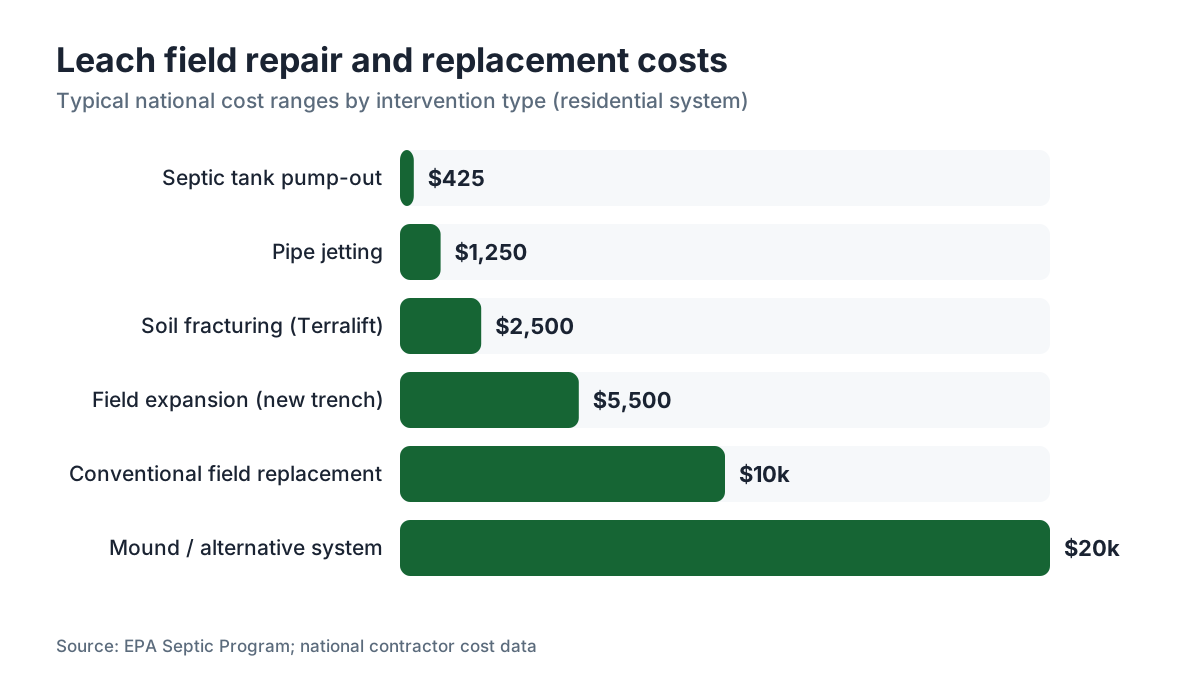
Here's a realistic cost table built from national contractor data and EPA estimates. Regional spread is big: labor runs cheap in rural areas and much higher in the Northeast and along the Pacific Coast.
| Repair Type | Low Estimate | High Estimate | Notes |
|---|---|---|---|
| Tank pumping (prerequisite) | $250 | $600 | Do before any field work |
| Septic additive/cleaner | $20 | $150 | Per treatment, not per year |
| Pipe jetting | $500 | $2,000 | Perforated pipes only |
| Soil fracturing (Terralift) | $1,000 | $4,000 | Field-size dependent |
| Field expansion (new trench) | $3,000 | $8,000 | Requires reserve area |
| Conventional field replacement | $5,000 | $15,000 | Standard 3-bedroom system |
| Mound or alternative system | $10,000 | $30,000+ | Poor soil or high water table |
Most homeowners spend $5,000 to $12,000 on field work when a full replacement is needed. [5] The wide range comes from soil conditions, field size, local permit fees, and whether the tank and distribution system also need work.
One real cost people forget: permitting. Most states require a permit before any field construction or replacement, and some counties take weeks to process the application. In New England and the Pacific Northwest, permit and engineering fees alone can add $500 to $2,500. [2]
Comparing repair against replacement on an older system, the honest math usually favors replacement when the field is over 20 years old, two or more repairs have already failed, or the inspection shows crushed or collapsed pipes. Spending $4,000 on a Terralift job over a 35-year-old field with broken pipe is money you won't see again.
Can a leach field be fixed without replacing it?
Sometimes, yes. The answer depends almost entirely on what caused the problem.
If the field has moderate biomat buildup and intact pipes, and you pump the tank and cut water use, some recovery is possible. A University of Minnesota Extension analysis found that resting a leach field by routing flow to a second field for 1 to 3 years can allow significant biomat die-off and soil recovery in systems with permeable native soil. [3] That's not a small commitment, but it beats replacement.
If the pipes are crushed, the gravel is packed with decades of sludge, or the soil has lost its structure for good, no gentle treatment will work. The field has to come out.
A few things get sold hard but don't work: pumping oxygen into the field with blowers, pouring drain cleaning chemicals into the system (that damages soil structure and kills the bacteria you want), and over-dosing any additive again and again. Chemical "best leach field cleaner" products with big claims deserve skepticism, especially when the label won't list specific bacterial strains and colony counts. [6]
The most underrated fix short of replacement is a legitimate inspection by a licensed septic engineer or soil scientist before you spend a dime on treatments. Plenty of homeowners drop $1,500 on additives and aeration before finding out the distribution box outlet was just clogged with roots. That fix costs $300.
What common mistakes cause leach fields to fail early?
These patterns show up over and over in failed systems.
Skipping pump-outs. The single biggest factor. A 1,000-gallon tank on a 3-bedroom home fills its sludge and scum layers to dangerous levels in roughly 3 to 5 years. [8] Wait 10 years and you're sending solids straight into the field. The how often to pump septic tank question has a real answer based on household size and tank volume.
Flushing wipes and solids. "Flushable" wipes do not break down in a septic system. Neither do feminine hygiene products, cigarette butts, or cotton swabs. They pile up in the tank and eventually reach the field.
Garbage disposals. A disposal raises the solids load entering the tank by 50% or more, according to some state extension estimates. [9] Many state health departments actively recommend against running a disposal on septic for that reason.
Water softener discharge. Brine from regenerating softeners adds salt and water. Some research suggests the sodium disperses clay particles and cuts soil permeability over time. [9]
Trees and shrubs over the field. Roots follow moisture. Willows, maples, and poplars are the worst offenders. A root that finds a perforation can grow enough in one season to block the pipe.
Parking or building over the field. One vehicle crossing once is usually minor. Repeated traffic, parking, or construction equipment is cumulative and eventually permanent. Never put a shed, deck, or addition over a leach field.
Connecting roof drains or sump pumps to the septic. Illegal in most places, and it dumps enormous hydraulic load. A single inch of rain on a 1,500 square foot roof produces nearly 1,000 gallons of runoff, and all of it has to go somewhere if it lands in the septic system.
How do I prevent leach field problems from coming back?
Prevention comes down to discipline on four things.
Pump the tank on schedule. Every 3 to 5 years for a typical home, sooner with a large household or a garbage disposal. This is not optional if you want the field to last. See septic tank cleaning for what a proper service covers.
Manage water use. The field has a daily absorption ceiling. Check your permit or as-built drawing for the designed daily flow. Spreading laundry across the week instead of 10 loads on Saturday makes a measurable difference.
Protect the field physically. Mark the corners with stakes before any landscaping, grading, or construction. Keep vehicles off it. Plant only shallow-rooted grass over the trenches.
Inspect on a schedule. The EPA recommends a professional inspection every 3 years for systems without mechanical parts, and yearly for systems with pumps or aerobic units. [1] Early inspection catches broken baffles and distribution box trouble before they wreck the field.
Stop treating drains like a trash chute. Coffee grounds, grease, medications, and household chemicals all mess with the bacteria in the tank or the soil chemistry in the field.
For operators juggling many service accounts, tracking pump intervals across dozens of clients is where systems like SepticMind earn their keep: automated service reminders and maintenance logs prevent the "nobody pumped it for 12 years" failure that drives most premature field replacements.
Does homeowner's insurance cover leach field failure?
Usually no. Standard homeowner's policies exclude septic failures because they're treated as a maintenance issue, not a sudden accidental loss. [10]
There are exceptions. If a specific outside event caused the failure, say a contractor crushing the field during a build, a homeowner's policy might cover it under the property damage clause. Some insurers sell septic riders or supplemental coverage as an add-on, worth asking about when you shop policies.
A few companies offer standalone septic insurance or service contracts. Coverage varies wildly, and many exclude the drain field specifically or cap payouts well below replacement cost. Read the exclusions before you pay a premium.
For most homeowners, the practical answer is to budget for it. A replacement field at $8,000 to $15,000 is a foreseeable expense on any septic home. Setting aside $500 to $800 a year covers it over 15 to 20 years with no financial emergency.
Buying a home on septic? Get a septic tank inspection before closing. Some states require it. All of them should. A failed or near-failing field changes the negotiation fast.
Are there regulations governing leach field repair and replacement?
Yes, and they vary a lot by state and county.
At the federal level, the EPA sets general guidance under the Clean Water Act but delegates onsite wastewater (septic) regulation to the states. [4] The EPA's 2003 Voluntary National Guidelines for Management of Onsite and Clustered (Decentralized) Wastewater Treatment Systems pushed states to adopt management programs, but adoption has been uneven. [12]
At the state level, every state runs its own onsite wastewater code. Most require a permit before field construction, repair, or replacement. Many require a licensed engineer or certified installer. Some states (Washington, Oregon, and Minnesota among them) have some of the most detailed codes in the country, spelling out minimum setbacks, soil evaluation methods, and monitoring requirements. [2]
Setback rules matter in practice. Most state codes require minimum distances from the field to property lines (typically 5 to 10 feet), water supply wells (typically 50 to 100 feet), surface water (typically 50 to 100 feet), and building foundations (typically 10 to 20 feet). [7] On a small lot, those setbacks can box in where a replacement field can go, which sometimes forces a mound system or alternative technology as the only legal option.
Local health departments issue the permits and usually sign off on the inspection after installation. Some jurisdictions require a licensed soil scientist to run a soil evaluation before any new field goes in. Do not skip permitting: unpermitted septic work creates title problems when you sell and can bring fines or a mandatory removal order.
State-specific code references are available through your state environmental or health agency. For a starting point, the EPA maintains a list of state program contacts at epa.gov. [4]
What's the difference between a leach field problem and a septic tank problem?
The two failure modes share some symptoms but come from different causes and cost very different amounts to fix.
A septic tank problem is usually a cracked tank, broken inlet or outlet baffles, a failed pump (in pump-out systems), or a clogged effluent filter. Symptoms include sewage backup, odors near the tank access lids, and sometimes a high liquid level inside the tank. Tank repairs often run $200 to $2,500, a fraction of field replacement. See septic tank repair and septic system repair for those cases.
A leach field problem is the soil-based treatment and absorption component failing. Symptoms include the same backups and odors, but with wet ground over the field, smells localized above the field, or an inspection showing the distribution lines flooded.
The diagnostic pivot is a level check in the distribution box, the small concrete or plastic box where the tank outlet splits flow to the field trenches. If the box shows effluent backed up to the top, the field isn't accepting flow. If the tank is high but the box is normal, the problem sits between the tank and the box.
Because these problems look identical from inside the house, a thorough inspection is the only way to pin the failure and avoid paying to fix the wrong thing.
Frequently asked questions
How long does a leach field last?
A well-maintained conventional leach field typically lasts 20 to 30 years, and many run 40 years or more. Lifespan depends heavily on soil type, daily water use, and whether the septic tank has been pumped on schedule. Poorly maintained systems, especially ones that went years without pumping, often fail in 10 to 15 years as solid carry-over destroys the soil's absorption capacity.
Can I fix a leach field myself?
Minor things like reducing water use, fixing a leaking toilet, or applying a bacterial additive are DIY. Any real construction, pipe repair, or soil work on the field requires a permit in nearly every state and usually a licensed contractor. Unpermitted field work creates problems when you sell the home and can bring fines. If you suspect a real failure, hire a licensed septic inspector before doing anything.
What is the best leach field cleaner or restorer?
The EPA's position is that no additive eliminates the need for regular pumping. Bacterial products with multiple strains of facultative anaerobes (Roebic K-570, for example) have the most contractor support for mild biomat in structurally sound fields. Enzyme-only products have weaker evidence. Avoid chemical drain cleaners, which damage soil structure. Any additive is a supplement to pumping, not a replacement for it.
How do I know if my leach field has failed completely?
Signs of complete failure: sewage surfacing consistently over the field, sewage backing up inside the house, effluent sitting at the top of the distribution box and not dropping even after days of minimal water use, and strong hydrogen sulfide odors over the field. A professional inspection with a level check and probing confirms it. Partial failure symptoms tend to be intermittent before they turn constant.
How long does it take to replace a leach field?
Physical installation of a conventional replacement field typically takes 1 to 3 days of excavation and pipe work for a residential system. Permitting adds 1 to 6 weeks in most jurisdictions. Some counties take longer, especially in dense or environmentally sensitive areas. Soil evaluation and engineering design, required in many states, can add another 1 to 3 weeks. Plan on 4 to 8 weeks from decision to finished installation in a typical case.
Can too much rain damage a leach field?
Yes. Heavy or prolonged rain raises the water table and saturates the soil around the trenches. When the soil is already holding all the water it can, effluent from the field has nowhere to go and backs up. This is a site condition, not a failure of the field itself, and most systems recover once the water table drops. Repeated seasonal flooding suggests the field was undersized or poorly sited for the soil.
How far should a leach field be from a well?
Most state codes require a minimum of 50 to 100 feet between a leach field and a drinking water well. Some states require 100 to 150 feet for certain soil types or high-capacity wells. The EPA recommends testing well water yearly for nitrates and coliform bacteria if you have an onsite septic system. Check your state's onsite wastewater code for the exact setback, since it isn't uniform nationwide.
Does a leach field need to be pumped?
The leach field itself is not pumped. What needs regular pumping is the septic tank that feeds it. Pumping the tank every 3 to 5 years removes the solids and scum before they can overflow into the field lines. Some systems use an effluent pump to move wastewater from the tank to the field, and that pump needs periodic inspection and eventual replacement, but it's separate from the field.
What happens if I keep using a failing leach field?
Continued use speeds up the damage and creates health hazards. Untreated sewage surfacing in the yard is a direct pathogen exposure risk to children, pets, and neighbors, and it can contaminate nearby surface water and wells. In most states, running a malfunctioning septic system is a code violation that can bring fines and mandatory repair orders. Some jurisdictions can issue a cease-use order until the system is fixed.
Can roots be destroying my leach field?
Yes. Tree roots are a real but under-diagnosed cause of field failure. Roots from willows, maples, poplars, and other large trees follow moisture and can enter pipe perforations within a few growing seasons. Once inside, they grow into dense mats that block flow. A camera inspection of the distribution lines confirms root intrusion. Caught early, mechanical cutting and root-killing treatments can help. Severely infested pipes need replacement.
What is a distribution box and why does it matter for leach field problems?
A distribution box (D-box) is a small concrete or plastic box between the tank outlet and the field trenches. It splits effluent evenly across all the field lines. If the box cracks, shifts, or clogs, one trench may take all the flow while others stay dry, overloading a single section. Inspecting and leveling the D-box is a cheap repair ($200 to $800) that gets skipped before expensive field work starts.
How does a mound system differ from a conventional leach field?
A mound system is used when the native soil fails percolation requirements, either because it's too dense, too close to the water table, or too shallow to bedrock. Instead of burying pipes in native soil, a mound builds up a raised sand and gravel bed above grade. Effluent is pumped up into the mound and treated as it percolates down. Mounds cost more ($10,000 to $25,000) and need more maintenance than conventional fields.
Does homeowner's insurance cover leach field replacement?
Standard homeowner's policies almost always exclude septic failures because they're classified as maintenance rather than a sudden accidental loss. Some insurers offer septic riders with partial coverage, but many specifically exclude the drain field or cap payouts below replacement cost. Read your policy exclusions carefully. The practical move for most homeowners is to budget $500 to $800 a year toward a septic replacement fund.
What is a perc test and does my replacement field need one?
A percolation (perc) test measures how fast water drains through your soil, in minutes per inch. It's used to size a leach field and confirm the soil can handle the expected load. Most states require a new perc test or soil evaluation before issuing a permit for field replacement, especially if the new field goes in a different area. Costs run $200 to $500 for the test plus a state-certified soil evaluator in many jurisdictions.
Sources
- EPA SepticSmart program, U.S. Environmental Protection Agency: Leading causes of septic failure are lack of maintenance, excess water use, and flushing improper materials; wet ground over field and odors are key failure signs; vehicle traffic over fields causes compaction damage
- Minnesota Pollution Control Agency, Septic Systems program: Soil absorption rates, field sizing based on daily flow per bedroom, setback requirements, and permitting requirements for field construction
- University of Minnesota Extension, Onsite Sewage Treatment Program: Conventional leach fields designed for 20-30 year lifespan; biomat formation mechanism; field resting allowing soil recovery; maintenance neglect accounts for majority of premature failures
- EPA, Septic Systems and the Clean Water Act: EPA delegates onsite septic regulation to states; recommends annual well water testing for nitrates; federal drinking water nitrate standard is 10 mg/L; EPA maintains state program contacts
- EPA, How Your Septic System Works: Tank pumping costs $250-$600; conventional field replacement $5,000-$20,000; alternative systems $10,000-$30,000+
- EPA, How to Care for Your Septic System: EPA states that additives have not been shown to eliminate need for regular pumping and some chemical additives can damage soil structure or contaminate groundwater
- Oregon Department of Environmental Quality, Onsite Wastewater program: Alternative system requirements including mound and drip irrigation systems; setback distance requirements from wells, surface water, and property lines
- EPA, How to Care for Your Septic System: A 1,000-gallon tank serving a 3-bedroom home should be pumped every 3-5 years based on household size and tank volume
- North Carolina State University Extension: Garbage disposals increase solids load to septic tanks by 50% or more; water softener brine may reduce soil permeability by dispersing clay particles
- Insurance Information Institute, Home Insurance and Septic Systems: Standard homeowner's insurance policies typically exclude septic system failures as maintenance issues rather than sudden accidental losses
- Washington State Department of Health, Onsite Sewage Systems: State-level permitting requirements, soil evaluation requirements, and setback rules for leach field construction and replacement
- EPA, Voluntary National Guidelines for Management of Onsite and Clustered (Decentralized) Wastewater Treatment Systems, 2003: EPA 2003 national guidelines encouraged states to adopt onsite wastewater management programs; professional inspection recommended every 3 years for gravity systems
Last updated 2026-07-09