Leach field parts: every component explained
By the SepticMind Editorial Team
TL;DR
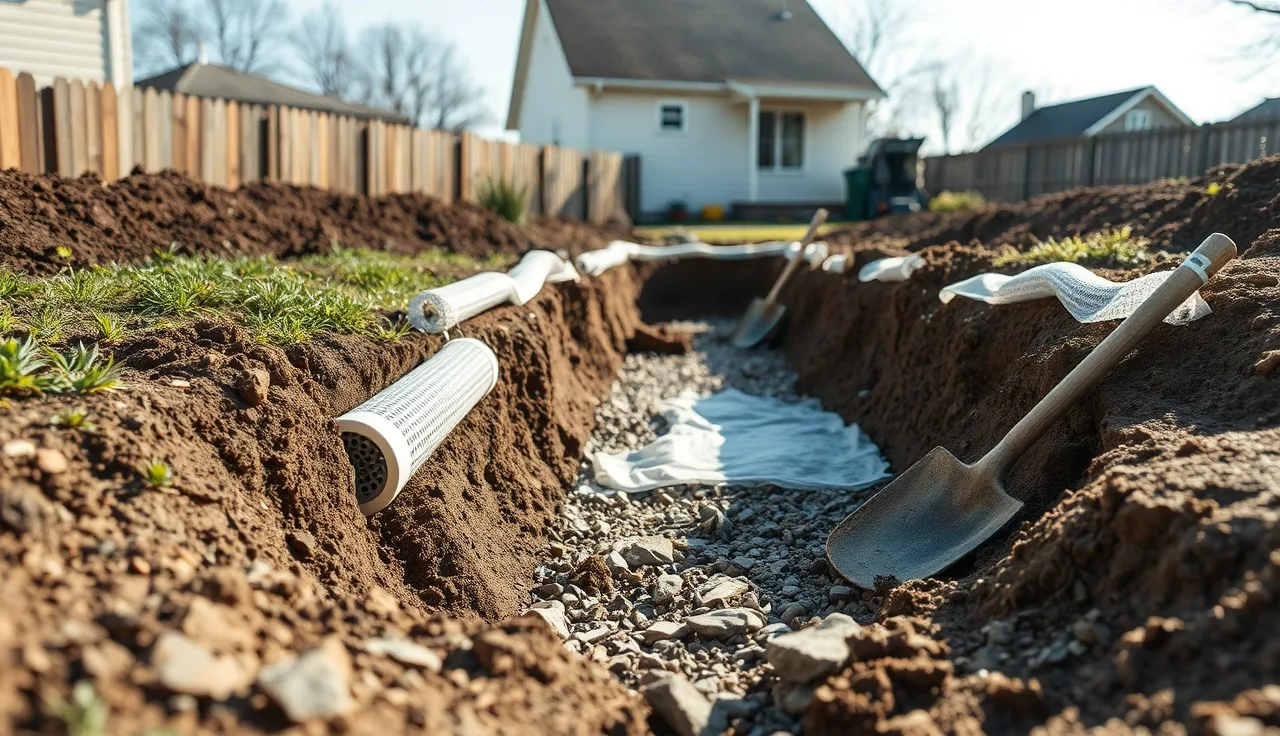
- A leach field has six main parts: perforated distribution pipes, a gravel or aggregate bed, geotextile fabric, a distribution box (or manifold), the inlet pipe from the septic tank, and the surrounding native soil.
- Each part has one job.
- When one fails, the whole field can back up.
- This guide covers what every part does, how long it lasts, and what replacement runs.
What is a leach field and how does the whole system work?
A leach field, sometimes called a drain field or absorption field, is the last treatment stage of a conventional septic system. Liquid effluent leaves the septic tank, flows to the field, and spreads through a network of perforated pipes buried in gravel trenches. From there it percolates down through the soil, which filters out pathogens and nutrients before the water reaches groundwater.
The soil is not passive ground. It is the actual treatment medium. The EPA describes a conventional system as one where "a distribution device sends effluent to a series of perforated pipes in a gravel or stone trench," where natural microbes finish the job [1]. Bad soil below the gravel means a failed field no matter how good the pipes are.
Most residential leach fields cover 500 to 2,500 square feet of trench area, depending on soil percolation rates and household size. State onsite wastewater codes set minimum trench lengths per bedroom, and those requirements swing widely. North Carolina requires a minimum of 150 linear feet of trench for a three-bedroom home in Group I soils, while California sets loading rates based on percolation test results [2][3].
Knowing every part matters because field failures are rarely one-component events. A cracked distribution box starves one trench while flooding another. Crushed pipe pools effluent in one spot. Geotextile fabric that has migrated blocks drainage across whole sections. You cannot diagnose a field intelligently without knowing what each piece is supposed to do.
What are all the parts of a leach field?
Here is a plain rundown of every component in a standard gravity-fed leach field, moving from the septic tank outward.
1. Outlet baffle and effluent filter (inside the tank, but field-adjacent)
Before effluent reaches the field, it passes through the outlet compartment of the septic tank. The outlet baffle keeps floating scum from leaving the tank. Many modern tanks add an effluent filter, a slotted plastic cartridge, to catch suspended solids. A clogged effluent filter is one of the most common causes of premature field loading with solids [4]. This part sits inside the tank but directly governs field health.
2. Effluent line (transport pipe)
A solid, non-perforated pipe, almost always 4-inch Schedule 40 PVC in modern installs, carries settled effluent from the tank outlet to the distribution device. Older homes may have clay tile or Orangeburg pipe here. This line has to hold a steady slope, usually 1/8 to 1/4 inch per foot, so it does not pool or siphon. A belly or low spot lets solids settle and eventually block the flow.
3. Distribution box (D-box)
The distribution box is a small concrete, plastic, or fiberglass chamber that takes effluent from the transport pipe and splits it evenly among the trench laterals. A standard residential D-box has one inlet and two to six outlets. Those outlets have to sit perfectly level with each other so every trench gets equal flow. Let the box settle half an inch and one trench drowns while the others stay dry. D-boxes are one of the first things a good inspector checks. See more on septic tank inspection.
4. Distribution manifold (alternative to D-box)
Some systems, mostly installed since the 1990s, use a header pipe or manifold instead of a D-box. The manifold is a solid pipe running the width of the field with lateral connections branching off at intervals. Pipe diameter and length split the flow instead of a single leveled chamber. Manifolds shrug off differential settling better than D-boxes, but they are harder to inspect and service.
5. Perforated distribution pipes (laterals)
These are the heart of the system. Each lateral is a 4-inch perforated pipe, either rigid PVC or corrugated ADS, running the length of a trench. Holes run about 1/2 inch in diameter, spaced every 6 inches along the bottom half of the pipe. Effluent drips out into the gravel bed below. Pipe length per trench runs 50 to 100 feet in most residential installs. In some older systems these are clay tile sections laid end-to-end with small gaps instead of drilled holes.
6. Gravel or aggregate bed
Coarse washed gravel, usually 3/4-inch to 1.5-inch crushed stone, surrounds and underlies the perforated pipes in each trench. A typical trench has 6 to 12 inches of gravel below the pipe and 2 inches above it. The gravel makes void space so effluent spreads sideways before entering the soil, keeps the pipe holes off direct soil contact, and holds up the overlying soil without crushing the pipe. Some modern systems use engineered plastic chambers (like Infiltrator brand) in place of gravel entirely.
7. Geotextile fabric (filter fabric)
A layer of non-woven geotextile fabric goes on top of the gravel before soil backfill. Its job is to keep fine soil particles from washing down into the gravel voids and clogging them over time. The fabric passes water and air but acts as a physical separator. Skip this layer or use the wrong grade and soil migrates into the gravel faster, cutting field life noticeably.
8. Soil cover (backfill)
Native soil or select fill covers the trench from the top of the geotextile fabric to final grade. Typical cover depth is 6 to 24 inches. Too little soil and the ground freezes over the pipes in cold climates, which can crack pipe and kill the microbial community. Too much soil and oxygen exchange drops, which slows aerobic treatment.
9. Inspection ports and cleanouts
Many modern codes require an inspection port at the end of each lateral, a short vertical pipe capped at grade, so a technician can confirm flow is reaching that trench and check for standing effluent. Older systems often lack them, which makes diagnosis much harder.
10. Native soil (the actual treatment zone)
Below the gravel, native soil does the final and most important treatment. A biologically active zone called the biomat forms at the soil-gravel interface. The biomat is a thin layer of organic material and microbial life that treats the effluent. It slows percolation slightly, which is normal and even helpful up to a point. When the biomat gets too thick from overloading or solids intrusion, it seals the soil surface and the field fails.
What does each leach field part cost to replace?
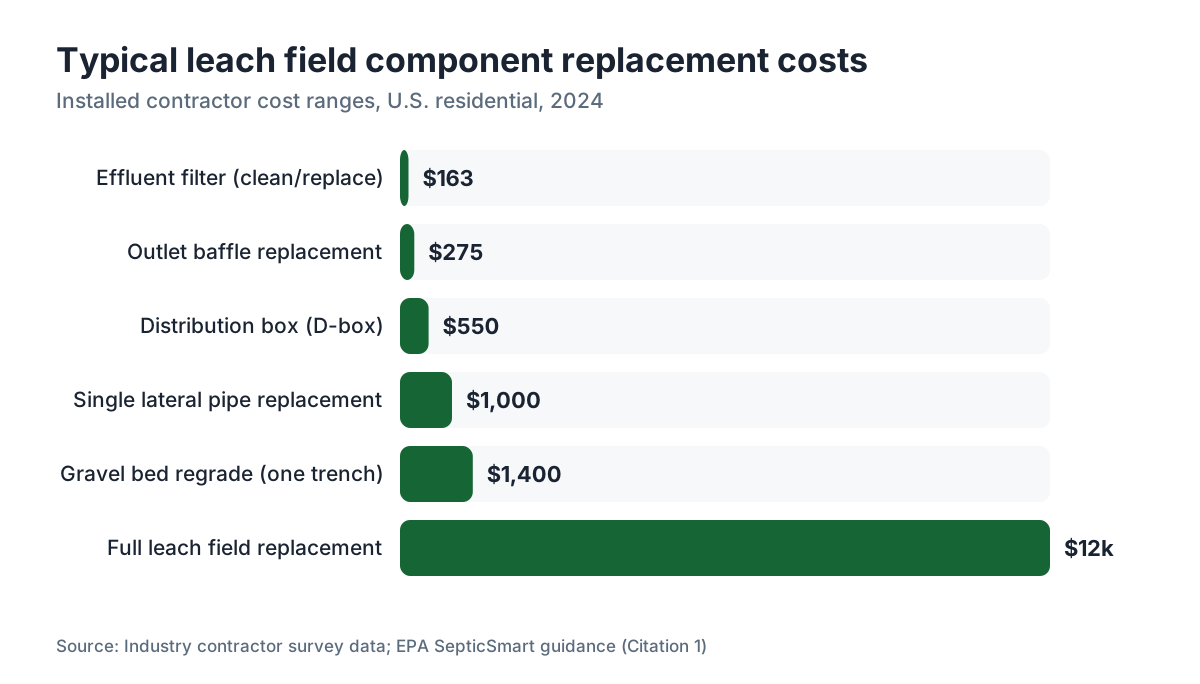
Costs swing a lot by region, soil conditions, and how accessible the components are. The figures below reflect contractor quotes and homeowner cost surveys. They are honest ranges, not bids. Get three local quotes before you commit.
| Part | Typical replacement cost | Notes |
|---|---|---|
| Effluent filter (clean or replace) | $75 to $250 | Usually done at tank pumping |
| Outlet baffle | $150 to $400 | Requires tank access |
| Transport (effluent) line, per linear foot | $25 to $60/ft | More if deep or under hardscape |
| Distribution box (D-box) | $300 to $800 installed | Concrete D-box plus labor |
| Perforated pipe, per trench | $500 to $1,500 | Depends on trench length |
| Gravel bed (regrade one trench) | $800 to $2,000 | Includes excavation |
| Geotextile fabric, per trench | $100 to $300 | Material only; usually bundled |
| Full leach field replacement | $5,000 to $20,000+ | Highly site-dependent |
| Plastic chamber system (Infiltrator) | $4,000 to $15,000 | Often cheaper than gravel |
A full leach field replacement in the continental U.S. ran roughly $10,000 to $15,000 as of 2023, but that number is nearly meaningless without site specifics. Rocky soil, high groundwater, setback rules, and permit fees can push a project past $30,000. The cost to install a septic system covers the full installation picture in more detail.
The cheapest fix with the biggest payoff is cleaning or replacing the effluent filter at every tank pump-out. At $75 to $250, it regularly heads off field damage that costs ten to a hundred times more.
What is a distribution box and why does it fail?
The distribution box, or D-box, is probably the most underappreciated part of the leach field. It is small, often only 12 by 12 by 12 inches inside, but it controls flow to every trench in the system.
D-boxes fail in a few ways. Differential settling is the most common. The box tilts even slightly, one outlet sits lower than the others, and all the effluent runs to that low trench. It drowns while the rest sit idle. The saturated trench builds an excessive biomat, loses absorption, and the field starts backing up. Meanwhile the unused trenches stay perfectly fine.
Cracking is the second common failure. Concrete D-boxes soak up moisture and ground movement over decades. Cracks let groundwater in, which dilutes and displaces effluent and floods the field, or they let tree roots in. Root growth through a cracked D-box can run all the way down a lateral and block a whole trench.
Replacing a settled D-box, including excavation, a new concrete or plastic box, leveling, and restoration, runs $300 to $800 in most markets. That is one of the best-value repairs in septic maintenance. A new D-box with properly leveled outlets can revive trenches that looked dead just by sending flow evenly again.
Some installers now prefer plastic D-boxes over concrete for new work. Plastic does not crack from frost heave the way concrete does, and most plastic boxes have adjustable outlet inserts that make leveling easier. The catch is that plastic boxes are lighter and float more easily if groundwater rises during installation.
What are perforated pipes made of and how long do they last?
Modern perforated distribution pipes are almost always PVC (Schedule 20 or SDR 35) or corrugated high-density polyethylene (HDPE). Both resist corrosion well. Under normal conditions, buried PVC leach field pipe has a service life of 25 to 40 years or more. The pipes rarely fail on their own unless a vehicle crosses the field, tree roots invade, or the ground settles and shears a joint.
Systems installed before the 1970s often used clay tile, laid in short sections (usually 12-inch lengths) with open joints between them. Clay is durable but brittle, and those open joints invite roots aggressively. Clay tile systems from the 1950s and 1960s that still work should be inspected carefully. Many are at or past their design life.
Orangeburg pipe is the real problem child. It is a pressed wood-fiber and pitch pipe, common from the 1940s through the early 1970s because of wartime metal shortages. It deteriorates when wetted and dried over and over, going soft and eventually collapsing. If a system has Orangeburg transport lines or laterals, replacement is not optional. It is a matter of when, not if.
Corrugated ADS pipe (the black corrugated plastic you see in big-box stores) shows up as laterals in budget installs. It works but has smaller holes and kinks if installed carelessly. It is not universally approved by state codes for use as leach field laterals, so check your jurisdiction.
If you are repairing a septic system, swapping old clay or Orangeburg laterals for SDR 35 PVC while the trench is already open is almost always worth the small added cost.
What do gravel and chambers do differently in a leach field?
Traditional leach fields use crushed stone gravel as the bed material. Engineered plastic chamber systems, the most widely sold being Infiltrator (now part of Infiltrator Water Technologies), are the main alternative, and some jurisdictions now accept them as equivalent or preferred.
Gravel beds work by making macro-pore void space around the pipe. Effluent spreads through the gravel and touches soil across a wide surface. The gravel also holds up the pipe and backfill. The downside: gravel is heavy and pricey to haul, and fine sediment slowly migrates into the voids over the years, cutting void space.
Chamber systems replace both the gravel and the perforated pipe with arch-shaped open-bottomed plastic chambers. Effluent runs inside the chamber and touches native soil directly through the open bottom. Chambers usually give more bottom contact with soil than a standard gravel trench of the same length, which allows shorter trenches or higher loading rates in some codes. Research at the University of Wisconsin showed chamber systems reaching similar or better treatment performance than gravel systems in sandy soils [5].
The practical question is cost. Chambers cost more per unit than gravel but kill the gravel hauling bill. Where gravel is expensive or access is tight, chambers come out cheaper total. Where crushed stone is cheap and close by, gravel may still win on price.
Neither system is universally better. Gravel is proven over 70-plus years. Chambers are proven over 30-plus. Your soil, local code, and site access should drive the choice, not marketing.
What is geotextile fabric and does it matter?
Geotextile fabric in a leach field is a non-woven, permeable synthetic fabric, usually polypropylene, laid over the top of the gravel bed before soil backfill. People also call it filter fabric or drain field fabric.
It matters. Without it, soil particles from the backfill work their way down through vibration, frost cycles, and moisture movement into the gravel voids. Over years, those fines cut void space and slow hydraulic conductivity. With geotextile fabric in place, that migration is largely blocked.
The fabric has to be the right type. A non-woven needlepunched geotextile with an apparent opening size (AOS) matched to the local soil is the correct choice. Woven fabrics or hardware-store landscape fabrics are not adequate substitutes. Their opening sizes are often wrong, and they either clog faster or let too much through.
Installation is simple, but the fabric has to cover the full width of the gravel, overlap at seams by at least 12 inches, and run up the trench walls so soil cannot migrate around the edges. Skimping on seam overlaps is a common field shortcut that cuts effectiveness a lot.
If you are having a field inspected or partly repaired, ask whether the original install included geotextile fabric. Systems built before the mid-1980s often skipped it, because it was not yet standard practice.
What are the most common leach field part failures?
Most field failures trace back to a handful of root causes, and parts usually fail together rather than one at a time.
Biomat overload is the most common. The biomat at the soil-gravel interface thickens past what the soil can keep up with, sealing the surface. This usually comes from solids escaping the tank (a failed or absent effluent filter, or a tank that never gets pumped) or from hydraulic overload (too much water for the field size). The biomat itself is not a part that breaks. It is a natural process gone wrong. No single component swap fixes it. You have to rest the field or aerate the soil.
D-box settling and cracking, described above, is a close second. A tilted D-box creates uneven loading that destroys individual trenches while hiding the problem at the surface.
Root intrusion through perforated pipe is common in fields planted with trees or shrubs, or where nearby trees have grown toward the field over decades. Willow, maple, and poplar are the worst. Roots can fill an entire lateral. A sewer camera confirms this fast.
Crushed or collapsed pipe from vehicle traffic is completely preventable and still happens all the time. One pass from a loaded concrete truck or backhoe can shear pipe joints and crack laterals. No vehicles, ever, on the leach field.
Effluent filter neglect is arguably the highest-leverage failure of all. The EPA's SepticSmart program recommends inspecting and cleaning the effluent filter at every pump-out [1]. A filter last cleaned five years ago on a three-year pump schedule is almost certainly partly clogged and sending more suspended solids to the field than the field can take.
For more on keeping the upstream parts healthy, see septic tank pumping and how often to pump your septic tank.
How do you inspect leach field parts without digging everything up?
A good inspection does not require excavating the whole field. Start with what you can see and reach.
First, pull the D-box lid and look at water levels inside. If effluent backs up above the outlet pipes, the field is not absorbing. If one outlet has no flow, that trench is blocked or the outlet is misaligned. A flashlight and a ruler tell you a lot.
Next, check each inspection port at the end of the laterals, if they exist. Drop a stick or probe in to check for standing effluent. Standing water means that trench is saturated. A dry port means flow reaches the end of the pipe and drains normally.
A sewer camera pushed through a lateral from the D-box shows pipe condition, root intrusion, collapse, and debris buildup. This runs $150 to $400 and is the closest thing to a definitive pipe diagnosis without excavation.
Soil probes driven into the field can find saturated zones. A probe that hits soft, wet soil where it should be dry points to either surface drainage pooling or a subsurface saturation problem.
Surface signs matter too. Bright green grass over specific trench lines can mean effluent is surfacing and fertilizing the soil. Soggy ground, odors, or sewage pooling are obvious late-stage signs. You want to catch trouble before that stage.
For a full septic tank inspection, a qualified inspector runs through most of this systematically and documents what they find. Some states require a licensed soil scientist or professional engineer to evaluate a failing field before a repair permit is issued.
Can leach field parts be repaired or do you always need a full replacement?
Repair is often possible, and often far cheaper than full replacement. The trick is diagnosing which part actually failed before you assume the whole field is dead.
A settled D-box, releveled or replaced, costs $300 to $800. If that was the only problem, the field can recover fully within weeks as dry trenches rehydrate and the biomat evens out.
A single blocked lateral, jetted or camera-inspected and relined, runs $500 to $2,000. Trenchless liner technology can now rehabilitate a collapsed or root-filled lateral without full excavation in many cases.
A biomat-affected field with intact pipes may respond to resting (routing effluent to a second field if one exists), aeration injection (some contractors offer this), or hydrogen peroxide treatment. Results are mixed. Honest contractors will tell you there is no guaranteed fix for a severe biomat. The closest controlled data comes from university extension research, and even those studies show variable outcomes depending on soil type and biomat thickness [5].
Full replacement is unavoidable when pipes are crushed or fractured across multiple trenches, when native soil has lost permeability from long-term overloading, or when the field was undersized from the start and no repair addresses the root cause. In those cases, see septic system repair for what a full replacement process looks like.
Operators tracking field repair histories across many properties see the patterns emerge fast. Tools like SepticMind let service companies log component-level repair records, so failing fields get flagged before they turn into emergency calls.
One rule of thumb that holds up in practice: if two or more major components (pipes, D-box, soil) have failed at once, the economics usually favor replacement over repair.
What building codes and regulations govern leach field parts?
Leach field construction is regulated at the state level, not federally, though the EPA publishes guidelines most states use as a baseline. The EPA's SepticSmart initiative pushes states to adopt minimum standards for onsite wastewater systems but does not mandate specific component designs [1].
State rules vary a lot. Some adopt NSF/ANSI Standard 40 or NSF/ANSI Standard 245 for certain components, especially alternative systems. California's Onsite Wastewater Treatment System Policy, adopted in 2012, requires all new systems to meet specific setback, soil depth, and hydraulic loading standards [3]. North Carolina's 15A NCAC 18A rules spell out minimum trench dimensions, pipe size, gravel depth, and inspection port requirements in real detail [2].
NSF International tests and certifies specific leach field components, including plastic chambers, against material standards. Infiltrator chambers carry NSF 14 and NSF 61 material certifications [7]. Using non-certified components in a permitted system can void the permit and create liability if the system later fails.
Local county health departments usually issue the actual permits, inspect during installation, and keep the records. If you are buying a home with a septic system, a permit history search through the county health department is one of the most useful things you can do before closing. Fields installed without permits may be undersized, badly placed, or missing required components entirely.
For new construction, the septic tank installation process and the cost to put in a septic tank tie directly to what your local code requires for field sizing and component specs.
How long do leach field parts last?
Honest answer: it depends heavily on maintenance. Here are the best available estimates.
| Component | Expected service life | Main failure mechanism |
|---|---|---|
| PVC perforated pipe | 25 to 40+ years | Root intrusion, vehicle damage |
| Clay tile lateral | 30 to 60 years | Root intrusion, cracking |
| Orangeburg pipe | 15 to 30 years | Material degradation |
| Concrete D-box | 20 to 40 years | Cracking, settling |
| Plastic D-box | 30 to 50+ years | UV degradation if exposed |
| Gravel bed | Indefinite (if protected) | Sediment migration |
| Plastic chambers | 30 to 50+ years | UV degradation if exposed |
| Geotextile fabric | 30 to 50+ years | Clogging from fine sediment |
| Native soil treatment zone | Indefinite (if not overloaded) | Biomat overload |
The system as a whole, designed and maintained well, should last 25 to 30 years at a minimum. Well-maintained systems on good soil often run 40 to 50 years. The EPA states that with proper maintenance a septic system can last a lifetime [1].
The biggest predictor of field longevity is not the quality of the parts. It is whether the tank upstream gets pumped on schedule and whether the effluent filter gets cleaned. Solids that escape the tank and reach the field cause irreversible biomat overload faster than any other single factor. The leach field guide covers failure modes and prevention in more depth.
Frequently asked questions
What is the pipe in a leach field called?
The pipes that distribute effluent through the trench are called perforated distribution pipes or laterals. They are typically 4-inch diameter PVC or corrugated HDPE with holes every 6 inches along the bottom half. Effluent drips through those holes into the surrounding gravel bed, then percolates into the native soil below for final treatment.
What is a D-box in a septic system?
A distribution box, or D-box, is a small concrete or plastic chamber that takes effluent from the septic tank and splits it evenly among the leach field trenches. It has one inlet and two to six outlets. If the D-box settles or tilts, one trench gets all the flow while others sit dry, causing localized failure. Replacing a failed D-box costs $300 to $800 installed.
How deep are leach field pipes buried?
Leach field laterals sit 18 to 36 inches below the surface, depending on local code and frost depth. The pipe rests on 6 to 12 inches of gravel with 2 inches of gravel above it, then geotextile fabric, then soil backfill. In cold climates, minimum cover depth goes up to protect the pipe from freezing, which can crack PVC and kill the microbial treatment zone.
What size pipe is used in a leach field?
Standard residential leach field laterals use 4-inch diameter perforated pipe: Schedule 20 PVC, SDR 35 PVC, or corrugated HDPE. The transport line from the tank to the distribution box is also usually 4-inch pipe, but solid (non-perforated). Some commercial or larger residential systems use 6-inch pipe. Local codes specify the required pipe size and material for permitted installations.
Do leach fields have gravel in them?
Traditional leach fields use 3/4-inch to 1.5-inch washed crushed stone, typically 6 to 12 inches deep below the pipe and 2 inches above it. The gravel makes void space so effluent spreads sideways before entering the soil. Some modern systems swap gravel for open-bottomed plastic chambers, which touch soil directly and are accepted by most state codes as equivalent.
What is geotextile fabric used for in a leach field?
Geotextile fabric goes on top of the gravel bed, under the soil backfill, to keep fine soil particles from washing down into the gravel over time. Without it, soil slowly fills the gravel voids, cutting drainage capacity and shortening field life. It needs to be non-woven polypropylene of the correct apparent opening size for the local soil, not a generic hardware-store landscape fabric.
What causes leach field pipes to fail?
The most common causes are root intrusion (willow, maple, and poplar are the worst), vehicle traffic crushing pipe, ground settling that shears joints, and solids from an unmaintained tank clogging the perforations. Orangeburg pipe, used from the 1940s to early 1970s, deteriorates on its own regardless of maintenance. PVC pipe in a well-maintained system can last 40 years or more.
Can you repair just one leach field trench instead of replacing the whole field?
Yes, and it is often the right call. If a camera inspection shows one lateral blocked by roots, or one trench failing from D-box settling, repairing just those components and resting the affected trench can restore function. Full field replacement is warranted when multiple components have failed at once or when native soil permeability has been permanently compromised by long-term overloading.
What is an effluent filter and why does it protect the leach field?
An effluent filter is a slotted plastic cartridge installed at the septic tank outlet to catch suspended solids before they reach the leach field. Without it, escaped solids speed up biomat buildup in the soil, the leading cause of premature field failure. The EPA recommends cleaning the filter at every pump-out. Cleaning costs $75 to $250 and prevents failures that run into the thousands.
What are plastic chamber systems and are they better than gravel?
Plastic chamber systems, most commonly the Infiltrator brand, replace gravel and perforated pipe with arch-shaped open-bottomed plastic units. Effluent touches soil directly through the open bottom. Chambers often give more soil contact area per trench length than gravel and skip the cost of hauling heavy stone. They are not universally better than gravel; performance depends on soil type, installation quality, and local code acceptance.
How do inspection ports work on a leach field?
Inspection ports are short vertical pipes capped at grade, placed at the end of each lateral. A technician pops the cap, drops in a probe, and checks whether effluent is standing in the pipe. Standing water means the trench is saturated. No water means effluent drains normally to the end of the pipe. Many older systems went in without ports, which makes diagnosis harder and often forces a camera inspection instead.
What happens to a leach field if the septic tank is never pumped?
Solids build up in the tank until they overflow into the effluent line and reach the distribution box and laterals. They clog pipe perforations and create a rapid, irreversible biomat in the soil. The field fails much faster than it would with regular pumping. Pumping every 3 to 5 years, depending on household size, is the single most cost-effective thing a homeowner can do to extend field life.
Are leach field parts covered by homeowners insurance?
Standard homeowners policies typically exclude septic failures from wear, neglect, or gradual damage, which covers most leach field failures. Some policies offer optional sewer and drain riders that may pay for sudden blockages or collapses. Read your policy and ask your insurer specifically about septic components. Where coverage exists, it usually excludes the soil remediation and field replacement that make up most of the actual cost.
Sources
- EPA SepticSmart: Maintaining Your Septic System: EPA describes conventional systems as using a distribution device to send effluent to perforated pipes in gravel trenches; recommends inspecting and cleaning the effluent filter at every pump-out; states a properly maintained system can last a lifetime.
- North Carolina 15A NCAC 18A rules for on-site wastewater systems (NC Department of Health and Human Services): North Carolina rules specify minimum trench length per bedroom, pipe size, gravel depth, and inspection port requirements, including 150 linear feet of trench minimum for a three-bedroom home in Group I soils.
- California State Water Resources Control Board, Onsite Wastewater Treatment System Policy: California OWTS Policy (adopted 2012) sets setback, soil depth, and hydraulic loading rate standards for leach fields based on percolation test results.
- EPA, Septic System Owner's Guide: Clogged effluent filters identified as a common cause of premature solids loading to leach fields.
- University of Wisconsin-Madison Division of Extension, on-site wastewater and gravelless drain field research: University of Wisconsin research shows chamber systems achieving comparable or better treatment performance to gravel systems in sandy soils, and reports variable biomat rehabilitation outcomes by soil type.
- NSF International certified products directory (NSF/ANSI 14 and 61): NSF 14 and NSF 61 material certifications for plastic leach field chamber components including Infiltrator brand.
- EPA, Onsite Wastewater Treatment Systems Technology Fact Sheet: Septic Tank-Soil Absorption Systems: Distribution box design, outlet leveling requirements, and transport pipe slope specifications for conventional septic systems.
- Infiltrator Water Technologies, chamber system technical specifications: Chamber system design data showing increased soil contact area relative to gravel trench systems of equivalent length.
- National Environmental Services Center, West Virginia University, septic system component data: Service life estimates for PVC pipe, concrete D-boxes, and native soil treatment zones under normal maintenance conditions.
Last updated 2026-07-09