Leach field septic system cost: what you'll actually pay
By the SepticMind Editorial Team
TL;DR
- A new leach field costs $3,000 to $20,000 installed, and most homeowners land between $5,000 and $12,000.
- The spread is that wide because lot size, soil type, permit rules, and system design each move the number hard.
- Catching a failing field early and repairing it runs $1,500 to $5,000.
- Replacing the whole system, tank included, runs $10,000 to $30,000.
What does a leach field actually cost?
A small conventional trench field on good-draining soil starts around $3,000. A failing field on a cramped lot that forces an engineered alternative can hit $20,000 or more. Most residential jobs sit between $5,000 and $12,000 for the field alone, tank not included.
That range is real, not contractor games. Your soil's percolation rate sets how many linear feet of pipe you need. Your lot's slope decides whether a pump is in the mix. Your local health department sets permit fees and inspection hoops. A 1,000-square-foot conventional trench on sandy loam costs a fraction of a 2,000-square-foot mound on clay across the same street.
Want the whole system from scratch, tank and distribution box and field? Budget $10,000 to $30,000. Our guide on cost to install septic system breaks down the tank side of that number.
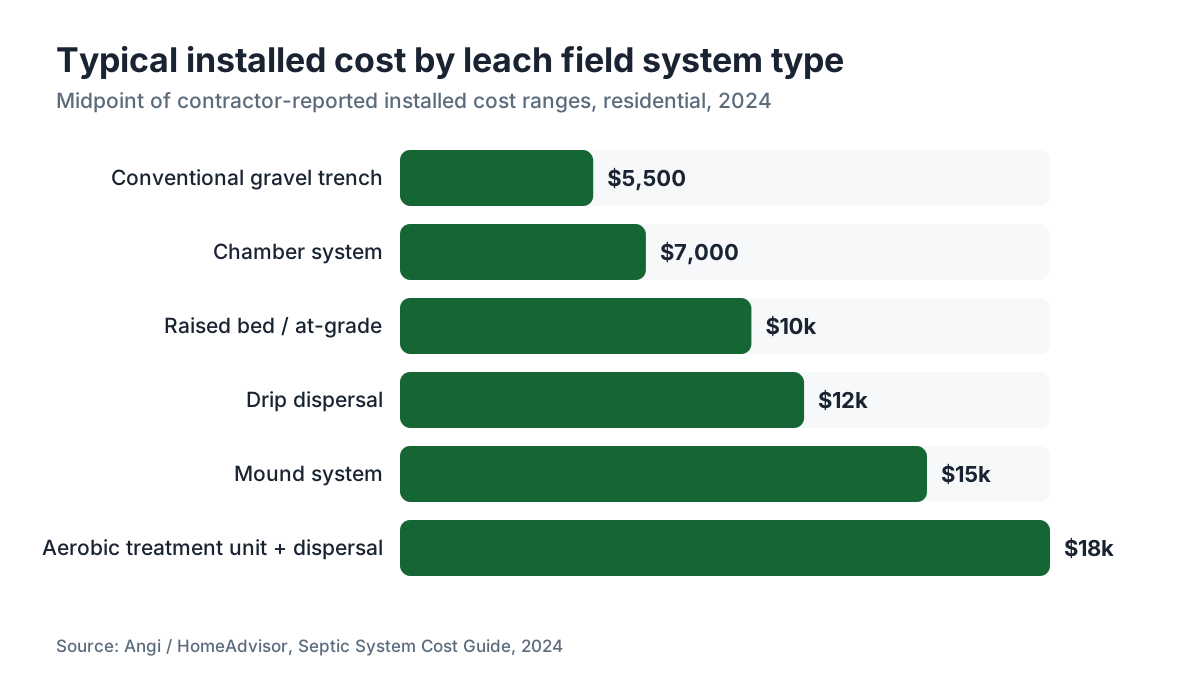
The table below shows typical installed ranges by field type. These are 2024 contractor estimates from multiple U.S. regions, and your local market will move them 20 to 40 percent in either direction [1].
How do costs compare across different leach field types?
Conventional gravel trench is the cheapest field type at $3,000 to $8,000 installed. Mound systems are the most expensive conventional-adjacent option at $10,000 to $20,000. Alternative systems like aerobic treatment units run $12,000 to $25,000 and carry yearly service contracts on top. Here's the full spread.
| Leach Field Type | Typical Installed Cost | Best For |
|---|---|---|
| Conventional gravel trench | $3,000 to $8,000 | Good-draining soil, adequate lot space |
| Chamber system (Infiltrator-style) | $4,000 to $10,000 | Moderate soil, easier install |
| Mound system | $10,000 to $20,000 | High water table, poor drainage |
| Drip irrigation/drip dispersal | $8,000 to $15,000 | Challenging lots, tight setbacks |
| Aerobic treatment unit (ATU) with dispersal | $12,000 to $25,000 | Very poor soil, failing conventional field |
| Raised bed / at-grade | $6,000 to $14,000 | Shallow bedrock or seasonal high water table |
Conventional trench wins on price because the parts are dead simple: perforated pipe, washed gravel, geotextile fabric. Chamber systems cost a bit more upfront but install faster with less excavation, so labor savings sometimes close the gap [2].
Mound systems get expensive because you're trucking in a large volume of sand fill, building an earthen mound, and usually wiring in a dosing pump. That pump adds $500 to $1,500 to the hardware and needs an electrical connection.
Drip dispersal and ATUs sting twice: high install cost, plus a service contract that runs $300 to $600 a year on its own. Price that in before you pick the system.
For the tank that pairs with any of these fields, our septic tank installation article covers tank-side costs.
What are the main factors that change the price?
Soil is the single biggest driver, followed by lot size, depth to groundwater, permit fees, labor rates, and the number of bedrooms in your home. Get the soil test back and half the price question is answered.
Start with soil. The EPA's SepticSmart program puts it plainly: "soil characteristics determine whether an onsite system is suitable for a given site" [3]. Fast-draining sandy soil means less linear footage. Clay or hardpan means a much larger field or an alternative system entirely.
Lot size and setbacks come next. Every state sets minimum horizontal distances from wells, property lines, buildings, and surface water. In many states that's 50 to 100 feet from a well, 10 feet from a property line, and 25 feet from a structure. A small or oddly shaped lot can knock a conventional field out of the running and push you to something pricier.
Depth to groundwater and bedrock matters a lot. In the Northeast, upper Midwest, and Pacific Northwest, systems often hit bedrock or a seasonal high water table at 2 to 4 feet. That forces a mound or at-grade design, adding $5,000 to $10,000 over a conventional trench.
Permit fees run from $200 in rural counties to $1,500 or more where oversight is strict. Some jurisdictions want a licensed engineer's stamp on the design, and that fee alone runs $500 to $2,000.
Labor swings by region. Excavation is the dominant labor cost, and a contractor in coastal California or the Northeast charges two to three times what a rural Midwest contractor charges for the same machine hours.
System size comes from your bedroom count, not how many people live there. Most state codes design for 75 to 150 gallons per bedroom per day. A four-bedroom house needs roughly twice the field area of a two-bedroom [4].
How much does leach field repair cost vs. full replacement?
Repair runs $300 to $6,000 and is always worth investigating first. Full replacement runs $5,000 to $15,000. A field that smells or drains slowly is not automatically dead, and paying $200 to $500 for a real diagnosis before you commit to replacement is the smartest money you'll spend.
The fixable problems are compaction from driving over the field, root intrusion from nearby trees, and biomat buildup on the trench walls from years of overloading. Hydro-jetting the distribution lines runs $300 to $700. Shock treatment with hydrogen peroxide or other oxidizers to break up biomat costs $500 to $1,500 and works in some cases, though long-term evidence is mixed. A cracked distribution box costs $300 to $600 to swap, labor included.
When the soil is saturated and the biomat is too thick to restore, you're into replacement. Partial replacement, where you abandon one section of a multi-zone field and switch on a rested zone, costs $2,000 to $6,000. Full field replacement runs $5,000 to $15,000 depending on type.
One honest warning. If a contractor pitches an additive or "field restoration" product instead of a proper diagnosis, walk. The EPA has stated that biological additives have not been shown to restore failed drainfields, and that they don't reduce the need for regular pumping [3]. An inspection by a licensed engineer or certified inspector costs $200 to $500 and is money well spent before any repair.
For repairs on the tank instead of the field, see septic system repair and septic tank repair.
What does a septic system without a leach field cost?
No-field alternatives cost more to run than they cost to install, and that's the trap. A holding tank installs for $1,500 to $4,000 but pumps out at $3,000 to $10,000 a year for full-time use. Composting and drip systems land between $3,000 and $15,000 installed, plus pretreatment or greywater dispersal on top.
Cesspools are banned in most states and should never go in new. Skip them entirely.
Holding tanks (pump-out-only) are legal in some jurisdictions for seasonal or low-use properties. A 1,000-gallon tank installs for $1,500 to $4,000, but you pay to pump it every 1 to 4 weeks depending on use. That's rarely economical for a full-time home.
Constructed wetlands and composting toilet systems are real alternatives in some states, though permitting gets complicated. A composting toilet system installs for $3,000 to $10,000 and still needs greywater dispersal for sink and shower water, which adds another $1,500 to $5,000.
Drip dispersal is probably the most common no-conventional-field solution for shallow-soil sites. A network of small-diameter emitters doses treated effluent at very low rates. Installed cost is $8,000 to $15,000, and it needs an ATU or other pretreatment stage upstream.
Almost every alternative system requires a licensed engineer and site-specific soil testing. Don't let a contractor skip that step.
What does a new leach field installation involve, step by step?
A new field goes through six stages: site evaluation and perc test, design, permitting, excavation and install, final inspection, and as-built drawings. The whole timeline runs from a few weeks in rural counties to three months or more in strict jurisdictions. Knowing the stages helps you read a quote and spot missing line items.
Site evaluation and perc testing come first. A soil scientist or engineer digs test pits, usually 3 to 6 feet deep, and runs a percolation test to measure drainage speed. Half a day of work, $300 to $800 depending on how many test holes your county wants.
Design follows. The engineer uses perc results, soil profile data, and your home's design flow to spec field size, trench dimensions, pipe layout, and any pretreatment. Design fees run $500 to $2,000.
Permitting takes the design to the local health department. Fees vary widely ($200 to $1,500), and review times range from a few days in rural counties to 6 to 12 weeks in some urban or coastal ones.
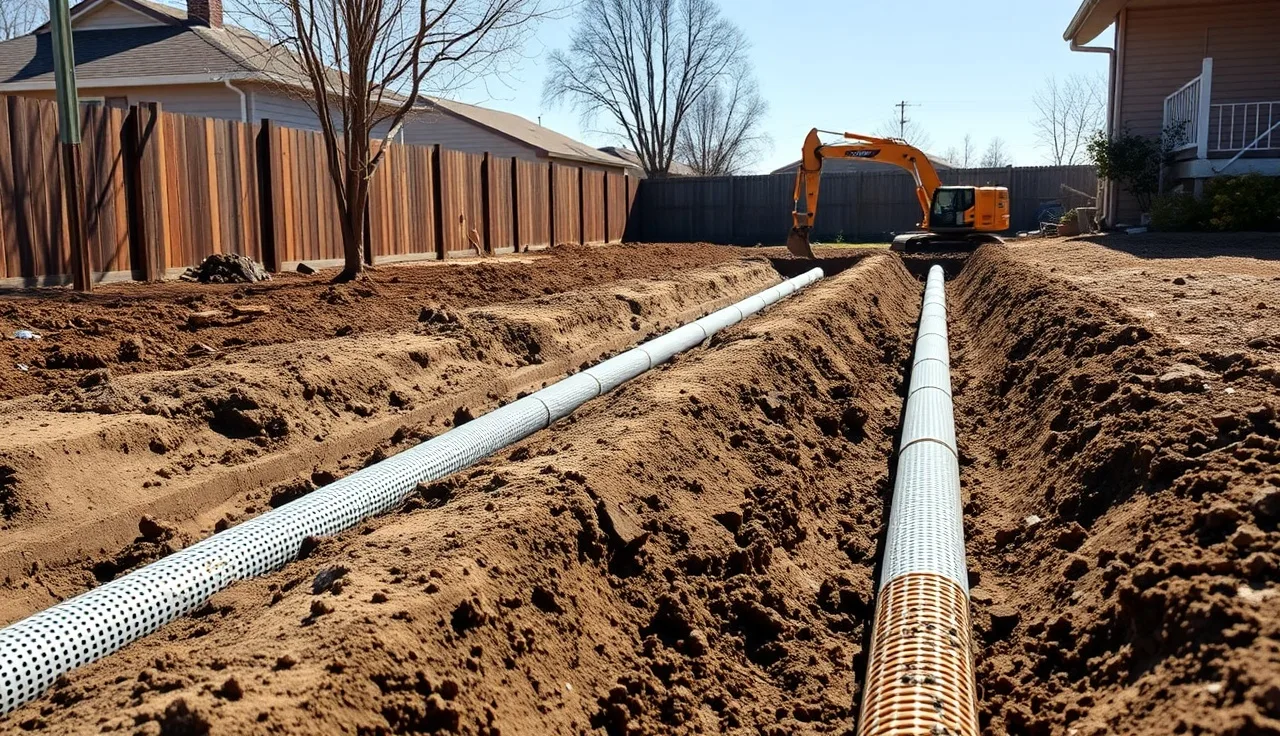
Excavation and installation is the biggest cost. A track excavator opens trenches, crews lay pipe and gravel or chambers, and the system gets covered with topsoil. Figure two to three days for a residential field.
Final inspection by the health department is required nearly everywhere before burial. Some jurisdictions want an engineer to certify as-built conditions.
As-built drawings go to the county. These matter enormously when you sell. Missing as-builts can kill a real estate deal.
For the maintenance schedule after installation, how often to pump septic tank covers what you owe the system going forward.
How much do permits and inspections add to the total cost?
Add $800 to $2,500 to any contractor quote for the full permit-and-inspection stack, depending on your state and whether an engineer is required. These fees are real costs that online estimates love to leave out, and they vary more than almost any other line item.
A state-program survey put permit fees for new onsite installations from under $100 in some rural counties to $1,800 in some California counties, with a national average around $400 to $600 [5]. Some states pile a state-level review fee on top of the county fee.
The pre-installation soil evaluation and perc test is separate from the permit and costs $300 to $800. An engineer's design stamp, required in roughly half of U.S. states for alternative systems, adds $500 to $2,000.
The final inspection, where the inspector signs off before the trenches get covered, is usually rolled into the permit fee. Fail it and need a re-inspection? Expect $100 to $300 more.
For a home sale, a private septic inspection costs $200 to $500, and that's on top of everything above. See our septic tank inspection guide for what those cover.
How long does a leach field last, and when do you know it's failing?
A properly designed and maintained conventional field lasts 20 to 30 years. Some go longer. Many die early from avoidable mistakes, and the warning signs are wet spots, sewage odors, slow drains, and backups into the lowest fixture in the house.
Overloading is the top cause of early failure. Push more water through than the soil can absorb and a biomat, a layer of anaerobic bacteria and organic material, builds on the trench walls. Once it's thick enough, infiltration stops. High-flow appliances, leaking toilets, and garbage disposals all speed it up.
Root intrusion from trees planted too close is another common killer. Keep trees and large shrubs at least 30 to 50 feet from the field boundary.
Compaction from vehicles or heavy equipment crushes soil pores and pipe, and it's permanent. Don't park on your field. Ever.
Watch for these signs: wet spots or lush green grass over the field in dry weather, sewage odors in the yard, slow drains at more than one fixture, sewage backing up into the lowest drain in the home. See any of them and call a licensed inspector before you call a contractor for replacement. You want a diagnosis, not a sales pitch.
Regular pumping is the single most effective thing you can do to extend field life. Solids that overflow the tank into the field speed up biomat formation. The EPA recommends pumping every three to five years for a typical household [3]. Our septic tank pumping guide has the details.
Lifespan also rides on the original design. A field built to the code minimum has no buffer. A field built at 150 percent of the required size lasts considerably longer [6].
Can you save money by doing any of this yourself?
On the install, almost nothing. On maintenance, plenty, and it's the maintenance that actually decides how long your field lasts.
Leach field installation needs permits, inspections, and in most states a licensed contractor. Try to install an unpermitted system and you're exposed to fines ($500 to $5,000 in most states), mandatory removal, and serious liability if it fails and causes a public health problem. It also turns your next home sale into a mess.
Here's what you can do yourself. Keep accurate pump-out records, fix leaking toilets the day you find them, divert roof drains and sump pumps away from the field, and keep the fats, oils, and grease out of the drain, since FOG clogs inlet tees. None of that costs money. All of it extends field life.
You can also do your own homework on bids. Get at least three quotes from licensed contractors. Ask each one to break out labor, materials, permit fees, and soil testing separately. A quote that bundles everything into one number is impossible to compare.
SepticMind's operator platform gives service companies a way to manage inspection reports and maintenance schedules digitally, so the records you need at resale are actually findable years later. For homeowners, keeping your own maintenance log is free and genuinely useful.
For a septic tank pump out or septic tank cleaning, you have to hire a licensed pumper. Those jobs involve handling regulated biosolids under state rules.
How does leach field design affect long-term cost?
Design choices drive 20-year ownership cost more than any single line on the install quote. Oversize the field, add resting zones, and plan for future load, and you can double field life for a few thousand dollars up front. Skimp to the code minimum and you'll pay for it later.
Oversizing is generally worth it. Adding 25 to 50 percent capacity above the code minimum costs $1,000 to $3,000 more at installation and can double field life [6]. On a $10,000 system, that's a reasonable bet.
Resting zones split the field into two sections you alternate annually. The premium is modest, $500 to $1,500 for valve hardware and extra pipe, and the payoff is real: resting lets biomat oxidize and soil recover.
Good design also plans for future loading. If you might add a bedroom or an accessory dwelling unit, design the field for that load now. Expanding a field later, if your lot even allows it, costs as much as or more than the original install.
Material choice matters less than people think. Perforated PVC pipe and gravel works as well as chamber systems in good soil. Chambers have a slight edge at limiting sediment intrusion and may hold up better in cold climates where frost could crack gravel-pipe interfaces.
For a property with no room for a conventional field, the leach field alternatives covered earlier are the path forward. Get an engineer involved early, before a contractor has already proposed a specific system.
What's the real cost of ignoring a failing leach field?
Ignoring a failing field is almost always the most expensive choice. A wet spot is worth $300 for a diagnosis. Waiting until sewage backs into the house means emergency rates at 1.5 to 2 times standard pricing, plus interior cleanup, plus a full replacement instead of a repair.
A slow failure that takes a year to show does measurable, irreversible damage to the soil. The biomat thickens. The treatment zone, the unsaturated soil below the trench where pathogen die-off actually happens, gets shorter and shorter. By the time sewage surfaces, repair is off the table and you're buying a new field.
Environmental liability is real. Most states require you to repair a failing system within 30 to 90 days of it being identified as failing [12]. Fines for noncompliance range from $100 to $10,000 per day in states with strict enforcement. Several states let neighbors affected by a malfunctioning system sue.
Property value takes the hit too. A home with a failed or unpermitted septic system is a known deal-killer. Buyers' inspectors flag it. Lenders in most states won't finance properties with failed systems. The cost to fix it comes off the sale price, and the buyer often demands the seller fix it before closing.
Act at the first symptom. For septic tank emptying as part of troubleshooting a sluggish system, that's often the right first step and costs $300 to $600.
Frequently asked questions
How much does it cost to replace a leach field?
Replacing a leach field costs $5,000 to $20,000 installed for most homes, depending on system type, soil, and local labor. A conventional gravel trench on good soil runs $5,000 to $8,000. A mound or alternative dispersal system on challenging soil runs $10,000 to $20,000 or more. Permit and engineering fees add $800 to $2,500 on top of the contractor's number.
How much does it cost to install a complete septic system with a leach field?
A full system with tank, distribution box, and leach field costs $10,000 to $30,000 installed for a typical three-bedroom home. The tank accounts for $3,000 to $8,000, and the field for $5,000 to $15,000 depending on type. Permitting, soil testing, and engineering add another $1,000 to $3,000. High-cost markets like coastal California or the Northeast push totals toward $25,000 to $35,000.
Can a leach field be repaired instead of replaced?
Yes, in some cases. If the problem is root intrusion, a broken distribution box, or a partially clogged lateral, repairs cost $300 to $2,000. Biomat restoration treatments help mild cases but have limited evidence for severe failures. A licensed inspector or engineer should diagnose the field first. Skipping diagnosis and jumping straight to replacement often wastes an extra $5,000 to $10,000.
How long does a leach field last?
A properly designed and maintained field lasts 20 to 30 years on average. Some go longer with good habits and a generous initial design. Fields fail early from overloading, root intrusion, compaction from vehicles, or skipped pumping that lets solids overflow into the field. The EPA recommends pumping every three to five years to protect field life.
What are the signs that a leach field is failing?
Watch for wet or soggy spots over the drain field in dry weather, unusually lush green grass in patches above the field, sewage odors in the yard, slow drains throughout the house, and sewage backing up into the lowest fixtures inside. Any combination warrants a professional inspection before you pursue repair or replacement. Early diagnosis is far cheaper than emergency replacement.
How much does a leach field inspection cost?
A septic inspection by a licensed inspector or engineer costs $200 to $500 for a standard visual and functional check. A detailed inspection with camera work on the laterals or load testing runs $400 to $800. For home sales, buyers usually pay for this as part of due diligence. Some states require a specifically certified inspector, so check your local health department rules.
What is the cheapest type of leach field system?
Conventional gravel trench systems are the least expensive, typically $3,000 to $8,000 installed for a home. They need adequate lot size, decent soil percolation, and enough depth to groundwater or bedrock. Chamber systems (Infiltrator or similar) cost a bit more but install faster, sometimes making them competitive once labor is factored in. Mound and alternative systems always cost more.
Do I need a permit to replace a leach field?
Yes, in nearly every U.S. jurisdiction. Replacing a leach field requires a permit from the local health department or environmental agency, a soil evaluation, and a final inspection before burial. An unpermitted system risks fines of $500 to $5,000 or more, mandatory removal, and serious trouble at resale. Some states also require an engineer to stamp the design for alternative systems.
What is the cost of a mound septic system?
A mound system costs $10,000 to $20,000 installed, among the priciest residential field options. The cost comes from imported sand fill (often 50 to 200 tons), a dosing pump and tank, electrical connections, and more complex engineering. Mound systems are required where the water table is high, bedrock is shallow, or soil drains too slowly for a conventional trench.
What happens if you build a house with no leach field option?
If a site can't support any dispersal field, options include holding tanks (legal in some places but expensive to pump often), composting toilets with separate greywater dispersal, or drip systems with aerobic pretreatment. Holding tanks install for $1,500 to $4,000 but cost $3,000 to $10,000 a year to pump for full-time use. All of these need specific state and local permits and rarely make sense for year-round living.
How much does it cost to add a leach field to an existing septic tank?
Adding a new field to an existing tank costs $4,000 to $15,000 depending on field type and site conditions. The tank has to be inspected and pumped first to confirm it's sound and correctly sized for your home. If it's undersized, you'll replace or add a second tank, which adds $2,000 to $6,000. Permits and soil testing are required even when the tank is reused.
Does homeowner's insurance cover leach field replacement?
Standard homeowner's policies generally don't cover leach field failure from wear and tear or gradual deterioration, which is how most fields fail. Some policies cover sudden and accidental damage, like a vehicle collapsing a trench. Specialty home warranty products sometimes include septic coverage, but read the exclusions. Most often, leach field replacement is entirely out of pocket.
How does soil type affect leach field cost and design?
Soil type sets how many linear feet of trench you need and whether a conventional system is even possible. Fast-draining sandy soils need less footage, which lowers cost. Slow-draining clay needs a larger field or an alternative system, which raises it sharply. Percolation testing, at $300 to $800, is required before any system can be designed or permitted. Skipping it isn't an option in any licensed design process.
Sources
- HomeAdvisor / Angi, Septic System and Drain Field Cost Guide, 2024: Typical installed cost ranges for residential leach field and septic system types in 2024 across U.S. regions
- University of Minnesota Extension, Septic System Maintenance and Alternatives: Chamber systems install faster than conventional gravel trench systems and may offer comparable long-term performance
- U.S. Environmental Protection Agency, SepticSmart Homeowner's Guide: EPA states biological additives have not been shown to restore failed drainfields; recommends pumping every three to five years; soil characteristics determine suitability
- U.S. Environmental Protection Agency, Onsite Wastewater Treatment Systems Manual (EPA/625/R-00/008): Design flow rates of 75 to 150 gallons per bedroom per day are used by most state codes; system size is bedroom-based
- National Onsite Wastewater Recycling Association (NOWRA), State Regulatory Survey: Permit fees for new onsite system installations range from under $100 in some rural counties to $1,800 in some California counties, with a national average around $400 to $600
- North Carolina State University Cooperative Extension, Septic System Operation and Maintenance: Resting zones and field oversizing extend leach field lifespan; minimum-size fields have no buffer capacity
- U.S. Environmental Protection Agency, Septic Systems: What Homeowners Should Know: Overloading with water, root intrusion, and compaction are the primary causes of early leach field failure
- Penn State Extension, Mound Septic Systems: Planning and Cost Considerations: Mound systems require large volumes of imported sand fill and a dosing pump, driving installed costs to $10,000 to $20,000 or more
- University of Florida IFAS Extension, Septic Tank Drainfield Failure: Causes, Prevention, and Remediation: Biomat buildup from overloading and infrequent pumping is the most common cause of drainfield failure; early detection significantly reduces repair costs
- California State Water Resources Control Board, Onsite Wastewater Treatment System Policy: California jurisdictions require permits, licensed contractors, and engineer-stamped designs for alternative onsite systems; some counties charge permit fees up to $1,800
- U.S. Environmental Protection Agency, Septic System Costs and Financial Assistance: Standard homeowner insurance policies generally do not cover septic system failure from gradual deterioration; replacement is typically an out-of-pocket expense
- Virginia Department of Health, Sewage Handling and Disposal Regulations: Most states require repair or replacement of a failing septic system within 30 to 90 days of identification; fines apply for noncompliance
Last updated 2026-07-10