Leach field specifications: what the rules actually require
By the SepticMind Editorial Team
TL;DR
- A leach field is sized to three things: the home's daily wastewater flow, the soil's percolation rate, and local setback rules.
- Most residential fields run 300 to 1,500 square feet of trench bottom.
- Trenches sit 18 to 36 inches deep, 1 to 3 feet wide, and at least 6 feet apart.
- Every state writes its own onsite wastewater code, so verify local numbers before you design or dig.
What is a leach field and how does it work?
A leach field (also called a drain field, disposal field, or soil absorption system) takes clarified wastewater from the septic tank and spreads it through perforated pipes into the soil. The soil does the real work. Bacteria in the top few feet of native soil break down pathogens, nutrients, and organic matter before the water reaches groundwater. No electricity. No chemicals. Physics and biology.
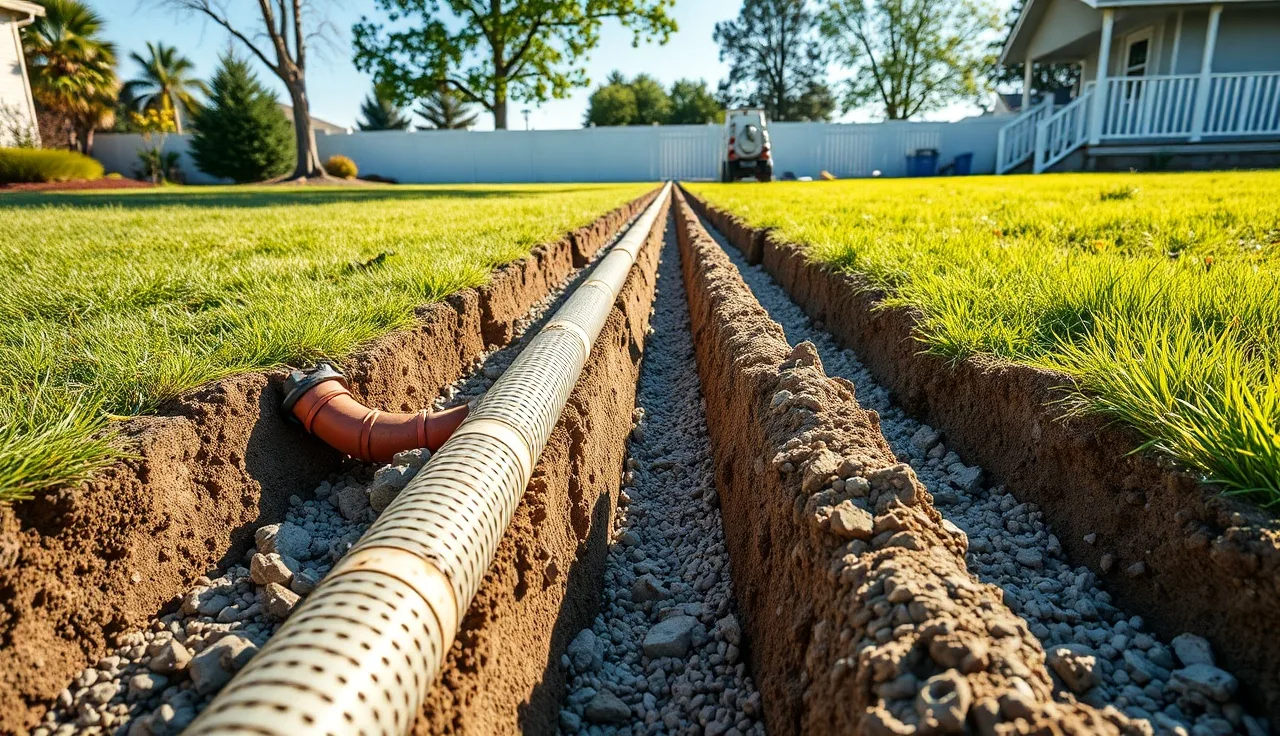
Effluent flows by gravity (or by pump, in pressure-dosed systems) from the tank into a distribution box or manifold, then out through 4-inch perforated pipes laid in gravel-filled trenches. Gravel wraps the pipe to roughly 12 inches above and below, and a geotextile fabric sits on top to keep fine soil from sifting down into the void space where effluent needs room to spread.
Soil absorption rate is the whole game. Sandy soils drink fast. Clay soils drink slow, or not at all. That's why almost every regulatory system starts with a percolation test or a soil morphology assessment before a permit gets issued. [1]
Our overview of leach field design and troubleshooting covers the rest of the system.
What soil percolation rate is required for a leach field?
Most state codes allow soil with a percolation rate between 1 minute per inch (MPI) and 60 MPI. The EPA's Onsite Wastewater Treatment Systems Manual puts the practical sweet spot at 1 to 30 MPI for conventional gravel-and-pipe trench systems. [1] Soil that drinks water in under a minute per inch is too coarse to filter pathogens. Soil slower than 60 MPI can't drain fast enough to keep effluent from surfacing.
States draw the line in different places. North Carolina caps conventional trench systems at 45 MPI and pushes anything slower into an alternative system. Virginia's sewage handling regulations allow conventional systems up to 60 MPI. [9] Read your own state's code, because the cutoff is not standard.
Soil scientists and licensed designers increasingly favor soil morphology (reading soil color, texture, and mottling in a backhoe pit) over the old perc test. A perc test can swing 50% or more depending on how wet the soil was the day someone ran it. Some states now require or strongly prefer morphology. [3]
Percolation rate thresholds for conventional leach fields
| Perc rate (min/inch) | Soil type (typical) | Conventional trench allowed? |
|---|---|---|
| Less than 1 | Gravel/cobble | No (too fast, no treatment) |
| 1 to 30 | Sandy loam to loam | Yes, standard sizing |
| 31 to 60 | Silty loam to clay loam | Yes, but larger area required |
| Greater than 60 | Clay | No conventional system; alternative required |
How do you calculate the size of a leach field?
Field size comes from two numbers multiplied together: daily wastewater flow (gallons per day) and soil application rate (gallons per square foot per day). Divide flow by application rate and you get the minimum trench bottom area in square feet. That's the whole formula.
Required area (sq ft) = Daily flow (gpd) / Soil application rate (gpd/sq ft)
The application rate comes from a table in your state code, keyed to perc rate. Soil that tests at 5 MPI might get 0.6 gpd/sq ft in one state and 0.5 in another. Same dirt, different number. That's why you need the actual local table, not a figure someone posted online.
For daily flow, most codes count bedrooms as a stand-in for occupancy. The EPA's manual uses 150 gallons per bedroom per day as a common design figure [1], though states range from 100 to 200 gpd per bedroom. A 3-bedroom house at 150 gpd per bedroom gives a design flow of 450 gpd.
Example calculation:
- 3-bedroom house: 450 gpd design flow
- Soil perc rate: 15 MPI, application rate: 0.5 gpd/sq ft (from state table)
- Required trench bottom area: 450 / 0.5 = 900 sq ft
At a standard 2-foot-wide trench, 900 sq ft of trench bottom means 450 linear feet of trench. Run the trenches 100 feet long and you need five of them, plus the minimum 6-foot spacing in between.
A good county health department or licensed site evaluator runs this for your exact property. The arithmetic is easy. The local application rate table is what makes or breaks the design.
What are the standard trench dimensions for a leach field?
Trench dimensions get set at the state level, but the ranges across states line up pretty closely. Here's what you'll see almost everywhere.
Depth: Trench bottom usually sits 18 to 36 inches below grade. Some codes allow up to 48 inches in ideal soil. Shallower is generally better for treatment, because the top 18 to 24 inches of soil hold the most active microbes. Go deeper and you drop effluent below the zone doing the most biological work. [1]
Width: Most codes call for 1 to 3 feet of trench width. Two feet is the common standard. Narrower trenches are hard to backfill right, and wider ones don't add treatment in proportion to the extra digging.
Length: Individual trench length usually caps at 100 feet. Longer trenches pool effluent near the inlet end and starve the far end.
Spacing: Center-to-center spacing is almost always at least 6 feet, often 8 to 10. Effluent spreads sideways from each trench and the wetted zones from neighboring trenches will merge underground. Crowd them and the shared soil saturates faster.
Gravel: The spec calls for washed, rounded stone, 3/4 inch to 2.5 inches, free of fines. Graded aggregate per ASTM standards is a common reference. The gravel runs at least 6 inches below the pipe and 2 inches above.
Cover: Minimum soil cover over the gravel is typically 6 to 12 inches. More than 36 inches of cover is generally prohibited in standard trench systems, because it cuts evapotranspiration and limits oxygen to the soil.
| Dimension | Typical minimum | Typical maximum |
|---|---|---|
| Trench depth (to bottom) | 18 inches | 48 inches |
| Trench width | 12 inches | 36 inches |
| Trench length | 20 feet | 100 feet |
| Center-to-center spacing | 6 feet | No cap (more is fine) |
| Gravel below pipe | 6 inches | 12 inches |
| Soil cover over gravel | 6 inches | 36 inches |
What are the setback requirements for a leach field?
Setbacks keep effluent away from drinking water, surface water, buildings, and property lines. Every state code has a setback table. Here are the ranges you'll run into most often nationwide. Your local rules may be stricter, and stricter always wins.
| From/to | Common minimum setback |
|---|---|
| Drilled water well (private) | 50 to 100 feet |
| Surface water (streams, lakes, wetlands) | 25 to 100 feet |
| Property line | 5 to 15 feet |
| Foundation of house | 5 to 25 feet |
| Swimming pool | 10 to 25 feet |
| Water supply line | 10 to 25 feet |
| Road or right-of-way | 10 to 25 feet |
The well setback is the one people argue about. The EPA recommends 50 to 100 feet as a general guideline. Florida's rules historically allowed 75 feet for conventional systems under Chapter 64E-6. [5] If you're buying a property where the well and field sit close, get the field mapped before you close.
Some setbacks get measured from the nearest trench edge, others from the distribution box. That difference matters when you're tight on land. Read the code definition, more than the number.
Wetlands and floodplains get special handling in most states. You generally cannot put a standard leach field in a mapped 100-year floodplain or inside a wetland buffer, no matter how good the soil is. The EPA's Clean Water Act Section 404 program and state wetland rules both apply. [6]
How deep does the water table need to be under a leach field?
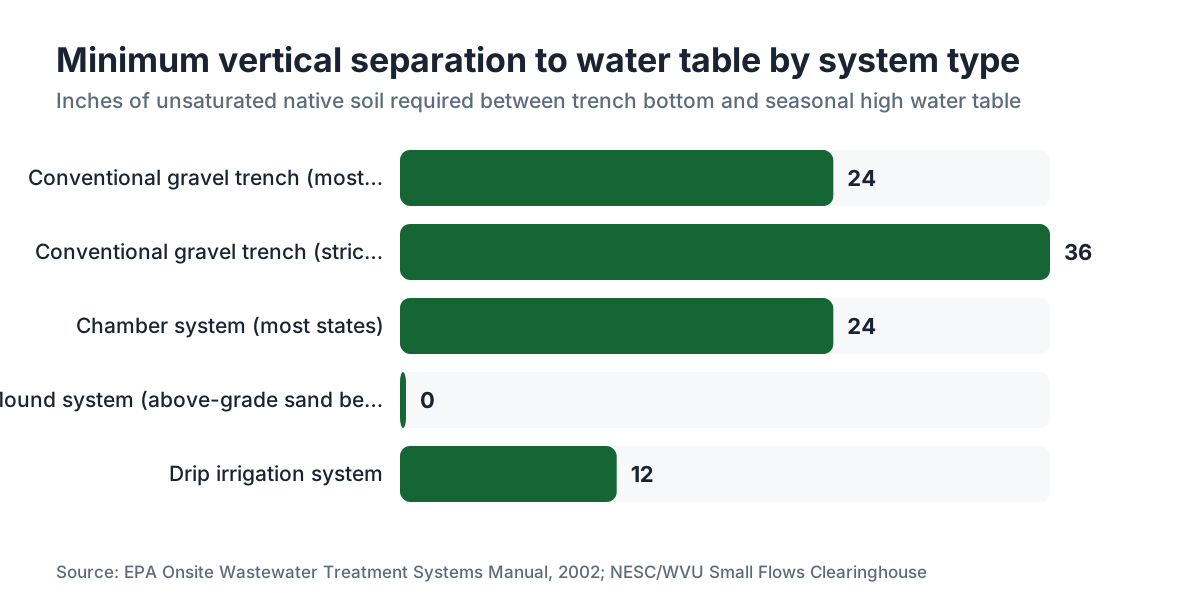
This is the single most common reason a site fails to qualify for a conventional leach field. You need at least 24 to 36 inches of unsaturated native soil between the trench bottom and the seasonal high water table. Most states set 24 inches as the hard floor. Some require 36 for conventional systems. [3]
Seasonal high water table is the phrase that trips people up. In August the water table might be 6 feet down. In March, after snowmelt, it could be 18 inches down. Soil morphology reads the historic high point from color patterns in the soil (grey mottling, or gleying) without waiting for the wet season. That's the big advantage over an August perc test that catches the ground at its driest.
Sites that miss the vertical separation still have options. Mound systems raise the infiltration surface above grade. Drip systems can sometimes place effluent shallow enough to keep separation. Engineered fill is allowed in some states. None of it is cheap. A mound typically adds $5,000 to $15,000 over a conventional in-ground field. [7]
Buying rural land? Ask for the seasonal high water table depth by name in the soil evaluation report. It should sit in the permit file at the county health department.
What is the minimum lot size or area needed for a leach field?
There's no federal minimum lot size for a septic system. It's all state and local. A few rough benchmarks give you the shape of it.
Many county health departments in the Southeast and Midwest want at least 1 acre for a home on septic, partly to keep separation from any future well on that lot or the one next door. Some rural western counties allow half-acre lots when soils are excellent and wells are shared. Coastal and suburban counties often demand 2 acres or more.
Raw lot size matters less than usable area. Subtract the house footprint, the well setback circle, the property line setbacks, wetland buffers, steep slopes, and poor-soil zones, and the buildable area for a field can shrink hard on even a big lot.
A 3-bedroom house needing 900 square feet of trench bottom, laid out as five 100-foot trenches at 8-foot spacing, wants roughly 40 by 100 feet (4,000 sq ft) of suitable, reasonably flat ground. Then add the reserve area. Many states require a second, unencumbered replacement area equal to 100% of the primary field. That doubles the land you need. [2]
Slope counts too. Most codes limit drain fields to 30% grade or less. Steep ground causes shallow lateral flow, exposed pipe, and erosion.
What is a reserve area and why does it matter?
A reserve area is a piece of the lot set aside for a replacement leach field if the primary one fails. In most states it's not optional. Regulations typically require the reserve to be identified, staked, and protected from construction at the time of the original permit. [2]
The reserve has to meet the same soil, setback, and sizing standards as the primary field. If your primary needs 900 sq ft of qualifying trench bottom, your reserve needs another 900 sq ft of equivalent soil. Some states require 50% of the primary area. Others require the full 100%.
That's why small lots cause headaches. You might have just enough room for the primary field and nothing compliant left for the reserve. When that happens, the county won't issue a permit, or it issues one with a variance that comes back to bite you at resale.
Protect the reserve for the life of the system. Don't build a shed there. Don't let a contractor park heavy equipment on it during the build. Compaction from vehicle traffic wrecks the soil structure you'll need for future absorption. Buying a home? Ask to see the original permit drawing that shows both the primary field and the reserve location.
What are the pipe and distribution box specifications?
Effluent distribution gets talked about too little for how much it decides. Spreading wastewater evenly across the whole field is what keeps the system alive for decades instead of years.
Distribution boxes (D-boxes): The D-box splits flow from the tank outlet into multiple trench laterals. In gravity systems, the outlet ports have to sit level with each other to within 1/8 inch. A D-box that settles or gets set out of level dumps all the flow into the lowest outlet, drowning one trench while the others sit dry. It's a common failure mode that almost nobody checks. [1]
Drop boxes: These route flow from one trench to the next in sequence instead of splitting it. The first trench fills until effluent reaches an overflow port, then flow steps down to the second. Serial loading works the first trench hard and rests the rest. There are tradeoffs, and most newer designs lean toward serial manifolds or pressure dosing.
Perforated pipe: Standard spec is 4-inch PVC or ABS perforated pipe per ASTM D2729 [4], with 1/2-inch holes or slots. Holes face down in some states and up in others, so check your local code. Solid pipe runs from the tank outlet to the D-box. Perforated pipe starts at the D-box.
Pressure distribution: For limiting soils, steep sites, or large systems, pressure dosing replaces gravity. A pump pushes effluent in timed doses through small-diameter manifolds with orifices every 5 to 6 feet. That spreads effluent evenly and gives the soil time to drain between doses. Pressure distribution is often required with mound systems and some advanced treatment units. [1]
If you track field loading, pump cycles, and inspection history across a book of properties, SepticMind is built for that kind of record-keeping.
What are the most common reasons a leach field fails inspection?
Inspectors reviewing plans or checking an existing field reject applications for a short, predictable list of reasons. Know them and you'll spot trouble before you spend money.
Not enough vertical separation to the water table. The most common site disqualification, hands down. The seasonal high water table sits too close to where the trench bottom would go. Variances are hard to get here, because it's a public health problem, not a paperwork one.
Setbacks too tight. A well, stream, or property line falls inside the required buffer. Common on small lots and older subdivisions laid out before modern codes.
Perc rate fails or lands on the edge. Too fast (coarse fill or gravel) or too slow (clay). Sometimes a second test in a better spot on the lot passes.
No reserve area. The primary field fits, but no compliant land is left for the replacement.
Evidence of an earlier failure. Soil borings turn up a black, greasy smear layer (a biomat) right at the depth where the trench bottom would sit. The site was overloaded before, and that soil zone may be impaired for good.
Slope over the limit. More than 30% grade in the proposed field area.
Encroachment on the field. Aggressive-rooted trees (willows, silver maples, cottonwoods) within 10 to 30 feet of planned trenches. Roots collapse perforated pipe and plug gravel voids over 5 to 10 years.
For a field that's already failing, our septic system repair coverage walks through the options and what they actually cost.
How do leach field specs differ for alternative systems?
When a site can't carry a conventional gravel-trench system, the code opens up into what regulators call alternative or innovative systems. Each carries its own spec sheet.
Mound systems: Built above grade on imported sand fill. The mound sits on a prepared native soil bed, and effluent spreads through pressure-dosed laterals in the sand. Specs typically call for 12 to 24 inches of clean medium sand, a specific sand gradation (ASTM C33 or equivalent [12]), and side slopes no steeper than 3:1. [3] Setbacks often run larger than conventional systems, because the mound is visible and the distribution sits at grade.
Drip irrigation systems: Subsurface drip emitters at 6 to 12 inches depth, spaced 18 to 24 inches apart. They require advanced treatment (secondary or tertiary) before effluent hits the drip lines. Emitter spacing and pressure come from the manufacturer and the state permit. Not common in cold climates, because shallow lines freeze.
Chambered systems (Infiltrator, EZflow, and similar): Plastic arch chambers replace gravel in the trench. Sizing shrinks because chambers expose more trench bottom than gravel-and-pipe. Many state codes allow a 40 to 50% cut in total trench bottom area when using approved chambers. [3] The exact reduction factor lives in the state's approved product list.
Aerobic treatment units (ATUs): These treat effluent to near-secondary quality before it reaches a field or drip system. Where they're required (usually in drinking water source protection areas or on lots with minimal separation), an ATU can allow a smaller field or shorter setbacks. They need maintenance contracts and periodic inspection, and that's a lifetime cost, not a one-time one.
The money spread is wide. A conventional field on good soil might cost $3,000 to $8,000 installed. A mound runs $10,000 to $25,000. A drip system with an ATU can hit $20,000 to $50,000 on a hard site. [7] Our cost to install a septic system guide breaks it down state by state.
How do you protect and maintain a leach field to keep it within spec?
A field built perfectly to spec can still die young if you neglect it. The rules for keeping it alive are simple, and most homeowners ignore them until sewage shows up in the yard.
Pump the tank on schedule. The EPA's SepticSmart program recommends pumping every 3 to 5 years for a typical household. [8] Skip it and solids carry over into the field and clog the gravel. That's the most common cause of early field failure, and it's completely preventable. Our guide on how often to pump a septic tank sets a schedule by household size.
Keep the surface clear. No vehicle traffic on the field. Ever. One pass from a loaded concrete truck can compact the soil enough to cut its absorption rate in half. No structures either. Sheds, decks, and patios block evapotranspiration and make future repairs impossible to reach.
No deep-rooted plants. Grass is fine. Vegetables are fine, though you probably don't want to eat them. Trees and large shrubs are not. Willow roots can chase a moisture gradient into perforated pipe from 30 feet away.
Divert surface water. Gutters, sump pumps, and grading should send runoff away from the field. Saturated soil can't take effluent, and every gallon of stormwater that soaks into the field area steals capacity from wastewater.
Watch your water use. Efficient appliances, fixed leaky toilets, and laundry spread across the week all cut peak loading. EPA SepticSmart notes that a single running toilet can waste 200 gallons a day, more than the design flow assigned to one bedroom. [8]
Our septic tank pumping and septic tank inspection guides lay out the full schedule.
Operators running multiple properties can track pumping history, reserve area status, and inspection records in one place with SepticMind.
What does a leach field permit application require?
A permit for a new leach field usually means a site evaluation, a design, and a formal application to the county health department or state environmental agency. Here's what most jurisdictions want in the package.
Soil evaluation report: Perc test results or soil morphology data from an approved evaluator, with boring locations, depth to restrictive layer, and depth to seasonal high water table. Some states require the evaluator to hold a soil scientist or geologist license.
Site plan or survey: A to-scale drawing showing property boundaries, the house, every well within 100 to 200 feet (including neighbors), surface water features, and the proposed layout with all setback dimensions labeled.
System design: Usually prepared by a licensed engineer or designer, showing trench layout, pipe sizes, D-box or manifold specs, proposed grades, and the reserve area. Alternative systems need manufacturer specs and any state approval documentation.
Application fee: Anywhere from $50 to several hundred dollars, depending on state and system type.
Inspection schedule: Most permits require at least one inspection during construction, before backfill. Some require several: trench depth, gravel placement, pipe placement, and final cover.
Processing time is all over the map. A rural county with a simple site might turn a permit in 2 to 4 weeks. A coastal county with heavy environmental review can take 3 to 6 months. Build that into your timeline if you're buying or building.
At sale, a septic tank inspection is often required at transfer. It covers the tank and the field condition, though not always a full soil re-evaluation.
Frequently asked questions
How many square feet does a leach field need to be?
It depends on daily wastewater flow and soil absorption rate. A typical 3-bedroom home has a design flow near 450 gallons per day. Divided by a soil application rate of 0.4 to 0.6 gallons per square foot per day, that comes to 750 to 1,125 square feet of trench bottom. Your state's onsite wastewater code holds the exact application rate table for your soil type.
How far does a leach field need to be from a well?
Most state codes require 50 to 100 feet between a leach field and a private drilled well. The EPA recommends 50 to 100 feet as a general minimum. Some states go stricter: Florida has used a 75-foot standard, and many coastal states require 100 feet or more. Check your state's onsite wastewater regulations rather than trusting a national average.
Can you build on top of a leach field?
No. You cannot put structures (houses, garages, sheds, decks, patios) over a leach field or its reserve area. Structures block evapotranspiration, cut off access for repairs, and add loads that crush buried pipes and gravel voids. Vehicle traffic is barred for the same reasons. Grass is the recommended cover.
How deep are leach field pipes buried?
Perforated trench pipes usually sit 18 to 36 inches below grade. Shallower trenches (18 to 24 inches) treat better, because the most biologically active soil is near the surface. Some codes allow up to 48 inches in good conditions. Soil cover over the gravel should be 6 to 36 inches; too much cover limits evapotranspiration and oxygen.
What percolation rate is too slow for a leach field?
Most state codes prohibit conventional gravel-trench systems in soil slower than 60 minutes per inch. At that speed the soil can't drain fast enough to prevent surfacing or saturation. Sites between 45 and 60 MPI often need an alternative system like a mound or drip. Below 1 minute per inch is also a problem: the soil drinks too fast to treat pathogens.
How long does a leach field last?
A well-designed, well-built, well-maintained field usually lasts 20 to 30 years, and some go longer. The biggest life-shorteners are skipping tank pumping (solids carry over and clog the field), vehicle traffic compacting the soil, and hydraulic overloading from heavy water use or surface water. Pumping the tank every 3 to 5 years is the single most effective thing you can do.
What is the minimum slope allowed for a leach field?
Most codes cap the field area at 30% slope, and many designers prefer 15% or less. Steeper ground makes trenches too shallow at the uphill end and too deep downhill, which fights level installation. It also raises the risk of effluent daylighting on the hillside. Some codes allow steeper slopes with engineered contour trenches installed on-grade.
Does a leach field need a reserve area?
Yes, in most states. A reserve area is unencumbered land that meets the same soil and setback standards as the primary field, held for a future replacement. Most codes require a reserve equal to 50% to 100% of the primary field area, marked on the permit drawing and legally protected from construction or other uses.
Can I install my own leach field without a permit?
Not legally, in nearly any U.S. jurisdiction. Onsite wastewater systems need a permit from your county health department or state environmental agency in all 50 states. Installing without a permit or inspection can bring fines, mandatory removal, and real liability if the system contaminates a neighbor's well. It also blows up at resale.
How do chamber systems compare to gravel trench systems in size?
Plastic arch chamber systems (like Infiltrator) are approved in most states and typically allow a 40 to 50% cut in total trench bottom area versus gravel-and-pipe, because chambers expose more soil surface per linear foot. The state's approved product list gives the exact reduction factor. Chambers also skip the cost and weight of hauling gravel, which often offsets their material price.
What are the signs that a leach field is failing?
Common signs: slow drains throughout the house, sewage odors in the yard, wet or spongy ground over the field when it hasn't rained, and sewage surfacing. Inside, gurgling drains and toilets that back up when other fixtures run point to a field that won't accept flow. If you see any of these, stop heavy water use and call a licensed septic pro right away.
How much does it cost to install a new leach field?
A conventional gravel-trench field for a 3-bedroom home runs roughly $3,000 to $8,000 in most U.S. markets, not counting the tank or site prep. Mound systems cost $10,000 to $25,000. Drip systems with aerobic treatment units can reach $20,000 to $50,000. Region, soil, permit fees, and labor rates move the number a lot. See our cost to install septic system breakdown.
Can tree roots damage a leach field?
Yes, and it's a common failure cause. Willow, silver maple, cottonwood, and poplar roots follow moisture into perforated pipe from 15 to 30 feet away. Once inside, they fill the pipe and colonize the gravel void. Most codes require trees at least 10 to 30 feet from any trench, depending on species. Grass or shallow-rooted groundcover is the safe cover.
What happens to a leach field in a flood?
Flooding saturates the soil around the field and stops absorption cold. If floodwater gets into the trenches, it can carry contaminants back into the septic system. After a flood, the EPA recommends not using the system until the water table drops and the soil drains, then having a pro inspect the tank and field before normal use resumes. Running a saturated system forces effluent to the surface.
Sources
- EPA, Onsite Wastewater Treatment Systems Manual (EPA/625/R-00/008): 150 gallons per bedroom per day design flow; 1 to 30 MPI as the practical range for conventional systems; distribution box leveling requirements; pressure dosing specifications
- North Carolina DHHS, Rules for Sewage Treatment and Disposal Systems (15A NCAC 18E): 45 MPI cap for conventional trench systems; reserve/repair area requirement equal to the primary field
- National Environmental Services Center (NESC), West Virginia University, Small Flows Clearinghouse: Soil morphology advantages over perc testing; 24 to 36 inches vertical separation to water table; chamber system reduction factors; mound system sand gradation specifications
- ASTM International, ASTM D2729 Standard Specification for Poly(Vinyl Chloride) Sewer Pipe and Fittings: 4-inch perforated PVC pipe specification for leach field laterals
- Florida Department of Health, Onsite Sewage Treatment and Disposal Systems (Chapter 64E-6 FAC): 75-foot well setback historically allowed in Florida for conventional systems
- EPA, Clean Water Act Section 404 (Wetlands Permitting Program): Federal prohibition on filling wetlands without a permit; applies to leach field installation in mapped wetlands
- EPA, Decentralized Wastewater Management Program (system cost and type guidance): Cost ranges for mound and drip systems relative to conventional fields
- EPA SepticSmart Program: Pump every 3 to 5 years recommendation; running toilet wastes approximately 200 gallons per day
- Virginia Department of Health, Sewage Handling and Disposal Regulations (12VAC5-610): 60 MPI maximum percolation rate allowed for conventional leach fields in Virginia
- ASTM International, ASTM C33 Standard Specification for Concrete Aggregates: Sand gradation specification commonly referenced for mound system fill material
Last updated 2026-07-09