Leach field size for a 3 bedroom home: what the codes actually require
By the SepticMind Editorial Team
TL;DR
- Codes size a leach field by daily sewage flow, and they estimate that flow from bedroom count.
- A 3-bedroom home generates roughly 300 to 450 gallons per day.
- Your soil's percolation rate turns that flow into anywhere from 300 to 900 square feet of trench bottom, with 450 to 600 sq ft being the common result in moderate soils.
- Your county health department sets the binding number.
Why does bedroom count drive leach field size?
Regulators do not count the people living in your house. They count bedrooms, because bedrooms predict worst-case occupancy, and worst-case occupancy sets the design daily flow. The federal standard, published by the EPA in its "Onsite Wastewater Treatment Systems Manual," treats each bedroom as adding roughly 75 to 100 gallons per day to the household flow estimate. [1]
A 3-bedroom home lands at a design flow of 225 to 450 gallons per day depending on the state. Most states cluster around 300 to 450 gpd for three bedrooms. A 4-bedroom home bumps that to 400 to 600 gpd under the same formulas, which is why the field for a 4-bedroom runs noticeably bigger on identical soil.
More design flow means more wastewater the soil has to swallow every day. More wastewater means more trench area. That is the whole logic.
The bedroom method has an obvious flaw. A retired couple in a 3-bedroom house uses a fraction of the water a family of five uses in the same house. Codes do not care. They are written for the day you sell to that family of five, and no inspector will size your system around your quiet lifestyle. Work inside the formula, because the formula is what gets stamped.
How does soil percolation rate change the field size calculation?
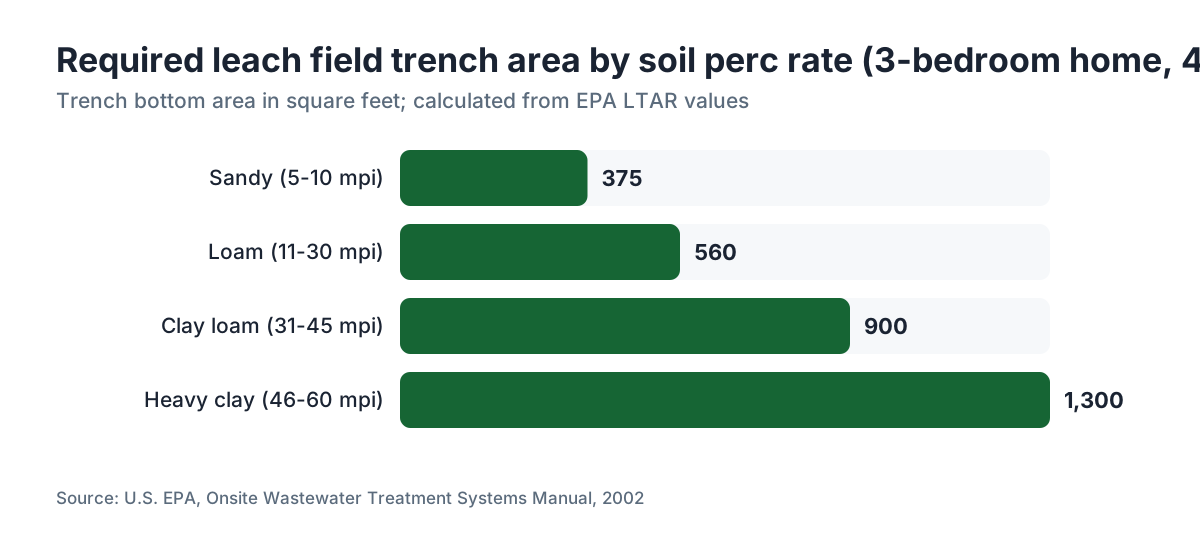
Percolation rate is the single biggest lever on your final square footage. It measures how fast water moves through your soil, in minutes per inch (mpi). Fast sandy soil percs at 5 to 10 mpi. Dense clay percs at 45 to 60 mpi. Soils slower than 60 mpi often get rejected for conventional trenches outright. [1]
The math runs in one direction. Once you know your design daily flow and your perc rate, you look up the long-term acceptance rate (LTAR), which is the gallons per square foot per day your soil can absorb without clogging. Required trench bottom area equals design flow divided by LTAR.
Here is what that produces for a 3-bedroom home at 450 gpd design flow:
| Perc rate (mpi) | Typical LTAR (gpd/sq ft) | Required trench area |
|---|---|---|
| 5 to 10 (sandy) | 1.2 | ~375 sq ft |
| 11 to 30 (loam) | 0.8 | ~560 sq ft |
| 31 to 45 (clay loam) | 0.5 | ~900 sq ft |
| 46 to 60 (heavy clay) | 0.3 to 0.4 | 1,125 to 1,500 sq ft |
These LTAR values track the ranges in EPA's 2002 manual (Table 7-2). [1] State codes use different divisors, so your permit number may shift, but the relationship holds everywhere: slower soil, bigger field.
Get a real perc test before you assume your lot will fit a conventional system. A bad perc test on a 3-bedroom lot is not a death sentence. It usually just means a more expensive system type.
What is the actual square footage range for a 3-bedroom home?
In moderate soils (perc 11 to 30 mpi), a 3-bedroom leach field runs 450 to 600 square feet of trench bottom area. That is the number your contractor uses to lay out the trench network. [1]
Trench bottom area is not the same as the land the system eats. Trenches run 1 to 3 feet wide and sit at least 6 feet apart, measured through undisturbed soil. A 600 sq ft trench-bottom system built with 2-foot-wide trenches on 8-foot centers occupies a footprint of roughly 50 feet by 24 feet, or about 1,200 sq ft of yard. Add setbacks from the house, property lines, wells, and water features, and the real land demand grows again. [2]
Most homeowners underestimate how much yard a septic system claims. A 3-bedroom system plus all its required buffers can tie up 3,000 to 5,000 sq ft of lot.
For a new 3-bedroom home on septic, minimum lot sizes in most states range from half an acre to two acres, though the spread by state and county is enormous. Your county's onsite wastewater ordinance has the specific minimum.
What are the standard setback requirements for a leach field?
Setbacks protect drinking water and your neighbors. EPA's SepticSmart guidance recommends placing leach fields at least 50 to 100 feet from any well or water supply. [3] State codes set the binding minimums, and they vary, but the common numbers look like this:
- 10 to 20 feet from the house foundation
- 5 to 10 feet from property lines
- 50 to 100 feet from a private well
- 100 to 200 feet from a public water supply
- 25 to 100 feet from surface water (streams, ponds, wetlands)
Some states go stricter. California requires 100 feet from a domestic well under most conditions. [4] Florida's Department of Health requires a 75-foot setback from potable water supply wells. [5]
Setbacks do not bend. A small lot with an existing well may have no room for a 3-bedroom system at all. That is exactly why a site evaluation before you buy land or plan an addition is money well spent.
Does your soil need a perc test, or will a soil evaluation work?
The rules here have shifted over the last 20 years. The traditional perc test (dig a hole, flood it, time the drop) was the standard for decades. Plenty of states still accept it. A growing number now require or prefer a full soil morphology evaluation done by a licensed soil scientist. [1]
A soil evaluation reads the actual soil profile: texture, structure, depth to restrictive layers, and mottling that signals seasonal saturation. It gives a more accurate and usually more conservative picture than a perc test run in dry weather.
EPA's 2002 manual notes that percolation tests "are subject to variability" and points to morphological evaluation as a better predictor of long-term performance. [1]
The practical question for you is short: what does your county require? Call the county health department before you hire anyone. A perc test, where still accepted, runs $300 to $500. A full soil morphology report from a certified soil scientist runs $500 to $1,500. [6]
Do not skip this. The site evaluation drives the permit, and the permit drives the design. Everything downstream depends on this one report.
How does a conventional trench system compare to alternative designs?
If your perc test fails or your lot is tight, a conventional gravity trench is not your only path. All 50 states allow some form of alternative system. Here is how the main types stack up for a typical 3-bedroom home:
| System type | Typical installed cost (3 BR) | Land footprint | Soil requirement |
|---|---|---|---|
| Conventional gravity trench | $3,000 to $10,000 | Medium | Perc 5 to 60 mpi |
| Pressure-dosed trench | $8,000 to $15,000 | Medium | Perc up to 90 mpi |
| Mound system | $10,000 to $25,000 | Large | Shallow water table or poor perc |
| Drip irrigation | $15,000 to $30,000 | Small | Flexible |
| Aerobic treatment unit (ATU) | $12,000 to $25,000 | Small | Flexible |
Cost ranges come from EPA SepticSmart guidance and industry data, and they swing hard by region and contractor. [3][6] For a fuller breakdown, the cost to install septic system page has current regional figures.
For most 3-bedroom homes on decent lots with moderate soils, the conventional gravity system wins on cost. Mound systems and ATUs cost real money to run and maintain over their life. Do not pick them unless the site forces your hand.
How do you calculate leach field size yourself before hiring anyone?
You cannot finalize this without a perc test and a permit. A back-of-envelope check is still useful before you buy land or commit to a project.
Step 1: Find your state's design daily flow per bedroom. Most states use 75 to 150 gpd per bedroom. For 3 bedrooms, assume 300 to 450 gpd until you confirm your state's figure. [1]
Step 2: Estimate your perc rate. Sandy loam topsoil with good drainage, assume 15 to 25 mpi. A yard that stays soggy after rain, assume 45 mpi or worse.
Step 3: Pull the matching LTAR from the EPA table or your state's table. For 20 mpi loam, a typical LTAR is 0.7 to 0.8 gpd/sq ft.
Step 4: Divide flow by LTAR. 400 gpd / 0.75 gpd/sq ft = 533 sq ft of trench bottom.
Step 5: Apply your state's safety factor. Many states multiply by 1.5 or enforce a minimum trench area regardless of perc. That 533 sq ft raw number can become a 750 sq ft permitted design.
For a 4-bedroom home, run the same steps at 450 to 600 gpd. The trench area typically comes out 30 to 50% larger than the 3-bedroom equivalent on the same soil.
This is an estimate, not a design. A licensed designer has to stamp the final plans.
What permits and inspections are required for a leach field?
Every state requires a permit before you install or replace a leach field. The process runs like this:
- Site evaluation and soil test (required before you can apply)
- System design by a licensed engineer or designer
- Permit application to the county health department or environmental agency
- Permit approval (2 to 8 weeks in most jurisdictions)
- Installation by a licensed contractor
- Inspection at key stages (usually trench bottom before gravel, then before backfill)
- Final permit closeout
EPA's SepticSmart program states that "state and local governments regulate the installation, operation, and maintenance of septic systems." [3] The agency name changes by state: Department of Health in some, Department of Environmental Quality or Environmental Services in others.
Permit fees typically run $200 to $1,000 for a residential system, and complex sites cost more. [6]
During a real estate deal, the septic tank inspection starts with permit history. A system installed without permits is a red flag for buyers and lenders both.
Never skip the permit. An unpermitted system is a liability when you sell, and some lenders will not finance a home that has one.
How long does a leach field last, and what shortens its life?
A well-installed, well-maintained field in good soil should last 20 to 30 years. Some run 40 years or more. Others die before 10. The gap almost always comes down to loading and maintenance. [3]
The things that kill leach fields fastest:
Biomat buildup. Every trench grows a biological mat at the soil interface. At normal loading it stabilizes and does its job. Overload the system and the biomat thickens until it seals the soil off. That is a dead drain field.
Skipping the pump. Solids that escape the tank clog the trench perforations and plug the soil pores. Getting the tank pumped every 3 to 5 years is the cheapest insurance policy on your leach field, and the EPA recommends exactly that interval for a typical household. [3]
Vehicle traffic. Compaction crushes pore space and kills the microbes. Never drive or park over a field.
Tree roots. Willows, poplars, and maples are the worst offenders. Keep them far from the field boundary.
High water tables. A seasonal water table that reaches the trench bottom drowns the aerobic treatment zone. This is why a soil evaluation that documents seasonal saturation depth matters as much as it does.
If your field is showing stress, the leach field overview walks through diagnostics and repair options before you commit to a full replacement.
What does it cost to install a leach field for a 3-bedroom home?
Leach field costs swing more than almost any other home project, because soil, lot access, and local labor rates each move the number hard.
For a conventional gravity trench system on a 3-bedroom home:
- Minimum (easy site, sandy soil, rural area): $3,000 to $5,000
- Typical national range: $5,000 to $12,000
- Complex site (clay soil, hard access, high-cost labor market): $12,000 to $20,000
If conventional trenches will not work and you need a mound or ATU, add $10,000 to $20,000 on top. [6]
The tank is a separate line item. On a fresh full-system install, the cost to put in a septic tank adds another $1,200 to $5,000 for the tank alone.
Field costs have climbed roughly 15 to 25% since 2020 on material and labor inflation. Any quote older than 18 months is worth re-soliciting.
Get at least three bids from licensed installers in your county. The lowest bid is not automatically wrong, but a bid 40% under the others usually means missing scope or unlicensed work. Neither one is a bargain.
Operators tracking costs across many residential installs can use a platform like SepticMind to keep permit documentation, site data, and job history in one place.
Can you expand a leach field if you add a bedroom or increase occupancy?
Yes, but it is never as simple as bolting on extra trenches. Adding a bedroom triggers a new design daily flow calculation under most state codes, which means a new permit, an updated site evaluation, and sometimes a full redesign.
The real constraint is land. If your original system was squeezed onto the lot with no margin, a bigger system may not fit once you keep every setback and separation distance intact.
EPA's 2002 manual recommends that original designs include a reserve area equal to 100% of the primary field, held in undisturbed condition for future expansion or repair. [1] Most state codes echo this. If your county required a reserve area when the system was permitted, expanding to a 4-bedroom equivalent may work. If no reserve exists, or it got disturbed, you may be looking at an alternative system type instead.
Call the county health department before you build the addition. Some counties require a full re-evaluation before they will issue a building permit for the extra bedroom.
How do state codes differ, and why does it matter for your permit?
The federal government sets guidance through the EPA, but onsite wastewater is regulated state by state, and often county by county on top of that. [3] The variation is real and it costs money.
North Carolina uses a soil classification system running Class I through Class VI, each with its own trench depth and LTAR requirements under the state sewage treatment rules. [7] In California, statewide water board policy sets a framework while county environmental health departments write the residential septic rules, so a San Diego County perc standard differs from a Sacramento County one. [4] Florida's Rule 64E-6 sets statewide minimums, and counties layer stricter standards on top. [5]
This matters for a 3-bedroom home because the same lot, same soil, and same house can require 450 sq ft of trench in one state and 700 sq ft across the line.
The only number you can trust for your permit is the one your county health department produces after reviewing your site evaluation. State extension services are a solid starting point for the baseline rules. University extension programs in North Carolina, Florida, Virginia, and Pennsylvania all publish good state-specific guides through their environmental health or biological engineering departments. [8]
A service operator running jobs across multiple counties can use a tool like SepticMind to track jurisdiction-specific requirements without a paper file for every municipality.
What maintenance keeps a leach field working for decades?
The maintenance list is short. The stakes are not.
Pump the septic tank every 3 to 5 years. The EPA recommends this interval for a typical 3 to 4 person household, and it is the most evidence-backed maintenance action you can take. [3] Solids escaping into the field are the number one cause of premature failure.
Read how often to pump a septic tank if you want the decision logic tied to tank size and household size.
Cut water loading in wet seasons. If your area has a high seasonal water table, easing off laundry and long showers through March and April gives the soil time to drain. Field failures cluster in late winter and spring for exactly this reason.
Keep grease, wipes (yes, the "flushable" ones too), pharmaceuticals, and harsh chemicals out of the drain. Grease coats the biomat and slows absorption. Wipes never break down. Antibacterial products can knock back the microbes doing the treatment in your tank.
Keep the field surface in grass. Deep-rooted plants and trees cause trouble. Shallow grass is fine, and it helps by pulling moisture out of the soil above the trenches.
Check the distribution box now and then. A tilted D-box sends all the flow to one end of the field, overloading it while the rest sits idle. A septic tank inspection should include a look at the D-box.
Skip the additives. EPA's position is that biological and chemical additives are not necessary for a properly functioning system, and there is no evidence they extend field life. [3]
Frequently asked questions
How many square feet of leach field does a 3-bedroom home need?
In moderate soils (perc rate 11 to 30 minutes per inch), a 3-bedroom home needs roughly 450 to 600 square feet of trench bottom area. Sandy soils may need as little as 300 sq ft. Heavy clay can push the requirement above 900 sq ft. Your county health department and a licensed soil evaluator give you the site-specific number after a perc test or morphology evaluation.
How big is a leach field for a 4-bedroom home compared to a 3-bedroom?
A 4-bedroom home's design daily flow runs roughly 30 to 50% higher than a 3-bedroom's under most state formulas. In the same moderate soil, expect 600 to 900 sq ft of trench bottom area. The exact increase depends on your state's per-bedroom flow rate. Some states use 75 gpd per bedroom, others 100 gpd, which changes the math meaningfully.
What is the minimum lot size for a 3-bedroom home on a septic system?
There is no single federal minimum. State and county rules vary widely. Common minimums range from 0.5 acres in some rural counties to 2 acres where well setbacks or sensitive soils apply. The binding number comes down to fitting the field, reserve area, tank, and every required setback on the available land. Call your county health department for the local standard.
How deep are leach field trenches for a residential system?
Most codes require trenches 18 to 36 inches deep, with the perforated pipe set on 6 inches of gravel and covered by 2 to 3 feet of soil. The minimum separation between trench bottom and seasonal high water table or a restrictive layer is typically 24 to 48 inches, depending on the state. Shallower or deeper installations need special engineering.
How long does a leach field last on a 3-bedroom home?
A properly installed and maintained field typically lasts 20 to 30 years, with many running 40 years or more. The main killers are solids escaping an unpumped tank, vehicle compaction, tree root intrusion, and sustained overloading. Regular tank pumping every 3 to 5 years, per EPA guidance, is the most effective way to extend field life.
Can a leach field be installed in clay soil?
Yes, but it is harder and pricier. Soils with a perc rate of 31 to 60 minutes per inch need a larger trench area and sometimes pressure dosing to spread effluent more evenly. Soils slower than 60 mpi often cannot support a conventional system and require a mound, drip irrigation, or aerobic treatment unit. A soil evaluation tells you which category your clay falls into.
What happens if a leach field is too small for the house?
An undersized field gets hydraulically overloaded. Effluent backs up in the trenches, the biomat thickens fast, and eventually the soil seals and stops absorbing. You get soggy ground over the field, sewage odors in the yard, and slow drains or backups inside. An undersized system can also contaminate groundwater. The fix is a new field or an alternative system, costing $8,000 to $30,000.
Does a 3-bedroom home need a separate leach field from its septic tank?
Yes. The septic tank and the leach field (also called a drain field or absorption field) are two separate components. The tank holds solids and provides primary treatment. The field disperses the clarified liquid effluent into the soil for final treatment. They are always connected, never combined. The tank usually sits 10 to 20 feet from the house, with the field extending further out.
Do I need a reserve area in addition to the main leach field?
Most state codes require a reserve area equal to 50 to 100% of the primary field, held undisturbed for future repair or replacement. EPA's 2002 Onsite Wastewater Treatment Systems Manual recommends a 100% reserve. If you are buying a property, confirm the reserve area exists and has not been built on, paved, or planted with trees. A missing reserve area badly complicates future repairs.
How much does it cost to replace a leach field on a 3-bedroom home?
Replacement of a conventional gravity trench system runs $5,000 to $15,000 for a typical 3-bedroom home in moderate soils. Poor site access, clay soils, or the need for an alternative system type can push costs to $20,000 to $35,000. Costs have risen since 2020. Get current bids from at least three licensed contractors in your county; regional labor markets swing the price.
How do I find my existing leach field's location and size?
Start with your county health department. Permitted systems have a record on file with a site plan showing tank and field location, dimensions, and install date. If the system predates permits or records are missing, a septic inspector can locate it with a probe rod or electronic locator. As-built drawings, where they exist, are the most reliable source for original trench dimensions.
Is a perc test required before installing a leach field?
In most jurisdictions, yes, though the test type varies. Many states now prefer or require a soil morphology evaluation by a certified soil scientist over a traditional perc test, because morphology reads seasonal conditions better. Check with your county health department before scheduling any testing. The results drive your permit application and system design.
Can you add a leach field to an existing septic system?
You can expand or add to an existing field, but it requires a new permit, a site evaluation, and proof that adequate land area and setbacks exist. If you are adding a bedroom, the extra flow gets calculated and the new total design flow must be accommodated. Many older systems were built without reserve area, which complicates expansion and may force an alternative system type.
Sources
- U.S. EPA, Onsite Wastewater Treatment Systems Manual (EPA/625/R-00/008, 2002): Design daily flow per bedroom (75-150 gpd), LTAR values by perc rate, recommendation for soil morphology evaluation over perc tests, and 100% reserve area guidance.
- U.S. EPA, Septic Systems (SepticSmart) homepage: Trench separation distances and general setback guidance for residential leach fields.
- U.S. EPA SepticSmart Program: EPA recommendation to pump every 3-5 years; statement that state and local governments regulate septic installation; position that additives are not necessary for properly functioning systems.
- California State Water Resources Control Board, Onsite Wastewater Treatment Systems (OWTS) Policy: California requires 100-foot setback from domestic wells under most conditions; county health departments set residential septic rules.
- Florida Department of Health, Onsite Sewage Treatment and Disposal Systems (Rule 64E-6 F.A.C.): Florida requires 75-foot setback from potable water supply wells; counties may impose stricter standards.
- Angi, Septic System Installation Cost Guide (2024): Installed cost ranges for conventional trench systems ($3,000-$20,000), mound systems, ATUs, and permit fee ranges ($200-$1,000). Soil evaluation cost ($300-$1,500).
- North Carolina State University Extension, Biological and Agricultural Engineering: University extension programs publish state-specific onsite wastewater guides for homeowners and designers.
- Virginia Cooperative Extension, Septic System Owner's Manual (Publication 448-407): Setback requirements and maintenance guidance for residential septic systems, including leach field trench spacing standards.
- Penn State Extension, Septic System Basics: Soil evaluation methods, perc test procedures, and reserve area requirements for residential onsite systems.
Last updated 2026-07-09