Leach field depth: how deep pipes must be and why it matters
By the SepticMind Editorial Team
TL;DR
- Standard leach field trenches run 18 to 36 inches deep, with distribution pipes 6 to 24 inches below grade.
- Depth depends on soil type, frost, local code, and how close groundwater sits.
- Most state codes require at least 6 inches of soil cover over the pipe and 12 to 36 inches of unsaturated soil below the trench, so effluent gets treated before it reaches groundwater.
What is the standard depth for a leach field?
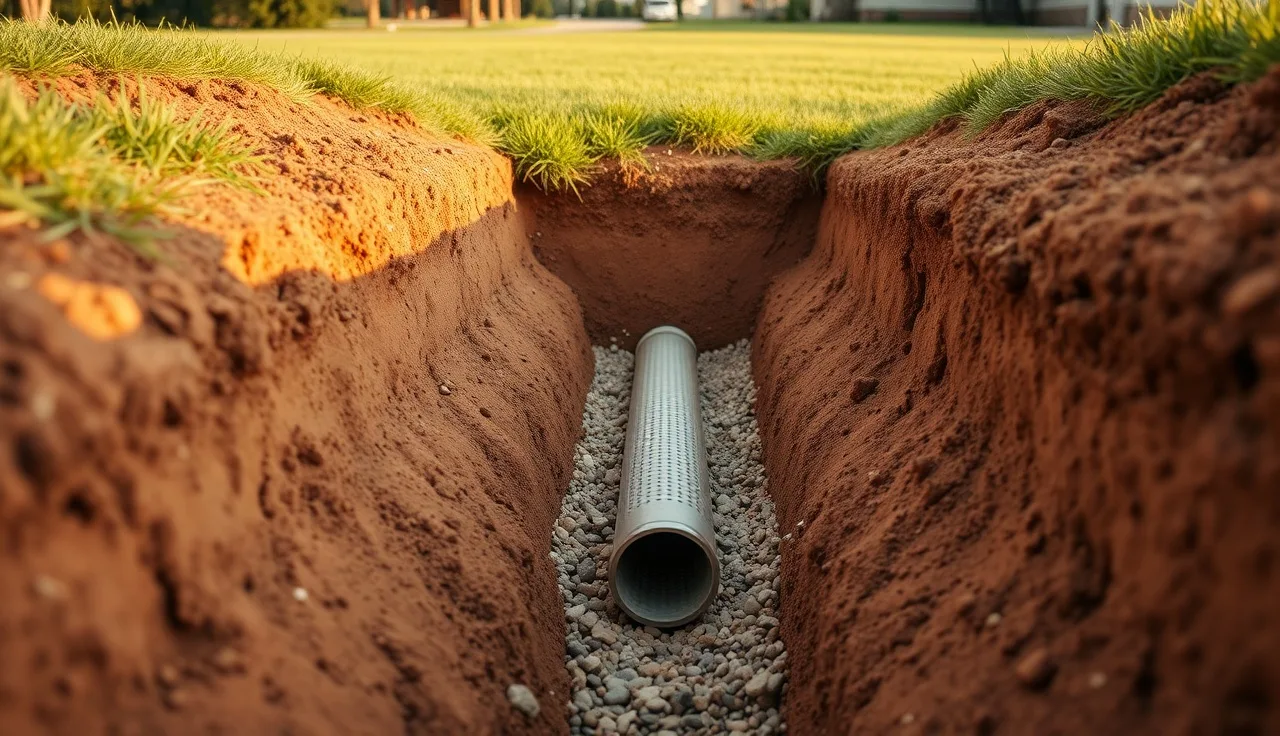
Most leach field trenches are dug 18 to 36 inches deep, measured from the ground surface to the bottom of the gravel bed. The perforated distribution pipe sits inside that gravel, usually 6 to 24 inches below grade. That range is wide because depth isn't arbitrary. It balances three demands: enough cover to protect pipes from vehicles and frost, enough distance from the surface for aerobic bacteria to treat effluent, and enough unsaturated soil below the pipe to filter pathogens before liquid reaches groundwater.
The EPA's SepticSmart program and state onsite wastewater rules generally require 12 to 36 inches of separation between the bottom of the trench and the seasonal high water table or a restrictive soil layer [1]. That requirement trips up a lot of sites. If your lot has a high water table or a clay hardpan close to the surface, you can't go as deep as a textbook design wants, which is why some sites need a mound system or another alternative instead of a conventional trench.
For a standard in-ground system, here's the working rule of thumb most state-certified designers use:
| Component | Typical depth below grade |
|---|---|
| Top of gravel bed | 6 to 12 inches |
| Distribution pipe centerline | 10 to 18 inches |
| Bottom of gravel bed | 18 to 30 inches |
| Required soil below gravel (separation) | 12 to 36 inches depending on state |
| Total trench depth (gravel bottom to surface) | 18 to 36 inches |
These are typical ranges. Your state code is the governing number, and it varies. Georgia requires 18 inches of naturally occurring soil between the trench bottom and the limiting layer [2]. California's Central Coast rules have required up to 36 inches in some zones. Check your county health department or state environmental agency before you assume a national average applies to your dirt.
Why does leach field depth vary so much from site to site?
Four things drive almost all of the variation.
Soil type comes first. Sandy, well-drained soil lets designers place pipes shallower because liquid moves through fast and microbes near the surface handle treatment fine. Dense clay or silty loam drains slowly, so separation requirements above groundwater get stricter, and the whole system may need to sit shallower or higher to stay above a restricting layer. Percolation rates, measured in minutes per inch during a perc test, are the field measurement that turns soil type into a design depth [3].
Frost depth is second. In Minnesota, Michigan, or Maine, the ground freezes 4 to 6 feet deep in a bad winter. Cold-climate codes require deeper cover, usually at least 12 inches of soil over the top of the pipe, and sometimes insulation board, to keep effluent from freezing. In Georgia or Texas, frost depth barely registers, so pipes can sit shallower.
Groundwater and limiting layers are third. The distance from the trench bottom to the seasonal high water table, a bedrock shelf, or a dense clay layer decides whether effluent gets treated before it enters groundwater. Most codes treat this number as the hard floor for design. When a site can't hit minimum separation with a standard trench, engineers switch to pressure-dosed systems, mounds, or drip irrigation.
Slope rounds it out. Trenches follow contour lines, and on steep lots the upslope end of a trench can end up shallower than code allows, pushing the field to a different layout or forcing serial distribution instead of simultaneous.
The EPA's onsite wastewater guidance frames it plainly: the treatment train depends on matching soil conditions to system depth, not the reverse [1]. A system dug to the wrong depth for its soil is a failure waiting to surface.
How does frost depth affect how deep a leach field needs to be?
Frost is the sleeper issue. Homeowners in warm states never think about it, and homeowners in cold states learn about it the hard way.
When effluent freezes inside a distribution pipe, the system backs up into the tank and eventually into the house. Frost also heaves pipes out of alignment, cracks joints, and disturbs the gravel bed. Cold-climate codes answer this with cover requirements that run measurably deeper than southern states.
The USDA Natural Resources Conservation Service publishes frost depth data and design freezing indexes by region [4]. States use these to set minimum cover. In practice:
| Climate zone | Minimum cover over pipe (typical state requirement) |
|---|---|
| Deep South (FL, LA, southern TX) | 6 to 8 inches |
| Mid-Atlantic, Pacific Coast | 10 to 12 inches |
| Northern Midwest, New England | 12 to 18 inches |
| Minnesota, northern Maine | 18 to 24 inches, sometimes with 2-inch foam insulation board |
The insulation board option matters. Some cold-climate designers put pipes shallower than frost depth on purpose, then lay rigid extruded polystyrene foam over the gravel bed to hold soil temperatures above freezing. Many northern states accept this, and it lets the field sit at a depth the soil profile actually supports rather than forcing pipes down into a zone that might hit groundwater [5].
A system that runs every day resists freezing better than a cabin used three weekends a year. Biological heat from decomposition keeps the gravel warm. Seasonal cabins are the highest-risk setup for a freeze event.
What is the minimum soil cover required over leach field pipes?
Most state codes set a minimum of 6 inches of soil over the top of the distribution pipe, with 12 inches the common standard in cold climates and where vehicles drive over the field. The EPA SepticSmart guidance echoes this: adequate cover protects pipes and keeps the biological treatment zone near the soil surface [1].
That 6-to-12-inch range matters beyond frost. Grass roots, earthworm activity, and aerobic bacteria are most active in the top 6 to 12 inches of soil. Effluent that reaches this zone gets extra treatment before evapotranspiration or lateral movement carries it away. Too shallow and you risk surface breakout, pooling, and odor. Too deep and you lose the aerobic treatment benefit.
Vehicle traffic is the practical argument for deeper cover. A riding mower over 6 inches of cover is fine. A delivery truck is not. Most codes want 12 to 24 inches of cover if the field is in a driveable area, or a physical barrier, and most designers say keep vehicles off the field entirely no matter how deep the cover [6].
Don't plant trees or shrubs over a leach field. Root intrusion is one of the most common causes of trench failure at any depth. Grass is the right surface cover, full stop.
How deep must a leach field be above groundwater or bedrock?
This is the regulation that controls site suitability more than anything else. Nearly every state sets a minimum vertical separation between the bottom of the trench and the seasonal high water table, bedrock, or a slowly permeable soil layer.
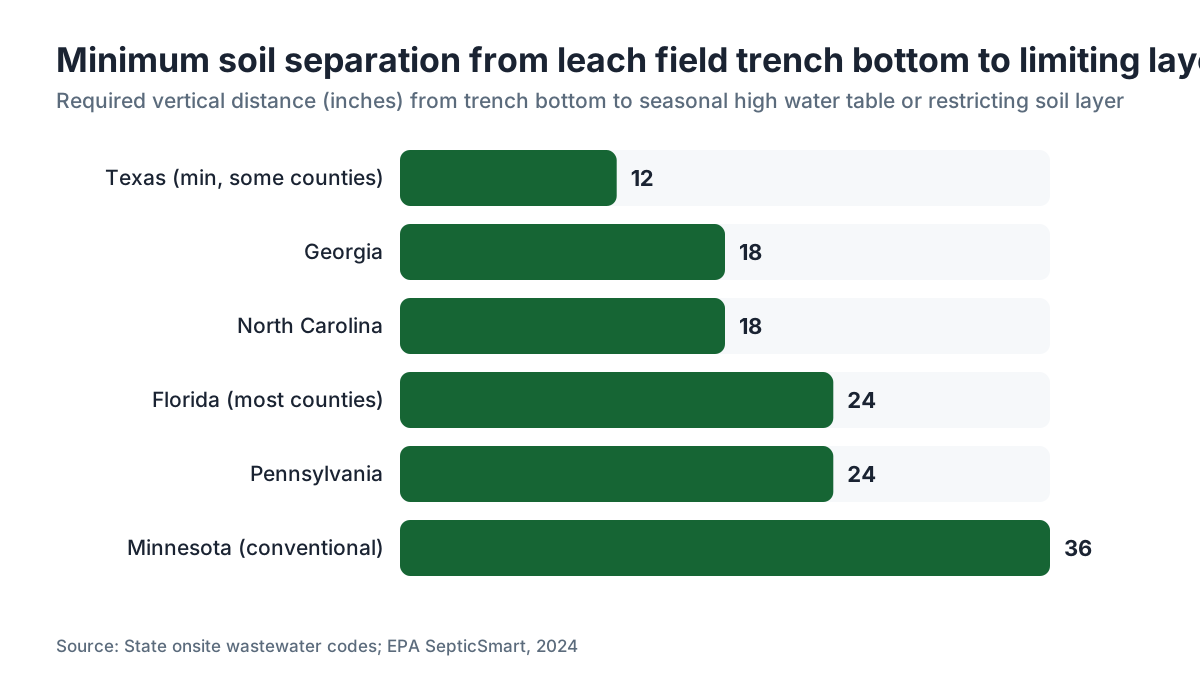
The numbers vary a lot by state:
| State | Minimum separation (trench bottom to limiting layer) |
|---|---|
| Florida | 24 inches (most counties) |
| Georgia | 18 inches naturally occurring soil |
| Texas | 12 inches (minimum, some counties require more) |
| North Carolina | 18 inches |
| Pennsylvania | 24 inches |
| Minnesota | 36 inches (conventional system) |
| California | 5 feet in some protection zones |
Minnesota's 36-inch separation is among the strictest in the country and is the main reason mound systems are so common there [7]. California's requirements shift by regional water quality board, and sensitive aquifer zones can demand separation distances that rule out conventional in-ground systems entirely.
If a site test shows the limiting layer is too close to the surface, you have three real options: redesign to an alternative system (mound, drip, aerobic treatment unit), apply for a variance if the site is borderline, or connect to public sewer if it's there. Building a system that ignores the separation requirement is a code violation, and it contaminates groundwater.
For what a full system install involves, see our guide on septic tank installation and cost to install a septic system.
How does leach field depth relate to leach field size?
Depth and size connect through soil loading rates, which is the amount of effluent a given volume of soil can absorb and treat without failing. The slower your soil drains, the larger the field area you need, and in many slow-soil sites depth is capped because you can't go deeper without hitting a restrictive layer.
The design process runs like this. A perc test or soil morphology analysis gives the designer the application rate, usually expressed in gallons per day per square foot of trench bottom. A single-family home produces roughly 100 to 150 gallons per bedroom per day. Divide total daily flow by the application rate and you get the required trench bottom area. Then the designer lays out trenches to deliver that area inside the site's depth limits.
A site with sandy soil and a deep water table might hit the required area with short, shallow trenches. A site with slower soil and a shallower water table needs longer trenches over a bigger footprint at the same depth, because the loading rate per square foot is lower.
Field size is not independent of depth. Constrain the depth and you usually widen the footprint. That's why tight lots in coastal New England with shallow bedrock often can't support a conventional system at all, and why leach field depth is the first number a site evaluator measures, not an afterthought.
For how the leach field fits into the whole system, the leach field explainer walks through function, sizing, and failure modes.
What depth requirements apply to different types of leach field systems?
Not every leach field is a trench. Different system types carry their own depth rules.
Conventional gravel trench systems are what most people picture: perforated pipe in a gravel-filled trench, 18 to 36 inches deep as described above. These are the baseline everything else gets compared against.
Chamber systems swap gravel for plastic arch chambers. The chambers sit in a trench at roughly the same depth as conventional systems, typically 12 to 24 inches to the bottom of the chamber. They need less excavation than gravel because the chamber creates its own void space for effluent storage, but the soil separation below the chamber bottom is identical to a conventional trench.
Mound systems get built above grade when the natural soil is too shallow, too wet, or too slow. The mound adds imported fill to create the required separation artificially. Pipes inside a mound sit 1 to 2 feet above the original ground surface, with the mound rising 2 to 4 feet total in most designs. Minnesota's mound standards require the bottom of the distribution medium to sit at least 2 feet above the limiting layer [7].
Drip irrigation systems deliver pre-treated effluent through emitter tubes buried 6 to 12 inches deep. Because an aerobic unit treats the effluent before it reaches the drip field, separation requirements can sometimes be reduced compared to a conventional trench, but that varies widely by state approval.
Aerobic treatment unit (ATU) dispersal fields sometimes allow shallower depths precisely because the effluent quality entering the field is higher. Some states permit ATU effluent at shallower depths or with shorter separation, but those allowances need state-specific review.
How can you tell if a leach field was installed at the wrong depth?
Wrong depth shows up two ways: too shallow and too deep. They cause different problems.
Too shallow means sewage breakout. If pipes sit less than 6 inches below grade, winter frost can freeze them solid, roots reach them easily, and heavy rain saturates the thin cover fast. The first sign is usually wet, spongy ground over the field, sometimes with a sewage smell. In dry weather you may see a green, lush stripe where nutrients are feeding grass roots near the surface. That's a health hazard and a code violation.
Too deep is less obvious and just as damaging. If trenches sit below the required separation from groundwater or bedrock, effluent skips the biologically active soil zone and enters the water table undertreated. You won't see it from the surface. Testing the drinking water well is the only way to catch it. Pathogens and nitrates from septic effluent are the concerns here [8].
Improper depth is a common finding in septic tank inspection reports too. A good inspector uses a probe or a review of installation records to verify pipe depth, more than a look at the surface. If you're buying a property, ask straight out whether the inspection included depth verification.
An older system installed before the code tightened may be grandfathered but worth watching closely. Once it starts showing symptoms, you're likely looking at septic system repair or a full leach field replacement.
Does leach field depth affect how long the system will last?
Yes, and by a lot. The relationship isn't simple, but depth that matches soil conditions extends field life, and depth that ignores them cuts it short.
A field installed at the correct depth for its soil has enough treatment time in the active zone, good drainage, and protection from frost. EPA estimates a properly designed and maintained conventional septic system lasts 25 to 30 years [1]. Many last longer with regular pumping and no compaction over the field.
A field too shallow in a cold climate takes repeated freeze-thaw cycles that shift gravel, crack pipes, and eventually collapse trenches. A field too deep in a wet site floods because the water table periodically fills the gravel bed, which kills the aerobic treatment zone and clogs the trench bottom with biomat faster than normal. Research on biomat development in saturated soil consistently shows quicker failure than properly drained systems [9].
Pumping the tank on schedule is the single biggest maintenance factor for field life at any depth, because it keeps solids out of the field and out of the gravel. See how often to pump a septic tank for a practical schedule.
For operators running multiple properties or service routes, tracking system age, depth, and soil conditions alongside pumping history is exactly the data SepticMind organizes into maintenance schedules, so nothing slips between service visits.
What do state codes and EPA guidance actually say about leach field depth?
The EPA sets no single national standard for leach field depth. Onsite wastewater treatment is regulated at the state and local level. The SepticSmart program provides education and pushes proper maintenance, but it defers to state and county codes for the design numbers [1].
Most states model their codes on the EPA's onsite wastewater manual, the NSF/ANSI 40 standard for aerobic treatment units where it applies, and their own soils data. Some states, like Florida and North Carolina, publish detailed statewide rules with specific depth tables. Others hand most of it to county health departments, so the required depth in one county can differ from the next one over.
Here's what the regulatory hierarchy looks like in practice:
- State onsite wastewater code (primary authority)
- County health department rules (may be stricter than state minimums)
- Local zoning overlays (setbacks and site-specific conditions)
- Designer judgment within allowed ranges (site-specific perc and soil data)
When you look up your own requirements, start at your state environmental agency's onsite wastewater section. The EPA's SepticSmart page links to state contacts [1]. NSF maintains a directory of state contacts and certification standards for onsite systems as well [10].
For real estate deals, the septic tank inspection report should reference the applicable state code and confirm the system meets current or grandfathered standards. Depth verification is a fair item to request from the inspector.
What happens to depth requirements when you add or replace a leach field?
Replacement or expansion triggers a full review under current code, not the code that was in force when the original system went in. This surprises a lot of homeowners.
If your existing field fails and you replace it, the new design has to meet today's depth, separation, and setback rules. On a lot permitted in 1975 under looser rules, current code may demand a larger or more sophisticated system than the one you're replacing. That's why replacement can cost far more than the original install did.
Most states require a repair zone or replacement area to be identified and protected when a system is first installed. If that area got built over, paved, or planted with trees across the decades, you may have lost your legal replacement footprint. That's a serious problem that sometimes forces a variance or a different system type.
Adding a bedroom or bathroom raises the system's daily flow design load, which may require a permit and a fresh look at whether the existing field is sized right for the new load at its current depth and layout.
For cost perspective on new install versus repair, see cost to put in a septic tank and septic system repair. The gap between a field repair and a full replacement often runs $5,000 to $25,000 depending on system type and site complexity.
How do you find out how deep your existing leach field is?
Start with the as-built drawing. When a system goes in, the installer is required in most states to file an as-built plan with the county health department showing the location, depth, and configuration of the field. Your county's environmental health or sanitation division holds these records, and many counties have digitized older ones. The as-built is the most reliable depth source because the installer recorded it at the time of construction.
No as-built? A septic inspector or engineer can probe the field. A thin steel rod pushed into the ground over a trench line will hit the pipe and register depth. It's not destructive and gives a direct measurement. A good inspector does this as a matter of course.
Some homeowners find distribution boxes or inspection ports where a tape measure reaches the depth of connected pipes. That works for the laterals closest to the D-box but may not capture the full trench picture.
Ground-penetrating radar (GPR) lets some inspectors and septic engineers locate and partly characterize buried infrastructure without digging. It isn't everywhere and it adds cost, but on a contested property sale or a system with no records, it's a legitimate tool.
One warning about the as-built: it records design intent, not necessarily what got built. Inspectors have found fields installed at the wrong depth despite correct numbers on paper. Physical probing stays the definitive check.
For routine service records that carry depth notes and inspection history, septic tank pumping visits are often the only time anyone physically touches the system, which makes those records a secondary source worth keeping. SepticMind gives operators a structured place to log depth, condition, and access notes at each visit, so every system on the route has a searchable history.
Frequently asked questions
How deep is a leach field supposed to be?
Standard leach field trenches are 18 to 36 inches deep, with perforated distribution pipes sitting 6 to 24 inches below grade. The exact depth depends on soil type, frost depth, groundwater level, and your state's onsite wastewater code. Most states require 6 to 12 inches of soil cover over the pipe, with deeper cover mandated in cold climates.
What is the minimum depth for a septic leach field pipe?
Most state codes require a minimum of 6 inches of soil cover over the top of the distribution pipe, though 12 inches is common in cold climates and areas with vehicle traffic. The pipe itself usually sits 6 to 18 inches below grade. Check your specific state or county onsite wastewater code, because these numbers vary and the local rule governs.
How deep does a leach field need to be above the water table?
Most states require 12 to 36 inches of unsaturated soil between the bottom of the leach field trench and the seasonal high water table. Minnesota requires 36 inches for conventional systems. Florida typically requires 24 inches. Texas allows as little as 12 inches in some counties. This separation is the primary factor deciding whether a conventional in-ground system is even feasible on a lot.
Can a leach field be too shallow?
Yes. A field too shallow for its climate freezes in cold winters, cutting off effluent flow and potentially backing sewage into the house. A field too shallow for its soil can produce surface breakout, with sewage pooling on the lawn and creating a health hazard. Shallow fields are also more vulnerable to root intrusion and compaction damage from vehicles or heavy foot traffic.
How deep should a leach field be in cold climates?
In northern states like Minnesota, Michigan, and Maine, pipes should sit at least 12 to 18 inches below grade, with added insulation in some designs. Cold-region codes often require 12 to 24 inches of cover over the pipe. Some designers use 2-inch extruded polystyrene foam boards over the gravel bed to insulate fields that can't go deeper because of soil conditions.
How deep is a leach field compared to a septic tank?
Septic tanks usually sit deeper than leach fields. A standard tank sits 2 to 5 feet below grade with its inlet and outlet pipes at roughly the same depth. Leach field pipes connect to the tank's outlet through a distribution box, then slope gently downhill, usually ending up 6 to 24 inches below grade. The tank is always at or above the field's elevation to allow gravity flow.
What happens if a leach field is installed too deep?
If a leach field sits below the required separation from groundwater or a restricting soil layer, effluent bypasses the biologically active treatment zone and enters the water table undertreated. This can contaminate drinking water wells with pathogens and nitrates. The problem stays invisible from the surface. A water test of nearby wells is the main way to detect it.
How does leach field depth affect how big the field needs to be?
Depth and size are linked through soil loading rates. When depth is capped by a high water table or restricting layer, the field can't go deeper for treatment capacity, so designers spread it wider instead. Slower-draining soils need more trench bottom area at any depth. In practice, sites with shallow depth constraints almost always need a bigger surface footprint to handle the same daily flow.
Do leach field depth requirements differ by state?
Yes, a lot. There is no federal minimum depth standard. States set their own rules based on local soil, climate, and groundwater sensitivity. Separation distances from limiting layers range from 12 inches in some Texas counties to 36 inches in Minnesota. California's requirements vary by regional water quality board and can be far stricter in sensitive areas. Always verify with your state or county environmental health office.
Can I find out how deep my existing leach field is without digging?
Yes. Start with the as-built drawing filed with your county health department at installation. A septic inspector can also probe the field with a steel rod to measure pipe depth without excavating. Ground-penetrating radar is a third option for fields with no records. Distribution box access ports sometimes allow direct measurement of connected pipe depths.
How does leach field depth affect system lifespan?
A field installed at the correct depth for its soil and climate can last 25 to 30 years or more with regular maintenance. Fields too shallow in cold climates suffer repeated freeze-thaw damage. Fields too deep in wet sites see accelerated biomat buildup because the gravel bed floods periodically, killing aerobic treatment. Proper depth matched to site conditions is one of the two biggest factors in field longevity, alongside regular tank pumping.
Does a mound system have the same depth requirements as a conventional leach field?
Mound systems exist for sites where depth to the limiting layer is too shallow for a conventional in-ground field. The distribution pipes in a mound sit above the original ground surface, typically 1 to 2 feet up, inside imported fill. The mound provides the required separation artificially. Minnesota, where mounds are common, requires the distribution medium bottom to sit at least 2 feet above the limiting layer.
What soil conditions affect how deep a leach field can be installed?
Sandy, well-drained soil allows flexible depth placement because infiltration is fast and treatment near the surface is adequate. Clay or silty loam drains slowly, often limiting how deep the field can go before hitting a saturated zone. Shallow bedrock forces the field up toward the surface, sometimes making a conventional trench impossible. A percolation test and soil profile evaluation set the allowable depth range for a specific site.
Is there a minimum distance between a leach field and a well based on depth?
Most state codes set horizontal setbacks between a leach field and a drinking water well, commonly 50 to 100 feet, and these apply regardless of field depth. Some states add vertical separation requirements for wells in the same groundwater zone as the field. Depth matters because shallower systems sitting closer to the water table raise the risk that undertreated effluent reaches a nearby well.
Sources
- U.S. EPA, SepticSmart Program: EPA SepticSmart program guidance on onsite wastewater treatment, maintenance, and system lifespan estimates of 25-30 years with proper care
- Georgia Department of Public Health, Onsite Sewage Management Systems Rules: Georgia requires 18 inches of naturally occurring soil between the trench bottom and the limiting layer for conventional systems
- U.S. EPA, Onsite Wastewater Treatment Systems Manual (EPA/625/R-00/008): Percolation rates measured in minutes per inch translate soil type into design loading rates and affect required trench depth and field sizing
- University of Minnesota Extension, Septic System Owner's Guide: Cold-climate designers use extruded polystyrene foam insulation boards over leach field gravel to protect pipes at depths that match soil separation requirements
- North Carolina State University Extension, Septic Systems and Their Maintenance: Soil compaction from vehicle traffic over a drain field damages pipe and gravel structure; minimum 12-24 inches of cover recommended in driveways
- Minnesota Pollution Control Agency, Mound Septic Systems: Minnesota requires 36 inches of separation for conventional systems and 2 feet between distribution medium bottom and limiting layer for mound systems
- U.S. EPA, Protect Your Water: Septic Systems: Effluent that bypasses biologically active soil due to excessive trench depth can introduce pathogens and nitrates into groundwater and nearby drinking water wells
- Journal of Environmental Quality (Soil Science Society of America / Wiley): Research on biomat development shows accelerated failure timelines in saturated conditions compared to properly drained, correctly depth-placed systems
- NSF International, Onsite Wastewater Program: NSF maintains state contact directory and certification standards for onsite wastewater systems including NSF/ANSI 40 for aerobic treatment units
- Florida Department of Health, Onsite Sewage Program: Florida requires 24 inches separation between trench bottom and seasonal high water table in most counties
- Pennsylvania Department of Environmental Protection, Onsite Sewage Facilities: Pennsylvania requires 24 inches of separation between the bottom of the absorption area and the seasonal high water table
Last updated 2026-07-09