Leach field design: how it works and what actually matters
By the SepticMind Editorial Team
TL;DR
- A leach field (drain field) treats septic effluent by distributing it through perforated pipes into gravel-filled trenches where soil microbes finish the cleaning job.
- Proper design depends on daily wastewater flow, a percolation or soil test, and local setback rules.
- Most residential systems need 300 to 1,000 linear feet of trench.
- Skip the perc test or cut trench depth and the field fails early.
What is a leach field and how does it actually work?
A leach field, also called a drain field or absorption field, takes liquid effluent from the septic tank and spreads it underground so soil can treat it before it reaches groundwater. It is not a mechanical filter. It is a biological treatment zone, and the soil does the real work.
Here is the sequence. Wastewater leaves your house and enters the septic tank. Solids sink to the bottom as sludge; grease floats as scum. The clarified liquid in the middle, called effluent, flows by gravity through an outlet pipe into the distribution system feeding your leach field. From there, perforated pipes release effluent into gravel-filled trenches. The effluent percolates down through gravel and then through native soil, where bacteria and other microbes digest the remaining organic matter and pathogens.
The EPA's SepticSmart program describes the field as providing "additional treatment" after the tank, with the soil acting as the final treatment and dispersal medium [1]. That framing explains why soil quality drives every design decision. If the soil is too tight (clay) effluent pools. If it is too coarse (gravel) effluent passes through too fast to be treated. You need something in between.
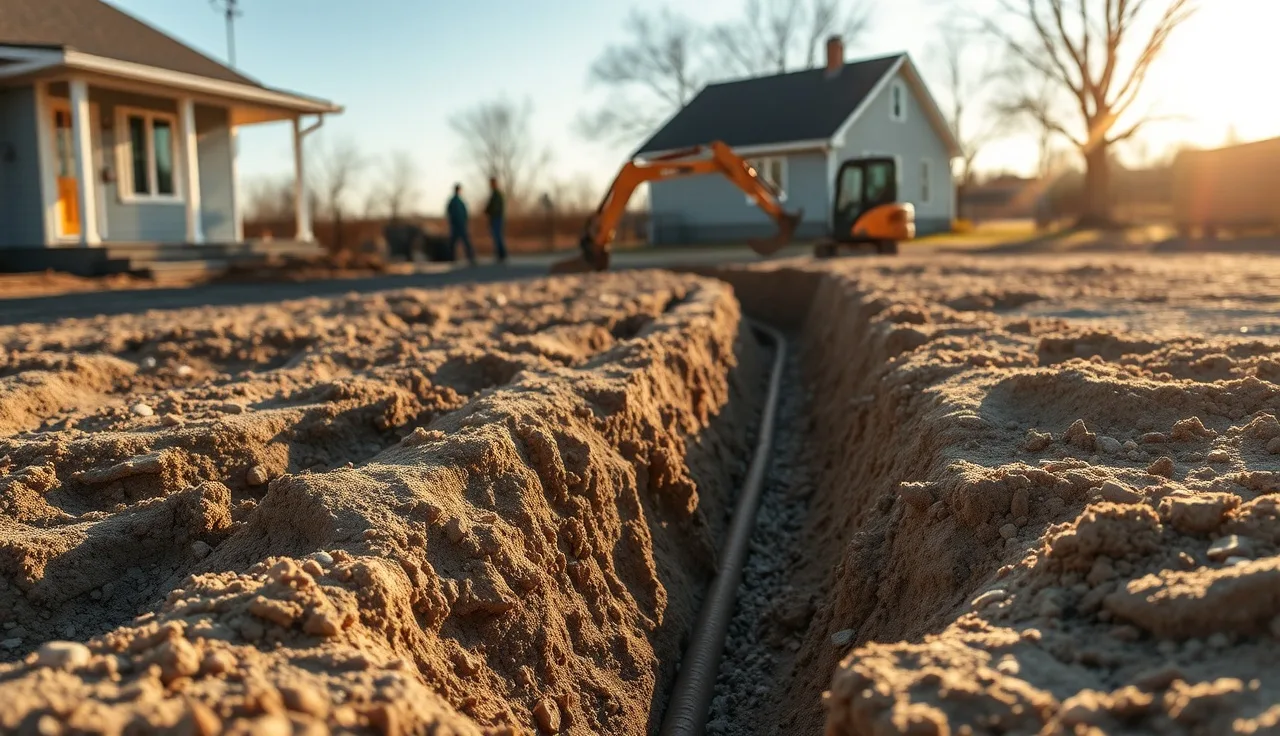
The trench itself usually holds a 12-inch layer of washed stone around and beneath the perforated pipe, a layer of geotextile fabric on top to keep soil out, then 6 to 24 inches of native soil cover. The biomat, a thin layer of microbial growth that forms at the gravel-soil interface, does most of the pathogen removal. Damage that biomat with grease or excess solids and the whole field fails.
What determines the size and layout of a leach field?
Three things set leach field size: how much wastewater the house produces daily, how fast the soil absorbs liquid, and the minimum trench dimensions your state code requires. Soil is usually the one that decides everything else.
Daily flow. Most states use bedroom count as a proxy for occupancy. A common standard is 150 gallons per bedroom per day, so a 3-bedroom home carries a design flow of 450 gallons per day (gpd). Some states have moved to fixture-based calculations, but bedroom count still dominates residential permitting [2].
Soil absorption rate. The percolation test (perc test) or a soil morphology evaluation by a licensed soil scientist tells you how many gallons of effluent one square foot of trench bottom can accept per day. This number, called the long-term acceptance rate (LTAR), runs from about 0.2 gpd/ft² in slow soils up to 1.2 gpd/ft² in moderately fast soils. Faster than that and codes often demand pretreatment before the field.
Trench dimensions. Trenches are commonly 1 to 3 feet wide and 18 to 36 inches deep, with a gravel bed 12 inches deep around the pipe. The bottom of the trench is the absorption surface.
The math is simple. If your design flow is 450 gpd and your soil's LTAR is 0.5 gpd/ft², you need 900 square feet of trench bottom. At 2 feet wide, counting the bottom surface only, that is 450 linear feet of trench. Add trench spacing (typically 6 to 10 feet between centerlines) and you have your total field footprint.
How long is a leach field? For a typical 3-bedroom home in moderate soil, 300 to 600 linear feet of trench is common. Large homes, poor soil, or mounded systems can push that past 1,000 feet. The EPA SepticSmart guidance and your state's onsite wastewater code hold the sizing tables, but the honest answer is: it depends entirely on your soil test result [1].
Many states also require a reserve area equal to 100% of the primary field footprint. That land has to stay undisturbed. It is your insurance policy if the primary field fails.
How does a perc test work and what results do you need?
The percolation test is the old-school method still used in many jurisdictions. A licensed evaluator digs test holes (typically 6 to 12 inches in diameter, 2 feet deep), saturates them with water over 24 hours, then measures how many minutes it takes for the water level to drop one inch. That rate, in minutes per inch (mpi), feeds straight into the sizing tables.
Common perc test interpretations [2]:
| Perc rate (min/inch) | Soil absorption classification | Typical use |
|---|---|---|
| 1 to 5 | Fast | Often requires pretreatment or modified design |
| 6 to 30 | Suitable | Standard trench system |
| 31 to 60 | Slow | Large area or engineered alternative |
| Over 60 | Failing | Not suitable for conventional drain field |
Many states now supplement or replace the perc test with a soil morphology evaluation, where a trained soil scientist reads the texture, structure, and mottling of a soil profile to assign an LTAR. Mottling (gray or orange streaks in soil) signals seasonal high groundwater, which is a hard constraint: most states require the trench bottom to sit at least 24 to 36 inches above the seasonal high water table [3].
A failed perc test does not automatically end a project. Alternative systems like mounds, drip irrigation, or aerobic treatment units can sometimes work on marginal soils, but they cost more and demand more maintenance. Get a second opinion from a licensed soil scientist before you write off a parcel.
What are the standard setback requirements for leach fields?
Setbacks protect drinking water, neighboring properties, and structures. They vary by state and county, but the ranges below reflect what most state onsite wastewater codes require [3].
| Feature | Typical minimum setback |
|---|---|
| Drinking water well (on-site) | 50 to 100 feet |
| Property line | 5 to 10 feet |
| Foundation / basement | 10 to 20 feet |
| Surface water (stream, pond) | 25 to 100 feet |
| Irrigation ditch or drain | 10 to 50 feet |
| Water service line | 10 feet |
| Road right-of-way | 10 feet |
These are minimums. State codes like North Carolina's 15A NCAC 18A .1900 rules or California's onsite wastewater policy specify exact numbers [3]. Local health departments can pile stricter requirements on top of state minimums. Always pull the actual county permit application, because that is where the binding numbers live.
The well setback is the one that most often kills a design on small lots. A 100-foot setback from a well on a half-acre lot with a 3-bedroom house leaves almost no room for a field plus a reserve area. That is the moment you call in a licensed designer, not a contractor with a backhoe.
What are the main leach field design types?
Conventional gravity trench systems are the baseline, but they are not the only option. The right design depends on your soil, topography, lot size, and local code.
Conventional gravity trench. Perforated pipes in gravel-filled trenches, fed by gravity from the distribution box or manifold. Simple and durable when soils cooperate. Most systems installed before 2000 are this type.
Chamber systems. Plastic arch-shaped chambers replace gravel and pipe. The open bottom sits directly on native soil. The EPA evaluated chamber systems and found they perform comparably to gravel-trench systems in suitable soils, with easier shipping and installation [4]. No gravel hauling. Many states accept chambers under the same sizing criteria as conventional gravel systems.
Pressure distribution. A pump doses effluent to laterals under low pressure, spreading it evenly across the field instead of letting gravity concentrate flow at the inlet end. Some states require it for large systems or sloped sites. Even distribution extends field life.
Mound systems. When the water table sits too high or the soil is too shallow, a mound builds a raised bed of imported sand on top of the native soil. Effluent gets pumped up into the mound. Expensive (easily 50 to 100% more than a conventional system) and dependent on a pump and controls [5].
Drip irrigation (drip dispersal). Effluent gets advanced treatment first, then goes out through small-diameter drip tubing buried 6 to 12 inches deep. Works on difficult lots with irregular shapes. Needs regular maintenance attention and reliable power. Not a DIY option.
Aerobic treatment unit (ATU) with dispersal. An ATU injects air to speed aerobic digestion before dispersal. The highly treated effluent can sometimes disperse in soil that would reject conventional effluent. Higher install and maintenance costs, plus an annual service contract in most states.
For most homeowners on suitable soil, the real choice is conventional gravel-trench versus chamber. Chambers win on convenience. Gravel-trench has more decades of performance data behind it. Neither is a clearly superior choice for typical residential use.
Can you build a homemade leach field design?
You can sketch one. Building one without a permit is a different story, and in most of the U.S. it is illegal. Let me be direct about this.
Every state requires a permit for new septic system installation, and most require one for any significant repair or modification to an existing field. The permit process exists because a failed or badly sited field can contaminate a neighbor's well, a stream, or a public water supply. Health departments treat this seriously. Unpermitted systems can trigger fines, mandatory removal at the owner's expense, and liens that complicate selling the property.
That said, a homemade leach field design is not crazy if it means doing your own layout math, hiring a licensed evaluator for the soil test, pulling the permit yourself as an owner-builder (which most states allow for your primary residence), and supervising or doing the physical trench work while a licensed engineer or sanitarian stamps the design. That owner-builder path is legal in many states, saves money, and still produces a permitted, inspected system.
What you should never do is skip the perc test, guess at soil conditions, or install pipe at whatever depth feels right. The consequences are not hypothetical. A field installed in the wrong soil or at the wrong depth will back up sewage into your home or surface in your yard within a few years. Read your state's onsite wastewater code first. Florida's Chapter 64E-6, Texas's Title 30 Chapter 285, and most state equivalents are public and written for non-engineers.
For trench dimensions, pipe sizing, and distribution box configuration, the EPA's "Onsite Wastewater Treatment Systems Manual" (2002) is the most complete free technical reference available [4]. It gives you the engineering behind every decision.
How deep should leach field trenches be?
Most conventional trench systems put the pipe invert (inside bottom of the pipe) between 18 and 36 inches below finished grade. Total trench depth, from the top of the gravel bed to the trench bottom, runs about 30 to 48 inches in typical installations. State codes vary, so your permit drawings give the exact required depth for your site.
Three constraints set the minimum and maximum depth:
- Seasonal high water table. You need at least 24 inches (some states say 36 inches) between the trench bottom and the highest annual water table. A soil scientist confirms this from soil borings.
- Frost depth. In northern climates, pipes need enough cover to keep from freezing. Northern Minnesota and Maine often require 18 to 24 inches of native soil cover over the gravel bed. In warm climates, 6 to 12 inches of cover is common.
- Gravity slope from the tank. The effluent has to run downhill from the tank outlet to the distribution point. The standard slope for the outlet pipe is 1/8 to 1/4 inch per foot. On flat lots, this limits how deep the trenches can go while still receiving gravity flow.
Deeper is not better. Deeper soil has had less contact with oxygen, microbial diversity drops, and treatment quality suffers. The sweet spot is the shallowest depth that satisfies water table clearance, frost protection, and slope.
What soil conditions make leach field installation impossible or very hard?
Some sites genuinely cannot support a conventional leach field. Others need engineered alternatives that cost a lot more. Knowing the red flags before you buy a property or plan an addition is worth real money.
High clay content. Clay soils have very low hydraulic conductivity. A perc test above 60 minutes per inch typically disqualifies a site for a conventional system. Heavy clay soils can read as "no perc" entirely.
Shallow bedrock. If competent rock is within 24 to 36 inches of the surface, there is no room for a trench with proper water table clearance. Mound systems or engineered fill may solve it, often at significant cost.
High seasonal water table. Common in coastal areas, river floodplains, and northern regions with spring snowmelt. The water table moves, and the high point, not the average, is what governs permitting.
Very coarse, rapid-draining soils. Sand or gravel that percs faster than about 1 minute per inch does not give effluent time to be treated before it hits groundwater. Some states require pretreatment before dispersal in these soils.
Small lot with setback conflicts. Sometimes the soil is fine but the geometry does not work: too close to a well, a property line, or surface water. An engineered design with alternative dispersal can sometimes thread the needle, but there is a point where a lot simply cannot support an onsite system.
If you are buying rural land and the perc test fails or the soil morphology evaluation comes back unfavorable, that is a material fact. Do not assume the previous owner's old system means a new one gets permitted in the same spot under current rules. Regulations have tightened a lot since the 1970s and 1980s.
How much does leach field design and installation cost?
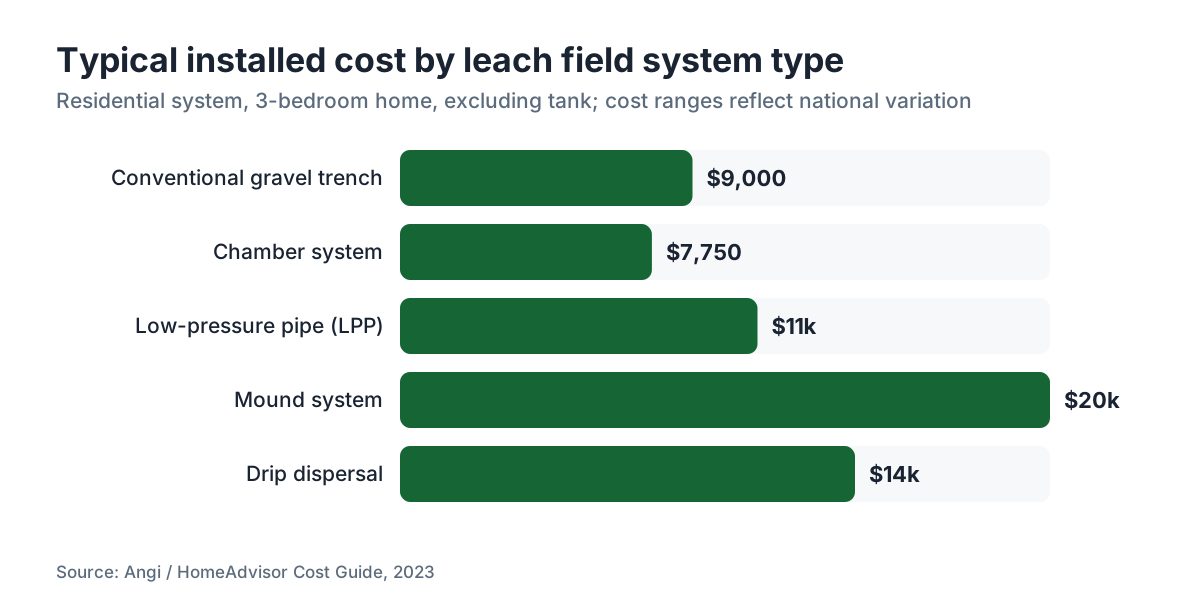
Costs span a wide range depending on soil conditions, system type, lot size, and local labor rates. Here are real ranges based on published industry and state agency data [5][6].
| Component | Typical cost range |
|---|---|
| Perc test / soil evaluation | $300 to $1,500 |
| Engineering / design | $500 to $3,000 |
| Permit fees | $100 to $1,500 |
| Conventional gravel-trench field (installed) | $3,000 to $15,000 |
| Chamber system (installed) | $3,500 to $12,000 |
| Mound system (installed) | $10,000 to $30,000+ |
| Drip dispersal system (installed) | $8,000 to $20,000+ |
| Full conventional septic system (tank + field) | $5,000 to $25,000 |
Soil conditions drive the cost more than labor does. A conventional trench in sandy loam soil might run $4,000 for a 3-bedroom home. The same home on a high water table lot needing a mound could hit $20,000 or more. Region matters too. New England and the Pacific Coast run higher than the rural Southeast and Midwest.
For more detail on total system pricing, see our guide to cost to install septic system and cost to put in a septic tank.
One place homeowners consistently overspend: paying for a full PE-stamped design on a standard 3-bedroom home in average soil. Many states let a licensed sanitarian or certified installer submit a standard design using county-approved tables, with no full engineering study. Ask the health department what the minimum submission requirement is before you hire a professional engineer.
How long does a leach field last and what shortens its life?
A well-designed and properly maintained conventional leach field should last 20 to 30 years. Some last longer. The National Environmental Services Center has cited ranges of 25 to 50 years for well-maintained systems in good soil [6]. Those numbers assume the system is sized right, the tank gets pumped on schedule, and the homeowner does not abuse it.
The things that kill fields early:
Skipping septic tank pumping. Solids overflow into the field when the tank gets too full. Those solids clog the gravel and the biomat zone permanently. Pump the tank every 3 to 5 years. See our guide on how often to pump septic tank for the exact schedule by household size.
Garbage disposal use. Disposals send a heavy load of fine organic solids into the tank, driving up how fast solids build and overflow to the field.
Flushing non-biodegradables. Wipes (even the ones labeled "flushable"), feminine hygiene products, and medications pass into the field and clog it or wreck the microbial community.
Driving or parking over the field. Soil compaction crushes the gravel and pipes and cuts off the oxygen aerobic bacteria need.
Planting trees near the field. Tree roots seek water and will find your perforated pipes. Keep trees at least 30 feet from field boundaries. Willows and maples are especially aggressive.
Diverting roof drainage or surface water onto the field. Saturating the soil blocks aerobic treatment and can hydraulically overload the trenches.
If your field is underperforming, a septic system repair evaluation should come before you assume you need full replacement. Sometimes resting the field (alternating sections, if the design allows) and tightening up tank maintenance is enough to bring it back.
What permits and inspections are required for leach field design?
Permitting runs through your local county or municipal health department or environmental authority, with state oversight. The process is consistent even when the paperwork varies.
- Site evaluation permit. Before anything is designed, you or your designer applies for permission to run a perc test or soil evaluation. Some jurisdictions bundle this into the overall construction permit.
- System design submittal. You submit a scaled site plan showing the house, well, property lines, existing structures, proposed tank location, field layout with dimensions, trench cross-sections, and a copy of the soil evaluation results. The health department reviews it against state code.
- Construction permit issuance. If the design passes, a construction permit is issued specifying the approved design. Deviating from it without a permit amendment is not allowed.
- Inspections during installation. Most jurisdictions require at least one inspection with the trenches open and pipe placed, before any backfill. The inspector confirms depths, gravel dimensions, pipe slope, and distribution box installation. Some states require a second inspection after backfill.
- Final permit sign-off. Once the system passes, the permit is closed. Keep a copy of the approved as-built drawing with your property records and file one with the local authority. Future buyers, lenders, and home inspectors will want it.
Operators managing permit documentation across many jobs often benefit from software that tracks permit status and inspection dates for a whole portfolio of clients. SepticMind is built for exactly that workflow, giving service companies one place to log inspections, design approvals, and maintenance schedules.
Never skip the inspection step. A failed or improperly installed system found after backfill means excavating it again on your dime. An inspector catching a depth error before backfill saves thousands of dollars.
How do alternative leach field designs work on difficult lots?
When conventional trenches will not work, these are the real options with real trade-offs.
Mound system. A mound is a raised bed of coarse sand placed on top of the native soil surface. Effluent gets pumped from the tank to the top of the mound through small-diameter pressure pipes and percolates down through the imported sand (which does the treatment), then into the native soil. Mounds sit visible above grade, need a pump and controls, and require an annual pump inspection and controls check. They work well on shallow soils or high water table sites.
Low-pressure pipe (LPP) system. Similar to conventional trenches but uses a pump to distribute effluent through small-diameter perforated pipes under low pressure. Better distribution across the whole field than gravity systems on sloped or uneven lots. Common in the Southeast, and in North Carolina LPP is practically the default for new residential systems.
Drip dispersal. Needs a treatment unit (typically an ATU or recirculating media filter) that brings effluent to a quality safe for shallow dispersal through drip tubing. Very flexible layout, works around trees and structures that would block trenches. High ongoing maintenance cost.
Constructed wetland + dispersal. Used in some states as a treatment step before a final dispersal field. Rare for residential use and heavy on permitting.
For a fuller overview of what a leach field is and how each type performs long-term, see our leach field guide.
Honest advice: if your lot needs a mound or drip system, get three quotes. Installed cost between contractors on engineered systems can swing 40 to 60%. And ask each contractor to show you a job they installed and maintained, more than installed.
What are the signs a leach field is failing and what can you do?
Leach field failure is usually gradual before it turns catastrophic. Catching it early matters.
Early warning signs: Slow drains throughout the house (more than one fixture). Gurgling toilets. Lush, unusually green grass over the field in dry weather. Soft or spongy ground over the field area.
Late-stage signs: Sewage odors outdoors. Standing water or wet spots above the field trenches. Sewage backing up into floor drains or the lowest fixture in the house.
If you see late-stage signs, call a licensed pumper immediately. A septic tank pump out buys time and lets you figure out what is happening. Sometimes the field is not failed, the tank is just overdue and pushing solids forward.
Actual field failure has two common causes: biological clogging of the biomat zone (usually from excess solids in the effluent) and hydraulic overloading (too much water too fast). Biological clogging in early stages sometimes responds to resting the field for 3 to 6 months while using a temporary connection. Hydraulic overloading usually means fixing water use habits first.
If the field is genuinely dead and needs replacement, the process is basically a new design and installation on the reserve area. That is why the reserve area matters. If it has been built on, paved, or otherwise compromised, you have a very expensive problem with very few solutions. A septic tank inspection during any home purchase should confirm both the primary field condition and the reserve area status.
Frequently asked questions
How long is a leach field for a 3-bedroom house?
A 3-bedroom house typically generates around 450 gallons per day of wastewater. In moderate soil with a long-term acceptance rate of 0.5 gpd per square foot, that translates to roughly 300 to 600 linear feet of trench, assuming 2-foot-wide trenches. Faster-absorbing soil means less trench; slow clay soil can push the requirement past 1,000 linear feet or make a conventional field impossible.
Can I design my own leach field?
You can do the sizing math yourself using your state's onsite wastewater code and the EPA's Onsite Wastewater Treatment Systems Manual. Most states allow owner-builders to pull their own septic permits for a primary residence. But you still need a licensed evaluator to conduct the perc test or soil morphology evaluation, and the health department must approve the design before any digging starts. Unpermitted leach fields are illegal, can cause property liens, and frequently fail early.
How deep should leach field trenches be?
Most conventional trench systems place the pipe invert 18 to 36 inches below finished grade, with total trench depth reaching 30 to 48 inches. The minimum is set by frost depth and the required clearance above the seasonal high water table, usually 24 to 36 inches. Going unnecessarily deep reduces oxygen availability and can hurt treatment quality. Your health department's permit drawings will give the exact required depth for your site.
What is the minimum lot size for a leach field?
There is no universal minimum because it depends on soil type, well location, and setbacks. A half-acre lot with a well, required setbacks of 100 feet from the well and 10 feet from property lines, plus a reserve area, may have almost no room for a conventional field. Some states set minimum lot sizes for onsite systems by ordinance, commonly 1 to 2 acres in areas with no public sewer. Check your county health department's rules.
How much does it cost to install a leach field?
A conventional gravel-trench leach field installation runs $3,000 to $15,000 for a typical residential system, depending on soil conditions, trench length, and local labor costs. Mound systems or engineered alternatives cost $10,000 to $30,000 or more. Add $300 to $1,500 for the perc test and $500 to $3,000 for design and permitting. Regional labor rates vary significantly, with higher costs in the Northeast and Pacific Coast.
What is the difference between a perc test and a soil morphology evaluation?
A perc test measures how fast water drains from a test hole over a timed period, expressed in minutes per inch. A soil morphology evaluation has a licensed soil scientist read the physical characteristics of a soil profile, including texture, structure, and mottling (signs of seasonal wetness), to assign a long-term acceptance rate. Many states now prefer or require morphology evaluations because they give a more reliable picture of seasonal high groundwater than a perc test conducted in a dry month.
How far does a leach field need to be from a well?
Most state codes require at least 50 to 100 feet between a leach field and a drinking water well, measured from the edge of the field to the well casing. Some states set 100 feet as the minimum for on-site wells; others allow 50 feet in limited circumstances. The specific number comes from your state's onsite wastewater code and your county's permit application. This setback is the constraint that most often makes small lots unworkable for conventional systems.
How long does a leach field last?
A properly designed and maintained leach field should last 20 to 30 years, and some last 40 years or more in ideal conditions. The biggest factors that shorten field life are skipping tank pumping (solids overflow and clog the field), heavy garbage disposal use, driving over the field, and planting trees nearby. Regular septic tank pumping every 3 to 5 years is the single most effective thing you can do to extend field life.
Can a leach field be repaired, or does it always need full replacement?
Not all failing fields need full replacement. If the problem is biological clogging from solids overflow, resting the field for 3 to 6 months while pumping the tank aggressively sometimes allows partial recovery. Hydraulic overloading can often be addressed by reducing household water use. True replacement is required when the gravel and soil are permanently clogged and resting provides no improvement. Always get a proper diagnosis before committing to full replacement.
What should you not put over a leach field?
Never drive or park vehicles over a leach field; soil compaction crushes pipes and cuts off oxygen. Do not build any structure on or over the field. Avoid planting trees or shrubs with aggressive roots, especially willows, maples, and poplars, within 30 feet of the field boundary. Do not direct roof downspouts, sump pump discharge, or surface drainage onto the field. Do not cover the field with impermeable pavement or plastic sheeting.
What permits do I need for a leach field?
You need a construction permit from your local county health department or environmental agency before installing or replacing a leach field. The permit requires a site evaluation (perc test or soil morphology report), a scaled site plan, and a design that complies with your state's onsite wastewater code. Most jurisdictions also require at least one inspection during installation, with trenches open before backfill. Unpermitted installation can result in fines and required removal.
Can you use a chamber system instead of gravel trenches?
Yes. Plastic arch chamber systems are accepted by most state codes as a direct replacement for gravel-and-pipe trenches in suitable soils. They use the same sizing calculations in many jurisdictions. Chambers are lighter to ship, require no gravel hauling, and the open bottom provides good soil contact. The EPA evaluated chamber systems and found comparable performance to gravel systems in appropriate soil conditions. Ask your designer whether your state accepts equal-area or equal-bottom-surface sizing for chambers.
What happens to the old leach field when you install a new one?
The old field is typically abandoned in place. The tank outlet is redirected to the new field, and the old field is left to dry out and eventually decompose the residual biomat over several years. Most state codes do not require excavation or removal of old gravel and pipe unless it is causing an active problem. The old field area may not be built on or paved, since soil disturbance can reactivate a saturated zone. Check local rules on abandonment.
Is a leach field the same as a drain field or absorption field?
Yes. Leach field, drain field, and absorption field all describe the same component: the network of perforated pipes in gravel-filled trenches that disperses and treats septic effluent underground. Regional terminology varies. In the South and Midwest, drain field is more common; in New England, leach field dominates. Some state codes use "subsurface soil absorption system" or "SSAS" as the formal term. They all mean the same thing functionally.
Sources
- U.S. EPA, SepticSmart Program overview: The soil in a leach field provides additional treatment and final dispersal of septic effluent after the tank
- U.S. EPA, Onsite Wastewater Treatment Systems Manual (EPA/625/R-00/008, 2002): Design flow calculations based on bedroom count (typically 150 gpd per bedroom) and perc test sizing tables
- North Carolina DHHS, Environmental Health, On-Site Water Protection (15A NCAC 18A .1900 rules): State setback requirements for leach fields including distances from wells, property lines, and surface water
- U.S. EPA, Onsite Wastewater Treatment Systems Manual (2002), Chapter 4: Soil Absorption Systems: Chamber systems perform comparably to conventional gravel-trench systems in suitable soils per EPA evaluation
- HomeAdvisor / Angi, Septic System Installation Cost Guide: Mound system installation cost range of $10,000 to $30,000 or more; conventional systems $3,000 to $15,000
- National Environmental Services Center (NESC) at West Virginia University, Septic Systems: What Every Homeowner Needs to Know: Well-maintained septic systems and leach fields can last 25 to 50 years in appropriate soil conditions
- Texas Commission on Environmental Quality (TCEQ), Title 30 TAC Chapter 285 On-Site Sewage Facilities: Texas state rules for onsite wastewater systems including design, permitting, and setback requirements
- Florida Department of Health, Chapter 64E-6 FAC Standards for Onsite Sewage Treatment and Disposal Systems: Florida's onsite wastewater design and permitting requirements including soil evaluation and setback rules
- University of Minnesota Extension, Septic Systems: Guidance on leach field maintenance, warning signs of failure, and system lifespan factors
- Penn State Extension, Septic System Basics: Explanation of perc test procedures, soil absorption rates, and drain field sizing for conventional residential systems
- Washington State Department of Health, Wastewater Management (On-Site Sewage Systems): State guidance on soil evaluation methods, LTAR values, and setback requirements for leach fields
Last updated 2026-07-09