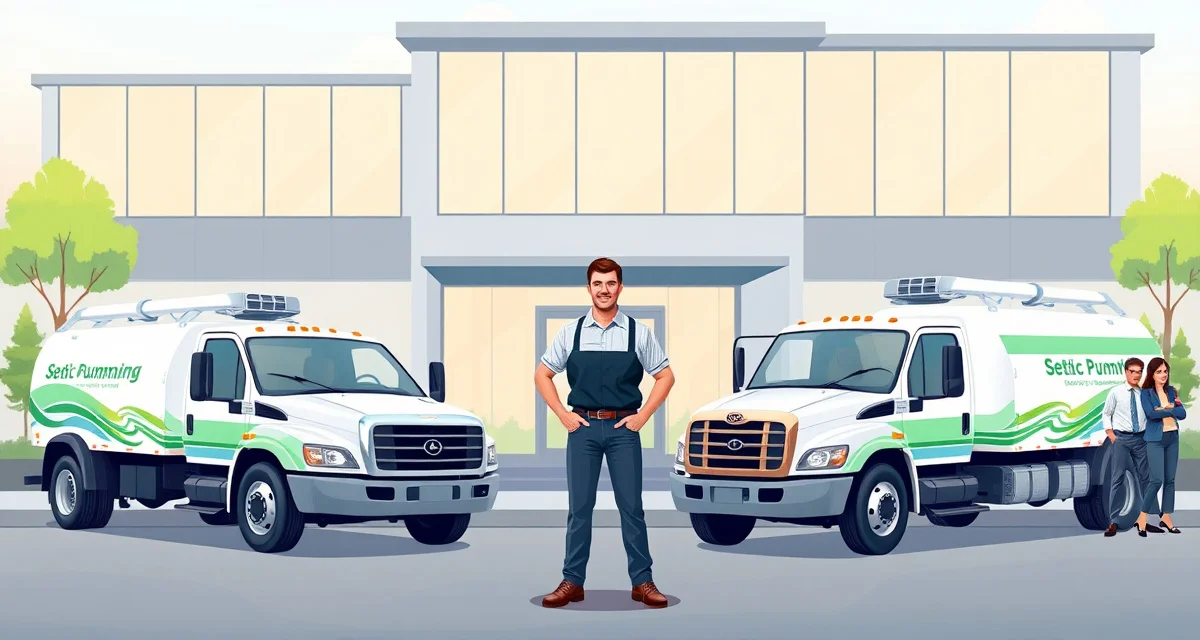
Growing a Septic Pumping Company: From One Truck to Five
By the SepticMind Editorial Team
Most septic companies start the same way. The owner buys or inherits a truck, builds a customer base through word of mouth, and runs routes personally for years. The business is profitable because labor is low and the owner knows every customer by name.
TL;DR
- The path from 1-2 trucks to 5+ trucks runs through recurring septic maintenance program, not one-time pump calls, because agreements create predictable forward revenue.
- Route density is the key metric for growth efficiency: adding customers in existing service areas increases margin faster than expanding geographic coverage.
- Each additional truck requires at minimum 200-300 additional service accounts to maintain utilization above break-even at typical per-job pricing.
- Companies that automate customer outreach and service reminders grow faster because they convert first-time customers into recurring accounts systematically.
- Hiring the second driver is typically the hardest growth step because revenue must be strong enough to support the fixed cost before the truck is fully utilized.
- Building commercial and ATU service contracts alongside residential pumping creates a more stable revenue base less susceptible to seasonal fluctuations.
The problem comes when demand exceeds what one truck can handle. The owner is the bottleneck. They can't take a vacation. They can't be sick. They can't take on new installation or inspection work because the pumping routes are already full.
Adding the second truck is the hardest step. Going from two trucks to five is harder than going from one to two. Here's what separates the companies that scale from the ones that stay at one truck.
The Foundation: Your Customer Base Is Already the Asset
Before you think about adding a truck, look at what you already have. A 300-customer account base with complete service history records is a business asset. Those customers are going to need pumping again. They're going to need real estate inspections. Their ATUs need maintenance contracts.
Step 1: Capture your current customer base completely.
Most one-truck operators can't tell you how many active accounts they have because "active" is poorly defined. Pull your invoices for the last 3 years. Every address you serviced is an account. Map them. Count them. Figure out:
- How many are due for service in the next 12 months?
- How many have ATUs that need maintenance contracts?
- How many are in real estate-heavy zip codes that generate inspection demand?
The answer to "should I add a truck?" is usually yes if you have 300+ accounts and are turning away work or delaying appointments by more than a week.
Adding the Second Truck: What Actually Changes
The second truck isn't just twice the capacity. It's a completely different operational structure.
With one truck, you run routes, dispatch, handle customer calls, manage billing, and stay compliant. You can hold everything in your head. With two trucks, you can't.
What you need before the second truck rolls:
A dispatch system. You need something other than your memory and a whiteboard. Every job needs to be assigned to a specific truck with a specific time window, and both trucks need to see their assignments. Paper dispatch works until it doesn't, and the first time a tech shows up at the wrong address because you wrote down the wrong one, you've lost the argument for paper.
A service record system. Techs not running your routes need to know what they'll find at each stop. Tank size, access notes, prior service history, customer preferences. If that information is only in your head, your second truck is flying blind.
A process for permit tracking. If you're doing any installation or repair work, permit tracking with two trucks is double the open permits to track. A spreadsheet works for 10. It fails at 30.
SepticMind is built exactly for this moment, when the operation gets too large to manage from memory but isn't large enough to justify enterprise software.
Building Recurring Revenue Before You Scale
The most important thing you can do before adding trucks is convert your customer base from reactive to recurring.
ATU maintenance contracts are the clearest recurring revenue path in the septic business. If you have ATU customers (and most markets have them), offer a maintenance contract at a fixed annual or quarterly rate. Include the required maintenance visits, the required reports, and your labor. Customers on ATU maintenance contracts are locked in for the life of the contract.
A 40-account ATU maintenance portfolio at $400/year generates $16,000 in recurring annual revenue before you dispatch a single reactive call. That's significant baseline revenue that makes the second truck less risky.
Scheduled pumping agreements work the same way. Offer customers a 3- or 5-year pumping agreement at a fixed price. They get price certainty and scheduling priority. You get confirmed future revenue.
Real estate inspection referral networks. Build relationships with 5–10 active real estate agents in your market. When they list a property, you want to be the septic inspector they recommend. Real estate inspections are high-margin and time-sensitive, agents will pay a premium for reliability and quick report turnaround.
Hiring and Training Technicians
The technical skill floor for a septic pumping technician is lower than most contractors assume. Driving a vacuum truck, operating the pump equipment, locating and opening access points, and servicing most standard systems can be taught in 2–4 weeks of supervised work.
What's harder to teach:
- Customer interaction in residential settings (you're on someone's property, often early morning, smells are real, people have questions)
- Field judgment on system conditions that need escalation
- Documentation discipline, filling out every field, attaching every photo, every job, without shortcuts
Where to find technicians:
- Other septic companies (your competitors' unhappy employees are your best recruiting pool)
- CDL holders looking for stable employment
- Veterans, military service background translates well to the discipline and early-hour culture of septic work
- Indeed and trade-specific job boards
Your first hire should ideally have:
- Valid CDL (or you pay for CDL training, typically $3,000–$5,000)
- Clean driving record
- Comfort with the physical and olfactory reality of the job
- A reliable track record in past employment
Pay market rate plus. Septic techs who are treated well, paid fairly, and equipped with the right tools stay. The cost of turnover, lost institutional knowledge, training time, disrupted customer relationships, is far more expensive than a $2/hour pay premium.
Systemizing Operations Before Adding the Third Truck
The jump from 2 trucks to 3 is where process gaps become expensive. Three trucks means you're almost certainly not running routes yourself anymore. You need systems that work without you present.
Standard operating procedures. Write down exactly how you expect each job type to be executed. Not as a lecture, as a reference document for your techs. How to complete a service record. What to photograph on every visit. When to flag a job for follow-up vs. escalating to the owner. What the process is when a permit issue comes up in the field.
Quality control touchpoints. At one truck, you inspect your own work. At three trucks, you need a QC system. SepticMind's service record completion tracking lets you see every job that was closed without complete documentation. Spend 20 minutes each morning reviewing incomplete records and following up with techs.
Financial tracking. At one truck, you can manage finances informally. At three trucks, you need monthly P&L by truck, labor cost tracking, and clear visibility on which customers and job types are driving margin. Most septic owners are surprised when they first do this analysis, the jobs they think are profitable often aren't, and the jobs they undervalue often have the best margins.
When to Add the Fourth and Fifth Truck
Each additional truck is easier than the one before it, because:
- Your systems are more mature
- Your hiring and training process is documented
- Your customer base is larger and more predictable
- Your recurring revenue covers fixed costs
The signal to add another truck is when your existing trucks are turning away work or delaying appointments by more than 10–14 days. At that point, you're losing jobs to competitors and stressing customer relationships you've spent years building.
The common mistake is waiting too long, adding the truck only after customers have already started leaving. By then, you've already lost market position in your territory.
Get Started with SepticMind
Running a profitable septic business means managing compliance, customer relationships, and field operations without letting any of them slip. SepticMind handles the operational and compliance infrastructure so you can focus on growing the business. See what the platform can do for your operation.
FAQ
How much revenue should I be generating before adding a second truck?
A general benchmark: each truck in a healthy septic operation should generate $350,000–$600,000 in annual revenue depending on your market and job mix. If your single truck is consistently generating above $300,000 and you're turning away work, the math on a second truck, which typically adds $80,000–$120,000 in annual operating costs including driver, equipment payments, and insurance, works in most markets.
Should I buy a used or new vacuum truck for the second truck?
Most small operations buy used for the second truck to manage cash flow. A used 3,000–4,000 gallon vacuum truck in working condition runs $60,000–$120,000. New trucks run $200,000–$350,000. The risk with used trucks is maintenance cost and downtime, a truck in the shop is a truck not generating revenue. Budget for a comprehensive pre-purchase inspection and a maintenance reserve fund. If cash flow permits, a newer truck with better reliability and financing terms may be a better long-term choice.
How do I compete with the large regional septic companies in my market?
Your advantages over regional operators are response time, local knowledge, and personal relationships. A regional company with 20 trucks can't match the customer service of an owner-operator who knows every customer by name and shows up when they say they will. Compete on service quality, reliability, and the fact that customers who call you get you, not a call center. Use SepticMind's automated reminders and customer communication tools to stay in front of your customers more consistently than the big operators do, and you'll win on retention.
When should a septic pumping company add a second truck?
The right time to add a second truck is when your first truck is consistently fully utilized and you are regularly turning away work or delaying bookings by more than one week. Financially, you should have service agreement revenue covering the fixed costs of the second truck before you add it, so the truck is not dependent on finding new work immediately to break even. Building a waiting list and pre-selling service agreements before the truck is in service reduces the break-even timeline on new equipment.
What account types should a growing septic company prioritize for revenue stability?
ATU maintenance contracts and commercial service agreements should be prioritized alongside residential growth because they create recurring revenue at higher margins than one-time pumping. A single multi-unit residential complex or commercial property can generate revenue equivalent to 15-20 residential pump accounts. HOA service agreements are particularly valuable because they cover multiple properties under one contract, providing a revenue anchor that supports equipment financing decisions with less financial risk.
Try These Free Tools
Sources
- National Onsite Wastewater Recycling Association (NOWRA)
- US EPA Office of Wastewater Management
- National Environmental Services Center (NESC)
- Water Environment Federation
- Occupational Safety and Health Administration (OSHA)