How much does a new leach field cost in 2025?
By the SepticMind Editorial Team
TL;DR
- A new leach field usually costs $5,000 to $12,000 for a standard gravity system on a normal lot.
- Prices run from $3,000 on the low end to $20,000 or more for mound or drip systems on hard sites.
- Soil type, system size, local permit fees, and whether you also need a new tank are the biggest cost drivers.
What is a leach field and why does replacing one cost so much?
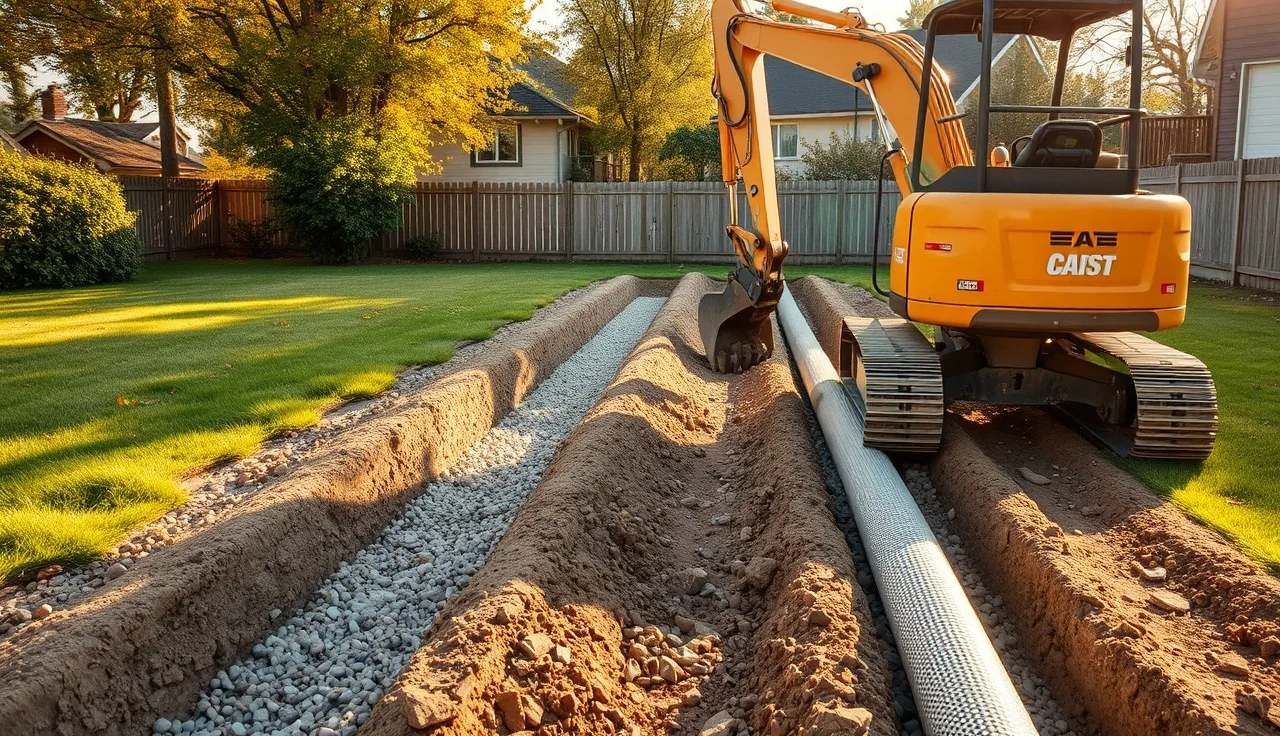
A leach field (also called a drain field or absorption field) is the underground network of perforated pipes buried in gravel-filled trenches that takes clarified wastewater from your septic tank and slowly spreads it into the soil [1]. The soil does the actual treatment, filtering pathogens and nutrients before the water reaches groundwater.
Replacement costs so much because you're running a small construction project. A crew has to excavate hundreds of square feet of soil, haul away the failed media, install new distribution pipes and aggregate, backfill, and restore the surface. In many states, a licensed engineer must design the system and a health department inspector must sign off on each phase before anything gets buried [2]. Permits alone can run $500 to $2,000 depending on where you live.
A failing leach field is rarely failing alone. The tank feeding it may need pumping, inspection, or repair. The distribution box may be cracked. And if the old field saturated the soil with biomat (the biological layer that clogs the pores over decades), you may need a whole new location on your lot, which triggers a new perc test. All of that piles on before a single pipe goes in the ground.
For a broader look at what a complete system overhaul involves, see our guide to the cost to install septic system.
What does a new leach field cost on average?
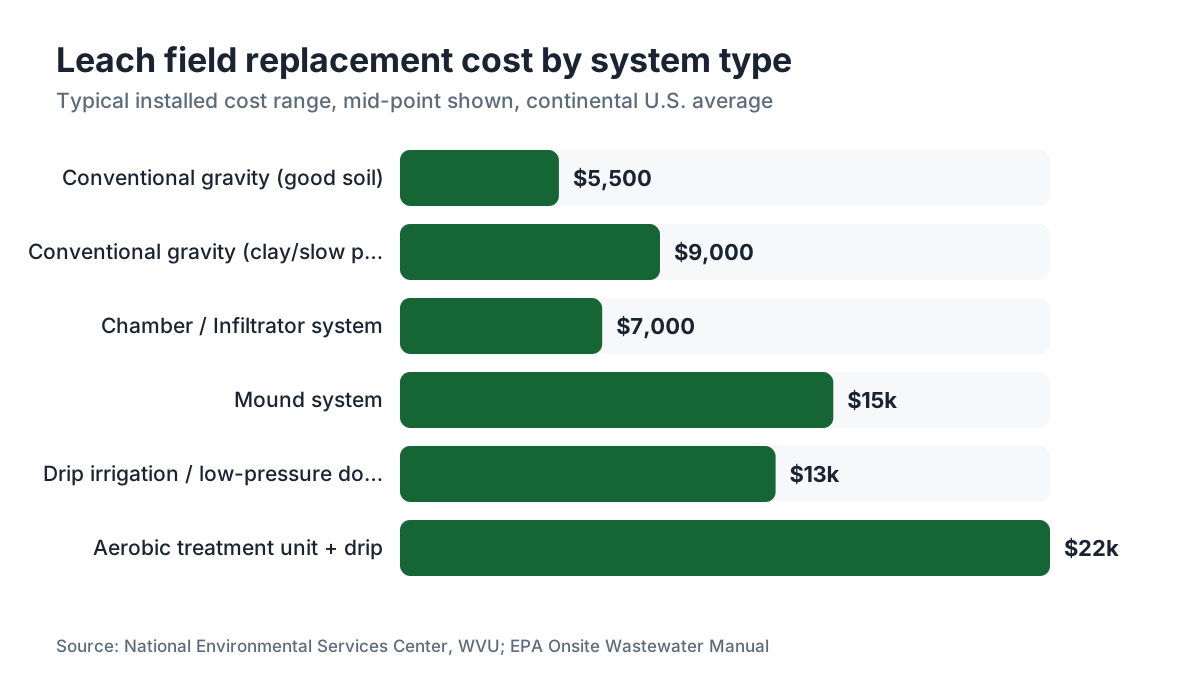
The honest answer is that "average" hides enormous variation. Here's a realistic range based on contractor data and state program cost surveys:
| System type | Typical installed cost | When you'd need it |
|---|---|---|
| Conventional gravity (new site, good soil) | $3,500, $7,500 | Standard replacement on suitable lot |
| Conventional gravity (tight soil, longer trenches) | $6,000, $12,000 | Clay or slow-perc soils needing more linear footage |
| Chamber/Infiltrator system | $4,000, $10,000 | Faster install, often used in space-limited lots |
| Mound system | $10,000, $20,000 | High water table or shallow bedrock |
| Drip irrigation / low-pressure dose | $8,000, $18,000 | Very tight sites, steep slopes, protective zones |
| Aerobic treatment unit (ATU) with drip | $15,000, $30,000+ | Nitrogen-sensitive areas, very poor soil |
Most suburban homeowners replacing a failed conventional field land in the $5,000 to $12,000 range when the soil is reasonable and there's a new spot on the lot to work with [3]. Budget toward the high end if you're in New England (rocky soil, short digging season) or a coastal area with strict nitrogen rules.
These figures cover the leach field alone. If your septic tank also needs replacement, add $1,500 to $5,000 for a precast concrete tank, or up to $8,000 for a larger fiberglass unit.
What factors drive the cost up or down the most?
Soil type is the single biggest variable. A sandy loam that passes a percolation test at 30 to 60 minutes per inch needs less trench footage than a clay soil that barely passes at the maximum allowed rate (often 60 or 90 minutes per inch, depending on state code) [2]. Clay soils need longer trenches, more excavation, and sometimes engineered fill. All of that costs money.
Lot size and available space matter enormously. If your old field saturated the surrounding soil and you have room to move 20 feet away, that's a straightforward job. If your lot is small, or close to a well, a property line, or a wetland setback, the installer may have to import sand fill, build a mound, or go to a drip system. Each option adds cost.
Depth to groundwater or bedrock sets a hard floor. Most state codes require at least 2 to 4 feet of unsaturated soil between the bottom of the trench and seasonal high groundwater [2]. If you don't have that, you're looking at a mound or ATU system almost by default.
Household size drives sizing. A 3-bedroom house typically needs a 1,000-gallon tank and a field sized for 300 to 450 gallons per day. A 5-bedroom house may need 50 to 100 percent more trench footage. Most states size leach fields by bedroom count using design flow tables in their onsite wastewater regulations [2].
Labor markets vary by region. Septic contractors in the rural Southeast charge less than contractors in coastal Massachusetts or the Pacific Northwest. Getting three quotes is not optional. Price spread on identical jobs can run 40 to 60 percent between contractors in the same county.
Permit and engineering fees get left out of a lot of budgets. Many states require a site evaluation by a licensed soil scientist or professional engineer before any permit is issued. That evaluation alone can cost $300 to $1,500, and the permit itself adds another $200 to $1,000 in most places [3].
Can you repair a leach field instead of replacing it, and what does that cost?
Sometimes. Repair makes sense when the failure is localized: a single crushed pipe, a clogged distribution box, or a trench section that flooded from surface water rather than true soil saturation. A partial repair or pipe jetting runs $500 to $3,000, which beats a full replacement handily.
Biomat is a different story. Biomat is the dense microbial layer that builds up at the soil-pipe interface over years of use. Once it seals off the soil's ability to absorb water, no chemical treatment reliably reverses it at scale. Products sold as leach field restorers have mixed evidence at best. The closest peer-reviewed work on soil clogging (Siegrist et al., 2000, in the NDWRCDP research program) found that resting a failed field for 6 to 12 months allowed partial biomat degradation in some soil types, but success was inconsistent and depended heavily on the soil.
Resting the field (using a second field or aerating the soil) is a legitimate tactic in some cases. Some states explicitly allow a homeowner to "rest" one of two alternating fields. But most homeowners don't have a second field already installed, which makes this option theoretical.
For a broader look at what repairs are possible before replacement, see our guide to septic system repair.
Here's the honest position. If your contractor says the field is fully saturated with biomat and the soil has lost its absorption capacity, replacement is almost certainly the right call. Get a second opinion if the quote surprises you. Don't expect a $500 treatment product to fix what is fundamentally a soil-capacity problem.
How long does leach field installation take?
The physical work takes 1 to 3 days for most conventional systems once permits are in hand and the site is ready. Mound systems and ATUs take 3 to 5 days because of the extra fill, pumps, and electrical work.
The real timeline is about permitting and inspections, which can stretch 2 to 12 weeks depending on your county health department's backlog. Some rural counties have a one-person environmental health office that schedules site evaluations weeks out. If you're rural and it's a busy spring, plan for 6 to 10 weeks from first call to final inspection.
Emergency permits exist in most states when a system poses an imminent public health hazard (sewage surfacing, well contamination). These can cut the wait to days, but they often come with restrictions on the permanent replacement design and still require all standard approvals eventually.
What permits and inspections are required for a new leach field?
Requirements vary by state and county, but the typical sequence looks like this:
- Soil evaluation or perc test, run by a licensed evaluator (sometimes the health department does it, sometimes a private engineer you hire).
- System design prepared by a licensed engineer or designer, submitted to the county or state health department.
- Construction permit issued.
- Inspection during installation (before backfill) by the health department or an approved inspector.
- Final inspection and certificate of completion.
The EPA's SepticSmart program says "proper siting, design, and installation are critical to the performance of onsite wastewater treatment systems" and points homeowners to their state environmental or health agency for permit requirements [1]. Every state has its own onsite wastewater code. Some are run at the state level (Florida, for example, uses the Florida Department of Health's Chapter 64E-6 rules) and some are mostly county-administered (California uses county environmental health departments under the authority of Title 17 CCR) [2].
Never let a contractor skip the permit. A system installed without permits can void your homeowner's insurance, create title issues when you sell, and leave you liable for groundwater contamination.
Does homeowner's insurance cover leach field replacement?
Standard homeowner's policies almost universally exclude septic system failure. The reasoning: leach fields fail through gradual deterioration, which insurers classify as a maintenance issue rather than a sudden, accidental loss.
Some riders exist. A handful of insurers offer service line coverage or sewer and drain riders that may cover sudden physical damage (a tree root crushing a pipe, for instance). Read the exclusions carefully. Biomat saturation from years of use won't be covered under these riders either.
Septic-specific service contracts are sold by some state programs and private companies. They typically cover pumping and minor repairs but cap payouts for major system replacement at $5,000 to $10,000, which may cover only part of the job.
The practical answer: budget for this out of pocket. If you own a home on septic and your system is more than 20 years old, keep a repair reserve. The EPA estimates the average septic system lifespan at 25 to 30 years with proper maintenance [1], and leach fields are the component most likely to end a system's life.
Are there financing options or grants for leach field replacement?
Yes, and they're underused. Several funding sources exist for homeowners who can't pay for replacement out of pocket.
USDA Rural Development's Section 504 Home Repair program offers loans up to $40,000 and grants up to $10,000 for very low-income rural homeowners to repair or replace failing septic systems [4]. Income limits apply and the property must be in an eligible rural area.
EPA's Clean Water State Revolving Fund (CWSRF) lets states fund onsite wastewater programs, and several states pass this through as low-interest loans or grants directly to homeowners [10]. Virginia's septic loan program, North Carolina's OSWW loan program, and Massachusetts's Title 5 loan program are examples. Check your state environmental agency's website.
Some counties have local health department assistance programs, especially in areas with documented groundwater quality problems from failing systems.
Property Assessed Clean Water (PACW) financing, modeled on PACE energy programs, is available in some states and lets you repay the cost through your property tax bill over 10 to 20 years.
If you're using a septic service company to manage the project, platforms like SepticMind help operators track job phases and permit status, which speeds up the paperwork side for both the contractor and the homeowner waiting on their system.
How do you know when a leach field actually needs full replacement?
The clearest signs are sewage surfacing over the field, sewage backing up into the house when the tank isn't overfull, or persistent wet spots and foul odors over the drain field area [1]. A dye test or camera inspection of the distribution system can confirm whether effluent is moving into the field or just sitting in the pipes.
A soil probe test by a licensed evaluator can check whether the soil right below the trench bottom has gone impermeable. If the probe hits a dense, greasy layer at the expected pipe depth, the biomat has sealed the soil. That's effectively a replacement diagnosis.
Failure also shows up in water table monitoring. If the groundwater mound beneath the field never drops between rain events, the field isn't recovering between loading cycles.
Before you spend $8,000 to $15,000, make sure you've had the tank pumped (sludge backing into the field speeds up failure) and had a proper inspection. See our septic tank inspection guide for what a thorough evaluation covers. A system backing up because the tank is overdue for pumping is not necessarily a failed leach field.
How can you make a new leach field last as long as possible?
The biggest predictor of long field life is tank maintenance. A properly working septic tank settles solids and sends only clarified liquid effluent to the field. When the tank overfills with sludge, it sends raw solids into the pipes, which speeds up biomat formation dramatically. Pump the tank every 3 to 5 years as a baseline; every 2 to 3 years if you have a garbage disposal or a large household [5].
Water conservation does real work. Every gallon of excess water you push through the system is a gallon the field has to absorb. Fix dripping faucets, spread laundry loads across the week instead of running all of them on Saturday, and keep pool water and roof drainage away from the field.
Keep vehicles off the field. Compaction crushes the pipes and packs down the trench aggregate, killing the void space the field needs to function.
Plant only grass over the field. Tree and shrub roots chase moisture and will get into the pipes within a few years.
Don't use the field area for storage, structures, or paving.
Skip the "septic additives" and enzyme treatments as a substitute for pumping. The EPA's SepticSmart guidance states these products are "not a substitute for proper maintenance," and some biological additives can actually throw off the tank's natural bacterial balance [1].
For a full maintenance schedule and cost breakdown, see our guide to how often to pump septic tank and our septic tank pumping overview.
How do you find and vet a contractor for leach field replacement?
Start with your state's licensing database. Most states require septic system installers to hold a specific license, and many publish online lookup tools where you can verify a license is active and check for complaints. In Florida, the Department of Health licenses septic tank contractors under Chapter 489 FS. In Texas, the OSSF (On-Site Sewage Facility) installer license comes from TCEQ.
Get at least three bids. Ask each bidder to spell out the system type, total linear footage of trench, gravel depth and spec, pipe size and material, distribution box placement, and total permit and inspection fees included or excluded. A bid that's vague on these details is a bid you can't compare.
Ask for references from jobs finished in the last two years, and call them. Ask specifically whether the final cost matched the bid, whether the permit process went smoothly, and whether there were any issues at the final inspection.
Check for insurance. The contractor should carry general liability and workers' compensation. Excavation work on your property without insurance is your risk.
A contractor who suggests skipping the permit to save money and speed things up is not someone you want on your property. Walk away.
Once you've picked a contractor, get the full scope of work and payment schedule in writing before any equipment shows up. For operators managing multiple jobs and quotes, SepticMind has tools to track job status, customer communications, and compliance documentation in one place.
Frequently asked questions
How much does it cost to replace a leach field for a 3-bedroom house?
A 3-bedroom house typically needs a leach field sized for 300 to 450 gallons per day. On a standard lot with suitable soil, expect $5,000 to $10,000 installed, including permits and inspection fees. If your soil forces a mound system or the site has access challenges, costs can reach $15,000 to $20,000. Always get three contractor quotes, since regional labor rates vary a lot.
Can I install a leach field myself to save money?
In most states, no. Nearly all jurisdictions require a licensed contractor for leach field installation, and the system must be inspected and approved by the health department before burial. DIY installation without permits can void your insurance, create title problems when you sell, and expose you to groundwater contamination liability. The permit and contractor rules exist because a failed system can contaminate wells and surface water.
How long does a leach field last before needing replacement?
With proper maintenance, a conventional leach field typically lasts 25 to 50 years. The EPA estimates a well-maintained septic system lifespan of 25 to 30 years, but fields on sandy soils with disciplined tank pumping sometimes last 40 to 50 years. Heavy use, infrequent tank pumping, and clay soils shorten that life considerably. Biomat buildup is the main failure mechanism in older fields.
What is the cheapest type of leach field replacement?
A conventional gravity-fed trench system is almost always the least expensive option, typically $3,500 to $7,500 on a suitable site. Chamber systems (like Infiltrator chambers) can trim costs slightly through faster installation. Mound, drip, and aerobic systems cost significantly more. The cheapest outcome comes from catching problems early, maintaining the tank, and replacing before the failure is so bad it rules out the simplest system type.
Does a new leach field add value to a house?
A working septic system is essentially required for a home to be sellable on well-and-septic. Buyers and their lenders typically require a passing septic inspection at sale. A new leach field may not add value beyond what a functioning system already provides, but a failing field is a big disclosure issue and negotiating point that can cost far more than replacement once it's factored into the sale price.
What is a perc test and how much does it cost?
A percolation test measures how quickly water drains through soil, which determines whether the site can support a septic system and what size field is needed. A licensed soil scientist or engineer runs the test by filling pre-dug holes with water and timing the drop. Cost is typically $300 to $1,500 depending on the number of test holes and local rates. Most states require a perc test or soil morphology evaluation before issuing a permit.
Can a leach field be repaired or does it always need full replacement?
Localized problems like a crushed pipe, clogged distribution box, or a single flooded trench section can sometimes be repaired for $500 to $3,000. Full biomat saturation of the soil, the most common failure mode in older fields, almost always requires replacement. There's no widely validated chemical or biological treatment that reliably restores saturated soil. Resting a field for 6 to 12 months can help in some soil types but isn't a reliable fix.
How does a mound system differ from a conventional leach field, and why does it cost more?
A mound system builds an elevated sand-fill bed above the natural soil surface, used when the water table is too high or bedrock is too shallow for conventional trenches. It needs a pump to dose effluent up into the mound, imported engineered sand fill, more excavation and grading, and often electrical work. All of that adds up to $10,000 to $20,000, roughly double a conventional gravity field on a comparable lot.
Does replacing a leach field require replacing the septic tank too?
Not necessarily. If the existing tank is structurally sound, sized correctly, and in good working condition, it can stay in place and feed the new field. But many contractors recommend inspecting and pumping the tank while the site is already dug up and equipment is on-site. If the tank has a cracked baffle, corroded outlet, or is undersized, replacing both at once saves on mobilization costs.
Are there government programs that help pay for leach field replacement?
Yes. USDA Rural Development's Section 504 program offers loans up to $40,000 and grants up to $10,000 for eligible low-income rural homeowners to repair failing systems. Some states run low-interest loan programs funded through EPA's Clean Water State Revolving Fund. Examples include Virginia's septic loan program and Massachusetts's Title 5 loan fund. Check your state environmental agency and county health department for local programs.
How far does a leach field need to be from a well or water body?
Setback requirements vary by state, but common minimums are 50 to 100 feet from a private drinking water well and 50 to 100 feet from surface water bodies. Some states, like Florida, set the minimum at 75 feet from wells. Setbacks from property lines typically run 5 to 15 feet. These setbacks are enforced during the permit process and often limit where a replacement field can go on a small lot.
How do I know if my leach field is failing before it's a total emergency?
Early warning signs include slow-draining fixtures when the tank isn't due for pumping, occasional gurgling in drains, or slightly wet, spongy ground over the field after dry weather. A full septic inspection, including a tank pump-out and effluent level check, can spot a field that's struggling before it fails completely. Catching it early often means you have months to plan and budget rather than days to react.
Sources
- U.S. EPA, SepticSmart homeowner guidance: Leach fields disperse clarified wastewater into the soil for final treatment; EPA estimates well-maintained septic systems last 25-30 years; EPA states septic additives are not a substitute for proper maintenance
- U.S. EPA, Onsite Wastewater Treatment Systems Manual (EPA/625/R-00/008): State codes typically require minimum unsaturated soil depth of 2-4 feet above seasonal high groundwater; soil perc rates and bedroom counts drive system sizing design flows
- National Environmental Services Center, Small Flows Quarterly, septic system cost surveys: Permit and engineering fees for new onsite systems commonly range $500 to $2,000; most suburban homeowners replacing a standard field pay $5,000 to $12,000
- USDA Rural Development, Section 504 Home Repair Loans and Grants: Section 504 program offers loans up to $40,000 and grants up to $10,000 for very low-income rural homeowners to repair failing septic systems
- U.S. EPA, How to Care for Your Septic System: EPA recommends pumping the septic tank every 3 to 5 years as a baseline maintenance interval
- Florida Department of Health, Chapter 64E-6 FAC, Standards for Onsite Sewage Treatment and Disposal Systems: Florida administers septic permitting through county health departments under state rules; minimum setback from private wells is 75 feet
- EPA, Clean Water State Revolving Fund (CWSRF) program: States may use CWSRF funds for onsite wastewater programs including low-interest loans or grants to homeowners for septic system replacement
- Virginia Department of Health, Sewage Handling and Disposal Regulations: Virginia administers a septic loan program for homeowners needing to replace failing onsite systems, funded through state and federal sources
- Massachusetts Title 5 (310 CMR 15.000), State Environmental Code: Massachusetts requires Title 5 inspection at property sale and administers a Title 5 loan program through MassDEP for septic repairs and replacements
Last updated 2026-07-09