How to find your leach field: a step-by-step guide
By the SepticMind Editorial Team

TL;DR
- Start at your county health or building department and pull the original septic permit drawing.
- If that fails, find the septic tank lid, then follow the outlet pipe roughly 5 to 20 feet to the distribution box, then trace the lateral lines outward.
- A probe rod and a site plan together locate nearly every residential leach field in under an hour.
What exactly is a leach field and why does it matter to find it?
A leach field (also called a drain field or absorption field) is the network of perforated pipes buried in gravel-filled trenches that takes clarified liquid from your septic tank and lets it soak slowly into the soil [1]. The soil does the real treatment work, filtering pathogens and nutrients before the water reaches groundwater.
Finding yours matters for three practical reasons. You need to know where it is so you never drive over it, build on it, or plant trees near it. Root intrusion and soil compaction are the two most common causes of premature field failure, and both are avoidable once you know the location. When something goes wrong, a pumper or inspector needs the location right away. And routine septic tank pumping is the single best thing you can do to protect the field, so crews want the layout before they start.
The EPA's SepticSmart program puts it plainly: homeowners should "know the location of your septic system and keep a diagram of it" as a baseline maintenance step [1].
Most homeowners don't have that diagram. This guide gets you one.
What records tell you where your leach field is?
Records are your fastest path. Before you put a probe rod in the ground, spend 20 minutes on the phone or online.
County health department or environmental health office. When a septic system gets permitted, the installer files an as-built drawing showing tank location, distribution box (d-box), and every lateral line with distances from the house. Most counties keep these indefinitely. Call your county environmental health office, give them your parcel number, and ask for the "as-built" or "site plan" for the septic system [2]. Many counties now run online permit portals where you can download the PDF yourself.
State onsite wastewater program. If the county doesn't have it, your state's department of environmental quality (or its equivalent) often holds older records. State programs keep system records under their own wastewater rules. North Carolina's rules at 15A NCAC 18E, for example, require permit records to stay on file with the local health department [3].
Your closing documents. When you bought the house, the transaction may have included a septic inspection report or a copy of the permit. Check the folder your closing attorney handed you.
Previous owners. Obvious but skipped. If the house is 20 years old and the original owner still lives nearby, a five-minute call can save two hours of probing.
If you find a permit drawing, measure from fixed reference points (house corners, fence lines) to the d-box and the lateral line ends. Most residential systems are drawn to scale, and those measurements translate well to the real yard.
How do you find the septic tank first, then trace to the field?
If records don't exist or you can't read them, find the tank first. The leach field always starts at the tank outlet.
Step 1: find the tank. The sewer line exits your house through the foundation, usually near a bathroom cluster or the utility room, and runs in a straight line to the tank. That pipe is typically 4-inch PVC or older cast iron, sloped about 1/4 inch per foot. Start inside at the lowest drain cleanout, go outside, and probe the soil 10 to 20 feet out along that bearing. Most tanks sit 10 to 25 feet from the foundation, though older systems sometimes ran longer [4].
A metal probe rod (a 3/8-inch steel rod with a T-handle, about 5 feet long) pushed into soft soil will hit the concrete or fiberglass lid with a distinct hollow thud. Probe in a grid until you get that sound at two or three points, which pins down the tank's length and orientation.
Step 2: locate the outlet end. Tanks have two ports: an inlet baffle on the house side and an outlet baffle on the far side. You want the outlet. If you found the tank by probing, the outlet is simply the end farther from the house. Effluent flows from there toward the distribution box.
Step 3: trace to the distribution box. From the outlet, the pipe runs 5 to 20 feet (sometimes up to 50 feet on large lots) to the d-box, a small concrete or plastic box that splits flow across the lateral lines. Probe along the outlet bearing in 2-foot steps. The d-box sounds more solid than the tank and usually sits shallower, often only 12 to 18 inches down.
Step 4: trace the laterals. From the d-box, pipes branch outward, often in parallel runs 6 to 10 feet apart. They tend to run perpendicular to the d-box inlet, though gravity systems on sloped lots favor the downhill direction. Each lateral runs about 50 to 100 feet on a residential system [4]. Probe at 5-foot intervals along each suspected bearing and you'll confirm the trench line.
That's the whole sequence. Records, then tank, then d-box, then laterals.
What tools do you need to locate a leach field yourself?
You don't need special equipment for most residential systems.
| Tool | Cost | What it does |
|---|---|---|
| Steel probe rod (3/8" x 5') | $15-30 | Physically finds buried concrete, d-box, pipes |
| Measuring tape (100 ft) | $20-30 | Measures distances from house corners for mapping |
| Flags or stakes | $5 | Marks confirmed locations as you probe |
| Flashlight or headlamp | Owned | Inspecting exposed lids |
| Tablet or graph paper | Owned | Sketch a to-scale site plan as you go |
If probing fails (hard clay, rocky soil, deep fill), two upgrades help a lot.
A pipe locator or utility locator rents from equipment shops for $50 to $150 a day and traces buried pipe by sending a signal down the line through a cleanout. It's the same technology utilities use. A plumber or septic contractor with one of these can walk the whole layout in 30 minutes.
Ground-penetrating radar (GPR) costs more (a locating service call runs roughly $300 to $600) but genuinely works on deep or difficult systems. GPR shows buried objects to about 3 feet in most residential soils [5]. It's overkill for a standard system, and worth every dollar after you've spent a day probing with nothing to show for it.
Are there visible signs of a leach field in the yard?
Sometimes the field shows itself without any probing.
The most reliable visual clue is differential grass color or growth. Leach fields feed moisture and nutrients into the root zone above. In a dry summer, the grass over the field often stays greener longer than the rest of the lawn. In a wet season, or over a struggling system, that same strip may look waterlogged or sit slightly high from the gravel fill [6].
Look for long rectangular depressions or ridges running parallel, 6 to 10 feet apart. The trenches settle a little over decades, leaving faint channels you can see in raking sunlight or after snow melts.
An area with no large trees or shrubs in an otherwise landscaped yard is another hint. Previous owners often kept that ground clear on purpose.
A soggy or spongy patch that won't drain after rain, or that smells, is a warning, not a healthy sign. It usually means the field is saturated or failing. Surfacing sewage or standing liquid is a system problem that needs a professional look, not a locate job. We cover that in our guide on septic system repair.
Visual signs alone aren't good enough for construction planning or a legal survey. Use the probe-and-measure method to confirm exact boundaries.
How deep is a leach field typically buried?
Depth changes with region, system age, and design. Across most of the continental United States, perforated leach pipes sit with their top 6 to 24 inches below grade [4]. The gravel bed adds another 6 to 12 inches, so the bottom of the trench may be 18 to 36 inches down.
Cold climates push things deeper. In northern states and Canada, designers often specify 24 to 36 inches at the pipe invert to get below frost. In warm, high-water-table states like Florida, systems can sit at or near the surface, sometimes built as mound systems only a few inches under a raised berm.
Older systems from the 1960s and 1970s were sometimes installed shallower than current codes allow, especially in the Southeast. If your probe hits something at 8 to 10 inches that sounds like pipe, that's plausible for a 50-year-old system.
For the design depth rules where you live, the document you want is your state's onsite wastewater treatment and disposal code. Most states publish it through their department of environmental quality or department of health [3].
How big is a typical residential leach field?
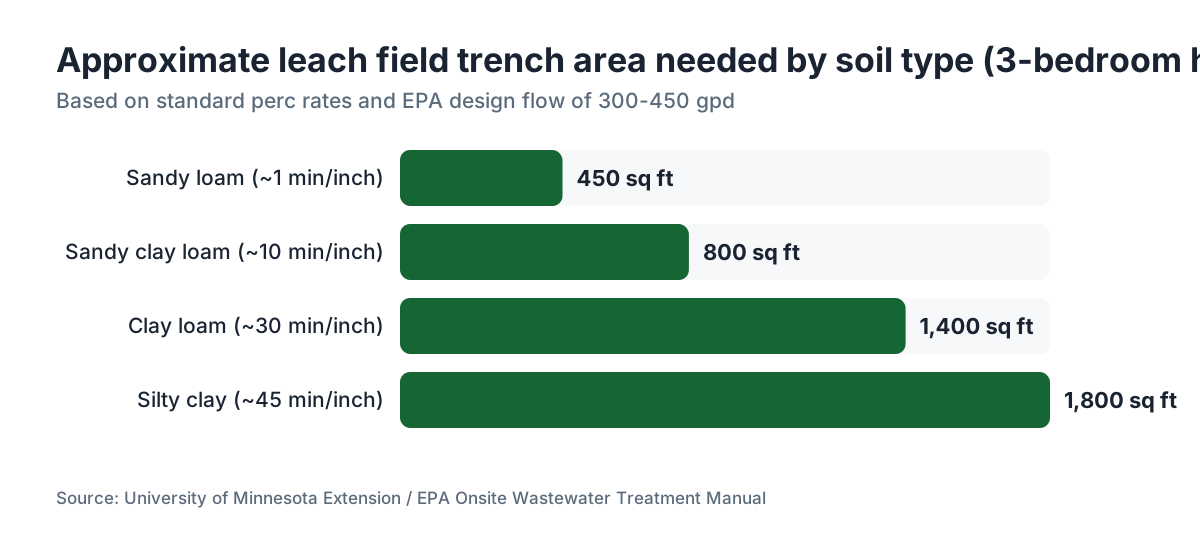
Size depends on soil type, daily flow, and local code. The design starts with a soil percolation test (perc test) or a soil morphology evaluation to figure out how many square feet of trench bottom the soil needs to absorb the household's daily flow without saturating.
For a 3-bedroom house, the most common design benchmark, most state codes assume 300 to 450 gallons per day [7]. Typical sizing looks like this:
| Soil Type | Approx. Perc Rate | Trench Bottom Needed (3BR) |
|---|---|---|
| Sandy loam | 1 min/inch | 400-500 sq ft |
| Sandy clay loam | 10 min/inch | 700-900 sq ft |
| Clay loam | 30-45 min/inch | 1,200-1,600 sq ft |
| Tight clay | >60 min/inch | Often not approvable |
In practice, a 3-bedroom home on average suburban soil often has a field footprint around 30 feet wide by 50 to 80 feet long (1,500 to 2,400 sq ft including the spacing between trenches). That's a real chunk of most suburban lots.
If your lot is small and you can't find the field within 100 feet of the tank, you might have a mound system, a seepage pit, or a chamber system. Those look different and sit differently. Your permit records will name the type.
Can you mark and map your leach field permanently?
Yes, and you should. Once you've located the tank, d-box, and laterals, spend 20 minutes making a permanent sketch.
Measure from at least two fixed reference points (a house corner, a utility pole, a fence corner) to the tank lid, the d-box, and the end of each lateral line. Write those distances on a hand-drawn or printed plat map. Laminate it, or scan it and store it with your home records. Photograph the stakes before you pull them.
For a digital record, some homeowners drop pins on the confirmed spots in Google Earth's measurement tool. That works fine as long as the satellite imagery is current.
Operators who manage many properties and want a systematic record of layouts, pump dates, and field notes can use a platform like SepticMind to attach site plans and service history to each address. That pays off when a new homeowner calls with no idea where anything is.
A mapped system also helps at resale. Buyers and their inspectors ask about septic location, and a clear diagram ready to hand over avoids delays in the septic tank inspection process.
What should you never do in or near a leach field?
The list of things that kill leach fields faster than neglect is short but definite.
Don't drive or park on it. Vehicle weight compacts the soil and crushes the gravel bed, and both cut the field's absorption capacity. One pass with a loaded vehicle can damage a trench. Septic contractors name this as the most common preventable field failure they see.
Don't plant trees or large shrubs within 25 to 30 feet. Willow, poplar, and maple are the worst offenders. The EPA SepticSmart program advises planting "only grass over and near your septic system" [1]. Grass roots stay shallow and don't threaten the pipes. Tree roots find them.
Don't build over the field. No sheds, decks, pools, or additions. Building over a leach field breaks most state codes and turns any future repair into an expensive dig [3].
Don't route surface water onto it. Downspouts, sump pump discharge, and swales that dump water over the field saturate the soil and shut down absorption. Send those flows somewhere else.
Don't flush anything but waste and toilet paper. Wipes (even the "flushable" ones), grease, medications, and household chemicals all reach the field, where they either clog the distribution pipes or kill the soil bacteria doing the treatment work [6].
For the long-term care side, our guide on leach field maintenance goes deeper.
How does finding your leach field connect to septic maintenance?
Knowing where the field is makes every maintenance task easier and cheaper.
The biggest lever is pump frequency. The EPA recommends pumping most residential systems every 3 to 5 years [1]. Sludge that overflows the tank because nobody pumped it is the leading cause of field clogging. If you don't know your last pump date, read our guide on how often to pump septic tank.
When a pumper shows up, they need the tank lid. Knowing where it is saves them 30 to 60 minutes of probing, and you'll see that time on the invoice. Some pumpers charge $50 to $100 extra to find a buried lid. Map the system and that fee disappears.
A periodic look at the d-box pays off too. A d-box with one clogged port sends all the flow to one or two laterals instead of spreading it evenly, which overloads part of the field while the rest sits idle. A quick visual check every couple of years, done after a pump-out when the water level is low, catches that early.
For routine cleaning and service, see our overview of septic tank cleaning. If the field shows signs of failure, the options and costs are in septic tank repair.
When should you hire a professional to locate your leach field?
Hire a pro in three situations.
If you're buying a house and the inspection requires a leach field location for a Title 5, escrow, or lender condition, use a licensed inspector. In several states (Massachusetts, for example, under 310 CMR 15.000) a full system inspection including component location is legally required at point of sale [8].
If you've probed 50-plus points and found nothing, the system may have an unusual setup: a seepage pit, drywells, a chamber system, or a very long run from the house. A contractor with a pipe locator or GPR can settle it in an hour.
If you see signs of failure (wet spots, odor, slow drains) and need to know whether it's a failing lateral or a damaged d-box, a professional camera inspection of the lines tells you more than surface probing ever will.
Locating services from a septic contractor usually run $100 to $300 depending on difficulty and region [9]. That's cheap next to the cost of wrecking field infrastructure because you didn't know where it was.
What's the process if your leach field can't be found or no records exist?
Old farmhouses, rural properties, and pre-permit systems (most states started requiring permits in the 1970s and 1980s) sometimes have no paper trail at all.
Start with the county assessor's GIS map and pull aerial imagery from different years. Google Earth's historical imagery slider sometimes shows the bare-soil scar from installation, especially if the house is fairly new or was renovated recently.
Call a local septic contractor who works your area and ask whether they've serviced the property. Companies that have been around 20 or 30 years often keep their own records from prior pump-outs.
If that fails, a licensed professional can run a dye test: flush a non-toxic fluorescent dye (usually fluorescein) through the system and watch for it surfacing in the yard. That confirms a specific wet area connects to the septic system, which at least points you to the field zone [10].
For properties where the field truly can't be documented and a replacement or expansion is needed, the local health department will require a new perc test and design. That process and its costs are in our cost to install septic system guide.
For what a brand-new system costs if the old field is unrecoverable, see cost to put in a septic tank.
Frequently asked questions
How can I find my leach field without digging?
Start with permit records from your county health department, which usually include a scaled drawing with measurements from the house. If those don't exist, use a 5-foot steel probe rod to follow the pipe from the septic tank outlet to the distribution box, then fan out along each lateral. No digging is needed for most residential systems. The probe rod confirms locations without breaking the surface.
How far from the house is a typical leach field?
In most installations, the septic tank sits 10 to 25 feet from the foundation, the distribution box is another 5 to 20 feet past the tank, and the laterals run 50 to 100 feet from there. So the near edge of the field is often 15 to 50 feet from the house, and the far end can reach 100 to 150 feet on a standard suburban lot. Setback minimums vary by state code.
What does a leach field look like from above?
From above, a healthy leach field usually just looks like a rectangular patch of lawn, sometimes greener than the surrounding grass because of extra moisture and nutrients. Older systems may show faint parallel ridges or depressions 6 to 10 feet apart where the trenches settled. A failing field may have soggy patches, dead or unusually lush vegetation, or visible discoloration.
Can I use my septic tank permit to find the leach field?
Yes, and it's the best first step. The as-built drawing filed with your county health department shows the tank, distribution box, and every lateral line, with measurements from fixed reference points on your property. Request it by parcel number from your county environmental health or building department. Many counties now keep these records in online permit portals you can search yourself.
What happens if I accidentally drive over my leach field?
A single pass with a light passenger vehicle probably won't cause catastrophic damage, but it compresses the gravel bed and soil above the pipes, which cuts percolation over time. Repeated traffic, or one pass with a heavy truck or tractor, can crush perforated pipes or compact the absorption zone for good. If you drove over it, watch for wet spots or slow drains and have a contractor assess if symptoms show up.
How do I find the distribution box (d-box) for my septic system?
The d-box sits in line between the septic tank outlet and the start of the laterals, usually 5 to 50 feet from the tank. Follow the outlet pipe bearing from the far end of the tank with a probe rod at 2-foot intervals. The d-box sounds more solid than the hollow tank and usually sits 12 to 18 inches deep. Once found, the laterals branch out perpendicular to the inlet pipe.
Is it safe to dig in my leach field area?
Light gardening (shallow annuals, bulbs) in the grassed zone over the field carries low risk if you stay above 6 inches. Anything deeper risks cutting a perforated pipe or disturbing the gravel bed. Never run power equipment like a rototiller, trencher, or backhoe in the field area without confirmed pipe locations. Trees and deep-rooted shrubs should never go within 25 to 30 feet of the laterals.
How do I find a leach field on a property I just bought?
Check your closing documents for a septic inspection report or permit drawing. If those aren't there, call the county environmental health office with your parcel number and request the as-built permit drawing. If the sale required a septic inspection (as it does in several states at point of sale), that inspector's report should include a system diagram. As a backup, a local septic contractor can locate the system for $100 to $300.
Can a leach field be under a driveway or paved area?
Legally, no. Current codes prohibit locating a leach field under impervious surfaces. But on older properties, driveways or additions may have been built over an existing field without permits. If your system predates the 1980s and you can't find the field in the yard, compare old photos or aerial imagery to check whether paved areas were added after the original install. A contractor with ground-penetrating radar can confirm.
What's the difference between a leach field and a drain field?
Nothing practical. Both terms name the same component: the network of perforated pipes in gravel-filled trenches that disperses clarified septic tank effluent into the soil for final treatment. "Drain field" is more common in some regions and industry standards; "leach field" or "absorption field" shows up in others. Your state code may prefer a specific term, but they all mean the same design.
How often should I have my leach field inspected?
The EPA recommends a full septic system inspection every 3 to 5 years, which typically includes a visual check of the field for surfacing effluent, ponding, or odors. If you're on that pump schedule and there are no symptoms, a dedicated field inspection isn't always needed every cycle. If you notice slow drains, wet spots, or unusually green grass over the field, get an inspection sooner rather than waiting.
Does my homeowner's insurance cover leach field damage?
Standard homeowner's policies almost always exclude septic components, the leach field included. Some insurers offer a rider or separate service line coverage for sewer and septic lines, but coverage for the absorption field itself is rare and expensive. Check your specific policy. Preventive maintenance is the only reliable financial protection for this component.
How long does a leach field last?
A well-maintained leach field on suitable soils typically lasts 25 to 50 years. The main variables are pump frequency (sludge overflow kills fields), household water use, soil type, and what gets flushed. Fields on tight clay or in high water table areas fail sooner. The EPA notes that proper maintenance, mainly regular pumping, is the most effective way to extend field life [1].
What does it cost to replace a leach field?
Leach field replacement costs vary widely. A straightforward conventional system on a residential lot runs roughly $3,000 to $10,000 for the field portion alone. Add design, permitting, and a new distribution box and total costs often reach $5,000 to $20,000. Complex sites needing mound systems or alternative designs can top $30,000. For a full breakdown, see our cost to install septic system guide.
Sources
- U.S. EPA SepticSmart Program: Homeowners should know the location of their septic system, keep a diagram, plant only grass over and near it, and pump every 3-5 years.
- U.S. EPA, Septic System Owner's Guide: Permit records including as-built drawings are filed with local county health departments at time of installation.
- North Carolina Department of Health and Human Services: North Carolina rules (15A NCAC 18E) require permit and as-built records to be maintained on file with the local health department; structures and impervious cover over the field are prohibited.
- University of Minnesota Extension: Conventional septic tanks are typically located 10-25 feet from foundations; perforated lateral pipes are buried with tops at 6-24 inches below grade; laterals commonly run 50-100 feet.
- U.S. EPA, A Homeowner's Guide to Septic Systems: Differential grass greenness over a leach field is a recognized visual indicator; flushing non-biodegradable items and chemicals disrupts field function.
- U.S. EPA, Onsite Wastewater Treatment Systems Manual (EPA/625/R-00/008): Standard design flow for a 3-bedroom residence is assumed at 300-450 gallons per day for sizing purposes.
- Massachusetts Department of Environmental Protection, Title 5 (310 CMR 15.000): Massachusetts Title 5 regulations require a full septic system inspection including component location at point of sale.
- Angi, Septic Tank Inspection Cost Guide: Professional septic system locating services from a contractor typically run $100-300 depending on difficulty and region.
- Penn State Extension: Fluorescent dye testing (fluorescein) is an accepted method to confirm whether surface wet areas are connected to a septic system's leach field.
- University of Minnesota Extension: Soil percolation rate (perc rate) directly determines required trench bottom area; sandy loam soils require less than 500 sq ft for 3-bedroom flow; clay loam soils may require 1,200-1,600 sq ft.
Last updated 2026-07-10