How to clean a septic tank without pumping (and when you can't)
By the SepticMind Editorial Team
TL;DR
- You can stretch the time between pump-outs by cutting waste loads, adding biological treatments that digest organic solids, and dropping habits that kill the bacteria doing the work.
- No product, enzyme, or additive ends the need for periodic pumping.
- Once sludge and scum pass about a third of tank depth, they have to come out physically.
- Real cleaning takes a pump truck.
What does 'cleaning' a septic tank actually mean?
Homeowners use "clean" to mean two different things, and mixing them up leads to expensive mistakes.
The first meaning is removing accumulated sludge and scum, the physical layers of solid waste that settle to the bottom and float on top of your tank. EPA's SepticSmart program is blunt about it: "A typical household septic system should be inspected at least every 3 years by a septic service professional and pumped every 3 to 5 years" [1]. That removal is pumping. Nothing you add to a tank, no enzyme, no bacteria culture, no chemical, dissolves the inert mineral solids and non-degradable material that make up a big fraction of sludge. They get vacuumed out or they stay.
The second meaning is restoring bacterial activity, breaking down organic solids faster, and slowing how quickly sludge piles up in the first place. That part you can influence. A biologically active tank digests organic matter more efficiently, which stretches the interval between pump-outs.
This article covers both. It tells you what you can genuinely do without a pump truck, which products have any evidence behind them, and where the line sits between maintenance and wishful thinking.
Not sure how long it's been since your last septic tank pump out? Start there before anything else.
Can additives and enzymes really clean a septic tank?
The honest answer: they can help maintain a healthy tank, but they cannot clean a neglected one.
The septic additive market is huge and barely regulated. Products fall into three buckets: biological additives (bacteria and enzyme cultures), chemical additives (solvents, acids, alkalis), and inorganic compounds. EPA has reviewed the evidence and lands on caution: "the use of chemical additives is not recommended," and biological additives have not been shown to reduce the need for pumping [2]. Several state onsite wastewater programs, including Massachusetts and North Carolina, go further and ban chemical additives outright, because the solvents that break down grease can also dissolve the biomat in your drain field and cause field failure [3].
Biological additives are a different story, though still no substitute for pumping. A working septic tank already holds billions of anaerobic bacteria doing exactly what packaged cultures do. If your tank's bacteria are healthy, adding more does almost nothing you can measure. If the population got wiped out by heavy antibiotic use, bleach, or drain cleaners, then reintroducing bacteria can genuinely restore digestion rates.
A 2013 review in Bioresource Technology examined studies on septic tank additives. Some biological products improved short-term measures of organic decomposition, but none showed a statistically significant reduction in sludge accumulation over time [4]. That's the honest state of the science.
So the rule is simple. Biological additives are a reasonable maintenance tool for a healthy, regularly pumped tank. They are not a cleaning fix for a tank that's overdue.
What actually reduces sludge buildup between pump-outs?
Behavior beats any product on the shelf. Here's what the evidence supports.
Cut non-degradable solids going in. Flushing anything besides human waste and toilet paper is the single biggest driver of premature sludge. Wipes marketed as "flushable" do not break down in a septic tank. Neither do cotton rounds, paper towels, or hygiene products. They sink and stack up as inert solids bacteria can't touch.
Reduce grease and fat. Fats, oils, and grease (FOG) build the scum layer at the top. Pour cooking grease down the drain and you thicken that layer, and a heavy scum layer eventually clogs the outlet baffle and shoves solids into the drain field. Scrape plates into the trash. Use sink strainers.
Fix heavy water use. A sudden surge, say an 8-person party running showers and toilets all weekend, physically stirs the settled sludge and pushes half-treated effluent into the drain field before it's ready. Spread laundry across the week. Fix running toilets. EPA estimates a leaking toilet wastes 200 gallons a day [1], and every gallon through the tank steals settling time from your solids.
Protect the bacteria. Bleach-based drain cleaners, heavy use of antibacterial soaps, and some medications excreted in urine cut down the bacterial population doing the work. You don't need to strip your house of cleaning products. A normal household seeds plenty of bacteria on its own. Just don't pour concentrated bleach into drains or dump septic-toxic drain openers.
Spread out cleaning chores. Running the dishwasher, three loads of laundry, and a bathroom scrub-down on the same day overwhelms the tank's biology and flushes undertreated waste downstream. Space the chores out and the bacteria get time to work.
Applied consistently, these habits meaningfully extend the interval between pump-outs. They won't erase the need, but they're the cheapest thing you can do. See how often to pump septic tank for what drives your specific schedule.
Step-by-step: how to maintain a septic tank between pumpings
This is a maintenance routine you can actually follow. None of it needs professional help or special tools.
Step 1: Know your tank's current sludge level.
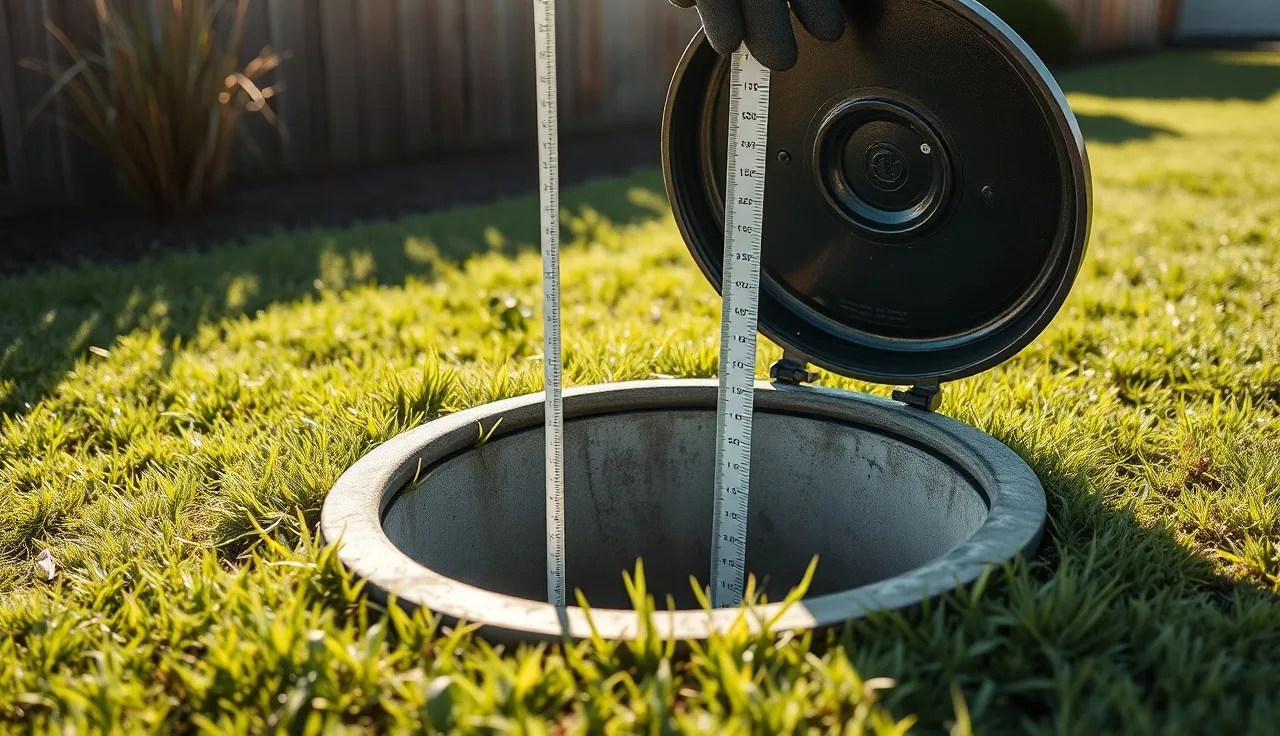
Measure sludge depth with a homemade tool: a long PVC pipe or wooden stick wrapped in white velcro or a white towel at the bottom. Open the access lid (septic gas is dangerous, so never lean over an open tank), lower the stick to the bottom, hold it a minute, then pull it up. The dark sludgy stain on the velcro shows how deep the sludge sits. Within 12 inches of the outlet baffle means you need a pump-out, not maintenance. For the full process, see our septic tank inspection guide.
Step 2: Check your inlet and outlet baffles.
Baffles steer incoming waste below the scum layer and keep sludge from escaping to the drain field. Cracked or missing baffles are a common failure point. If you can safely see them through the access port, look for intact T-shapes or tees. A broken baffle means solids are probably reaching your leach field, and no additive fixes that.
Step 3: Keep water conservation habits.
Install low-flow fixtures if you haven't. EPA WaterSense-labeled toilets use 1.28 gallons per flush against the 3.5 to 7 gallons older models burn [5]. For a family of four over a year, that difference runs into tens of thousands of gallons less flowing through your tank.
Step 4: Use a biological additive on a schedule, if you want to.
Recently pumped and want to support the bacteria? A monthly biological additive (a bacteria-and-enzyme culture, not a chemical) is a reasonable low-cost choice. Expect $10 to $30 a month. Don't expect fireworks. Treat it like a probiotic: probably helps, won't hurt, doesn't replace the fundamentals.
Step 5: Keep records.
Write down when the tank was last pumped, the sludge depth reading, and any change in household size or habits. Many state programs require a service record. If you sell the house, you'll want documentation for the septic tank inspection.
Step 6: Walk the drain field.
Every spring, look at the field. Soggy ground, a stripe of lush green grass directly over the lines (a sign effluent is surfacing), or odors all mean the system needs professional attention. Additives will not solve any of it.
Do septic tank treatments and biological additives work?
Depends on what you mean by "work."
Products like Rid-X, Septic Drainer, and dozens more are legal in most states and everywhere on store shelves. Manufacturers claim they digest solids faster and stretch the pump interval. North Carolina Cooperative Extension, which ran one of the more careful independent reviews, put it plainly: "there is no scientific evidence that microbial or enzymatic additives reduce sludge accumulation rates to a degree that eliminates or substantially delays the need for pumping" [6].
A few narrower claims hold up better. Some biological additives show real improvement breaking down fats and proteins in controlled lab tests. If your household leans on antibacterial products, or someone just finished a long antibiotic course, a bacterial reintroduction product may restore digestion capacity that got knocked down.
Chemical additives are a harder no. Products that use solvents to break down grease can push that grease out of the tank as dissolved compounds instead of settled solids. Sounds helpful right up until those compounds hit your drain field and plug the soil pores. Massachusetts Title 5 [3], which governs onsite septic systems in that state, flatly bans chemical additives containing solvents for exactly this reason.
Here's the take. Monthly biological maintenance products are a reasonable low-cost habit. Don't pay up for premium "tank cleaner" claims or anything promising to end pumping.
Can you use aeration or agitation to clean your tank?
Some homeowners and a handful of vendors push aerating a conventional tank, pumping in oxygen to speed decomposition. The theory is fine: aerobic bacteria break down organic matter faster than the anaerobic bacteria in a conventional tank.
The problem is that conventional septic tanks are built to be anaerobic. Adding air wrecks the settling process that separates solids from liquid. To use aerobic decomposition safely, you'd need a different system entirely, an aerobic treatment unit (ATU) [7]. ATUs are real technology used in states where soil conditions or lot size can't support a conventional drain field, but converting a conventional tank into an aerobic unit takes engineering, permits, and real money. It is not a DIY maintenance step.
Mechanical agitation, stirring the tank contents with any device, is actively harmful. It re-suspends settled solids, sends cloudy effluent to the drain field, and speeds up clogging. Don't do it.
One aeration-adjacent tool is legitimate, and it's a septic tank inspection using a camera. Some operators run camera inspections of tanks and drain lines, which spot clogged baffles, cracked tanks, or root intrusion without disturbing anything. That's diagnostic, not cleaning.
When do you absolutely have to pump, no matter what?
Some situations make additives, habits, and careful maintenance irrelevant. You need a pump truck.
Sludge depth passes one-third of liquid depth. This is the standard threshold in most state programs [8]. Once sludge fills that much of the tank, there isn't enough liquid left to treat incoming waste before it exits to the field.
Sewage is backing up into the house. This is an emergency. Either the tank is full or the drain field is failing, and neither problem answers to additives.
You're selling the home. Almost every state requires a septic inspection at point of sale, and most inspectors call for pumping first so they can read the tank's structural condition. A septic tank inspection on a full tank is incomplete.
Wet spots or odors are showing over the drain field. That can mean the tank is spilling solids into the field. Step one is always pumping the tank to take pressure off the field.
More than 5 years have passed since the last pump-out. Even a small household with careful habits should treat EPA's every-3-to-5-years guidance as the ceiling, not the target [1]. Some state programs set shorter mandatory intervals.
A standard pump-out from a licensed septic service runs $300 to $600 in most markets, moving with tank size and local rates [9]. That's pocket change next to septic tank repair or septic system repair after field failure, which can hit $5,000 to $25,000 or more.
What products are safe to put in a septic tank?
This matters because the wrong things harm the bacterial ecosystem and speed up failure.
Safe to use:
- Regular (non-antibacterial) household soaps and detergents in normal amounts
- Toilet paper labeled "septic safe" (single-ply breaks down fastest)
- Biological septic additives that list bacteria strains and enzyme types (not solvents)
- Water from normal household use, including dishwashers and laundry
Avoid or use carefully:
- Bleach-based drain cleaners (occasional diluted use is probably fine; dumping a quart of concentrated bleach is not)
- Chemical drain openers (lye, sulfuric acid) that kill the tank's bacteria and eat away baffles
- Garbage disposal waste in quantity (doubles or triples solids loading per some extension guidance [6])
- Medications flushed down the toilet, especially antibiotics
- "Flushable" wipes of any brand
- Paint, paint thinner, or solvents of any kind
- Pharmaceuticals (they also raise a public health concern, since they can pass through the system)
Thinking about a garbage disposal on septic? The honest advice: it sharply raises solids loading and shortens your pump interval. University of Minnesota Extension, which publishes detailed septic guidance, recommends against disposals for septic users, or pumping every 1 to 2 years instead of 3 to 5 if you keep one [8].
For operators running multiple properties or educating customers at scale, tracking which households use disposals and adjusting pump schedules is a good example of where software like SepticMind helps standardize service records and flag accounts coming due.
How long can you go without pumping a septic tank?
This is the question everyone actually wants answered, and the honest reply is: it depends on tank size and household size more than anything else.
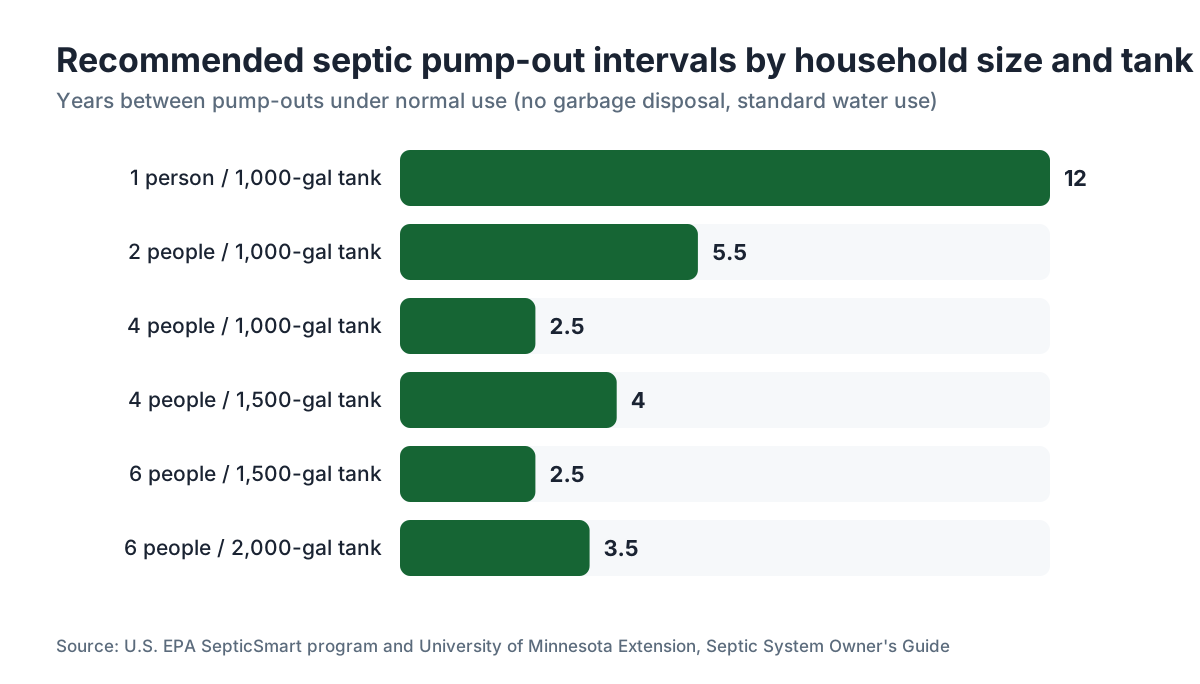
EPA's pump-frequency logic ties tank volume (in gallons) to household waste generation (people times daily flow) [1]. The table below draws on EPA and University of Minnesota Extension data.
| Household size | Tank size (gallons) | Pump interval (years) |
|---|---|---|
| 1 person | 1,000 | 12+ |
| 2 people | 1,000 | 5-6 |
| 4 people | 1,000 | 2-3 |
| 4 people | 1,500 | 3-5 |
| 6 people | 1,500 | 2-3 |
| 6 people | 2,000 | 3-4 |
These assume no garbage disposal, normal water use, and no non-degradable solids. Add a disposal, or a household member on heavy antibiotics, and knock a year or two off each row.
The longest any household should go between pump-outs is 5 years, and only for a small household with a large tank and careful habits. Stretching past that doesn't save money. It risks field damage that costs more than a decade of pump-outs combined. See septic tank emptying for what that service involves.
If your system has never been pumped, or the previous owners left no record, schedule a pump-out now. The cost is predictable. The cost of ignoring it is not.
Are there any DIY methods that actually help?
A few, yes. But let's be clear about the line between real maintenance and things sold as help that deliver almost nothing.
Yeast treatments: Some homeowners drop a packet of dry baker's yeast down the toilet monthly, on the theory that yeast digests organic matter and feeds the bacterial ecosystem. No controlled study shows it works. It's harmless and cheap. If it makes you feel better, it probably won't hurt.
Enzyme-based septic treatments: Products like Rid-X carry bacterial spores and enzymes. As covered above, the evidence for real sludge reduction is thin. For a recently pumped, healthy tank, a monthly dose may help hold bacterial balance. Price runs about $8 to $15 a month [9].
Water efficiency upgrades: This is the highest-value DIY move there is. Swapping old toilets (3.5 to 7 gallons per flush) for WaterSense models (1.28 gallons per flush) cuts the hydraulic load on your tank hard. Fix leaking faucets and running toilets the day you notice them. These changes genuinely extend the pump interval.
Sludge depth measurement: The velcro stick method above is a legitimate DIY diagnostic. Checking sludge depth every 1 to 2 years lets you schedule pump-outs on actual need instead of the calendar.
What doesn't help (and may hurt):
- Pouring baking soda, vinegar, or hydrogen peroxide in to "balance pH." The tank buffers its own pH. Adding acids or bases just disrupts bacteria.
- Using chemical drain cleaners, then adding a bacterial packet to make up for it. The chemical damage is real; the recovery from a packet is marginal.
- Jetting or pressure-washing the inside of your tank. That's a job for professionals during a pump-out. Done wrong, it disperses settled solids all through the tank.
For a deeper look at what a real cleaning entails, see septic tank cleaning.
What's the difference between cleaning and pumping, and does it matter?
"Cleaning" sounds more thorough than "pumping," and some providers charge more for it. Here's what the terms usually mean in practice.
Pumping removes the liquid, the floating scum layer, and most of the sludge using a vacuum truck. It's fast, usually 30 to 60 minutes. Some sludge can stay on the walls and bottom.
Cleaning, sometimes called a "full cleanout," adds backwashing or jetting the tank interior to lift residual sludge off walls and corners, and may include a camera inspection of the inlet and outlet baffles. It costs more, generally $400 to $800, and earns its keep on a pre-sale inspection or a tank that hasn't been serviced in years.
For routine maintenance, pumping is what you need. Full cleaning fits every few pump cycles or before a real estate deal.
See the detailed comparison at septic tank pumping and septic tank cleaning for what each service covers and what to ask your provider.
If you run a septic service operation or manage multiple properties, SepticMind's service record system tracks which customers got full cleanouts versus standard pump-outs, flags accounts due for baffle inspection, and schedules them without you digging through paper.
What state regulations govern septic tank maintenance?
Septic systems are regulated at the state level, and standards vary a lot. A few points apply almost everywhere.
EPA's SepticSmart program [1] gives federal guidance but has no enforcement authority over residential systems. The actual legal requirements come from state onsite wastewater codes, enforced through your county health department.
Massachusetts Title 5 (310 CMR 15.00) [3] is one of the most detailed state codes and gets cited as a model. It requires inspection every 3 years or at time of sale, mandates that pumping be done by a licensed septage hauler, and bans chemical additives containing organic solvents.
North Carolina's rules (15A NCAC 18E) require permits for installation, repair, and major modification, and tie pump-out requirements to tank capacity and occupancy.
Most states require a licensed or certified pumper to legally transport and dispose of septage. In most jurisdictions you cannot legally pump your own tank and haul it away. Septage disposal is regulated under 40 CFR Part 503, EPA's federal biosolids rule [10].
A few states (Florida, for one) have written mandatory pump-out intervals into law, though enforcement is uneven. Others lean on inspection-at-sale to trigger maintenance.
If you're in a state with a mandatory inspection program and haven't had your system checked recently, your county health department's website has the current requirements. Guessing doesn't pay off here.
Frequently asked questions
Can I clean my septic tank myself without a professional?
You can handle maintenance yourself: measuring sludge depth, cutting water use, avoiding harmful products, and adding biological treatments. Actually removing accumulated sludge takes a licensed vacuum truck and, in most states, a licensed septage hauler. DIY pumping is illegal in most jurisdictions, and opening and emptying a tank without proper equipment is genuinely dangerous because of toxic hydrogen sulfide gas.
Does Rid-X actually work to clean a septic tank?
Rid-X and similar biological additives can help hold bacterial populations in a healthy, recently pumped tank. They will not clean a tank that's overdue. EPA and multiple university extension services found no evidence that any additive meaningfully reduces sludge accumulation or ends the need for pumping. Use it as a maintenance supplement, not a replacement for professional service.
How do I know if my septic tank needs pumping or just maintenance?
Check sludge depth with a velcro-wrapped stick lowered to the tank bottom. Sludge within 12 inches of the outlet baffle, or filling more than one-third of the tank's liquid depth, means you need pumping, not maintenance. Other signs: slow drains throughout the house, gurgling, or wet spots and odors over the drain field. At that point no additive helps. You need a pump truck.
What can I put in my septic tank to help break down waste?
Biological additives with bacterial strains and enzymes (not chemical solvents) are the only category with any supporting evidence. Products using Bacillus species bacteria are common. Monthly use in a well-maintained tank is reasonable and cheap, around $10 to $30 a month. Avoid chemical drain cleaners, baking-soda-and-vinegar combos, and any product claiming to end pumping for good.
How long can a septic tank go without being pumped?
For a family of four with a 1,000-gallon tank, the EPA-supported interval is 2 to 3 years. With a 1,500-gallon tank and careful habits, that stretches to 3 to 5 years. A single-person household with a large tank may go 10 to 12 years. Going past 5 years in an average household risks the drain field, and field repair or replacement runs $5,000 to $25,000 or more.
Is it safe to add baking soda or vinegar to a septic tank?
These won't help and can cause minor harm. A septic tank holds a near-neutral pH on its own because the bacterial process self-regulates. Adding acid (vinegar) or base (baking soda) briefly disrupts the bacteria. The amounts most people use are too small to do lasting damage, but there's no upside either. Skip it and focus on water conservation and keeping real toxins like chemical drain cleaners out.
Can a garbage disposal damage my septic system?
Yes, a lot. A garbage disposal roughly doubles the solids load entering your tank, per University of Minnesota Extension guidance. On septic, expect to pump every 1 to 2 years with regular disposal use, instead of the standard 3 to 5. If you aren't willing to shorten your pump interval, skip the disposal. Many septic professionals recommend avoiding them entirely.
What happens if you never pump your septic tank?
Sludge builds until it reaches the outlet baffle, then solid waste flows into the drain field and clogs the soil pores that treat effluent. Once the field clogs, sewage backs up into the house or surfaces in the yard. Field restoration is expensive, and replacement can run $10,000 to $30,000 or more. Compare that to a $300 to $600 pump-out every 3 to 5 years and the math is obvious.
Do septic tank enzymes reduce pumping frequency?
No credible controlled study has shown that enzyme products meaningfully extend pump intervals. North Carolina Cooperative Extension and EPA both conclude that no additive has been proven to reduce the need for professional pumping. Enzymes may improve short-term organic decomposition in a healthy tank, but inert solids, the non-degradable fraction of sludge, don't respond to enzymes and pile up regardless.
Can I aerate my septic tank to speed up breakdown?
Not as a DIY step. Aerobic treatment units (ATUs) that add oxygen to speed decomposition are a real engineered system, not a retrofit for a conventional tank. Adding air to a conventional anaerobic tank disrupts settling and makes performance worse, not better. If your soil conditions require an ATU, that's a permitted installation project, not a maintenance option. Talk to your state environmental office.
What should I do after my septic tank is pumped to help it recover?
A freshly pumped tank rebuilds its bacterial population on its own within a few weeks, as long as normal household waste keeps flowing in. You don't need a bacterial starter culture, though it won't hurt. Resume normal water use, ease off antibacterial products, and skip massive water loads (10 loads of laundry in a day) in the first week. The biology recovers by itself.
Are there any chemicals that can dissolve septic tank sludge?
Chemicals strong enough to dissolve inorganic sludge would also damage your tank, baffles, and drain field. No safe, legal chemical dissolves sludge enough to substitute for pumping. Some solvent-based products briefly liquefy grease in the scum layer, but that pushes the grease downstream into the drain field, trading one problem for a worse one. Massachusetts and other states ban such products for this reason.
How much does a septic tank cleaning cost compared to pumping?
Standard pumping runs $300 to $600 in most U.S. markets, depending on tank size and local rates. A full cleaning, which adds backwashing of tank walls and may include camera inspection, runs $400 to $800. For routine maintenance, pumping is enough. Full cleaning makes sense pre-sale, if the tank hasn't been serviced in 10-plus years, or when a camera inspection is needed to check baffle condition.
Does water softener discharge harm a septic tank?
This one is genuinely debated. High salt concentrations from softener backwash can, in theory, affect bacteria and soil structure in the drain field. Some state programs, including Wisconsin's, restrict softener discharge to septic systems. University of Minnesota found mixed results in its review. The safest move is to route softener discharge to a separate drywell if your code and site allow it.
Sources
- U.S. EPA, SepticSmart: Protect Your Investment: Typical household septic systems should be pumped every 3 to 5 years; a leaking toilet can waste 200 gallons per day
- U.S. EPA, Septic System Additives: EPA states chemical additives are not recommended and biological additives have not been shown to reduce the need for pumping
- Massachusetts Department of Environmental Protection, Title 5 regulations (310 CMR 15.00): Massachusetts Title 5 prohibits chemical additives containing organic solvents and requires licensed pumpers for septage removal
- Bioresource Technology, review of septic system additive efficacy (2013): Review found no biological product demonstrated a statistically significant reduction in sludge accumulation rates over time
- U.S. EPA, WaterSense Program: Toilets: WaterSense-labeled toilets use 1.28 gallons per flush versus 3.5 to 7 gallons for older models
- North Carolina Cooperative Extension, Septic System Care and Maintenance: No scientific evidence that microbial or enzymatic additives reduce sludge accumulation to eliminate or substantially delay pumping; garbage disposals increase solids loading significantly
- U.S. EPA, Aerobic Treatment Units for Onsite Wastewater: Aerobic treatment units are an engineered alternative technology, not a retrofit for conventional septic tanks
- University of Minnesota Extension, Septic System Owner's Guide: Sludge should be pumped when it exceeds one-third of liquid depth; garbage disposal use shortens pump interval to 1 to 2 years
- Angi, Septic Tank Pumping Cost Guide (2024): Standard pump-out costs $300 to $600; enzyme additive products cost approximately $8 to $15 per month
- U.S. EPA, 40 CFR Part 503, Standards for Use or Disposal of Sewage Sludge: Federal rule governs septage transport and disposal; septage haulers must meet regulatory standards
- U.S. EPA, How Your Septic System Works: Pump-out frequency depends on household size, tank volume, and waste loading rates, as modeled in EPA's system guidance
Last updated 2026-07-09