How often to clean your septic effluent filter (and how to do it right)
By the SepticMind Editorial Team
TL;DR
- Clean your septic effluent filter at least once a year, or every time the tank gets pumped (usually every 1-3 years).
- Big households need it every 6 months.
- A skipped filter is one of the most common reasons a drain field dies early.
- The job takes 15 minutes and costs nothing if you do it yourself.
What is a septic effluent filter and what does it do?
An effluent filter is a cartridge that sits inside the outlet baffle of your septic tank. Its job is simple: catch solids before they leave for the drain field. Without one, grease, hair, and fine particles ride the liquid out of the tank into the soil pipes, where they clog the biomat layer your drain field depends on.
Most filters are polypropylene or PVC, ranging from about 4 to 18 inches in diameter depending on the tank outlet. The common residential models are the Orenco Biotube, the Polylok PL-68, and the Zabel A1800. They all work the same way. Effluent has to pass through small slots in the filter body, and anything bigger than those slots stays trapped in the tank where it belongs.
Filters weren't standard on every tank until the late 1990s and 2000s, when states began requiring them on new installs. If your house went up before roughly 1995, there's a real chance you don't have one. Adding one is one of the best $50 to $150 you can spend on your drain field's life [1].
The filter hangs inside the outlet tee, near the tank's liquid surface. Effluent flows in through the outer screen and up through the center to reach the outlet pipe. As solids build on the outer screen, flow slows. When the filter gets too full, flow can stop completely, and that usually shows up as a backup in the house before the homeowner suspects a thing.
How often should you clean a septic effluent filter?
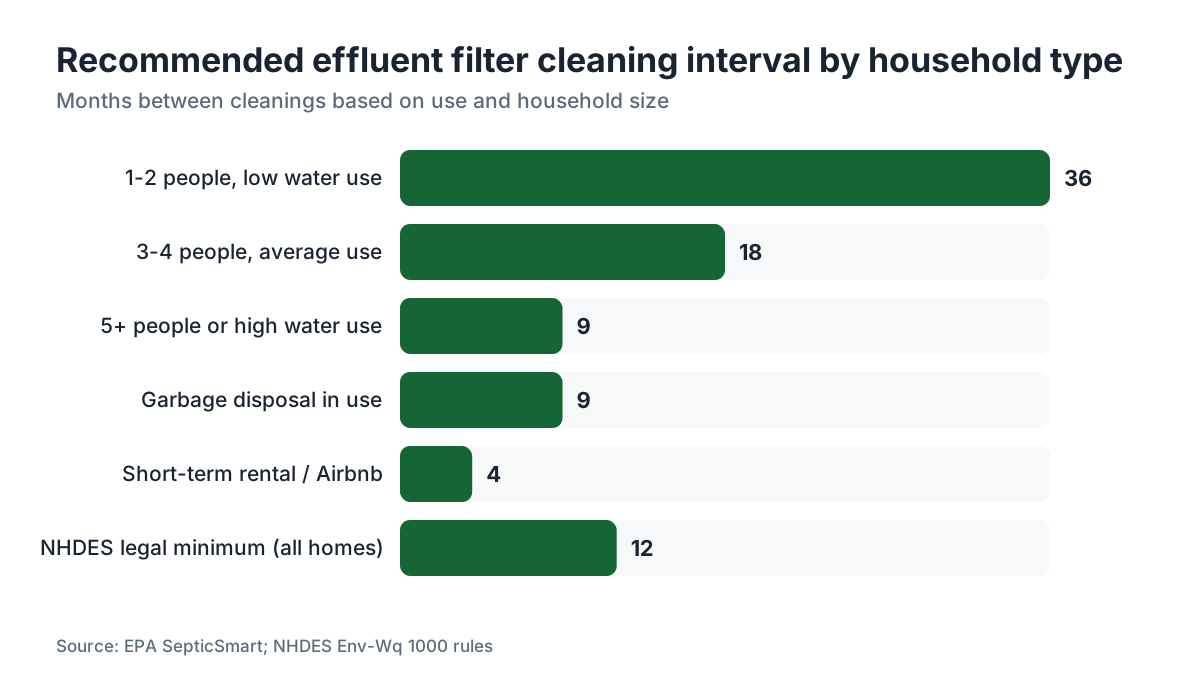
Clean it at least once a year, and always at pump-out. Every 1-3 years is the standard range for most homes, but the real interval depends on household size, water use, and what goes down the drains [1][2]. Annual cleaning is the safe default that keeps you out of trouble.
The EPA's SepticSmart program recommends inspecting and cleaning the effluent filter each time the tank is pumped [2]. New Hampshire goes further. Under RSA 485-A and the state's Env-Wq 1000 rules, the Department of Environmental Services (NHDES) requires that effluent filters be cleaned at least annually or per manufacturer specifications, whichever is more frequent [3]. That's an enforceable standard, not friendly advice.
Here's how it breaks down by household:
| Household situation | Recommended cleaning interval |
|---|---|
| 1-2 people, low water use | Every 2-3 years |
| 3-4 people, average use | Every 1-2 years |
| 5+ people or high water use | Every 6-12 months |
| Garbage disposal in use | Every 6-12 months |
| Short-term rental or Airbnb | After each heavy-use period |
| Alarm triggered by float | Immediately |
If your system has a high-water alarm or a pump chamber ahead of the filter, you get a warning when flow starts to restrict. Without one, you're flying blind. So check the filter once a year, clean it if you see any buildup, and never skip it at pump-out.
One thing people miss: a brand new filter can clog faster than an old one. It takes a few months for the tank's microbial community to settle after a pump-out or a filter swap. Don't assume the clean-looking filter from six months ago is still clear.
What happens if you don't clean the effluent filter?
A clogged filter builds backpressure, and that shows up two ways. Sewage backs up through floor drains, toilets, or the lowest fixture in the house. Or, if the clog comes on slowly and nobody notices the sluggish drains, solids eventually force their way around the filter and reach the drain field anyway, which defeats the whole point [1].
Drain field damage is the real risk. Replacing a drain field runs $3,000 to $15,000 or more, depending on soil and system type [4]. Cleaning a filter costs you 15 minutes. That math isn't close.
Some people think a clogged filter means the filter is failing. It's the opposite. A clogged filter means it's doing its job. Those solids would have gone somewhere worse. Clean it, put it back, and note how fast it filled, because rapid clogging tells you the tank needs pumping sooner than you planned.
Long neglect also hurts the digestion inside the tank. When the filter is fully blocked and liquid levels climb, it can disturb the scum and sludge layers and drop the tank's treatment efficiency. Even after you clean the filter, you'll push partly treated effluent out until the tank biology settles back down.
How do you clean an effluent filter in a septic tank?
Cleaning an effluent filter is straightforward. No special tools. You need gloves, eye protection, and a garden hose.
Step 1: Find and open the outlet access port. Most tanks have two lids, one over the inlet baffle and one over the outlet baffle. The filter lives in the outlet chamber. If you only have one central lid, the outlet is the end of the tank closest to your drain field.
Step 2: Pull the filter straight up and out of the outlet tee. Most models have a handle. Some need a slight twist. Don't yank sideways or you might crack the tee.
Step 3: Rinse it over the open tank, not over your lawn. You want the solids that come off to drop back into the tank. Hold the filter over the open access port and rinse top to bottom with the hose. The debris falls right back where it belongs.
Step 4: Inspect the filter while it's out. Look for cracked end caps, broken ribs, deformed mesh, or a housing warped enough that it won't seal when you put it back. A damaged filter that passes solids is worse than no filter, because it gives you a false sense of security.
Step 5: Reinsert it with the flow arrow pointing the right way. Most filters are keyed or marked. Seat it fully into the outlet tee until it clicks or sits flush.
Step 6: Replace the lid and write down the date. I mean it: mark it on the lid with a paint marker or log it somewhere. Memory fails, and people move.
Do not use bleach or antibacterial cleaner on the filter. Those kill the bacteria that run your tank. Plain water does the job. If a biofilm coating won't rinse off, a soft brush is fine, but don't scrub it bare. A little biological activity on the filter surface actually helps filtration.
If you want a running log of filter cleanings alongside pump-out records, SepticMind has a maintenance tracking tool that service operators use to schedule and document exactly this kind of work for their customers.
For what happens during a full tank service, see our guides on septic tank cleaning and how often to pump your septic tank.
Can you clean a septic effluent filter yourself or do you need a pro?
You can do it yourself. The steps above need no license, no special gear, and no training past reading the instructions for your filter model. If you're comfortable opening your tank lids and working near wastewater, you can handle this.
There are times to call a pro, though. If the filter sits deep enough that you can't reach it without leaning over an open tank, that's a confined-space hazard, and it's not worth the risk. If the outlet tee itself is broken (something you might find out the hard way trying to pull the filter), that's a septic tank repair job, not a cleaning. And if you've never opened your tank and you're not sure where the outlet baffle even is, a first inspection by a licensed pumper is money well spent.
Plenty of homeowners run a professional cleaning with the pump-out every 3 years and do one self-cleaning in between. That's a reasonable rhythm. The pro cleaning also lets the tech eyeball the filter, the tee, and the tank condition all at once.
A standalone filter cleaning by a pro usually adds $50 to $150 to a service call, depending on access and region. Done during pump-out, most pumpers throw it in free or charge a small add-on.
What are the NHDES effluent filter septic tank requirements?
New Hampshire is one of the states with clear, written effluent filter rules, and NHDES is specific enough to be worth reading even if you live elsewhere, because it shows where most state codes are heading.
Under New Hampshire's Env-Wq 1000 rules for onsite wastewater treatment, effluent filters are required on new system installations and on certain repairs. The rules mandate that filters be cleaned at least annually or per manufacturer specifications [3]. The state also requires that filters stay accessible for inspection and maintenance, which is why risers to grade are required on new installs.
NHDES guidance says filters must be installed in the outlet pipe of the septic tank or in the pump chamber, positioned to catch solids before they reach the soil treatment area. Filters must meet NSF/ANSI Standard 46, which governs the performance of components used in onsite wastewater treatment systems [3][5].
Outside New Hampshire, the rules swing widely. California, Florida, Oregon, and Washington all set their own effluent filter standards. Some require filters only on new construction. Others force retrofits on older tanks during a property transfer inspection. A few states have no statewide rule and hand it to county health departments. If you don't know what applies to your property, start with your state's department of environmental quality or department of health, onsite wastewater division.
For a septic tank inspection or a real estate deal, filter condition is usually part of the checklist in states with mandatory standards.
How do you know when the effluent filter needs cleaning between scheduled visits?
The clearest signal is a high-water alarm, if you have one. A float switch set above normal liquid level trips when flow out of the tank restricts, which is exactly what a clogged filter does. If that alarm sounds, check the filter first, before you assume pump failure or tank damage.
Without an alarm, the warning signs are inside the house. Slow drains at more than one fixture. Gurgling toilets when water runs somewhere else. Sewage odor near the tank or indoors. These symptoms overlap with several other septic problems, so slow drains alone don't prove a clogged filter. But if the filter's overdue and you're seeing any of this, start there.
Some homeowners fit a riser-mounted inspection port so they can check the filter without fully opening the tank. A clear-lid riser cover lets you eyeball the buildup. Orenco makes a clear-cap riser system for this. It's not cheap, but for a high-use household it pays for itself in avoided emergency calls.
Here's a practical tip. When you clean the filter, note how loaded it was. If it was nearly solid with material, shorten your interval. If it was barely dirty, you're probably cleaning more often than your household needs. The filter gives you the feedback.
Does a septic effluent filter affect the drain field?
Yes, directly. The drain field, or leach field, fails mostly because solids and fats load up the biomat in the soil. The biomat is a thin, living layer at the soil-pipe interface that gives the effluent its final treatment. A thin biomat is good. An over-thick one, fed by too many solids, turns impermeable and causes ponding, surfacing effluent, and eventual failure.
The effluent filter is the main mechanical barrier between tank solids and the drain field. University of Minnesota Extension research on onsite systems found that the quality of effluent entering the soil treatment unit is one of the biggest variables in drain field life [6]. Filtered effluent stretches that life. Unfiltered effluent cuts it short.
If you've had a drain field problem and you're looking at septic system repair costs, ask your contractor about installing or verifying a filter if one isn't already in place. Fixing a drain field without addressing what loaded it up just treats the symptom.
For what drain field and full system repairs actually cost, see our pages on septic system repair and cost to install a septic system.
What type of effluent filter is best for a residential septic tank?
There's no single best filter, but a few models own the residential market because they're reliable, easy to clean, and easy to find parts for.
The Orenco Biotube is the one engineers spec most often. It uses concentric tubes with fine slots (typically 1/16 inch) and handles high-flow applications well. It's NSF/ANSI 46 certified [5]. The catch is price, $75 to $200 depending on size.
The Polylok PL-68 is popular for standard 4-inch outlet tees on older tanks getting retrofitted. It's cheaper ($40 to $80) and easy to clean, with a simple cartridge design. A lot of installers reach for it on straightforward residential jobs.
The Zabel A1800 uses an accordion-style mesh that packs a lot of surface area into a compact housing. Good for tanks with modest flow and easy cleaning access.
On sizing, the filter has to match the outlet pipe diameter (usually 4 inches) and the outlet tee type. When in doubt, check the manufacturer's sizing chart or let a licensed installer make the call. An undersized filter clogs faster. An oversized one may not seal in the tee.
NSF International keeps a searchable database of products certified under Standard 46 [5]. Cross-checking your filter against that list is the simplest way to confirm it meets performance requirements in states that mandate NSF-certified products.
How does filter cleaning fit into overall septic maintenance?
Think of the effluent filter as one piece of a system that only works as a whole. The tank needs pumping to clear accumulated sludge and scum. The filter needs cleaning to stay permeable. The drain field needs protection from both of those working right. None of it is optional, and each piece leans on the others.
The EPA's SepticSmart guidance frames maintenance as a four-part routine: inspect and pump regularly, use water efficiently, maintain your drainfield, and know the warning signs of failure [7]. Filter cleaning sits in that first bucket. The agency recommends a professional inspection every 3 years at minimum, with pumping frequency driven by household size and tank volume [2].
A tank pumped on schedule but never cleaned at the filter will still kill the drain field. A tank with a clean filter but never pumped will send solids out once sludge climbs high enough. Both pieces have to work. See our guides on septic tank pumping and septic tank pump out for the pumping side.
For operators managing schedules across dozens or hundreds of accounts, the coordination gets real. Tracking which customers have filters, which model, and when each was last cleaned is the kind of structured data SepticMind's service operations platform is built to hold, alongside pump schedules and inspection records.
The short version on frequency: pick an interval, stick to it, and write it down. Annual is the safe default. If you're in a state with a legal requirement like New Hampshire's, that interval is mandatory.
Frequently asked questions
How often should an effluent filter be cleaned?
Most residential effluent filters need cleaning every 1-3 years, with annual cleaning the safe default. High-use households (5+ people, garbage disposals, or short-term rentals) may need it every 6 months. At a minimum, clean the filter every time the tank is pumped. New Hampshire's NHDES rules legally require at least annual cleaning or per manufacturer specifications, whichever is more frequent.
Can a clogged effluent filter cause sewage backup in the house?
Yes. When an effluent filter is fully blocked, liquid has nowhere to go and backs up into the tank, then into the house through the lowest fixtures: floor drains, toilets, or shower drains. This is one of the most common causes of a sudden whole-house backup in a system that was otherwise fine. Cleaning the filter usually clears the backup right away.
How do I clean an effluent filter in a septic tank myself?
Open the outlet access port, pull the filter straight up by its handle, hold it over the open tank, and rinse with a garden hose so debris drops back into the tank. Inspect for cracks or damage, then reinsert it fully with the flow arrow oriented correctly. The whole job takes about 15 minutes. Use water only; bleach or disinfectants harm the beneficial bacteria in your tank.
What does an effluent filter cost to replace?
A replacement residential effluent filter costs $40 to $200 for the unit, depending on brand and size. The Polylok PL-68 runs $40 to $80; the Orenco Biotube runs $75 to $200. Professional installation adds $50 to $150 in labor. Filters usually last 10 to 20 years if cleaned regularly; damage typically comes from yanking them sideways during removal or from freezing when water is trapped over winter.
Does my septic tank have an effluent filter?
Homes built after the late 1990s or early 2000s likely have one, since most states began requiring filters on new installs around then. Older homes often don't have one unless it was retrofitted. To check, open the outlet side of your tank (the end closest to the drain field) and look inside the outlet tee for a cylindrical device with a handle. If it's empty, no filter is installed.
Is an effluent filter required by law?
It depends on the state. New Hampshire's NHDES requires effluent filters on new installations and mandates annual cleaning. California, Florida, Oregon, and several other states have similar rules. Some require filters only on new construction; others require retrofits during property transfers. Check with your state's department of environmental quality or local health department for what applies to your system.
What is NSF/ANSI Standard 46 for septic filters?
NSF/ANSI Standard 46 is a performance standard for components used in onsite wastewater treatment systems, including effluent filters. It covers materials safety (the filter won't leach harmful substances), structural integrity, and flow performance. Many states require that effluent filters on permitted systems be NSF 46 certified. NSF International keeps a public database of certified products you can search by product type.
Will cleaning the effluent filter fix slow drains?
If the slow drains come from a clogged filter backing up the tank, then yes, cleaning it should fix them fast. But slow drains can also come from a clogged inlet baffle, a full tank that needs pumping, pipe blockages between the house and tank, or drain field problems. If cleaning the filter doesn't help within a day or two, get a professional inspection to find the real cause.
How long does an effluent filter last before it needs to be replaced?
A well-maintained effluent filter usually lasts 10 to 20 years. The most common causes of early failure are physical damage during removal (cracked end caps, broken ribs) and UV degradation on filters left in the sun. Inspect yours each time you clean it. If you see cracks, deformation, or mesh broken enough to pass large particles, replace it.
Does an effluent filter affect how often I need to pump my septic tank?
Not much. The pump-out schedule is driven by sludge and scum accumulation, which depends on household size and tank volume. The filter doesn't change how fast solids build up; it just stops them from leaving. But a filter that clogs quickly signals a tank with high solids loading that may need more frequent pumping. Use it as a diagnostic cue, not a replacement for scheduled pump-outs.
What is the NHDES effluent filter septic tank requirement?
New Hampshire's Department of Environmental Services requires effluent filters on new and repaired onsite systems under the state's Env-Wq 1000 rules. Filters must meet NSF/ANSI Standard 46, stay accessible for maintenance, and be cleaned at least annually or per manufacturer specifications, whichever is more frequent. NHDES guidance also says filters must be installed in the outlet pipe of the septic tank or pump chamber to catch solids before the soil treatment area.
Can an effluent filter prevent drain field failure?
It's one of the most effective preventive measures you have. The leading cause of early drain field failure is solids and fats loading up the biomat in the soil. An effluent filter stops most of those solids from ever leaving the tank. University of Minnesota Extension research on onsite systems names effluent quality entering the soil treatment unit as a major factor in drain field life. A filter alone won't guarantee a forever field, but it stretches the life substantially.
What happens if I rinse the effluent filter with bleach?
Bleach kills beneficial bacteria. Your tank works because of a community of anaerobic bacteria that break down waste. Washing a filter with bleach and returning it to the tank introduces enough disinfectant to disrupt that community, slowing digestion and degrading effluent quality. Use plain water only. A soft brush for stubborn buildup is fine. Even mild dish soap isn't recommended; let the tank's biology do its work.
Sources
- EPA, "How Your Septic System Works" (SepticSmart): Effluent filters catch solids before they reach the drain field; lack of maintenance is a leading cause of drain field failure
- EPA SepticSmart, "Maintain Your System": EPA recommends inspecting and cleaning the effluent filter each time the septic tank is pumped; systems should be professionally inspected every 3 years at minimum
- New Hampshire Department of Environmental Services, Env-Wq 1000 Onsite Wastewater Treatment Rules: NHDES requires effluent filters on new and repaired onsite systems and mandates annual cleaning or per manufacturer specifications, whichever is more frequent
- University of Minnesota Extension, Onsite Sewage Treatment Program (septic system costs): Drain field replacement costs range from $3,000 to $15,000 or more depending on soil conditions and system type
- NSF International, NSF/ANSI Standard 46: Evaluation of Components and Devices Used in Wastewater Treatment Systems: NSF/ANSI Standard 46 governs performance and materials safety requirements for effluent filters and other onsite wastewater components
- University of Minnesota Extension, Onsite Sewage Treatment Program (septic system owner's guide): Effluent quality entering the soil treatment unit is one of the most significant variables in drain field longevity
- EPA, "Septic System Maintenance" (SepticSmart program): EPA SepticSmart four-part maintenance framework: inspect and pump regularly, use water efficiently, maintain the drainfield, know warning signs of failure
- Penn State Extension, Septic Systems (effluent filters): Effluent filters should be installed in the outlet baffle and cleaned at every pump-out; rapid clogging indicates high solids loading
- Oregon Department of Environmental Quality, Onsite Wastewater Management Program: Oregon requires effluent filters on new onsite system installations as part of state onsite wastewater treatment rules
- Florida Department of Health, Onsite Sewage Program: Florida's onsite sewage program includes effluent filter requirements for new system installations statewide
Last updated 2026-07-09