How often to drain your septic tank (and what changes the answer)
By the SepticMind Editorial Team
TL;DR
- Most households should drain their septic tank every 3 to 5 years.
- The EPA and most state codes point to that range as a starting point, but your real interval depends on tank size, how many people live in the home, and how fast solids pile up.
- A 1,000-gallon tank serving four people hits the mark around year 2.5 to 3.
- Smaller tanks or bigger households may need service every year.
What is the standard recommendation for how often to drain a septic tank?
The EPA's SepticSmart program says the average household septic system should be inspected every three years by a professional and pumped every three to five years. [1] That range is the closest thing this trade has to a universal answer, and almost every state onsite wastewater code either mirrors it or points back to the same accumulation research.
Three to five years is a starting point. Nothing more. It came from studies of sludge and scum buildup in tanks serving average households, and the word "average" hides a lot. A retired couple in a two-bedroom house with a 1,500-gallon tank might genuinely go six or seven years between pumpings. A family of six sharing a 750-gallon tank might need service every 12 to 18 months. The interval is math, not a date on the calendar.
So here's what to do. If you have no records, book a professional inspection, measure the sludge and scum layers, and let that measurement set a real interval for your system. Everything short of that is a guess.
What actually determines how often your tank needs to be drained?
Four things drive almost all the variation in pumping frequency: tank size, household size, water use habits, and what goes down the drains. Nail down each one and you go from the generic 3-to-5-year range to a number that fits your house.
Tank size. A bigger tank has more room to bank solids before the liquid zone shrinks to a dangerous level. EPA sizing guidance ties 750-gallon tanks to 1-to-2 person households, 1,000-gallon tanks to 3-to-4 person households, and 1,250-gallon tanks to 5-to-6 person households at typical intervals. [1] Older homes often have tanks that are undersized by modern standards, which squeezes the interval.
Household size. This is the strongest variable of the four. More people means more wastewater and more solids hitting the tank every day. The EPA's interval table shows a 1,000-gallon tank serving two people going almost six years between pumpings, while the same tank serving five people needs service roughly every two years. [1]
Water use habits. High-efficiency fixtures cut the volume of water pushing solids toward the drain field. Run five loads of laundry in one day, though, and you can hydraulically overload the tank, shoving partially settled solids into the drain field before they belong there. A garbage disposal adds a real load of organic solids that speeds up sludge buildup. [2]
What goes down the drains. Flushing so-called flushable wipes, feminine hygiene products, or grease does more than clog pipes. It drops inert solids into the tank that bacteria can't touch, so they stack up fast and pull your pumping date forward. Households that stay disciplined about this genuinely buy themselves an extra year or more.
One more thing, because people ask about it constantly: commercial septic additives. The EPA and most state extension programs say there's no scientific evidence that biological or chemical additives cut sludge accumulation enough to stretch pumping intervals. [3] Keep your money.
How do you calculate the right pumping interval for your specific tank?
There's a formula that shows up in the academic literature and in several state extension guides. The University of Minnesota Extension version works like this: pumping interval in years equals tank capacity in gallons divided by the sludge and scum accumulation rate, which is estimated from household size. [4]
Here's the plain-English version. Take your tank volume, subtract the space taken by the scum layer (top) and sludge layer (bottom), and figure how long those layers need to eat up more than about a third of the tank's liquid capacity. Once sludge and scum together fill more than a third of the tank, the treatment zone gets too small and solids start slipping out toward the drain field. That's your pump point.
Most homeowners don't run the math themselves. They hire a pumper who measures the layers with a Sludge Judge (a clear tube with a check valve on the bottom) and reads off the condition. Ask that pumper to record sludge depth before and after pumping, write down the date, and you can compare readings at the next visit and lock in a real interval.
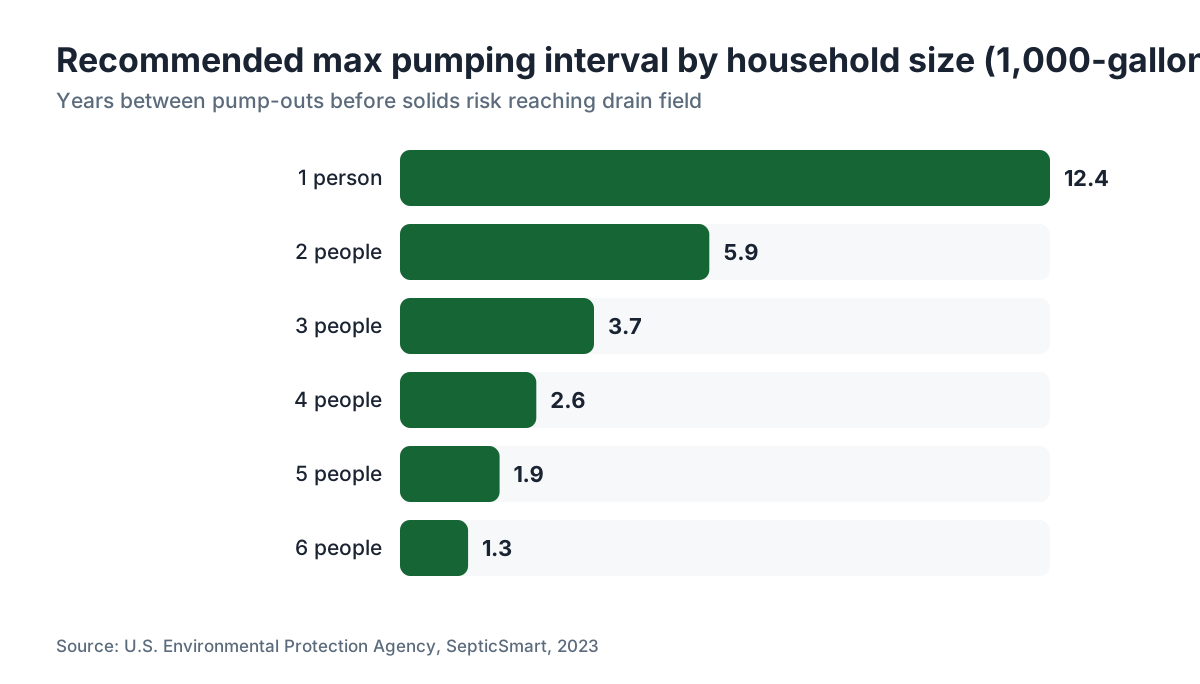
Want a quick table with no arithmetic? The EPA published one that most practitioners keep as a starting point:
| Household size | 500-gal tank | 750-gal tank | 1,000-gal tank | 1,250-gal tank |
|---|---|---|---|---|
| 1 person | 5.8 yrs | 9.1 yrs | 12.4 yrs | 15.6 yrs |
| 2 people | 2.6 yrs | 4.2 yrs | 5.9 yrs | 7.5 yrs |
| 3 people | 1.5 yrs | 2.6 yrs | 3.7 yrs | 4.8 yrs |
| 4 people | 1.0 yr | 1.8 yrs | 2.6 yrs | 3.4 yrs |
| 5 people | 0.7 yr | 1.3 yrs | 1.9 yrs | 2.6 yrs |
| 6 people | 0.4 yr | 0.8 yr | 1.3 yrs | 1.8 yrs |
Source: U.S. Environmental Protection Agency, "Septic Systems: What You Need to Know" [1]
Read those as recommended maximum intervals before pumping is required, not as a suggested schedule. Your system might tolerate a slightly longer gap if water use is low, or it might need pumping sooner under heavy use.
Does the type of septic system change how often the tank needs draining?
Yes, and by a lot. The intervals in the table above apply to conventional gravity-fed systems with a single- or two-compartment tank feeding a passive drain field. Other system types run on their own logic.
Aerobic treatment units (ATUs). These pump air into the tank to feed aerobic bacteria, which break down solids harder than the anaerobic bacteria in a conventional tank. The effluent leaving the tank is cleaner, but ATUs still build sludge. Most manufacturers and state codes call for inspection every six to twelve months and pumping every one to three years. [5]
Mound and pressure-distribution systems. The tank itself follows the same accumulation rules as a conventional tank. The pumping chamber at the outlet end, which holds the effluent pump, also needs periodic inspection and cleaning. People forget the pump chamber all the time. Don't.
Holding tanks. These aren't treatment systems. They hold waste until a truck comes. Depending on household size and use, they may need pumping every four to eight weeks. If you own one, you already know it.
Recirculating and nitrogen-reducing systems. Some send treated effluent back through the tank, which shifts sludge accumulation rates. Follow the manufacturer's maintenance schedule, which is usually written into your state permit.
Not sure what you have? Your county health department or environmental office should have a permit on file. That permit lists the system type, tank volume, and sometimes the required maintenance schedule.
What happens if you wait too long between drainings?
The fallout runs from annoying to expensive to a public health problem, in that order.
The first sign is usually slow drains or gurgling in the house, sometimes with a sewage smell near the tank or drain field. Those are early warnings. The bad one is solids carryover. When the sludge and scum layers get big enough, they push partially treated solids into the drain field. Once those solids plug the soil pores, the field can fail outright.
Drain field replacement runs $3,000 to $15,000 or more depending on soil, system type, and local labor. [6] A routine pumping runs $300 to $600 for a standard tank. Skipping a $400 pumping and then paying $8,000 for a new drain field is the most common money mistake in residential septic ownership. Don't make it.
There's a public health side too. Failing systems can push pathogens and nitrates into groundwater and nearby surface water. The EPA lists poorly maintained septic systems among the leading sources of groundwater contamination in the country. [10] Some states require periodic proof of pumping to protect water quality, especially near sensitive waterways or shellfish beds.
For a closer look at what drain field failure costs and how it gets repaired, see our guide to leach field problems.
How often should your septic tank be pumped if you have a garbage disposal?
More often. That's the honest answer.
A disposal grinds food waste into fine particles and sends them to the tank, adding to the organic load bacteria have to process. The part bacteria can't fully break down settles as sludge. Multiple state extension publications put it plainly: households with garbage disposals should expect to pump roughly 50 percent more often than households without one. [4]
Say the EPA table gives you 3.7 years for a three-person household. Use a disposal regularly and a fair working number is closer to 2.5 years. Some pumpers will tell you to cut the interval in half. That may be aggressive, but it tells you how seriously the trade treats disposal use.
The cheaper fix is to compost food scraps or use a countertop bin. That keeps the organic load out of the tank and hands you back the full interval.
Are there signs that your tank needs draining sooner than scheduled?
Several. You don't have to wait for a failure to know you're overdue.
Slow drains across more than one fixture often mean the tank is backing up. If just one sink or toilet drains slowly, that's more likely a clog in that fixture's line. When several fixtures slow down at once, the tank or the line running to it is the likelier suspect.
Sewage odors inside or outside the house are a warning. A working septic system is nearly odorless. Smells near the tank risers or over the drain field say the system is under stress.
Green, spongy, or unusually lush grass over the drain field can mean effluent is surfacing, or close to it, because the field is saturated. That's not a call to a pumper. That's a call to a septic contractor and maybe a repair specialist. See our overview of septic tank repair for what to expect.
Wet spots or standing water over the tank itself can point to a cracked tank or a failed baffle. A pumper can check the tank's physical condition during a service visit.
One last case. If you bought a house with no pumping records, treat the tank as overdue no matter what the previous owner claims. A septic tank inspection by a qualified pro, ideally with a sludge measurement, is the only reliable way to know where you stand.
Does seasonal use or vacation homes change the pumping schedule?
Part-time use slows solids accumulation, so the interval stretches. But it never drops to zero, and there are wrinkles.
A tank that sits idle for months banks little new solids, but the bacterial colony can go dormant or partially die off during a long quiet stretch, especially in cold climates. When heavy use returns, the bacteria need time to rebuild before the tank treats effluent well. In that gap, partially treated effluent can reach the drain field.
A good move for vacation properties: pump before a long closure or right at the start of the active season, not mid-season. That resets the biology and gives you a clean baseline.
For very light seasonal use, say four to six weeks a year, pumping every five to seven years can be defensible if the tank is sized right. Check your state's rules first. Some states set a minimum pumping frequency no matter the use, partly because the inspection at each service catches physical tank problems before they turn into failures.
If the property sits in a northern climate, confirm the tank and risers are insulated. A frozen inlet baffle can back up a system fast. That's a maintenance issue separate from pumping frequency, but it usually gets caught at the same visit.
What does a septic tank draining service actually involve?
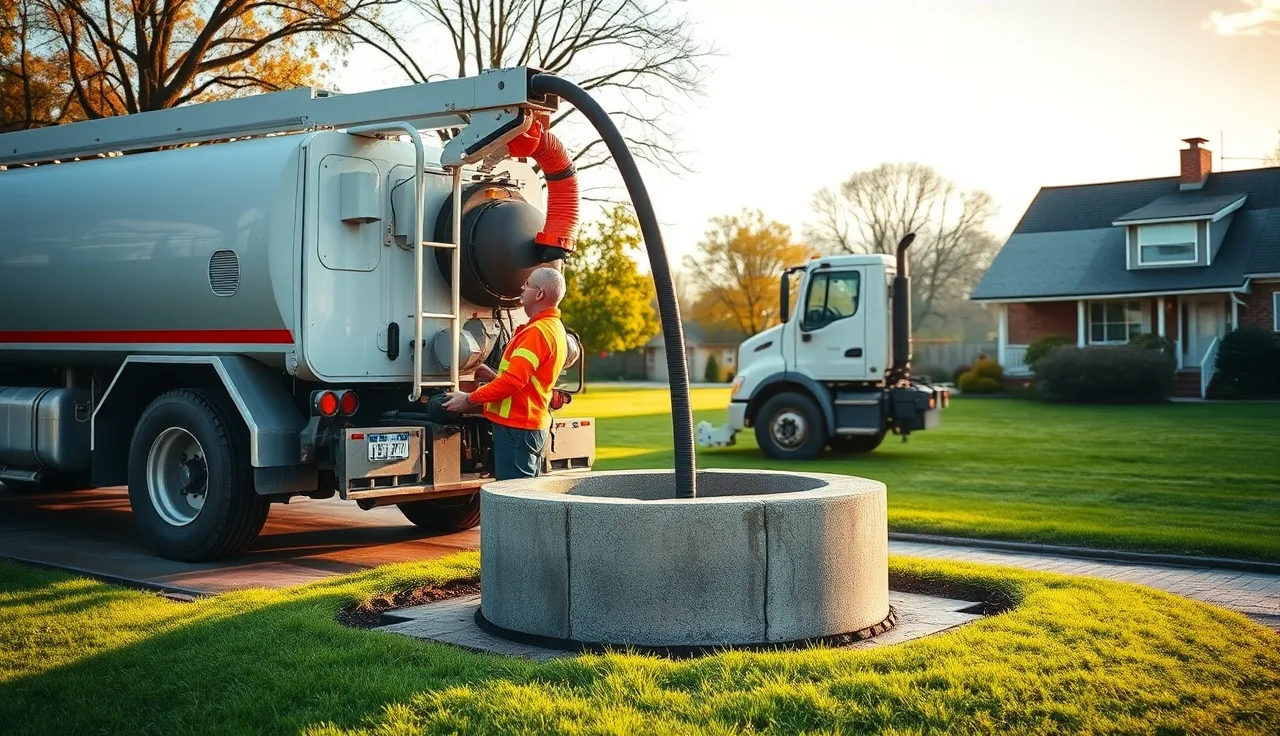
What most people call "pumping" or "draining" is a pump-out. A vacuum truck connects to the tank access port (or riser), drops a hose in, and pulls all the liquid and solid contents out of the tank. A thorough pump-out includes agitation with water or back-flushing to break up the sludge layer so it comes out fully. Some haulers skip the agitation to save time. Ask them not to.
A good visit also includes a look at the inlet and outlet baffles (the internal fittings that keep scum from reaching the drain field), the tank walls for cracks, and the condition of the access covers. If you don't have risers bringing the access ports up to grade, ask about adding them. They make every future service faster and cheaper, and they kill the cost of locating and digging up the tank each time. Our guide to septic tank pump out covers the full process.
After pumping, the hauler takes the waste to a licensed septage receiving facility, usually a municipal wastewater treatment plant. Most state regulations require them to keep disposal records, and some states require those records be shared with the property owner or county.
For the full cost picture, including regional price swings, see our breakdown of septic tank pumping costs and what drives them.
What do state regulations say about pumping frequency?
State rules vary more than most homeowners expect. A few examples show the range.
Many states follow the EPA's guidance and set no specific interval, leaving it to the homeowner to keep the system running and act when it fails. Others are prescriptive. Connecticut requires pumping of residential septic tanks at least once every three years under its Public Health Code. [7] Massachusetts requires inspection and maintenance every three years under Title 5, with pumping triggered by inspection findings. [8]
Some states tie requirements to how close a system sits to sensitive water. In North Carolina, systems near shellfish harvesting waters or classified surface waters may have mandatory inspection and pumping schedules written into the operating permit. [9]
Local health departments sometimes stack requirements on top of state code. If your town has its own environmental health office, its rules can be stricter than the state floor.
So look up your state's onsite wastewater regulations. Your state health department or department of environmental quality holds the code. If you run service schedules across multiple jurisdictions, software that tracks permit-level requirements by property keeps you from missing a mandatory service window. SepticMind is built for exactly that kind of compliance tracking across large service territories.
If you want a feel for what installation codes look like (permit documents often spell out required maintenance too), our guide on septic tank installation walks through what's typically specified.
How much does draining a septic tank cost?
A standard residential pump-out runs $300 to $600 in most U.S. markets as of 2024, with real regional spread. [6] Rural areas with few providers can run higher. Dense metros with competitive markets can run lower. Tank size moves the price, since bigger tanks take more time and disposal capacity.
Extra charges show up for tanks that need digging to reach (add $50 to $150 or more for excavation), tanks that need high-pressure water jetting to break up hardened sludge, pump chamber service on ATUs or pressure-distribution systems, and emergency calls.
Installing risers during a pump-out usually costs $200 to $500 depending on depth and material, and it pays back in lower labor at every future visit. It's one of the few add-ons I'd actually push you to buy.
If a quote comes in way under the range above, ask how the waste gets disposed of. Unlicensed disposal is an environmental violation and can put liability on you if you knowingly hire someone working outside the rules.
For more on what moves the price, see our full article on septic tank emptying costs and how to compare quotes.
How do you keep records and track when you're due for service?
Most homeowners keep no records at all. That bites them at resale, during inspections, and when a problem shows up and nobody knows the system's history.
At a minimum, keep a paper or digital log with the date of each pumping, the service company name, the tank volume pumped, any notes from the pumper on baffle condition or tank integrity, and the estimated next service date. Some pumpers hand you a written report. Ask for one if they don't offer it.
Photos of the access ports and interior baffles at each service build a visual history that earns its keep the moment something changes between visits.
At resale, buyers and their inspectors will ask for pumping records. In states with Title 5-style inspection rules, you may have to show evidence of recent pumping as part of the transfer. [8]
For operators scheduling service across dozens or hundreds of properties, manual tracking falls apart quickly. Platforms like SepticMind send service reminders, store inspection data by property, and generate compliance documents automatically. For a single homeowner, a spreadsheet or a note in a home maintenance app does the job.
Our deeper resource on how often to pump septic tank covers record-keeping and reminder systems in more detail.
Frequently asked questions
How often should a septic tank be drained for a family of 4?
For a family of four on a 1,000-gallon tank, the EPA's interval table points to about 2.6 years. Move up to a 1,250-gallon tank and it stretches to roughly 3.4 years. If the household runs a garbage disposal regularly, plan on the shorter end, closer to every two years to stay safe.
Can a septic tank go 10 years without being pumped?
Possibly, but only under narrow conditions: a large tank, a one- or two-person household, and disciplined water use with no garbage disposal. For a single occupant on a 1,000-gallon tank, the EPA table estimates 12.4 years as a maximum. For any larger household, ten years is almost certainly too long and risks pushing solids into the drain field.
What happens if you never pump your septic tank?
Eventually sludge and scum fill so much of the tank that the treatment zone disappears. Solids escape into the drain field and clog the soil pores. Drain field failure costs $3,000 to $15,000 or more to repair or replace. Before you see visible failure, an overloaded system can also push pathogens and nitrates into groundwater.
How do I know when my septic tank is full and needs draining?
The reliable way is to measure it. A Sludge Judge tube through the access port gives an accurate sludge depth. Warning signs include slow drains across the house, sewage odors near the tank or drain field, gurgling fixtures, or unusually green grass over the drain field. Any of those is a reason to call a pumper now, not later.
Is it OK to pump a septic tank every year?
Yes. Annual pumping doesn't hurt the tank or the bacterial colony, since bacteria repopulate quickly from returning wastewater. For small tanks, heavy water use, or homes with garbage disposals, yearly pumping is a reasonable conservative schedule. The only downside is spending money you don't need to. A sludge measurement at each visit tells you whether the frequency fits.
How often does a 1,000-gallon septic tank need to be pumped?
The EPA's table gives these estimates for a 1,000-gallon tank: one person, 12.4 years; two people, 5.9 years; three people, 3.7 years; four people, 2.6 years; five people, 1.9 years; six people, 1.3 years. Intervals run shorter with a garbage disposal or high water use, and slightly longer with very conservative use.
Does a garbage disposal mean you need to pump more often?
Yes. Disposals add real organic solids to the tank. University of Minnesota Extension and other state programs suggest households with disposals should pump roughly 50 percent more often than the standard interval. If your baseline is three years, plan on closer to two. Composting food scraps instead of grinding them is the best way to win that interval back.
How often does a two-person household need to drain the septic tank?
For two people on a 1,000-gallon tank, the EPA table estimates a maximum of 5.9 years. Drop to a 750-gallon tank and it falls to about 4.2 years. If you watch what goes down the drains and skip a garbage disposal, the longer end of those ranges is realistic. A sludge measurement every three years costs almost nothing and confirms where you stand.
How often do you need to pump a septic tank for a vacation or seasonal home?
Seasonal use stretches the interval because less waste enters the tank. For a property used four to eight weeks a year, pumping every five to seven years is reasonable if the tank is sized right. Many pros recommend pumping at the start of a season or before a long closure rather than mid-season, which resets the biology and lets a thorough inspection happen before heavy use.
Do septic tank additives reduce how often you need to pump?
No credible science backs that claim. The EPA and most state extension programs state plainly that biological and chemical additives haven't been shown to cut sludge accumulation enough to extend intervals. Some additives can actually harm the drain field by dispersing solids into the soil instead of letting them settle. Save the money for a real pump-out.
Does my state require me to pump my septic tank on a set schedule?
Some do. Connecticut requires pumping at least once every three years. Massachusetts requires inspection every three years with pumping based on inspection findings. Many other states set no mandatory interval and rely on homeowner discretion. Check your state health department's onsite wastewater regulations. Local health departments can add requirements beyond the state minimum, especially near sensitive water.
How long does a septic tank pumping service take?
A standard residential pump-out usually takes 30 to 60 minutes when the access ports are visible and the tank is easy to reach. Add time for locating and digging up buried lids, for tanks that need water jetting to loosen hardened sludge, or for large-volume tanks. Installing risers during the same visit adds an hour or so but ends excavation costs at every future service.
What is the difference between draining and cleaning a septic tank?
"Draining" or "pumping" pulls all liquid and solid contents from the tank with a vacuum truck. "Cleaning" usually means that same pump-out plus high-pressure jetting or scrubbing to strip hardened deposits off the tank walls and baffles. Cleaning fits tanks neglected for a long time or showing heavy buildup beyond what suction removes. Most routine maintenance is a pump-out, not a full clean.
Sources
- U.S. Environmental Protection Agency, SepticSmart: Septic Systems What You Need to Know: The average household septic system should be inspected every three years and pumped every three to five years; EPA published household-size and tank-size pumping interval table
- U.S. Environmental Protection Agency, How to Care for Your Septic System: Garbage disposals add organic solids that increase sludge accumulation; high-volume laundry days can hydraulically overload a tank
- U.S. Environmental Protection Agency, Septic System Additives: EPA states there is no scientific evidence that biological or chemical additives reduce sludge accumulation or extend pumping intervals
- University of Minnesota Extension, Septic System Owner's Guide: Households with garbage disposals should pump approximately 50 percent more frequently; formula for calculating pumping intervals based on tank volume and household size
- North Carolina State University Extension, Aerobic Treatment Units for Onsite Wastewater: Aerobic treatment units require inspection every six to twelve months and pumping every one to three years per most state codes and manufacturer guidance
- Angi, Septic Tank Pumping Cost Guide: Standard residential septic pump-out costs between $300 and $600 in most U.S. markets; drain field replacement costs $3,000 to $15,000 or more
- Connecticut Department of Public Health, Public Health Code Regulations for Subsurface Sewage Disposal: Connecticut requires pumping of residential septic tanks at least once every three years under its Public Health Code
- Massachusetts Department of Environmental Protection, Title 5: Standards for the Siting, Construction, Inspection, Upgrade and Expansion of On-site Sewage Treatment and Disposal Systems: Massachusetts Title 5 requires septic system inspection every three years; evidence of recent pumping required at property transfer
- North Carolina Department of Environmental Quality, Onsite Wastewater Section: North Carolina systems near classified surface waters or shellfish harvesting waters may have mandatory inspection and pumping schedules in their operating permits
- U.S. Environmental Protection Agency, Septic Systems and Sources of Contamination: EPA estimates poorly maintained septic systems are one of the leading sources of groundwater contamination in the United States
Last updated 2026-07-09