How to locate your leach field: 6 reliable methods
By the SepticMind Editorial Team

TL;DR
- Pull the as-built drawing from your county health department first.
- No record?
- Probe outward from the septic tank with a steel rod, read the greenest strip of grass in your yard, or hire a licensed inspector with a drain camera and locating transmitter.
- Most homeowners narrow it down in under an hour.
Why does it matter where your leach field is?
You need to know where the field sits before you dig, plant a tree, park a vehicle, or pour a slab. Drive a car over it once and you can crack a distribution pipe or crush a chamber. Plant a willow 20 feet away and the roots find the effluent within a few growing seasons.
The leach field, also called a drain field or absorption field, is the last treatment stage of your septic system. Perforated pipes laid in gravel trenches (or plastic chambers) release clarified wastewater into the soil, which finishes the job biologically. Wreck that zone and you're looking at a repair or replacement that commonly runs $5,000 to $20,000 or more, depending on soil and local labor [1].
The EPA's SepticSmart program tells homeowners to "know where your septic system is located and keep a record of maintenance" [2]. That's not busywork. Unknowing damage is one of the most common paths to a dead field, and it's completely avoidable if you know the footprint.
What should you check first: official property records
Start here, before you touch a probe or call anyone. Most counties that permit septic systems keep an as-built drawing, sometimes called a site plan, plot plan, or sewage disposal permit. It shows the tank, the distribution box, and the field footprint drawn to rough scale.
Where to find them:
- County health department or environmental health office. The most common keeper of septic permits. Search your county website for "onsite wastewater," "environmental health," or "sewage disposal permit." Many counties put these online. Others still want a phone call or an in-person visit.
- County building or planning department. Some jurisdictions split permit records between agencies.
- Your deed or title documents. A few states require the as-built to be recorded with the deed at transfer.
- Previous home inspection report. If you had a septic inspection at purchase, the inspector may have sketched or photographed the layout.
If the home was built after roughly 1975, a permit almost certainly exists somewhere. Older rural homes sometimes predate formal permitting, and you'll find no paper at all.
Got the drawing? Find two fixed points shown on it (a house corner, a property pin, a well) and measure out from them with a tape. The drawing won't be surveyor-accurate, but it puts you within 5 to 10 feet in most cases.
How do you find the leach field by tracing from the septic tank?
If records are missing or vague, find the septic tank first, then trace outward. The outlet side of the tank connects to a distribution box (D-box) or straight to the field lines.
Step 1: Find the tank.
The sewer line exits your house through the basement or crawlspace. Note its direction, then step outside. Tanks sit almost always within 5 to 30 feet of the foundation, in the direction the pipe runs. A metal probe rod (a 3/8-inch steel rod, 4 to 6 feet long, sold at any hardware store) pushed into the soil every foot or two along that line will hit the concrete or fiberglass lid with a solid thud. Probe at 6-inch depths first, then work shallower if you find nothing. Most tanks are buried 12 to 36 inches deep [3].
Step 2: Find the outlet pipe.
Once you've located the tank, find the lid (or both lids on a two-compartment tank). The outlet baffle is on the downhill side. The effluent pipe leaves in that direction.
Step 3: Probe toward the D-box and field lines.
Probe in a straight line from the tank outlet. You'll hit the distribution box within 5 to 20 feet in most residential systems. From the D-box, field lines run parallel to each other in the same direction. Trench spacing is usually 6 to 10 feet on center [4]. Keep probing at that spacing and you can map the whole footprint.
This works well in soft or sandy soil. In clay or rocky ground, probing is slow and you risk hitting shallow pipe. Feel any resistance that might be pipe instead of rock? Stop and move over.
Can you find the leach field by looking at the grass?
Sometimes. The field changes surface vegetation in two ways you can read if you know the pattern.
In dry summer months, the lines deliver moisture and dissolved nutrients to the root zone. Grass directly over the field often stays greener longer than the turf around it. A strip or rectangle of dark, lush grass in late July or August is a solid clue.
After heavy rain, or when a system is stressed, the flip happens. A patch of soggy, spongy ground or a low berm with wet spots can mark a saturated field. Both patterns follow the same shape, a rectangle or parallel strips, which helps tell them apart from random wet ground.
The limits: this method is unreliable in wet climates, on irrigated lawns, or in shaded yards. It narrows the search, then you confirm with probing or a record check. Don't mistake a low wet spot near the road for a field. Road drainage and surface runoff make similar patterns.
What professional tools can locate a leach field accurately?
When records don't exist and probing gives you nothing clear, pros carry tools that are worth the money before you dig blind.
Drain camera with locator transmitter. A camera pushes through a cleanout or the tank outlet, and a sonde transmitter on the camera head sends a signal to a handheld receiver above ground. The tech walks the yard and the receiver beeps louder over the camera head. This traces the exact path of the outlet pipe to the D-box and shows which way the laterals run. Expect $150 to $350 for this on its own, though many inspectors fold it into a full inspection [5].
Ground-penetrating radar (GPR). GPR images buried pipes and chambers through the soil surface, no probing or cameras needed. More common on commercial sites and larger properties, and available from specialty geophysical contractors. Cost runs $500 to $1,500 for a residential locate, so it's overkill for most homeowners.
Soil probe with a camera scope. Some inspectors push a flexible camera into the soil above a suspected lateral to eyeball the pipe. Less common, occasionally useful in hard cases.
A licensed septic inspector can usually locate a system and hand you a rough sketch in one visit. If you're buying and the field location is unknown, a septic tank inspection before closing is money well spent.
SepticMind's inspection workflow tools help licensed operators log field locations with GPS coordinates and attach the sketch to the property record, so the next owner never runs this search again.
What are visual clues around the yard that indicate a leach field?
Grass color aside, several physical features hint at a field's location.
Inspection ports or cleanout caps. Many systems installed after the mid-1990s have 4-inch or 6-inch PVC riser caps flush with or just above grade at the distribution box, and sometimes at the ends of laterals. They look like a white or green plastic cap sitting in the lawn.
A flat rectangular area with no big trees. Fields need open soil. A stretch of yard with no trees, no shrubs, and no garden beds, especially on a slight slope away from the house, is often intentional.
Downslope from the house, away from the well. Most codes require the field to sit at least 50 to 100 feet from any drinking water well and lower than the house so gravity carries effluent away [4]. If your land slopes, the field is almost certainly downhill.
Frost-free ground in winter. Biological activity in a working field puts off a little heat. In cold climates, the trench area can be the last to freeze solid or the first to thaw in early spring. Subtle, but you can see it.
Don't chase the wrong signal. People confuse the septic tank (a single rectangular concrete lid) for the field. The tank is one component, usually a buried box 5 to 8 feet long. The field always sits some distance off, typically 10 feet minimum from the tank [3].
How do you map the leach field once you find it?
Finding it once isn't enough. You want a permanent record so you and future owners never repeat this.
After you've pinned the field down by any mix of the methods above:
- Measure from fixed reference points. Use two house corners (or a well, property pin, or outbuilding) as anchors. Measure the distance and compass bearing to each corner of the field. Write it down.
- Mark it on an aerial photo. Google Maps or the county assessor's GIS viewer pulls up a satellite image of your property. Print or screenshot it, then sketch the field boundary on top.
- Drive stakes at the corners. Wooden stakes or survey flags mark the boundary while a construction or landscaping project is live.
- File the sketch somewhere permanent. Tape it inside the water heater closet or wherever your home records live. Some owners add it to the title file.
No record on file at the county? Consider handing them your sketch. Some counties add it to their database. Others won't, but it's worth a call.
Here are common setback distances, which also help confirm you've found the right zone.
| Feature | Typical minimum setback from leach field |
|---|---|
| Foundation / structure | 10 ft |
| Property line | 5 to 10 ft |
| Drinking water well | 50 to 100 ft (varies by state) |
| Surface water / stream | 50 to 100 ft |
| Swimming pool | 15 to 25 ft |
| Large trees | 10 to 30 ft (depends on species) |
Setbacks come from state and local codes, not one federal standard. Check your state's onsite wastewater regulations for the exact numbers on your property [4].
What should you never do over or near a leach field?
Once you know where it is, the job shifts to protecting it. A surprising share of field failures trace straight back to things that seemed harmless at the time.
Drive or park on it. Passenger cars can crack perforated pipes or compress the gravel drainage layer. Trucks, RVs, and construction equipment can collapse old clay tile laterals outright. This is probably the single most common cause of mechanical field damage.
Plant trees or large shrubs. Roots chase water and nutrients. Willows, poplars, silver maples, and other fast growers infiltrate pipes from 30 feet away. Even "safe" ornamentals cause trouble planted right over the field. Turf grass is the standard cover because its roots stay shallow and it needs no irrigation [2].
Build a structure over it. Sheds, decks, patios, additions, and driveways violate most local septic codes and also kill access for repair. Many states require permits that include a septic setback check before any accessory structure goes up.
Add a pool or pond nearby. Soaking the soil around the field with pool leaks or irrigation cuts its ability to absorb effluent. Even routine lawn watering over the field causes problems in wet seasons.
Cover it with impermeable surfaces. Concrete and asphalt cut off the oxygen the soil bacteria need to treat effluent. Plastic sheeting and thick mulch do the same.
The EPA's SepticSmart guidance says it flat out: homeowners should "never plant anything but grass over or near your drain field" and "never park or drive on your drain field" [2].
How is a leach field different in alternative septic system designs?
The probe-from-the-tank method works well for conventional gravity-fed systems, the most common design. Alternative systems are trickier to locate because they look different underground.
Mound systems. The field sits above native soil, built on a sand mound. You can't miss it once you know the look: a raised rectangular berm, typically 2 to 4 feet tall, somewhere on the property. It's usually grassed over with an inspection port at the top [6].
Chamber systems. Instead of gravel-filled trenches, these use plastic arched chambers over bare soil. From the surface they look like conventional systems. Probing hits plastic rather than gravel or pipe, which feels different, softer, and the rod may slide along the curved surface.
Pressure-dosed systems. A pump pushes effluent to the field in timed doses instead of by gravity. Distribution is more even, but the footprint is close to conventional. Expect a pump chamber (another buried tank) between the septic tank and the field.
Aerobic treatment units (ATUs). More common in some Southern states. The "field" equivalent may be a spray irrigation zone instead of buried trenches. Spray heads in the yard are the giveaway.
Not sure what you have? The permit record usually names the design. A licensed installer or inspector can confirm it on-site.
How much does it cost to have someone professionally locate a leach field?
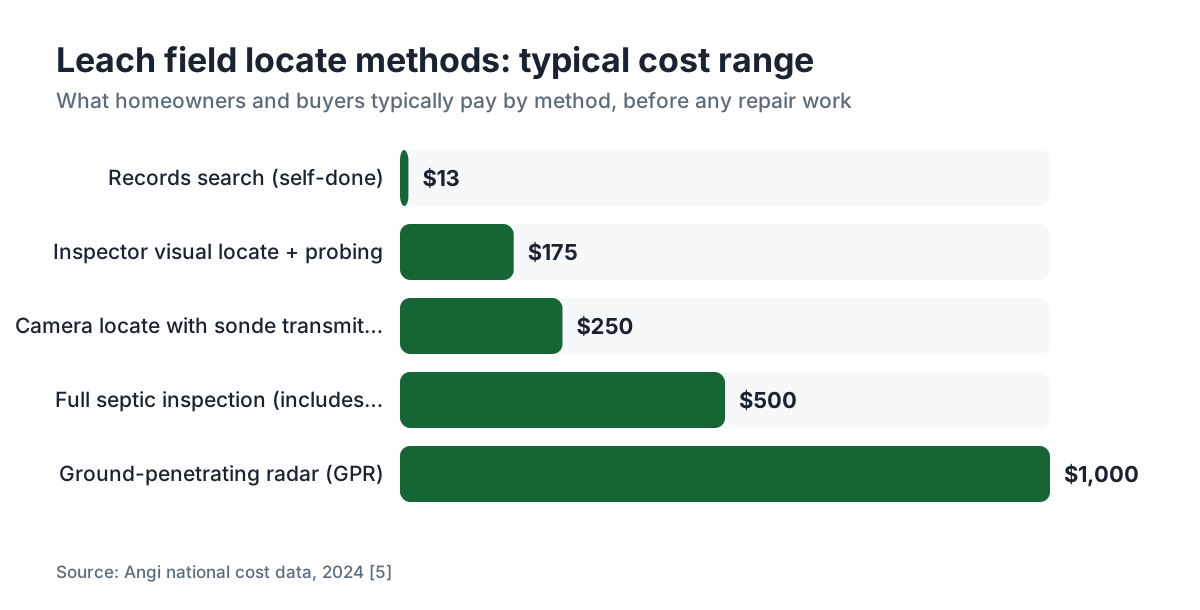
Cost tracks the method and the region. Here's a realistic breakdown of what inspectors and plumbers charge:
| Method | Typical cost range |
|---|---|
| Records search (self-done) | $0 to $25 (county fee) |
| Septic inspector visual locate + probing | $100 to $250 |
| Camera locate with sonde transmitter | $150 to $350 |
| Full septic inspection (includes locate) | $300 to $700 |
| Ground-penetrating radar (GPR) | $500 to $1,500 |
For a house sale, the full inspection is almost always the right call, because you get a written report on top of a location mark in the grass. If you just need the field mapped before a landscaping project, probing by a local septic pumper or inspector is the cheapest useful option.
DIY with a probe rod costs under $20 in materials if you already have a record to start from. If the record puts you in the right neighborhood and you're comfortable probing, this is a reasonable job to do yourself. The risk is pipe damage from pushing too hard in the wrong spot. A 3/8-inch steel rod pushed straight down, slow and deliberate, almost never harms a properly buried lateral.
For scale on what a full system costs if things go wrong: the cost to install a septic system typically runs $10,000 to $30,000 for a new build, which makes a $200 professional locate look cheap.
What if the leach field can't be found by any of these methods?
This happens more than you'd think on properties with old or informal systems, especially rural homes built before the 1960s. A few options remain.
First, pull a detailed aerial photo from the year the property was freshly developed. The USGS Earth Explorer archive and many county GIS viewers hold historical imagery [7]. You can sometimes see the disturbed soil pattern of original trenching decades later, best in dry summer shots.
Second, ask neighbors or the previous owner if you can reach them. Longtime neighbors sometimes remember where a system went in because they watched it happen.
Third, hire a geophysical survey contractor with GPR. Highest cost, but it locates buried infrastructure with zero surface disturbance.
If none of that lands, a licensed plumber or septic contractor can trace the outlet pipe from inside the house using a sonde transmitter threaded through the sewer cleanout. That needs no existing information about the system, and it will at minimum give you the tank outlet direction.
Once you find the field, keep up with septic tank pumping every 3 to 5 years. A well-maintained tank is the best protection for field longevity, because solids overflow is the most common cause of field failure [8].
Frequently asked questions
Can I find my leach field location online?
Often yes. Many county health or environmental health departments now post septic permit records in an online GIS or document portal. Search your county name plus "septic permit records" or "onsite wastewater." Some states run statewide databases. If the county hasn't digitized older records, you may need to call or visit in person. Urban counties tend to have better online access than rural ones.
How deep are leach field pipes buried?
Conventional field laterals sit 6 to 24 inches deep, with about 6 inches of gravel below the pipe and another 6 to 12 inches of cover soil above. Exact depth depends on local code, frost line, and site conditions. In cold climates, pipes may go deeper to prevent freezing. Mound system laterals can be shallower because the mound itself supplies the treatment depth.
What does a leach field look like from above?
From ground level it looks like a normal stretch of lawn, usually rectangular and flat or on a gentle slope. From aerial photos in a dry summer, you may spot a greener rectangular zone against the surrounding turf. Some systems show small white or green PVC inspection caps at grade. Mound systems are obvious: a raised grassy berm, typically 2 to 4 feet high.
How far is the leach field from the septic tank?
There's no single required distance. In most systems the distribution box sits 5 to 20 feet from the tank outlet, and the field lines start from there. Total distance from tank to the far end of the field is commonly 30 to 100 feet depending on system size. Local codes set minimum separation; most require at least 5 to 10 feet between the tank and the start of the field.
Is it safe to probe for a leach field myself?
Generally yes, if you're careful. Use a 3/8-inch steel rod, push straight down at a slow pace, and stop if you feel resistance that could be pipe rather than rock. The odds of cracking a properly installed lateral with a hand probe are low. Never hammer or drive the rod with force. If you find the tank lid, have the tank pumped by a pro before entering or leaning over it. Septic gases can be lethal in enclosed spaces.
How do I know if my leach field is failing?
Common signs: slow drains throughout the house, gurgling in the plumbing, sewage odors outdoors near the field, wet or soggy ground over the field that won't dry, and unusually lush grass right over the lines. Any of these warrants a call to a licensed septic inspector. A failing field caught early may be repairable. One that's been saturated for months often needs full replacement.
Can I build a garden over my leach field?
No. Growing vegetables over a field is a health risk, because edible plants can take up pathogens from effluent, and some state codes flatly prohibit it. Even ornamental gardens cause trouble because irrigation adds water the field doesn't need and deep roots damage laterals. Grass is the standard, correct cover. If you need the space, put a raised-bed garden completely outside the field boundary.
What's the difference between a leach field and a drain field?
Nothing. The terms are interchangeable and name the same component: the network of perforated pipes or chambers buried in soil that receives clarified effluent from the tank and disperses it for final treatment. "Absorption field" is another synonym. Regional preference varies. "Leach field" is more common in the Northeast and Midwest, "drain field" in the South and West.
Does the county have a map of my septic system?
Maybe. Counties that have required septic permits since the 1970s or earlier usually have an as-built drawing on file. Pre-1970 systems and homes in areas with historically lenient permitting may have no record at all. Your county health or environmental health department is the first call. Some states have pushed counties to digitize these records. Many have not.
How long does a leach field last?
A well-maintained field in suitable soil can last 25 to 50 years or more. The common killers: solids overflow from an overfull or neglected tank (which clogs the soil pores), compaction from vehicles or structures, root intrusion, and hydraulic overload from heavy water use. Pumping the tank every 3 to 5 years is the main way to extend field life. Soil matters too. Sandy loam drains well and lasts longer; clay is slower to absorb and more prone to failure.
What happens if I accidentally damage my leach field?
Stop whatever caused the damage right away. If a pipe is cracked but the field isn't fully saturated, a plumber or septic contractor may excavate and repair the single damaged section, which costs far less than full replacement. If repeated vehicle traffic compacted the field, the gravel drainage layer may be permanently compromised and need replacement. Call a licensed septic contractor for an assessment before guessing.
Does a home inspection include finding the leach field?
Standard home inspections usually don't include a full septic inspection. A general home inspector may note a field location if it's obvious, but they typically don't probe, camera-scope, or pull permit records. A separate septic inspection by a licensed septic inspector or engineer is what you need for a reliable locate and assessment. Many buyers negotiate a septic inspection contingency when buying a home on septic.
Sources
- EPA, SepticSmart program, septic system overview: Leach field repair or replacement commonly costs thousands to tens of thousands of dollars depending on soil and system type
- EPA SepticSmart, homeowner guidance: EPA instructs homeowners to know system location, keep maintenance records, never plant anything but grass over the drain field, and never park or drive on it
- University of Minnesota Extension, Onsite Sewage Treatment Program: Septic tanks are typically buried 12 to 36 inches deep and located 5 to 30 feet from the foundation
- Minnesota Pollution Control Agency, Subsurface Sewage Treatment Systems program: State codes require minimum setback distances from wells, property lines, and surface water; trench spacing typically 6 to 10 feet on center
- Angi national cost data, septic inspection cost range: Camera locate with sonde transmitter typically costs $150 to $350; full septic inspection $300 to $700
- NC State Extension, onsite wastewater and mound systems guidance: Mound system leach fields are elevated 2 to 4 feet above native soil and visually distinct from conventional buried systems
- USGS EarthExplorer historical aerial imagery archive: Historical aerial photos can reveal disturbed soil patterns from original leach field trenching even decades after installation
- EPA, How Your Septic System Works: Solids overflow from a neglected tank is the most common cause of drain field failure
- Penn State Extension, water and septic systems resources: Regular septic tank pumping every 3 to 5 years is the primary maintenance action to protect leach field longevity
- Virginia Department of Health, Environmental Health programs: State environmental health departments maintain as-built drawings for permitted septic systems and some have digitized records
Last updated 2026-07-09