How to locate a septic system on any property
By the SepticMind Editorial Team

TL;DR
- Start with your county health department's as-built permit records, which show the tank on a site diagram.
- Then follow the sewer line out from the house, probe the soil with a thin steel rod, and read the ground for clues like greener grass or a low mound.
- Most tanks sit 10 to 25 feet from the foundation.
Why does finding your septic system actually matter?
Most homeowners have no clue where their septic system is until a pumper shows up, spends an hour hunting for the lid, and bills by the minute. Or until a contractor drives a fence post straight through the tank. Both are avoidable.
Location matters for real reasons: safe digging, on-time maintenance, honest disclosure when you sell, and catching drain field trouble before it becomes a $10,000 repair. The EPA's SepticSmart program treats locating your system as the first step in owning one, because you cannot maintain what you cannot find. [1]
Just moved in? Doing a pre-purchase inspection? This guide runs through every practical method, cheapest first, most technical last.
What records tell you where a septic system is located?
Records are the right first stop every time. They cost a phone call or a short drive, and they work more often than people expect.
Your county health department (sometimes called environmental health, the sanitarian district, or the onsite wastewater program) keeps as-built drawings for every permitted septic system. These are sketches drawn at installation showing the tank, the distribution box, and the drain field, usually with measurements taken from fixed points like house corners or property lines. Plenty of counties have digitized them. Search your county name plus "septic permit records" or "onsite wastewater as-built." [2]
If the county turns up nothing, work down this list:
- State health department: Some states run a statewide septic database. Minnesota logs every permitted system in the Minnesota Pollution Control Agency's SSTS records. [3]
- Seller disclosure documents: Real estate deals often include a septic disclosure form. Dig through your closing paperwork.
- Home inspection reports: A septic inspection done at purchase usually has a hand-drawn location map.
- Aerial photographs: Google Earth's historical imagery sometimes shows the excavation scar from the original dig, especially on properties under 30 years old.
- Local pumping companies: Pumpers keep tank location notes. If the prior owner used a local outfit, they may hand over the spot.
One caveat. If the house went up before roughly 1980, record-keeping was thin in a lot of counties. Don't be shocked when nothing turns up. That's when you go physical.
How do you trace the sewer line from the house to the tank?
Every septic tank sits downstream from the house on the same sewer line that carries waste out. That line is your guide wire.
Find where the main sewer leaves the foundation. In most homes it's in the basement or crawl space, a 4-inch pipe (older houses sometimes run 3-inch clay or cast iron) heading toward an exterior wall. [4] Mark that wall on the outside.
Now walk straight out from that mark. The sewer line drops at a minimum slope of 1/8 inch per foot, usually 1/4 inch per foot, under most state onsite wastewater codes. [5] The tank sits at the end of that run, typically 10 to 30 feet from the foundation. Many state codes set a 5-foot minimum setback from the foundation, though 10 feet is more common in practice.
A few things complicate the walk.
The line doesn't always run dead straight off the foundation. Older jobs jog around obstacles. And in a house with bathrooms on opposite ends, two stub-outs can merge into one line underground before they reach the tank.
Use a long, flexible metal probe (a soil probe or tile probe) to feel for the pipe. Push it into the soil at a slight angle along your estimated line until you hit something solid 12 to 24 inches down. Clay holds a pipe's impression for decades, so you're hunting for a firm, hollow-sounding obstruction.
How do you use a probe rod to find the septic tank?
A soil probe costs $15 to $40 at a farm supply store or online, and it's the most reliable DIY tool once you've traced the general line. It's a 5/8-inch steel rod, 4 to 6 feet long, with a T-handle.
Start probing along your estimated sewer line, 2 feet out, then 5 feet, then 10, in a grid. When the probe hits the tank lid or wall, you feel a firm, flat resistance that doesn't behave like a rock (rocks shift, tank walls don't). Concrete sounds slightly hollow when you tap the probe. Plastic flexes a hair.
Found an edge? Map the perimeter. Probe in a rectangle to find all four sides. Most precast concrete tanks run 5 feet by 8 feet, or 8 feet by 10 feet, though sizes vary by age and design. [6] Old steel tanks are sometimes only 4 feet wide.
Don't punch through a plastic or fiberglass tank. In soft ground a probe can pierce a deteriorated fiberglass wall without much effort. If the soil directly over a suspected tank feels very soft and wet, stop and call a professional. That's a warning sign of a damaged tank or a high water table, and it earns a septic tank inspection before anybody digs.
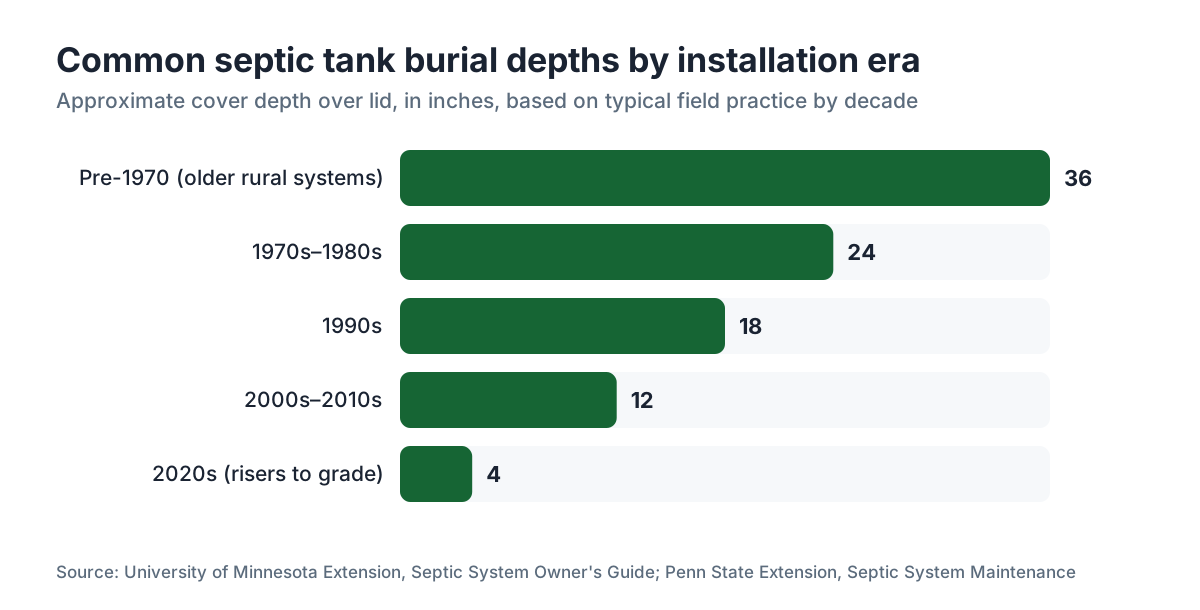
Flag or stake the corners once you've mapped the edges. Most lids sit within 6 inches of the surface, though some older tanks carry 18 to 24 inches of cover if the yard was graded after installation.
What visual clues on the ground reveal the septic system?
Sometimes the landscape hands you the answer.
Look for these surface signs:
| Ground clue | What it suggests | Reliability |
|---|---|---|
| Lush green stripe of grass, greener than surroundings | Drain field or tank area, extra nutrients from effluent | High |
| Slight rectangular depression or mound | Tank settling or drain field trenches | Medium-High |
| Spongy, wet, or soft ground | Drain field saturated, possible failure | High (and urgent) |
| Circular or rectangular depressions | Old tank access points, especially steel tanks that rust and collapse | High |
| Snow-free strip when the yard is otherwise covered | Warm effluent in the drain field below | High (winter only) |
| Cleared strip with no large trees, small shrubs only | Intentional clearing over the field, or roots the old system killed | Medium |
A dry August is the best window for the greener-grass effect, because everything around it is stressed and dull. The winter snow-melt pattern is nearly as good.
Watch one thing. A neighbor's system running across your line is more common than people think in rural areas, especially on subdivided farms. If the visual clues don't line up with where your sewer exits, you may be staring at someone else's system. County records settle the boundary.
The leach field itself is often the biggest visible clue. A conventional gravity system runs perforated pipes in gravel-filled trenches, usually 3 feet wide and 18 to 36 inches deep, laid in parallel lines. You can often read the lines as faint ridges or dips spaced 6 to 10 feet apart.
Can a metal detector or electronic locating device find a septic tank?
Yes, with caveats.
Metal detectors work on steel tanks and on the rebar inside precast concrete. A ground-penetrating metal detector set to a modest depth (12 to 24 inches) picks up reinforced concrete lids reliably. Pure plastic tanks are invisible to a detector unless they have a metal access riser.
Electronic pipe locators (a sonde, or a drain line transmitter) are the most precise tool going. A plumber or septic contractor feeds a transmitter head into the sewer clean-out and pushes it down the line. A surface receiver reads the pipe path and depth in real time. That's how professionals find systems in the ugly cases, and it's worth the $150 to $300 service call when records don't exist and probing has struck out. [7]
Ground-penetrating radar (GPR) maps voids and density changes underground. It can pin the tank, the distribution box, and even the trench lines in the field. GPR is accurate but runs $300 to $800 for a site visit, so it's mostly for high-stakes work: pre-purchase inspections on expensive property, or legal disputes.
For operators who coordinate these calls, SepticMind builds job records and site maps into every customer file, so a return visit doesn't mean re-locating the system from scratch. That saves real hours across repeat service.
For most homeowners, a probe rod plus county records finds the tank. The electronic tools are for when the basics fail.
How do you find the drain field once you've found the tank?
The drain field starts at the outlet end of the tank, not the inlet. Getting that direction right saves you an hour of wasted probing.
The inlet pipe connects at the end closer to the house. The outlet connects at the far end and leads to a distribution box (D-box) or straight to the drain field laterals. Older systems skip the D-box entirely; the outlet pipe splits underground through a simple tee.
From the outlet side, probe in the direction away from the house. Hunt for the D-box first. It feels like a smaller concrete box, usually 12 to 18 inches square, sitting 5 to 20 feet past the tank outlet. [8] Each outlet port on the D-box feeds one lateral. Standard systems run 2 to 5 laterals in parallel, each 50 to 100 feet long.
Want to trace the laterals? Probing works, but it's slow. The visual clues (grass pattern, trench lines) map the field faster. In sandy soil the laterals often show as slightly raised mounds.
Here's the practical rule that matters most: keep all digging, driving, and heavy equipment off the drain field. Compacting the soil above it or crushing the pipes forces a repair or full replacement, and that bill is steep. [9] Our leach field guide covers what's safe on top and what isn't.
What if the tank is very deep or buried under a patio or deck?
Deep burial and covered tanks are the hard cases. Here's the honest picture.
Tanks buried more than 3 feet down are common when the property was regraded after installation. County records sometimes note depth, often not. When they're deep, a sonde locator or GPR is the right call, not a probe rod.
Tanks under patios, decks, or additions are legal in some states and banned in others. Many codes require the tank to stay accessible for pumping. The International Private Sewage Disposal Code (IPSDC), which many states reference, calls for tank access within 6 inches of grade. [10] If someone built over the tank, the prior owner may have run extension risers (PVC access tubes up to grade). Find them by pressing on patio stones and listening for hollow spots, or by spotting a suspiciously clean concrete cap flush with the surface.
If the system has no accessible cleanout and you still can't find the tank, hire a licensed septic inspector. They bring the locating gear, and the find gets documented for your file. A documented location pays off when you sell, and nearly every state now requires the seller to disclose septic location and condition.
How do you mark the location and keep a permanent record?
Once you've found everything, don't let the information evaporate.
Draw a simple sketch on graph paper or use a free tool like Google My Maps. Measure from two fixed house corners to the tank lids (both of them, since most tanks have inlet and outlet access). Measure from a house corner to the D-box. Sketch the lateral direction and rough length.
Photograph the sketch and store it with your home files. Hand a copy to your pumper. If you keep property records in an app, drop it there.
Install extension risers if you don't have them. Plastic or fiberglass risers bring the lids to within 1 to 2 inches of grade, cut the excavation charge out of every pumping, and make future locating a non-event. Risers run $50 to $150 in materials. Many pumpers set them during a septic tank pump out for $100 to $300 labor. Money well spent.
SepticMind's operator platform stores site maps and service history, so every technician who visits inherits the location data from the first pump-out on. For a company running repeat calls, that's a genuine time saver.
For how often to pump septic tank guidance, the EPA's standard recommendation is every 3 to 5 years for a typical household, but the real interval turns on household size and tank volume. Once you know where the tank is, pumping is easy.
Step-by-step: the full locating sequence from scratch
Here's the practical order when you're starting from zero.
Step 1: Pull county records. Call or visit the county health or environmental services office. Ask for the as-built or permit record for your address. Ten minutes to a few days.
Step 2: Check disclosure and inspection documents. Your closing packet or home inspection report may already carry a location map.
Step 3: Find the sewer exit point. Go to the basement or crawl space, find the main waste pipe where it leaves the foundation, and mark that spot on the exterior.
Step 4: Walk the sewer line direction. From the exit, walk downhill the way the pipe runs. Mark the line with string or stakes.
Step 5: Probe for the tank. Grid-search the soil 10 to 30 feet out along your marked line, working at 2-foot intervals until you hit a flat, firm surface.
Step 6: Map the tank perimeter. Once you touch the tank wall, probe all four sides. Flag the corners.
Step 7: Find the outlet and D-box. From the outlet end (farther from the house), probe in a straight line toward the field until you find the distribution box.
Step 8: Map the drain field. Use visual clues and careful probing to read the lateral direction and rough field extent.
Step 9: Measure and record. Take measurements from fixed house corners to the tank lids and D-box. Sketch and photograph.
Step 10: Install risers if absent. Book a septic tank pumping visit and have the pumper add risers if your lids are buried.
Most homeowners run the whole sequence in 1 to 3 hours on a typical lot. Hire out if you hit a wall at any step.
When should you hire a professional to locate the system?
There's no shame in calling someone. Some situations truly need professional gear.
Hire a licensed septic inspector or service company when:
- County records don't exist and two hours of probing found nothing.
- The yard has been heavily regraded, or an addition or patio sits over the suspected area.
- You're running a pre-purchase inspection and need a documented record.
- You suspect a failing system (wet spots, odors) and don't want to disturb the site before an inspector looks.
- The property runs more than 2 acres with an older or complex layout.
A locate-only visit typically costs $100 to $300, depending on whether they haul out electronic equipment. That's nothing next to a septic system repair caused by digging in the wrong spot.
For buyers, a full septic tank inspection including pumping and location documentation runs $300 to $700 in most markets. It's standard due diligence on any home with septic. [11]
Frequently asked questions
How do I find my septic system if I have no records?
Find where the main sewer pipe leaves your foundation, walk downhill from that point, and probe the soil with a metal rod at 2-foot intervals. Read the ground for greener grass, slight mounds, or rectangular depressions. Most tanks sit 10 to 25 feet from the foundation. If a couple of hours of probing fails, call a septic company with a sonde locator.
How deep is a septic tank buried?
Most tanks carry 6 inches to 2 feet of cover over the lids. Tanks installed before modern grading rules run deeper sometimes, up to 4 feet, especially if the yard was landscaped after installation. County as-built records occasionally note depth. A soil probe hits the lid at whatever depth it's buried, so you don't need the number ahead of time.
Can I find my septic system with Google Maps or satellite imagery?
Historical satellite imagery in Google Earth sometimes shows the disturbed soil from the original dig, mostly on systems installed in the last 30 years. Worth a look, but don't bank on it. Older systems rarely leave a clear mark. Treat imagery as a starting clue, not a definitive answer.
Will a metal detector find a concrete septic tank?
Yes. A standard metal detector picks up the rebar inside most precast concrete tanks and finds steel tanks directly. It won't detect plastic or fiberglass tanks unless they have a metal access riser. Set the detector to an 18 to 24 inch scan depth and sweep slowly along your estimated sewer line.
Where do septic tanks usually go relative to the house?
The tank sits in the direction the main sewer pipe exits the foundation, downhill from the house, typically 10 to 25 feet from the foundation wall. Most state codes require at least a 5-foot setback from the foundation and 50 feet from any well. The tank always falls between the house and the drain field.
How do I find the drain field if I already found the tank?
The field starts at the outlet end of the tank, the end farther from the house. From the outlet, look for a distribution box 5 to 20 feet out, then trace parallel trench lines running away from it. Green grass stripes, low mounds, or depressions spaced 6 to 10 feet apart mark the individual laterals.
What do I do if the septic tank is under a deck or patio?
First check whether extension risers bring access up through the deck surface. Look for flush concrete caps or PVC lids. If the tank is truly buried under a structure, most state codes require it to be accessible for pumping, so you may need to create an access point. A licensed inspector can document the setup and lay out your state's rules.
Is it safe to probe for a septic tank with a metal rod?
Yes for concrete tanks. Go easy with plastic or fiberglass tanks, especially old ones, because a firm push can pierce a deteriorated wall. If the soil over the suspected tank feels very soft or wet, stop probing and call a professional. That wet zone can mean a damaged tank rather than a high water table.
How do I get official septic system records?
Contact your county health department, environmental health department, or sanitarian district and ask for the as-built or permit record for your address. Many counties run searchable online databases. Some states keep statewide ones. Records vary by age: systems installed after the early 1990s usually have clear diagrams, while older ones may have nothing on file.
Does the county always have records of my septic system?
No. Systems installed before permit requirements were common, particularly before the 1970s in many rural counties, may have no record at all. Plenty of older systems were self-installed with no inspection or permit. If the county comes up empty, try the state health database, seller disclosure documents from prior sales, or local pumpers who serviced the property.
What's the best time of year to find a septic system by looking at the ground?
Late summer, around August, is ideal for the greener-grass effect, because drought stress dulls surrounding grass while nutrient-rich effluent keeps the ground over the tank and field green. Winter works too: a snow-free stripe across an otherwise snowy yard marks the drain field clearly, because warm effluent melts snow from below.
How much does it cost to have a professional locate a septic system?
A locate-only service call runs $100 to $300 in most markets, depending on whether electronic equipment is needed. A full pre-purchase inspection with pump-out and location documentation typically costs $300 to $700. Ground-penetrating radar surveys cost more, $300 to $800, and get used mainly in high-stakes or complex cases.
What should I do once I find the tank and drain field?
Measure from two fixed house corners to each tank lid and to the distribution box, draw a simple sketch, and photograph it. Store the map with your home files and give your pumper a copy. If the lids are buried, install extension risers so every future pump-out is fast and cheap. Mark the drain field and keep vehicles and heavy equipment off it for good.
Can I locate a septic system myself, or do I always need a professional?
Most homeowners find the tank themselves with county records, the sewer exit point, and a soil probe in one to three hours on a typical suburban lot. You need a professional when records don't exist and probing has failed, when the tank may sit under a structure, or when you need a documented inspection for a real estate deal.
Sources
- U.S. EPA, SepticSmart homeowner guidance: EPA SepticSmart lists locating your system as a foundational step in septic maintenance and ownership
- U.S. EPA, Septic System Records and As-Built Drawings guidance: County health departments maintain as-built permit drawings showing tank and drain field placement
- Minnesota Pollution Control Agency, Subsurface Sewage Treatment Systems (SSTS): Minnesota MPCA operates a statewide database of permitted septic systems
- Penn State Extension, Septic System Operation and Maintenance: The main house sewer exit is usually a 4-inch pipe (older homes 3-inch clay or cast iron) running toward an exterior wall
- U.S. EPA, Design Manuals for Onsite Wastewater Treatment and Disposal Systems: Sewer lines run to the tank on a minimum slope of 1/8 inch per foot, typically 1/4 inch per foot
- University of Minnesota Extension, Septic System Owner's Guide: Precast concrete septic tanks commonly measure 5 by 8 feet or 8 by 10 feet, with sizes varying by age and design
- University of Minnesota Extension, Septic System Owner's Guide: Electronic pipe locators fed through the sewer clean-out trace the line path and depth from the surface
- University of Rhode Island, Cooperative Extension: Distribution boxes are typically 12 to 18 inches square and are located 5 to 20 feet beyond the septic tank outlet
- U.S. EPA, How to Care for Your Septic System: Driving or parking over the drain field compacts soil and can damage pipes, potentially requiring costly repairs
- International Association of Plumbing and Mechanical Officials, International Private Sewage Disposal Code (IPSDC): The IPSDC requires septic tank access to be within 6 inches of finished grade, referenced by many state onsite wastewater codes
- National Association of Realtors: Pre-purchase septic inspections including pump-out and location documentation typically cost $300 to $700
- U.S. EPA, Septic System Costs and Maintenance Overview: EPA recommends pumping a septic tank every 3 to 5 years for a typical household as a standard maintenance interval
Last updated 2026-07-09