How big is a leach field? Size rules, soil tests, and what drives the math
By the SepticMind Editorial Team
TL;DR
- A leach field for a typical 3-bedroom home is roughly 1,000 to 2,500 square feet.
- The actual number depends on household size, daily wastewater flow (usually 100 to 150 gallons per bedroom per day), and how fast your soil absorbs water (the percolation rate).
- Soil matters more than bedroom count.
- A properly sized, maintained leach field lasts 20 to 30 years, sometimes longer.
What is a leach field and what does it actually do?
A leach field (also called a drain field or absorption field) is the ground-level treatment zone of a conventional septic system. Wastewater flows from your house to the septic tank, gets partially treated there, then the liquid effluent travels out through perforated pipes buried in gravel-filled trenches. The soil does the real work. Bacteria in the top few feet of earth eat pathogens and nutrients before the water reaches groundwater.
The field has to handle every gallon your household sends down the drain, every single day, without surfacing or backing up. Size it wrong and the consequences are immediate and messy. Too small, and effluent ponds on the surface or backs up into the house. Too large, and you paid for land and installation you never needed.
How big a leach field needs to be starts with what the soil can absorb. The field doesn't store wastewater. It disperses it continuously. Soil that's too tight (clay-heavy) or too fast (coarse gravel) fails at opposite extremes, and neither works well without engineering fixes.
What is the standard formula for leach field size?
Every U.S. state writes its own onsite wastewater code, but nearly all of them build off the same two-variable formula:
Required absorption area (sq ft) = Daily wastewater flow (gallons) ÷ Soil absorption rate (gallons per sq ft per day)
Here's what each piece means.
Daily wastewater flow is usually estimated from bedroom count, not actual water use. Most state codes, following EPA guidance, assume 100 to 150 gallons per bedroom per day [1]. A 3-bedroom home generates an estimated 300 to 450 gallons per day. Some states use fixture count or measured flow instead, but bedroom-based estimates are the common starting point.
Soil absorption rate comes from a percolation test ("perc test") or, increasingly, a soil morphology evaluation done by a licensed soil scientist. Perc rates are reported in minutes per inch (mpi): how many minutes it takes water in a test hole to drop one inch. A rate of 30 mpi is moderately good. Faster isn't always better. A rate quicker than 1 mpi (very coarse sand or gravel) can mean the soil doesn't treat effluent before it hits groundwater [2].
The EPA's design guidance converts perc rate to an application rate. For a perc rate of 30 mpi, that's about 0.30 gallons per square foot per day [1]. Run the math:
450 gallons/day ÷ 0.30 gal/sq ft/day = 1,500 sq ft required
At 60 mpi (slower, clay-heavy soil), the application rate drops to roughly 0.20 gal/sq ft/day, so the same house needs 2,250 sq ft. At 10 mpi (sandy), you might only need 750 sq ft, though your designer will also check for enough treatment depth above groundwater.
Most states add a safety factor of 20 to 50 percent on top of the calculated minimum. That's why permit documents often show a field larger than the raw formula suggests.
How big is a leach field for a 3-bedroom or 4-bedroom house?
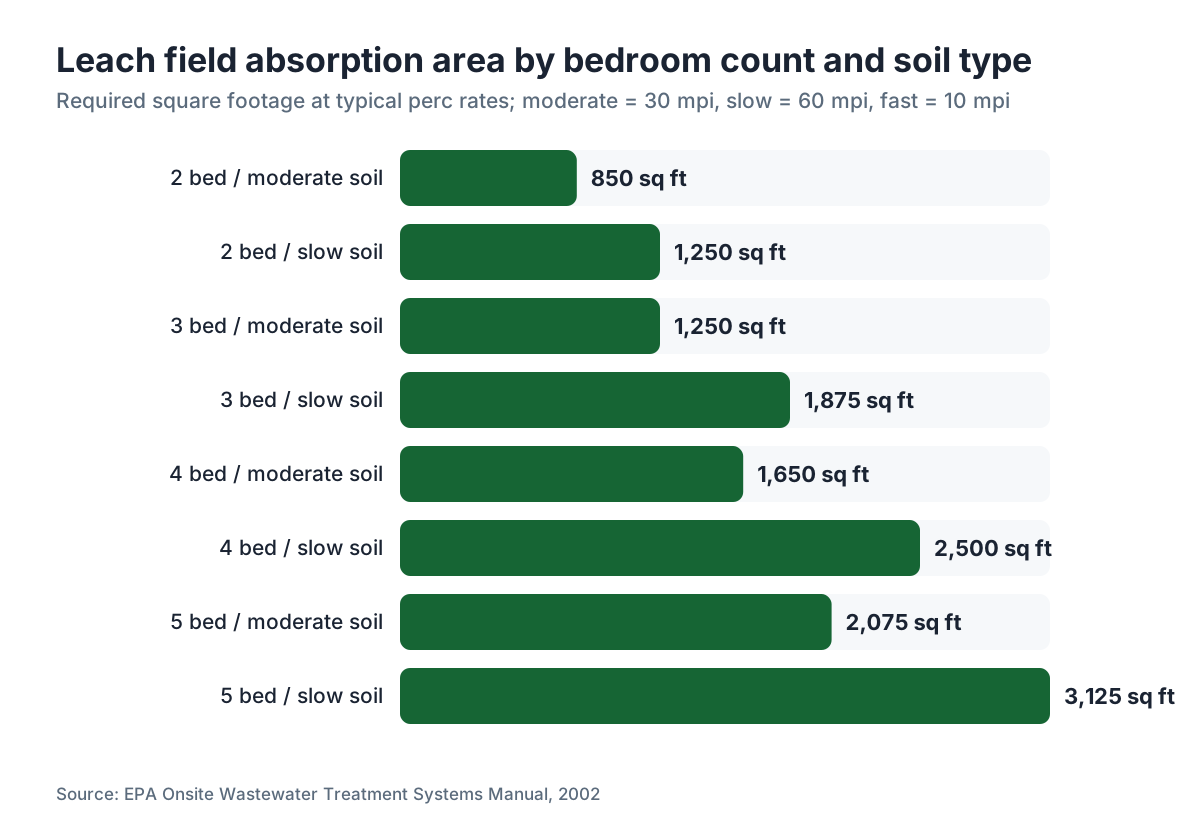
For most single-family homes, a 3-bedroom design lands between 1,000 and 2,500 square feet of absorption trench, and a 4-bedroom design runs 1,300 to 3,000 square feet [1][3]. Soil type moves you within that range. Here's a practical size table based on typical state design standards and moderate soil (roughly 30 mpi perc rate). These are representative ranges, not guarantees. Your state code and actual soil test override them.
| Bedrooms | Est. daily flow (gal) | Moderate soil (sq ft) | Slow soil (sq ft) | Fast soil (sq ft) |
|---|---|---|---|---|
| 2 | 200 to 300 | 700 to 1,000 | 1,000 to 1,500 | 400 to 700 |
| 3 | 300 to 450 | 1,000 to 1,500 | 1,500 to 2,250 | 500 to 1,000 |
| 4 | 400 to 600 | 1,300 to 2,000 | 2,000 to 3,000 | 650 to 1,300 |
| 5 | 500 to 750 | 1,650 to 2,500 | 2,500 to 3,750 | 800 to 1,650 |
Those square feet translate to physical trench runs. A 1,500 sq ft field might be three 100-foot trenches, each 4 feet wide, spaced 6 feet apart center-to-center. The total lot footprint those trenches occupy is larger than the absorption area itself, because of required setbacks, access paths, and reserve area.
Almost every state requires you to set aside a "reserve" or "replacement" area equal to 50 to 100 percent of the primary field, untouched and unpaved, in case the primary fails [3]. That doubles your effective land requirement. If you're buying rural land planning to install septic, budget at least a half-acre of suitable ground for the drain field system alone, once you count primary, reserve, and setbacks from wells, property lines, and structures.
How does a percolation test determine leach field size?
The perc test is a field measurement, not a lab calculation. A licensed installer, engineer, or soil evaluator digs or bores test holes to the proposed trench depth (usually 12 to 36 inches), pre-soaks them with water (some states require 4 hours, but overnight soaking gives more accurate results in clay), then watches how fast water drops over a set period. The slowest reliable reading sets the design rate [2].
Perc testing has real limits. Results shift by season. Test in summer drought and your soil looks faster than it runs in a wet spring. That's why many states now prefer or require soil morphology evaluations by a certified soil scientist, who reads the soil profile for mottling (gray and rust spots that mark seasonal water saturation), texture, and structure. Mottling shows where the seasonal high water table sits, which decides how much unsaturated soil is available for treatment [9].
The EPA's Onsite Wastewater Treatment Systems Manual recommends that no system be installed where less than 2 feet of unsaturated soil exists between the trench bottom and the seasonal high water table [2]. Some states are stricter. Florida requires 24 inches in most counties, and parts of coastal areas require engineered mound or drip systems instead of conventional trenches [3].
A "failed" perc test (usually slower than 60 mpi or faster than 1 mpi) doesn't always kill septic on a lot. It means a conventional gravity trench won't work. You'd need an alternative: a mound system, drip irrigation, or an aerobic treatment unit. Those cost more and usually require a yearly service contract, but they let people build on marginal soils.
What site factors make a leach field bigger or smaller?
Soil type is the biggest single variable, but several others push the design number up or down.
Slope. Most codes limit gravity-fed trench systems to lots under 20 to 30 percent slope. Steeper grades need pressure-dosed systems (a pump doses effluent to the field in timed pulses), which spread flow evenly across a larger area. Some states count only the level portion of a lot toward usable leach field area.
Setbacks. You can't put trenches everywhere. Typical minimum setbacks: 50 to 100 feet from a drinking water well, 5 to 10 feet from property lines, 10 to 25 feet from the house foundation, and 50 to 100 feet from surface water [3]. On a small or oddly shaped lot, setbacks can make the required area impossible to fit even when the soil is perfect.
Depth to bedrock or hardpan. Shallow bedrock limits trench depth and forces a wider horizontal footprint or an alternative design.
Water use habits. Heavy-use households (large families, irrigation, water softeners that discharge to septic) generate more flow than the bedroom estimate assumes. A softener backwashing 150 gallons every two days adds real load. The EPA's SepticSmart program recommends spreading laundry across several days rather than running every load on one day, to avoid hydraulic overload [4].
Local variance. Some towns add design flow multipliers for properties in sensitive watersheds near lakes, streams, or the coast. Massachusetts Title 5 adds a 1.5 multiplier to bedroom-based flow estimates in certain nitrogen-sensitive areas [5].
If you're planning a new install and want to see how these variables stack up under your state's code, the septic tank installation guide covers the full permitting and design sequence.
How long does a septic leach field last?
A well-designed, properly maintained leach field lasts 20 to 30 years, and many run 40 years or more [6]. The honest answer is that longevity comes down almost entirely to how the field gets treated.
The main killer is biomat: a dense layer of organic material and bacteria that forms at the soil-gravel interface over time. Biomat is normal and actually helps treatment, but it thickens faster when untreated solids from an under-pumped tank reach the field. Solids clog the soil pores and the field loses absorption capacity, usually slowly rather than all at once.
The other common cause of early failure is hydraulic overload. Send twice the design flow into a field, whether from heavy water use, a dripping fixture, or a softener discharging to the system, and the soil can't absorb the excess. The field stays saturated, anaerobic conditions set in, and biomat accelerates.
Regular septic tank pumping is the single most effective thing a homeowner can do to extend field life. The EPA recommends pumping every 3 to 5 years for most households [4]. A tank that's never pumped will pass solids to the field within 3 to 7 years of reaching capacity. Once solids hit the trenches, recovery is hard and replacement is expensive.
Catch early stress fast. Slow drains, soft or wet spots over the trenches, and odor are the first signals. The leach field repair guide covers what's actually fixable and what isn't. Resting a field (routing flow to an alternate section) for 3 to 6 months sometimes lets the biomat oxidize. More often, a field that failed from solids contamination needs replacement.
So how long should a leach field last? Pump the tank on schedule, keep heavy vehicles and deep-rooted plants off the field, and don't overload it, and 25 to 35 years is a reasonable target. Some fields installed in the 1970s still run. Others fail in under 10 years from neglect. The design is just the starting condition. Maintenance decides the real lifespan.
What are the physical dimensions of a typical leach field?
Most designers work with trenches 12 to 36 inches wide and 18 to 36 inches deep, with perforated pipe centered in 6 to 12 inches of gravel [3]. Trench length depends on the required absorption area. A 1,500 sq ft field built with 2-foot-wide trenches needs 750 linear feet of trench, typically split into runs of 100 feet or less. Longer runs distribute unevenly.
Trench spacing (center-to-center) is usually a minimum of 6 feet, but often 8 to 10 feet to allow equipment access and give the soil between trenches time to aerate. On a 1,500 sq ft design with four 150-foot trenches spaced 8 feet apart, the actual land footprint runs roughly 150 feet long by 35 feet wide, about 5,250 square feet, even though only 1,500 of those square feet do active absorption.
Chamber systems (plastic arch-shaped chambers instead of gravel-and-pipe) show up more and more because they cut excavation depth and can shrink the footprint 20 to 40 percent for the same absorption area, depending on the manufacturer's approved soil loading rates [7]. Your designer may spec chambers when lot space is tight and the product's loading rate is tested and approved in your state.
Whatever the design, the total installed footprint, including reserve area, setbacks, and access corridors, is almost always larger than the numbers on the permit suggest. When you buy property, don't assume the leach field is only as big as the primary absorption area.
How does leach field size affect septic installation cost?
Leach field size is the dominant cost driver in a new septic installation. Excavation, gravel, pipe, and labor all scale with square footage. As a rough benchmark, the leach field portion of a new conventional system runs $5 to $20 per square foot installed, depending on region, soil, and site access [8]. A 1,500 sq ft field might cost $7,500 to $30,000 for the field alone, before the tank, distribution box, risers, and permits.
Alternative systems cost more. Mound systems typically run $10,000 to $20,000 above a conventional field of equal capacity, because of the imported fill, dosing pump, and controls [8].
The cost to install a septic system varies widely by state, site, and system type, but field size and soil together explain most of the spread between a $10,000 rural job and a $40,000 suburban one.
If you're getting a septic tank inspection on a property you're buying, ask specifically whether the existing leach field has a permitted reserve area. A system with no reserve on a fully developed lot has nowhere to go when the primary field fails. That's a material defect worth pricing into your offer.
Can you expand a leach field if your system is undersized?
Yes, but it's not simple and not cheap. Expanding a conventional field usually means installing new trenches in the reserve area, which requires a permit, a new soil evaluation, and updated design. If the reserve area was never preserved (common in older developments), you're stuck finding replacement space within setback limits, which sometimes isn't possible.
When a field is undersized because household size grew (you added bedrooms or an ADU), a designer calculates the extra absorption area needed and specs new trenches. Total cost for expansion typically runs $3,000 to $15,000, depending on how much new trench is needed and how accessible the site is.
For systems that are failing rather than just undersized, the repair math is different. Biomat-clogged trenches sometimes respond to aeration products or fracturing (injecting air under pressure to break up the clogging layer), but results are inconsistent. The most reliable fix for a failed field is a new one.
If you suspect your system is undersized or struggling, a septic tank inspection is the first step. An inspector can measure scum and sludge layers, check distribution box flow, and tell you whether the tank is the problem or the field is.
What are the rules about what you can put on top of a leach field?
The surface above a leach field carries real restrictions, and breaking them is one of the most common ways homeowners shorten field life.
No structures. No sheds, decks, patios, or additions over the field. The soil needs to breathe and needs access for maintenance.
No pavement. Concrete or asphalt over the field blocks oxygen from reaching the soil, which speeds anaerobic conditions and biomat growth. It also makes inspection and repair nearly impossible.
No vehicles. A truck driving over the field once can compact the soil and crack the distribution pipe. Repeated traffic wrecks trench integrity within a few seasons. Landscapers parking heavy mowers on the field are a common cause of preventable failure.
No deep-rooted plants. Tree and large shrub roots follow water and will enter perforated pipes. The EPA's SepticSmart program recommends keeping trees at least 30 feet from any part of the system [4]. Grass is fine and actually helps. Grass roots improve surface drainage and take up nitrogen.
You can walk on it, mow it, and plant shallow-rooted groundcovers. That's the list.
Tracking system details, pump schedules, and field condition notes in one place matters as a field ages. Septic service operators managing multiple properties use platforms like SepticMind to keep that maintenance history organized and flag systems approaching the service interval where field stress usually shows up.
How do state codes and EPA guidelines shape leach field size requirements?
The EPA doesn't directly regulate individual septic systems. That authority sits with states, which delegate to counties in many cases [1]. The EPA's 2002 Onsite Wastewater Treatment Systems Manual is the most widely cited federal technical reference and forms the backbone of most state standards, but states can and do go further [2].
A few examples of how state rules diverge:
Massachusetts Title 5 (310 CMR 15.000) requires soil evaluations by a licensed soil evaluator and uses a design flow of 110 gallons per bedroom per day as a minimum, with higher rates for larger bedrooms [5].
Florida's Chapter 64E-6, Florida Administrative Code, requires a minimum of 24 inches of unsaturated soil in most standard systems [3].
California regulates systems at the county level, with some counties (Marin, Santa Cruz) setting much stricter nitrogen management rules than the baseline state standard.
The EPA's SepticSmart program sums up the general principle: "Properly designed, constructed, and maintained onsite systems need little maintenance to treat household waste effectively." [4] The phrase "properly designed" is doing real work there. A field that meets local code at installation will handle a household's normal wastewater load without trouble, as long as the tank gets pumped and the field isn't overloaded.
If you're in the design or permitting stage, your state's environmental or health department website has the actual code. The EPA maintains a state-by-state resource list at epa.gov/septic that links to state programs [1].
How do you know if your leach field is failing or too small?
The signs are usually obvious once you know what to watch for, and they escalate in a predictable order.
First sign: slow drains throughout the house, especially when several fixtures run at once. This can also mean a full or clogged tank, so pump and inspect the tank first before you blame the field.
Second sign: wet, spongy ground over the leach field area, even in dry weather. Effluent is surfacing because the soil can't absorb it fast enough.
Third sign: bright green grass stripes right over the trench lines. The grass is fertilizing itself on nutrients in effluent that's rising close to the surface.
Fourth sign: sewage odor outdoors, near the field or the tank. That's hydrogen sulfide from anaerobic conditions.
Fifth and final sign: sewage backup inside the house. By this point the system has struggled for a while.
Catch it at stage one or two and you still have options. Get a septic tank inspection and a camera inspection of the distribution box and outlet line to see if flow even reaches the field. Sometimes the problem is a blocked outlet baffle or a shifted distribution box, not the field itself. That's a much cheaper fix than a new field.
For any system showing stress, how often you pump matters a lot. The how often to pump a septic tank guide gives the real answer on intervals, which vary by household size and tank volume.
Frequently asked questions
How big is a leach field for a 3-bedroom house?
For a 3-bedroom home generating roughly 300 to 450 gallons of wastewater per day, a leach field in moderate soil (about 30 minutes per inch perc rate) typically needs 1,000 to 1,500 square feet of absorption area. Slow, clay-heavy soil can push that to 2,000 to 2,500 square feet. Your actual permit number reflects your site's specific soil test and your state's design code.
How big of a yard do you need for a leach field?
Plan for at least 5,000 to 10,000 square feet of suitable ground for the full system: primary field, required reserve area (usually 50 to 100 percent of primary), setbacks from the well, house, and property lines, and access corridors. On a typical suburban lot, the field and its reserve eat most of the backyard. Sites under half an acre often need an engineered alternative system to fit.
How long does a septic leach field last?
A properly sized, maintained leach field typically lasts 20 to 30 years, and many exceed 40 years. The biggest threat is solids from an un-pumped tank reaching the trenches and clogging the soil. Pumping every 3 to 5 years and avoiding hydraulic overload are the two most effective ways to hit or beat the design lifespan.
How long should a leach field last?
Realistically, expect 25 to 35 years from a leach field that was properly designed, installed, and maintained. Fields that fail in under 10 years almost always have a contributing factor: undersizing for actual household flow, no tank pumping, vehicle traffic over the trenches, or a design that ignored the seasonal high water table. Meeting the design lifespan is about maintenance, not luck.
What is the minimum lot size required for a septic leach field?
There's no single federal minimum. It varies by state and county. Many rural county codes set a minimum lot size of 1 to 2 acres for a conventional septic system, but that's a local zoning rule, not a physical requirement. What matters physically is whether enough suitable soil area fits within the setback limits. Some half-acre lots work fine. Some 5-acre lots fail the soil test completely.
How many linear feet of trench does a leach field need?
It depends on trench width and the total required absorption area. A 1,500 sq ft field with 2-foot-wide trenches needs 750 linear feet of trench, typically split into runs of 100 feet or less for even distribution. With 3-foot-wide trenches, you'd need 500 linear feet for the same absorption area. Most designers cap individual trench runs at 100 feet to avoid uneven dosing end to end.
Can you build over or park on a leach field?
No on both counts. Structures, pavement, and vehicles compact the soil, block oxygen exchange, and can crush distribution pipes. Even a truck parking on the field once can crack a perforated pipe or collapse a trench wall. The surface should stay natural grass or very shallow-rooted groundcover, accessible for inspection and maintenance. Keep deep-rooted trees at least 30 feet from the system.
What happens if a leach field is too small for the house?
An undersized field hydraulically overloads: more effluent enters the soil than it can absorb. The trench bottoms stay saturated, anaerobic conditions develop, biomat builds faster than normal, and eventually effluent surfaces or backs up into the house. Early symptoms are slow drains and wet spots over the field. The fix is either expanding into the reserve area (if one exists and passes soil evaluation) or installing an alternative system.
Does a leach field need to be replaced if it fails?
Not always. Early-stage failures from biomat can sometimes be reversed by resting the field (routing flow to a reserve section) for several months, or through aeration and pressure fracturing treatments. Results are inconsistent, though. Fields contaminated with solids from a long-neglected tank usually need replacement. Catching the problem during the slow-drain phase, before surfacing effluent appears, gives you the most options.
How does a perc test affect leach field size?
Directly and significantly. A slow perc rate (more minutes per inch) means the soil absorbs less water per square foot per day, so you need more square footage for the same daily flow. A site that percs at 60 mpi needs roughly twice the absorption area of a site at 15 mpi for the same household. Sites that fail the perc test entirely (below 1 mpi or above 60 mpi in most codes) require alternative designs.
How do I find out the size of my existing leach field?
Start with the as-built drawing or installation permit on file with your county health or environmental department. Most jurisdictions require permitted drawings for any system installed since the 1970s, and many have digitized records. If your system predates permit records, a septic inspector can probe the field with a metal rod to map the trenches, or your installer may have a camera scope. The permit drawing is the most reliable source.
Are chamber leach fields smaller than gravel trench systems?
Often yes. Plastic chamber systems (like Infiltrator or similar products) can provide 20 to 40 percent more effective absorption surface per linear foot of trench than gravel-and-pipe systems, because effluent contacts more soil area. That can cut total trench footage for the same absorption requirement. State approval of the specific chamber product and its credited application rate decides whether you can take the reduction.
How far does a leach field need to be from a well?
Most state codes require 50 to 100 feet between a leach field and a drinking water well. The exact distance depends on your state and the well type. Drilled wells in tight rock sometimes have shorter setbacks than bored or dug wells in sand. Some states use 100 feet as the default minimum, with more distance in sandy soils or sensitive groundwater zones. Check your state's onsite code for the specific number.
Do alternative systems like mounds or drip fields need the same amount of space?
Mound systems actually need more surface area than conventional trenches, because the imported fill spreads across the landscape and needs its own setbacks. A mound for a 3-bedroom home might cover 2,500 to 4,000 square feet of ground. Drip irrigation systems can sometimes fit smaller lots because the drip lines distribute effluent over a wider shallow area, but they require a pump, controls, and annual maintenance contracts, which add ongoing cost.
Sources
- EPA, Septic Systems Overview and SepticSmart resources: Bedroom-based design flow of 100-150 gallons per bedroom per day and state-by-state septic program resources
- EPA, Onsite Wastewater Treatment Systems Manual (EPA/625/R-00/008): Percolation rate design tables, 2-foot minimum unsaturated soil depth requirement, and soil absorption rate guidance
- Florida Department of Health, Chapter 64E-6 Florida Administrative Code (onsite sewage treatment): 24-inch unsaturated soil requirement, reserve area requirement, and setback standards as a representative state code example
- EPA, SepticSmart Homeowner Care and Maintenance guidance: Pump every 3-5 years recommendation, spread laundry loads across the week, keep trees 30 feet from system, and the 'properly designed, constructed, and maintained' statement
- Massachusetts DEP, Title 5 Regulations (310 CMR 15.000): Massachusetts Title 5 requires 110 gal/bedroom/day design flow minimum and licensed soil evaluator for site evaluation
- Penn State Extension, septic system maintenance resources: Well-maintained leach fields expected to last 20-30 years or more; neglect and solids migration are primary causes of premature failure
- Infiltrator Water Technologies, Chamber Product Approvals and Loading Rates: Chamber systems can reduce required absorption area 20-40 percent versus conventional gravel-and-pipe based on manufacturer's credited soil loading rates
- HomeAdvisor / Angi, Septic System Installation Cost Guide: Leach field installation costs roughly $5 to $20 per square foot; mound systems add $10,000 to $20,000 above conventional system cost
- National Environmental Services Center (NESC) at West Virginia University, percolation testing guidance: Perc rate measurement methodology, pre-soaking requirements, and limitations of perc test versus soil morphology evaluation
- University of Minnesota Extension, onsite septic system resources: Reserve area requirement of 50-100 percent of primary field, trench spacing minimums, and surface use restrictions for leach fields
Last updated 2026-07-09