How big is a septic system? Tank and drain field sizing explained
By the SepticMind Editorial Team
TL;DR
- Most single-family homes use a 1,000 to 1,500 gallon septic tank paired with a drain field of 300 to over 900 square feet.
- The tank is sized by bedroom count.
- The drain field is sized by how fast your soil drains.
- A 3-bedroom home needs at least a 1,000 gallon tank under most state codes.
- Soil type drives the drain field more than anything else.
What actually determines septic system size?
Septic system size comes from two separate calculations that get combined at the end: tank size and drain field size. They don't scale together neatly. Plenty of homeowners assume a bigger tank means a bigger field. It doesn't work that way.
Tank size is driven mainly by the number of bedrooms, because bedrooms stand in for the number of people who might live there. Most state codes assume roughly 50 to 75 gallons of wastewater per person per day [1]. A bedroom count is easier to verify than counting occupants, so regulators standardized around it decades ago and never looked back.
Drain field size is driven by something completely different: how fast your soil soaks up water. That's measured by a percolation test (a perc test), where a licensed soil evaluator times how fast water drops in a test hole. Slow soil means you need more square footage to disperse the same daily flow. Fast sandy soil needs far less area than dense clay.
There's a third factor people forget: local code. Every state, and often every county, sets its own minimum tank size and drain field rules. What passes in rural Georgia won't necessarily get permitted on the Massachusetts coast. Verify with your local health department or onsite wastewater office before you plan a thing.
How big does a septic tank need to be for my house?
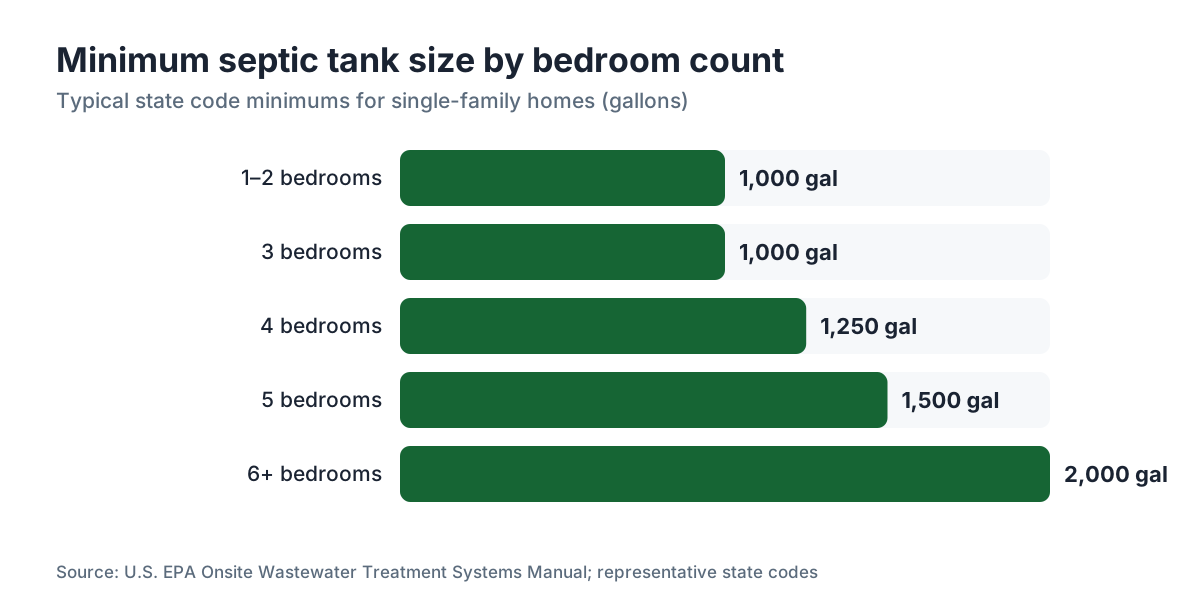
The standard, written into most state codes and reflected in EPA guidance, is a 1,000 gallon minimum tank for homes up to 3 bedrooms [1][2]. Above that, tank size steps up by bedroom count.
Here are the sizing thresholds you'll see across most state codes:
| Bedrooms | Typical minimum tank size |
|---|---|
| 1 to 2 | 750 to 1,000 gallons |
| 3 | 1,000 gallons |
| 4 | 1,200 to 1,500 gallons |
| 5 | 1,500 to 1,750 gallons |
| 6+ | 2,000+ gallons |
These are floors, not targets. Installers often push one size up, especially with a garbage disposal, water softener discharge, or a family bigger than the bedroom count suggests. A 1,250 gallon tank costs only a little more than a 1,000 gallon tank at install, and the extra capacity buys longer stretches between septic tank pumping visits.
The EPA's SepticSmart program puts average household wastewater at about 70 gallons per person per day [1]. Run that for four people and you get 280 gallons daily, which means a 1,000 gallon tank holds roughly 3.5 days of flow before theoretical overflow. The real limit isn't daily flow though. It's sludge piling up over years.
One thing worth knowing: tank size drives pumping frequency more than most homeowners expect. See how often to pump septic tank for the full breakdown.
How big does a drain field need to be?
The drain field (also called a leach field or absorption field) handles the liquid effluent that leaves the tank after solids settle. It's usually a series of perforated pipes in gravel-filled trenches, where liquid seeps slowly into the soil below.
Drain field size comes from two numbers: your daily wastewater flow (gallons per day) and your soil's percolation rate (minutes per inch, or mpi). The formula most state codes use:
Required absorption area (sq ft) = Daily flow (gallons/day) divided by the soil application rate (gallons per sq ft per day)
Soil application rates swing hard. The EPA's Design Manual for Onsite Wastewater Treatment and Disposal Systems lists rates from about 0.4 gallons/sq ft/day in slow clay to 1.2 gallons/sq ft/day in faster sandy loam [3]. Two houses with the same bedroom count can need drain fields that differ by a factor of three, purely because of dirt.
For a typical 3-bedroom home at 300 gallons per day:
- Sandy loam (rate 1.0 gpd/sq ft): 300 sq ft of drain field
- Moderate clay-loam (rate 0.5 gpd/sq ft): 600 sq ft of drain field
- Slow clay (rate 0.4 gpd/sq ft): 750+ sq ft of drain field
Most residential drain fields in moderate soil land between 300 and 900 square feet of absorption area. Large lots with slow soil run much higher. A properly designed leach field is usually the biggest physical footprint on the whole system.
Setback rules add even more land. Fields typically need to sit 50 to 100 feet from wells, 10 to 25 feet from property lines, and clear of any structure or pavement. Factor that in before you assume a small lot can take a new system.
What does a complete septic system look like physically?
A conventional gravity-fed septic system has four parts: the house sewer line, the septic tank, the distribution box or manifold, and the drain field trenches.
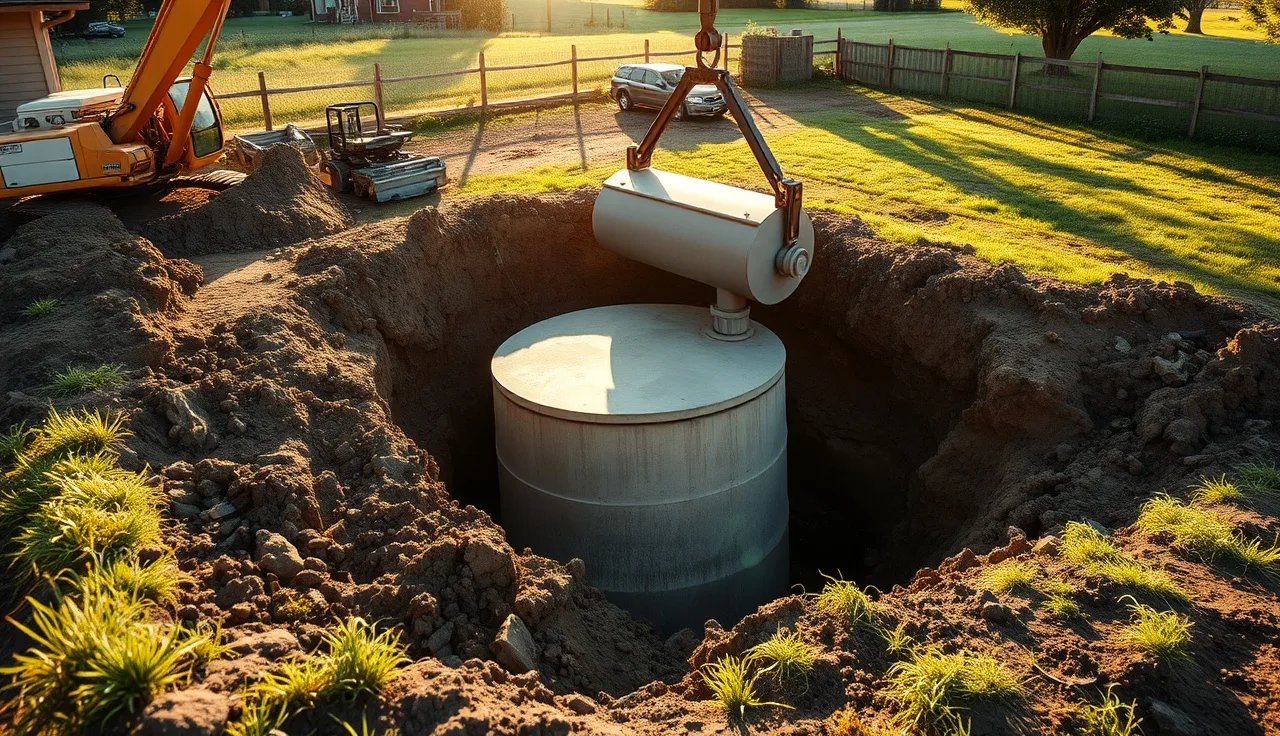
The tank sits buried 1 to 3 feet down, usually 10 to 25 feet from the house foundation. A concrete 1,000 gallon tank runs roughly 8 feet long by 5 feet wide by 5 feet deep. A 1,500 gallon concrete tank stretches closer to 10 feet long. Plastic and fiberglass tanks are lighter and a touch more compact for the same liquid volume.
Drain field trenches are typically 2 to 3 feet wide and 2 to 4 feet deep, run in parallel lines spaced 6 feet apart center-to-center. If you need 600 sq ft of absorption area in 2-foot-wide trenches, that's 300 linear feet of trench, maybe split into 4 or 5 runs of 60 to 75 feet each. The ground footprint of that field can easily cover 2,000 to 3,000 square feet of yard.
Mound systems (for sites with high water tables or poor soil) add a raised bed of imported fill on top of the existing grade. The footprint is both wider in area and taller, sometimes 2 to 4 feet above natural grade. Chamber systems and drip irrigation systems have their own dimensions.
The tank is compact and easy to place. The drain field is the part that eats up serious land.
How do I calculate the right septic system size for a new home?
Start with your bedroom count to estimate daily wastewater flow. Most state codes publish a table that maps bedrooms straight to design flow in gallons per day. As a working number, use 150 gallons per day per bedroom for a conservative design [2][4].
Step 1: Figure out design flow. A 4-bedroom house at 150 gpd per bedroom = 600 gpd.
Step 2: Size the tank. Most codes want the tank to hold at least 24 hours of peak flow plus room for accumulated sludge, which pushes most 4-bedroom homes to a 1,200 to 1,500 gallon tank.
Step 3: Get a perc test and soil evaluation. A licensed soil scientist or engineer does this. Without real perc data, any drain field size is a guess. Don't skip it, and don't borrow a neighbor's results. Soils change across a single street.
Step 4: Calculate drain field area using your local code's soil application rate table. Your engineer or installer runs this formally, but knowing the inputs helps you catch errors before they cost you.
Step 5: Check setback rules for your jurisdiction. These can knock large parts of your lot out of play.
Planning a new install? Septic tank installation covers what to expect from permitting and construction, and cost to install septic system breaks down what you'll pay by system type and region.
Does household water use actually change what size you need?
Yes, a lot. This is where the bedroom-count shortcut falls apart in real life.
A 3-bedroom house with two retired adults uses far less water than the same house with two adults and three teenagers. Some state codes let you use actual occupancy instead of bedroom count if you can prove it, but that's uncommon and rarely worth the paperwork for the small tank savings.
Add-ons matter more. Garbage disposals add roughly 10% to daily organic load and speed up sludge buildup. Hot tubs that drain to the septic can dump hundreds of gallons at once and carry chlorinated water that kills the bacteria doing the treatment. Water softener backwash, if it goes to the septic, raises both flow and salt load. High-efficiency fixtures (low-flow toilets, front-load washers) genuinely cut flow and can stretch pump-out intervals at the same tank size.
EPA SepticSmart guidance points out that spreading laundry across the week instead of running every load on Saturday is one of the best habits a homeowner can adopt, because septic systems are built for steady daily flow, not big intermittent surges [1].
If your household runs above-average water use, size up one bracket at install. The gap between a 1,000 and 1,250 gallon tank is usually a few hundred dollars during construction. That's nothing against the cost of a septic tank repair or full replacement.
Are there minimum size rules set by federal or state law?
There's no single federal minimum septic size law. The EPA publishes guidance and design manuals but leaves permitting to the states, which usually push it down to counties or local health districts [3].
Each state runs its own onsite wastewater code. North Carolina's rules (15A NCAC 18A .1900) set minimum tank sizes by bedroom and flow. Florida Administrative Code 64E-6 has its own sizing tables. Texas Title 30 Chapter 285 governs on-site sewage facilities with different thresholds. Most states cluster around 1,000 gallons minimum for a 3-bedroom home, but the details vary.
The Uniform Plumbing Code and International Plumbing Code both offer model sizing tables that many jurisdictions adopt straight or with tweaks. UPC Table 702.1, for one, lists fixture unit loads that some places use instead of bedroom counts to figure design flow [5].
Your local health department or county environmental office holds the rules that actually get enforced. The national numbers in this article are fine for planning and budgeting. The permit application in your jurisdiction is the only thing that counts.
How does septic system size affect pumping and maintenance schedules?
Tank size sets how long you can go between pump-outs. A larger tank fills with sludge more slowly relative to daily flow, which stretches the interval.
EPA guidance, built on research from University of Minnesota Extension and others, uses a simple table linking tank size, household size, and pumping frequency [1][6]. The gist: a 1,000 gallon tank for a 4-person household should be pumped roughly every 2.6 years. Bump that to a 1,500 gallon tank and the same household can push closer to 4 years.
EPA guidance states it plainly: "a household of 4 people with a 1,000-gallon tank should have the tank inspected every 3 years and pumped as needed," with the interval built from the Septic System Owner's Guide model [1].
Oversizing doesn't always help. A tank that's way too big for daily flow can actually treat worse, because the biology in the tank slows down when organic loading gets too light. One step up from the minimum beats two or three sizes up.
Regular septic tank cleaning and septic tank pump out keep the system inside its design parameters no matter its size. The main thing is not skipping inspections. Plenty of failures get caught at a routine septic tank inspection before they turn into expensive emergencies.
What size septic system do I need for a small or large property?
Property size matters less than soil quality and setbacks. You can own 10 acres and still fail to get a permit if your soil won't perc. You can sometimes fit a system on a half-acre lot if the soil is great and the setbacks work.
Small lots (under an acre in many cases) often force alternative systems when a conventional gravity field won't fit. Drip irrigation, aerobic treatment units (ATUs), and mound systems each have their own footprint. Drip irrigation has the smallest surface footprint per gallon treated but needs more maintenance. ATUs treat effluent to a higher standard, so they can legally use smaller absorption areas under some state codes.
Large properties feeding multiple dwellings or high-use sites (farms, event venues, big vacation rentals) scale the calculation up and usually need an engineered design instead of a standard permit. A commercial or semi-commercial system might run a 5,000 to 10,000 gallon tank or a string of tanks in sequence.
Comparing the cost to put in a septic tank across system types? ATUs and mound systems typically run 50 to 100% more than a conventional gravity system for the same design flow, thanks to extra components and site work.
For operators juggling many sites with different sizes and pumping schedules, SepticMind tracks tank capacities and service intervals across a whole customer base, which matters when you're dispatching trucks and lining up permits.
How does septic system size affect cost?
Bigger systems cost more, but not on a straight line. Tank fabrication scales roughly with volume. Site work, excavation, and drain field install are driven by labor and equipment hours, which don't shrink much for a smaller system.
A general range based on industry pricing:
- 1,000 gallon concrete tank (materials only): $400 to $900
- 1,500 gallon concrete tank (materials only): $600 to $1,200
- Basic conventional system installed (1,000 to 1,500 gal tank plus drain field, 3-bedroom home): $3,000 to $10,000 in most rural markets
- Mound or alternative system: $10,000 to $20,000+
- Large or engineered commercial system: $20,000 to $50,000+
These ranges are wide because local labor rates, soil, permitting fees, and distance from suppliers vary hard by region [10]. New England and Pacific coastal states run high. Rural Midwest and Southeast markets run low.
The drain field is usually 40 to 60% of total install cost, which is why soil conditions swing the whole project price. Poor soil that forces a mound system can add $5,000 to $10,000 to a job that might have been $6,000 in good dirt.
SepticMind cost data from operator accounts shows regional swings of up to 3x for the same system type and size, which is why national averages are only good for a ballpark. Get at least three local quotes.
What are the signs that your septic system is undersized for your home?
An undersized system shows itself fast. The clearest sign is slow drains or sewage odor inside the house, usually after heavy water use like a holiday gathering. If you're flushing normally, things are sluggish, and the tank was pumped recently, undersizing (or overloading) is a fair suspect.
Wet spots or spongy ground over the drain field, especially with no recent rain, mean the field is taking on more liquid than it can absorb. That's a real failure, not an annoyance, and it usually needs septic system repair or field expansion.
A tank that needs pumping more often than EPA guidance predicts for its size and household is worth watching. If a 1,000 gallon tank for three people needs pumping every year instead of every 3 to 4 years, something's off. Could be undersizing, could be excess water use, could be groundwater leaking into the tank.
The other direction happens too. An oversized tank in a near-empty house can turn overly anaerobic when residence time runs too long. Neither extreme is good. If you think your system doesn't match your house's real demand, a licensed inspector can measure sludge and scum depths and tell you exactly where you stand.
See septic tank emptying for what happens during a service visit and what the technician is measuring.
Frequently asked questions
How big is a septic system for a 3-bedroom house?
A 3-bedroom house needs a minimum 1,000 gallon septic tank under most state codes, paired with a drain field of 300 to 750 square feet depending on soil percolation rate. The full system footprint, including setback areas and the field, can occupy 2,500 to 5,000 square feet of yard even though the tank itself is compact.
How big a septic system do I need for a 4-bedroom house?
Most state codes require a 1,200 to 1,500 gallon tank for a 4-bedroom home, with a design flow of 480 to 600 gallons per day. Drain field size depends on soil percolation: in moderate soil, expect 500 to 900 square feet of absorption area. Confirm local minimums with your county health department, since requirements vary.
What is the standard size of a residential septic tank?
The most common residential septic tank in the United States is 1,000 gallons. It handles homes up to 3 bedrooms in most jurisdictions. A 1,000 gallon concrete tank runs roughly 8 feet long by 5 feet wide by 5 feet deep. Larger homes use 1,250, 1,500, or 2,000 gallon tanks.
How much land do you need for a septic system?
The drain field itself needs 300 to 900 square feet of trench area for a standard single-family home, but setbacks from wells, buildings, and property lines expand the land need a lot. Plan for at least 5,000 to 10,000 square feet of usable area (roughly a quarter acre) to fit a conventional system with required setbacks and a reserve area.
How deep is a septic tank buried?
Most tanks sit with the top 1 to 3 feet below grade, depending on the slope of the sewer line and local frost depth. Colder climates bury deeper to prevent freezing. The bottom of a tank can sit 6 to 8 feet below the surface once you account for the tank's own depth of 4 to 5 feet.
Can a septic system be too big?
Yes. A drastically oversized tank relative to daily flow can treat waste worse, because the bacteria that digest solids work best with steady organic loading. In practice, one size up from the code minimum is fine and often smart. Going two or three sizes up for a small household adds cost and does little else.
How big is a septic drain field?
A residential drain field usually holds 300 to 900 square feet of absorption trench, though the ground footprint including spacing between trenches can cover 1,500 to 3,000 square feet or more. Size comes from daily wastewater flow divided by your soil's application rate. Slow clay soils push field size high; well-draining sandy soils need less area.
Does a larger septic tank mean less frequent pumping?
Generally yes. A larger tank relative to daily flow fills with sludge more slowly, stretching the pump-out interval. EPA guidance shows a 1,000 gallon tank for a 4-person household needs pumping every 2 to 3 years, while a 1,500 gallon tank for the same household can go 4 or more. Tank condition and household habits also matter.
How is a perc test used to size a septic system?
A percolation test measures how fast water drains through your soil, in minutes per inch (mpi). Engineers convert that to a soil application rate in gallons per square foot per day. That rate divided into your home's daily wastewater flow gives the required drain field area. Slow perc rates mean bigger fields. Most jurisdictions require a perc test before issuing a permit.
What size septic system do I need for a 2-bedroom home?
Most state codes allow a 750 to 1,000 gallon tank for a 1 to 2 bedroom home, though many jurisdictions still set 1,000 gallons as an absolute floor regardless of bedroom count. The drain field for a 2-bedroom home with good soil can be as small as 200 to 300 square feet. Check your local code, since some states set higher minimums.
How do I find out the size of an existing septic system?
Check with your county health department or environmental office. Most keep records of septic permits and original design plans listing tank size, field dimensions, and system type. You can also hire a licensed inspector to locate the tank, pump it, and measure internal dimensions directly. For older systems predating permit records, physical inspection is the only reliable method.
Does a garbage disposal affect what size septic system I need?
Yes. Garbage disposals raise the organic solids load by roughly 10 to 30% depending on use. Many codes require adding 250 to 750 gallons of tank capacity if a disposal is present. Sizing a new system and planning to use one? Tell your designer. Adding a disposal to an existing system? Check your tank capacity first.
How big is a commercial or multi-family septic system?
Commercial systems scale with design flow, calculated from fixture units, occupancy, or facility type rather than bedroom count. A small office might use a 2,000 to 5,000 gallon tank. A restaurant or food-service facility can need 5,000 to 15,000 gallons because of high organic load. Multi-family housing uses per-unit flow, typically 100 to 150 gallons per unit per day.
What happens if a septic system is too small for the house?
An undersized system gets overwhelmed. Solids carry into the drain field before they settle, clogging the soil and failing the field early. You'll see slow drains, sewage odor, wet spots over the field, or backup inside the house. Fixing a failed field from overloading often runs $5,000 to $20,000 and sometimes requires a whole new field in a different spot.
Sources
- U.S. EPA, SepticSmart Program: Average household generates about 70 gallons of wastewater per person per day; EPA guidance on pumping frequency by household size and tank size
- U.S. EPA, Onsite Wastewater Treatment Systems Manual (EPA/625/R-00/008): Design flow estimates of 150 gallons per bedroom per day used in system sizing; minimum tank size guidance for residential systems
- U.S. EPA, Design Manual: Onsite Wastewater Treatment and Disposal Systems: Soil application rates ranging from 0.4 to 1.2 gallons per square foot per day depending on soil percolation rate; states hold permitting authority
- North Carolina Department of Health and Human Services (15A NCAC 18A .1900): State septic code specifying minimum tank sizes by bedroom count and design flow; 150 gpd per bedroom design flow standard
- International Association of Plumbing and Mechanical Officials, Uniform Plumbing Code: UPC Table 702.1 provides fixture unit loads used by many jurisdictions to calculate septic system design flow
- University of Minnesota Extension, Septic System Owner's Guide: Research basis for EPA pumping frequency tables; 1,000 gallon tank for 4-person household requires pumping approximately every 2.6 years
- Florida Department of Health, Environmental Health (Florida Administrative Code 64E-6): State-specific sizing tables and minimum tank sizes for residential septic systems; state-level permitting authority
- Texas Commission on Environmental Quality, Title 30 Chapter 285 (On-Site Sewage Facilities): Texas state code for on-site sewage facility sizing, design flow calculations, and minimum tank requirements
- Washington State Department of Health: State code requiring perc testing and soil evaluation before septic permit issuance; sizing methodology for drain fields
- National Environmental Services Center (NESC), West Virginia University: Cost ranges for conventional septic system installation ($3,000 to $10,000) and alternative systems ($10,000 to $20,000+); tank material cost comparisons
Last updated 2026-07-09